
- Print Business Cards in Sugar Land – Same Day Service
- Copying Services
- Document Printing, Finishing & Lamination in Sugar Land
- Flyers
- Print Banner in Sugar Land | Same-Day Banner Printing Near Me
- Graphic Design
- Photo Printing
- Postcard Printing
- Document Printing
- EDDM Full Service Postcards
- FotoZoomer Large Format Printing


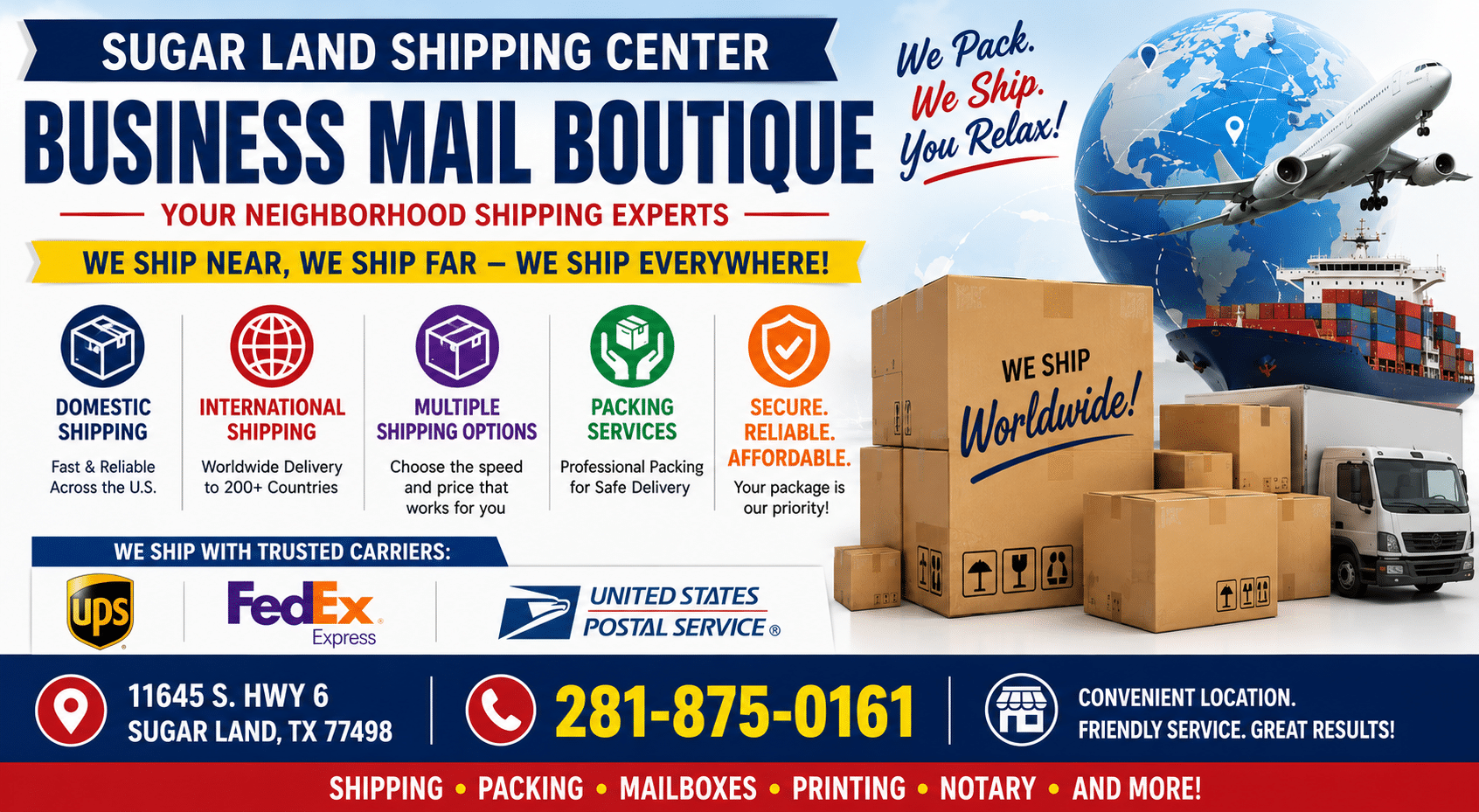
Businessmailboutique
11645 S. Hwy 6 Sugar land, Texas 77498 United States (US)Phone: 281-875-0161
Email: info@businessmailboutique.com
PackageHub Shipping Center – Beyond Postage Services
Businessmailboutique
11645 S. Hwy 6
Sugar land, Texas 77498 United States (US)
Email: info@businessmailboutique.com
You’re probably doing this right now. One browser tab has orders waiting to go out, another has a carrier site open, your phone is buzzing with a customer asking where their package is, and your dining table has turned into a packing station.
That setup works for a while. Then the business grows a little. Returns start showing up. One fragile shipment breaks. A rush order needs to go out today. You need business cards for a local event, a notary stamp for paperwork, and a real street address that doesn’t put your home on every customer-facing document.
That’s when a local shipping center stops being a convenience and starts becoming part of how you run your business in Sugar Land.
Table of Contents
- Your Business Is Growing But Shipping Is a Headache
- What a Shipping Center Really Is Your Logistics Hub
- A Full Spectrum of On-Demand Business Services
- How a Shipping Partner Boosts Your Small Business
- Expert Tips for Smarter Shipping and Lower Costs
- Choosing the Right Shipping Center in Sugar Land
Your Business Is Growing But Shipping Is a Headache
A lot of local business owners hit the same wall. At first, packing orders at home feels manageable. You print a few labels, reuse a few boxes, and drop shipments off when you’re already out running errands. It feels lean and practical.
Then the cracks show.
A candle seller has to guess how much padding is enough. A boutique owner gets hit with return requests after a busy weekend market. A home-based consultant needs contracts printed, signed, notarized, and mailed without losing half a day. Someone selling custom gifts online realizes that “I’ll ship it tonight” has turned into a nightly routine that eats into family time.
Often, the primary issue isn’t postage. It’s the pileup of small tasks around postage. Packing, repacking, label issues, address mistakes, tracking questions, missed cutoffs, and the constant interruption of having to stop core work so you can act as your own mini warehouse clerk.
Most growing businesses don’t fail at shipping because they can’t buy a label. They struggle because fulfillment keeps stealing time from sales, service, and operations.
That’s why a local shipping center matters. It gives you a place to move those tasks out of your kitchen, garage, or front office and into a workflow that’s built for them. Instead of patching together supplies, carriers, and office services from three or four places, you can use one location as your operating support.
If you want to see what that looks like locally, PackageHub shipping and business services in Sugar Land shows the kind of one-stop setup many entrepreneurs need once order volume and admin work start colliding.
What a Shipping Center Really Is Your Logistics Hub
A shipping center isn’t just a counter where boxes change hands. It’s the front-end access point to a much larger delivery system.
The simplest way to think about it is an on-ramp. Your package may start in Sugar Land, but it has to enter a network built around route-level delivery infrastructure. The USPS delivery framework distinguishes activity by carrier route and Post Office box section, reflecting how mail moves through city, rural, highway contract, and P.O. box delivery patterns, not just through a single retail location, as described in the USPS Delivery Statistics Product overview.
That matters because mistakes made at the counter level don’t stay small for long. A weak address, a bad label placement, or the wrong packaging choice can create delays once the package enters the broader system.

Why the entry point matters
When people think about delivery, they usually picture the truck arriving at the destination. In practice, the first few minutes are just as important. A shipping center staff member checks whether the box is secure, whether the address is complete, whether the service level matches the shipment, and whether the package is ready for machine handling and route sorting.
That early review helps with:
- Address quality: Better addressing reduces the chance of failed delivery attempts and returns.
- Packaging fit: Boxes need to match the item and the transportation environment.
- Service matching: Some shipments need speed, some need economy, and some need extra handling.
- Carrier alignment: Not every carrier option makes equal sense for every shipment.
What a good shipping center actually does
A strong shipping center acts more like an operational filter than a drop box. It catches preventable issues before they become customer service problems.
Here’s the practical sequence:
- You bring in the item or the finished parcel.
- The staff evaluates the shipment. That includes size, destination, protection needs, and timing.
- The shipment gets packed or checked for transit readiness.
- The label and service are matched to the shipment’s actual requirements.
- The package enters the carrier network in a form the network can process efficiently.
Practical rule: The cheaper mistake is the one you catch before the package leaves the counter.
For businesses shipping regularly, carrier access under one roof also matters. Being able to compare or route shipments through available services is a lot more useful than forcing every package into one lane. For local entrepreneurs who need that flexibility, UPS services in Sugar Land are one example of how a shipping center can connect retail customers and small businesses to a broader carrier network without making them manage the process alone.
A Full Spectrum of On-Demand Business Services
The modern shipping center is doing much more than sending parcels. It’s becoming a small business command center, especially for people who don’t have an office manager, shipping department, print vendor, and compliance team sitting in the next room.
Research on access barriers highlights how trust, local infrastructure, and practical service availability shape whether people can complete important tasks in person. That’s part of why shipping centers have expanded into services like mailbox rental, notarization, and identity-related support, as discussed in this community access and trust resource from UC Davis Health. For freelancers, mobile professionals, and home-based businesses, that kind of support is real infrastructure.

Professional packing
Packing is where many small businesses lose money without noticing it. They use oversized cartons, too little cushioning, or the wrong box style for the item. The shipment looks fine at the counter, then fails after stacking, sorting, or last-mile handling.
Professional packing helps when you ship:
- Fragile retail products like candles, glassware, cosmetics, or gifts
- Awkward items that don’t fit standard boxes cleanly
- Important documents or presentation kits that can’t arrive bent or scuffed
- Return shipments that need repacking before they can go back out
This is one place where having a physical store matters. Staff can see the item, choose materials, and build protection around the actual risk.
Multi-carrier shipping
One carrier strategy sounds simple, but it doesn’t always work well in real life. Delivery speed, destination, package size, and special handling needs can shift what makes sense.
A shipping center with multiple carrier options gives businesses more room to make practical choices:
| Shipment type | What matters most | Useful approach |
|---|---|---|
| Local or regional parcel | Reliable transit and easy drop-off | Choose the service that fits urgency |
| Lightweight document | Cost and tracking | Avoid overpaying for speed you don’t need |
| Time-sensitive order | Deadline protection | Match service level to customer promise |
| Return package | Simplicity | Use the easiest documented route back |
At Business Mail Boutique LLC, that mix includes authorized UPS and FedEx shipping, USPS services, returns processing, packing, and freight support. For a growing business, that means fewer separate stops and fewer improvised workarounds.
Streamlined returns
Returns create more drag than most owners expect. The refund is only part of the issue. The time drain comes from customer instructions, repacking, label confusion, and deciding whether the returned item can be resold.
One verified industry note points out an underserved question customers keep asking: what happens when they need more than standard drop-off, such as repacking, fragile-item protection, or multi-carrier routing? It also notes projected global retail e-commerce sales of about $6.3 trillion in 2024 in the context of growing pressure on shipping support needs, according to this UPS Authorized Shipping Outlet page.
A useful returns counter should help customers with the messy middle, not just scan a code.
If a return requires new packaging, extra paperwork, or a different carrier decision, the process needs a person, not just a kiosk.
Private mailbox rentals
For many solo operators, a private mailbox is one of the cleanest upgrades they can make. It gives them a real street address, separates business mail from home life, and creates a more professional outward presence.
That matters when you:
- Run a home-based business: You don’t have to place your home address on invoices, websites, or vendor forms.
- Travel often: Mail receiving and forwarding keep important items from piling up.
- Need secure package receipt: Deliveries don’t sit exposed on a porch.
- Want a stronger business image: A street address looks more established than a residential return address.
If that’s on your list, mailbox rental with street address for your business solution shows how this service supports both privacy and day-to-day operations.
On-site printing
A surprising number of shipping-center visits are really business support visits in disguise. Someone comes in to mail a package and remembers they also need flyers, labels, signs, or presentation documents.
That convenience matters because momentum matters. When you can print and ship in one stop, you cut out delays between “I need this” and “this is done.”
Common jobs include:
- business cards for networking events
- flyers for local promotions
- posters and banners for pop-ups
- blueprint or plan printing
- labels, forms, and short-run marketing materials
For local businesses in Sugar Land, that’s often the difference between acting today and postponing until next week.
Business finishing services
Notary, passport photos, fingerprinting, lamination, key duplication, and document finishing don’t sound related to shipping until you look at how people run a business. They are all friction-reduction services.
A mobile notary need is often tied to a contract that also has to be sent. Passport or ID photos may be part of a travel document task that includes mailing forms. Lamination and finishing help protect menus, badges, certificates, and display materials.
The value here isn’t novelty. It’s consolidation. One stop, fewer errands, and less context switching.
How a Shipping Partner Boosts Your Small Business
Most owners don’t need more tasks. They need fewer interruptions.
That’s why using a shipping center as a business partner makes sense. The point isn’t to outsource responsibility. The point is to stop spending owner time on low-impact work that still has to be done correctly.
The pressure behind this is real. An industry summary projects global e-commerce sales at $7.4 trillion by 2025, and says 73% of consumers will expect same-day shipping by 2025, which helps explain why small shippers feel pushed to move faster and present more professionally, according to this e-commerce logistics statistics summary.

Time goes back to the work that pays
If you’re the owner, every hour has an opportunity cost. An hour spent patching a damaged return, waiting in line, or rebuilding a shipment is an hour not spent on sales, hiring, product development, or customer follow-up.
A shipping partner helps by taking repetitive logistics work off your plate, especially when your volume is uneven. You don’t have to build your own mini fulfillment operation just to keep up.
Fewer shipping mistakes means fewer expensive conversations
Customers rarely care why something went wrong. They care that it did.
A shipping center reduces avoidable problems by handling the details people often rush through:
- package prep
- service selection
- label placement
- return handling
- tracking visibility
When those basics are handled well, you get fewer “Where is my order?” messages and fewer replacement shipments.
Your brand looks more established
Professional shipping affects how customers judge your business. Clean packaging, consistent labels, protected contents, and predictable delivery all reinforce the idea that you run a serious operation.
That matters even more for small brands. A customer may forgive slow growth. They won’t easily forget a crushed package, a messy return, or a confusing handoff.
A polished shipment does more than deliver a product. It signals that the business behind it is organized.
You can scale without locking yourself into overhead
Many businesses don’t need a warehouse. They need flexibility.
Some weeks are light. Some are packed with event prep, online orders, or seasonal demand. A local shipping center lets you increase support when volume rises without committing to staff, storage, or equipment you may not need year-round.
For many Sugar Land businesses, that’s the sweet spot. Enough support to look and operate professionally, without taking on the cost and complexity of building the whole system in-house.
Expert Tips for Smarter Shipping and Lower Costs
The fastest way to overspend on shipping is to treat every box like it’s the same. It isn’t. Cost, damage risk, and processing issues usually come from a few technical details that are easy to miss when you’re in a hurry.

Pack for billed weight, not wishful thinking
Carriers often bill by dimensional weight if it’s greater than actual weight. One verified routing guide gives a FedEx-style benchmark formula of length × width × depth ÷ 250, with billed weight compared against actual weight. If dimensional weight is higher, you pay on that higher figure, as shown in this parcel routing guide PDF.
That’s why a light but bulky package can cost more than people expect.
Use this checklist before sealing a box:
- Right-size the carton: Don’t default to the next box up because it’s nearby.
- Cut empty space: Extra void fill can protect the item, but too much oversized space can drive cost.
- Standardize common box sizes: If you ship the same products repeatedly, build a shortlist of carton sizes that fit them well.
- Separate fragile from bulky thinking: A fragile item may need protection, but that doesn’t mean it needs a dramatically oversized carton.
Use cartons built for stacking
A box doesn’t fail only when something pokes through it. Many failures happen because lower cartons get crushed under stacking pressure.
One industry shipping instruction specifies corrugated cartons of at least 32 ECT and says cartons should be strong enough to withstand stacking at least five layers high in transit, with double-wall corrugate recommended or required for heavier or larger items, according to this corrugated packaging guidance PDF.
That leads to a straightforward rule set:
- Use single-wall boxes for lighter, lower-risk items.
- Move up to double-wall corrugate for larger or heavier shipments.
- Keep box certificates or specifications when compliance matters.
- Leave enough flat surface for labels and machine scanning.
A pretty box that collapses in transit is still a bad box.
For a visual walkthrough of packaging choices and shipping prep, this short video is a useful reference:
Prepare packages for a clean handoff
Some shipping problems start before the box even enters the carrier stream. Labels get wrapped around corners, old barcodes remain visible, or weak seams pop open during routine handling.
A cleaner handoff usually comes down to habits:
- Remove or cover old labels completely.
- Tape all seams firmly, not just the center split.
- Place the shipping label on the largest flat surface.
- Keep barcodes unwrinkled and unobstructed.
- If you ship in batches, group by destination or service level before arriving.
The goal isn’t fancy packaging. The goal is a parcel that moves through sorting equipment and handling steps without creating its own problems.
These are small adjustments, but they add up fast when you ship regularly.
Choosing the Right Shipping Center in Sugar Land
Not every shipping center is built for the same kind of customer. Some are fine for a basic drop-off. That’s enough if you’re mailing one prepaid package every few weeks.
Most local businesses need more than that.
They need a place that can handle repacking, fragile-item protection, returns, printing, mailbox services, and the paperwork that comes with running a real operation. Verified guidance tied to shipping outlet demand notes that many customers need help beyond a simple drop-off, including repacking, fragile-item protection, and returns. That’s why the strongest shipping centers solve those “last-mile paperwork and packaging” problems instead of just accepting parcels, as noted earlier in the UPS outlet reference.
When you’re comparing options in Sugar Land, look for four things:
- Service range: Can the location handle shipping, packing, printing, and office-service needs in one visit?
- Carrier flexibility: Do you have more than one path for getting a shipment out?
- Problem-solving staff: Can someone help when the shipment is awkward, urgent, fragile, or return-related?
- Operational convenience: Are the location, hours, and workflow realistic for how you work?
A good shipping center should reduce decisions, not create more of them. It should help you move faster, look more organized, and keep routine logistics from taking over your day.
If you want one local place to handle packing, shipping, printing, mailbox services, notary work, passport photos, and other business support tasks, Business Mail Boutique LLC gives Sugar Land residents and entrepreneurs a practical way to keep those jobs moving without juggling multiple stops.

Related posts

Custom Memorial Glasses Engraved in Three Hours in Sugar Land
When a customer needed eight personalized glasses for a memorial, Business Mail Boutique completed the engraving or...

Custom Martini Glass Engraving in Sugar Land, TX
Custom Logo Engraving on Martini Glasses in Sugar Land, Texas.
Business Mail Boutique recently completed a beautiful custom engravin...

Custom Engraved Wine Glasses for a Golf Club Event in Sugar Land, TX
Custom Engraved Wine Glasses for a Golf Club Event in Sugar Land.
Custom wine glass engraving in Sugar Land, TX at Business Mail Bouti...