
- Print Business Cards in Sugar Land – Same Day Service
- Copying Services
- Document Printing, Finishing & Lamination in Sugar Land
- Flyers
- Print Banner in Sugar Land | Same-Day Banner Printing Near Me
- Graphic Design
- Photo Printing
- Postcard Printing
- Document Printing
- EDDM Full Service Postcards
- FotoZoomer Large Format Printing


Fingerprinting Near Me in Sugar Land, TX | Walk-Ins Welcome
Businessmailboutique
11645 S. Hwy 6
Sugar land, Texas 77498 United States (US)
Email: info@businessmailboutique.com
Route
PrintScan Authorized Fingerprinting Center – Walk-Ins Welcome
If you’re searching for “fingerprinting near me” or “where can I get fingerprints done near me,” Business Mail Boutique offers convenient fingerprinting services in Sugar Land, Texas. We provide digital fingerprinting, FBI background check fingerprinting, FD-258 fingerprint cards, and employment-related fingerprinting services. Walk-ins are welcome during business hours.
You got the email, offer letter, or licensing packet. Somewhere in the instructions it says you need fingerprints. Now you’re searching for fingerprinting close to me, and every listing looks the same until you start reading the fine print. Some places only do Live Scan. Some only do ink cards. Some can take your prints, but not in the format your agency wants.
That’s where people lose time. Not because fingerprinting is hard, but because the wrong location can still be the wrong answer.
If you’re in Sugar Land, the easiest way to make this simple is to match the service to your paperwork before you ever get in the car. Once you know what your employer, licensing board, or agency requires, the rest gets much easier.
Table of Contents
- Your Guide to Finding Fingerprinting Services in Sugar Land
- First Find the Right Type Not Just the Closest Place
- What to Bring to Your Fingerprinting Appointment
- The On-Site Fingerprinting Process Explained
- Understanding Costs and Turnaround Times
- Your Trusted Fingerprinting Center in Sugar Land
Your Guide to Finding Fingerprinting Services in Sugar Land
Few individuals plan ahead for fingerprinting. A school district asks for it during hiring. A board requests it for a professional license. A volunteer role, immigration packet, or background screening suddenly puts it on today’s to-do list. That’s why searches for fingerprinting close to me usually happen when someone is already on a deadline.
The good news is that fingerprinting itself isn’t new or experimental. It has a long documented history, with use in China as early as 300 B.C. and in the United States since 1902, and its standardized system made it practical for large-scale civil, criminal, and administrative screening according to the National Institute of Justice fingerprint history overview. That long track record is why agencies still trust it for identity verification today.
What usually throws people off isn’t the process. It’s the menu of options.
Some customers walk in expecting any fingerprint provider to handle any request. Then they discover their paperwork calls for a specific submission method, a card format, or agency instructions they hadn’t noticed. If you want a local starting point, this guide to Live fingerprint scan locations near you can help narrow the field, but location is only part of the decision.
The closest office can still be the wrong office if it doesn’t offer the format your application requires.
In Sugar Land, the smartest move is to treat fingerprinting like any other official filing. Bring the right documents, confirm the right method, and choose a site that can complete the job the way your requesting agency expects.
First Find the Right Type Not Just the Closest Place
The biggest mistake people make is choosing by distance alone. A listing might be five minutes away and still not help you if your agency requires a different fingerprint format.
Why the format matters first
A major point of confusion for applicants is the required format, especially Live Scan versus ink card fingerprinting, and government pages note that some locations only offer one method, which is why confirming the correct screening pathway comes first, as outlined in South Dakota’s Live Scan instructions and location guidance.
Here’s the practical rule. Before you compare addresses, read your paperwork for words like Live Scan, digital submission, FD-258, fingerprint card, mail to agency, or submit to state repository. Those words usually tell you what kind of appointment you need.
If the paperwork isn’t clear, call the employer, licensing board, or agency that requested the fingerprints. Ask one direct question: Do you need Live Scan or an ink card such as FD-258?
Practical rule: Never let a provider guess which format you need. Your requesting agency decides that, not the fingerprint counter.
A place can be efficient, courteous, and nearby, but if it captures the wrong type, you may end up paying twice and losing a day.
Live Scan vs Ink Card Fingerprinting
The simplest way to think about it is this. Live Scan is electronic capture and transmission. Ink card fingerprinting is physical or card-based capture for a paper submission process.
| Feature | Live Scan | Ink Card (e.g., FD-258) |
|---|---|---|
| How prints are captured | Digitally scanned | Rolled or placed onto a card |
| How prints are sent | Electronically transmitted | Card is typically carried or mailed |
| Common use case | State or agency workflows that accept digital submission | Applications that require a physical fingerprint card |
| Speed at the counter | Usually faster to review and correct onsite | More dependent on card handling and form accuracy |
| Main risk | Going to a site that cannot submit to the required system | Using the wrong card or sending it to the wrong destination |
Some applicants need digital submission because the agency wants the prints transmitted directly. Others need an FD-258 card because the receiving office still works from a mailed card process. If you’re not sure what those instructions mean in plain language, this complete fingerprinting FAQ guide is a useful reference before you book or walk in.
What works is simple. Match the service type to the paperwork. What doesn’t work is assuming all fingerprinting is interchangeable.
What to Bring to Your Fingerprinting Appointment
People rarely get turned away because fingerprinting is complicated. They get delayed because they arrive missing one required item.
Your short checklist before you leave home
Bring your identification first. That’s the item that matters most, because the technician has to verify that you are the person named on the request.
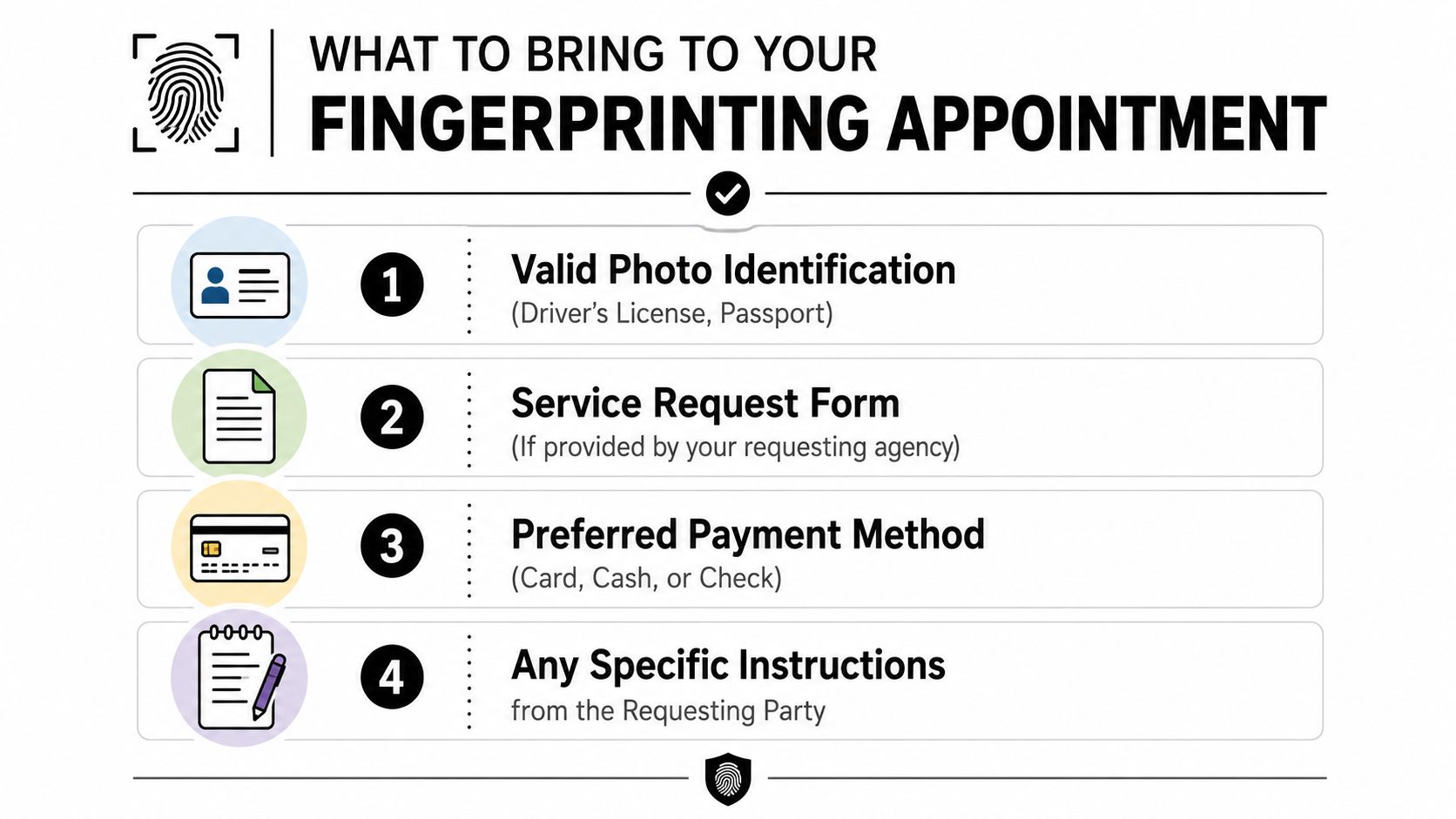
A clean appointment usually starts with these items:
- Valid photo ID: Bring a government-issued photo ID such as a driver’s license or passport. If the name on your paperwork and the name on your ID don’t match, ask the requesting agency what supporting documents they want.
- Request form or agency paperwork: Some employers, boards, and agencies issue a form, request number, or submission instructions. Don’t leave that in your car or email inbox.
- Payment method: Fingerprinting providers may accept different payment types, so it’s smart to confirm ahead of time.
- Any special instructions: If your agency told you to enroll online first, use a specific vendor, or bring a card like FD-258, follow that exactly.
If you need a physical fingerprint card, bring the card if your agency supplied one. If they didn’t, ask the fingerprint provider whether they can supply it onsite. For applicants looking specifically for card-based service, this FD-258 card information for Sugar Land can help clarify what to expect.
Bring the original instructions, even if you think you remember them. A technician can work faster when the exact agency requirement is sitting on the counter.
This is one of those errands where a two-minute check at home can save a return trip later.
The On-Site Fingerprinting Process Explained
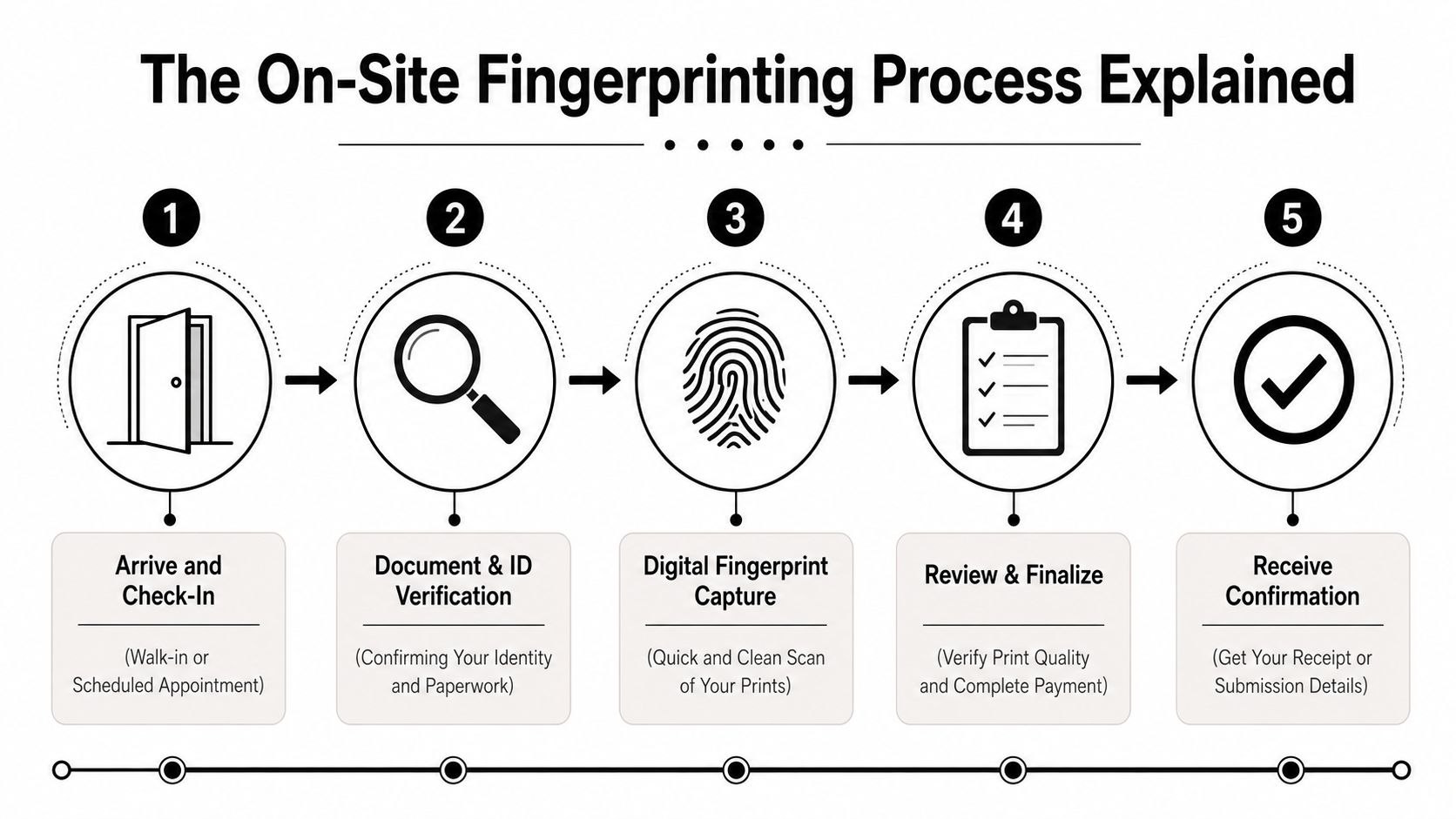
You walk in, hand over your ID and paperwork, and within a few minutes you can usually tell whether you are in the right place for your request. That matters more than people expect. A quick Live Scan appointment and a properly prepared ink card appointment feel different at the counter, and a good technician will catch that before your fingerprints are taken.
What happens at check-in
Check-in is where errors are prevented. The technician reviews your ID, confirms the name and date of birth match your paperwork, and verifies what kind of submission you need before starting.
For Live Scan fingerprinting, your information is entered into the electronic system first. Then your prints are captured and transmitted to the receiving agency. In many cases, you will leave with a receipt or transaction record that includes a tracking number tied to that submission.
For ink card fingerprinting, the technician confirms the correct card type and mailing requirements before rolling prints. That extra minute matters. If the wrong card is used, or if an agency needs signatures in a specific spot, the card may have to be redone later.
Here’s a short look at the process in action.
What the capture step looks like
With Live Scan, each finger is placed on the scanner in sequence, followed by flat impressions. The screen shows the image quality right away, so the technician can retake a print if needed before the file is sent. That is one reason Live Scan is often the faster option when your agency accepts it.
Ink cards take a steadier hand and a little more patience. Each finger is rolled onto the card in the correct box, with attention to pressure, placement, and clarity. Good card work is slower, but for out-of-state applications, licensing packets, and certain federal requests, it is still the right service.
A few practical tips help the appointment go smoothly:
- Keep your hands clean and dry: Moisture, dirt, or heavy lotion can affect print quality.
- Let the technician guide the movement: Too much pressure or twisting can blur the ridges.
- Check your confirmation before you leave: Make sure the receipt, transaction record, or fingerprint card matches what your agency asked for.
The appointment itself is usually simple. Getting the right format, with the right paperwork, is the part that saves time.
Understanding Costs and Turnaround Times
If you walk in for fingerprinting, the first two questions are usually simple. What will this cost me, and how long will this take?
Both answers depend on whether you need Live Scan or ink cards, and whether your agency adds its own processing fee on top of the fingerprinting appointment.
What you are paying for
There are usually two charges. One is the provider’s fee for capturing your fingerprints. The other can be an agency or government fee tied to the background check, license, or application itself.
For Live Scan, the provider fee is often listed separately from the state or federal fee. For ink cards, you may pay for the card service, extra cards, or mailing supplies if your packet has to be sent out. The FBI’s applicant guidance for identity history summary requests also shows that fingerprint submissions can involve separate steps and fees depending on how the request is handled through an approved channeler or by mail, as outlined on the FBI Identity History Summary Checks page.
The practical point is straightforward. A low posted price does not help if you leave with the wrong format, an incomplete card, or paperwork your agency will reject. Getting the right service the first time usually saves money.
What affects turnaround time
The appointment itself is short in most cases. The waiting starts after the fingerprints are submitted.
Live Scan usually moves faster because the prints go out electronically and image quality can be checked on the spot. Ink cards often take longer because they may need to be mailed, scanned later by the receiving agency, or reviewed manually if the prints are light, smudged, or incomplete.
Resubmissions can also slow things down. The Texas Department of Public Safety explains that if fingerprints are rejected for poor quality, the applicant may be asked to submit a new set before processing can continue, as described in its fingerprint applicant services information. That is one reason experienced technicians pay close attention to print quality at the counter.
One more point matters here. Fast fingerprinting does not mean instant results. The agency reviewing the background check controls that timeline, not the storefront taking the prints.
A good rule is to budget for the appointment separately from the agency review period, and to respond quickly if you are told to reprint or correct something. That is how you avoid turning a short errand into a second trip.
Your Trusted Fingerprinting Center in Sugar Land
If you’re searching for fingerprinting close to me in Sugar Land, convenience matters, but only after service fit is confirmed. The right local provider should be able to tell you whether your request calls for digital Live Scan, an ink card, or an FD-258 workflow, and then handle that process cleanly.
Why local convenience only works when the service is correct
Fingerprinting remains firmly embedded in real screening systems, not as a niche service but as part of a mature identity network. By February 2026, the FBI’s Next Generation Identification system was processing an average of more than 165,000 daily searches against more than 194 million computerized criminal and civil fingerprint records, as noted in this fingerprint history and NGI overview. That scale is why employers, licensing boards, and security programs still rely on fingerprints for official review.
In practical terms, you want a local center that can do more than take prints. You want one that checks paperwork carefully, understands the difference between submission methods, and helps prevent avoidable errors at the counter.
Business Mail Boutique LLC is one local option in Sugar Land for applicants who need fingerprinting alongside other business-center services. It offers walk-in fingerprint support, including digital and card-based options, which is useful for customers who don’t yet know whether their paperwork points to Live Scan or an ink card process.

A good fingerprint visit should feel organized. You bring the right documents, confirm the right method, complete the capture, and leave with the right confirmation for your records. That’s what gets the job done the first time.
FBI Background Check Fingerprinting
We assist customers who need fingerprints for:
- FBI Identity History Summary Checks
- Federal employment requirements
- Security clearances
- Professional licensing boards
- Adoption and immigration applications
Digital Fingerprinting and FD-258 Cards
We offer:
Digital Fingerprinting
- Electronic capture
- High accuracy
- Fast processing
FD-258 Fingerprint Cards
- Ink fingerprint cards
- Federal applications
- State licensing requirements
- Out-of-state background checks
Fingerprinting Services for Professionals
Nurses and Healthcare Workers
Teachers and Educators
Real Estate Agents
Security Officers
Insurance Agents
Medical Students
Government Contractors
Each subsection can be 100–200 words to build topical authority.
Fingerprinting Near Sugar Land
Business Mail Boutique proudly serves:
- Sugar Land
- Missouri City
- Richmond
- Rosenberg
- Stafford
- Katy
- Houston
- Fort Bend County
If you need help sorting out Live Scan versus ink card fingerprinting, or you’re ready to get fingerprinted in Sugar Land, contact Business Mail Boutique LLC. Bring your photo ID and agency paperwork, and the staff can help you identify the correct fingerprinting path before you start.
