
- Print Business Cards in Sugar Land – Same Day Service
- Copying Services
- Document Printing, Finishing & Lamination in Sugar Land
- Flyers
- Print Banner in Sugar Land | Same-Day Banner Printing Near Me
- Graphic Design
- Photo Printing
- Postcard Printing
- Document Printing
- EDDM Full Service Postcards
- FotoZoomer Large Format Printing


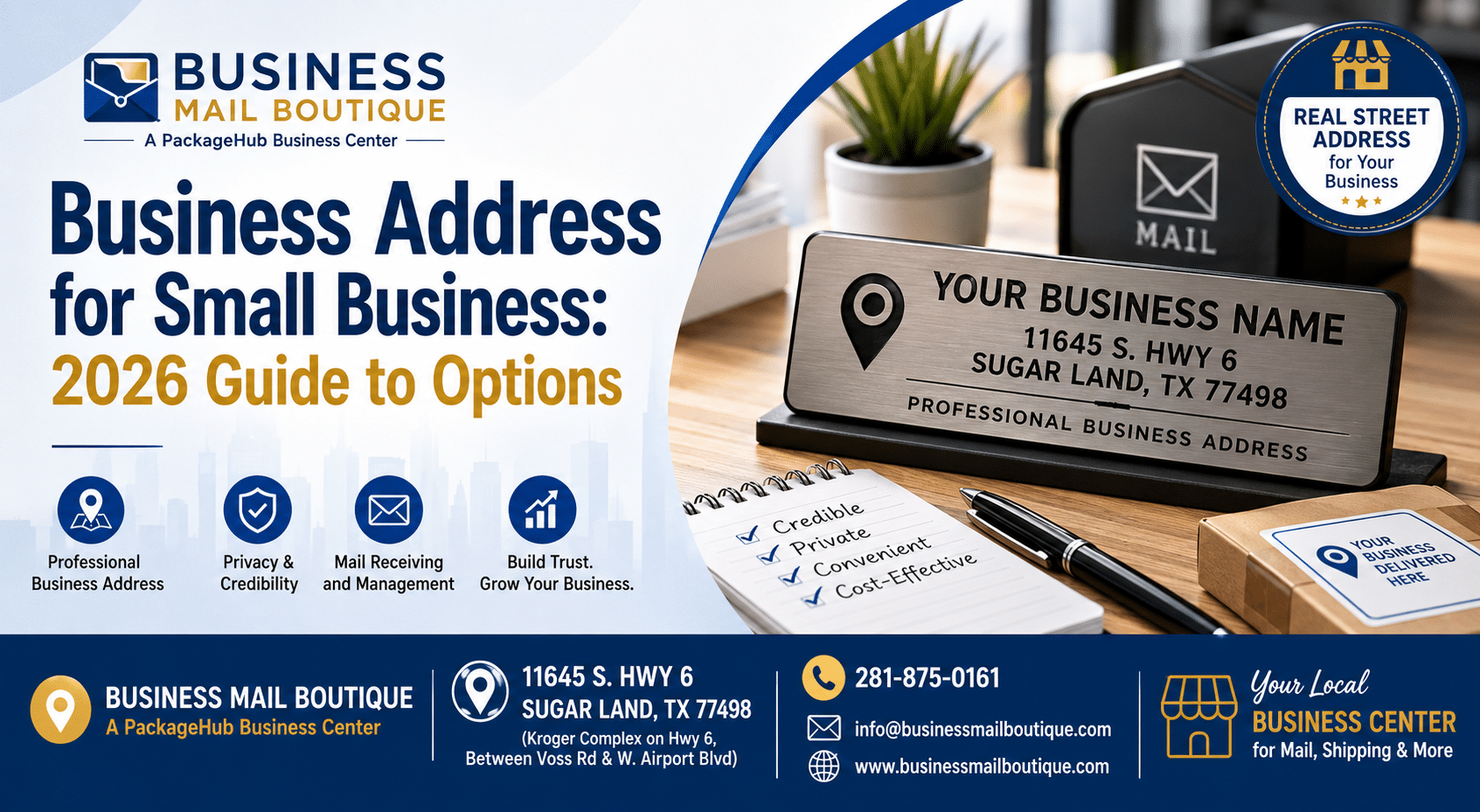
Business Address for Small Business: 2026 Guide to Options
Businessmailboutique, 11645 S. Hwy 6, Sugar land, Texas 77498, United States (US) - Phone: 281-875-0161 Email: info@businessmailboutique.com
Route
You register your LLC, design a logo, and start ordering business cards. Then you hit one line on the form that suddenly feels bigger than it should: business address.
A lot of owners stall right there. They don’t want their home address printed on invoices, listed on state records, or tied to customer correspondence. They also don’t want to make the wrong choice and find out later that a bank, filing office, or carrier won’t accept it. That hesitation is normal.
It’s also common. A projected 36.2 million small businesses operate in the United States as of 2026, and they make up 99.9% of all U.S. businesses, according to United States small business statistics. For many of them, getting a public-facing address right is one of the first practical decisions that affects credibility, privacy, and day-to-day operations.
If you’re still sorting out formation basics more broadly, this guide on how to launch an Australian business is also useful for seeing how founders in another market think through early setup choices. The legal details differ, but the underlying issue is the same. New businesses need a professional identity that works in the actual world.
Table of Contents
- Your Business Starts Here But Where Is Here
- Why Your Business Address Is More Than a Mailbox
- Comparing Your Business Address Options
- How to Choose the Right Address for Your Business
- A Step-by-Step Guide to Setting Up Your New Address
- Your Local Solution The Business Mail Boutique Advantage
- Establish Your Professional Foundation Today
Your Business Starts Here But Where Is Here
The usual scenario looks like this. A consultant starts working from a spare bedroom. A home baker takes custom orders through Instagram. An online seller stores inventory in the garage. Everything is moving, right up until they realize their address is about to appear on registration forms, banking paperwork, shipping labels, and customer-facing materials.
That moment changes how the business feels. It stops being an idea and becomes something public.
For new owners, the problem isn’t only image. It’s also control. Once a home address starts circulating, it can end up on vendor records, customer correspondence, return paperwork, and directory listings. Pulling that back later is messy.
A business can start at home without needing to look home-based everywhere it appears.
The right address closes the gap between how you operate and how you present yourself. It gives you a stable place for mail, keeps personal information more private, and makes the business look organized from day one. That’s why this decision matters much earlier than one might expect.
Why Your Business Address Is More Than a Mailbox
A business address isn’t just where envelopes land. It’s part of your brand infrastructure, much like your domain name, phone number, and company email. If one of those looks improvised, people notice. Your address works the same way.

According to the SBA, about 50% of all small businesses are home-based, which helps explain why so many owners are trying to separate personal life from business operations through a professional mailing solution, as noted in this discussion of home-based business address needs.
Customers read signals fast
People don’t usually say, “I don’t trust this address.” They hesitate. They wonder whether the business is established, whether returns will be handled properly, or whether anyone is really behind the brand.
A real street address helps reduce that friction. It looks more established on invoices, contact pages, directories, and shipping materials than a residential address or plain P.O. Box. That’s especially important if you’re trying to show up in local search and keep your online presence consistent. If local visibility matters, this GBP guide for small businesses is worth reviewing alongside your address decision.
For a practical breakdown of how different mailbox types affect perception and use, compare private mailbox versus P.O. Box options.
Privacy and compliance are practical issues
Privacy is the obvious concern. If you work from home, using your residential address can expose more of your personal life than most owners intend. That matters for solo operators, family-run companies, and anyone who doesn’t want customer mail or unexpected visitors tied to their front door.
Compliance is less visible, but it causes more trouble. Some address formats work for receiving letters yet create problems when you use them for registration or banking. That’s where many businesses make a costly shortcut.
Practical rule: If the address will appear on legal, banking, or public-facing records, choose one that works beyond simple mail delivery.
A business address should do three jobs at once:
- Represent the business professionally: It should look appropriate on your website, cards, forms, and account applications.
- Protect your household details: It should keep personal residence information out of routine business circulation.
- Support operational use: It should handle mail and packages in a way that matches how the business operates.
A basic mailing solution can solve one of those. A better one solves all three.
Before you decide, it’s worth hearing a quick overview of why businesses move away from residential and box-only setups:
Comparing Your Business Address Options
Most owners choose from three realistic paths: use a home address, rent a P.O. Box, or get a virtual mailbox through a Commercial Mail Receiving Agency (CMRA). On paper, they can all look similar. In practice, they behave very differently.
A key distinction is that a CMRA address requires USPS Form 1583. That verification is what helps it function as a legitimate street address accepted by banks and state agencies, unlike a P.O. Box, which can trigger compliance issues. If you want the mechanics behind that setup, this page on virtual address services for business explains how these addresses are typically structured.
Business Address Options Compared
| Feature | Home Address | P.O. Box | Virtual Mailbox (CMRA) |
|---|---|---|---|
| Privacy | Low. Your residence becomes part of business use. | Better privacy for mail. | Strong privacy for business correspondence. |
| Professional appearance | Often acceptable early on, but looks residential. | Limited. “P.O. Box” format signals mailbox-only use. | Strong. Uses a real street-address format. |
| Bank and state acceptance | Can work, but owners may not want it public. | Can run into acceptance issues. | Built for broader business use when properly verified. |
| Package acceptance | Depends on your personal availability. | Limited compared with a full mailbox service. | Better suited for mail plus carrier packages. |
| Mail management | Manual. You sort everything yourself. | Basic pickup model. | Remote handling options are available. |
| Separation of business and personal life | Weak | Moderate | Strong |
| Use on customer-facing materials | Many owners avoid it for privacy reasons. | Usable, but not ideal for branding. | Usually the cleanest presentation. |
What usually works and what usually fails
A home address works when you’re testing an idea and need the fastest possible setup. It stops working when privacy starts to matter, when mail volume grows, or when you don’t want your residence tied to every business document.
A P.O. Box is better than publishing your home, but it’s still limited. The format can be a problem for some business uses, and it doesn’t solve every operational need if you receive carrier shipments or want one address that does more than hold letters.
A CMRA virtual mailbox is usually the most flexible option for a small business that wants one address to support registration, public use, and mail handling. It’s not magic. You still need to set it up correctly and understand how you’ll use it. But it tends to fit the way modern small businesses operate.
If you want one address for customer materials, routine mail, and practical business administration, a verified street-address mailbox usually creates the fewest headaches.
The common mistake is choosing by monthly price alone. Owners often discover later that the cheapest option creates extra friction everywhere else. When that happens, they end up changing addresses after the business is already live, which means updating forms, directories, payment processors, and printed materials twice.
How to Choose the Right Address for Your Business
The right choice depends less on the business name and more on how you work week to week. A freelancer, e-commerce seller, contractor, and therapist may all need an address, but not for the same reasons.
Ask these questions in order
Start with privacy. If you don’t want customers, vendors, or public records tied to your home, rule out your residential address immediately.
Then consider how the address will be used:
- Will this appear on formation or banking paperwork?
If yes, use an address format that won’t create avoidable acceptance issues. - Do you receive packages from multiple carriers?
If yes, don’t choose a setup designed only for basic letter mail. - Do you travel, work remotely, or keep irregular hours?
If yes, look for mail handling that doesn’t require you to be physically present every time something arrives. - Will customers see this address on your website, invoices, or cards?
If yes, appearance matters more than many owners expect. - Are you trying to keep one stable address long term?
If yes, pick the option you can still live with after the business grows.
A good business address isn’t the cheapest line item. It’s the one you won’t have to undo six months later.
Simple fit by business type
Some patterns show up repeatedly:
- Solo service provider working from home: A street-address mailbox usually solves privacy and presentation in one move.
- Online seller receiving returns or shipments: Package handling matters as much as mail.
- Side-hustle owner still validating demand: A temporary compromise may be fine, but only if you know you’ll likely upgrade.
- Owner forming an LLC and opening accounts immediately: Go straight to the most compliant, business-ready option you can reasonably support.
If your priorities are professionalism, privacy, and flexibility together, a CMRA-based solution is usually the cleaner fit than either a home address or standard P.O. Box.
A Step-by-Step Guide to Setting Up Your New Address
Once you’ve chosen an address, execution matters. Owners often lose time at this stage. They set up the mailbox but forget to update half the places that rely on it.
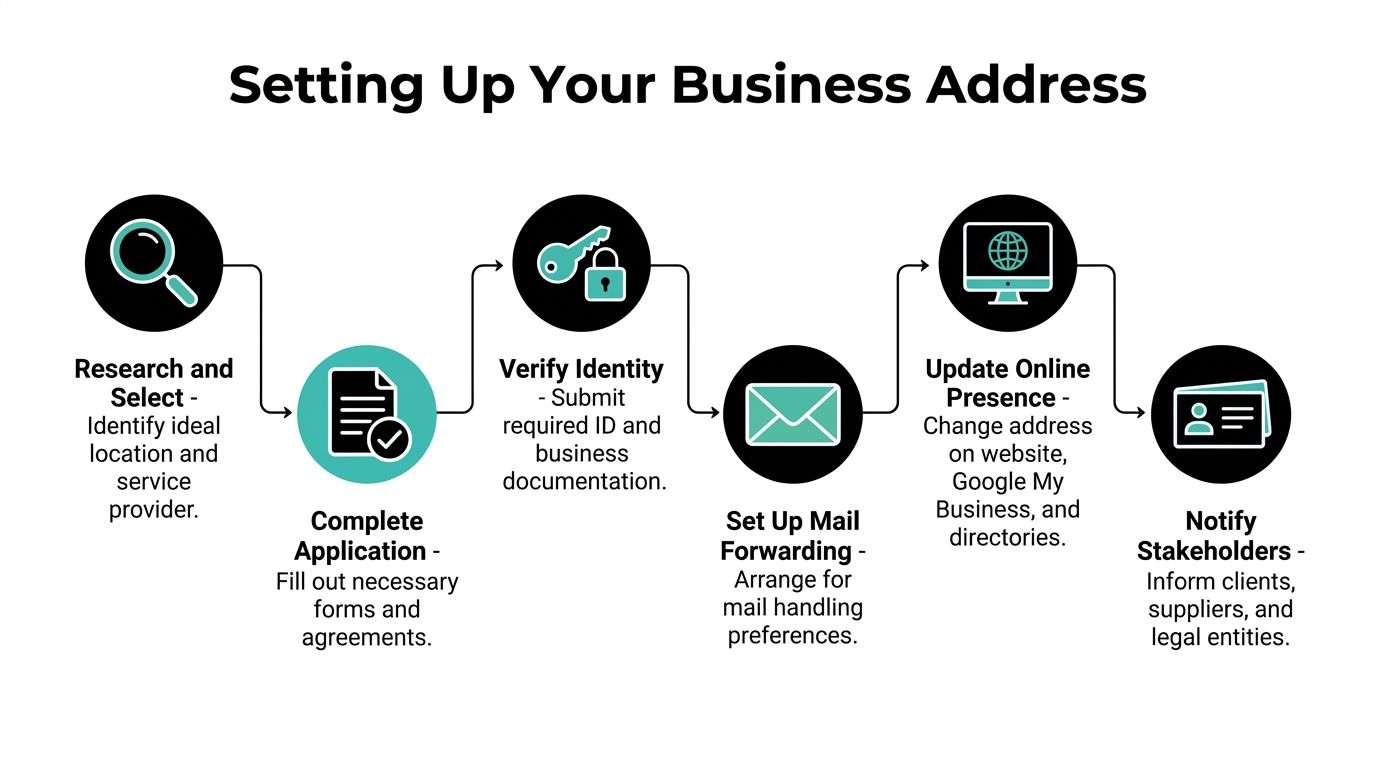
Set the address up correctly first
If you’re using a CMRA mailbox, complete the identity verification properly. That’s not optional. USPS verification is part of what makes the address usable in a business context. This guide to USPS Form 1583 requirements is the piece many owners should review before they submit anything.
Then decide how mail should be handled from day one:
- Forwarding plan: Decide whether you’ll pick up, forward on a schedule, or use scanning where available.
- Naming consistency: Use the same business name format across the mailbox application, state filings, and bank documents.
- Authorized recipients: If a partner or team member needs access, handle that early instead of improvising later.
Then update every place that matters
After setup, update records in an order that prevents mismatches.
- State formation records and business registrations
If your entity documents need the address, change those first so your core business records match. - IRS and tax-related records
Make sure tax mail reaches the right place. This is also the point where you should think carefully about state obligations if you operate across borders. - Banking and merchant accounts
Your bank, payment processor, and lending partners should see the same business information that’s reflected on your registration documents. - Website, invoices, and email signatures These are the customer-facing touchpoints people see.
- Google Business Profile and directory listings
Consistency matters. If you use business directories, don’t let old address data linger in multiple places. - Vendors, suppliers, clients, and insurers
Anyone who mails checks, contracts, replacement parts, or policy notices needs the current address.
A critical tax point often gets missed. 41% of small e-commerce businesses face multi-state tax nexus issues, so if you use an address in a state where you don’t physically work, you need to understand whether it could contribute to a filing obligation under de facto presence rules. That’s a real compliance question, not just a mailing detail.
Clean setup beats fast setup. The address itself is only half the job. The other half is making every record agree with it.
A short checklist helps prevent drift:
- Check legal records first: Registration details should match before you touch public listings.
- Update financial accounts second: Banks and processors dislike conflicting business data.
- Fix public profiles last: Once your back-end records are aligned, refresh what customers see.
Your Local Solution The Business Mail Boutique Advantage
For owners in Sugar Land, the most practical setup is usually a real street-address mailbox that handles both image and operations in one place. That means you can publish a business address without using your home, receive routine mail in a business format, and avoid the limitations of a basic P.O. Box.
What a local street-address mailbox solves
A strong local service should offer a few things together:
- Street-address formatting: Better suited for business use than a box-only format.
- Mail and package receiving: Useful when carriers, returns, and supplier shipments are part of normal operations.
- Forwarding and remote handling: Important if you travel, work from home, or don’t want daily pickup responsibilities.
- Related business services in one stop: Printing, shipping, notary, and document support save time when you’re still setting up.
Premium CMRA-based services can also include all-carrier package acceptance and remote mail management, including high-resolution scanning. Businesses using those kinds of services can see a 40% reduction in administrative overhead related to mail handling. That matters most when mail starts becoming one more recurring task that interrupts actual revenue work.
Why local support matters
A nearby provider has an advantage over generic online advice. You can ask how the address is formatted, what documents are needed, how carrier deliveries are handled, and what happens if you’re out of town. Those details affect whether the setup feels smooth or frustrating.
For local owners, Business Mail Boutique LLC provides private mailbox rentals with a real street address in Sugar Land, along with mail receiving, forwarding, package handling, printing, shipping, and other front-office services that many small businesses need as they get established.
The best address setup is the one that works on ordinary Tuesdays, not just on signup day.
That’s the true test. Not whether the address looks good in a screenshot, but whether it supports the way your business receives mail, sends packages, updates records, and interacts with customers.
Establish Your Professional Foundation Today
A business address does more than collect mail. It shapes how customers see you, how much personal information you expose, and how smoothly your paperwork and deliveries are handled.
If you’re still using a home address because it feels easy, that choice may be costing you privacy and creating extra cleanup later. If you’re leaning toward a basic P.O. Box, make sure it can support the business uses you have in mind. For many small businesses, a verified street-address mailbox is the more practical long-term fit.
The right move is usually the one that gives you a professional public identity now and fewer administrative problems later. For a Sugar Land entrepreneur, that means choosing a local address solution you can use confidently on forms, directories, client materials, and routine business mail.
If you need a professional business address in Sugar Land, Business Mail Boutique LLC offers real street-address mailbox services along with mail receiving, forwarding, package handling, printing, and shipping support, so you can set up one reliable business location and move forward with fewer loose ends.

Related posts

Custom Memorial Glasses Engraved in Three Hours in Sugar Land
When a customer needed eight personalized glasses for a memorial, Business Mail Boutique completed the engraving or...

Custom Martini Glass Engraving in Sugar Land, TX
Custom Logo Engraving on Martini Glasses in Sugar Land, Texas.
Business Mail Boutique recently completed a beautiful custom engravin...

Custom Engraved Wine Glasses for a Golf Club Event in Sugar Land, TX
Custom Engraved Wine Glasses for a Golf Club Event in Sugar Land.
Custom wine glass engraving in Sugar Land, TX at Business Mail Bouti...