
- Print Business Cards in Sugar Land – Same Day Service
- Copying Services
- Document Printing, Finishing & Lamination in Sugar Land
- Flyers
- Print Banner in Sugar Land | Same-Day Banner Printing Near Me
- Graphic Design
- Photo Printing
- Postcard Printing
- Document Printing
- EDDM Full Service Postcards
- FotoZoomer Large Format Printing


Beyond Engraving on Wooden Board: Secure a Pro Mailbox
Businessmailboutique
11645 S. Hwy 6
Sugar land, Texas 77498 United States (US)
Email: info@businessmailboutique.com
Route
You’re at the kitchen table, your laptop is open, and your business is already real even if it still looks temporary from the outside. Orders are coming in. Vendors need an address. A bank rep asks for business mail details. A customer return is headed somewhere. Right now, that “somewhere” is probably your house.
That setup works for about five minutes.
After that, the small headaches start piling up. Packages land on the porch while you’re out. Client mail gets mixed in with school flyers and grocery coupons. You hesitate before putting your home address on an invoice, Google Business profile, LLC filing, or website footer. For Sugar Land entrepreneurs, especially home-based ones, the mailbox question stops being administrative and starts becoming operational.
If you found this while searching for engraving on wooden board services, you’re not off track. A lot of local owners first walk into a business center for one need, maybe shipping, printing, notary work, or even product personalization, then realize they also need a proper mailing setup to make the business run cleanly. That’s a common turning point.
Table of Contents
- Why Your Home Address Is Hurting Your Business
- Choosing Your Mailbox Type Private Mailbox vs PO Box
- Understanding Mailbox Sizes Pricing and Cost Factors
- The Application Process and USPS Form 1583
- Advanced Mailbox Features Package Forwarding and Privacy
- Your Sugar Land Solution Business Mail Boutique
Why Your Home Address Is Hurting Your Business
A lot of small businesses start the same way. Someone launches from home, gets the first few customers, prints labels at night, and tells themselves the home address is “good enough for now.” Then one missed delivery turns into two. A vendor ships by a carrier that won’t leave the package where you expected. A customer return shows up while nobody’s home. Your private life and business life start sharing the same front step.
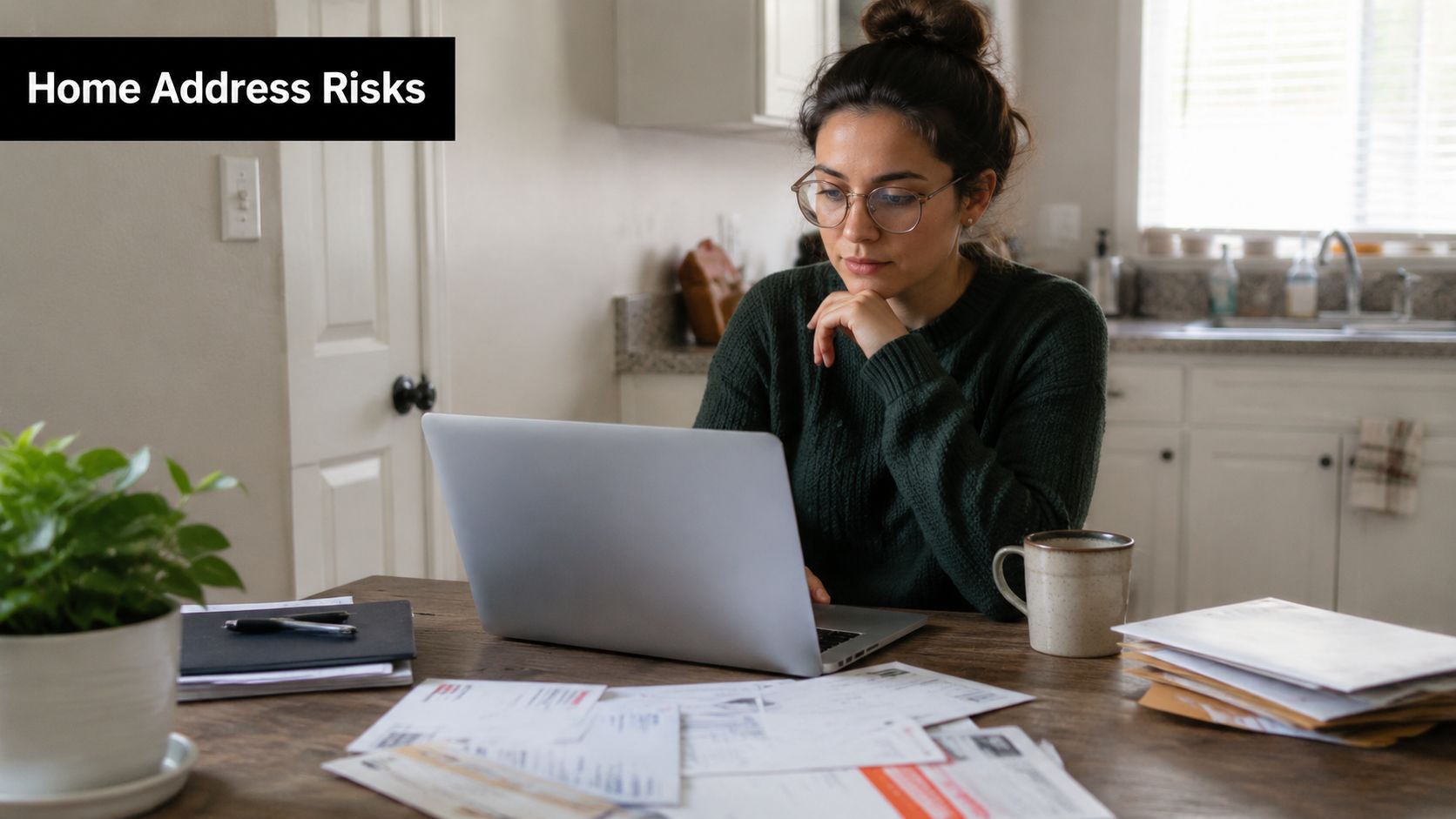
That problem shows up all over Sugar Land. Freelancers, Etsy sellers, consultants, mobile service businesses, and side-hustle owners often don’t need a leased office. They do need a stable address where business mail can land without exposing their household. Once your address appears on public-facing materials, it stops being private in any practical sense.
Daily friction becomes a business problem
The trouble isn’t just image. It’s workflow.
- Deliveries get messy: Carriers arrive when you’re at school pickup, on a service call, or in a meeting.
- Your home address becomes public: Clients, directories, forms, and vendor records start using it.
- Mail feels unprofessional: A home address can raise questions when you’re opening accounts or building trust with new customers.
- Returns and replacements become harder: If you sell physical products, consistency matters.
For owners who also make or sell goods, the issue grows faster. If you’re offering personalized products, gift items, or engraving on wooden board orders, you already know that shipping, pickups, and customer communication have to be reliable. Product care matters too. If you’re sending engraved kitchen items, sharing guidance on essential wood board care helps customers maintain the piece properly after purchase.
Your mailing address isn’t a detail. It’s part of how customers, vendors, and agencies experience your business.
A dedicated business address fixes more than appearance. It creates separation. It gives you one place for documents, returns, packages, and official correspondence. If you want a closer look at why many owners switch early, this guide on a business address for small business lays out the practical advantages clearly.
Choosing Your Mailbox Type Private Mailbox vs PO Box
The first real decision is simple on paper and easy to get wrong in practice. You’re usually choosing between a USPS PO Box and a private mailbox at a commercial mail receiving agency. Both solve part of the problem. Only one may fit how your business operates.
What a PO Box does well
A PO Box is familiar. It’s a straightforward option if your business mainly receives standard letter mail and you’re comfortable working inside the USPS system.
For some owners, that’s enough. If you don’t expect carrier-delivered packages, don’t need a street-style business address, and just want mail held securely off your porch, a PO Box can do the job.
A PO Box often makes sense when:
- You receive mostly envelopes: Statements, notices, checks, and light correspondence.
- You want a simple setup: Fewer service layers, less customization.
- You already work around USPS limitations: That matters if your suppliers and customers mostly use postal mail.
Still, a lot of first-time renters assume a PO Box behaves like a full business address. It doesn’t always function that way for every business need.
Where a private mailbox fits better
A private mailbox is usually the better fit when the address needs to work harder. That includes entrepreneurs registering a company, receiving packages from multiple carriers, or trying to keep their home address off customer-facing materials.
At this stage, the difference becomes practical, not theoretical.
- Street address format: That looks and feels more like a business location than a PO Box line.
- Carrier flexibility: You can receive more than basic postal mail.
- Service options: Forwarding, notifications, and package handling matter once operations get busy.
- Better separation: Home stays home.
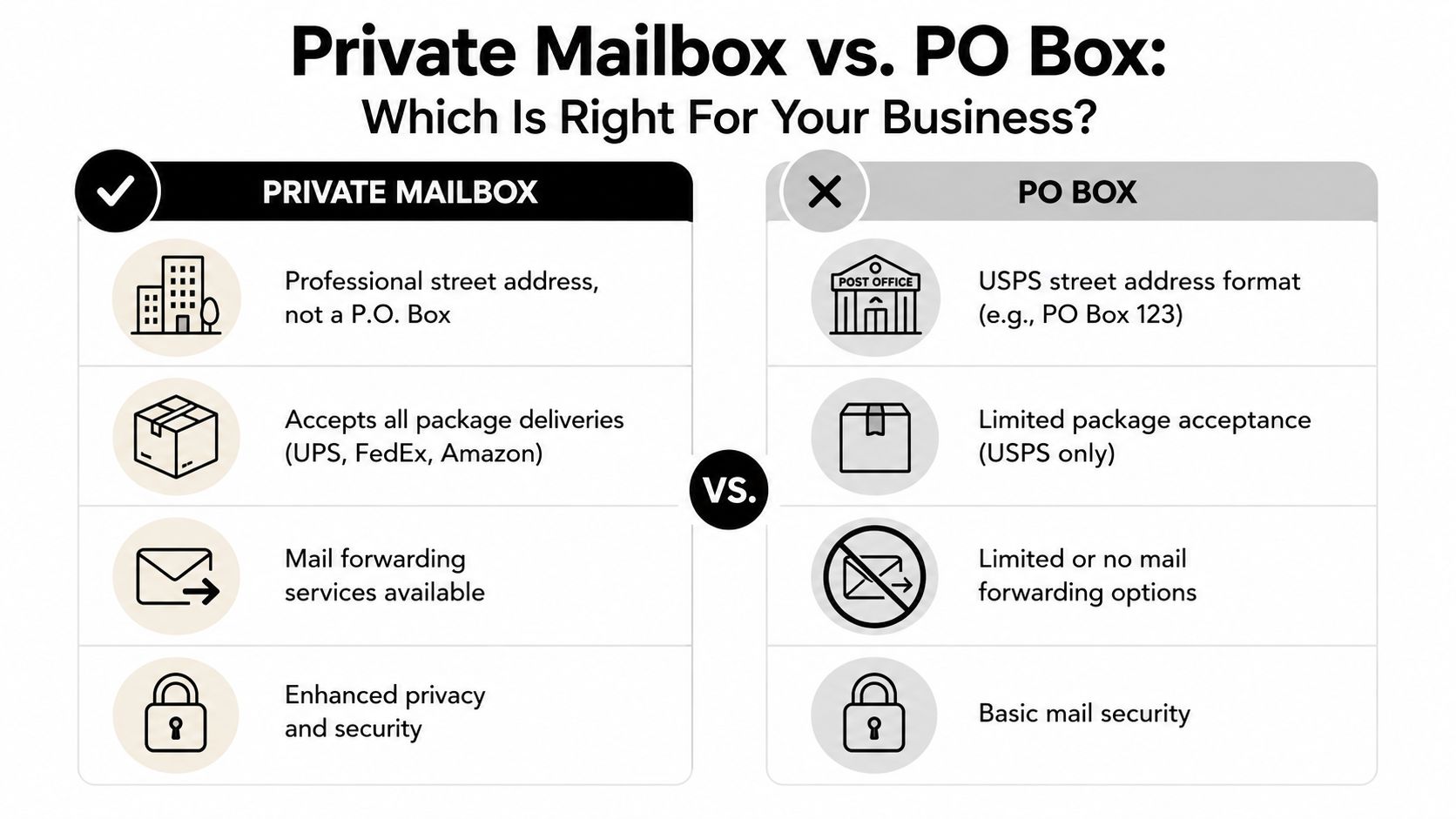
Here’s the comparison most owners need:
Private Mailbox vs. PO Box at a Glance
| Feature | Private Mailbox (like Business Mail Boutique) | USPS PO Box |
|---|---|---|
| Address style | Real street address format | PO Box format |
| Package acceptance | Typically accepts deliveries from multiple carriers | Primarily USPS-based handling |
| Business use feel | More professional for customer-facing materials | More limited presentation |
| Forwarding options | Often available through the provider | More limited |
| Privacy | Keeps your home address off routine business use | Also protects home address, but with less flexibility |
For many Sugar Land businesses, the decision comes down to one question. Are you only storing mail, or are you building a business presence?
A short side-by-side review of private mailbox vs PO box helps if you’re weighing the trade-offs for your exact setup.
Here’s a quick visual if you want to compare the options before deciding:
Practical rule: If you expect packages, vendor shipments, customer returns, or official business use of the address, don’t choose based on the monthly rate alone. Choose based on what happens on your busiest week.
Understanding Mailbox Sizes Pricing and Cost Factors
Mailbox pricing gets confusing when people focus only on the advertised monthly fee. The better way to look at it is fit, handling, and service. A cheap box that overflows or triggers constant workarounds usually costs more in time and stress.
Match the box to your mail habits
You don’t need the biggest box available. You need the right one for the type of mail your business receives.
A simple way to think about sizes:
- Small mailbox: Works for owners who mostly receive letters, legal notices, checks, and occasional flat mail.
- Medium mailbox: Better for businesses getting mixed mail with some padded envelopes or smaller packages.
- Large mailbox: Useful when your business receives frequent product shipments, customer returns, or supplier samples.
If you run a home office with mostly digital operations, you may not need much physical space at all. If you sell products online, host events, or work with printed materials, a larger setup saves hassle.
The right size isn’t about volume alone. It’s about how often you want to deal with overflow, package notices, and exceptions.
Questions to ask before you sign
A common pitfall arises. Two mailbox providers can look similar until you ask about the extras.
Use this checklist when comparing options:
- Ask how packages are handled
Some places are built for mixed carrier deliveries. Others are much more limited.
- Ask about forwarding
If you travel, work remotely, or split time between locations, this matters.
- Ask what triggers extra charges
Oversized parcels, forwarding requests, setup costs, key replacement, and special handling can all change the effective price.
- Ask how access works
You want a clear understanding of pickup routines, notice methods, and what happens when a package arrives after hours.
- Ask how upgrades work
A good provider should make it easy to move into a larger mailbox if your mail volume grows.
Some businesses only need mail receiving. Others need a small logistics hub. Those are different products, even when both are called “mailboxes.”
A local owner who sends invoices and receives tax mail has one set of needs. A maker fulfilling custom product orders has another. If you also sell personalized items or handle engraving on wooden board requests, package flow can increase quickly around holidays, events, and gifting seasons. Planning for that from the start is smarter than resizing after the system breaks.
The Application Process and USPS Form 1583
For many first-time renters, the paperwork feels harder than the decision. It isn’t hard once you know what the form is for.
What Form 1583 actually does
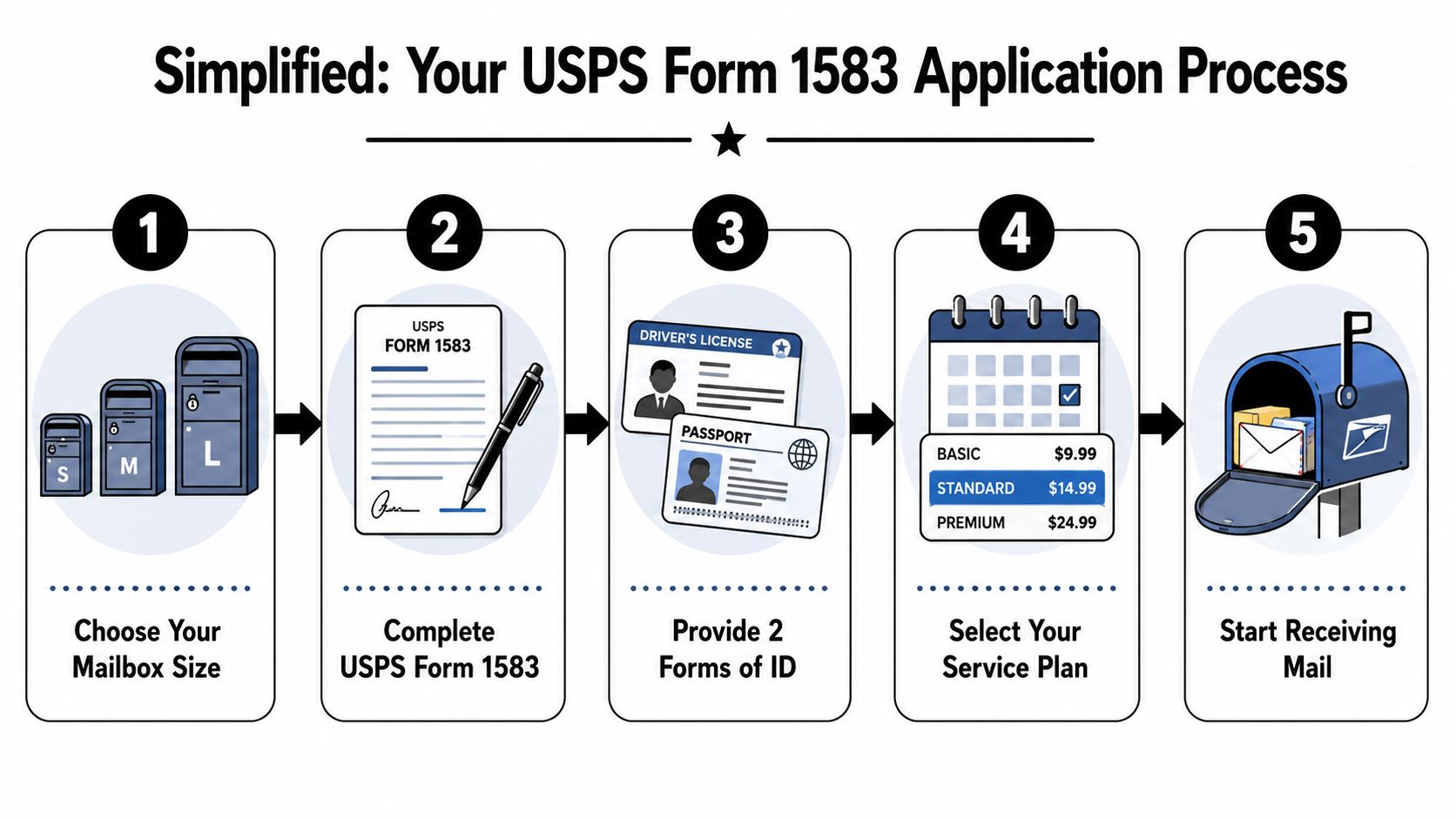
USPS Form 1583 authorizes a Commercial Mail Receiving Agency, often shortened to CMRA, to receive mail on your behalf. If you’re renting a private mailbox rather than a standard PO Box, this step is part of the process.
That’s the reason providers ask for identification and why the form matters. They’re not making up extra paperwork. They’re following the rules that let them accept and hold your mail properly.
The easiest way to think about it is this:
- You choose the mailbox.
- You complete Form 1583.
- You provide identification.
- The identity portion is verified as required.
- The mailbox is activated for use.
If you want the official requirements in plain language before you walk in, this overview of 1583 USPS Form is helpful.
A simple way to get it done
The cleanest application process looks like this:
- Pick your mailbox first: Size and service level should match your actual business use.
- Bring the required ID: You’ll need identification that supports the form requirements.
- Review the name format carefully: Make sure your personal name and business name match the records you plan to use.
- Complete the authorization correctly: Small mistakes here can slow activation.
- Handle notarization if required for your situation: Many applicants need this step completed properly before everything is finalized.
What slows people down is usually not complexity. It’s mismatch. A name is written one way on one document and another way on the form. Someone forgets a second piece of ID. A business owner shows up ready to open the box but not ready to complete the authorization.
Bring your IDs, know the exact business name you want tied to the box, and don’t wait until the same day you need a package delivered.
That’s especially important for new Sugar Land entrepreneurs opening an LLC, setting up vendor accounts, or trying to clean up their business records all at once. Handle the mailbox early, then use that address consistently.
Advanced Mailbox Features Package Forwarding and Privacy
A private mailbox earns its keep after the basic setup is done. Its value shows up when business starts moving faster and you need mail handling to support that pace.
Services that matter once business picks up
Most owners don’t need every feature. They do need the right ones.
Mail forwarding is a good example. If you travel between client sites, work from home but spend part of the week elsewhere, or leave town regularly, forwarding keeps your business correspondence from sitting still while you’re moving.
Package receiving is another one. This matters for e-commerce sellers, consultants receiving supplies, and anyone dealing with returns. A package accepted at a staffed location is very different from a box left outside a front door.
Useful features often include:
- Package notifications: You know something arrived before making a trip.
- Forwarding services: Helpful for remote work, travel, and multi-location routines.
- Mail receiving across business categories: Legal mail, client mail, supplier shipments, and returns stay in one channel.
- Scanning or administrative handling options: Depending on the provider, these can reduce delays.
A lot of local owners discover this while using other business-center services first. They come in for shipping, printing, notary work, or engraving on wooden board products and realize a dedicated mailbox would solve several recurring problems at once.
Privacy is not a luxury for home-based owners
For a home-based business, privacy is operational protection.
If your address appears on registrations, customer receipts, public listings, vendor accounts, and return labels, you’ve effectively turned your house into a published business location. That may not feel serious on day one. It usually feels serious later.
A separate mailbox helps in a few ways:
- It keeps your residence off routine business documents
- It reduces direct exposure to clients and vendors
- It creates a cleaner line between family life and work
- It gives you one address to use consistently across records
That consistency matters more than people expect. When your address changes from document to document, confusion follows. When everything routes through one dedicated business mailbox, the admin side gets easier.
Some owners rent a mailbox for professionalism. They keep it because it restores control.
There’s also a mindset shift here. A dedicated business address changes how you run the company. You stop improvising around missed deliveries and start using a system. That’s a small move, but it often marks the point where a side business starts operating like a real one.
Your Sugar Land Solution Business Mail Boutique
For Sugar Land owners who want one local place to handle the mailing side properly, Business Mail Boutique LLC provides private mailbox rentals with a real street address, package receiving, forwarding options, and on-site support that helps with the Form 1583 process, including notary-related needs as part of the broader service environment.
That matters because most small business owners don’t want to manage three separate errands just to get operational. They want a mailing address that works for daily business, a location that can receive packages from major carriers, and staff who can explain the paperwork without turning it into a government puzzle.
For a local entrepreneur, that can mean fewer workarounds from the start. You can use one address, keep your home address private, receive business mail more reliably, and avoid building your company on top of temporary habits.
If you’re ready to stop using your home address for business, Business Mail Boutique LLC is a practical Sugar Land option for setting up a private mailbox, handling Form 1583 requirements, and receiving mail and packages through one local storefront.

Related posts

Custom Memorial Glasses Engraved in Three Hours in Sugar Land
When a customer needed eight personalized glasses for a memorial, Business Mail Boutique completed the engraving or...

Custom Martini Glass Engraving in Sugar Land, TX
Custom Logo Engraving on Martini Glasses in Sugar Land, Texas.
Business Mail Boutique recently completed a beautiful custom engravin...

Custom Engraved Wine Glasses for a Golf Club Event in Sugar Land, TX
Custom Engraved Wine Glasses for a Golf Club Event in Sugar Land.
Custom wine glass engraving in Sugar Land, TX at Business Mail Bouti...