
- Print Business Cards in Sugar Land – Same Day Service
- Copying Services
- Document Printing, Finishing & Lamination in Sugar Land
- Flyers
- Print Banner in Sugar Land | Same-Day Banner Printing Near Me
- Graphic Design
- Photo Printing
- Postcard Printing
- Document Printing
- EDDM Full Service Postcards
- FotoZoomer Large Format Printing


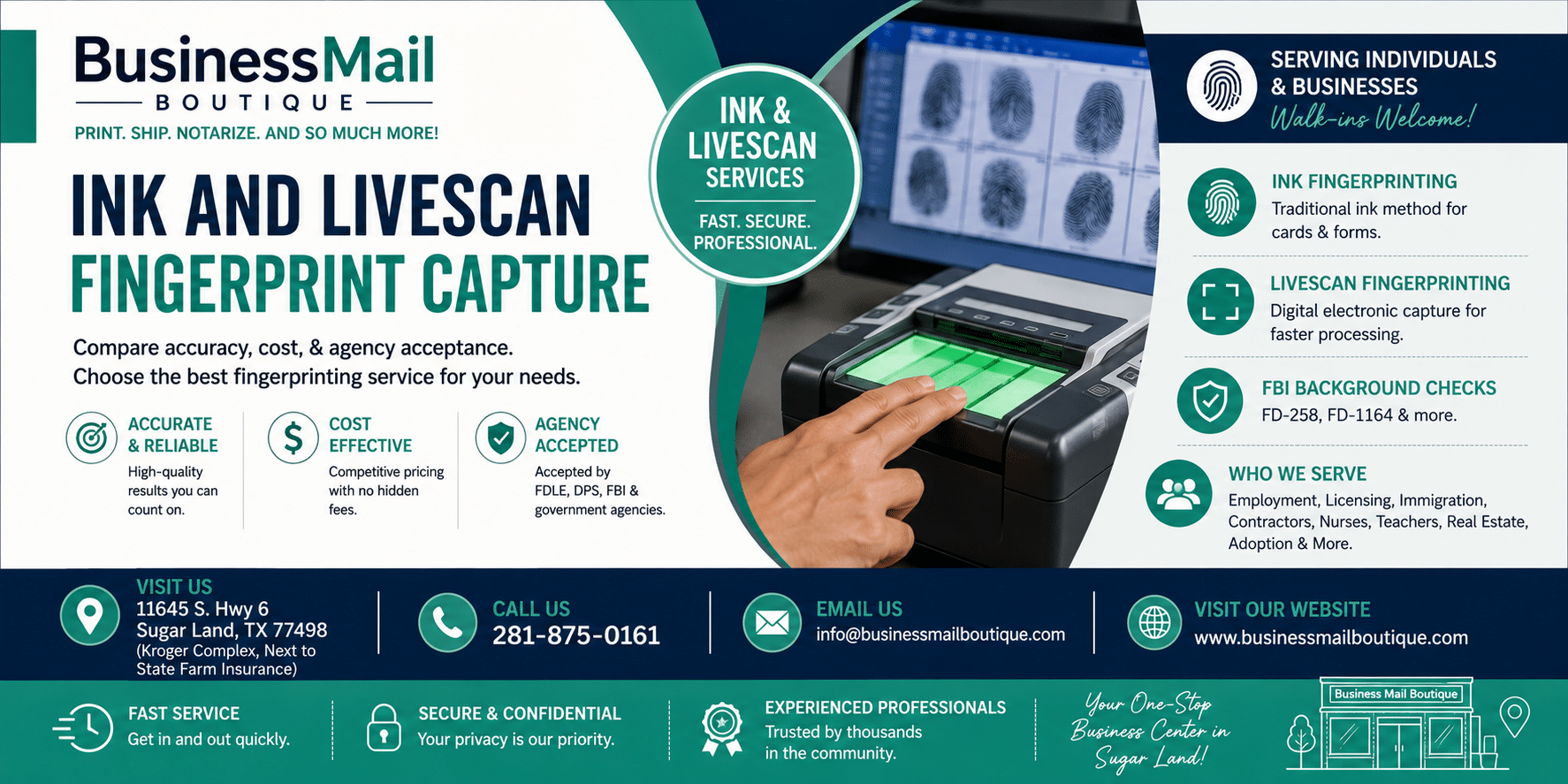
Fingerprinting – Ink and Livescan Capture
Ink and Live Scan Capture: Compare accuracy, cost, and agency acceptance. Choose the best fingerprinting service for your needs in Sugar Land, Missouri City, Stafford, Richmond, Rosenberg, Katy, Fulshear, Fresno, Sienna, and throughout Fort Bend County and Southwest Houston.
You’ve probably had this happen. An employer, licensing board, or agency tells you to “go get fingerprinted,” then leaves out the part that matters most: what kind.
That’s where people lose time. They book a Live Scan because it sounds modern, then find out the agency wanted an FD-258 ink card. Or they show up for ink cards when the state system only accepts electronic submission. In a fingerprinting appointment, the capture method isn’t a minor detail. It’s a compliance decision.
For most applicants, ink and livescan capture isn’t really a technology debate. It’s a question of matching the method to the agency’s rules, the submission route, and the practical reality of how fast you need the result. Live Scan is usually faster and easier. Ink is still necessary more often than people expect.
Table of Contents
- Do You Need Fingerprints for a Background Check
- Understanding Ink vs Digital Fingerprint Capture
- The Process Step by Step for Ink and Livescan
- Comparing Ink and Livescan Capture Key Differences
- When Ink Fingerprinting Is Required or Recommended
- Why Livescan Is the Standard for Most Background Checks
- Where to Get Ink or Livescan Fingerprinting in Sugar Land
Do You Need Fingerprints for a Background Check
Applicants for fingerprinting aren’t confused about whether they need prints. They’re confused about which submission format they need. A new teacher, nurse, real estate applicant, volunteer, immigration applicant, or job candidate may all be told the same thing by email: get fingerprinted. That instruction sounds simple until you realize there are two very different workflows behind it.
One customer might have a state form with an agency code for digital submission. Another might have instructions telling them to mail fingerprint cards with a packet. Those are not interchangeable. If you submit the wrong format, the issue usually isn’t that your fingerprints were “bad.” The issue is that the receiving agency wanted a different channel.
For people who are also dealing with housing, screening, or onboarding paperwork at the same time, it helps to understand the broader compliant tenant referencing process, because fingerprinting often shows up as just one compliance step in a larger review. The same rule applies across all of it: follow the requesting organization’s exact instructions, not assumptions.
A common fork in the road
A digital submission often moves much faster. LiveScan systems can deliver results in minutes and keep rejection rates below 1%, while traditional ink methods can take days and have rejection rates as high as 10%, according to Quick Fingerprint’s comparison of Live Scan and traditional fingerprinting.
That sounds like an easy decision, but it isn’t universal. Some agencies only accept electronic capture. Others still require a physical card.
If your paperwork names a specific form, card type, ORI, service code, or mailing instruction, that detail matters more than personal preference.
Start with the instruction sheet, not the device
The fastest way to avoid a second appointment is to read the agency notice carefully before you book. Look for:
- Submission type: Does it say Live Scan, digital submission, card scan, or FD-258?
- Destination: Is it going to a state agency, a federal agency, or an out-of-state board?
- Supporting paperwork: Some agencies require forms, control numbers, or authorization details.
- Card requirement: If it says mail the fingerprint card, assume ink unless the provider confirms a compliant printed card workflow.
If you need a local overview of what applicants usually ask before an appointment, this fingerprinting FAQ guide is a practical place to start.
Understanding Ink vs Digital Fingerprint Capture
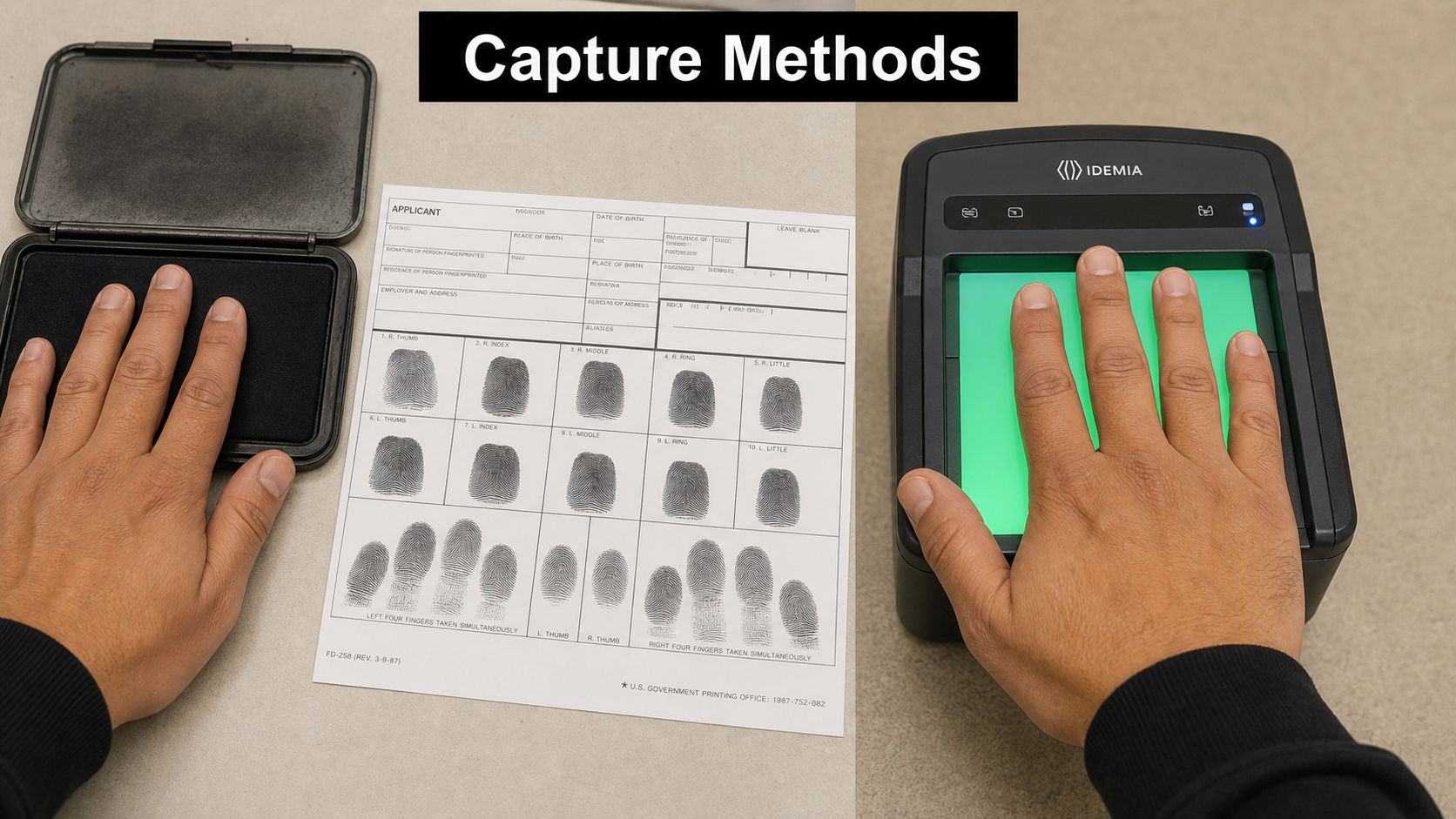
At the counter, both methods look simple. Under the surface, they’re built around two different ideas. Ink creates a physical record on a fingerprint card. Live Scan creates a digital biometric image that can be checked before it’s sent.
What ink fingerprinting actually is
Traditional ink fingerprinting usually means rolling each finger onto an FD-258 card or another agency-approved card. The technician inks the finger, rolls it from one side of the nail to the other, and places both rolled and flat impressions in the right boxes. The completed card becomes the physical document that gets mailed or included with an application package.
That physical nature matters. The card can be copied, mailed, stored, signed, and attached to supporting paperwork. Some agencies still rely on that exact format because their process was built around manual handling, legacy intake, or specific federal requirements.
Ink also places more responsibility on the technician’s hands and the applicant’s skin condition. If the pressure is uneven or the roll is rushed, the problem is captured on the card itself.
What Live Scan capture does differently
Live Scan replaces the ink pad and card impression with a digital scanner. The applicant places fingers on a glass platen, and the machine captures fingerprint images electronically. Good systems don’t just take a picture. They assess quality during capture and allow the operator to retake prints immediately if needed.
Approved LiveScan scanners must meet the FBI’s Appendix F standards, capture images at 500–1000 ppi, and use AES-256 encryption for secure transmission, as described in this overview of FBI-standard Live Scan equipment.
For readers who want the wider security context, this explanation of how biometric verification works for security gives a helpful non-technical overview of why identity systems rely on image quality, liveness checks, and controlled transmission.
Practical rule: Ink is a physical document workflow. Live Scan is a digital transmission workflow. If you understand that difference first, most agency instructions make a lot more sense.
The Process Step by Step for Ink and Livescan
The appointment itself is usually straightforward. What changes is how the technician captures the print and what happens after the capture is complete.
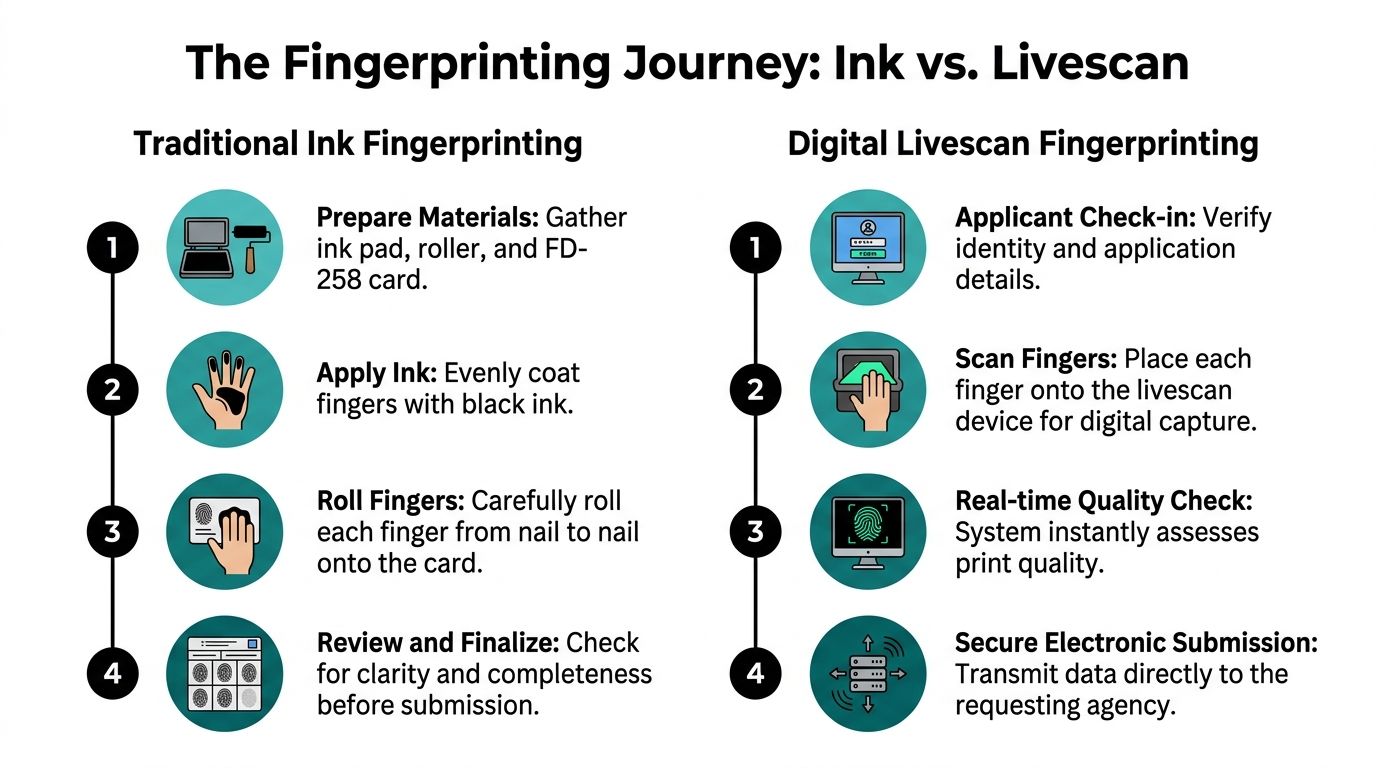
What happens during an ink appointment
With ink fingerprinting, the technician starts by confirming the card type and the destination requirements. Then the hands are checked for cuts, dryness, worn ridges, or residue that might interfere with clarity. Small preparation steps matter more than people expect.
The actual capture is slow on purpose. Each finger is rolled nail-to-nail, not pressed straight down like a stamp. That rolling motion is what records the ridge detail across the full fingertip. According to Bayometric’s discussion of ink versus Live Scan for card-based submissions, the historical 7% to 10% rejection rate for ink prints is often tied to human error, and technician skill in pressure control and nail-to-nail rolling is critical, especially for applicants with worn ridges.
A solid ink appointment usually includes:
- Hand prep: Cleaning residue, checking dryness, and improving ridge visibility where possible.
- Rolled impressions: One finger at a time, with full controlled rotation.
- Flat impressions: Grouped plain impressions placed in the correct boxes.
- Card review: The technician checks for smudging, missing ridge detail, or obvious defects before the applicant leaves.
If you’re comparing local options that offer both methods, this page on digital and ink roll fingerprinting in Sugar Land shows the kind of mixed-service setup many applicants look for.
What happens during a Live Scan appointment
A Live Scan appointment feels cleaner and faster because there’s no ink transfer. The technician verifies your identity and enters the transaction details from the agency form. Then you place your fingers on the scanner one at a time or in groups, depending on the system prompts.
The biggest operational difference is immediate feedback. If the scan quality isn’t acceptable, the system flags it during capture and the technician retakes that print before submission. That’s why Live Scan tends to feel simpler for the applicant. You don’t need to wonder whether the card will look acceptable days later after it arrives somewhere else.
What to bring either way
No matter which method you need, don’t show up empty-handed. Bring:
- Government-issued photo ID: The technician has to verify identity before capture.
- Agency paperwork: Forms, service codes, ORI numbers, request letters, or printed instructions.
- Mailing details if required: For card submissions, confirm where the completed card needs to go.
- Any extra cards or forms the agency provided: Some agencies insist on their own paperwork.
A good fingerprint appointment starts before the first finger is captured. The technician needs the right ID and the right submission instructions, or the quality of the print won’t save the transaction.
Comparing Ink and Livescan Capture Key Differences
When customers ask which method is “better,” the honest answer is that Live Scan is usually better operationally, but ink can still be the correct method legally. The comparison only makes sense if you judge both by compliance, speed, error risk, and what the receiving agency accepts.
Ink vs Livescan at a glance
| Feature | Ink Fingerprinting (FD-258 Card) | Livescan Capture |
|---|---|---|
| Capture format | Physical fingerprint card | Digital fingerprint image |
| Submission route | Usually mailed or physically delivered | Electronically transmitted |
| Error handling | Problems may be discovered after submission | Quality checked during capture |
| Dependence on technician technique | High | Lower for the applicant experience |
| Best fit | Federal forms, legacy systems, card-based submissions | Most modern background checks, state systems, digital workflows |
What matters most in real use
The clearest separation is rejection risk. The FBI rejection rate for traditional ink cards is estimated at 7% to 10%, mainly due to smudging and uneven pressure, while Live Scan rejection rates are below 1% because the software verifies quality in real time and allows immediate retakes, according to Mr. Fingerprints’ explanation of Live Scan versus traditional fingerprinting.
That difference has a direct practical effect. Ink cards can fail because the print looked acceptable at the counter but not after mailing, handling, or later review. Live Scan catches more of those problems during the appointment itself.
A rejected card doesn’t just mean “try again.” It can mean a second appointment, another mailing cycle, and a stalled hiring or licensing file.
There are still trade-offs where ink holds its ground:
- Portability: A physical card can be mailed to agencies that aren’t connected to a digital network.
- Multi-agency use: Some applicants prefer having several completed cards for different packets.
- Legacy acceptance: Older systems often still process cards more naturally than digital submissions.
Live Scan wins in most day-to-day situations because it removes extra handling, cuts down avoidable errors, and fits modern agency workflows. Ink remains useful when the process is card-centered from the beginning.
When Ink Fingerprinting Is Required or Recommended
This is the part most online guides skip. They explain why Live Scan is cleaner and faster, then leave readers with the impression that ink is obsolete. It isn’t. In several categories of applications, it’s still the only compliant choice.
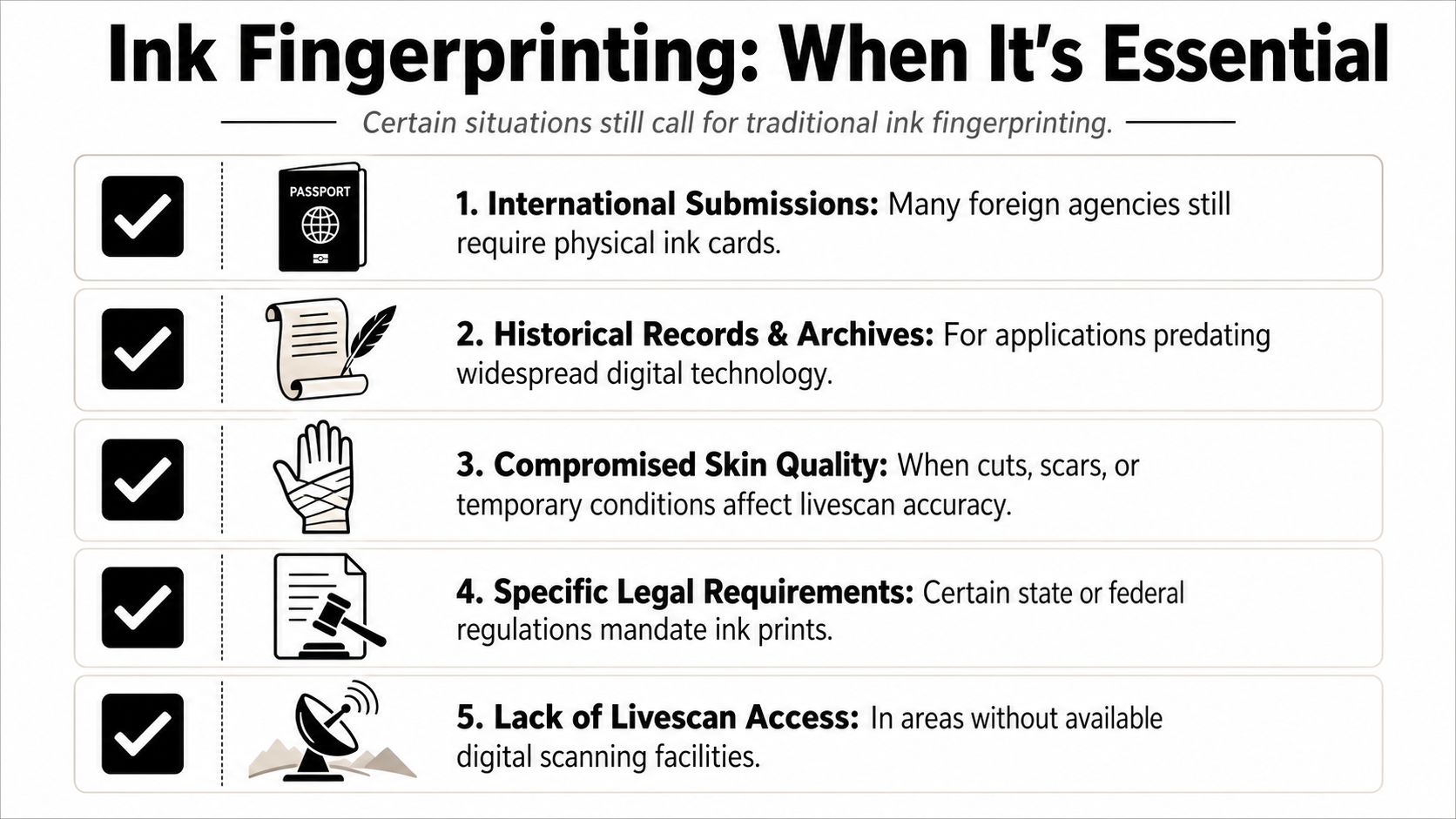
Cases where ink is mandatory
Traditional ink fingerprinting remains legally mandatory for specific federal forms such as ATF NFA paperwork, and it’s also the only practical option for applicants in rural areas or those dealing with legacy agency systems that aren’t equipped for digital submission, according to Biometrics4ALL’s analysis of Live Scan versus ink fingerprinting.
That means “Live Scan is better” doesn’t help if the receiving process starts with a card. In those cases, the agency isn’t asking for a high-quality image in the abstract. It’s asking for a specific submission format.
Cases where ink is simply more practical
Ink also makes sense in situations that aren’t strictly mandatory but are still card-friendly in practice:
- Out-of-network submissions: The receiving office may be outside your state or outside a connected digital workflow.
- Multiple application packets: If several boards or organizations want paper files, completed cards can simplify assembly.
- Remote access limitations: Not every applicant has easy access to a digital site approved for their exact transaction.
One thing customers learn quickly is that “recommended” and “required” aren’t the same. If the agency says cards are accepted and your packet is already paper-based, ink can be a sensible route. If the agency says electronic only, there’s no reason to fight that.
Ink is not the fallback for people who missed technology. It’s the correct tool when the receiving agency still operates on card-based compliance.
Why Livescan Is the Standard for Most Background Checks
Most employment and licensing checks now fit digital workflows better than paper ones. Agencies want the applicant identified, the prints captured clearly, and the submission transmitted without extra handling. Live Scan does that cleanly.
Why agencies prefer digital submission
A digital capture process reduces the number of failure points. There’s no ink distribution issue, no smearing during transfer to a card, and no physical custody chain for the print image itself. The transaction also moves in a way that matches modern records systems, where forms, identity checks, and submission confirmations are tied together electronically.
That’s one reason state employment, licensing, and regulated professions often default to Live Scan. It fits agencies that process a high volume of background checks and need consistent intake.
Who usually benefits most from Live Scan
Applicants for in-state jobs, professional licenses, volunteer clearances, and many common background check requests usually benefit from Live Scan because the method is built for speed and administrative simplicity. It also helps applicants who are on a hiring deadline and don’t want card mailing to become a bottleneck.
Identity verification still matters at the front end. If you’re curious how document screening intersects with identity intake, this piece on insights on fake ID scanning is useful background. Fingerprinting works best when the capture itself and the ID review process are both handled carefully.
The practical takeaway is simple. If your paperwork points to a state system, a digital authorization, or an electronic background check route, Live Scan is usually the right answer.
Where to Get Ink or Livescan Fingerprinting in Sugar Land
Finding a fingerprinting provider sounds easy until you need something specific. Plenty of places advertise fingerprinting, but they may only offer one method, only handle certain agencies, or leave you to interpret the paperwork yourself.
What to look for in a local fingerprinting provider
A useful local provider should be able to do three things well:
- Confirm the method: They should help determine whether your request calls for ink cards or Live Scan.
- Handle the paperwork details: Service codes, card types, and agency instructions shouldn’t be guesswork.
- Capture cleanly the first time: Especially for ink cards, technique matters.
You also want practical convenience. Walk-in availability, business-hour accessibility, and familiarity with local employment and licensing requests can make the process much easier.
A practical option in Sugar Land
For applicants in Sugar Land who need either route, Business Mail Boutique LLC offers both card-based fingerprinting and digital submission services, including LiveScan fingerprinting in Sugar Land. That kind of two-method setup helps when the main problem isn’t getting printed, but making sure you’re using the correct format before the appointment starts.
If you’re local, the simplest move is to bring your ID and the agency instructions exactly as you received them. That gives the technician something concrete to work from and reduces the odds of booking the wrong service.
If you need help choosing between ink and Live Scan, Business Mail Boutique LLC can help you match the fingerprint method to your actual paperwork, so you can move forward with the right submission the first time.

Related posts

Custom Memorial Glasses Engraved in Three Hours in Sugar Land
When a customer needed eight personalized glasses for a memorial, Business Mail Boutique completed the engraving or...

Custom Martini Glass Engraving in Sugar Land, TX
Custom Logo Engraving on Martini Glasses in Sugar Land, Texas.
Business Mail Boutique recently completed a beautiful custom engravin...

Custom Engraved Wine Glasses for a Golf Club Event in Sugar Land, TX
Custom Engraved Wine Glasses for a Golf Club Event in Sugar Land.
Custom wine glass engraving in Sugar Land, TX at Business Mail Bouti...