- Print Business Cards in Sugar Land – Same Day Service
- Copying Services
- Document Printing, Finishing & Lamination in Sugar Land
- Flyers
- Print Banner in Sugar Land | Same-Day Banner Printing Near Me
- Graphic Design
- Photo Printing
- Postcard Printing
- Document Printing
- EDDM Full Service Postcards
- FotoZoomer Large Format Printing


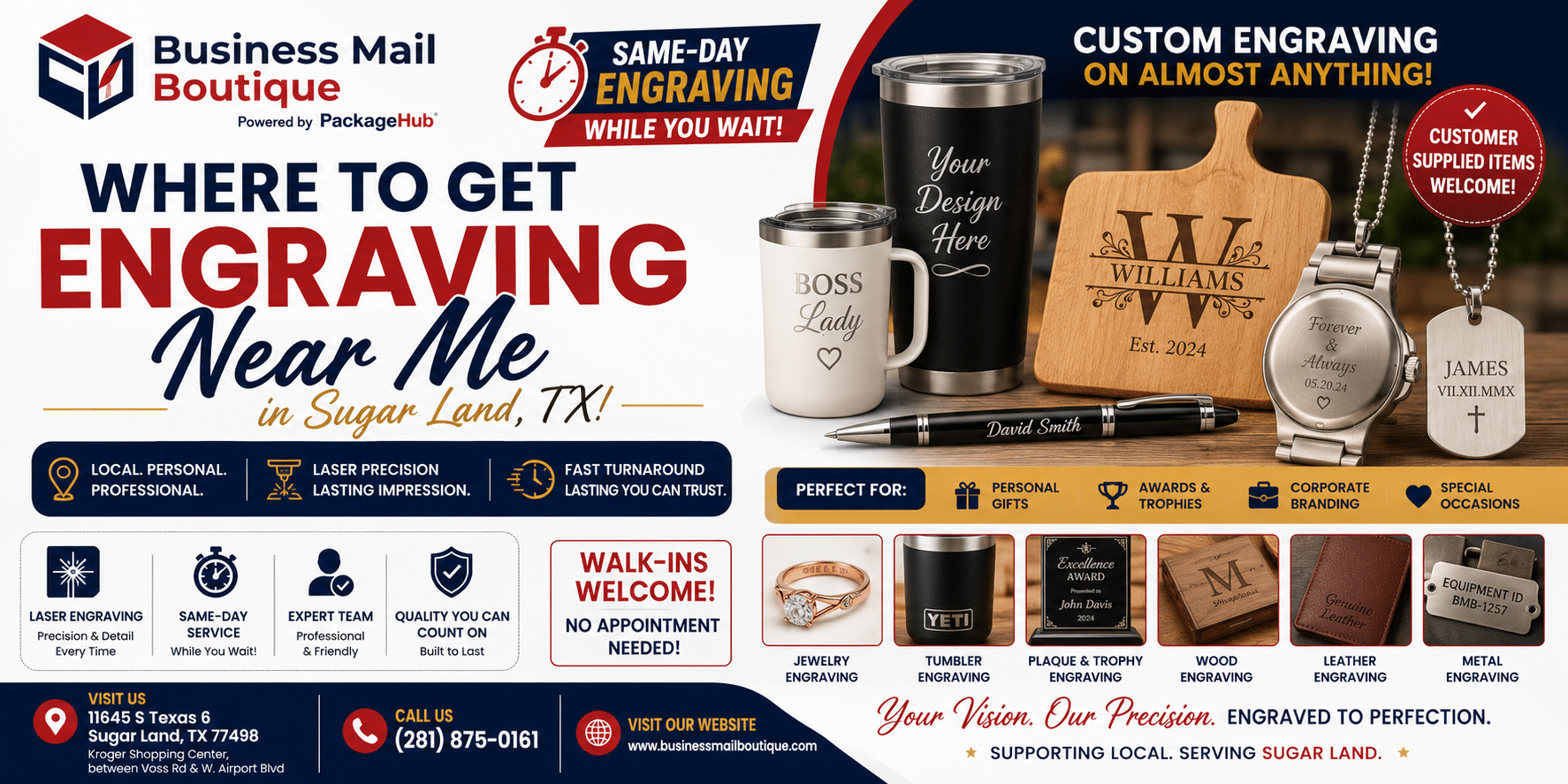
Where to Get Engraving Near Me in Sugar Land, TX.
Where to Get Engraving Near Me in Sugar Land, TX: discover local shops offering same-day custom gifts, awards, and signs.
You’ve got the item already, the deadline is close, and the blank surface is the only thing keeping it from feeling personal. Maybe it’s a tumbler for a teacher gift, a plaque for an upcoming recognition ceremony, or a logo that needs to go on several client gifts. Searching for engraving near me in Sugar Land, TX is easy. Choosing a shop that can match the material, prepare the artwork, confirm the finish, and complete the order on time takes a little more judgment.
Sugar Land is well suited to local, convenient personalization. The city had 111,026 residents in the 2020 Census, while the U.S. Census Bureau estimated 108,515 residents on July 1, 2023, and the city sits about 20 miles southwest of downtown Houston according to the City of Sugar Land population overview. That creates a useful customer base for walk-in gifts, awards, branded merchandise, and commemorative items. This guide focuses on the practical questions that matter at the counter: what can be engraved, which process fits, how to prepare your file, whether same-day service is realistic, and when a one-stop print and ship center makes more sense than a specialty kiosk. Businesses comparing several service locations may also benefit from a scalable framework for multi-location audits, especially when convenience and consistency matter across markets.
Table of Contents
- Why Sugar Land Shoppers Search for Engraving Nearby
- How Laser Engraving Actually Works on Different Materials
- Popular Items and Use Cases at Local Sugar Land Shops
- Preparing Artwork, Fonts, and Text for a Clean Engraving Run
- Turnaround Times, Pricing Drivers, and Same-Day Reality
- Why a One-Stop Print, Pack, and Engraving Center Changes the Workflow
- A Walk-In Checklist for Your Sugar Land Engraving Visit
Why Sugar Land Shoppers Search for Engraving Nearby
A parent may need a teacher gift before school pickup. An HR coordinator may have plaques ready for a quarterly ceremony. Another customer may bring in a YETI cup for a name, monogram, or company logo. Each person needs practical answers: can the surface be marked cleanly, can the shop finish it on schedule, and what happens after the item is handed over?
Sugar Land’s customer base supports this kind of local service. City data lists a median household income of $123,733, 35.9% foreign-born residents, and 43.9% of residents speaking a language other than English at home in the reported data, creating demand for personalized gifts, multilingual presentation materials, and business services. The same City of Sugar Land population and community data reports 38,680 total housing units and 80.9% owner-occupied units, a substantial household base for celebrations, home offices, commemorative pieces, and customized gifts.
What a local order actually involves
A dependable order starts with the item, not the machine. The operator checks the substrate, coating, curvature, finish, and usable marking area before recommending a process.
- Artwork review: Text, logos, and images are checked for spelling, resolution, proportions, and readability.
- Proof approval: Placement and approximate appearance are confirmed before production.
- Test or parameter check: Unfamiliar materials may require a test burn or sample area.
- Production and finishing: The mark is made, then the item may be cleaned, polished, color-filled, wrapped, or prepared for shipment.
- Pickup or delivery: The finished piece can be collected locally or added to a packing and shipping workflow.
A specialty kiosk can handle a straightforward blank product efficiently. A one-stop print and ship store becomes more useful when engraving is one part of the assignment, such as plaques paired with printed certificates, wedding gifts needing packaging, or branded items shipped to recipients nationwide. That workflow can also help businesses seeking a scalable framework for multi-location audits keep ordering and fulfillment details consistent across markets.
How Laser Engraving Actually Works on Different Materials
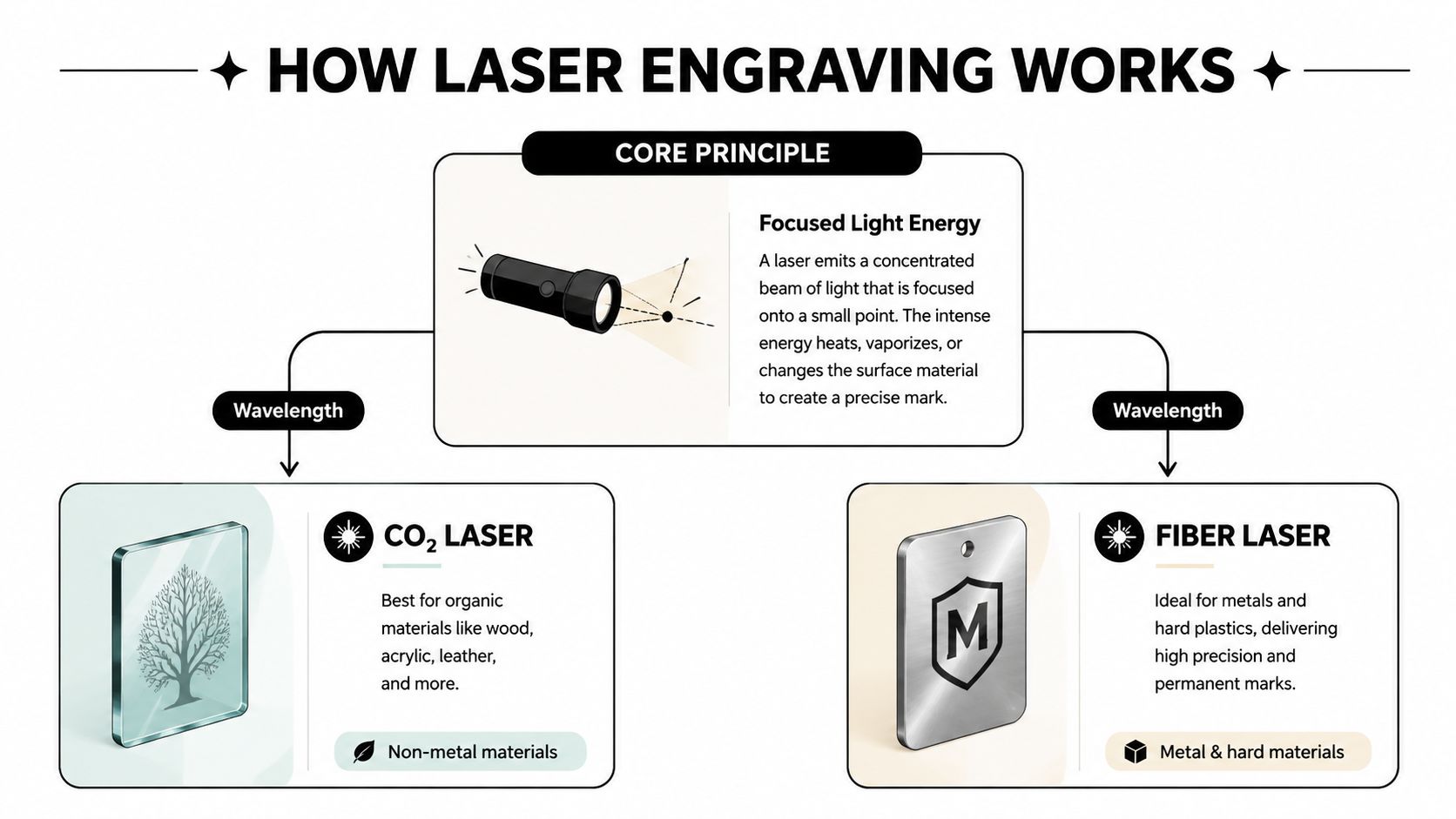
Laser engraving is focused light energy used to change or remove a small area of a surface. A simple analogy is a flashlight. A regular flashlight spreads light broadly, while an engraving laser concentrates energy into a controlled point and moves that point according to the artwork. The result may be material removal, a color change, coating removal, or a textured mark, depending on the substrate and settings.
The laser has to match the surface
A fiber laser is generally the right tool for metals and some hard plastics. A CO2 laser is typically used for organic materials and non-metals. The distinction comes from wavelength and the way different materials absorb and respond to heat, as outlined in the engravers handbook from Trotec.
Think of the two systems as different keys. A fiber laser can produce a controlled mark on stainless steel, anodized aluminum, jewelry metals, metal keychains, and some coated products. A CO2 laser is better suited to wood, acrylic, leather, many glass applications, and other non-metal surfaces. A shop that handles a leather patch well may not have the equipment needed for a wedding band or bare stainless steel item.
Coatings change the answer. An anodized aluminum tumbler may produce a clean, contrasting mark when the laser removes the colored top layer. A coated stainless mug may need a fiber laser to expose or alter the surface beneath that finish. If the system and material don’t match, the result can be faint contrast, excess charring, uneven texture, or an incomplete mark.
Practical rule: Match the material first, then the artwork, then the deadline.
Laser versus rotary engraving
Laser engraving is often preferred for detailed logos, fine text, and repeatable graphic placement. Rotary engraving uses a physical cutter to remove material, which can create a deeper, tactile groove on suitable plaques, plates, plastics, or metals. Neither method automatically wins. The right choice depends on whether you want a surface mark, coating removal, visible depth, or a traditional carved appearance.
Before ordering, tell the shop exactly what the item is made from and whether it’s painted, powder-coated, anodized, plated, polished, or brushed. For customers considering unusual keepsakes or memorial pieces, this guide to laser engraving on stones and custom gifts offers another example of why substrate selection comes before production.
Popular Items and Use Cases at Local Sugar Land Shops
Most local engraving requests fall into a few recognizable groups, but the finish changes the recommendation. A tumbler, a plaque, a wine glass, and a watch may all accept personalization, yet they don’t take the same process or produce the same visual effect.
Tumblers, YETI cups, Stanley mugs, and similar drinkware are common choices for employee gifts, school presents, wedding parties, and small-business branding. Coated drinkware often offers strong contrast when the colored layer is removed. Bare or brushed stainless steel may look subtler, and a curved body requires careful alignment. Ask whether the operator will use a rotary attachment and whether the mark is intended to be a surface contrast or a deeper cut.
Wine glasses and other glassware suit weddings, anniversaries, client gifts, and event tables. Glass can look refined when the design is restrained, but fine details and crowded text may become difficult to read. A short name, date, monogram, or simple logo usually has more visual impact than a paragraph.
Gifts and personal keepsakes
Watches, pens, cufflinks, jewelry, keychains, and small tags work well for milestones because the available area encourages concise wording. Initials, dates, coordinates, or a short message are usually safer than a detailed image on a very small surface. Jewelry also demands careful inspection because plating, curvature, and polished finishes can affect contrast.
Cutting boards and leather goods are strong choices for weddings, housewarming gifts, and client appreciation. Wood grain can add character, though it may compete with delicate artwork. Leather patches, wallets, and folios often suit bold lettering and clean logos, while thin scripts may lose definition depending on the material and finish.
Plaques, trophies, awards, and small signs are practical for schools, offices, teams, real estate closings, and community events. These projects often combine engraving with a printed certificate, presentation folder, or shipping requirement. A flat plaque generally makes placement and proofing easier than a curved item, but the final appearance still depends on the plate material and whether the customer wants a cut, etched, or color-filled effect.
For powder-coated drinkware, the finish deserves special attention because the visual result depends on how the coating reacts and what lies beneath it. Customers comparing options can review engraving on powder-coated tumblers before bringing in a favorite cup.
Ask before production: “What will the mark look like on this exact finish, and do you recommend a test area?”
Unfamiliar substrates, heavily textured surfaces, unusual coatings, and personal items with sentimental value should never be treated as automatic jobs. A test burn may add a little preparation time, but it can prevent a disappointing full-size run.
Preparing Artwork, Fonts, and Text for a Clean Engraving Run
Artwork preparation often determines whether a job moves directly into setup or gets delayed by tracing, cleanup, and repeated proofing. Vector files, including SVG, AI, EPS, and vector PDF formats, are preferred for logos and line art because the operator can resize them without introducing the jagged edges found in a low-quality bitmap. The laser artwork file requirements guide recommends vector artwork where possible and identifies 300 DPI at final size as a practical minimum for raster artwork, with some workflows benefiting from 600 DPI or higher input.
A phone screenshot may look acceptable on a small screen but contain too little information for crisp engraving. Social media downloads, compressed JPEGs, and images copied from a website often need manual tracing or smoothing. That extra preparation can affect a rush order, especially when the design includes fine text, a serial number, or a small business logo.
Send the operator usable information
Bring or email the following:
- The original logo file: SVG, AI, EPS, or vector PDF is preferable. If you only have a PNG or JPEG, send the highest-resolution version available.
- Exact wording: Check names, dates, titles, capitalization, and punctuation before approval.
- Placement instructions: Identify the front, back, lid, handle side, or lower corner, and include a reference photo if orientation could be unclear.
- Finished dimensions: State the approximate width and height if you already know them, especially for a logo or plaque layout.
- A preferred font: If the font matters, provide its name or an outline version. Otherwise, ask for a readable recommendation.
Make small text readable
Engraving isn’t a typesetting contest. Thin script fonts, tight kerning, narrow counters, and very small lettering can close up or disappear after processing. A clean sans serif or sturdy serif often performs better on pens, keychains, and curved tumblers than an ornate script with hairline strokes.
Curved items also need more than a flat layout. The operator may need to account for diameter, available marking width, rotation, and the point where the design begins and ends. Ask for a proof that shows the intended placement, but remember that a screen proof can’t fully reproduce the final texture or reflective quality of metal and glass.
File-prep shortcut: Send the artwork, the exact text, a photo of the item, and the required completion date in one message. That gives the shop enough context to answer accurately instead of starting a long back-and-forth.
Turnaround Times, Pricing Drivers, and Same-Day Reality
“Same day” describes a possible service window, not a guarantee that every job can be finished while you wait. A clean logo on a standard blank item is a different assignment from a delicate piece with custom artwork, a batch of plaques, or an unfamiliar coating. Shops that advertise same-day work can often complete suitable projects quickly, but they still need time for inspection, file setup, proof approval, machine preparation, production, and cleanup.
The main pricing and scheduling variables are practical:
- Material and finish: Metal, glass, wood, acrylic, leather, and coated items may require different equipment and settings.
- Item preparation: A clean, flat, accessible surface is easier to process than an object with hardware, residue, curvature, or a fragile finish.
- Artwork complexity: A simple name requires less setup than a detailed logo, photo, or design that needs tracing.
- Quantity: A group order may need one setup followed by repeated production, but every item still requires placement and quality checks.
- Finishing: Polishing, paint fill, protective treatment, gift wrapping, or presentation packaging can add labor.
- Shipping: Packing and sending finished pieces creates another handling stage and a delivery schedule beyond the engraving itself.
Compare the service modes
| Service Mode | Typical Turnaround | Best Fit For |
|---|---|---|
| Walk-in while-you-wait | Same day when the item, artwork, and workload allow it | One straightforward gift or small personal item |
| Scheduled same-day order | Later the same day after review and production | A time-sensitive gift, award, or branded item that needs setup |
| Longer-run order | Several business days, depending on quantity and finishing | Multiple plaques, event pieces, complex artwork, or unfamiliar materials |
| Drop-ship workflow | Based on production, packing, and carrier transit | Recipients outside Sugar Land or businesses sending items nationwide |
A local business directory lists 18,577 businesses in Sugar Land and records 287 chamber-directory additions in 2018 compared with 220 the year before (Sugar Land business directory). That commercial activity helps explain why local engraving requests often include awards, promotional merchandise, and client gifts, not just one-off presents. The same directory profile reports 56,099 people employed and a 4.8% unemployment rate, while an independent business article cited different income and unemployment figures, so treat directory and third-party market figures as context rather than a quote for your individual order.
Get a written estimate before approving production. Confirm the item, design, quantity, finishing, tax, pickup date, and shipping charges. If the deadline is fixed, say so before the machine starts, not when you arrive for pickup.
Why a One-Stop Print, Pack, and Engraving Center Changes the Workflow
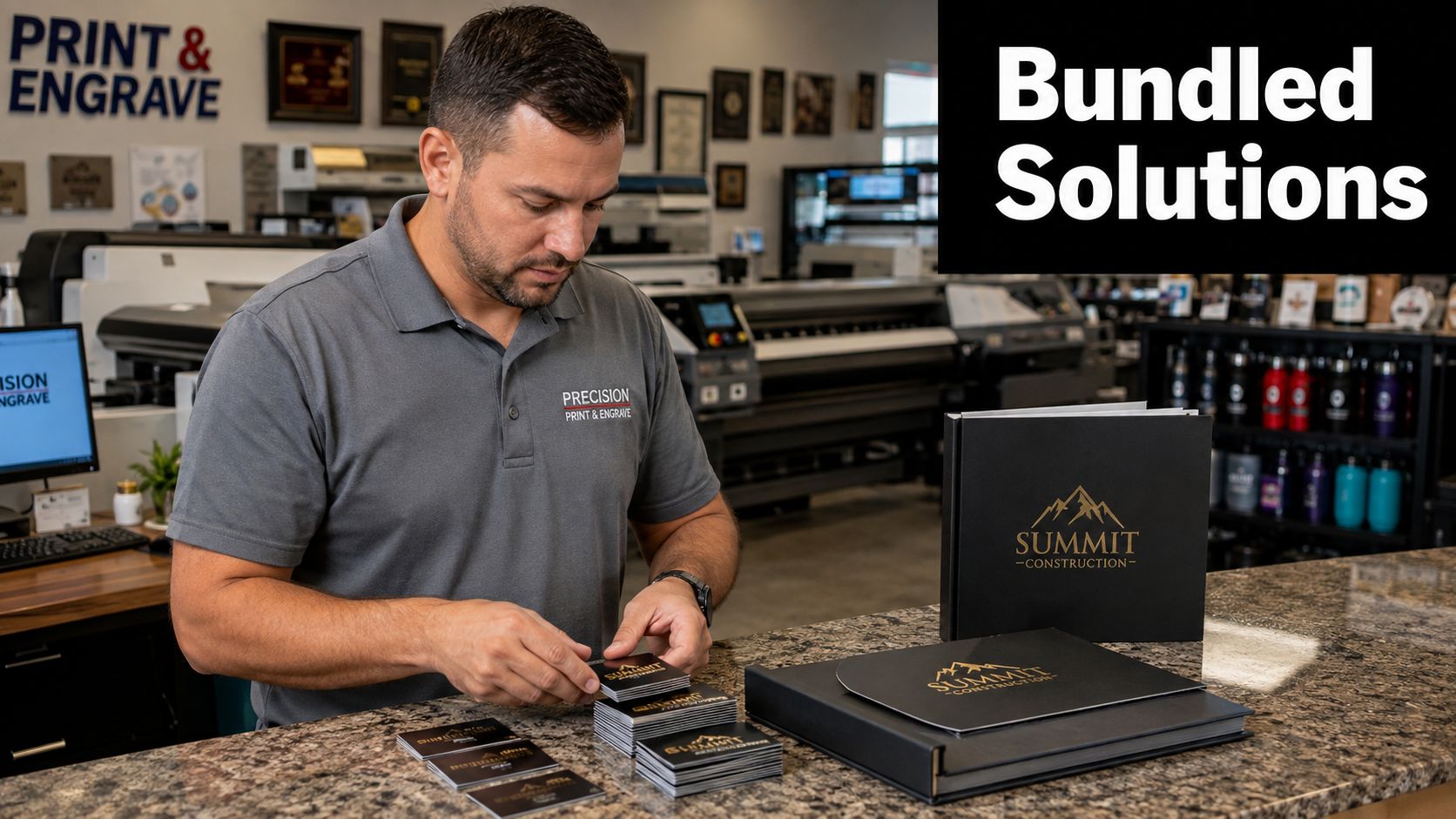
Engraving becomes more valuable when it isn’t isolated from the rest of the project. A business may need plaques, printed certificates, presentation folders, and shipping labels for the same recognition event. A couple may need a cutting board engraved, gift-wrapped, and sent to relatives in another state. A contractor may need an engraved plaque alongside business cards, yard signs, decals, and a folder for a client presentation.
A single-service kiosk may handle the mark, but a one-stop print, pack, and ship center can reduce handoffs. You can review the engraving proof, order related print materials, package the completed items, and arrange delivery through one workflow. Fewer handoffs mean fewer opportunities for a name to be copied incorrectly, a package to lose its supporting document, or a deadline to get missed between vendors.
Where consolidation pays off
Consider a small company recognizing a project team. The order might include engraved plaques, printed award certificates, business cards for the event organizer, presentation folders, and individual shipments to remote employees. Ordering each component separately creates separate proofs, invoices, pickup times, and packing decisions. Consolidating the work lets the customer coordinate the presentation as one deliverable.
The same logic applies to personal orders. A wedding gift may require engraving, a protective box, tissue, a note, and nationwide shipping. A local center that already handles packing and carrier services can prepare the item for transit rather than sending the customer to another location after engraving.
Business Mail Boutique LLC operates as a Sugar Land business center offering printing, packing, shipping, mailbox, document, and engraving services. Its broader copy and ship services guide is useful for customers deciding whether their engraving request belongs inside a larger print or delivery project.
The trade-off is that a one-stop center isn’t automatically the right choice for every specialized job. A highly intricate heirloom restoration, deep industrial marking, or unusual production material may require a specialist with dedicated tooling. For ordinary gifts, awards, branded items, and coordinated delivery, however, consolidating related steps can make the order easier to manage.
A Walk-In Checklist for Your Sugar Land Engraving Visit
A productive visit starts before you reach the counter. Bring the actual item whenever possible, because a product name alone doesn’t reveal its coating, curvature, finish, hardware, or usable engraving area. If the item contains electronics, batteries should be removed before handing it over, and any fragile or valuable piece should be identified clearly.
What to bring
- Your item: Bring the tumbler, plaque, jewelry, cutting board, leather good, glass, or other object you want marked.
- Digital artwork files: Use a vector logo when available, plus a high-resolution raster file if that’s all you have.
- Reference photos: Photograph the front, back, lid, handle, or other areas that affect orientation and placement.
- Exact wording: Type names, dates, titles, and messages rather than relying on handwritten notes.
- Deadline and contact details: Give the shop a realistic pickup date and a phone number or email for proof approval.
If the item will touch food, ask whether the finished surface and any color fill or coating are appropriate for that use. Don’t assume every engraved cutting board, mug interior, or treated surface has the same care requirements. Gift packaging is another small detail worth confirming early, especially when the recipient won’t collect the item in person.
Questions to ask at the counter
- What is the substrate and finish? Ask whether the surface is bare, coated, anodized, powder-coated, plated, painted, or textured.
- Which process fits? Confirm whether the shop recommends a fiber laser, CO2 laser, rotary engraving, or another method.
- Will the mark be deep, etched, or coating-removal? These produce different looks and levels of tactile feel.
- Do you recommend a test burn? This matters for unfamiliar materials and sentimental items.
- Can I approve a proof? Verify spelling, size, orientation, and placement before production.
- What is included in the estimate? Confirm artwork cleanup, setup, finishing, packaging, tax, and shipping.
- When and how will I receive it? Confirm pickup, local delivery if available, or nationwide shipping arrangements.
Counter rule: Don’t approve the job until the item, wording, placement, finish, price, and completion method are all written down.
Use this process for a teacher gift, an engraved YETI, a wedding keepsake, a school award, or a business order. It gives the operator the information needed to make a sound recommendation and gives you a clear record of what you approved.
For engraving, printing, packing, and shipping in one Sugar Land workflow, visit Business Mail Boutique LLC. Bring your item and artwork for a material check, proof review, and practical recommendation on same-day pickup or nationwide delivery.

Related posts

Custom Memorial Glasses Engraved in Three Hours in Sugar Land
When a customer needed eight personalized glasses for a memorial, Business Mail Boutique completed the engraving or...

Custom Martini Glass Engraving in Sugar Land, TX
Custom Logo Engraving on Martini Glasses in Sugar Land, Texas.
Business Mail Boutique recently completed a beautiful custom engravin...

Custom Engraved Wine Glasses for a Golf Club Event in Sugar Land, TX
Custom Engraved Wine Glasses for a Golf Club Event in Sugar Land.
Custom wine glass engraving in Sugar Land, TX at Business Mail Bouti...