
- Print Business Cards in Sugar Land – Same Day Service
- Copying Services
- Document Printing, Finishing & Lamination in Sugar Land
- Flyers
- Print Banner in Sugar Land | Same-Day Banner Printing Near Me
- Graphic Design
- Photo Printing
- Postcard Printing
- Document Printing
- EDDM Full Service Postcards
- FotoZoomer Large Format Printing


Business Address for LLC.
Learn how to pick a business address for LLC needs, from home to virtual offices, with tips on registered agents, privacy, and Sugar Land setup.
Businessmailboutique
11645 S. Hwy 6
Sugar land, Texas 77498 United States (US)
Email: info@businessmailboutique.com
Route
You’ve formed your Texas LLC, chosen a name, and started setting up banking. Then you search the Texas Comptroller’s online filing database, click your company’s record, and see your home street address displayed for anyone to find. That moment surprises many first-time founders, especially solo consultants, remote sellers, and home-based service providers in Sugar Land.
A business address for an LLC isn’t just the address printed on your website. It can affect public privacy, legal service, tax correspondence, banking verification, and the way state agencies identify your company. The safest approach isn’t always to find one address that does everything. It’s to build a practical address stack, with separate roles for legal service, business operations, and mail.
Table of Contents
- What a Business Address for an LLC Actually Means
- Registered Agent Address vs Principal Office Address
- Address Options Founders Can Choose From
- State-Specific Rules and Common Filing Pitfalls
- Step-by-Step Setup for Your LLC Business Address
- Privacy Tradeoffs and Real-World Verification Risks
- Practical Tips for Sugar Land Small Businesses
What a Business Address for an LLC Actually Means
A business address for an LLC is a physical location associated with the company where official correspondence, legal documents, and state notices can be delivered. For formation purposes, that usually means a real street address, not merely a mailing line or a P.O. Box.
Washington’s Secretary of State explains that the registered agent address must be a physical street address in the state, available for service of process. The same filing guidance says the principal office address must also be a street address, and that P.O. boxes, private mailbox addresses, and virtual addresses aren’t accepted for those fields. Washington Secretary of State filing guidance provides a clear example of why address selection is a compliance decision, not just a branding preference.
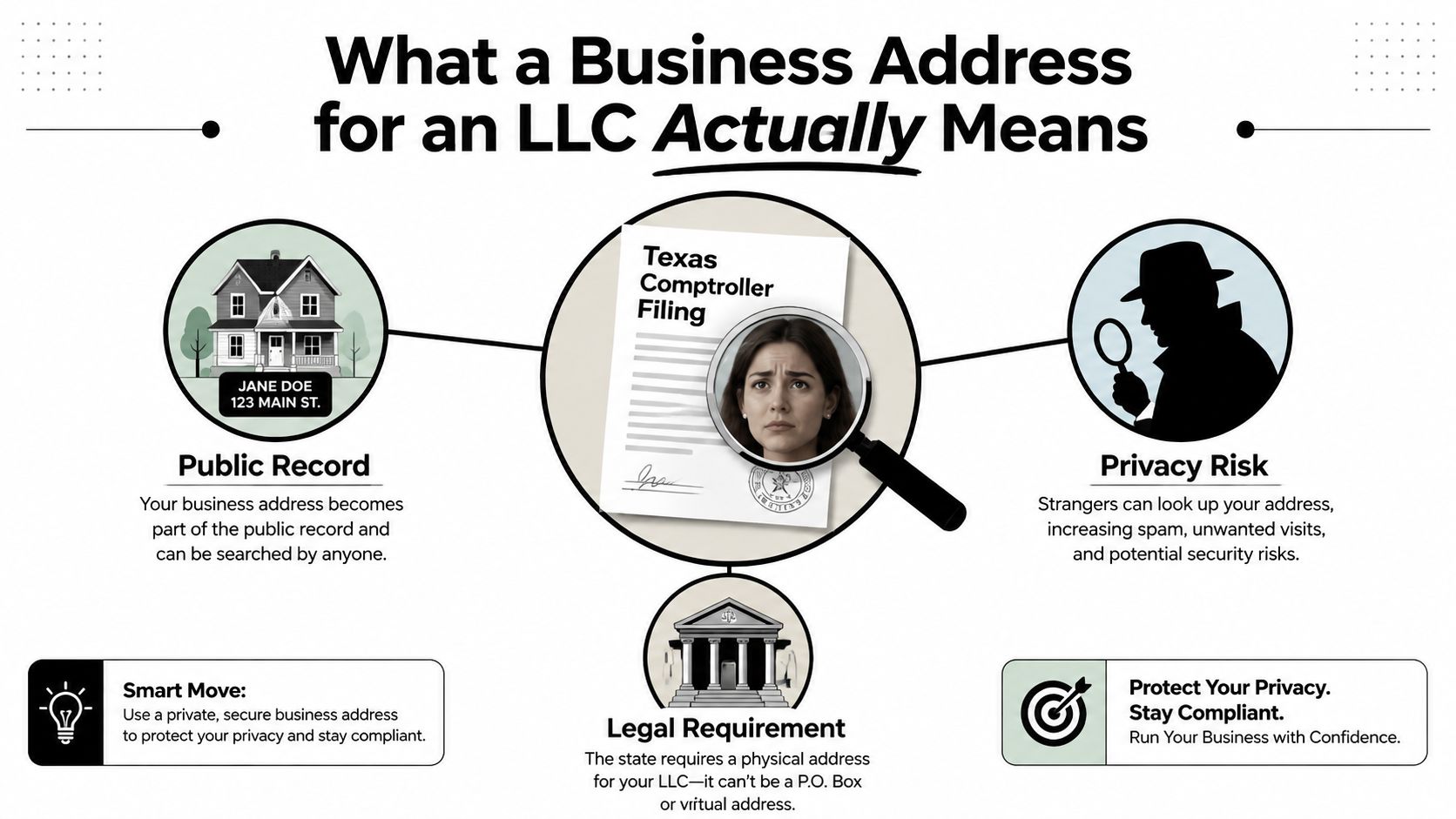
The address may become part of the public formation record. That creates a practical privacy issue for founders who operate from home. A stranger, potential customer, process server, or online researcher may be able to connect the LLC with a residential location.
The three-address framework
Most confusion comes from treating several different fields as one decision:
- Registered agent address: Where someone can accept lawsuits, subpoenas, and official service of process for the LLC.
- Principal office address: The company’s primary business or operational location, when the state filing requires it.
- Mailing address: Where routine letters, packages, and forwarded correspondence should go.
These addresses can sometimes be the same, but they don’t have to be. A Texas single-member LLC, multi-member LLC, or professional LLC may use a commercial location for its public business address, a Texas registered agent for legal service, and a separate mail workflow for daily correspondence.
The U.S. Small Business Administration also notes that businesses generally need to register in every state where they conduct business activities. The SBA’s business launch guidance helps explain why an expanding LLC may eventually manage several state registrations, each with its own address fields and registered agent requirements.
Practical rule: Choose addresses by function first. Privacy, credibility, and convenience matter, but they shouldn’t override the exact field requirements on the state filing.
Registered Agent Address vs Principal Office Address
The registered agent address and principal office address answer different legal questions. The registered agent address tells the state where legal documents can be delivered during business hours. The principal office address identifies the company’s main business location or designated office.
A registered agent can be an owner, but doesn’t have to be. The agent may be an individual who lives in the formation state or a commercial registered agent service that maintains an in-state street address and accepts service for the LLC.
The principal office can be a separate location. A public Wisconsin business record illustrates this structure by listing a registered agent office in Middleton and a principal office in Lodi for the same LLC. The record shows why founders shouldn’t assume that the address used for legal service is automatically the address used to describe business operations.
| Field | Registered Agent Address | Principal Office Address |
|---|---|---|
| Main purpose | Accepts service of process and official state documents | Identifies the company’s primary office or operating location |
| Typical requirement | Physical in-state street address | Required by the state filing schema in some states |
| Public-record role | Often appears on formation records | May appear on formation records and business registries |
| Who controls it | Owner, authorized individual, or commercial agent | The LLC and its operating team |
| Mail responsibility | Handles legal and state correspondence assigned to the agent | May receive business, tax, licensing, or banking correspondence |
When one address can serve both roles
A founder who works from home may use the same residential address for both fields if the state permits it and the founder is willing to receive service there. That arrangement is straightforward, but it exposes the home address and puts legal delivery responsibilities directly at the residence.
A commercial office, coworking location, or compliant virtual office may support both roles only when the provider expressly permits it and the state accepts the address format. A mailbox service that handles ordinary mail may not accept legal service, and a registered agent service may not want its address used as the LLC’s principal office.
The technical distinction matters because a mismatch can create a gap. If the registered agent is prepared to receive a lawsuit but the principal office address is outdated, tax or licensing notices may still go somewhere the owner doesn’t monitor.
Address Options Founders Can Choose From
A Sugar Land consultant may work from home, meet clients elsewhere, and need only dependable mail handling. Another LLC may need meeting rooms, staffed reception, or an address that supports banking reviews. Founders weigh privacy, physical access, mail handling, banking credibility, and operating cost together, because each address type solves a different part of the three-address setup.
A home address is usually the simplest option because the founder already controls it. It can suit a solo consultant who has no objection to public disclosure and does not receive clients at home. Public records may expose the residence, while a lease, homeowners association rules, visitors, or legal service may create added concerns.
A commercial mailbox service, such as a mailbox at a shipping center, provides a street-style address for correspondence and packages. As a Commercial Mail Receiving Agency, it requires the customer to complete USPS Form 1583, verify identity, and keep authorization current. Forwarding and scanning can simplify mail handling, but a bank or online platform may still recognize the address as a mailbox rather than an operating location.
A virtual office generally combines a commercial street address with mail receipt, scanning, forwarding, and sometimes meeting room access. That arrangement can fit a remote professional services firm seeking a public business location without leasing a dedicated office. Confirm, before subscribing, whether the provider supports the particular registered agent role, state filing field, bank review, and local license involved. A virtual address for business can be one part of that arrangement, but the provider’s permitted uses still need review.
A coworking space may provide a staffed front desk, meeting rooms, and a visible place to work. Some locations let members use the address for business purposes. Others restrict registered agent use or require a separate service, so read the usage policy before placing the address on formation documents.
| Address Option | Typical Monthly Cost | Privacy Level | Best For |
|---|---|---|---|
| Home address | Varies by household arrangement | Low | Home-based founders comfortable with public disclosure |
| Commercial mailbox | Provider-dependent | Moderate to high | Sellers and consultants needing mail and package handling |
| Virtual office | Provider-dependent | High | Remote firms seeking a commercial presence |
| Coworking space | Provider-dependent | High | Teams needing workspace, meetings, and staffed reception |
The cost column is provider-specific, not a promise. A lower monthly price may include limited forwarding, restricted package handling, or no permission for legal service. Check those conditions before assigning the address to a filing, bank account, or compliance record.
State-Specific Rules and Common Filing Pitfalls
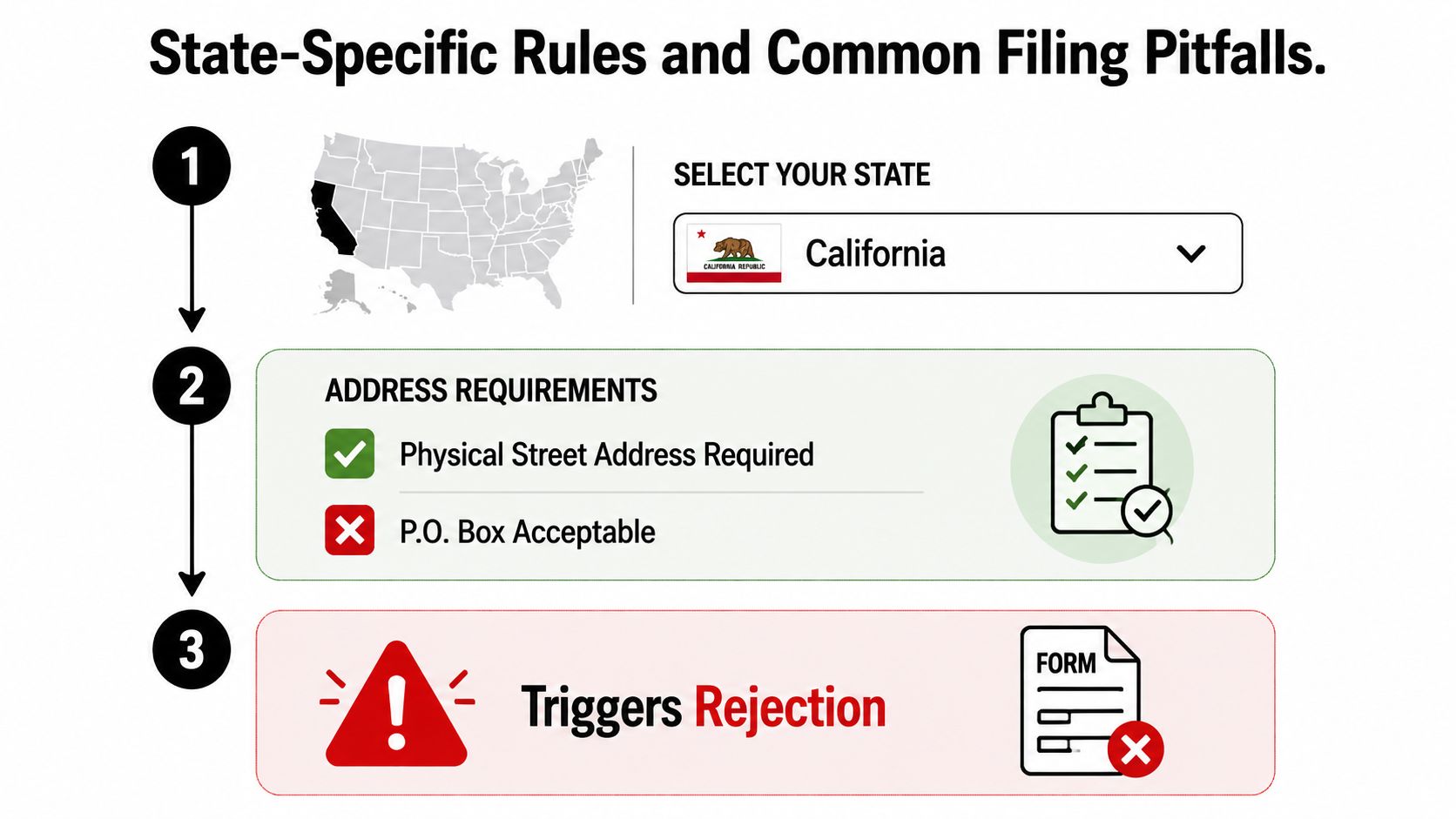
Address rules vary by state and by filing field. A P.O. Box may work for some routine mail, but state formation offices commonly reject P.O. boxes for registered agent or principal office fields. Washington expressly requires physical street addresses for those fields, and Nolo’s LLC address guidance describes the broader rule that states generally don’t allow P.O. boxes for LLC registration or registered agent purposes.
Check the address before paying
A mailbox or virtual office provider may advertise a real street address, but that doesn’t automatically mean every state agency, bank, or licensing office will accept it. Before subscribing, ask the provider and the filing office:
- Does the address satisfy the registered agent field?
- Does the state require a separate principal or designated office?
- Is the suite format accepted exactly as written?
- Can someone receive legal documents during required business hours?
- Is the location a CMRA that requires USPS Form 1583?
- Will the provider confirm its authorization for business filings?
USPS rules require CMRA customers to complete Form 1583, provide identity verification, and maintain authorization. The CMRA compliance explanation describes why a mailbox-style address isn’t compliant for mail receipt until that process is complete.
Avoid small formatting errors
A valid location can still create trouble if the filing omits a suite number, uses a different county description, or lists an address that doesn’t match the provider’s records. Confirm the address through the state business search, USPS address tools, and the registered agent provider’s onboarding documents.
Don’t assume Texas, California, Delaware, Wyoming, and New York use identical schemas. Check the Secretary of State instructions for the specific entity type, then verify local licensing requirements separately. If the state requires an office address, a registered agent address alone may not satisfy the filing.
Step-by-Step Setup for Your LLC Business Address
Address setup works best as an administrative sequence rather than a last-minute form entry.
Start with the roles
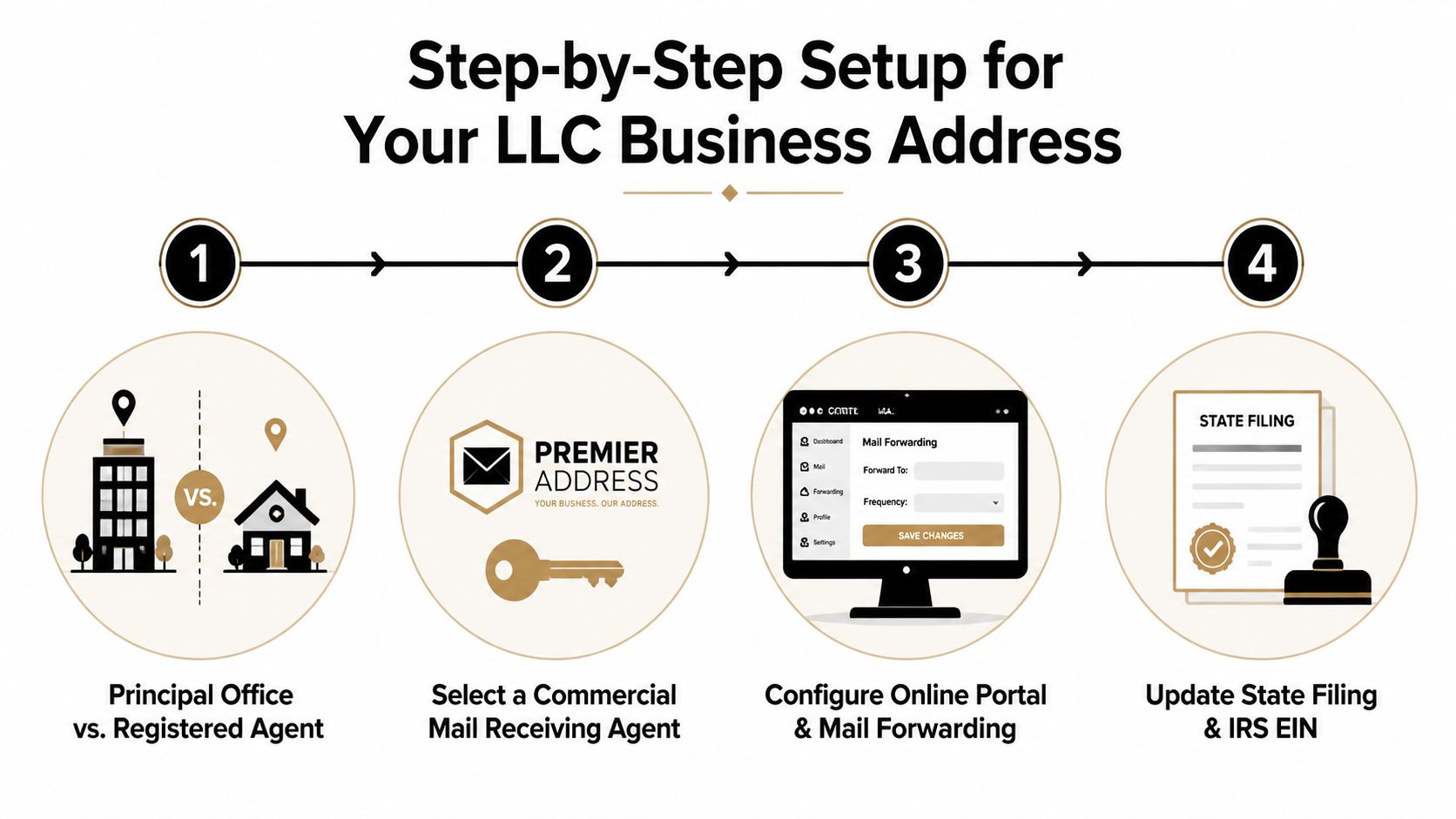
First, decide whether the principal office and registered agent address will be the same. A home-based Texas founder may combine them, while a privacy-conscious owner may use a commercial location for the principal office and a separate Texas registered agent.
Second, choose the address type. Compare a home, commercial mailbox, virtual office, or coworking space against the exact state fields. Don’t subscribe until the provider confirms whether it supports legal service, ordinary mail, or both.
Third, complete the provider’s onboarding. If the location is a CMRA, complete USPS Form 1583 and identity verification. The USPS Form 1583 resource can help you understand the authorization process before mail forwarding begins.
Put the details in writing
Fourth, enter the address exactly as authorized. Include the suite or unit identifier, city, state, ZIP code, and county information where the filing requires it. A small formatting difference can make the state record disagree with the provider’s records.
Fifth, create a mail workflow. Decide who receives scans, how forwarding is requested, and how urgent government correspondence is escalated. Legal and tax notices should go to a monitored inbox or responsible person, not an unattended mailbox.
Sixth, update the IRS, bank, sales tax permits, insurers, vendors, and payment platforms. Address consistency helps institutions reconcile the company across their records. For founders working through a broader formation process, a Connecticut business launch checklist offers a useful example of how formation tasks can be organized, even though the state rules won’t be identical to Texas.
This video can supplement the written checklist with a visual walkthrough:
Finish with a verification sweep after setup. Compare the state record, EIN letter, bank profile, provider portal, website footer, invoices, and permits. Confirm that mail arrives, scans are readable, forwarding works, and the registered agent knows how to notify you when legal documents are served.
Privacy Tradeoffs and Real-World Verification Risks
A legally usable address isn’t automatically accepted everywhere. State filing offices, banks, tax agencies, payment processors, and marketplace platforms may each ask different questions about where the LLC operates.
A virtual office may pass a formation review yet prompt a bank to request proof of operating presence. A registered agent address may be valid for service of process but unsuitable as the principal address on a bank application. A P.O. Box may be useful for routine mail while failing a physical-location check.
| Address Type | State Filing | Bank KYC | Platform Verification |
|---|---|---|---|
| Home address | Often usable if state rules permit | May require personal and business records to align | Usually easy to verify, but privacy exposure remains |
| Commercial mailbox | Field-dependent | May trigger questions about mailbox use | May require additional business documentation |
| Virtual office | Accepted in some filing contexts | Provider and institution policies vary | May require proof of real operations |
| Coworking space | Depends on usage authorization | Can support credibility when documentation is available | Usually depends on address records and business activity |
Decide which risk matters most
Choose privacy when your business operates remotely, customers don’t visit, and you can document the commercial address. Choose credibility when you expect banking reviews, merchant onboarding, or professional licensing. Choose a staffed commercial location when you need one address to support multiple verification layers.
A home address may create unwanted visibility or customer contact. A virtual address may protect privacy but create a documentation gap if an institution asks where work is performed. The Shopify app privacy overview is a useful reminder that digital business tools also involve information-handling decisions, including how business identity details are presented and managed.
Before opening a bank account, verify that the address is searchable, matches the state filing, appears consistently on the EIN record, and has documentation from the provider. Keep the service agreement, authorization records, mail receipts, and any proof of workspace access in one folder. For a practical comparison of mailbox arrangements, see this guide to private mailbox vs. P.O. Box.
Practical Tips for Sugar Land Small Businesses
Consider a Sugar Land consultant operating remotely near 11645 S. Hwy 6, between Highway 6 and US-90A. The founder wants home privacy, needs reliable mail, and plans to open business banking near First Colony or River Park. The first question isn’t “Which address looks most professional?” It’s “Which address can each institution verify for the role I’m assigning it?”
A local commercial mailbox can keep the founder’s home address out of public-facing business records while providing a street location for mail and packages. The founder should still confirm whether the provider’s address is acceptable for the Texas filing field, whether it can receive legal service, and whether USPS Form 1583 is complete.
Use a local verification checklist
- Confirm the street format: Check that the suite appears consistently in the provider’s records and on mapping services.
- Separate legal service: Use a registered agent physically located in Texas and authorized to receive service for the LLC.
- Review county and city requirements: Contact the appropriate Fort Bend County and Sugar Land offices for local permits and address verification rather than assuming the state filing answers every local question.
- Match the records: Compare the formation filing, IRS EIN letter, bank application, permits, invoices, and website contact details.
- Monitor mail: Retain digital scans and forwarding records through the Sugar Land mail center, especially for tax and state notices.
- Schedule reviews: Recheck the address stack when the company moves, adds a state registration, changes providers, or approaches a Texas franchise tax filing deadline.
ZIP code selection can also affect routing, so use the ZIP assigned to the actual delivery location rather than choosing between nearby Sugar Land or Missouri City options for appearance. If the business uses a location near Sweetwater Boulevard or the Highway 6 corridor, record the exact authorized format and preserve the provider’s documentation before submitting formation or banking paperwork.
Business Mail Boutique LLC provides private mailbox rentals with a real street address, mail forwarding, and package receiving from its Sugar Land storefront, along with shipping, printing, and document services. Review the address and mailbox options at Business Mail Boutique LLC, then confirm which address role fits your LLC before filing.

Related posts

Custom Memorial Glasses Engraved in Three Hours in Sugar Land
When a customer needed eight personalized glasses for a memorial, Business Mail Boutique completed the engraving or...

Custom Martini Glass Engraving in Sugar Land, TX
Custom Logo Engraving on Martini Glasses in Sugar Land, Texas.
Business Mail Boutique recently completed a beautiful custom engravin...

Custom Engraved Wine Glasses for a Golf Club Event in Sugar Land, TX
Custom Engraved Wine Glasses for a Golf Club Event in Sugar Land.
Custom wine glass engraving in Sugar Land, TX at Business Mail Bouti...