
- Print Business Cards in Sugar Land – Same Day Service
- Copying Services
- Document Printing, Finishing & Lamination in Sugar Land
- Flyers
- Print Banner in Sugar Land | Same-Day Banner Printing Near Me
- Graphic Design
- Photo Printing
- Postcard Printing
- Document Printing
- EDDM Full Service Postcards
- FotoZoomer Large Format Printing


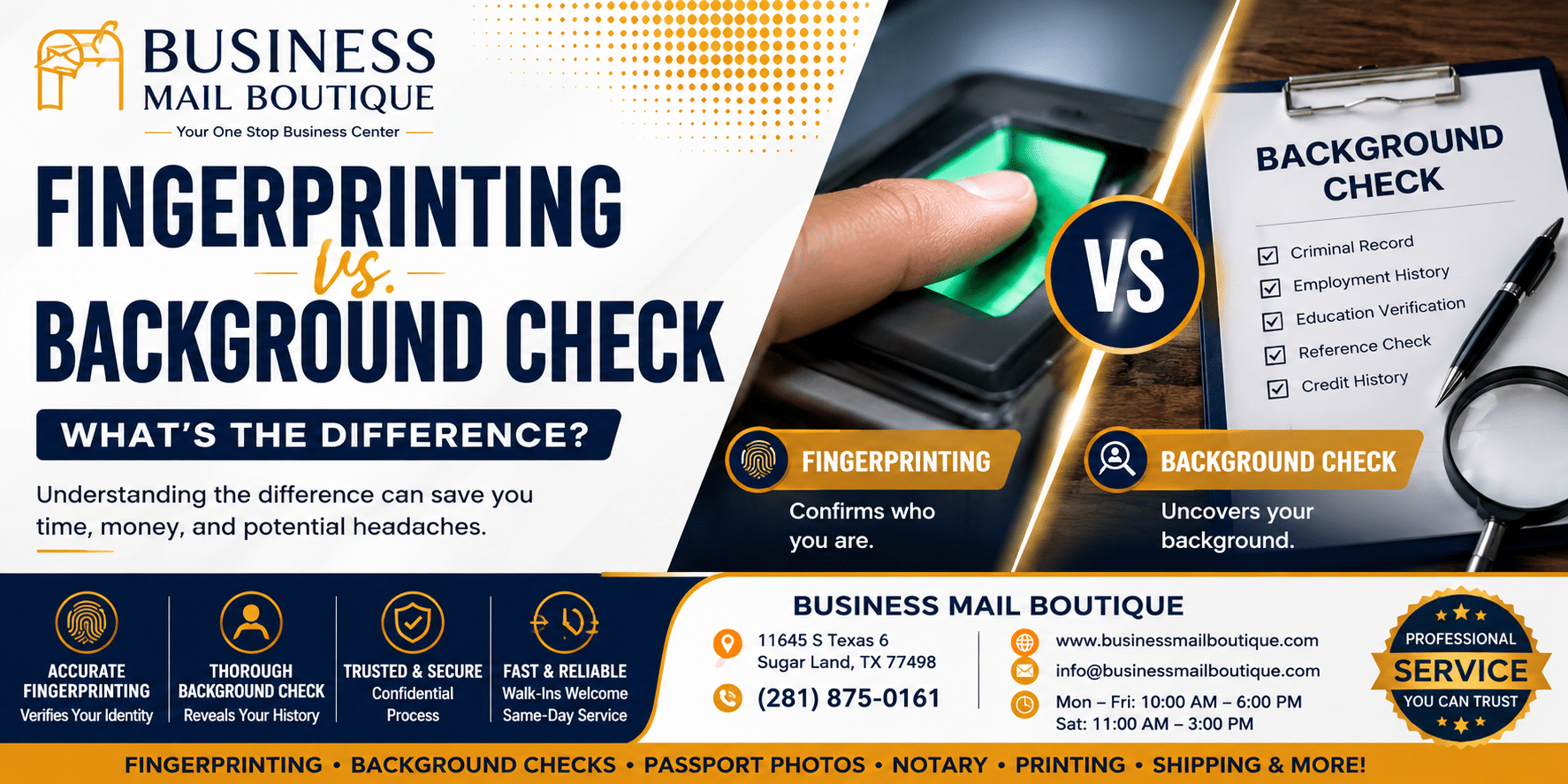
Fingerprinting vs Background Check.
Fingerprinting vs background check explained clearly. Learn what each covers, accuracy differences, costs, turnaround time, and when each is legally required.
Businessmailboutique
11645 S. Hwy 6
Sugar land, Texas 77498 United States (US)
Email: info@businessmailboutique.com
Route
A clinic owner is ready to onboard a medical assistant. The offer is signed, the start date is set, and then the licensing board says, “Submit fingerprints.” The owner has already ordered what the vendor called a background check, so the obvious question follows: Is fingerprinting the same thing, or is another screening required?
It isn’t the same thing. Fingerprinting is a biometric identity-verification layer. A background check is a broader screening process that can combine criminal records with identity, employment, education, licensing, driving, credit, and civil-record searches. Treating them as substitutes creates compliance gaps, delays, and false confidence.
The practical recommendation is straightforward. Use the screen the law or licensing authority requires, then add the checks that match the actual risks of the job. For regulated roles, fingerprinting often comes first. For ordinary hiring, a properly administered name-based background check may be enough. For positions involving vulnerable people, money, sensitive systems, or patient care, a layered screen is usually the defensible choice.
| Decision point | Fingerprinting | Broader background check |
|---|---|---|
| Primary purpose | Confirm identity against fingerprint-linked records | Build a wider employment-screening profile |
| Criminal-history method | Biometric search through authorized repositories | Usually name-based searches across relevant records |
| Employment verification | Not included | Can be included |
| Education and license verification | Not included | Can be included |
| Civil, credit, and driving records | Generally not included | Can be included when permitted and relevant |
| Legal role | Required for some regulated positions | Common hiring screen for general employment |
| Main limitation | Can be incomplete and narrower than employers assume | Can produce identity ambiguity without stronger verification |
Table of Contents
- What Fingerprinting and Background Checks Actually Mean
- What Each Screen Covers and Where the Gaps Are
- Side-by-Side Comparison of Accuracy, Speed, and Cost
- Which Screen Your Industry and Role Requires
- How to Prepare, Book, and Read Your Results
- Choosing the Right Screen for Your Situation
- Common Myths and a Quick Decision Checklist
What Fingerprinting and Background Checks Actually Mean
Fingerprinting captures the unique ridge patterns on a person’s fingers and submits them for comparison against authorized criminal-history repositories. Depending on the agency and purpose, that process can involve a state repository, the FBI’s Next Generation Identification system, and other authorized fingerprint systems. The objective is identity matching, not a complete review of someone’s life or work history.
The two common capture methods are Live Scan and ink cards. Live Scan uses an electronic scanner to capture rolled or flat impressions without ink, then sends the submission through the required agency channel. Traditional ink-and-roll processing places prints on a paper card, such as an FD-258 or another agency-approved form, for mailing or later electronic submission.
A fingerprint result answers a focused question: Does this person’s biometric identity match a criminal-history record held by the repositories searched? It doesn’t verify that an applicant worked for a particular employer, earned a degree, holds an active professional license, or has no civil judgments.
The broader meaning of a background check
“Background check” is an umbrella term. A package may include a name-based criminal search, sex offender registry search, address or Social Security number trace, employment verification, education verification, professional-license confirmation, driving record, credit report where legally permitted, and civil court searches.
Some of these reports are consumer reports under the Fair Credit Reporting Act, which brings disclosure, authorization, adverse-action, accuracy, and dispute obligations. Other activities, such as direct employment or education verification, may be handled as non-FCRA verification services depending on how the information is collected and used.
Employers hiring drivers may need a more specialized process than a standard criminal search. A resource on background check for fleet hiring can help clarify why driving records, role-specific requirements, and criminal screening shouldn’t be treated as one interchangeable product.
Practical rule: Ask what decision the screen must support. “Background check” describes a package, not a single standardized search.
The FBI describes fingerprint-based checks as providing positive identity verification and eliminating the false positives and false negatives associated with name-based checks when matching a person to a record is the concern. That advantage is real, but it doesn’t make fingerprinting a complete background investigation. The FBI’s fingerprint history also shows how this method has become part of identity infrastructure. The Identification Division began on July 1, 1924, with custody of 810,188 fingerprint cards, and its files exceeded 149 million cards by July 1958 (FBI history of fingerprint and criminal-history records).
What Each Screen Covers and Where the Gaps Are
The right comparison starts with the decision each screen must support. Fingerprinting is one biometric identity-verification layer inside a broader screening stack. It is strongest when an employer or agency must confirm that a criminal record belongs to the applicant. A name-based background check reaches beyond fingerprint-linked repositories and can add records tied to the role.
| Category | Fingerprint check | Name-based background check |
|---|---|---|
| Identity | Strong biometric match to submitted prints | Uses names, dates of birth, addresses, and other identifiers |
| Criminal history | Searches authorized fingerprint-linked repositories | Searches available court, state, federal, and registry records by identity data |
| Employment history | Not covered | Verification can be ordered |
| Education | Not covered | Verification can be ordered |
| Professional license | Not included | License status can be verified separately |
| Civil records | Generally outside the fingerprint repository | Civil searches may be added |
| Driving record | Not covered | Motor vehicle record can be added |
| Credit | Not covered | Credit reporting may be available where lawful and relevant |
| Sex offender registry | Limited or missing in many state and local jurisdictions | Registry search can be added |
Where fingerprinting is strongest
A name-based search can confuse people with similar names, miss a former surname, or depend on records that agencies have not updated consistently. Fingerprinting reduces that identity ambiguity because the submitted prints are compared with prints associated with a record.
Its scope remains narrow. A fingerprint-only result does not verify a résumé, confirm a degree, reveal a driving violation, or search every civil court record. It can also be incomplete when repositories lack court dispositions or state and local agencies have not reported information.
For employers, the recommendation is direct: use fingerprinting when identity certainty is the primary requirement, especially for regulated roles. Do not treat a clear fingerprint result as proof that every relevant screening category is clear.
Where a name-based check is stronger
A broader package can examine employment and licensing facts tied to the role. It can combine several searches, so the employer does not use one criminal database as a substitute for overall suitability.
That breadth creates an identity-control obligation. If the provider does not establish identity carefully, an apparent match may belong to another person. A missed alias or incomplete address history can also leave relevant records undiscovered. Providers and employers must distinguish no record found from a conclusion that the applicant has no history anywhere.
For practical guidance on electronic and paper capture, see this explanation of fingerprinting ink and Live Scan capture. Capture quality and submission routing affect the result’s handling, not the categories a fingerprint search can inspect. Choose the broader package when the hiring decision also depends on work history, education, licensing, driving, civil, credit, or registry information.
Side-by-Side Comparison of Accuracy, Speed, and Cost
Employers usually compare these screens through four questions: Which one identifies the right person? Which one returns first? Which one fits the hiring budget? Which one will the regulator accept? The answer changes by role, but the trade-offs are consistent.
| Criterion | Fingerprint check | Background check |
|---|---|---|
| Identity accuracy | Stronger biometric identity match | Depends on identifiers, aliases, and record quality |
| Criminal-record coverage | Limited to records available through the authorized repositories | Can combine multiple record sources and jurisdictions |
| Turnaround | Electronic submissions are generally faster than paper cards, but agency routing controls timing | Often faster for standard searches, with added time for courthouse or verification work |
| Cost | Capture, agency, and routing fees apply | Price varies with the number and depth of searches |
| Legal acceptability | Mandatory for some regulated jobs | Commonly accepted for general employment, subject to applicable law |
| Main risk | A clean result can be mistaken for a complete history | A record can be attached to the wrong person or miss an alias |
Accuracy is about identity and completeness
Fingerprinting is the better tool when the central concern is whether a criminal record belongs to the applicant. The FBI says fingerprint-based checks eliminate the false positives and false negatives associated with name-based matching (FBI guidance on national fingerprint checks).
That doesn’t mean a fingerprint result is universally more complete. Independent criminal-justice research has identified a practical trade-off: FBI fingerprint checks can return incomplete histories when court dispositions are missing, and they can take longer than name-based checks (Urban Institute report on criminal background checks). A “no record” outcome means no matching record was returned through that search, not that every possible record category was examined.
Speed and price follow the workflow
Electronic capture avoids paper handling, but the result still depends on the authorized channel, repository, agency workload, and whether the submission is rejected for poor print quality. Ink cards add mailing and manual-processing steps. Name-based searches can return quickly, but county courthouse research, employment verification, and licensing checks may extend the process.
Don’t choose on price alone. A low-cost criminal search can be wasteful if the regulator requires fingerprints, while a fingerprint-only order can be under-scoped for a role involving cash, patient access, driving, or confidential systems.
Which Screen Your Industry and Role Requires
A nurse can clear an employer’s name-based report and still lack the fingerprint submission required for a license. A school volunteer may need the district’s approved process, not a report purchased independently. Start with the authority governing the role, then build the broader screening stack around that requirement.
| Role or scenario | Governing authority | Required screen | Recommended product |
|---|---|---|---|
| Healthcare license or clinical role | State licensing board or healthcare agency | Agency-directed fingerprint submission, often through a state and federal channel | Required fingerprint check plus role-relevant name-based screening |
| K-12 teacher or school volunteer | State education department or school authority | State and FBI fingerprint check where mandated | Agency-approved fingerprint service and supplemental checks |
| FINRA-registered financial role | FINRA and applicable securities rules | Fingerprint submission connected to the registration process | Required regulatory fingerprint process plus employment and identity verification |
| Licensed childcare or early-learning staff | State childcare or protective-services authority | State fingerprint registry or state and federal screening | Required registry process plus checks required by the state |
| Firearm permit or explosives work | ATF and state authority, as applicable | Fingerprint submission required by the application or permit process | Exact agency form, capture method, and submission route |
| General non-regulated employment | Employer policy and applicable employment law | No universal fingerprint requirement | FCRA-compliant name-based package tailored to the job |
Use the mandated screen, then add targeted checks
A licensing board’s fingerprint requirement cannot be replaced with a commercial name-based package. A regulatory filing cannot be substituted with an ordinary consumer report. The fingerprint step is one identity-verification layer, while employment history, licensing status, driving records, financial records, and other checks answer separate questions.
The consequence is practical as well as legal. Without the correct submission, an applicant may be unable to obtain a license, start work, enter a facility, or remain in a regulated position until the process is completed.
General employers have more discretion. Use it narrowly. Match each search to the job’s real exposure, document the reason for each check, apply the same process to comparable candidates, and follow applicable FCRA and state requirements.
Employers seeking a current overview can consult navigate hiring compliance in 2026, then confirm role-specific rules with the relevant regulator.
Compliance decision: If a statute, license, or agency form calls for fingerprints, a name-based report is an add-on, not a replacement.
Use a layered stack when the role combines risks, such as direct patient contact with financial authority, vulnerable-client access with sensitive systems, or driving with significant trust responsibilities. In those cases, biometric identity verification, criminal records, employment history, licensing, driving records, and financial checks should be assigned to the questions they can answer. A fingerprint check supports the stack. It does not replace it.
How to Prepare, Book, and Read Your Results
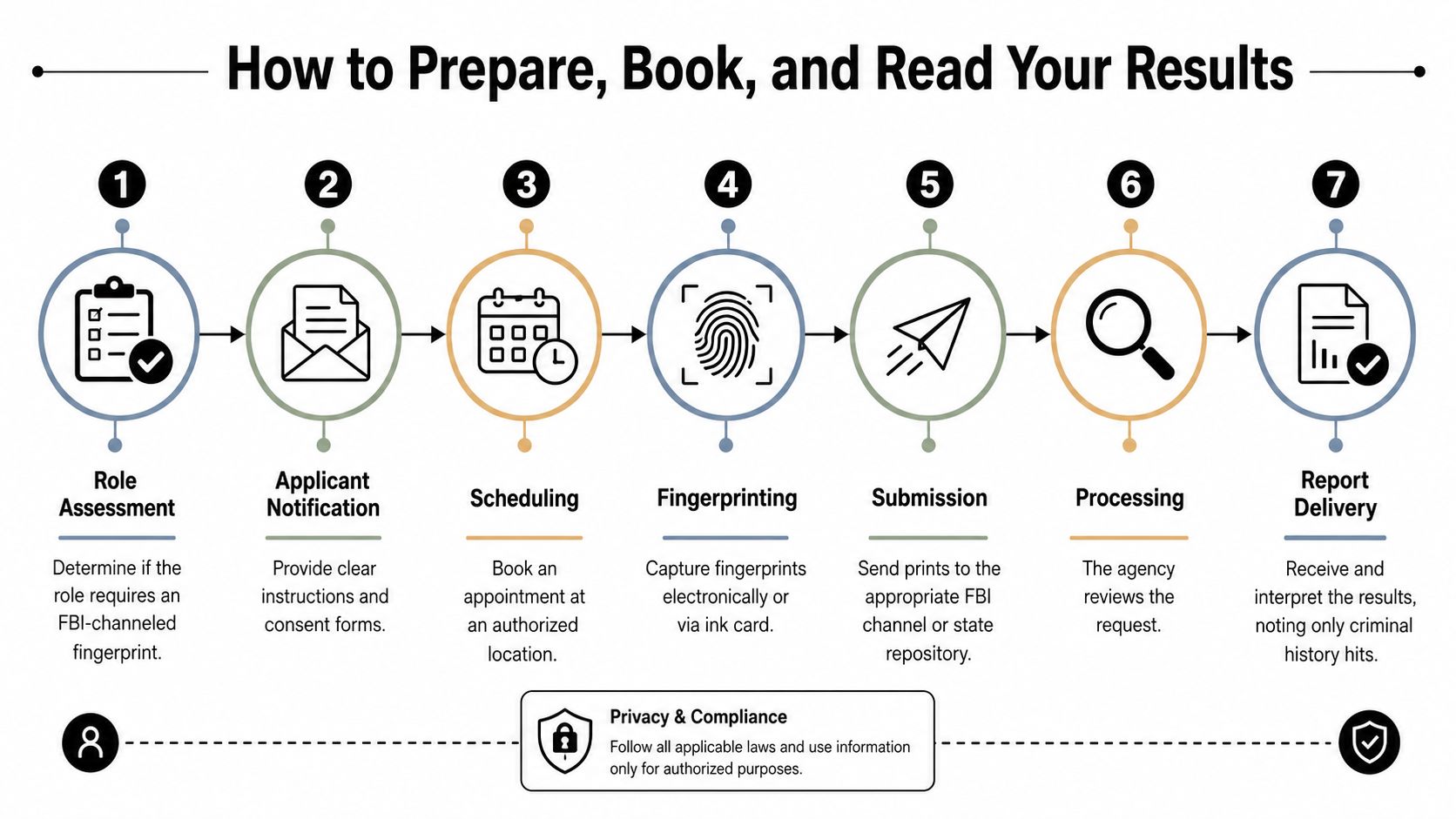
The safest process starts with the requester, not the appointment calendar. Before booking, the employer or agency should identify the exact submission type, confirm whether an FBI-channeled fingerprint submission is authorized, and provide the correct agency code, form, and instructions. A generic appointment can produce the wrong card, destination, or report.
Confirm these details before attending:
- Identification: Bring valid government-issued photo identification.
- Authorization: Carry the agency authorization form, consent documents, and any ORI or billing code supplied by the requester.
- Payment: Confirm who pays and which payment methods the provider accepts.
- Personal details: Prepare the requested identifying information and enter it consistently.
- Capture choice: Check whether the agency accepts Live Scan, an ink card, or both.
At the appointment, a technician captures electronic impressions or rolls ink onto an approved card. The provider then transmits or routes the submission to the state repository, FBI channel, licensing agency, or another destination named by the requester. A fingerprint location may not support every submission type or agency, so verify routing before the appointment.
Read the result without overreading it
A No Record result means the submitted identifiers produced no matching criminal-history record in the repositories searched. It does not certify that the person has no civil case, résumé discrepancy, unreported local record, or record outside that system. Read the result as one layer of identity and criminal-history screening within the broader hiring process.
A Hit calls for review rather than automatic rejection. Confirm that the record belongs to the applicant, examine the disposition, apply the same job-related standards to comparable applicants, and follow the required pre-adverse and adverse-action process when a consumer report is involved. The applicant can dispute inaccurate information through the reporting company’s FCRA dispute process and submit documents clarifying identity or case outcome.
For practical preparation questions, use this complete fingerprinting FAQ guide.
Plan for international use after delivery
Receiving the report does not complete the process for overseas use. Depending on the destination country’s rules, criminal-record documents may require authentication, an apostille, certified translation, or non-apostille legalization. The U.S. State Department explains that FBI fingerprint search results can be authenticated before further legalization steps, so check the receiving authority’s requirements before ordering the document (State Department guidance on criminal records abroad).
Choosing the Right Screen for Your Situation
Use a three-question decision framework.
First, is the job statutorily regulated? If a licensing board, education authority, childcare registry, financial regulator, or public-safety agency requires fingerprinting, order that process first. The choice is then provider quality, correct routing, capture quality, and turnaround, not whether to substitute a cheaper name search.
Second, what can the worker access? A low-risk retail position, a role handling money, a job serving vulnerable people, and an administrator with system-level access don’t present the same exposure. The screen should reflect the harm the employer is trying to prevent.
Third, which facts must be verified beyond criminal history? If the job depends on a license, degree, driving record, employment claim, or financial responsibility, fingerprinting alone won’t answer the question.
| Situation | Direct recommendation |
|---|---|
| Low-risk general hire | Name-based criminal search, with employment verification if the résumé matters |
| Regulated healthcare or education role | Required fingerprint submission first, then role-relevant supplemental searches |
| Role involving vulnerable people | Fingerprint check plus name-based criminal and identity-related searches |
| Fiduciary or financial responsibility | Broader employment, license, and legally permitted financial screening, with fingerprinting when required |
| System administrator or sensitive-data role | Layered identity, criminal, employment, and license verification |
| Driver or fleet position | Criminal screening plus motor vehicle and employment checks |
Don’t confuse the price of the search with the cost of a bad hiring decision. The appropriate package depends on the jurisdictions, records, verifications, and agency requirements involved. For an FBI-focused option, employers can review FBI criminal history services for businesses and confirm whether the requested submission is available for their organization and use case.
A small business should keep its policy simple enough to apply consistently. Regulated role equals fingerprint-first. Unregulated, high-trust role equals layered screening. Low-risk role equals a focused name-based check.
Common Myths and a Quick Decision Checklist
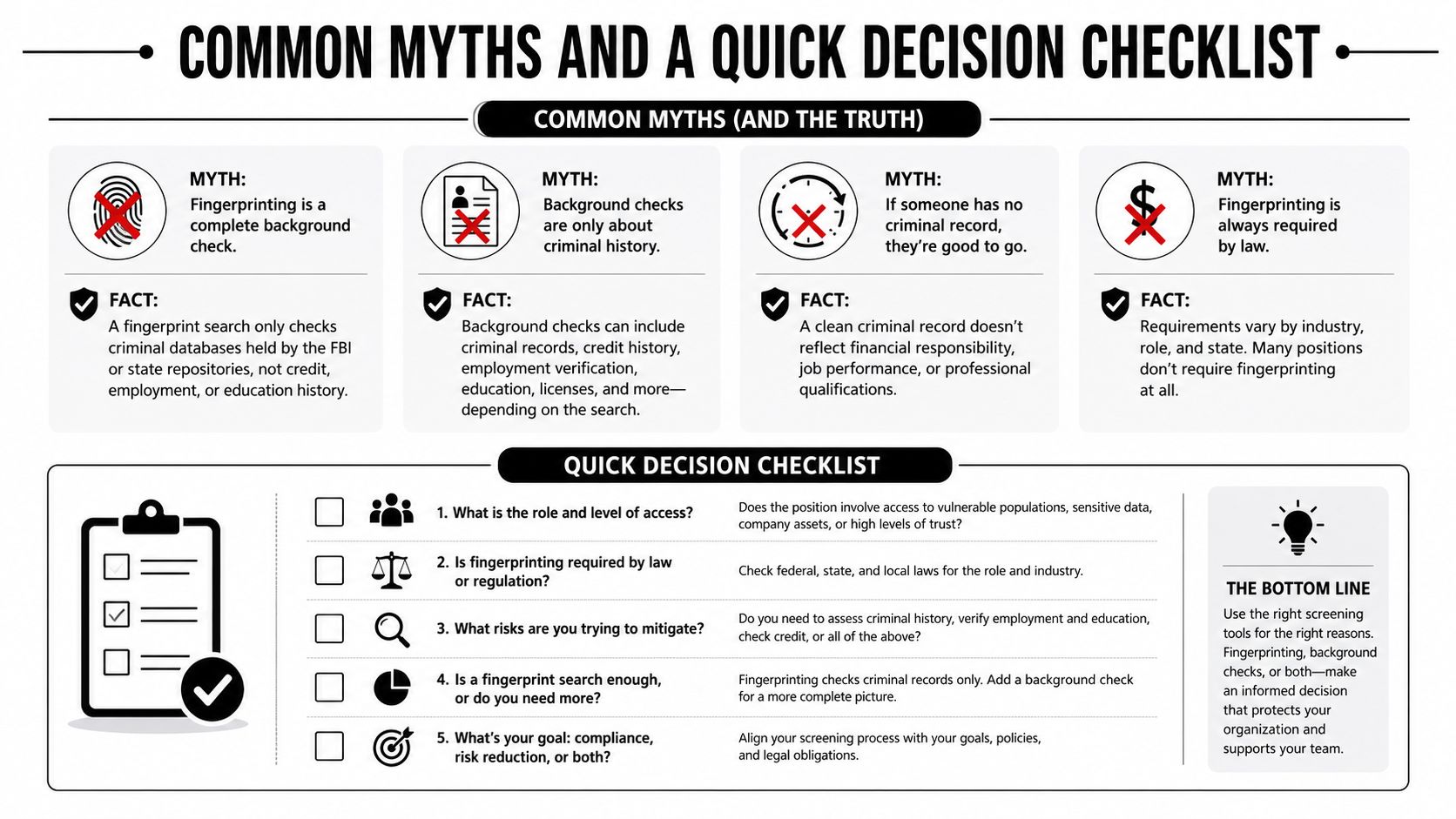
The most damaging myth is that fingerprinting equals a complete background check. It doesn’t. A fingerprint search primarily identifies criminal-history records available through the authorized state or federal repositories, while employment, education, credit, driving, licensing, and civil searches sit outside that core function.
The FBI’s modern scale illustrates why fingerprinting matters, not why it answers every screening question. In fiscal year 2023, the FBI reported processing 74 million fingerprints, while its Next Generation Identification system contained 162 million sets of fingerprints tied to criminal-history information and had processed more than 1 billion electronic fingerprint transactions overall (FBI CJIS director video). Those systems can be powerful identity and criminal-history tools, but the underlying records can still lack complete dispositions or depend on reporting from state and local agencies.
Myths that create hiring mistakes
- Myth: A clean fingerprint result proves the applicant is record-free. Fact: It means no matching record was returned through the repositories searched.
- Myth: A fingerprint check verifies a résumé. Fact: Employment and education require separate verification.
- Myth: A name-based hit automatically belongs to the applicant. Fact: Identity must be reviewed because names and personal identifiers can overlap.
- Myth: The result is ready for overseas use as soon as it arrives. Fact: Authentication, apostille, translation, or legalization may still be required.
The 60-second pre-booking checklist
Employers should confirm:
- Role classification: Is the position regulated, high-trust, or low-risk?
- Agency requirement: Does a board, department, registry, or regulator specify fingerprints?
- Screening scope: Are employment, education, license, driving, credit, or civil checks relevant?
- Applicant process: Have you provided authorization, disclosures, timing expectations, and dispute instructions?
- Consistency: Will every similarly situated applicant be screened under the same written policy?
Applicants should confirm:
- Requesting authority: Who will receive the result, and for what purpose?
- Accepted format: Is Live Scan accepted, or must you submit an ink card?
- Identification: Which government ID and supporting documents are required?
- Result use: Will the document be used in another country and need legalization?
- Correction route: Who handles a dispute if the result contains someone else’s record?
If the role is regulated or serves a vulnerable population, use fingerprinting plus a name-based background check. If it’s a low-risk general hire, use a focused name-based check and add verifications that the job requires.
Business Mail Boutique LLC provides digital and ink fingerprinting, including FD-258 and FD-1164 fingerprint card processing, for uses such as FBI background screening and security-clearance submissions. Visit Business Mail Boutique LLC to arrange fingerprint services or get practical help with the document and submission requirements before you book.

Related posts

Custom Memorial Glasses Engraved in Three Hours in Sugar Land
When a customer needed eight personalized glasses for a memorial, Business Mail Boutique completed the engraving or...

Custom Martini Glass Engraving in Sugar Land, TX
Custom Logo Engraving on Martini Glasses in Sugar Land, Texas.
Business Mail Boutique recently completed a beautiful custom engravin...

Custom Engraved Wine Glasses for a Golf Club Event in Sugar Land, TX
Custom Engraved Wine Glasses for a Golf Club Event in Sugar Land.
Custom wine glass engraving in Sugar Land, TX at Business Mail Bouti...