
- Print Business Cards in Sugar Land – Same Day Service
- Copying Services
- Document Printing, Finishing & Lamination in Sugar Land
- Flyers
- Print Banner in Sugar Land | Same-Day Banner Printing Near Me
- Graphic Design
- Photo Printing
- Postcard Printing
- Document Printing
- EDDM Full Service Postcards
- FotoZoomer Large Format Printing


Medical Board Fingerprinting.
Navigate medical board fingerprinting with ease. Learn live scan vs ink cards, document prep, and submission tips.
Businessmailboutique
11645 S. Hwy 6
Sugar land, Texas 77498 United States (US)
Email: info@businessmailboutique.com
Route
You’ve finished the transcripts, exam verification, references, and application forms. Then the medical board sends a notice that your fingerprints can’t be accepted. A smudged ridge, an incorrect ORI code, or demographic information that doesn’t match your application can hold up a license that was otherwise ready for review.
Medical board fingerprinting is often treated as a quick administrative errand. In practice, it’s a controlled identity-verification process that moves through a state repository, the FBI, and the licensing board. The capture itself may take only a short appointment, but errors after submission can create a much longer problem. The safest approach is to treat fingerprinting as a document-control task, not a walk-in service.
Table of Contents
Why Medical Board Fingerprinting Matters for Your License
State medical boards use fingerprint-based screening to verify an applicant’s identity and support criminal-background checks through state and federal systems. The process became more common across the United States during the 2000s. The Federation of State Medical Boards’ state-by-state background-check history identifies California’s nursing board as the first to require criminal background checks for initial licensure, with only five nursing boards authorized to collect fingerprints by 1998 and 18 states requiring fingerprints for FBI licensure checks by 2005.
Today, fingerprinting is part of the initial licensing workflow for most U.S. medical boards. FSMB materials report that 52 state medical boards require fingerprints for initial licensure, while 58 have access to the FBI’s NCIC database (FSMB criminal-background-check materials). In practical terms, your submission usually goes to the board or its designated vendor first, then moves through state and federal database checks before the result returns to the board. One board exception identified in that material requires only a thumbprint rather than a full fingerprint set.
Why small errors create large delays
Your transcripts and verification letters usually remain visible in the application portal. Fingerprint results follow a separate route. If the provider uses the wrong Originating Agency Identifier, the board may never receive the result. If the demographic information doesn’t match your application, staff may need to investigate manually. If the ridge detail is too faint or blurred, the submission can be rejected before the background check is completed.
That’s why fingerprinting deserves the same care as primary-source credential verification. A provider familiar with regulated identity workflows, including healthcare cybersecurity services, can also help put the privacy and information-handling risks of healthcare-related documentation into perspective, although your state board’s instructions remain the controlling authority.
Practical rule: Don’t consider fingerprinting complete when the scan or card is captured. Consider it complete when the board confirms that the result was received and accepted.
Verifying Your State Board Requirements
Before booking an appointment, open the official website for the medical board issuing your license. Find the fingerprint instructions under the initial application checklist, background-check page, or application-deficiency resources. Requirements can differ by state, application type, residence, and submission method, so advice intended for another board may be technically correct and still wrong for your application.
Start by recording the board’s exact routing information. The ORI code directs the result to the correct agency, and a single incorrect character can send the submission somewhere else. Confirm whether the board accepts electronic Live Scan, an FBI FD-258 card, or another approved form. Also check whether the board requires a particular vendor, whether out-of-state applicants may use ink cards, and whether the provider sends the result directly or gives you documentation to submit.
The distinction between initial licensure, Interstate Medical Licensure Compact applications, and renewals deserves special attention. FSMB data identifies 13 medical boards that require fingerprints only for compact-related purposes, while other boards use fingerprints for initial applications. Texas guidance states that fingerprints are required for all licensure applicants and some compact applicants, while Florida expanded electronic fingerprinting to all physicians at renewal beginning July 1, 2025 (Texas Medical Board fingerprint instructions). Don’t assume a previous initial-licensure submission automatically satisfies a renewal requirement.
| Requirement Category | What to Confirm | Common Pitfall |
|---|---|---|
| Application type | Initial license, compact application, endorsement, or renewal | Following initial-application instructions for a renewal |
| Capture method | Live Scan, ink card, or another approved method | Choosing the fastest method when the board doesn’t accept it |
| ORI and routing | Exact ORI, agency name, and destination | Using an old code from a prior application |
| Form | FD-258 or the board’s specific request form | Completing a generic card without the board’s identifiers |
| Vendor | Approved provider, law-enforcement office, or vendor network | Visiting a convenient location that isn’t authorized |
| Delivery | Direct transmission, mailed card, or applicant-submitted copy | Leaving without proof of submission |
If you’re comparing requirements across healthcare occupations, use your CNA background check guide only as general background. A nursing-assistant process doesn’t replace the instructions issued by your medical board. For a broader document-focused reference, review this guide to criminal background check requirements for medical students and nurses, then verify every instruction against the board handling your license.
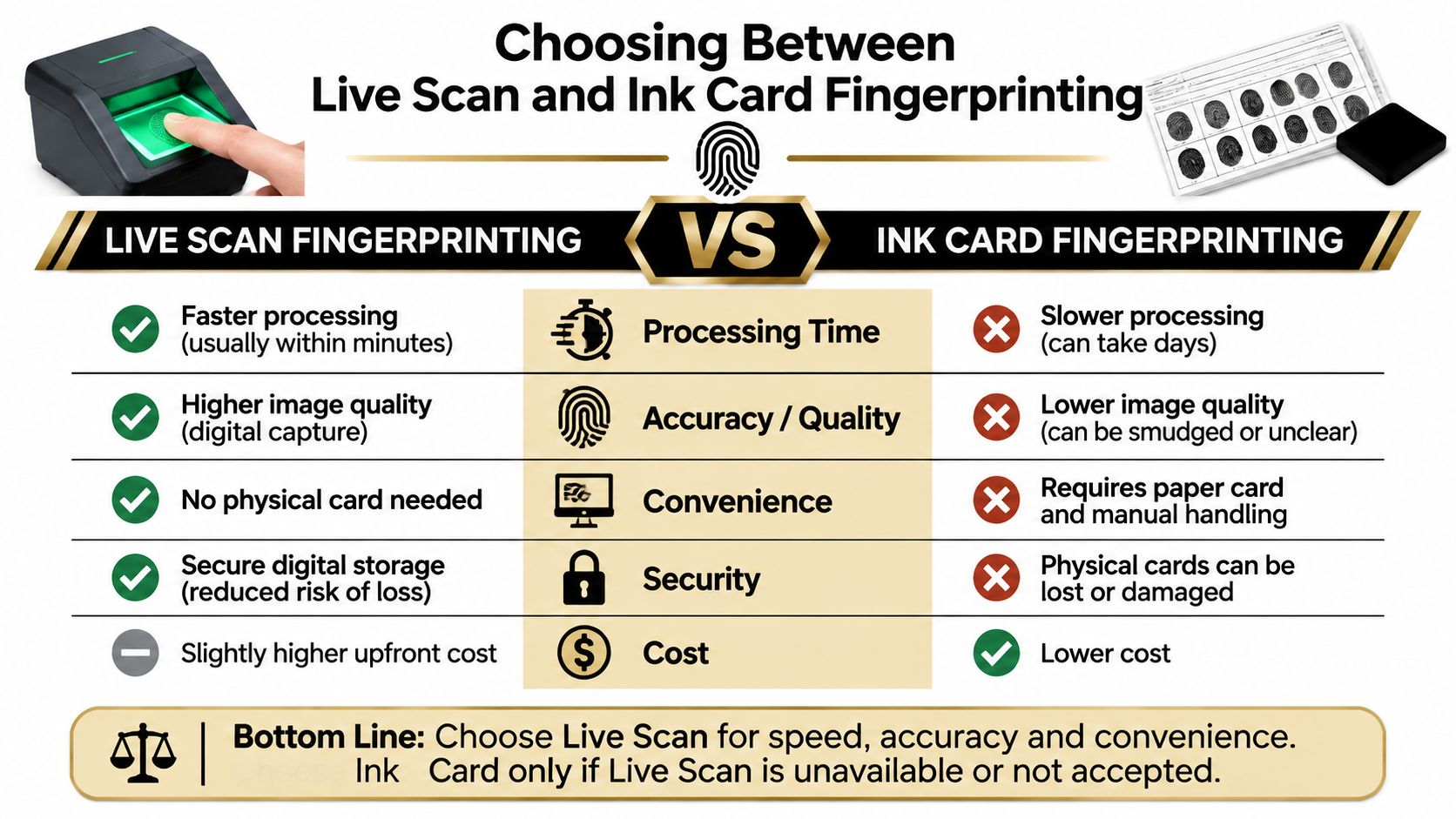
Choosing Between Live Scan and Ink Card Fingerprinting
A rejected fingerprint submission can hold up a license application for weeks, even when the prints were captured correctly. The practical choice between Live Scan and ink card fingerprinting depends on the board’s routing rules, the provider network available to you, and how much control you need over the record after capture.
Live Scan records fingerprints digitally and sends them through an approved channel. An ink card places the impressions on an FBI FD-258 form, usually requiring physical delivery and careful handling. Live Scan can reduce mailing and smearing risks, but only when the location uses the correct board code and destination. An ink card can work well for applicants outside the board’s state, in rural areas, or when the board specifically requires a hard copy.
When Live Scan makes sense
Choose Live Scan when the board permits it and an approved provider is accessible. The operator can often identify an unreadable impression during the appointment, recapture it, and provide a transaction receipt or control number. That record becomes useful if the board later says it has no submission on file.
The main failure point is data, not equipment. A wrong agency code, misspelled name, incorrect birth information, or mismatched application identifier can route an otherwise clear submission incorrectly. Before leaving, check the confirmation against your board instructions and keep the receipt with your application documents.
When an ink card is the practical option
Ink cards remain practical when no approved Live Scan site is available or when the board requires mailed materials. They demand more applicant oversight. Protect the card from smearing, complete each required field, use the board’s identifiers, and follow its delivery instructions exactly. Keep a copy or other proof of mailing when permitted.
For a focused comparison of Live Scan and FBI FD-258 fingerprint cards, apply the board’s acceptance rules rather than relying on a generic speed comparison. Before booking, confirm the accepted method and save the transaction receipt or mailing proof in your application file.
Preparing for Your Fingerprinting Appointment
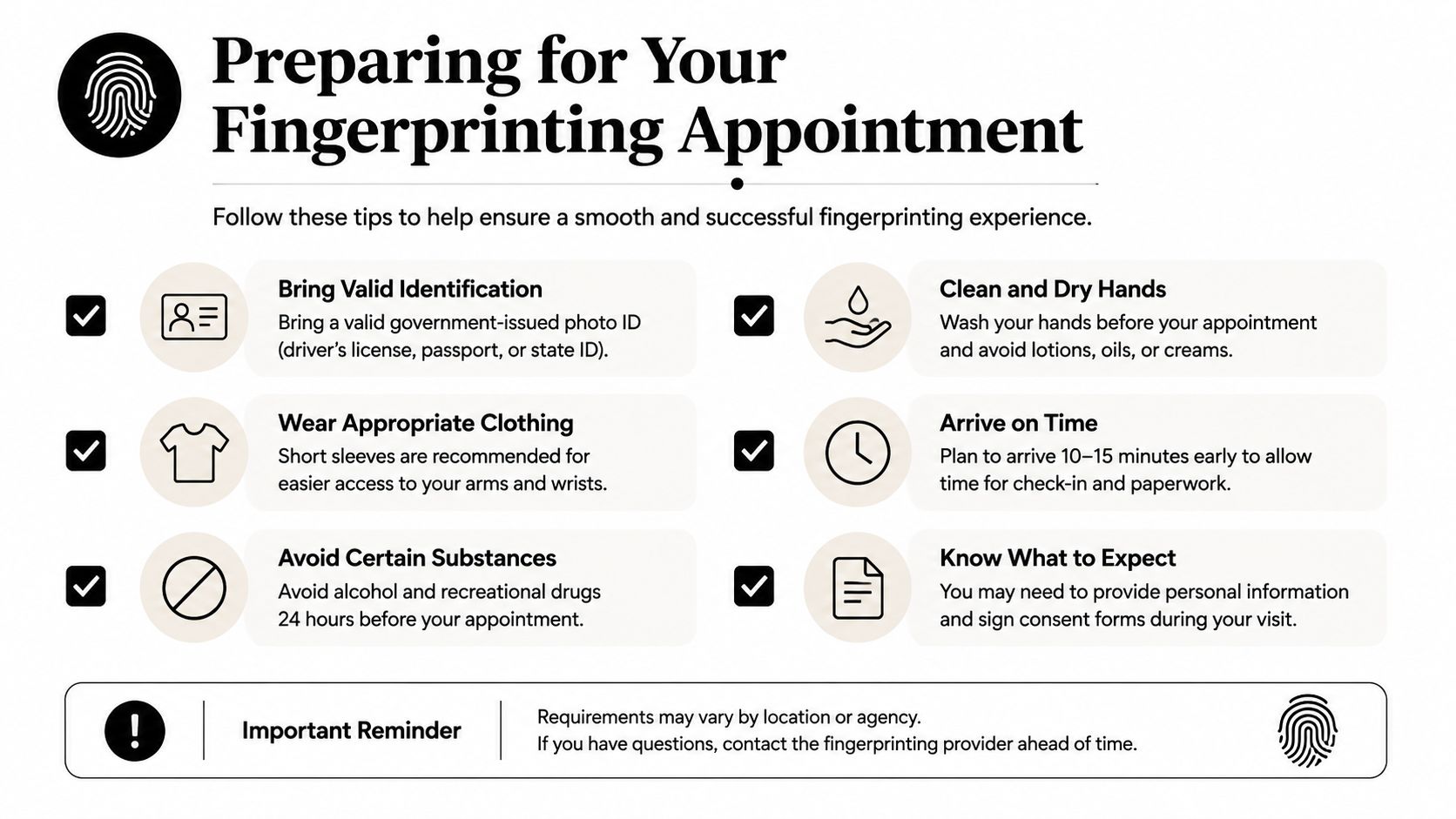
The appointment should be simple if you prepare the same way you’d prepare any identity-sensitive licensing task. Bring a valid government-issued photo ID, the board’s fingerprint request form or exact ORI information, and an accepted payment method. If the board gave you a case number, application number, or special instruction sheet, bring that too.
Book through the provider identified by the board. Depending on the state, that may be an approved Live Scan vendor, IdentoGO, or a local law-enforcement agency. Don’t rely on a general internet search alone. A location that offers fingerprinting for employment may not be authorized to route medical-board results.
Preparing your fingers
Dry skin can reduce ridge detail, while excess lotion can interfere with capture equipment or leave a slippery surface. Moisturize appropriately before the appointment, then arrive with clean, lotion-free fingers. Avoid activities that scrape, abrade, or heavily soil your fingertips immediately beforehand. If your fingerprints are worn because of manual work, skin treatment, or another medical circumstance, tell the operator before capture begins.
The provider should verify your identity, confirm the request details, and capture each required impression. For Live Scan, the operator will guide your fingers across a digital platen. For an ink card, each finger must be rolled and placed with enough ridge detail to distinguish the pattern without smearing.
Review everything before you leave
Ask to see the confirmation or card. Check your legal name, date of birth, identifying information, agency destination, ORI, and any transaction control number. On an ink card, look for incomplete boxes, excess ink, smudged impressions, or missing signatures. On a digital submission, confirm that the receipt identifies the correct board or agency.
Save the receipt in two places. Photograph the paper immediately and store the image with your licensing documents. The receipt may be the only practical evidence that the vendor transmitted your submission if the board later reports that it can’t locate the result.
The following video offers a visual overview of the capture process:
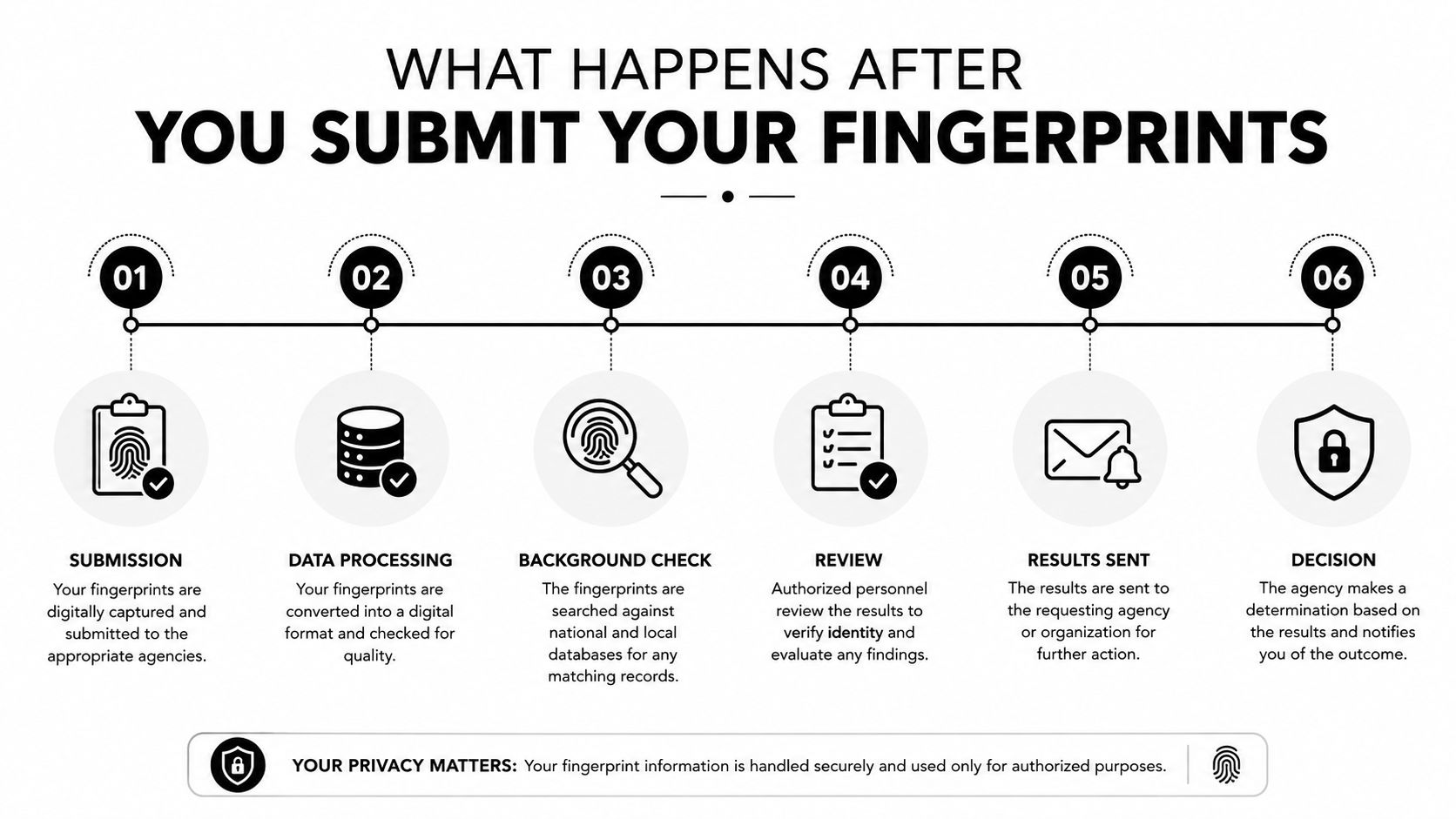
What Happens After You Submit Your Fingerprints
Submission is only the midpoint of the background-check workflow. The provider transmits a Live Scan record or prepares an ink card for delivery. The state repository and FBI process the record, then send the result to the medical board, where staff match it with your licensing file and review the remaining application materials.
Electronic transmission may reach the processing agencies sooner than a mailed card, but it does not guarantee immediate board action. After the result arrives, staff may still need to identify the correct applicant, connect the record to the application, and resolve any missing or inconsistent information. A fingerprint result can therefore be complete while the licensing file remains pending.
How rejection happens
Minnesota’s criminal-background-check program reports that about 2% of submitted fingerprints are rejected, and about 75% of rejected submissions become acceptable on a second attempt (fingerprint quality-control guidance). The percentage is small, but a rejected record can add weeks when your license start date is close.
Preventable failures usually involve weak ridge detail, excessive or insufficient pressure, smudging, incomplete fields, or incorrect demographic and routing information. A rejection does not by itself indicate a background problem. It often means the system could not use the biometric record or could not confidently match it to the identifying data.
If a rejection arrives, read the notice before scheduling anything. Contact the original provider and ask whether its rejection policy allows a resubmission. Bring the notice and original receipt to the new appointment, then notify the medical board that the record has been resubmitted. Provide the new control number, if requested, and keep the first receipt as well. The board or vendor may need that original transaction number to trace the delay.
Don’t wait for silence to resolve itself
Use the transaction control number, vendor receipt, or state portal to check status when tracking is available. If the provider’s expected processing window has passed, ask the vendor to confirm transmission first. Then contact the board to verify that it received the result and matched it to your file.
A clean receipt gives you a starting point for every inquiry. Without it, staff may have to search by incomplete appointment details or ask you to repeat the submission.
Troubleshooting Common Fingerprinting Problems
Most fingerprinting problems fall into a few recognizable categories. The solution is usually procedural, but timing matters because a delayed correction can affect the entire license file.
- Faint or smudged ridges: Ask the provider to inspect the impressions before submission. The capture may need a different pressure, cleaner fingers, or a new roll. If the board rejects the record, request a fresh capture and retain the rejection notice.
- Mismatched personal information: Compare the fingerprint record with the license application, passport, and board account. International medical graduates should confirm how their legal name, middle names, accents, transliteration, and prior names appear across every document.
- Wrong ORI or agency destination: Don’t guess from a prior application. Verify the current code directly with the board, particularly when applying to multiple states or using the Interstate Medical Licensure Compact.
- Lost receipt or control number: Contact the provider promptly and ask whether the transaction can be located by appointment details. Photograph receipts at the appointment and save the files with your application records.
- Worn or difficult-to-capture fingerprints: Explain the issue before the operator begins. A trained provider may try an adjusted technique, but the board may also have a specific procedure for repeated unreadable submissions.
Physicians applying in several states should maintain a separate checklist for each board. Don’t assume one state’s result can be reused elsewhere, because some states require new fingerprinting even when an applicant was fingerprinted previously. For broader answers to common capture and submission questions, consult this complete fingerprinting FAQ guide.
Build a two-week buffer into your licensing schedule when possible. That reserve gives you room to correct a rejected capture, replace a missing form, or resolve a routing error without placing your application deadline at risk.
Business Mail Boutique LLC offers digital and ink fingerprinting, including FD-258 and FD-1164 cards, for applicants who need a documented submission for a licensing or background-check process. If you’re in Sugar Land and need fingerprinting, printing, tracking, or related document services in one visit, visit Business Mail Boutique LLC to review the available options and confirm what to bring.

Related posts

Custom Memorial Glasses Engraved in Three Hours in Sugar Land
When a customer needed eight personalized glasses for a memorial, Business Mail Boutique completed the engraving or...

Custom Martini Glass Engraving in Sugar Land, TX
Custom Logo Engraving on Martini Glasses in Sugar Land, Texas.
Business Mail Boutique recently completed a beautiful custom engravin...

Custom Engraved Wine Glasses for a Golf Club Event in Sugar Land, TX
Custom Engraved Wine Glasses for a Golf Club Event in Sugar Land.
Custom wine glass engraving in Sugar Land, TX at Business Mail Bouti...