
- Print Business Cards in Sugar Land – Same Day Service
- Copying Services
- Document Printing, Finishing & Lamination in Sugar Land
- Flyers
- Print Banner in Sugar Land | Same-Day Banner Printing Near Me
- Graphic Design
- Photo Printing
- Postcard Printing
- Document Printing
- EDDM Full Service Postcards
- FotoZoomer Large Format Printing


FBI Background Check & Apostille Service.
Get your FBI background check & apostille service done right. Learn fingerprinting options, U.S. Department of State authentication, timelines, fees, and common.
You can have the FBI report in hand, the deadline on the calendar, and still get stalled by one tiny packet mistake. That’s the part many people don’t see until they’re already paying for resubmission, because an FBI background check & apostille service lives or dies on document precision, not just speed.
The workflow looks simple from the outside. Get the FBI Identity History Summary, route it through the federal authentication channel, and send it to the country that needs it. In practice, the hidden failures are usually boring, mechanical errors, the wrong file version, the wrong office, the wrong fee, or a packet that looked fine until someone opened it and found the digital signature had been stripped away.
Table of Contents
- Why Your FBI Background Check Needs an Apostille
- Requesting Your FBI Identity History Summary
- Navigating the U.S. Department of State Apostille Process
- Common Rejection Triggers and How to Avoid Them
- Realistic Timelines for Every Pathway
- How Business Mail Boutique Simplifies the Process
- Your Complete FBI Apostille Action Checklist
Why Your FBI Background Check Needs an Apostille
A client usually reaches this point with a very specific look on their face, part relief because the FBI report arrived, part frustration because the foreign ministry, employer, or consulate still won’t accept it. The document they’re holding is the FBI Identity History Summary Check, the official federal background record used for international document legalization, and the FBI says the public can request these checks through its website, with the record often needed for foreign use when a foreign authority wants proof the federal seal and signature are genuine. FBI Identity History Summary Check FAQs
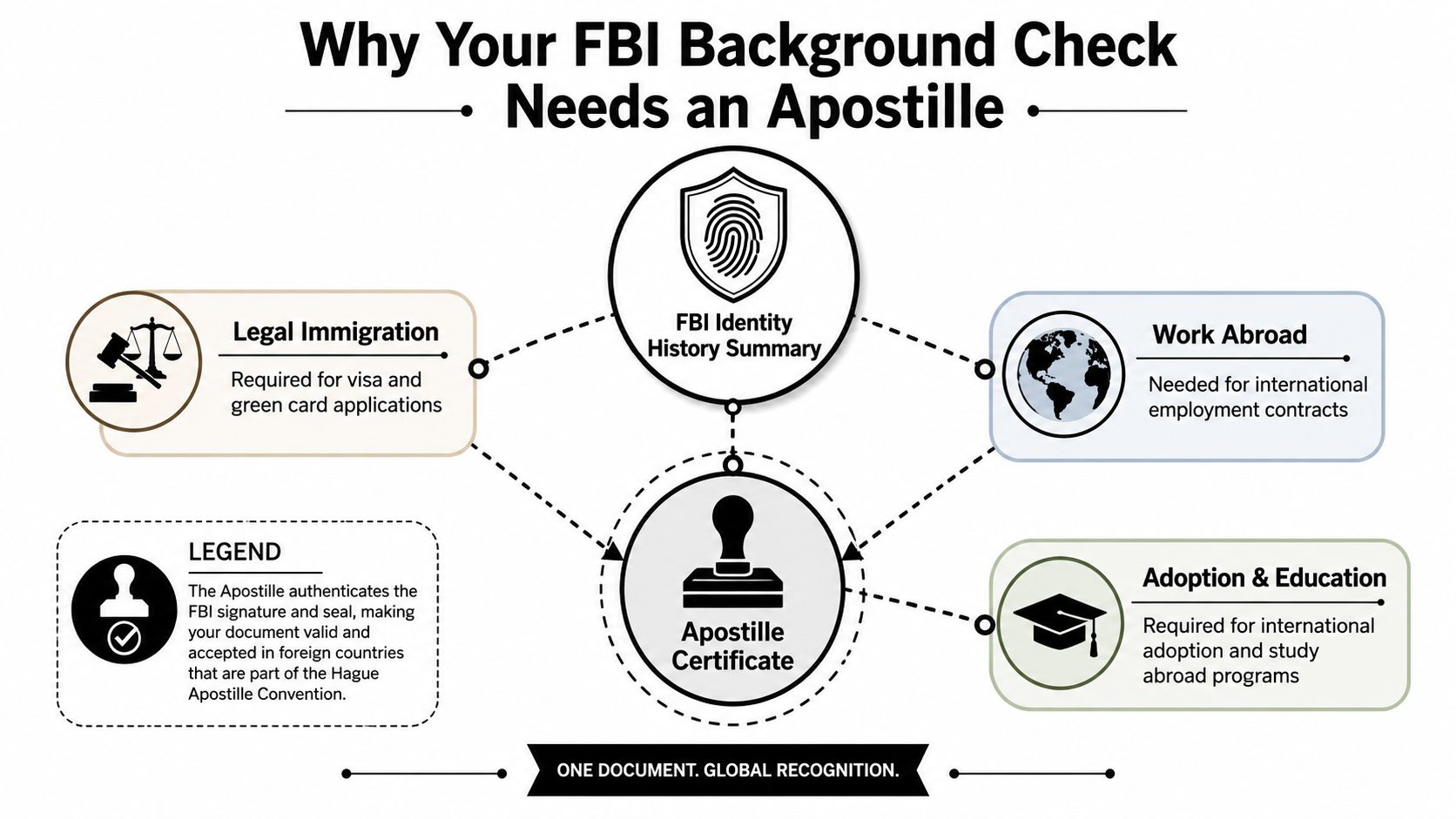
The need usually shows up in the middle of real life, not in theory. People hit it during international employment, immigration, overseas marriage documentation, study abroad, or professional licensing abroad, where the receiving authority wants a document it can trust without chasing U.S. agencies for extra confirmation. A straight FBI report often isn’t enough on its own, because foreign offices are looking for legalized authenticity, not just the contents of the record.
Federal records follow a different path
The mistake I see most often is simple confusion between state and federal papers. A birth certificate, diploma, or state record usually goes through a state-level channel, but an FBI background check is federal, so it cannot be authenticated at the state level in the same way. The apostille for this document is routed to the U.S. Department of State Office of Authentications, and that difference determines the whole packet, the mailing address, and the turnaround.
Practical rule: if the record came from the FBI, stop thinking about the state apostille desk. Federal source means federal authentication.
The end goal is also narrower than people expect. You are not trying to make the FBI report “more official” in a vague sense. You’re trying to get the federal signature and seal authenticated so a foreign authority can accept the document under the Hague Apostille Convention framework, which standardizes recognition among member countries and removes extra consular legalization for qualifying documents. That’s the finish line.
Requesting Your FBI Identity History Summary
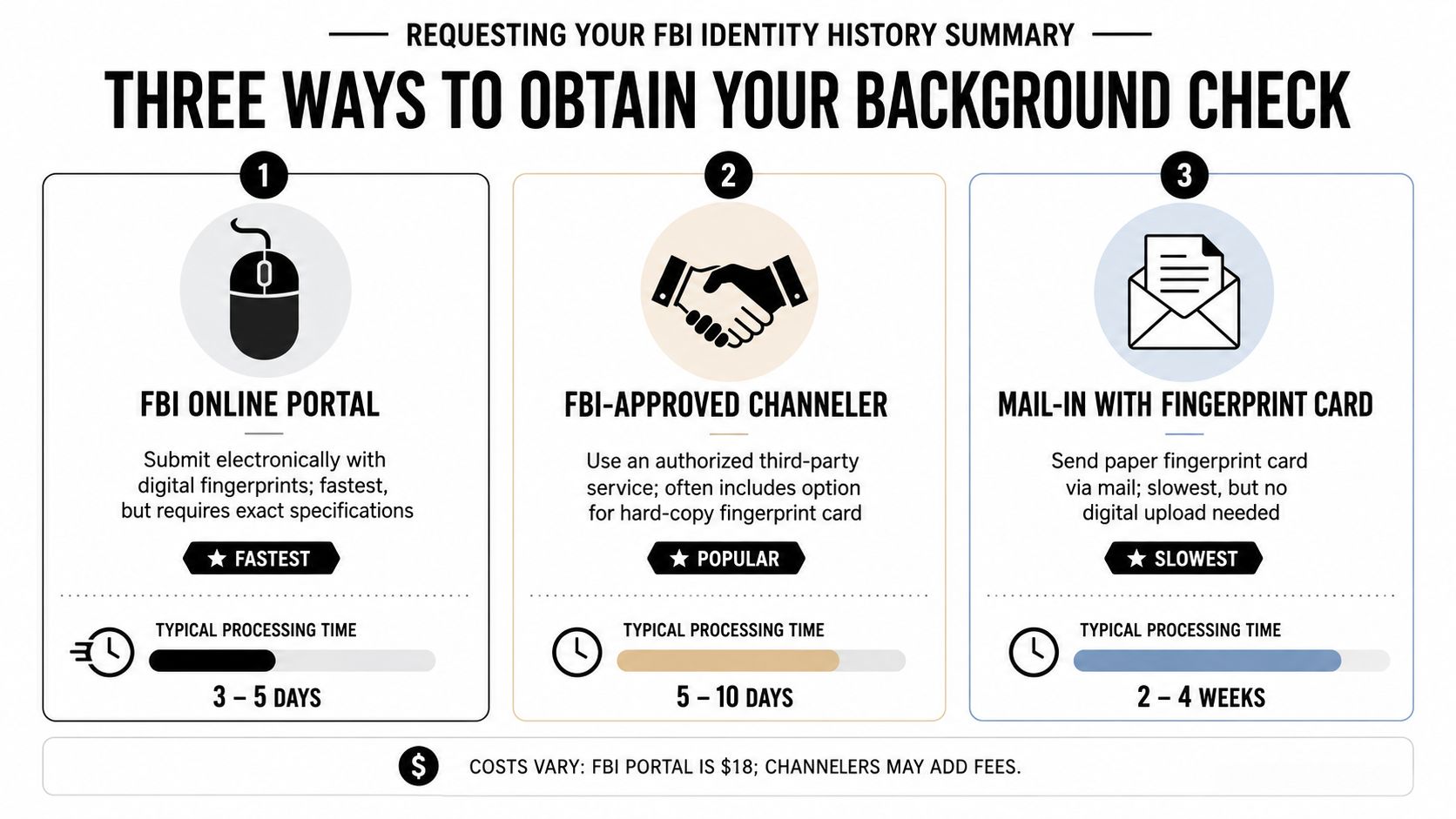
The request path matters because it sets the pace for everything else. The FBI Identity History Summary can be obtained electronically or by fingerprint card, and current 2026 guidance cited in industry sources says an FBI-approved channeler can sometimes deliver same-day issuance, while mail-in processing can take 5+ weeks and a Washington, DC walk-in drop-off route is around 9 business days. The FBI fee is commonly cited at $18 through approved channels. DC Mobile Notary FBI Apostille Guide
Choose the route that matches your deadline
The online portal and approved channeler routes are the best fit when time is tight, but they demand clean submission discipline. If your fingerprints are electronically captured or handled through an approved intermediary, you avoid the paper-handling issues that come with a card, yet you still need the output in the correct unmodified format for apostille use. A mail-in FD-258 card gives you a paper trail from the start, but it’s the slowest path and the one most likely to be delayed by image quality problems.
The quality of the fingerprint capture matters more than most applicants expect. Clear ridge detail, full finger rolls, and accurate identity data reduce the odds of return. A digital scan is not a shortcut if it changes the document format in a way the receiving office won’t accept.
What gets a fingerprint card accepted
If you’re using an ink card, the card has to be legible, complete, and consistent with the identity document you’re sending under the same name. Smudged prints, faded ink, clipped edges, and mismatched identity fields are common reasons packets slow down before they even reach the apostille stage. If you’re not sure your FD-258 card is clean enough, have it inspected before you mail anything.
For practical routing, many people use a local fingerprinting provider, then move directly into apostille prep. Business Mail Boutique’s FBI fingerprint and FD-258 card service is one example of a local intake option that fits into that kind of workflow when you want fingerprints handled before shipping.
The fastest request method isn’t the one with the fewest clicks, it’s the one that doesn’t have to be corrected later.
Navigating the U.S. Department of State Apostille Process
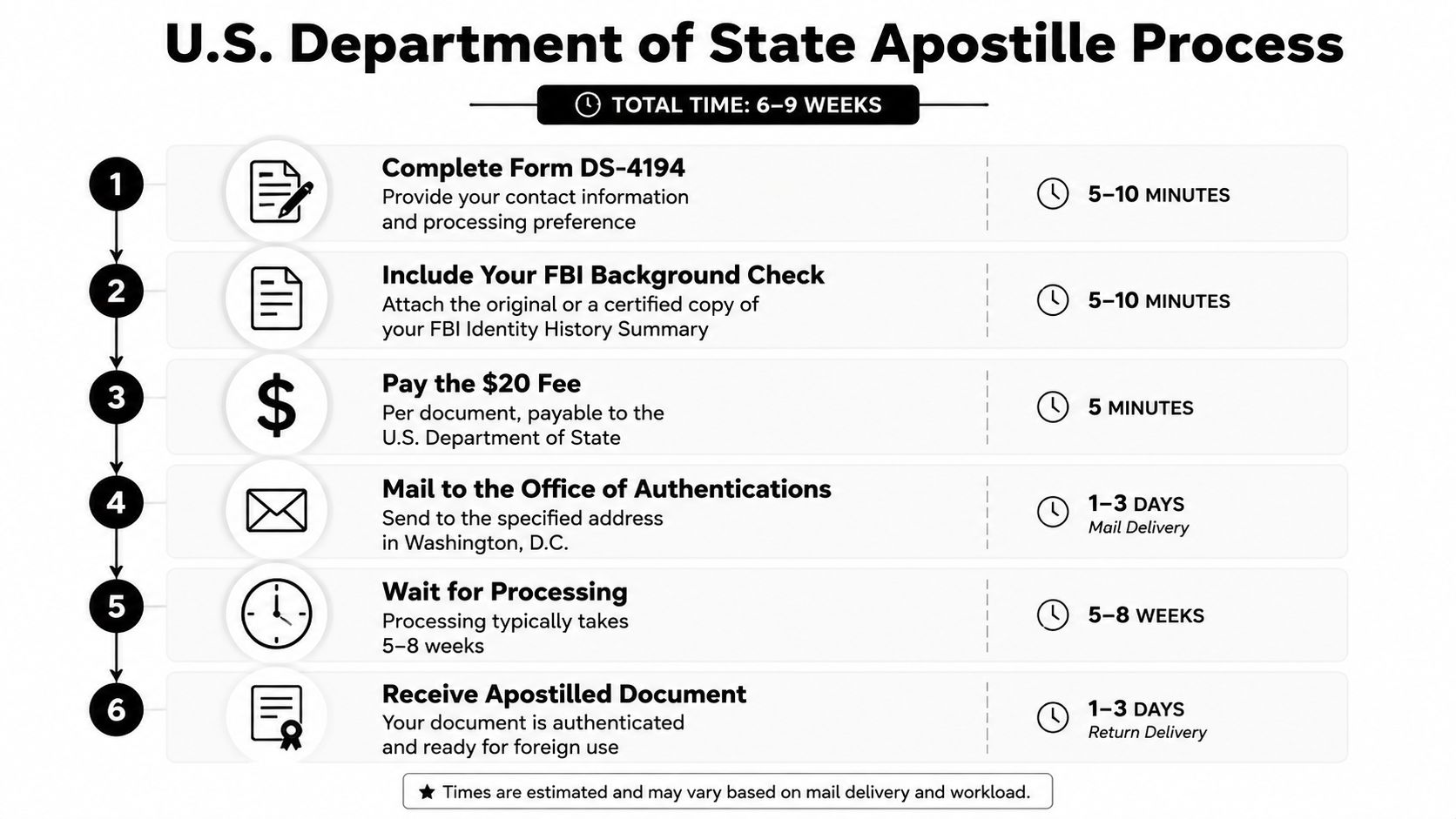
The federal apostille stage is where solid packets often fail, because people treat it like a routine mailing instead of controlled document handling. The FBI record has to go to the U.S. Department of State Office of Authentications because the FBI report is federal, not state-issued, and the FBI notes that results already processed cannot be re-authenticated. The request also has to list the correct country of use. A small mismatch there is enough to send the packet back. U.S. Department of State criminal records guidance
Put the packet together the way the office expects
Form DS-4194 anchors the submission. It has to align with the document, the destination country, and the payment. The federal authentication fee is $20 per document. The FBI Identity History Summary is usually the original document authenticated for use abroad, especially for Hague Convention countries where the apostille is the acceptance step that matters.
The legal path depends on the destination. In a Hague country, the apostille is usually the final federal authentication. In a non-Hague destination, embassy legalization may still follow, so a correct apostille packet is necessary, but not always the last step.
Protect the document in transit
Mailing details cause problems when they are handled casually. A compliant return label, a protected envelope, and accurate contact information lower the odds of delay. If the packet goes by mail, keep it simple, but protect it properly. Use packaging that keeps the FBI PDF flat, keeps the form readable, and keeps the payment and return label together.
Operational habit: list the destination country exactly as the receiving authority expects it, then check every line against the packet before sealing the envelope.
People comparing federal apostille workflows with other document types often miss the source rule. Federal source means federal authentication. The distinction shapes every step of the packet, including cases handled through a certificate of naturalization apostille.
Common Rejection Triggers and How to Avoid Them
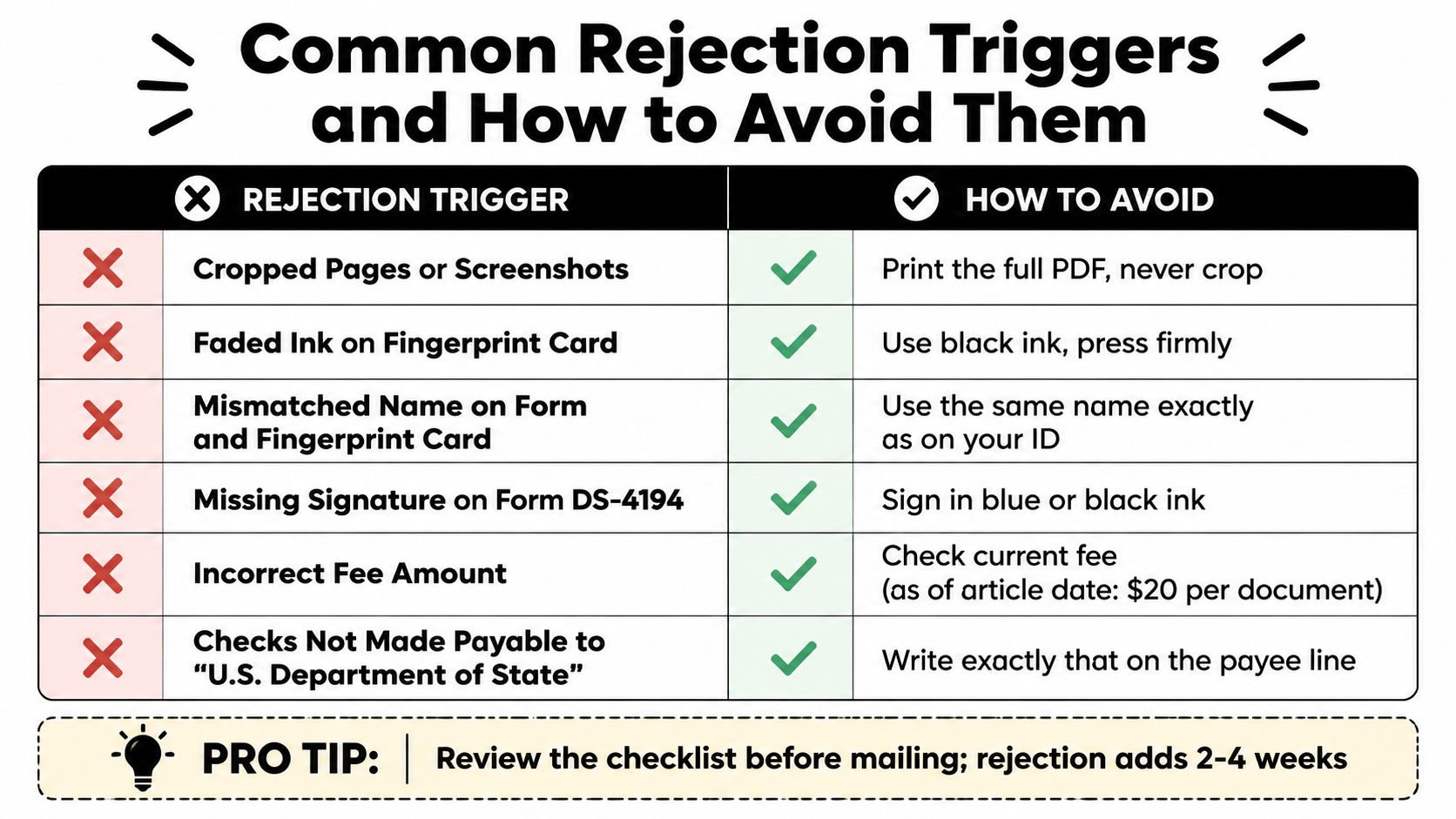
The packets I see sent back most often usually look fine at first glance. The failure is in the details, a cropped page, a screenshot, a re-saved PDF, a scan of a printout, or a forwarded file that no longer preserves the FBI digital signature. The State Department criminal records guidance points to those file changes as common rejection triggers, and it also helps explain why a notary cannot certify a federal record.
The original file has to stay original
Once the FBI Identity History Summary is altered, the risk goes up fast. Printing and re-scanning often strips the format the receiving office needs, and even a well-meaning edit to “clean up” the PDF can turn a valid file into a rejected one.
The notary issue causes its own problems. Federal records are not personal affidavits, so adding a notary seal where it does not belong can make the packet less acceptable, not more. If a provider tells you to notarize the FBI report itself, stop and verify the workflow before anything goes out.
Freshness and re-authentication rules
A report that is too old can still fail, even if every page looks perfect. For apostille use, the FBI report is commonly expected to be issued within the last six months, so timing matters as much as format. A previously processed result also cannot be recycled for a new federal authentication.
For applicants working toward residency or work authorization, freshness often lines up with the foreign filing calendar. The Spain residency for US citizens page from Legal Fournier is a useful parallel because it shows how document timing can matter alongside destination-country rules.
If the file has been touched, printed, cropped, or forwarded more than once, treat it as a new risk and check the chain before mailing.
The fingerprint source matters just as much. Business Mail Boutique’s live scan FBI FD-258 fingerprint card information is relevant here because many rejected packets start with a poor capture, not the apostille form. When the print is weak or the card is incomplete, the rest of the packet rarely recovers.
Realistic Timelines for Every Pathway
The smart way to plan is to work backward from the hard deadline, not forward from the day you feel ready. Visa appointments, enrollment cutoffs, and employer onboarding dates leave very little room for packet correction. The fastest path cited in current guidance is a same-day channeler on the FBI side plus federal processing, but the safer plan still needs buffer time for mailing, review, and any resubmission if the packet comes back incomplete. Federal Apostille 2026 guide
Comparison of common pathways
| Acquisition Method | FBI Report Timeline | Apostille Timeline | Total Estimated Duration |
|---|---|---|---|
| FBI online or approved channeler | Same-day through approved channelers, or very fast electronic delivery | Roughly 10 to 12 business days in one expert guide, or 2 to 4 weeks in another once the report is in hand | Fastest when everything is clean |
| Washington, DC walk-in drop-off | Not the main bottleneck, but the FBI record still has to be ready | Around 9 business days for the walk-in route cited in current guidance | Shorter than mail, but location-dependent |
| Mail-in fingerprint card | Mail-based acquisition is slowest | Mail-in processing can take 5+ weeks | Longest overall |
The six-month freshness window has to sit on top of that timeline. If the foreign authority wants a recent FBI report and your processing drifts too long, you may need to restart the request even if the apostille itself eventually arrives.
How I’d plan around a real deadline
If the deadline is fixed and the destination is strict, don’t pick the slowest route and hope for a perfect run. The packet has to arrive complete, the document has to be current, and the return leg has to be predictable. That usually means choosing the fastest safe acquisition path, keeping the original FBI PDF untouched, and mailing only after every field matches.
The practical difference between a successful schedule and a failed one is often one missing field or one bad scan. That’s why timeline planning and packet precision belong together, not in separate conversations.
How Business Mail Boutique Simplifies the Process
Business Mail Boutique LLC in Sugar Land, Texas is set up as a consolidation point for the parts of the workflow that usually get split across different vendors. The location handles professional fingerprinting, including digital and ink FD-258 cards, plus passport and ID photos, public and remote online notary, and secure shipping through authorized UPS and FedEx channels. For people who’d rather finish intake, paperwork, and outbound shipment in one stop, that matters more than any marketing promise.
What can be done in one visit
The practical advantage is coordination. A client can walk in, get fingerprinted, prepare supporting documents, have them reviewed for shipping readiness, and send the packet out without crossing town to separate providers. The store’s address at 11645 S. Hwy 6 makes that especially useful for residents in Sugar Land, Houston, Missouri City, Richmond, Stafford, and Katy, and the published hours of Monday through Friday, 10 AM to 6 PM give a workable window for weekday drop-ins. Business Mail Boutique
The biggest value isn’t speed by itself. It’s fewer handoffs, fewer opportunities for a page to be lost or altered, and fewer chances to mismatch the fingerprint identity data with the apostille packet. That’s the part that reduces rework.
Where local support helps most
Fingerprinting and shipping are the two places where people usually need a physical office, while notarization becomes useful for supporting documents that belong in the packet but aren’t the FBI report itself. The office also fits the needs of small business owners, travelers, and families who want a local team to handle the mechanics instead of coordinating multiple stops.
For an FBI background check apostille workflow, that can be the difference between a clean first submission and a delayed one. The fewer people who touch the packet, the easier it is to keep the original file intact.
Your Complete FBI Apostille Action Checklist
A clean FBI apostille packet starts with one question, where is the document going. Confirm whether the destination is a Hague Convention country or a place that needs extra legalization, because that answer determines the authentication chain before you spend time on forms or shipping.
Use this as the working checklist:
- Verify the destination rules first. Check the country’s acceptance path before you request or mail anything.
- Get the FBI report through an approved route. Keep the output in its original form and avoid edits, crops, or re-saves.
- Check the report date. If the FBI summary is outside the accepted freshness window, replace it before submission.
- Complete Form DS-4194 accurately. Match the document name, destination country, contact details, and return information.
- Include the correct fee. The Department of State authentication fee is $20 per document.
- Protect the packet. Use secure packaging and a return label that matches your delivery method.
- Send it to the right office. Federal records go to the Department of State Office of Authentications, not a state apostille desk.
- Review for rejection triggers. Cropped pages, screenshots, re-saved PDFs, or any sign the digital signature has been altered will slow the file down.
- Track the return. When the packet comes back, verify the apostille is attached correctly before you file or forward it.
- Keep a clean copy. Save a record of exactly what was mailed, because it makes follow-up easier if something goes missing.
A broader travel-document check helps catch timing conflicts before they turn into a resend. The visa checklist by My Global Trips is a useful companion reference for lining up document timing with trip or relocation paperwork.
The strongest packet is the one that reaches the reviewer without needing an explanation.
If you want the fingerprinting, shipping, and document-prep steps handled in one local visit, Business Mail Boutique LLC can help with the parts that usually create delays in an FBI background check apostille workflow. Visit Business Mail Boutique LLC to review their fingerprinting, notary, and secure shipping services before you mail your packet.

Related posts

Custom Memorial Glasses Engraved in Three Hours in Sugar Land
When a customer needed eight personalized glasses for a memorial, Business Mail Boutique completed the engraving or...

Custom Martini Glass Engraving in Sugar Land, TX
Custom Logo Engraving on Martini Glasses in Sugar Land, Texas.
Business Mail Boutique recently completed a beautiful custom engravin...

Custom Engraved Wine Glasses for a Golf Club Event in Sugar Land, TX
Custom Engraved Wine Glasses for a Golf Club Event in Sugar Land.
Custom wine glass engraving in Sugar Land, TX at Business Mail Bouti...