
- Print Business Cards in Sugar Land – Same Day Service
- Copying Services
- Document Printing, Finishing & Lamination in Sugar Land
- Flyers
- Print Banner in Sugar Land | Same-Day Banner Printing Near Me
- Graphic Design
- Photo Printing
- Postcard Printing
- Document Printing
- EDDM Full Service Postcards
- FotoZoomer Large Format Printing



The Postal Depot Explained: Your All-in-One Guide
Businessmailboutique
11645 S. Hwy 6
Sugar land, Texas 77498 United States (US)
Email: info@businessmailboutique.com
Route
You’ve got three errands that all feel too small to take half a day. One package needs to go out. A return needs a label. A document needs printing and maybe notarizing. If you work from home, sell online, or manage a small business, that kind of errand pileup happens fast.
That’s where people start hearing terms like the Postal Depot and wondering what it means. Is it a post office? A mailbox store? A shipping counter? In practice, it’s often a local business center that brings several of those jobs under one roof, so you don’t have to bounce from one place to another.
Table of Contents
- Your One-Stop Hub for Shipping and Business Needs
- What Exactly Is a Postal Depot
- Common Services and Customer Use Cases
- How to Choose Your Postal Depot Provider
- Postal Depot vs The Post Office vs Carrier Stores
- Your Local Solution Business Mail Boutique in Sugar Land
Your One-Stop Hub for Shipping and Business Needs
A lot of people don’t go looking for the Postal Depot as a concept. They go looking for relief from a messy to-do list. You need to ship a package before pickup, print a few pages for a meeting, drop off a return, and check whether your mailbox service can accept a delivery while you’re out. When those tasks are split across different locations, the work feels bigger than it is.
That’s why the local all-in-one shipping and office center matters. Instead of treating mailing, packing, printing, and document help as separate errands, the Postal Depot model puts them together in one place. For busy families, freelancers, and small business owners, that’s less driving, less waiting, and fewer handoffs.
This idea isn’t new. The roots of organized mail handling in the United States go back to 1639, when the first American post office opened in a Boston tavern, and the Constitution later gave Congress the power to establish post offices in 1787, showing how long centralized mail service has mattered in daily life and commerce, as documented in the history of U.S. post offices.
A good local depot solves a simple problem: too many small business tasks compete for the same hour of your day.
In a modern neighborhood setting, that old idea becomes much more practical. You’re not just mailing letters. You’re handling returns, receiving packages, storing mail securely, getting documents prepared, and keeping your business moving. If you want a real local example of that one-stop approach, the PackageHub shipping and business services in Sugar Land page shows how these locations are often built around convenience, not just postage.
What Exactly Is a Postal Depot
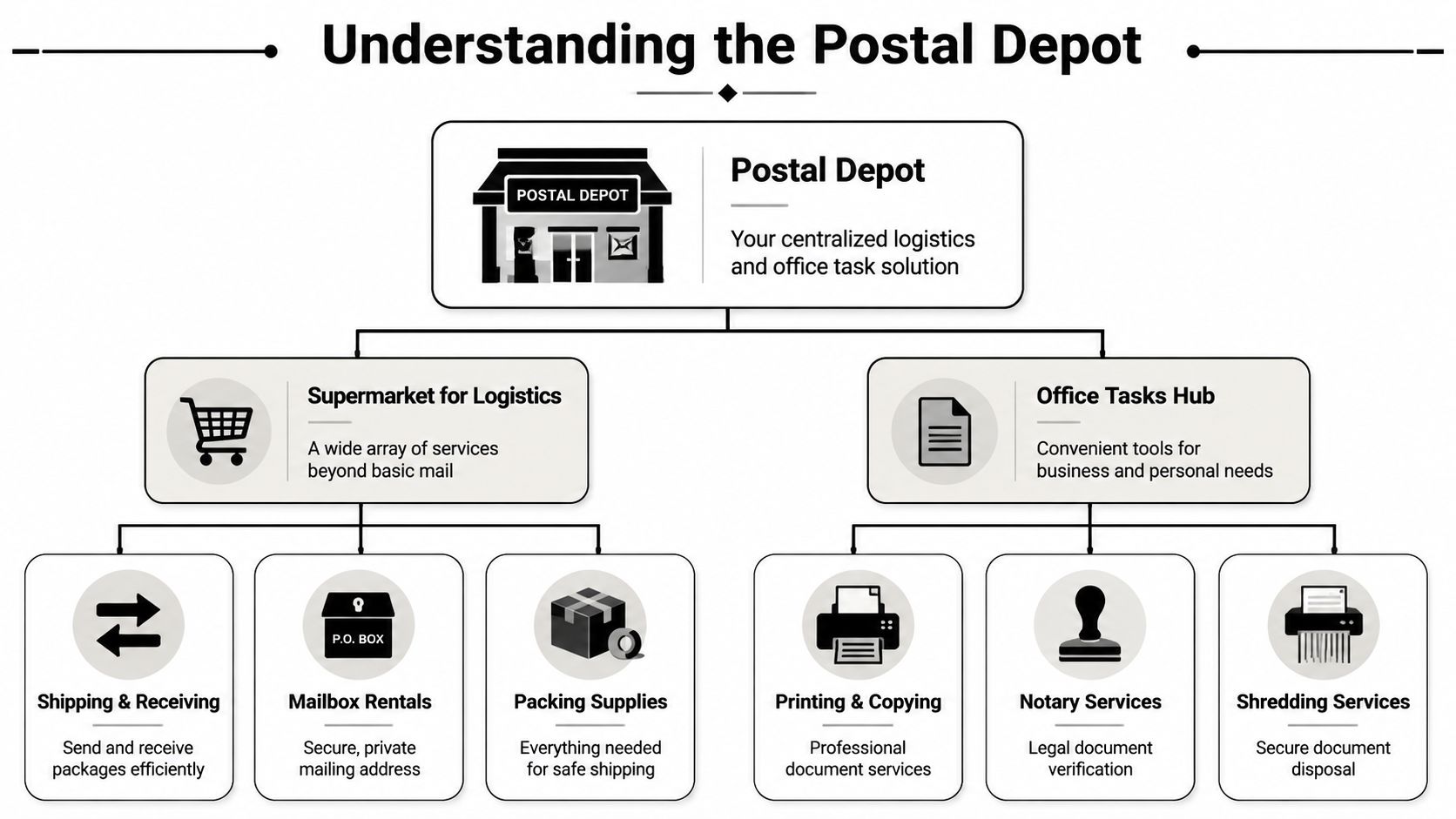
The Postal Depot is easiest to understand when you stop thinking of it as a single service counter. Think of it as a supermarket for logistics and office tasks. A traditional carrier location usually specializes in its own system. A depot-style business center usually helps with several kinds of everyday tasks in one stop.
Think of it as a logistics supermarket
If a single-carrier store is like a specialty bakery, the Postal Depot is more like a neighborhood market. You can still get shipping help, but you can also handle related jobs that naturally come with it. That might include mailbox rental, package receiving, printing, notary work, copying, shredding, passport photos, or packing supplies.
Many of these locations are independently operated businesses. Their role is practical. They help customers compare options, prepare shipments correctly, accept packages, and provide small-business support services that don’t fit neatly inside one carrier’s system.
Behind that simple storefront experience is a much larger logistics chain. International postal handling uses standards such as the Universal Postal Union’s S9, which defines a 29-character receptacle ID encoded in Code 128 barcode format for dispatch handling, supporting machine-readable chain-of-custody tracking across handoff points, according to the UPU postal transport guide.
Four core service pillars
The Postal Depot can be understood by grouping its services into four main pillars:
- Shipping and receiving This is the front-door function often noticed first. You bring in a package, a return, or pre-labeled shipment. The staff weighs it, checks packaging, helps with label placement, and routes it through the right carrier process.
- Professional packing
This matters when the item is fragile, awkward, valuable, or time-sensitive. A lamp, framed print, electronics item, or gift basket may need more than a reused box and some tape. Proper materials and packing technique reduce the chance of damage and help avoid carrier disputes over inadequate packaging. - Mailbox and mail handling
This goes beyond “a place to get mail.” It can include package receiving, forwarding, hold requests, and notifications when something arrives. For many home-based operators, this is the bridge between personal life and professional appearance. - On-demand business services
These are the tasks people often forget until the last minute. Printing, copying, document finishing, notary work, shredding, scanning, photos, and office support often belong in the same trip because they’re tied to a shipment, filing deadline, or customer order.
Practical rule: If one errand creates two follow-up errands, a postal depot is often the better fit than a single-purpose counter.
Common Services and Customer Use Cases
The easiest way to judge the value of the Postal Depot is to look at how different people use it in real life.
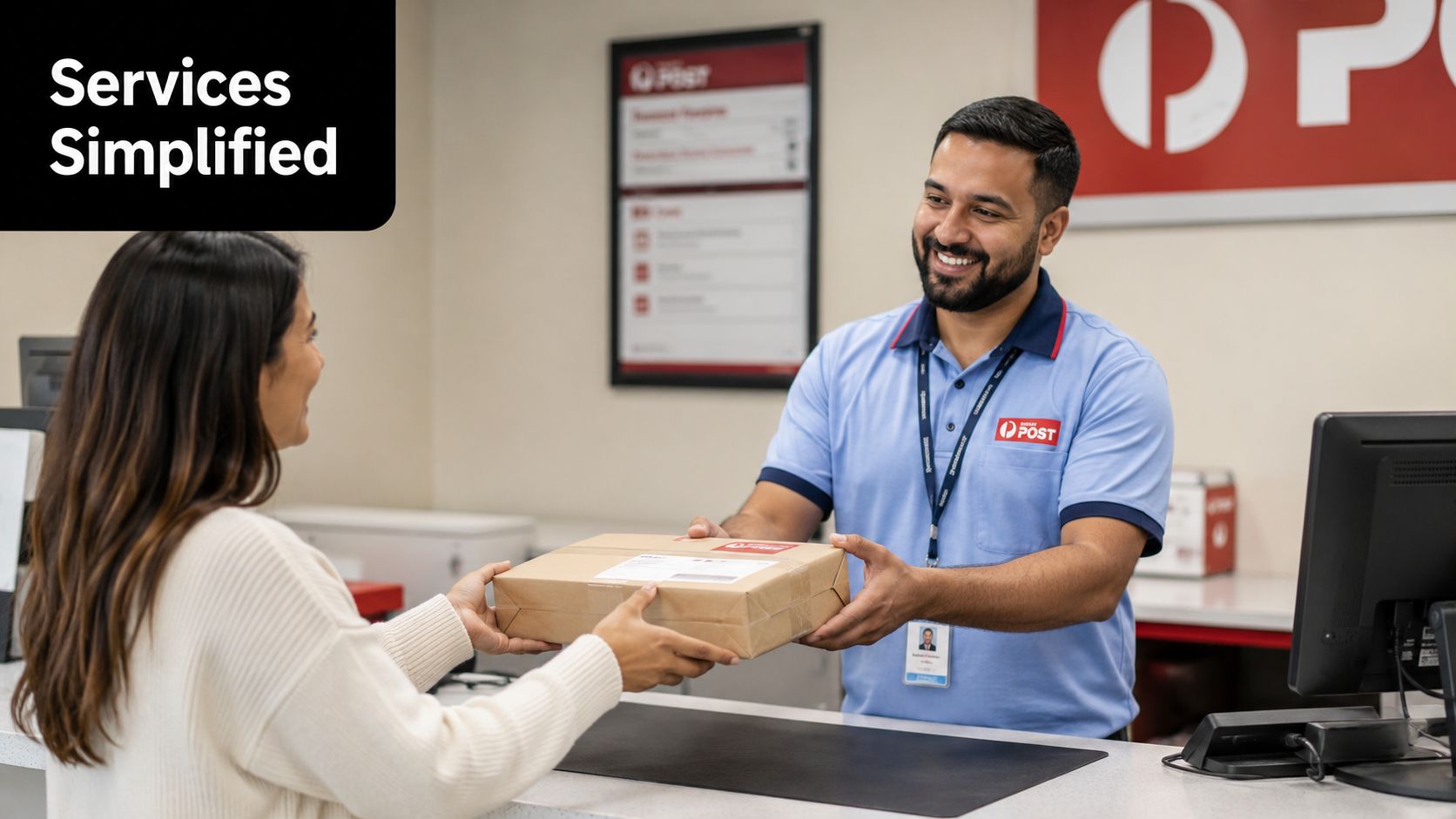
For the home-based business owner
A freelancer who works from a spare bedroom may not want client mail going to a home address. That’s where a private mailbox becomes useful. A major advantage over a standard PO Box is that a private mailbox service can provide a physical street address, accept deliveries from UPS, FedEx, and USPS, and avoid some of the access and delivery limits tied to USPS-only PO Box arrangements, as shown by USPS location and PO Box access information.
That matters for image and workflow. A consultant can place a street address on invoices. A small online shop can receive supply orders from different carriers. A traveling business owner can ask for mail to be held or forwarded rather than letting packages pile up at home.
If you’re comparing mailbox options more broadly, a practical outside reference is this guide to business mailbox rental. It helps frame what to look for when privacy, package acceptance, and business presentation all matter.
For sellers, families, and travelers
An online seller usually needs more than postage. They may need bubble wrap, a stronger box, help with return labels, or a staffed counter that catches packaging mistakes before the parcel leaves. That’s why a local hub with packing and shipping services for businesses and residents is often more useful than a basic drop box.
A busy parent uses the same place differently. One trip might cover a school form, a passport photo, a return, and a package pickup. The value isn’t just the service list. It’s that the tasks fit together.
A frequent traveler cares about continuity. They need someone to receive packages, keep mail secure, and make handoff simple when they get back. They don’t want to wonder whether one item went to a mailbox, another to a porch, and a third to a failed-delivery notice.
Here are a few common use cases that come up again and again:
- E-commerce fulfillment: A seller drops off outgoing orders, buys packing materials, and handles customer returns in the same visit.
- Client-facing freelancers: A designer or consultant uses a street-address mailbox to separate home life from business communication.
- Legal and paperwork errands: A customer prints forms, signs them, and looks for notary help without driving to a second location.
- Package receiving: Someone who misses home deliveries prefers a staffed business center over porch exposure or repeated redelivery attempts.
The best use case is often the boring one. A place that quietly receives your mail, prints what you need, and gets your package out on time saves more stress than a flashy feature list.
How to Choose Your Postal Depot Provider
Not every location that offers shipping is a good long-term fit. Some are fine for quick drop-offs but weak on mailbox service. Others are strong on mail handling but limited on document support. A little checking up front can save frustration later.
What to check before you sign up
Start with the service mix. If you only need occasional outgoing shipping, many places will work. If you need mail receiving, forwarding, notary access, printing, or frequent returns, you want a provider whose daily operations match that pattern.
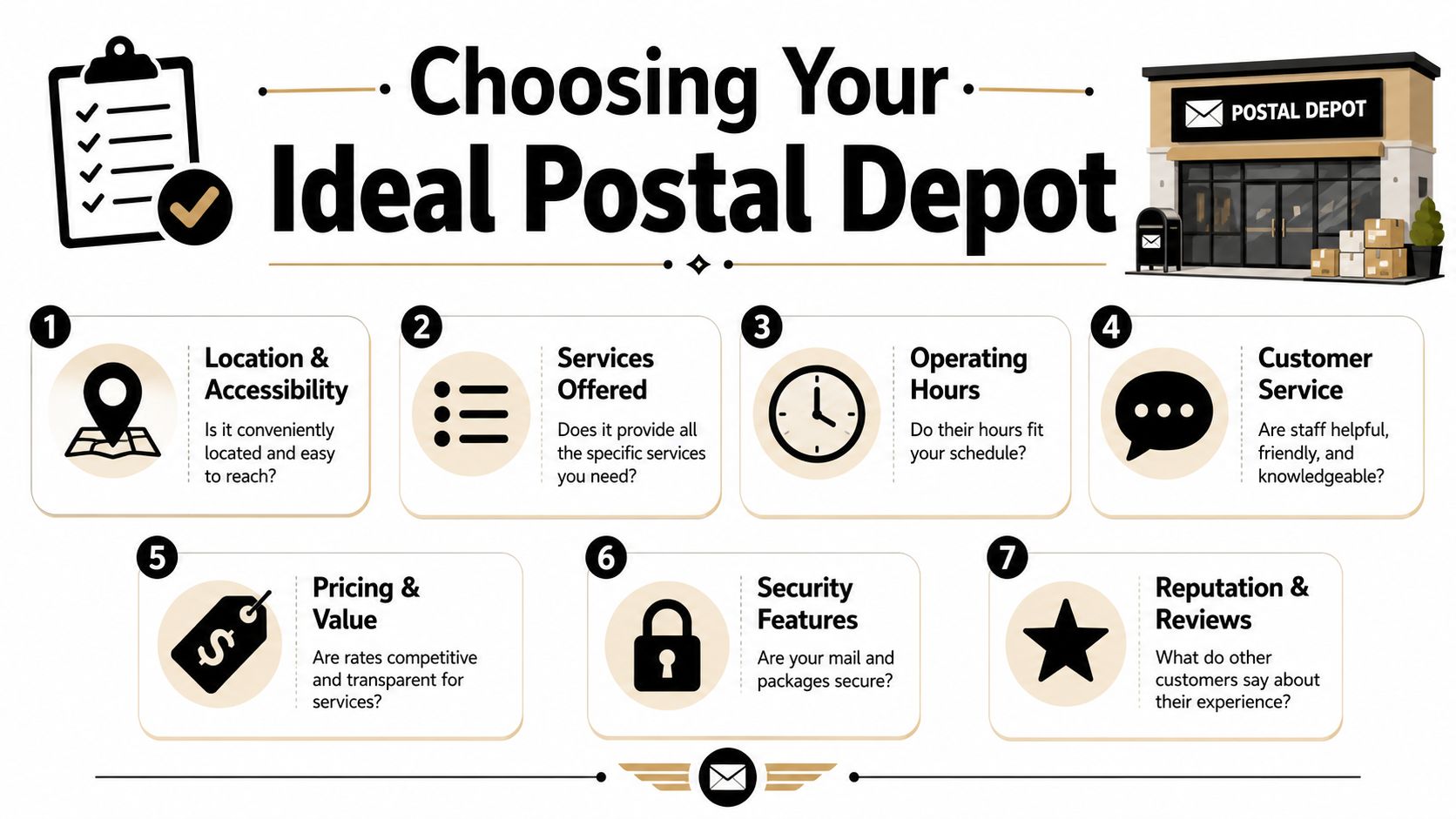
Use this checklist when you evaluate a location:
- Carrier flexibility: Ask which carriers they handle and whether they can accept incoming packages from multiple networks.
- Mailbox details: Confirm whether the mailbox includes a street address, package receiving, forwarding, and customer notifications.
- Printing and document help: Check whether they handle simple prints only or also offer business cards, signs, scans, finishing, and forms support.
- Staffed support: See whether the counter team helps with packing choices, labels, and service exceptions instead of just taking drop-offs.
- Security and storage: Ask how incoming packages are stored and what happens if you can’t pick up right away.
Questions worth asking at the counter
The fine print matters more than people expect. Some providers state that basic mailbox packages are stored for up to 6 business days free, after which a $3 per day per package fee applies, and notary service may be available only Monday-Friday, 10 am-4 pm, subject to confirmation, as listed on The Postal Depot concierge services page.
That kind of detail can change your decision if you travel often, sell online, or depend on time-sensitive paperwork.
Ask direct questions such as:
| Question | Why it matters |
|---|---|
| Do you accept packages from all major carriers? | It affects whether one address can truly handle your deliveries. |
| How long do you hold packages? | Storage windows shape pickup habits and possible fees. |
| When is notary available? | Many people assume it’s all day, then find out it isn’t. |
| Do you offer forwarding or notifications? | This matters if you work remotely or travel often. |
| What happens with oversized or missed pickups? | Exception handling is where hidden inconvenience shows up. |
Don’t judge a provider by the lobby alone. Ask how they handle late pickups, special documents, and incoming packages when your schedule changes.
A reliable depot isn’t the one with the longest service menu. It’s the one whose rules fit the way you work.
Postal Depot vs The Post Office vs Carrier Stores
When people compare options, they usually compare the wrong things. They look at who can mail a package, not who can handle the whole task around the package.
The United States Postal Service is enormous. In fiscal year 2025, it operated 30,972 retail offices, served nearly 169 million addresses, and delivered 108.7 billion packages and pieces of mail to 170.4 million delivery points, according to the USPS overview. That scale is unmatched for national mail service. But its retail focus is still centered on USPS products and rules.
A postal depot serves a different role. It acts as a flexible local service point that may combine multiple carriers with office support under one roof.
| Feature | Postal Depot | Post Office | Single-carrier store |
|---|---|---|---|
| Carrier options | Often multi-carrier | USPS-focused | Usually one main carrier |
| Mailbox type | Often private mailbox with street address | PO Box model | Varies by brand and location |
| Business services | Often includes printing, notary, shredding, and more | Limited and location-dependent | Usually shipping-centered with some extras |
| Receiving packages | Common use case | USPS system rules apply | Usually tied to that store’s service model |
| Best for | People who want one-stop convenience | USPS mailing tasks | Customers loyal to one carrier |
If your needs are simple and strictly USPS-based, the post office may be enough. If you only ship through one carrier, a dedicated carrier store may fit. If your errands usually spill into printing, receiving, returns, mailbox handling, or documents, the Postal Depot makes more sense.
Your Local Solution Business Mail Boutique in Sugar Land
For Sugar Land residents and small businesses, the Postal Depot idea becomes tangible when a local center combines shipping, printing, mailbox service, and office support in one storefront.
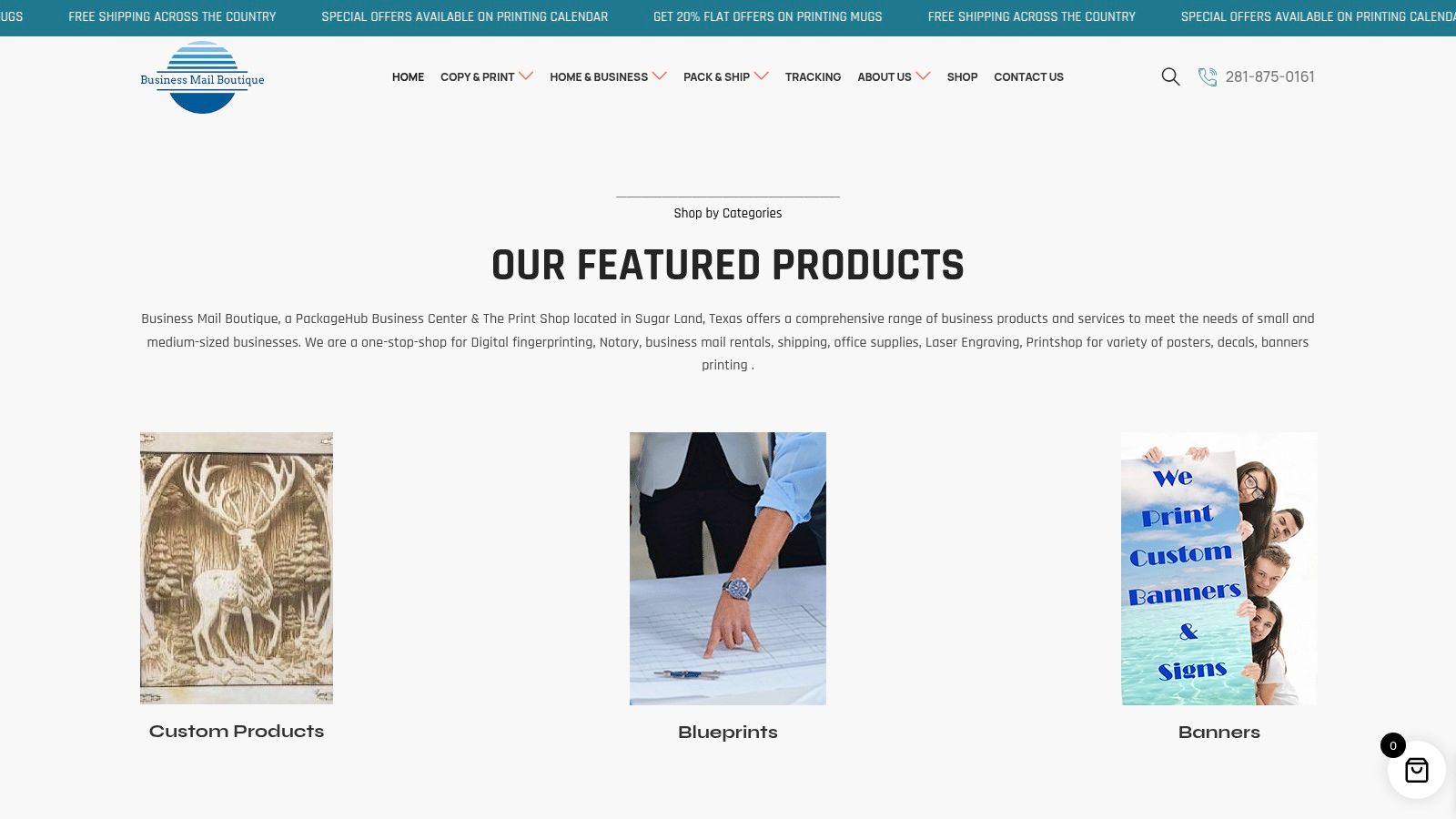
One local example is Business Mail Boutique LLC, a Sugar Land business center that offers multi-carrier shipping support, private and digital mailbox rentals with a real street address, printing, notary options, fingerprinting, photos, and related services. If you want to review the location directly, the Sugar Land shipping center page outlines its local service setup.
That combination matters because the Postal Depot isn’t really about one product. It’s about reducing friction. If you’re mailing business orders, receiving client correspondence, printing signs for an event, or trying to handle a return and a notarized document in one afternoon, a center like this matches how people work.
For local customers, the practical question isn’t “Where can I buy postage?” It’s “Where can I finish the whole errand?”
If you need a local place to handle shipping, printing, mailboxes, and office services in one stop, Business Mail Boutique LLC is a practical next place to check.

Related posts

Custom Memorial Glasses Engraved in Three Hours in Sugar Land
When a customer needed eight personalized glasses for a memorial, Business Mail Boutique completed the engraving or...

Custom Martini Glass Engraving in Sugar Land, TX
Custom Logo Engraving on Martini Glasses in Sugar Land, Texas.
Business Mail Boutique recently completed a beautiful custom engravin...

Custom Engraved Wine Glasses for a Golf Club Event in Sugar Land, TX
Custom Engraved Wine Glasses for a Golf Club Event in Sugar Land.
Custom wine glass engraving in Sugar Land, TX at Business Mail Bouti...