
- Print Business Cards in Sugar Land – Same Day Service
- Copying Services
- Document Printing, Finishing & Lamination in Sugar Land
- Flyers
- Print Banner in Sugar Land | Same-Day Banner Printing Near Me
- Graphic Design
- Photo Printing
- Postcard Printing
- Document Printing
- EDDM Full Service Postcards
- FotoZoomer Large Format Printing


Freight Shipping Services: A Guide for Small Businesses
Businessmailboutique
11645 S. Hwy 6
Sugar land, Texas 77498 United States (US)
Email: info@businessmailboutique.com
You finally land the order you’ve been working toward. Maybe it’s a wholesale request from a local retailer. Maybe your online store starts selling furniture, gym equipment, trade show materials, or large custom pieces. The excitement lasts about five minutes, then the shipping question hits you.
Your regular parcel routine doesn’t seem to fit anymore. The item is too heavy, too bulky, too awkward, or too valuable to trust to a simple label-and-dropoff workflow. That’s the moment many small business owners meet freight for the first time, and it can feel like a different language.
It helps to remember that freight isn’t some distant, corporate-only system. It’s the same network that moves products for businesses of every size. Maritime transport alone carries over 80% of goods traded worldwide by volume, according to UNCTAD’s seaborne trade statistics. Your shipment may be one pallet instead of a ship full of containers, but it belongs to that same chain of commerce.
If you’re also juggling stock levels while sales grow, this practical guide to managing e-commerce inventory can help you think through the storage side of the puzzle before freight even gets booked.
Table of Contents
- Your Small Business Is Growing Now What
- When a Box Becomes Freight A Clear Definition
- Choosing Your Freight Shipping Method
- Decoding Freight Costs and Transit Times
- A Freight Preparation Checklist for Success
- Your Local Freight Partner Business Mail Boutique
- Freight Shipping FAQs for Small Businesses
Your Small Business Is Growing Now What
A lot of owners hit the same turning point. One week, you’re shipping individual boxes. The next, a customer wants six display units on pallets, or a reseller asks for a bulk order that won’t fit in the back of an SUV.
That shift can feel bigger than it is. You’re still doing what you’ve always done, getting products from your hands to someone who needs them. The difference is that the shipment now needs different equipment, different paperwork, and a different type of booking.
The moment freight starts making sense
An artist shipping framed work to a gallery, a candle maker sending a wholesale pallet, and an online seller moving oversized returns all run into the same question. What’s the safest and most sensible way to move this without guessing?
Freight shipping services step in when parcel shipping stops being practical. You don’t need to become a logistics manager overnight. You just need to understand the basic choices well enough to ask the right questions.
Freight feels intimidating because the terms are unfamiliar, not because the process is unreachable for a small business.
Growth creates shipping decisions
Growth usually creates three problems at once:
- Your shipment gets bigger: A single carton becomes several pallets, crates, or irregular pieces.
- Your customer expectations rise: Wholesale buyers and business customers often want tighter scheduling and cleaner documentation.
- Your mistakes get more expensive: A bad packaging choice or wrong service level can create delays, damage, or avoidable fees.
The good news is that freight shipping services are built to solve exactly those problems. Once you understand how freight works, it stops feeling like a leap and starts feeling like the next tool your business needs.
When a Box Becomes Freight A Clear Definition
Freight starts where ordinary parcel shipping becomes inefficient or unsuitable. A simple way to think about it is this: parcel shipping is like mailing everyday packages, while freight is closer to arranging transportation for larger commercial goods.
The easiest way to tell
In plain terms, a shipment usually moves into freight territory when it’s too heavy, too large, or too awkward for standard parcel handling. That often means palletized goods, crated items, commercial equipment, furniture, multiple boxes moving together, or anything that needs a truck instead of a conveyor-based parcel network.
You’ll also hear people talk about freight when a shipment needs special equipment or handling. A liftgate, pallet jack, forklift access, appointment delivery, inside delivery, or special protection are common clues that you’re dealing with freight, not just a bigger box.
A quick mental check helps:
- Single consumer-style package: Usually parcel
- Several boxes wrapped on a pallet: Usually freight
- Oversized or irregular item: Likely freight
- Business shipment with dock or forklift handling: Freight
Why this matters for a small business
Freight isn’t a niche corner of shipping. It’s part of the core economy. In the United States, businesses spent $1.63 trillion on logistics costs in 2019, equal to 7.6% of U.S. GDP, according to this logistics industry summary. That tells you something important. Freight is not reserved for giant manufacturers. It’s part of how American business operates every day.
Practical rule: If your shipment needs a pallet, a crate, special handling, or a truck-based quote instead of a simple parcel label, start treating it as freight early.
That changes how you pack, how you budget, and how you communicate with the carrier. It also changes what information matters. Dimensions, weight, pickup conditions, and delivery conditions become just as important as the destination itself.
For a small business owner, a significant advantage is knowing when to stop forcing a parcel solution onto a freight problem. That one decision can prevent damage, delays, and a lot of confusion.
Choosing Your Freight Shipping Method
When owners hear “freight,” they often assume there’s one standard service. There isn’t. The right choice depends on what you’re shipping, how quickly it has to arrive, and how much handling risk you can tolerate.
To make this easier, start with the four methods most small businesses run into.
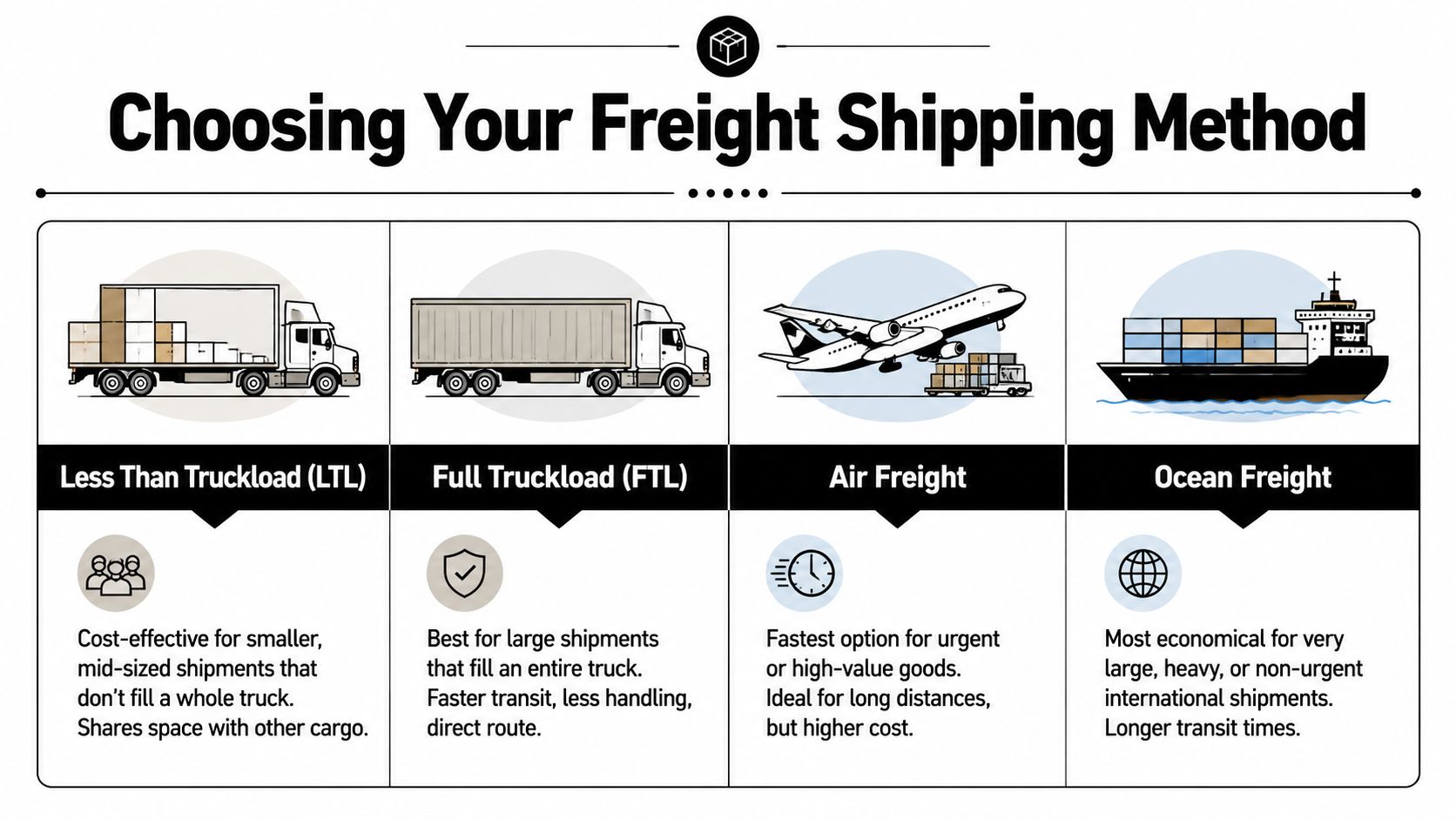
Four common methods small businesses use
LTL, or less-than-truckload, is for shipments that don’t need a full trailer. Your freight shares truck space with other shipments. This is often the practical choice for one pallet, a few pallets, or smaller commercial moves where keeping cost under control matters.
FTL, or full truckload, gives your shipment the entire truck. That can make sense when the load is large, fragile, high-value, or time-sensitive enough that fewer touchpoints matter. It’s also useful when you want a more direct route.
Air freight is the speed-first option. Businesses usually choose it when inventory is urgent, a replacement part can’t wait, or the product has high enough value to justify the faster movement.
Ocean freight is commonly used for large international shipments that aren’t urgent. If the shipment is bulky, heavy, or moving overseas at scale, ocean often becomes the practical choice.
A lot of confusion comes from focusing only on the cheapest quoted rate. That’s where many small businesses get burned. As Universal Cargo notes in its freight service overview, the cheapest per-pound option often isn’t the cheapest overall once delays, rework, and damage enter the picture.
Freight Shipping Methods at a Glance
| Method | Best For | Cost | Speed | Typical Shipment |
|---|---|---|---|---|
| LTL | Smaller freight that doesn’t fill a truck | Lower than dedicated truck service in many cases | Moderate | One or several pallets |
| FTL | Large loads, fragile freight, direct moves | Higher for smaller loads, more sensible for larger dedicated shipments | Faster and more direct | Full trailer or shipment needing exclusive space |
| Air | Urgent or high-value goods | Highest | Fastest | Time-sensitive commercial freight |
| Ocean | Large international shipments | Economical for bulky overseas cargo | Slowest | Containers, heavy goods, non-urgent international freight |
If you want a broader look at service choices before narrowing it down to freight, this guide to small business shipping services gives a helpful big-picture overview.
A short walkthrough can also help if you’re more visual. This video gives a useful introduction to freight transport options.
How to make the call
Use three filters.
- Speed: If the shipment has to move fast, air or a more direct truck option may make more sense than a shared network move.
- Handling: If the product is delicate, reducing transfers can matter more than getting the lowest quote.
- Total landed cost: Include delay risk, repacking, claims, customer frustration, and missed deadlines. The sticker price is only part of the decision.
If your freight is irregular, fragile, or tied to an event date, choose the method that protects the outcome, not just the rate.
That’s the heart of good freight decision-making. You’re not buying truck space alone. You’re buying the right balance of cost, control, speed, and protection.
Decoding Freight Costs and Transit Times
Freight quotes can look inconsistent when you’re new to them. Two shipments that seem similar can price differently, and delivery windows can shift even when the route looks straightforward. That isn’t random. Freight pricing pulls in operational details that parcel shipping often hides.
What shapes a freight quote
The first layer is the physical shipment itself. Carriers look at dimensions, weight, density, packaging style, and how much trailer space the freight uses. A dense pallet of boxed hardware doesn’t behave the same way as a bulky but lightweight display piece.
You may also hear terms like freight class or NMFC code. In everyday language, these are ways the industry categorizes certain freight based on traits like density, handling, and risk. You don’t need to memorize the code system, but you do need accurate dimensions and an honest description of the goods.
Then come accessorials, which are extra services attached to the move. Common examples include:
- Liftgate service: Needed when a truck must load or unload without dock equipment.
- Residential delivery: Applied when the destination isn’t a standard commercial receiving location.
- Inside delivery: Used when freight must go beyond the curb or dock area.
- Appointment service: Needed when delivery requires scheduling coordination.
Small details create big quote changes. A shipment going to a warehouse dock usually books differently from the same pallet going to a home garage.
Why delivery windows can move
Transit time is also more dynamic than many owners expect. Freight carriers deal with route density, weather, road conditions, terminal activity, equipment availability, and congestion at ports or hubs. Modern freight pricing and planning now rely on over 700 million data points, including signals like weather, traffic, and port congestion, according to Xeneta’s shipping data analysis.
That’s one reason quotes and timelines can move between booking and pickup. It’s also why planning matters. If you want a simple primer on how logistics teams think about movement efficiency more broadly, these efficient route planning strategies are useful background reading.
Ask for a quote with complete details the first time. Missing information usually doesn’t save money. It just postpones the real price.
A good quote starts with good input. Measure carefully. Note whether you have a dock. Mention if the freight is stackable, fragile, crated, or irregular. The clearer you are, the fewer surprises you’ll face when the invoice arrives.
A Freight Preparation Checklist for Success
A freight shipment usually succeeds or fails before the truck arrives. Good preparation protects the product, keeps paperwork clean, and lowers the chance of damage claims or delivery problems.
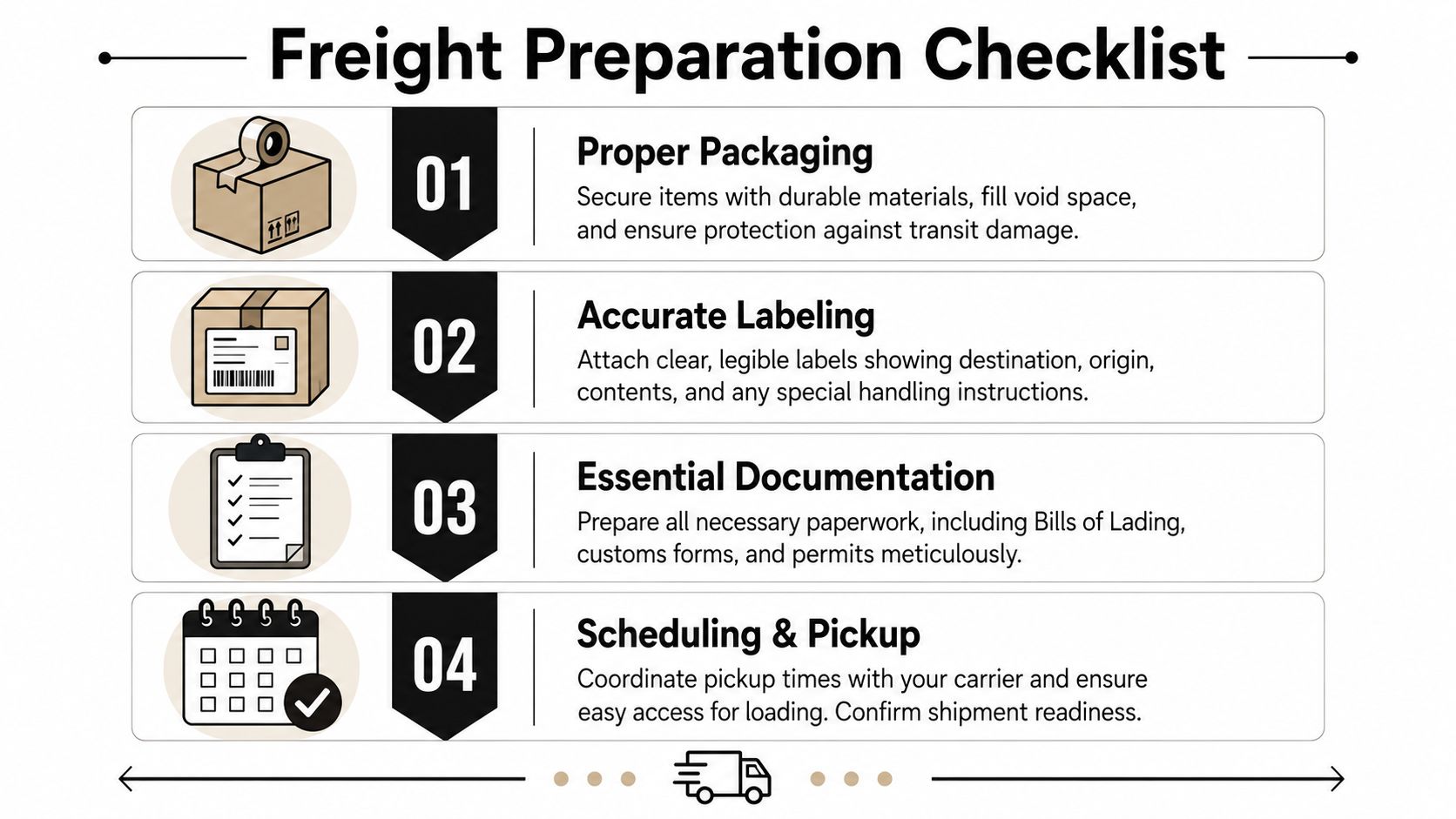
Pack it for a forklift not a front porch
Freight moves through a different environment than parcel shipments. It may be stacked near other cargo, transferred between terminals, or moved by pallet jack or forklift. That means your packaging needs to protect the shipment from compression, shifting, and repeated handling.
A useful checklist:
- Use a stable base: If you’re palletizing, choose a pallet in sound condition and make sure the load sits evenly.
- Control movement: Stretch wrap, banding, corner boards, and internal cushioning help keep goods from shifting.
- Choose crating when needed: Fragile, expensive, or oddly shaped items often need more than cardboard.
- Keep edges inside the footprint: Overhang increases the chance of crush damage.
Label and document everything clearly
Freight labels need to be visible and durable. Put destination and return information on more than one side when possible, and include any handling notes that matter.
The core document is the Bill of Lading, often shortened to BOL. Think of it as the shipment’s travel document. It identifies what is moving, where it’s going, who is responsible for pickup and delivery, and what service conditions apply.
Before pickup, confirm these basics:
- Shipment description: Match the goods accurately.
- Piece count: Make sure labels and paperwork agree.
- Pickup and delivery details: Include dock, contact, and access information.
- Special service needs: Add liftgate, appointment, or inside delivery if required.
If you need the physical materials for safer prep, this local guide to shipping supplies in Sugar Land is a practical place to start.
Protect yourself before pickup
Carrier liability and freight insurance are not the same thing. Many owners assume the carrier automatically covers the full value of the shipment. That assumption can become expensive.
Take these precautions:
- Photograph the shipment: Capture all sides before handoff.
- Save packing notes: Keep a record of how the item was packed or crated.
- Review coverage options: Ask what carrier liability includes and where gaps may exist.
- Inspect at delivery: If damage appears, note it clearly at the time of receipt.
Clean documentation wins arguments later. Blurry photos and vague paperwork usually don’t.
Freight rewards preparation. If you package, label, and document like the shipment matters, the process gets much smoother.
Your Local Freight Partner Business Mail Boutique
Many small businesses don’t need a full in-house logistics department. They need someone local who can help them choose a service, prep the shipment properly, and stay involved if something changes.
What a local partner actually handles
A local shipping center can do more than print a label. For freight shipping services, its core value is often in the translation work. Someone helps turn “I need to get this large item to my customer” into the details a carrier needs: dimensions, packaging method, pickup conditions, service type, and paperwork.
That can include:
- Professional packing or pallet prep when the item isn’t ready for truck transport
- Carrier and service selection for LTL, larger truck moves, or special handling
- Documentation support for BOL details and shipping records
- Tracking visibility so you’re not left guessing where the shipment is
For businesses in Sugar Land, this local shipping center page shows the kinds of packing, shipping, and freight-related support available in one place.
Why returns and exceptions matter
Freight gets especially stressful when something doesn’t go as planned. A customer rejects a pallet. A damaged oversized item needs to come back. An event display must be repacked and rerouted. Those situations are where local support often matters most.
A specialty freight overview from Unishippers highlights a key point for e-commerce sellers and other growing companies: reverse logistics for large items often requires help with packing, carrier selection, tracking, and claim-ready documentation. Standard consumer return flows usually don’t cover that well.
That’s where Business Mail Boutique LLC can fit as one practical option for local businesses that need hands-on support with freight quotes, packing, shipping coordination, and returns-related logistics. For a small operation, that can feel less like outsourcing and more like having a shipping counter that understands commercial freight.
Freight Shipping FAQs for Small Businesses
The basics get much clearer once you’ve seen the moving parts. Most remaining questions come down to paperwork, access, tracking, and returns.
What is a Bill of Lading
A Bill of Lading is the main document tied to a freight shipment. It identifies the shipment, parties involved, route details, and service instructions. Yes, you generally need one for freight because it acts as the formal shipping record.
Can I ship freight without a loading dock
Yes, you can. Many small businesses and home-based sellers ship freight without dock access. The important part is telling the carrier or shipping partner ahead of time so they can arrange the right equipment, such as liftgate service.
Can I track freight like a regular package
Usually, yes, but the experience is different from parcel tracking. Freight updates may show milestones such as pickup, terminal movement, transfer, and delivery status instead of constant scan-by-scan consumer-style updates.
What if my customer needs to send a large item back
Treat the return like a new freight shipment, not a simple return label. The item may need inspection, repacking, photos, revised paperwork, and a carrier chosen for the condition of the goods. That’s why return planning matters so much for oversized items.
If you’re staring at a pallet, crate, oversized order, or complicated return and aren’t sure what service fits, Business Mail Boutique LLC offers local help with packing, shipping, freight coordination, and the details that make the process easier to manage.

Related posts

Perfume Bottle Engraving Sugar Land | Same-Day Service
Same-Day Perfume Bottle Engraving in Sugar Land.
Custom Perfume Bottle Engraving in Sugar Land — Same-Day Personalized Gifts
Make a...

Leather Portfolio Engraving in Sugar Land | Custom Initials
Custom Leather Portfolio Engraving in Sugar Land: Personalized Initials for Corporate Gifts
A professional portfolio is something ...

Corporate Watch Engraving in Sugar Land | Business Mail Boutique
Custom Watch Engraving in Sugar Land: Meaningful Gifts for Employee Appreciation
A personalized watch can turn a company’s thank-you i...