
- Print Business Cards in Sugar Land – Same Day Service
- Copying Services
- Document Printing, Finishing & Lamination in Sugar Land
- Flyers
- Print Banner in Sugar Land | Same-Day Banner Printing Near Me
- Graphic Design
- Photo Printing
- Postcard Printing
- Document Printing
- EDDM Full Service Postcards
- FotoZoomer Large Format Printing


What Is Freight Shipping Class? a Guide to Lower Costs
Businessmailboutique, 11645 S. Hwy 6, Sugar land, Texas 77498, United States (US) - Phone: 281-875-0161 Email: info@businessmailboutique.com URL: https://www.businessmailboutique.com/
You get a freight quote for a shipment that doesn’t even seem that heavy, and the price still makes you stop and reread the screen. That usually happens when the freight is large, awkward, fragile, or packed in a way that takes up more trailer space than you expected. Small business owners run into this all the time, especially when they move displays, furniture, boxed products, returns, or mixed pallet loads through LTL shipping.
The good news is that freight class isn’t a mystery reserved for carriers and brokers. It’s a system you can learn, influence, and use to your advantage. If you understand how class works, measure your shipment correctly, and pack with density in mind, you’ll quote more accurately and avoid a lot of painful invoice surprises later.
Table of Contents
- What Is Freight Shipping Class and Why Does It Matter
- Understanding the Four Freight Classification Factors
- A Step-by-Step Guide to Calculating Freight Density
- Common Freight Classes and What They Mean for Your Cargo
- Smart Packing Strategies to Lower Your Freight Class
- Common Classification Mistakes and How to Avoid Them
- Let the Experts Handle Your Freight Shipping
What Is Freight Shipping Class and Why Does It Matter
A lot of small businesses assume freight cost is mostly about weight. Then they ship a lightweight but oversized item and learn very quickly that LTL pricing doesn’t work that way.
Freight shipping class is the standard carriers use to price and handle many U.S. less-than-truckload shipments. The National Motor Freight Classification system groups commodities into 18 classes, from 50 to 500, and class is assigned using density, stowability, handling, and liability according to NTG’s freight class overview. That’s why two shipments with the same scale weight can price very differently.
If you run a small company, this matters for a simple reason. The class shown on your paperwork affects what the carrier charges, and if the description or NMFC code is incomplete, the shipment can be reclassified later. That’s one reason it helps to spend time understanding bills of lading before you schedule a pickup.
Practical rule: If your shipment is light for its size, hard to stack, or needs special care, expect the class to work against you unless you pack and document it carefully.
Freight class also helps you budget with more confidence. Instead of treating every quote like a surprise, you can start to predict which products are easy to move and which ones need better packaging or a different shipping plan.
For smaller operations that compare carriers and methods often, it also helps to know where freight fits among your other delivery options. A general overview of shipping services for small business can help you decide when parcel, local courier, or freight is the right lane for the job.
Understanding the Four Freight Classification Factors
A small business ships the same product every week, yet one pickup bills higher than the last. In my shop, that usually comes back to one of four things the carrier saw on the dock. The pallet took up more space than expected, would not stack cleanly, needed extra care, or created more risk than the paperwork suggested.
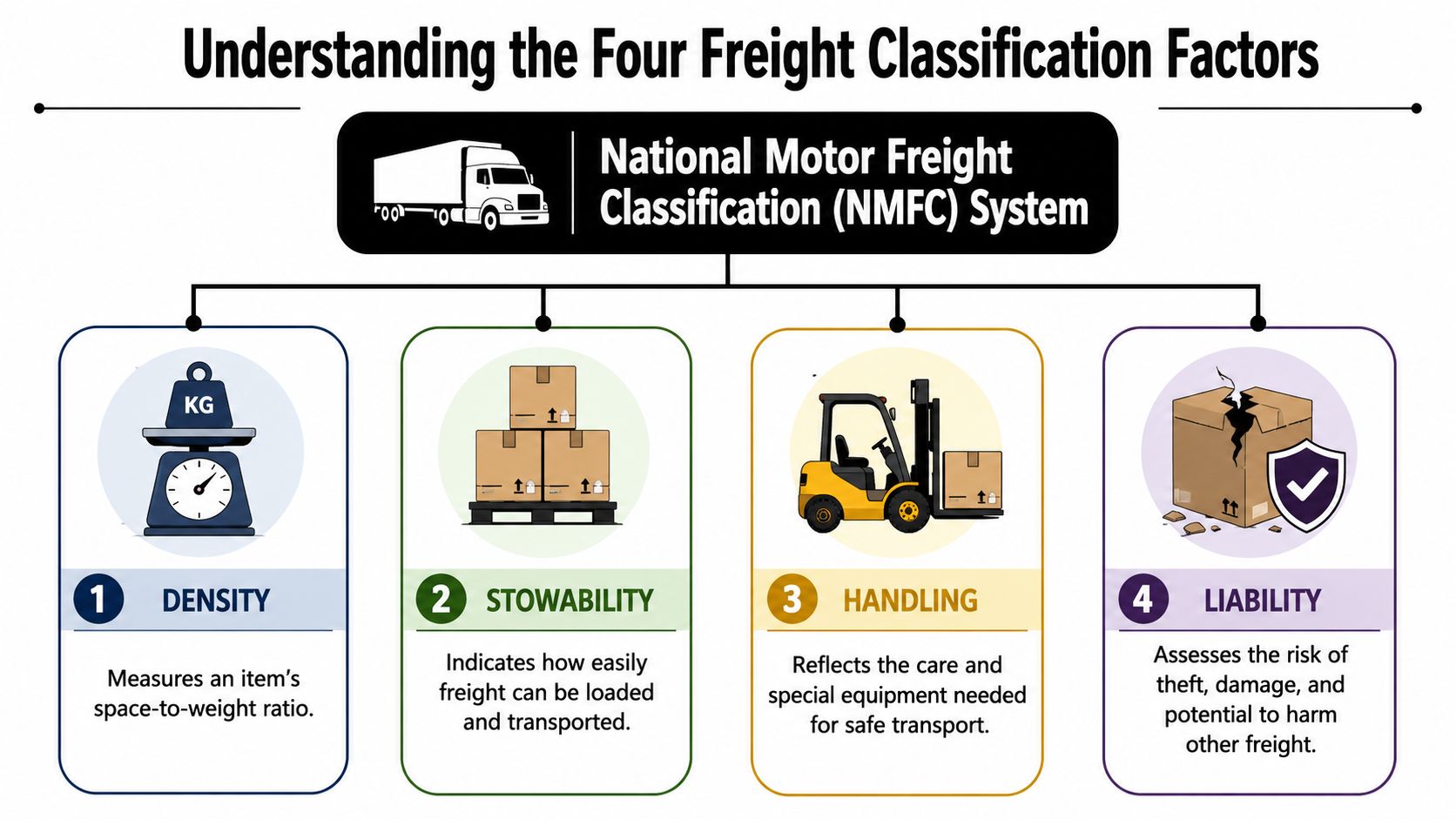
These four factors matter because freight class is not fixed the moment you decide to ship an item. Small businesses often have more control here than they realize. Better packing, tighter dimensions, and clearer paperwork can improve how a shipment fits the carrier’s system.
Density
Density is usually the first place to look because it is the factor you can influence most directly. Carriers prefer freight that packs more weight into less space. A compact, heavy pallet tends to class better than a large pallet with a lot of empty air inside the cartons.
This is why packing decisions affect cost. If you use oversized boxes, add unnecessary pallet overhang, or leave product loose inside the load, you may push the shipment into a higher class than it needs. Pack the freight first, then measure the final dimensions, not the product by itself.
Stowability
Stowability is about how well your freight fits with everything else in a trailer. Carriers want freight that stacks, sits square, and stays within its footprint.
Odd shapes create problems fast. Long items, round items, freight with protruding parts, or pallets with overhang can waste usable trailer space even if the shipment is light. I have seen businesses pay more because a skid was built wider than necessary or the top layer was unstable and could not be stacked.
Good stowability starts in the warehouse. Keep pallets square. Avoid bulges under stretch wrap. If parts stick out, crate them or block them so the load stays clean and uniform.
Handling
Handling comes down to how easy the shipment is to move through terminals without extra labor or extra risk. A pallet of sealed cartons with a solid base is straightforward. A top-heavy machine on a weak pallet is not.
Preventable reclass charges often impact small businesses. If a forklift operator cannot enter the pallet cleanly, if the freight leans, or if loose pieces need special attention, the shipment becomes harder to handle. The product itself may be fine. The packaging creates the problem.
Freight class reflects how the shipment moves through the carrier’s network, not just what the product is.
Use packaging that matches the trip. Strong pallets, even weight distribution, secure strapping, and clear orientation labels can reduce handling concerns before pickup.
Liability
Liability covers the shipment’s risk profile. That includes damage risk, theft risk, contamination risk, and the chance the freight could damage nearby cargo.
High-value electronics, fragile goods, liquids, and items prone to breakage often bring more liability concerns than durable industrial parts. Documentation matters here as much as packaging. If the bill of lading is vague, the declared commodity is incomplete, or the NMFC item does not match the actual shipment, the carrier may reassess what they are taking on.
This is one area where accuracy saves money. Describe the freight clearly, use the correct NMFC item when available, and pack to prevent leaks, crushing, or shifting. Small businesses that treat class as manageable, rather than automatic, usually get fewer surprises after delivery.
A Step-by-Step Guide to Calculating Freight Density
For many small shippers, density is the part you can control most directly. If you want a more accurate quote, start here.
Pack first, then measure
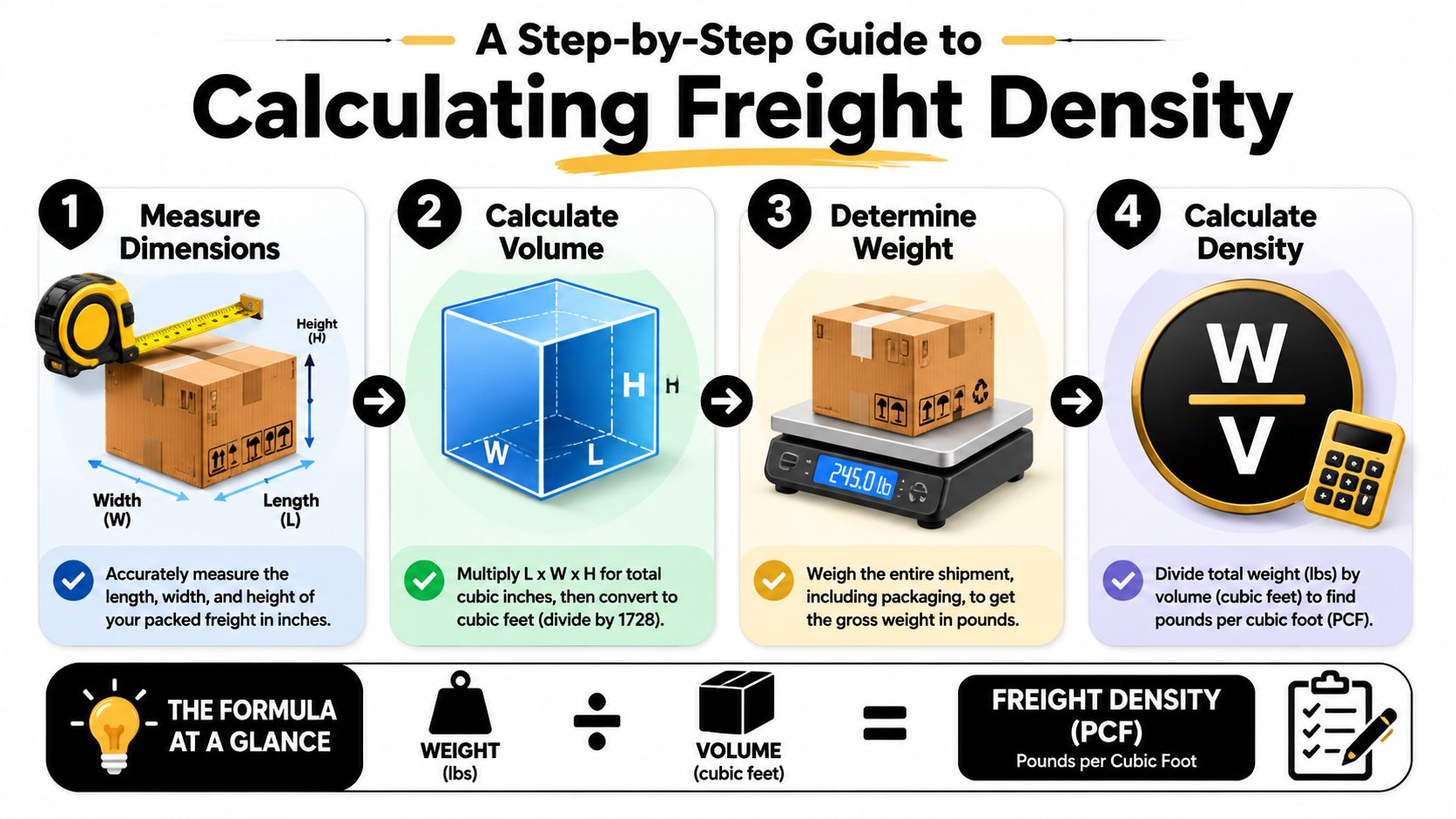
Don’t measure the item by itself if it’s going on a pallet, inside a carton, or wrapped with protective material. Carriers care about the final packed shipment, including the outermost dimensions.
Here’s the process I recommend:
- Pack the shipment completely
Seal the cartons, stretch-wrap the pallet, add corner boards, and strap it if needed. Measure the freight in the condition the carrier will pick up. - Measure length, width, and height in inches
Use the widest, longest, and tallest points. If anything sticks out, include it. - Find the total cubic inches
Multiply length × width × height. - Convert cubic inches to cubic feet
One standard method is to divide by 1,728, as explained in this LTL freight class article from FML Freight and also noted in the verified guidance above.
Before the final calculation, it helps to see the process in motion:
A simple density example
Now finish the calculation.
- Weigh the packed shipment in pounds
Use the total gross weight, not the product-only weight. - Divide weight by cubic feet
That gives you pounds per cubic foot, often shortened to PCF.
A straightforward example looks like this:
- Packed dimensions: 48 in × 40 in × 36 in
- Cubic inches: 48 × 40 × 36
- Cubic feet: cubic inches ÷ 1,728
- Shipment weight: use the full packed weight
- Density: weight ÷ cubic feet
You don’t need to memorize the math. You do need to be disciplined about the order. Pack first. Measure second. Weigh third. Then calculate.
If you measure an unpackaged product and quote from that, you’re usually building error into the shipment before the carrier ever sees it.
The outermost dimensions matter because freight often gains inches from pallets, foam, overboxing, and stretch wrap. Those extra inches can change the density enough to affect the class or trigger a billing correction if your paperwork doesn’t match what the carrier measures.
Common Freight Classes and What They Mean for Your Cargo
Small businesses usually want a shortcut here. They want to know, “Where does my shipment probably land?” That’s a fair question, but freight class works better when you think in ranges rather than one fixed label.
A quick way to read the class scale
In general, higher-density freight tends to fall into lower classes, while very light freight lands in higher-cost classes. One industry guide places class 300 around 2 to 3 lb/ft³, class 400 around 1 to 2 lb/ft³, and class 500 below 1 lb/ft³ according to EmoTrans’ freight class guide.
That pattern explains why a compact pallet usually behaves better on a quote than a large crate that contains mostly air. In LTL freight, size can hurt you more than weight.
Freight class examples by density
| Freight Class | Density (lbs/cubic foot) | Examples |
|---|---|---|
| 50 | Higher-density freight | Steel parts, dense machinery components |
| 70 | Higher-density freight | Compact boxed hardware, heavy metal items |
| 100 | Mid-to-higher density freight | Heavier packaged goods on stable pallets |
| 150 | Mid-range density freight | Mixed commercial shipments with balanced weight and cube |
| 250 | Lower-density freight | Bulkier products that take more room for the same weight |
| 300 | Around 2 to 3 lb/ft³ | Light but fairly bulky freight |
| 400 | Around 1 to 2 lb/ft³ | Large lightweight cartons, bulky consumer goods |
| 500 | Below 1 lb/ft³ | Extremely light, oversized freight such as very airy packaged items |
The examples in the table are directional, not a substitute for the actual NMFC item and shipment details. That’s important because two products that look similar can classify differently if one is fragile, awkward to stack, or packed in a much larger footprint.
A simple way to use this table is to ask three questions before you quote:
- Is the freight compact or bulky? Bulk drives class upward fast.
- Can another pallet sit on top of it? If not, you may have a stowability issue.
- Does the packaging reflect the actual shipment? If the crate or pallet is oversized, density will show it.
Once you start checking your own products this way, freight quotes get less random. You begin to spot which SKUs are naturally efficient and which ones need packaging changes before they ever become profitable to ship.
Smart Packing Strategies to Lower Your Freight Class
This is the part many small businesses miss. They treat freight class like a fixed label attached to the product itself. In practice, packing and palletization often change the outcome.
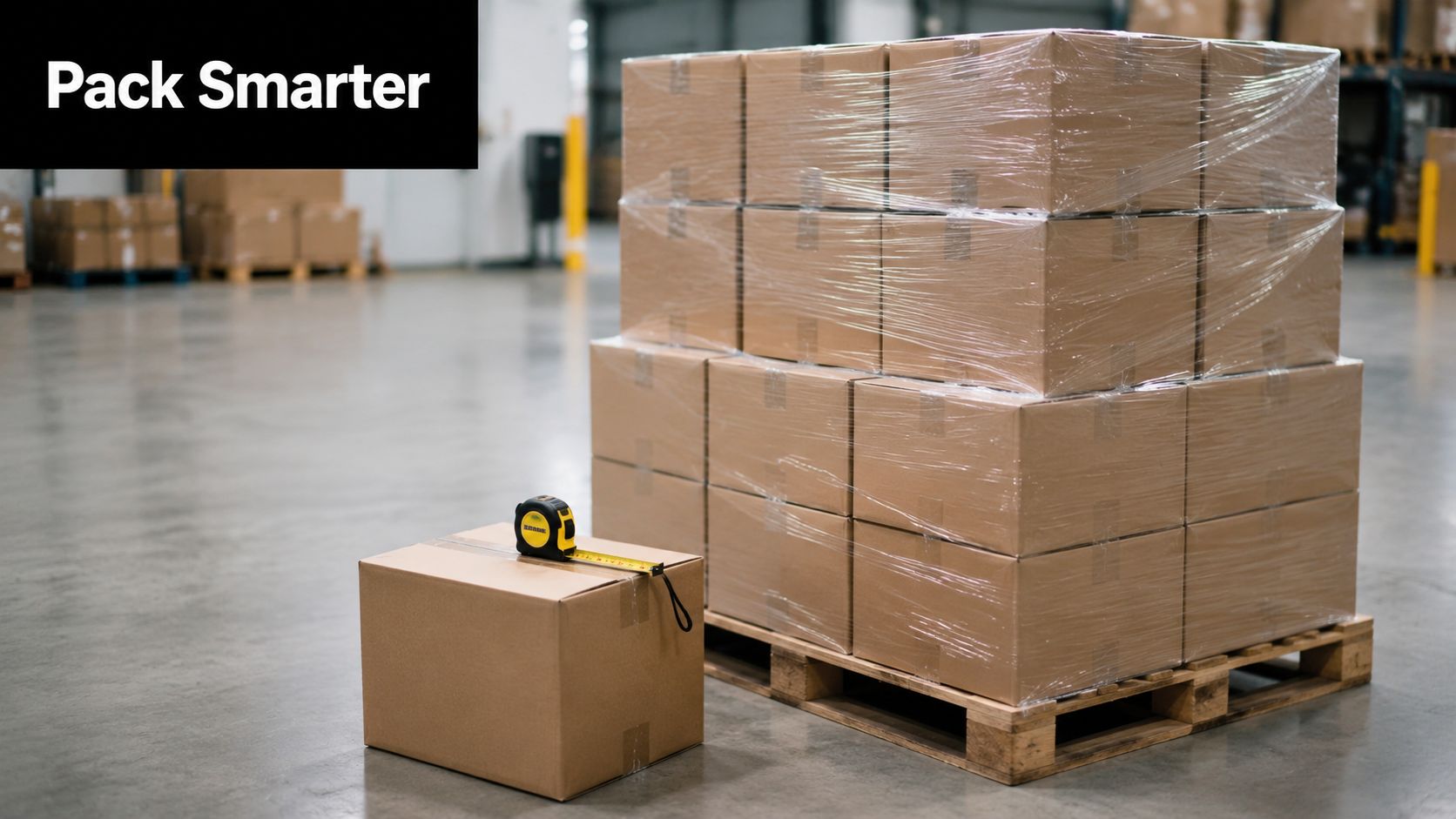
Industry guidance notes that packaging and palletization can change freight class outcomes, and that compacting freight and reducing empty space can lower the effective class and overall shipping cost, as discussed in this article on the role of freight class in volume LTL shipping.
Where small businesses lose money
The usual mistake is overbuilding the package in the wrong way. A shipper uses an oversized carton, adds a lot of filler, then places that box on a pallet that’s bigger than necessary. The product is protected, but the shipment becomes low-density and harder to stow.
Another common problem is splitting freight that could have been consolidated. Several loose cartons may be easy to pack individually, but they often cost more to move than one tight, stable pallet.
Packing moves that usually help
- Right-size the box so you aren’t paying to ship empty air. Protection matters, but wasted cube adds up quickly.
- Build a dense pallet by keeping cartons flush, square, and tightly stacked. A neat pallet usually performs better than a scattered one.
- Reduce overhang and void space because both can hurt density and handling.
- Use protective materials that don’t add unnecessary bulk. The goal is safe freight, not oversized freight.
- Consolidate compatible pieces when one combined pallet creates a better footprint than several awkward packages.
If you need materials or want to compare box sizes, local access helps. A practical starting point is finding shipping supplies near Sugar Land so you can test smaller cartons, better pallet wrap, and sturdier packaging before you lock in your process.
The cheapest freight quote often starts in the packing area, not in a rate negotiation.
The best results usually come from treating packaging as a cost-control tool. Same product. Same destination. Different cube. Different class outcome.
Common Classification Mistakes and How to Avoid Them
You quote a job on Monday, the freight gets picked up on Tuesday, and the invoice shows up higher than expected on Friday. Small businesses run into this all the time. In my experience, the problem usually starts before the truck arrives.
A common mistake is treating freight class like a rough estimate instead of a documentable detail. If the carrier inspects the shipment and finds different dimensions, weight, or packaging than what was listed, the class can be corrected after pickup. That usually means a revised invoice, and sometimes a customer service mess you did not plan for.
Another mistake is measuring the item you sell instead of the shipment you tender. The carrier rates the freight that shows up at the dock. Pallet footprint, final height, wrap bulge, corner boards, and anything hanging over the edge all count. A product spec sheet does not protect you if the finished pallet is larger than the paperwork says.
Paperwork causes plenty of trouble too. Descriptions like “parts,” “supplies,” or “equipment” are easy to type, but they are weak on a bill of lading. If the description is vague, the shipment is harder to classify cleanly and easier to question in an audit.
The fix is not complicated. It just has to be consistent.
Use this checklist before pickup:
- Measure the finished freight, not the product before packing
- Weigh the shipment after it is fully packed and ready to move
- Use a specific commodity description that matches what is on the pallet
- Check that the BOL, quote request, and labels all describe the same shipment
- Keep a quick photo and your measurements on file in case the class is challenged later
That last step helps more than people expect. If a carrier rebills a shipment, having a dated photo and recorded dimensions gives you something concrete to review instead of relying on memory.
Small businesses have more control here than they think. Freight class is not just something handed down by the carrier. You can influence the result by packing carefully, measuring the final shipment correctly, and documenting it clearly the first time.
If your team does not ship freight often, getting a second set of eyes can save money. A local shop that offers freight shipping services for packing, measuring, and freight paperwork can help catch classification problems before they turn into rebills. If you are comparing outside support options, this guide on what is a 3PL provider gives useful context on when third-party help makes sense.
If the pallet on the dock does not match the paperwork, the final invoice often will not match the quote either.
Let the Experts Handle Your Freight Shipping
Freight class gets much easier when you stop treating it like a billing code and start treating it like an operating process. Measure accurately. Pack for density. Describe the freight clearly. Those three habits solve a surprising number of shipping problems before they start.
When outside help makes sense
If your shipments vary a lot, outside support can save time. A shop that handles freight regularly can help you weigh the shipment, check final dimensions, prepare the bill of lading, and spot packaging problems that push a load into a worse class than necessary. If you’re sorting through provider options, this primer on what is a 3PL provider gives a useful overview of where third-party support fits.
For local businesses that want hands-on help, freight shipping services at Business Mail Boutique LLC are one practical option for getting a shipment measured, packed, quoted, and documented in one place.

The main point is simple. You don’t have to accept freight class as an uncontrollable cost. Small businesses can influence it. Better packing, better measurements, and better paperwork usually lead to fewer surprises and more dependable freight spend.
If you’re planning an LTL shipment and want help getting the class, packing, and paperwork right, Business Mail Boutique LLC can help you prepare the freight before it turns into an expensive correction on the invoice. Bring in your shipment details, dimensions, or packed pallet, and get practical support for quotes, documentation, and freight coordination.

Related posts

Custom Memorial Glasses Engraved in Three Hours in Sugar Land
When a customer needed eight personalized glasses for a memorial, Business Mail Boutique completed the engraving or...

Custom Martini Glass Engraving in Sugar Land, TX
Custom Logo Engraving on Martini Glasses in Sugar Land, Texas.
Business Mail Boutique recently completed a beautiful custom engravin...

Custom Engraved Wine Glasses for a Golf Club Event in Sugar Land, TX
Custom Engraved Wine Glasses for a Golf Club Event in Sugar Land.
Custom wine glass engraving in Sugar Land, TX at Business Mail Bouti...