
- Print Business Cards in Sugar Land – Same Day Service
- Copying Services
- Document Printing, Finishing & Lamination in Sugar Land
- Flyers
- Print Banner in Sugar Land | Same-Day Banner Printing Near Me
- Graphic Design
- Photo Printing
- Postcard Printing
- Document Printing
- EDDM Full Service Postcards
- FotoZoomer Large Format Printing


Comb Binding vs Coil Binding: A Practical Guide for 2026
Businessmailboutique
11645 S. Hwy 6
Sugar land, Texas 77498 United States (US)
Email: info@businessmailboutique.com
At the print counter, this comes up all the time. A sales deck needs to look clean in a client meeting. A training manual needs page updates next month. A field workbook needs to survive being opened all day. The paper is already printed, but the document still isn’t finished until the binding matches how people will use it.
For most small business jobs, the primary decision involves comb binding vs coil binding. Both are common. Both can look professional. Both solve different problems. The trick is choosing the one that fits your document, your deadline, and how much flexibility you need after it leaves the shop.
If you’re also protecting pages from spills, heavy handling, or repeated use, pairing the right binding with lamination and document finishing options can make the final piece hold up much better in day-to-day use.
Table of Contents
- Choosing the Right Finish for Your Project
- An Overview of Comb and Coil Binding
- Comb vs Coil A Detailed Comparison
- Analyzing Cost and Project Turnaround Time
- Best Use Cases for Each Binding Style
- Our Recommendation at Business Mail Boutique
- Your Document Binding Checklist
Choosing the Right Finish for Your Project
A Sugar Land business owner walks in with two printed sets of documents. One is a proposal for a client meeting tomorrow morning. The other is an internal training packet that the staff will revise after the next policy update. On paper, both look fine. In use, they need different finishes.
That’s where binding stops being a cosmetic choice and becomes a practical one. If the proposal needs to feel polished and stay intact through repeated handling, one option usually rises to the top. If the training packet will change, a different option makes more sense even if it looks a little more utilitarian.

The mistake is treating all bound documents the same. A handbook, a workbook, a menu draft, a board packet, and a leave-behind sales presentation don’t live the same life after printing. Some get tossed in a bag, some sit on a conference table, and some get revised again and again.
Practical rule: Bind for the way the document will be used, not just the way it looks on pickup day.
The decision most owners are actually making
Most customers aren’t asking for plastic combs or coils because they care about binding hardware. They’re asking for a finished document that does one of two things well.
- Stays flexible for updates. This matters for staff manuals, draft reports, and operating procedures.
- Holds up under frequent use. This matters for workbooks, field guides, presentation books, and notebooks.
If you sort your project into one of those two categories first, the rest of the decision gets easier. The details matter, but the purpose matters more.
What works in a real print-shop setting
In-store, the best binding choice usually comes from three quick questions: Will this document change later? Will people fold it back while using it? Does the page count push the limit of the binding style?
Those answers narrow the options fast. From there, you’re not guessing. You’re choosing a finish that supports the document instead of fighting it.
An Overview of Comb and Coil Binding
If you’ve never looked closely at the hardware, the easiest way to understand comb binding and coil binding is to imagine two different hole patterns and two different ways of holding pages together.
Comb binding uses rectangular holes punched along the edge of the document. A plastic spine with curved teeth snaps into those holes. That plastic comb can be opened and closed again, which is why it’s often used for documents that might need changes later.
Coil binding uses small round holes punched along the edge. A continuous coil is spun through those holes and then crimped at both ends so it stays in place. Once it’s finished, it forms a more permanent spine.
If you’re preparing files before bringing them in, it helps to think about the final assembly step while ordering your document printing and pickup service, especially if your project includes covers, tabs, or mixed paper stocks.
How comb binding works in practice
Comb binding is straightforward. The pages are punched, the comb is opened on a machine, and the punched sheets are placed onto the spine. Then the comb closes around them.
That physical design creates its biggest advantage. You can reopen the comb later and add, remove, or reorder pages without destroying the whole document.
How coil binding works in practice
Coil binding takes a different path. After the round holes are punched, the coil is threaded through the stack. The ends are then crimped so the coil doesn’t unwind.
That gives the document a tighter, more finished feel. It also means edits after assembly are less convenient because changing pages usually requires cutting off the coil and rebinding the book.
A lot of customers decide correctly as soon as they hold a sample. Comb feels adjustable. Coil feels more final.
Why the mechanics matter
This isn’t just shop talk. The hole pattern and spine style directly affect how the document behaves on a desk, in a briefcase, or out in the field.
A comb-bound book usually suits office use where flexibility matters. A coil-bound book usually suits repeated handling where movement and durability matter more. Once you understand that mechanical difference, most of the later trade-offs make sense.
Comb vs Coil A Detailed Comparison
A Sugar Land business owner usually gets to this choice at the counter with a real deadline. The file is approved, the meeting is on the calendar, and the question is no longer “what is comb or coil?” It is “which one will hold up, look right, and still fit the schedule?”
That is the useful comparison.
| Criteria | Comb Binding | Coil Binding |
|---|---|---|
| Editability | Reopen spine and change pages | Usually requires cutting and rebinding |
| Durability | Better for lighter to moderate office use | Better for frequent handling |
| Page movement | Opens flat | Opens flat and folds back on itself |
| Appearance | Functional, office-friendly | Cleaner, more finished look |
| Thick document handling | Higher mechanical capacity at the top end | Slightly lower than comb at the top end |
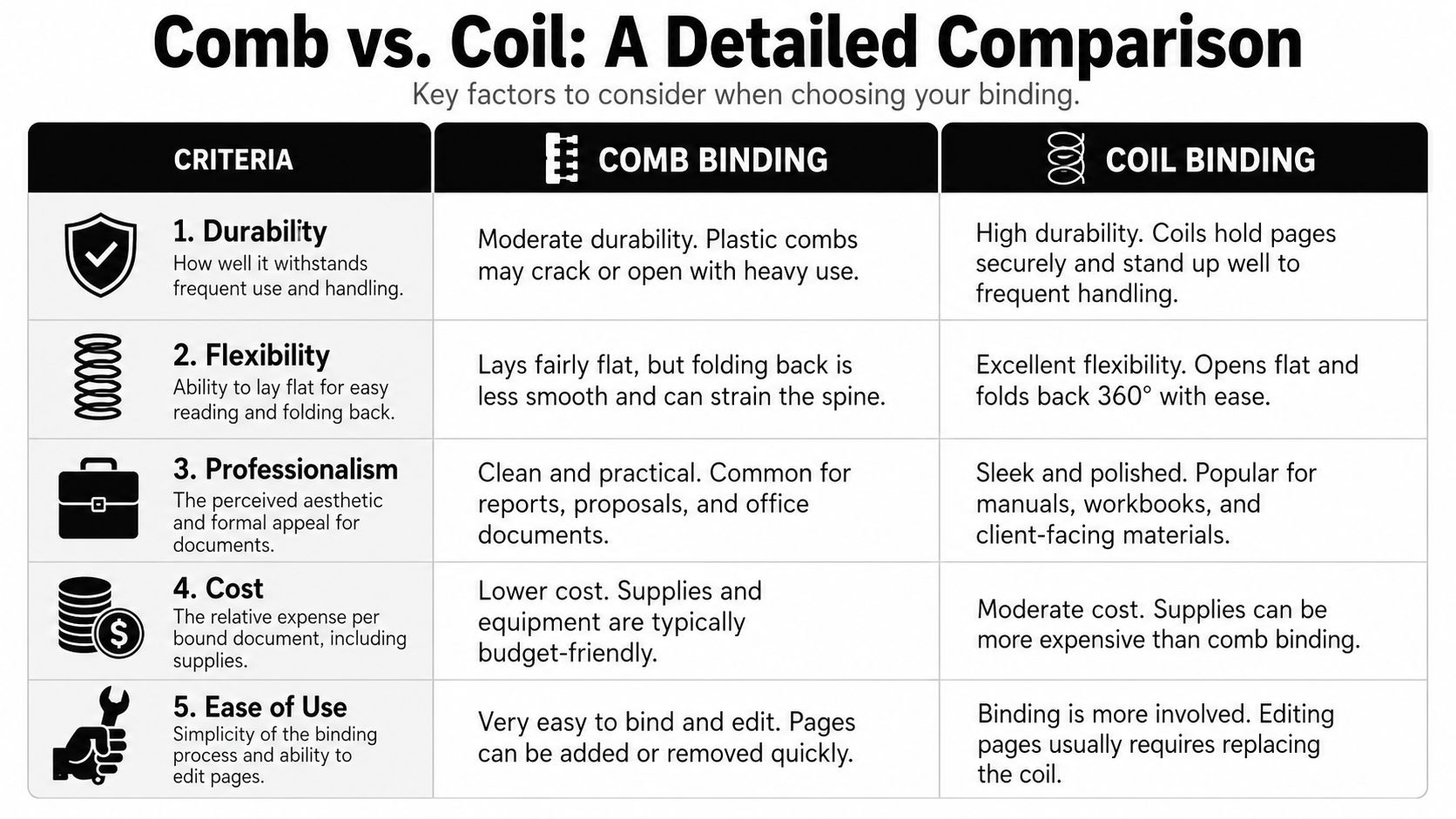
Durability and editability
This is usually the deciding factor at our print counter.
Comb binding gives you room to correct the job later. If a trainer updates a policy page next week or your office adds a revised pricing sheet before distribution, the comb can be reopened and the set can be updated without rebuilding every book from scratch. For internal manuals, draft proposals, and handouts that tend to change, that flexibility saves hassle.
Coil binding asks for a cleaner final decision. Once the coil is in and the ends are crimped, page changes usually mean cutting the coil off and rebinding the document. In return, the book tends to handle repeated flipping, carrying, and daily use better.
For a small business, the practical question is simple. Will this document change after pickup, or does it need to survive steady handling with minimal fuss?
Appearance and client perception
The difference shows up fast in person.
Comb binding looks functional and familiar. It fits internal packets, staff guides, board drafts, and working documents where nobody expects a polished presentation piece. In those settings, the editable look is not a drawback. It matches the job.
Coil binding has a tighter, more finished appearance. The spine looks cleaner, the pages turn smoothly, and the book usually feels more presentation-ready in a client meeting, sales call, or workshop.
At Business Mail Boutique, I often tell customers to match the binding to the moment the document will be used. If it is being reviewed, revised, or marked up, comb makes sense. If it is being handed to a customer, carried to a job site, or used as a finished workbook, coil usually fits better.
How the pages move in use
This part matters more than many online comparisons suggest.
Both styles open flat, which helps on a desk or conference table. Coil also folds back on itself, so the user can hold a manual in one hand without fighting the spine. That is useful for training booklets, field instructions, checklists, and workbooks used while walking around.
Comb works well for desk use. It is less convenient for mobile use because the spine is bulkier and does not fold back as neatly.
If you need bound books on a tight deadline for an event or staff training, our guide to same-day rush printing success can help you plan the job with fewer last-minute surprises.
Capacity and document thickness
Very thick documents can narrow your options before price or appearance enters the conversation.
Comb usually has the advantage at the high end of sheet capacity. Coil handles plenty of standard business documents, but once a manual gets thick enough, comb may be the simpler way to keep it in one volume instead of splitting it into two. That is one reason we like to check page count, paper stock, and covers together before recommending a binding style.
If you are still balancing specs and production choices, this resource can help you understand your book printing budget before you finalize the format.
Production and finishing differences
Comb is more forgiving during assembly. If a late page replacement comes in before the job is finished, corrections are easier to make without starting over.
Coil rewards clean approvals. Once the file is final, the finished piece usually feels sturdier and more refined, but it gives you less room for late changes.
That is why local turnaround matters in the actual buying process. A Sugar Land customer who needs books by tomorrow may choose comb if the content is still shifting. A customer with an approved file and a client-facing presentation often chooses coil, even if it costs a bit more, because the finished result better matches the use case.
Analyzing Cost and Project Turnaround Time
Budget conversations usually start with the unit price, but finishing choices affect labor too. Hole punching, inserting binding elements, and completing the final assembly all add steps that simple glued or stapled formats don’t require.
What affects the price
Mechanical binding methods, including comb and coil, cost at least 20% more than perfect binding, according to Printing Industry of America’s industry pricing note. That gap exists because mechanical binding adds manual production steps that adhesive formats don’t require.
Within the mechanical category, comb is generally the more economical path and coil usually runs a bit higher. That doesn’t make comb the automatic budget choice. If a document needs to withstand frequent handling, rebinding damaged copies later can cost more in time and hassle than choosing the sturdier format upfront.
If you’re pricing a larger publication project and want a broader framework for how finishing choices affect total production, this guide can help you understand your book printing budget before you lock in specs.
What affects the schedule
Turnaround doesn’t depend on binding alone. It depends on file readiness, paper availability, cover stock, page count, proof approval, and whether the order is straightforward or keeps changing.
Comb binding is often easier to manage when the content is still in motion. Late page swaps are less painful. Coil binding is smoother when the file is final and nobody plans to touch it again after production starts.
For rush jobs, the question isn’t “Which one is faster in theory?” It’s “Which one creates fewer chances for rework on this specific project?” If your team is notorious for sending revised pages after approval, comb can save time by absorbing those changes more gracefully. If the document is locked and the job just needs to move, coil is often a clean finish.
For businesses with tight deadlines, local production matters because you can confirm specs, catch issues early, and coordinate pickup through a same-day printing workflow for rush jobs instead of waiting on a mail-order correction cycle.
The binding that saves time is the one that fits the way your team actually works. Fast production falls apart when the file isn’t stable.
Best Use Cases for Each Binding Style
A Sugar Land business owner usually asks this at the counter after the file is already done. “Will this stay in the office, or will people carry it around and use it every day?” That question gets to the answer faster than a generic online comparison.
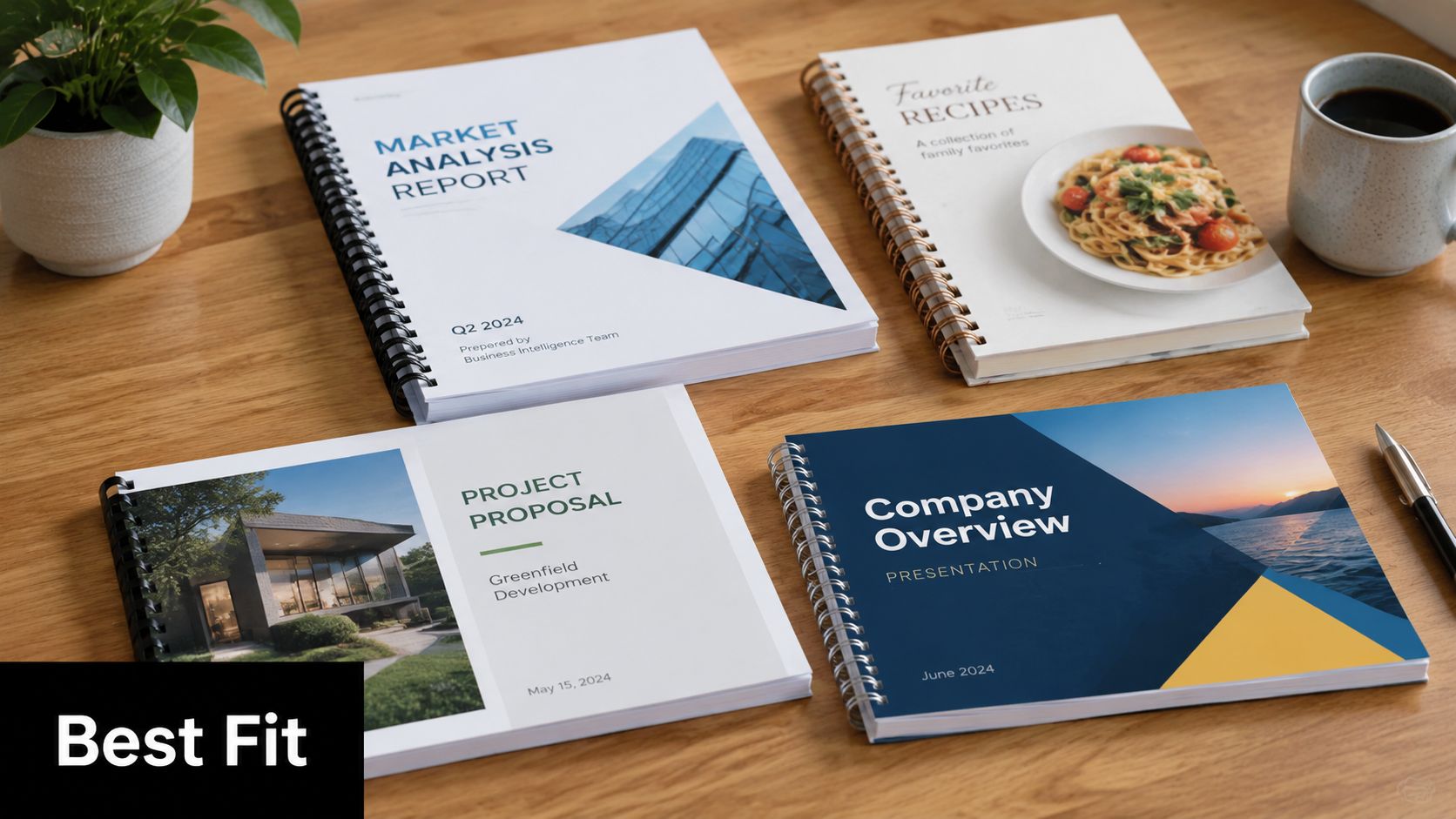
When comb binding makes more sense
Comb binding fits documents that are still subject to change. If pages may need to be replaced, added, or reordered after the first print run, comb is usually the easier choice.
That matters for practical office jobs such as:
- Employee training packets with policy updates, new forms, or department-specific inserts
- Draft planning books that will be reviewed, marked up, and revised
- Operations manuals that change as software, staffing, or procedures change
- Proposal sets where pricing, scope, or schedules may be updated after client feedback
Comb also works well for lower-stress use. If the book will sit on a desk, go into meetings, or circulate internally for a short period, the ability to reopen it often matters more than a tougher finished look.
At the print counter, this is usually the right pick for teams that say, “We may need to swap a few pages next week.”
When coil binding is the better fit
Coil binding fits documents that are final and meant to be used hard. Pages turn smoothly, the book can fold back on itself, and the finished piece tends to hold up better in shared or mobile use.
Typical coil jobs include:
- Workbooks and course materials used in repeated training sessions
- Field manuals that travel between job sites, vehicles, and desks
- Reference guides kept open on a counter, bench, or workstation
- Presentation books that need a cleaner finished appearance
- Recipe books, instruction books, and directories that benefit from easy page movement
A quick visual example helps if you want to see how spiral formats behave in use:
Coil is often the safer choice for customer-facing or daily-use pieces. If several people will handle the same book over time, durability and lay-flat performance usually outweigh the ability to reopen the binding later.
A quick in-store checklist
For Business Mail Boutique customers, the decision is usually straightforward once these points are answered:
- Will the content change after printing? Choose comb if yes.
- Will the book be used daily or carried around? Choose coil if yes.
- Does it need to fold back flat during use? Coil handles that better.
- Is this mainly for internal review or short-term use? Comb often makes more sense.
- Do you need the job finished quickly with materials available locally? Ask what is in stock before locking the binding style.
That last point matters more than online guides admit. In a local shop, the best option is not only about theory. It is also about what can be produced cleanly, on schedule, with the covers, stock, and binding color available for your deadline.
A simple rule works for most orders. Choose comb for documents that may change. Choose coil for documents that are finished and need to stand up to regular use.
Our Recommendation at Business Mail Boutique
For most local business orders, the recommendation comes down to one practical question. Is this document still evolving, or is it finished?
Choose comb binding when your team expects revisions, page inserts, or reordered sections. That’s common with internal manuals, onboarding materials, draft board packets, and proposal sets that may change after review.
Choose coil binding when the document is final and people will handle it regularly. That usually fits workbooks, reference guides, training books used on the floor, and presentation materials that need a more polished feel in the hand.
A lot of small businesses don’t need a long theory session. They need a fast decision that avoids rework. In that setting, the most useful advice is simple:
- Pick comb for flexibility
- Pick coil for everyday use
- Check page count early if the document is unusually thick
- Lock the final file before choosing coil
For customers comparing local finishing options, Business Mail Boutique LLC handles document printing and finishing in one place, which is useful when you need to confirm paper, covers, and binding together instead of piecing the job out across different vendors.
Your Document Binding Checklist
Before placing your order, gather the answers to these questions. They’ll prevent the usual delays and help the print counter steer you to the right finish faster.
Ask these before you bind
- What’s the document for
A draft handbook, a client proposal, a workbook, and an operations guide don’t need the same binding behavior. - Will pages change later
This is often the deciding factor. If the answer is yes, say so before production starts. - How will people hold it
Desk reading and fold-back use are different. The way the document is handled should drive the choice. - How thick is the stack
Very large manuals can push the limits of mechanical binding, so bring the full page count early. - Is the job routine or urgent
Rush timelines leave less room for file changes and finishing surprises.
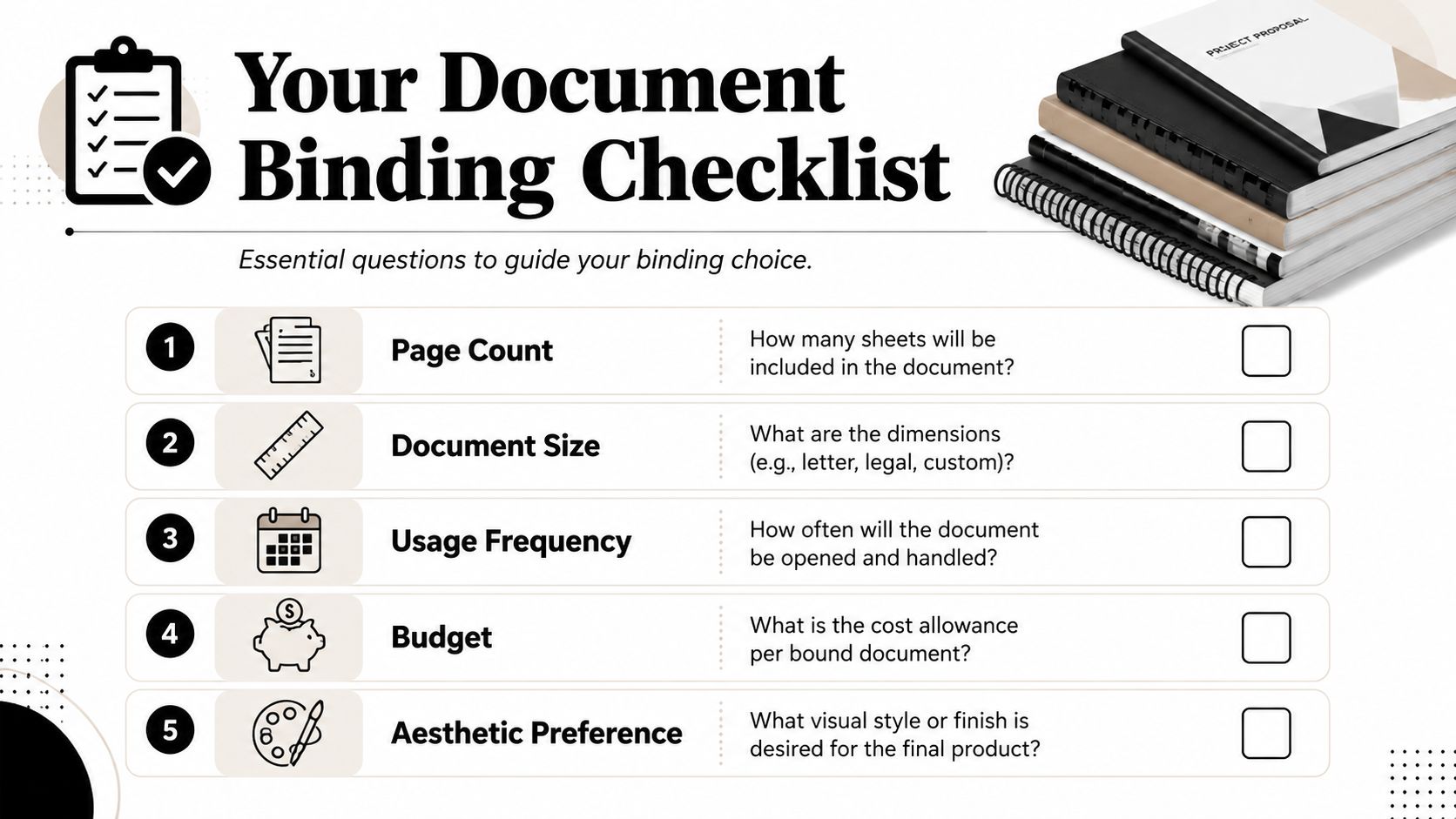
What to bring with your order
A smooth order usually starts with complete information, not just a PDF attachment.
Bring or send:
- Your final file version, clearly labeled so nobody binds the wrong draft.
- The expected use case, such as training, presentation, field use, or internal review.
- Any cover preferences, including clear front covers or heavier back stock if needed.
- Your deadline, especially if pickup timing matters.
- Questions about revisions, because those should be addressed before the bind style is locked in.
Bring the use case, not just the file. The file shows what you printed. The use case determines how it should be finished.
If you need help choosing between comb binding and coil binding, Business Mail Boutique LLC can review your document specs, intended use, and timing so you can order the right finish the first time.

Related posts

Custom Memorial Glasses Engraved in Three Hours in Sugar Land
When a customer needed eight personalized glasses for a memorial, Business Mail Boutique completed the engraving or...

Custom Martini Glass Engraving in Sugar Land, TX
Custom Logo Engraving on Martini Glasses in Sugar Land, Texas.
Business Mail Boutique recently completed a beautiful custom engravin...

Custom Engraved Wine Glasses for a Golf Club Event in Sugar Land, TX
Custom Engraved Wine Glasses for a Golf Club Event in Sugar Land.
Custom wine glass engraving in Sugar Land, TX at Business Mail Bouti...