
- Print Business Cards in Sugar Land – Same Day Service
- Copying Services
- Document Printing, Finishing & Lamination in Sugar Land
- Flyers
- Print Banner in Sugar Land | Same-Day Banner Printing Near Me
- Graphic Design
- Photo Printing
- Postcard Printing
- Document Printing
- EDDM Full Service Postcards
- FotoZoomer Large Format Printing


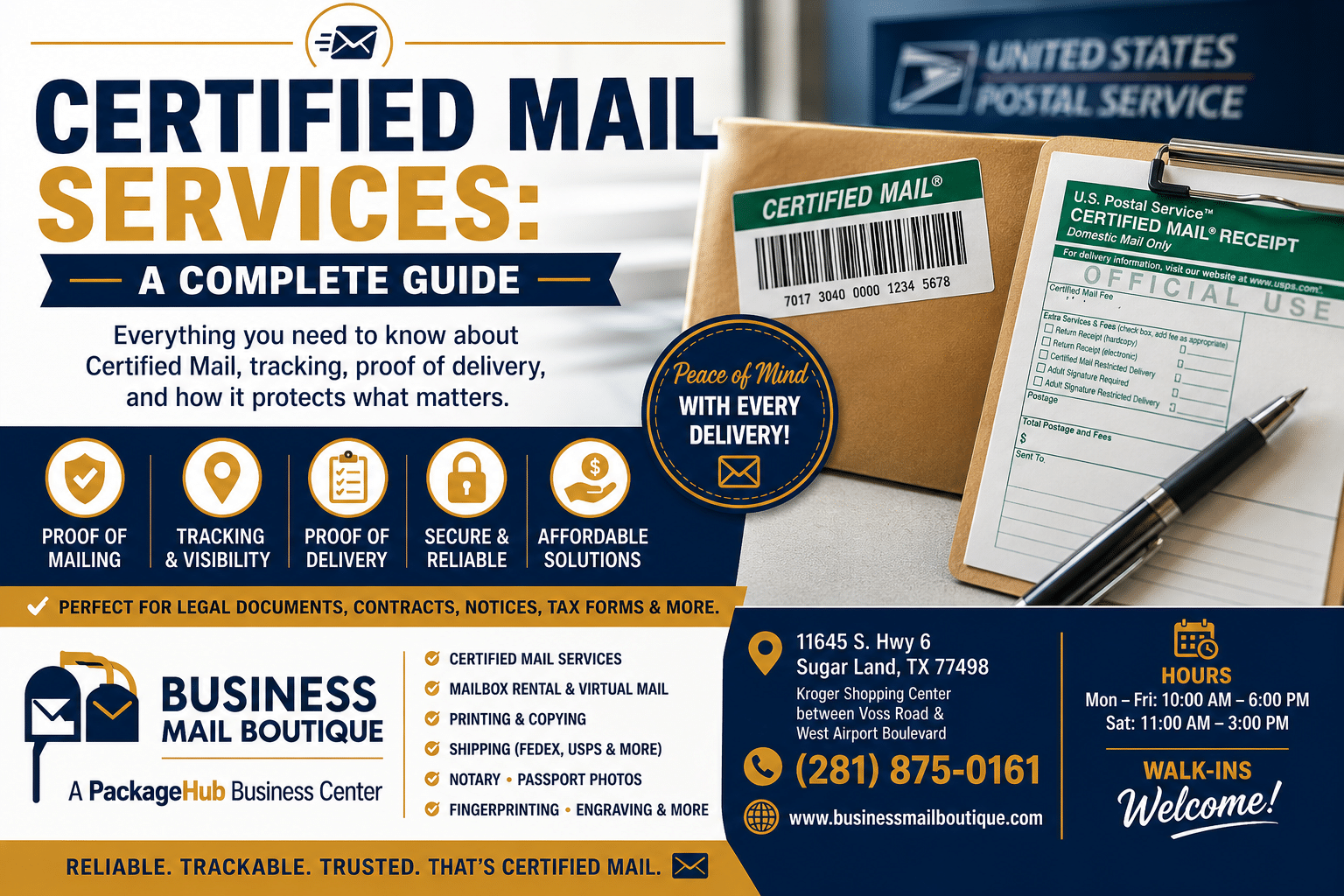
Certified Mail Services: A Complete Guide for 2026
Businessmailboutique, 11645 S. Hwy 6, Sugar land, Texas 77498, United States (US) - Phone: 281-875-0161 Email: info@businessmailboutique.com
Route
You’re usually looking for certified mail services at a very specific moment. A lease notice has to go out. A client termination letter needs a paper trail. Tax paperwork must reach the right office, and you can’t afford a dispute later over whether it was mailed or delivered.
That’s why certified mail still matters. It gives you documentation at the point of mailing, visibility while the item moves through the system, and delivery evidence when receipt matters. For a small business owner, landlord, accountant, office manager, or individual handling a formal notice, that record can be the difference between a clean file and a messy argument.
Table of Contents
- What Is Certified Mail and Why Does It Matter
- Certified Mail vs Registered and Other Services
- Understanding Key Features and Pricing
- How to Send Certified Mail Step by Step
- Common Use Cases for Certified Mail
- Frequently Asked Questions About Certified Mail
What Is Certified Mail and Why Does It Matter
Certified Mail is for mail that has consequences.
If you’re sending a payment demand, a legal notice, a contract cancellation, or a formal employee communication, standard mail often isn’t enough. You may need to show when you sent it, that USPS accepted it, and whether delivery was completed or attempted. That’s the practical reason people use certified mail services.
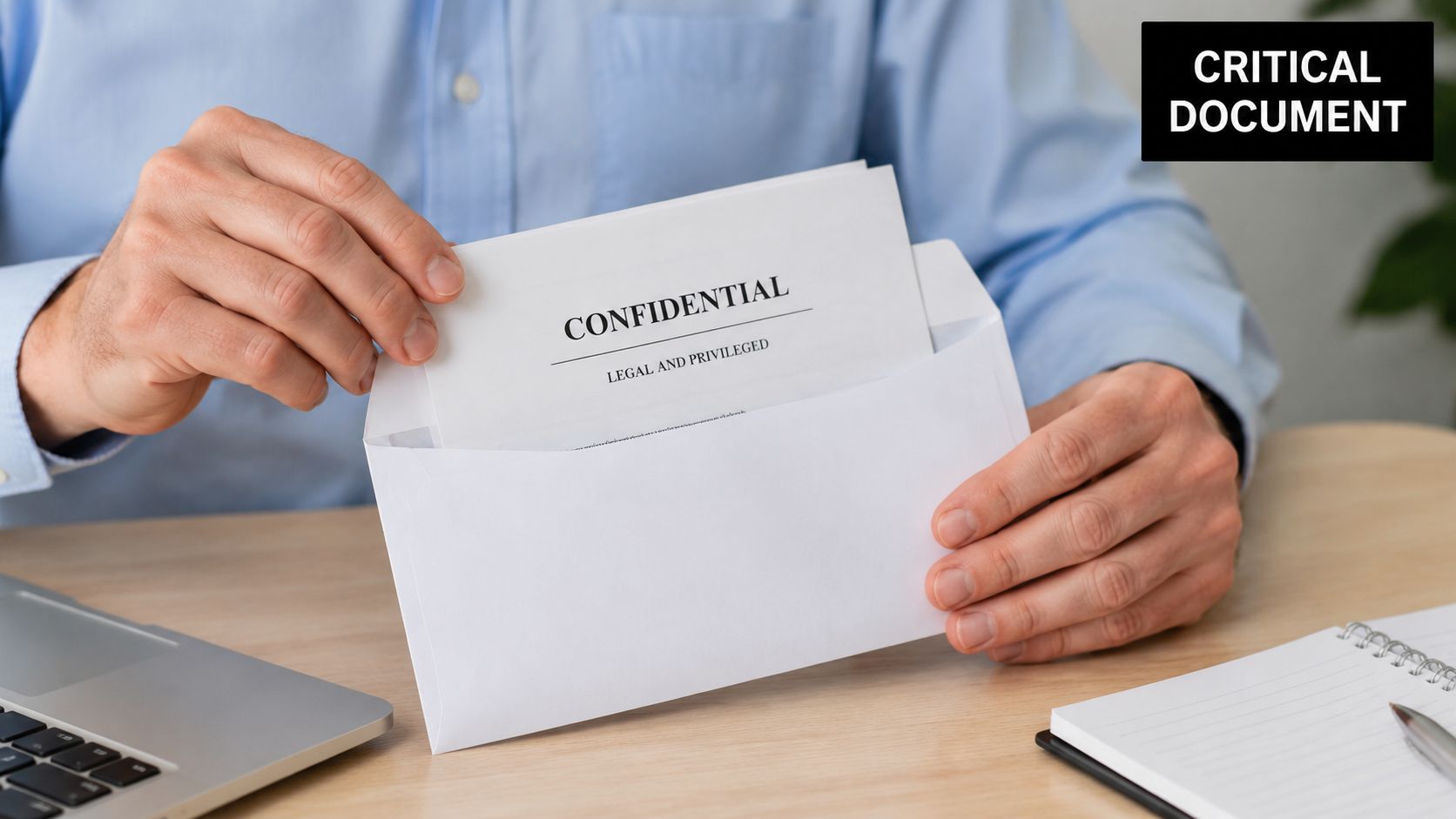
What Certified Mail actually is
A lot of people assume Certified Mail is its own shipping category. It isn’t. USPS says it’s an extra service added to First-Class Mail or Priority Mail, which means the piece still travels through the normal mail stream while the service adds the documentation and tracking record that make it useful for formal correspondence, as explained in the USPS Certified Mail guidebook.
That distinction matters. Certified Mail doesn’t exist to make delivery faster. It exists to create an official chain of evidence around an otherwise ordinary mailpiece.
What you receive when you send it
At the counter, the sender gets proof of mailing. That’s the acceptance record showing the item entered the USPS system. The mailpiece also gets a unique tracking number, so you can follow its movement and later check delivery status.
If you add a return receipt option, you also get proof of delivery tied to the recipient’s signature or delivery record. For many formal notices, that’s the part that matters most.
Practical rule: If the letter could end up in court, in an audit file, or in an HR dispute, send it with tracking and retain every receipt.
Why small businesses rely on it
Small businesses often don’t need armored transport or maximum-security handling. They need something simpler. They need a reliable way to prove they mailed an important document and to show what happened after that.
That’s why certified mail services fit so many day-to-day tasks:
- Lease and property notices: Landlords and managers need a clear mailing record.
- Client and vendor disputes: A dated, trackable notice is stronger than “we emailed them.”
- Tax and compliance mail: Formal correspondence often needs documented delivery history.
- Personnel matters: Sensitive notices need more than a casual envelope.
For businesses already mailing invoices, forms, and notices through routine channels, Certified Mail is practical because it layers onto the same workflow. If you already use a local shipping and mailing service in Sugar Land, adding Certified Mail is usually about choosing the right service level, not rebuilding your process.
Certified Mail vs Registered and Other Services
People often ask the wrong question. They ask, “Which mailing service is best?” The better question is, “What proof do I need if someone challenges this later?”
Certified Mail is built for documents where mailing evidence and delivery evidence matter. Registered Mail is used when security and custody matter more. Priority Mail is about transit class. Standard First-Class Mail works when documentation isn’t the main concern.
USPS Mail Services Compared
| Service | Proof of Mailing | Tracking | Proof of Delivery (Signature) | Best For |
|---|---|---|---|---|
| Certified Mail | Yes | Yes | Available with signature-based options | Legal notices, compliance letters, formal business correspondence |
| Registered Mail | Yes | Yes | Yes | High-security or highly sensitive mailpieces |
| Priority Mail | Basic acceptance record may be available depending on transaction method | Yes | Not the main purpose | Faster routine mail and packages |
| First-Class Mail | Usually no formal evidentiary service attached by default | Limited or none for ordinary letters | No | Everyday correspondence |
When Certified Mail is the right choice
Certified Mail makes sense when the contents are important, but the envelope itself isn’t a high-value object. Think notice letters, signed documents, account demands, and regulated communications.
It gives you what most small businesses need:
- A dated acceptance record
- A trackable USPS article number
- A delivery record that can be retrieved later
- Optional signature confirmation for stronger documentation
This is why many people choose Certified Mail instead of paying more for a faster service.
When another service is better
Registered Mail is the stronger choice when the issue is security, not just proof. If the item is unusually sensitive or valuable in physical form, Certified Mail may not be enough.
Priority Mail is useful when speed matters more than formal evidence. If you’re sending a presentation packet or time-sensitive but non-disputed paperwork, speed may be the deciding factor. Standard First-Class Mail is fine when there’s no likely challenge and no reason to preserve a formal trail.
Don’t use a premium service just because the document feels important. Match the service to the risk. For most formal letters, the risk is a future dispute over mailing or receipt, not theft in transit.
A related issue is delivery address quality. If you’re deciding between commercial mailbox options and traditional postal box use, this guide on private mailbox vs. P.O. Box differences is worth reviewing because the delivery destination can affect how recipients retrieve important mail.
Understanding Key Features and Pricing
The useful part of certified mail services isn’t the green label by itself. It’s the set of proof options you attach to the mailing.
The strongest technical advantage is the signature-bound proof chain. USPS records mailing acceptance, assigns a unique article number, and retains delivery evidence that can be retrieved. The recipient’s signature is captured at delivery, and the Certified Mail add-on fee was reported at $4.40 in 2024-era pricing references, in addition to postage, which makes the cost model straightforward rather than distance-driven, according to this Pitney Bowes explanation of Certified Mail.
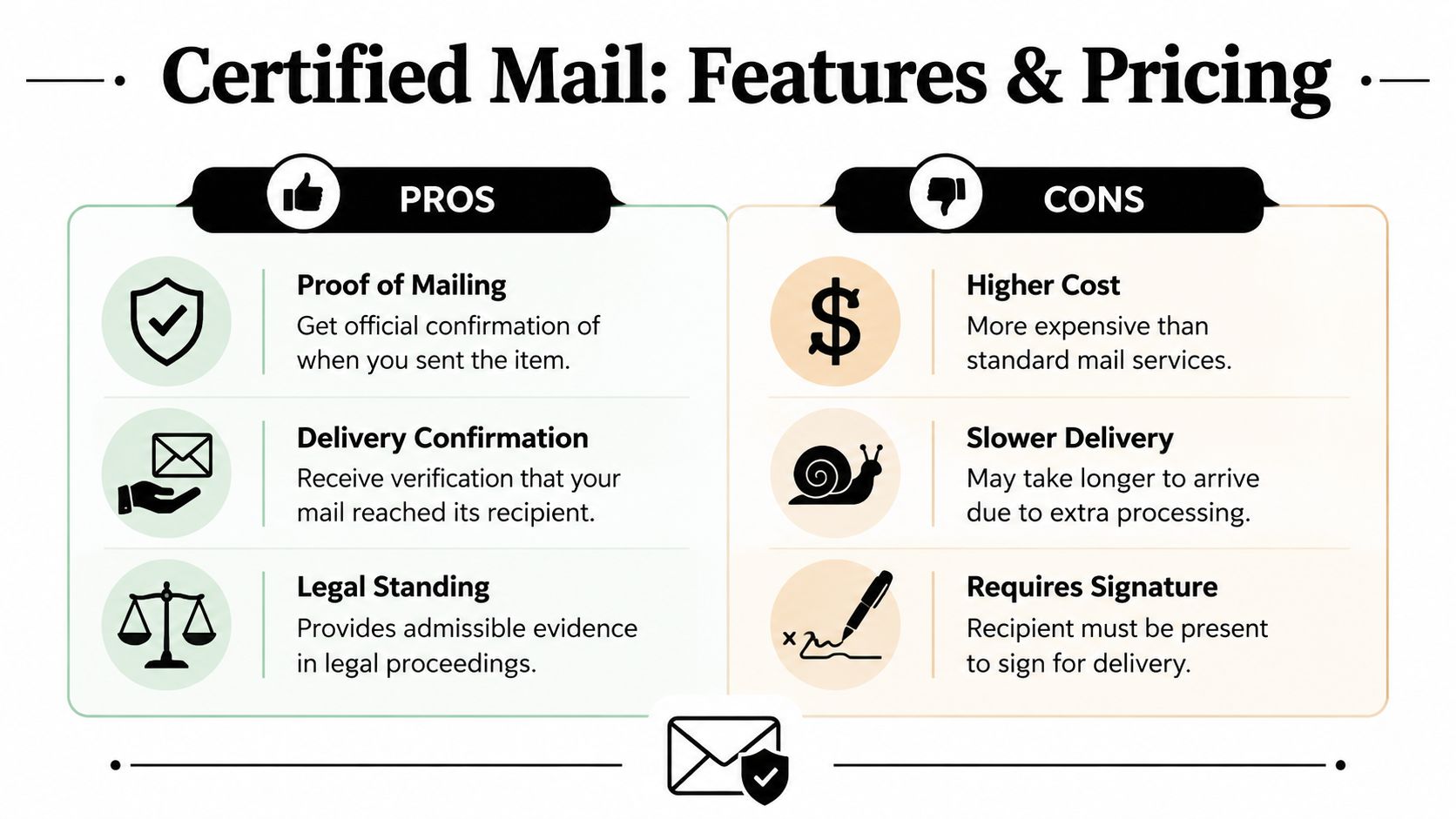
The core features that matter
Here’s what people should pay attention to before they mail anything:
- Mailing receipt: This is your proof that USPS accepted the item on a specific date.
- Tracking history: You can follow the piece through the mail stream instead of relying on guesswork.
- Delivery evidence: If delivery is completed or attempted, that status becomes part of the record.
- Recipient signature: For higher-stakes correspondence, the signature is often the key document in your file.
Return Receipt and when to add it
Return Receipt is the add-on many senders care about. It creates a more complete record that shows who signed, or at minimum ties the delivery event to a stronger documentation trail.
Choose it when:
- A deadline matters. Notice periods often start from mailing or receipt.
- A dispute is likely. Tenant issues, collection matters, and contract terminations often invite pushback.
- You’re mailing for a file. Attorneys, accountants, HR managers, and property managers usually need a clean record.
Restricted Delivery and similar choices
Some mailings need tighter control over who can accept the envelope. In those cases, asking about recipient restrictions can make sense. The right add-on depends on the document, the recipient, and whether your priority is broad proof of delivery or proof that a specific person accepted it.
What doesn’t work is adding services mechanically. Many people overpay for options they don’t need, or they skip the one option that would have made the mailing useful later.
Ask one question before paying for extras: “If this is challenged six months from now, what exact record will I wish I had kept?”
How to Send Certified Mail Step by Step
There are three common ways to send Certified Mail. All of them can work. The right one depends on how often you mail, how much margin for error you can tolerate, and whether you want to handle forms yourself.
Certified Mail has been mainstream for a long time, which explains why so many workflows exist around it. By FY 2016, certified mail generated $670 million in revenue on its own, and roughly $1 billion when postage and add-ons were included. The same USPS Office of Inspector General report found that 54% of certified pieces included Return Receipt, showing that delivery evidence was already a standard part of use for many senders, as detailed in the USPS OIG report on certified mail.
The Post Office method
This is the traditional route. It works, but it’s the most manual.
- Prepare the letter correctly. Print the document, place it in the envelope, and confirm the recipient address is complete and legible.
- Fill out the Certified Mail form. If you’re doing this yourself, accuracy matters. A rushed form can create headaches later.
- Decide on add-ons before you get to the counter. If you need stronger delivery documentation, ask for the right receipt option up front.
- Pay for postage plus the service. Keep every receipt immediately. Don’t leave the counter without checking that the tracking number is readable.
- Track and archive. Save the mailing receipt, any return receipt record, and a copy of the mailed document in one file.
Common problems with the DIY approach are predictable. People forget to keep a copy of the enclosed letter. They lose the receipt. They attach forms incorrectly. Or they stand in line only to realize they’re missing information.
The business center method
For many local senders, this is the easiest balance of convenience and control.
A good business center helps you confirm the service, prepare the envelope, check the address, and avoid form mistakes before the item enters the system. That matters if you send formal notices only occasionally, because occasional users are the ones most likely to miss a detail.
This approach is also useful when you’re already handling other tasks, such as printing letters, making copies for your records, notarizing related documents, or dropping multiple mailpieces at once. If you need a local handoff point, USPS drop-off services in Sugar Land can simplify the trip.
Here’s a practical walkthrough to visualize the process:
The online method
Online Certified Mail services appeal to businesses that send formal notices regularly and want digital records without handling paper forms every time.
This method works best when:
- You mail at volume: Repeating the same workflow manually gets old fast.
- You need centralized records: Digital tracking history is easier to retrieve than a folder full of slips.
- You want consistency: Staff can follow the same process each time.
It’s less ideal if you only send an occasional notice and prefer face-to-face confirmation at acceptance. For many small businesses, the choice comes down to habit. If your operation is document-heavy and process-driven, online tools fit well. If your needs are occasional but important, local in-person help is often the safer bet.
Common Use Cases for Certified Mail
Certified Mail is most useful when the sender expects one of two things. Either the recipient may deny receiving the document, or a third party may later ask for evidence that the sender followed the proper process.
A recent industry summary reported 158 million Certified Mail pieces in a recent year, with over 112 million including a signed Return Receipt. That’s roughly 71%, which tells you how often senders pair certified mail services with signature-based delivery evidence for formal communications, as noted in this Certified Mail versus Registered Mail summary.
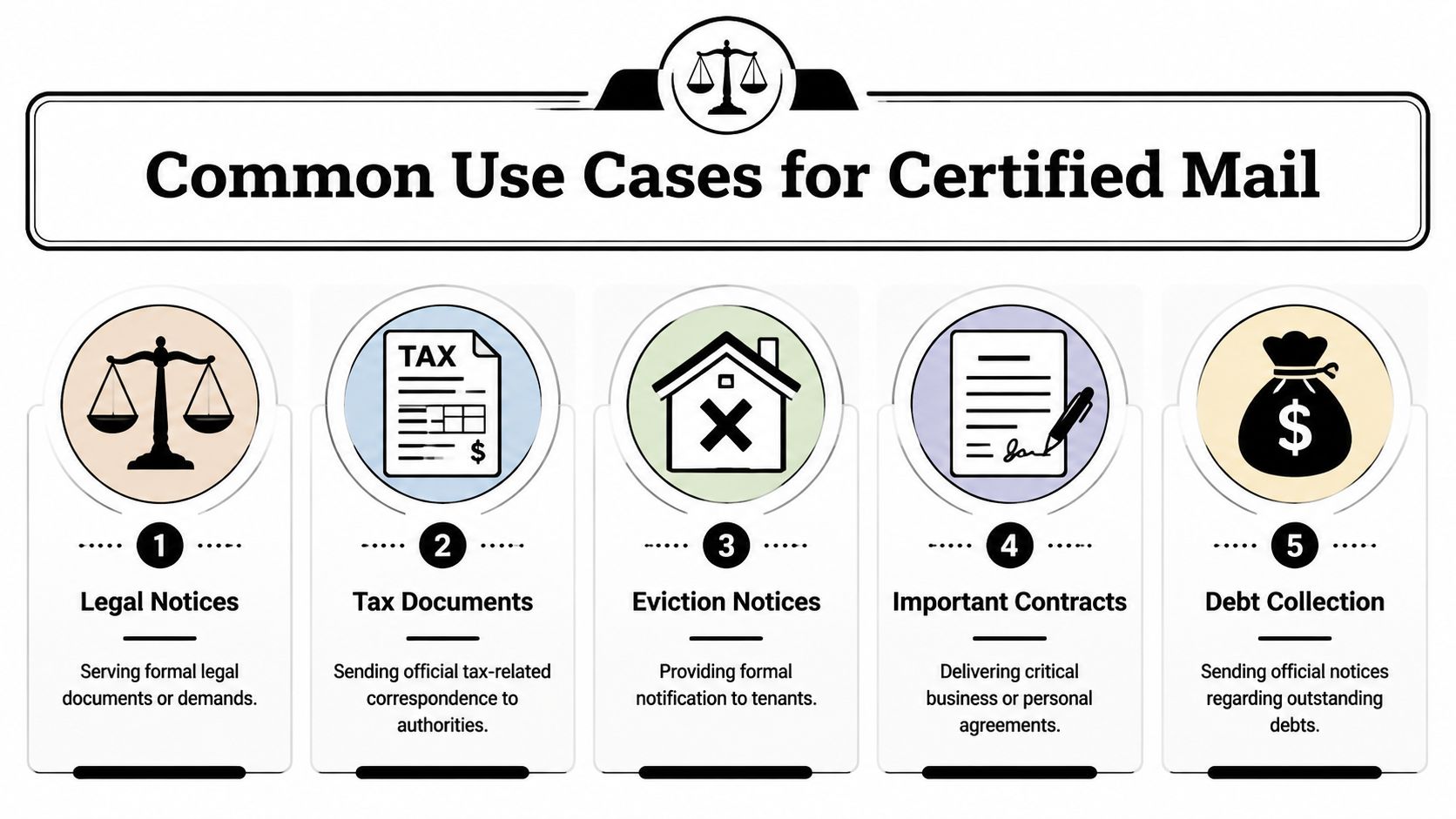
Legal and compliance notices
If you send a cease-and-desist letter, formal demand, court-related notice, or regulated disclosure, ordinary mail leaves too much room for argument.
A lawyer’s office may need to show that notice was sent on time. An HOA may need to document that a violation letter went out properly. A healthcare or finance office may need a mailing record to support internal compliance.
Field note: The value isn’t in sending a scary-looking envelope. The value is in being able to produce the mailing record later without scrambling.
Business operations and contract disputes
Small businesses run into formal notice situations more often than they expect.
Examples include:
- Contract termination: You need to show the other party received notice under the agreement.
- Employee correspondence: Sensitive workplace notices should have a dependable record.
- Collections activity: If a customer disputes notice, your file needs more than an email thread.
- Vendor issues: A breach notice or demand letter should be traceable from the start.
In these cases, Certified Mail creates a cleaner file. It also changes behavior. People tend to take a certified letter more seriously than a routine envelope.
Property, tax, and account matters
This is one of the most common categories for everyday senders.
A landlord may send a lease default notice. A property manager may mail a compliance demand. An accountant may send tax documentation or response material. An executor may notify parties tied to an estate matter. A creditor may send a formal demand before escalating.
What doesn’t work well is using Certified Mail for everything. It adds cost and process, so reserve it for documents where timing, delivery evidence, or legal posture matters. For routine statements, promotions, and general updates, simpler services are usually enough.
Frequently Asked Questions About Certified Mail
People rarely struggle with the concept of Certified Mail. They struggle with the edge cases. What if the recipient dodges it? What if the receipt goes missing? What if the address is a box instead of a street delivery point?
What happens if the recipient refuses to sign
Refusal doesn’t erase the mailing record. The item still has its acceptance and tracking history, and the delivery attempt or refusal may become part of the documented trail.
That said, whether refusal satisfies your legal or contractual obligation depends on the situation. Court rules, lease language, agency requirements, and contract terms can all differ. If the mailing is tied to a legal deadline, ask your attorney or compliance advisor what level of proof is required.
How long are records kept
USPS guidance summarized in the earlier discussion notes that delivery evidence can be retrieved and that delivery records may remain on file at the destination Post Office for an extended period. The safest practice is not to rely on future retrieval alone.
Keep your own file:
- A copy of the document mailed
- The mailing receipt
- The tracking number
- The delivery record or return receipt
- Any supporting note about why the notice was sent
Can you send it to a P.O. Box
Yes, in practical terms, mail can be addressed to a P.O. Box. The key issue isn’t whether the box exists. The key issue is how delivery and signature handling work for that destination.
If your reason for using Certified Mail is highly specific proof tied to the intended recipient, confirm in advance that the destination type and service option match what you need for your records.
Is Certified Mail available internationally
Certified Mail is generally discussed as a USPS service for domestic formal mailings. If you need international proof-oriented delivery, don’t assume the same service applies the same way.
Ask the mailing provider which international option creates the specific documentation you need. For overseas legal or compliance notices, the mailing method should match the destination country, the document type, and the evidentiary standard you may need later.
Keep the process simple. If the mailing matters, prepare the address carefully, choose the right add-ons once, and store every record in a single place the same day you send it.
If you need help preparing, mailing, or tracking important documents, Business Mail Boutique LLC offers a practical local option in Sugar Land for certified mail services, shipping support, printing, and related business center tasks. For small businesses and individuals who want the paperwork done correctly without an extra headache, having an experienced counter team nearby can save time and prevent avoidable mistakes.

Related posts

Knife & Leather Case Engraving in Sugar Land | Business Mail Boutique
Custom Knife and Leather Case Engraving in Sugar Land — Same-Day Service at Business Mail Boutique
A name can turn an everyday item in...

Custom Brass Plate Engraving in Sugar Land | Business Mail Boutique
Custom Brass Plate Engraving in Sugar Land: A Personal Tribute to Remember
A few carefully chosen words can turn a small brass plate i...

Silver Bracelet Engraving in Sugar Land | Business Mail Boutique
Personalize silver bracelets with names, dates, and hearts at Business Mail Boutique in Sugar Land. Call 281-875-0161 for a quote.
ers...