
- Print Business Cards in Sugar Land – Same Day Service
- Copying Services
- Document Printing, Finishing & Lamination in Sugar Land
- Flyers
- Print Banner in Sugar Land | Same-Day Banner Printing Near Me
- Graphic Design
- Photo Printing
- Postcard Printing
- Document Printing
- EDDM Full Service Postcards
- FotoZoomer Large Format Printing


Businessmailboutique
11645 S. Hwy 6
Sugar land, Texas 77498 United States (US)
Email: info@businessmailboutique.com
Route
Business Mail Address: Guide for Entrepreneurs
You’re ready to print business cards, update your LLC paperwork, and put a website live. Then you hit one small detail that suddenly feels big: what address are you going to use?
For a lot of new entrepreneurs in Sugar Land, that’s the moment the home address starts to feel like a bad fit. You may work from a spare bedroom, kitchen table, or garage studio, but you probably don’t want your personal address on registrations, invoices, directories, shipping labels, and client-facing materials. Privacy matters. So does credibility. And if you expect deliveries, returns, or important mail, convenience matters too.
A business mail address solves more than one problem at once. It gives your business a place to receive mail, helps separate work from home life, and can make everyday operations cleaner from day one. It also helps you avoid a common mistake: choosing an address option that looks fine at signup but creates trouble later when you need package handling, mail forwarding, or registration paperwork.
Table of Contents
- Is Your Home Address Holding Your Business Back
- The Four Main Types of Business Mail Addresses
- A Head-to-Head Comparison of Your Address Options
- The Strategic Benefits of a Professional Address
- How to Set Up Your Business Mail Address in 4 Steps
- Local Advantages for Sugar Land Entrepreneurs
- Frequently Asked Questions About Business Addresses
- Can I use a virtual business address to establish state residency or get a driver’s license
- Can I use my business mail address for LLC registration and bank accounts
- What’s the real difference between a virtual mailbox and a local CMRA
- Which option is usually the safest choice for a new entrepreneur
Is Your Home Address Holding Your Business Back
A common first move is using your home address everywhere because it’s easy. It’s already yours, it costs nothing extra, and it works well enough to get started.
Then the trade-offs show up.
A freelance designer starts getting client packages at the front door during family dinner. A home baker realizes her address is now visible in places she didn’t expect. A new consultant hesitates before sending a proposal because the address line doesn’t match the professional image she wants to project. None of those problems stop a business overnight, but they create friction.
What usually goes wrong first
For most small operators, the first issue isn’t legal. It’s personal.
Your home stops feeling private when business mail mixes with personal deliveries, returns, and marketing pieces. If you ever need someone else to help sort mail, receive a package, or forward documents, a home setup gets messy fast. It also becomes harder to draw a line between business hours and home life.
A business can start at home without advertising the home.
Why a dedicated address changes the day-to-day
A proper business mail address creates separation. That sounds simple, but it fixes a surprising number of small headaches.
- Privacy protection: Your personal residence doesn’t need to appear on every piece of business paperwork.
- Cleaner operations: Mail, packages, and customer correspondence go to one place.
- Better presentation: A commercial street address usually looks more established than a residential address.
- Less interruption: You don’t have to monitor the porch for every delivery.
Email still dominates business communication, but physical mail hasn’t gone away. In 2026, there are approximately 4.7 billion email users worldwide, and about 376 billion emails are sent and received daily, while the average office worker receives 121 emails per day according to these 2026 email statistics. That volume is one reason many businesses need their physical mail process to be simpler, not more chaotic. If inboxes are already overloaded, your mailing setup should reduce friction instead of adding to it.
The Four Main Types of Business Mail Addresses
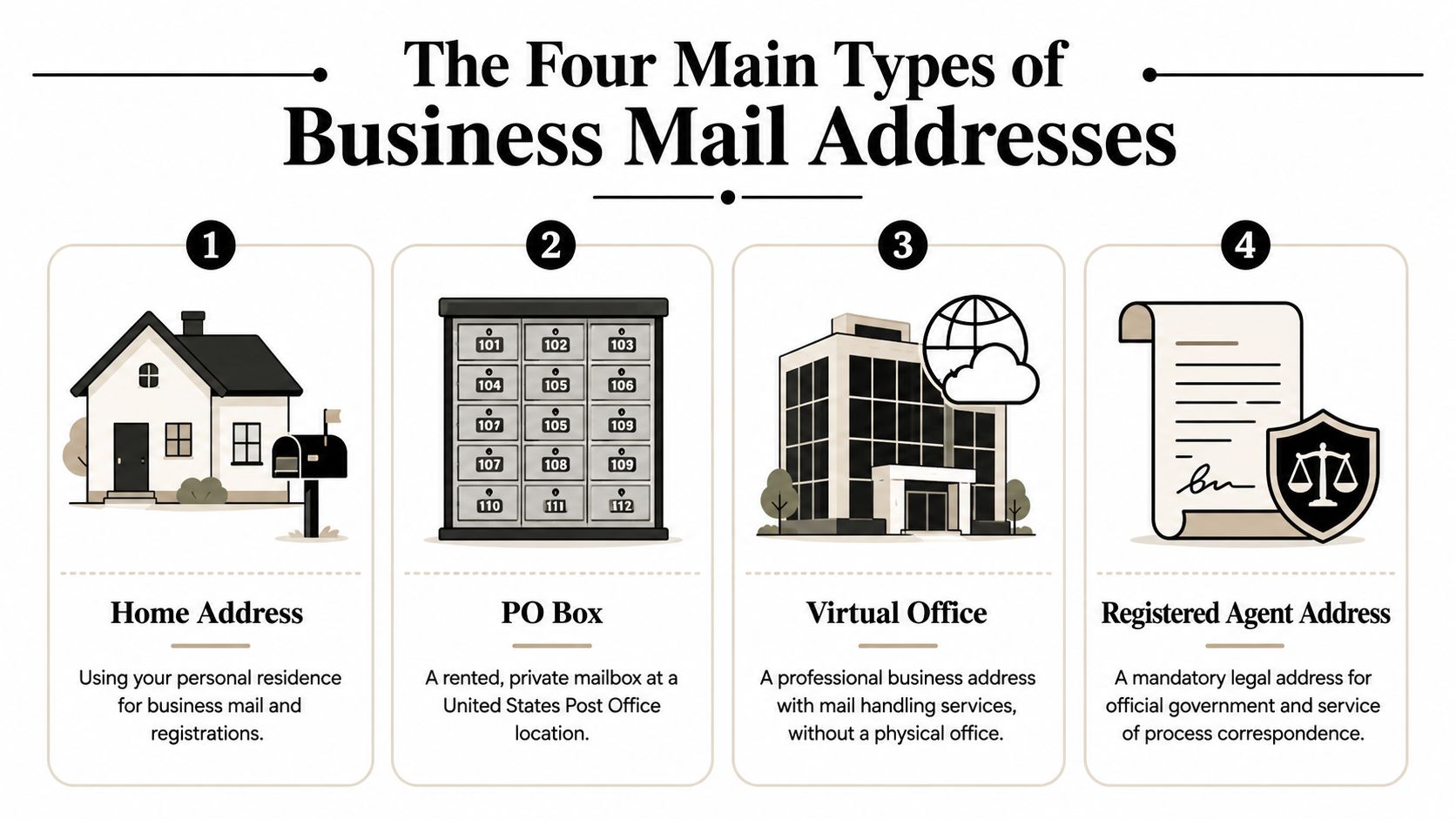
There isn’t one universal answer. The right setup depends on how you receive mail, what you need the address for, and whether you want basic receipt, package handling, forwarding, or digital access.
Home address
This is the default option. You use your residence for registrations, customer correspondence, and deliveries.
It’s the easiest choice because there’s nothing extra to set up. For a side hustle in its earliest stage, that may be enough for a short time. But it ties your business identity to your private life, and it isn’t ideal if you want to keep work separate, accept packages reliably, or present a more polished image.
Home addresses also create practical issues. Someone has to be available for deliveries. Important mail can get buried in household paper. And if your business grows, your home mailbox becomes a weak point.
P.O. Box
A P.O. Box is a mailbox you rent at a post office. It’s a simple way to avoid publishing your home address and to keep mail at a separate location.
This option works well for basic letter mail. It’s familiar, relatively straightforward, and often chosen by solopreneurs who mainly need a mailing destination. The downside is that a P.O. Box is still a post office box, not a typical street address presentation.
That difference has practical implications. Some businesses don’t like using a P.O. Box on customer-facing materials. Package handling can also be more limited than a commercial mailbox setup.
CMRA with a real street address
A Commercial Mail Receiving Agency, often shortened to CMRA, gives you a mailbox at a commercial location with a real street address and a private mailbox or suite number.
For many small businesses, this is the most balanced option. You get the look of a street address, plus services that often include mail receiving, package acceptance, forwarding, and in-person pickup. That’s different from a post office box because the address reads like a standard business location.
If you’re weighing this against a P.O. Box, this guide on private mailbox versus P.O. Box differences is useful because it focuses on how each option works in practice.
Practical rule: If you expect packages from more than one carrier, look closely at a real street address option before you decide.
Virtual mailbox service
A virtual mailbox adds a digital layer to mail handling. Your mail goes to a provider’s address, and you manage it remotely through scans, notifications, forwarding requests, or pickup options.
This setup is useful for remote founders, frequent travelers, and businesses that don’t want to visit a mailbox location often. It can also help if you want someone else to receive mail while you review it online first.
That said, not every virtual mailbox is equal. Some are highly local and service-oriented. Others are more national and hands-off. The details matter. You’ll want to check how they handle packages, forwarding speed, customer support, and required paperwork before signing up.
A Head-to-Head Comparison of Your Address Options
Definitions are helpful, but most entrepreneurs need a faster decision tool. The table below shows where each option usually fits and where it falls short.
Business Address Options Compared
| Feature | Home Address | P.O. Box | CMRA / Real Street Address |
|---|---|---|---|
| Professional image | Lowest for most client-facing businesses | Better than home for privacy, but still looks like a box | Strongest for a polished business presence |
| Privacy protection | Weak, your residence stays tied to the business | Good for mail privacy | Strong, keeps home separate while using a commercial address |
| Package and freight acceptance | Depends on whether someone is home | More limited than a commercial receiving service | Usually the most flexible for business deliveries |
| Use for business registration | Sometimes used because it’s convenient, but ties records to home | Often not the best fit for broader business use | Commonly preferred when a real street address is needed |
| Mail forwarding options | Manual, you handle it yourself | Limited service model | Often available as part of the mailbox service |
| In-person support | None | Limited to post office counter services | Often includes staff support and related business services |
| Best for | Very early side hustles with minimal public exposure | Basic mail receipt only | Entrepreneurs who want privacy, professionalism, and flexibility |
What works best for different business models
If you’re a consultant, coach, online seller, real estate professional, startup founder, or freelancer meeting clients, a home address usually starts to feel limiting fast. It’s functional, but it doesn’t scale well.
A P.O. Box can work if your needs are narrow. If you mainly receive letters and want a separate mail location, it can do the job. But many business owners outgrow it once they need package receiving, easier registration use, or a more professional street-address format.
The option most owners settle on
A CMRA or real street address often hits the practical middle ground. It gives you a business-facing address without requiring you to lease office space. It also handles the kinds of problems that come up in daily operations, such as carrier deliveries, staff acceptance of packages, and forwarding when you’re not in town.
Choose the option that fits how you work now, but also how you’ll receive mail six months from now.
That mindset saves people from switching addresses too soon after launching.
The Strategic Benefits of a Professional Address
A professional address does more than collect envelopes. It changes how your business appears, how your personal information is exposed, and how smoothly you handle deliveries.
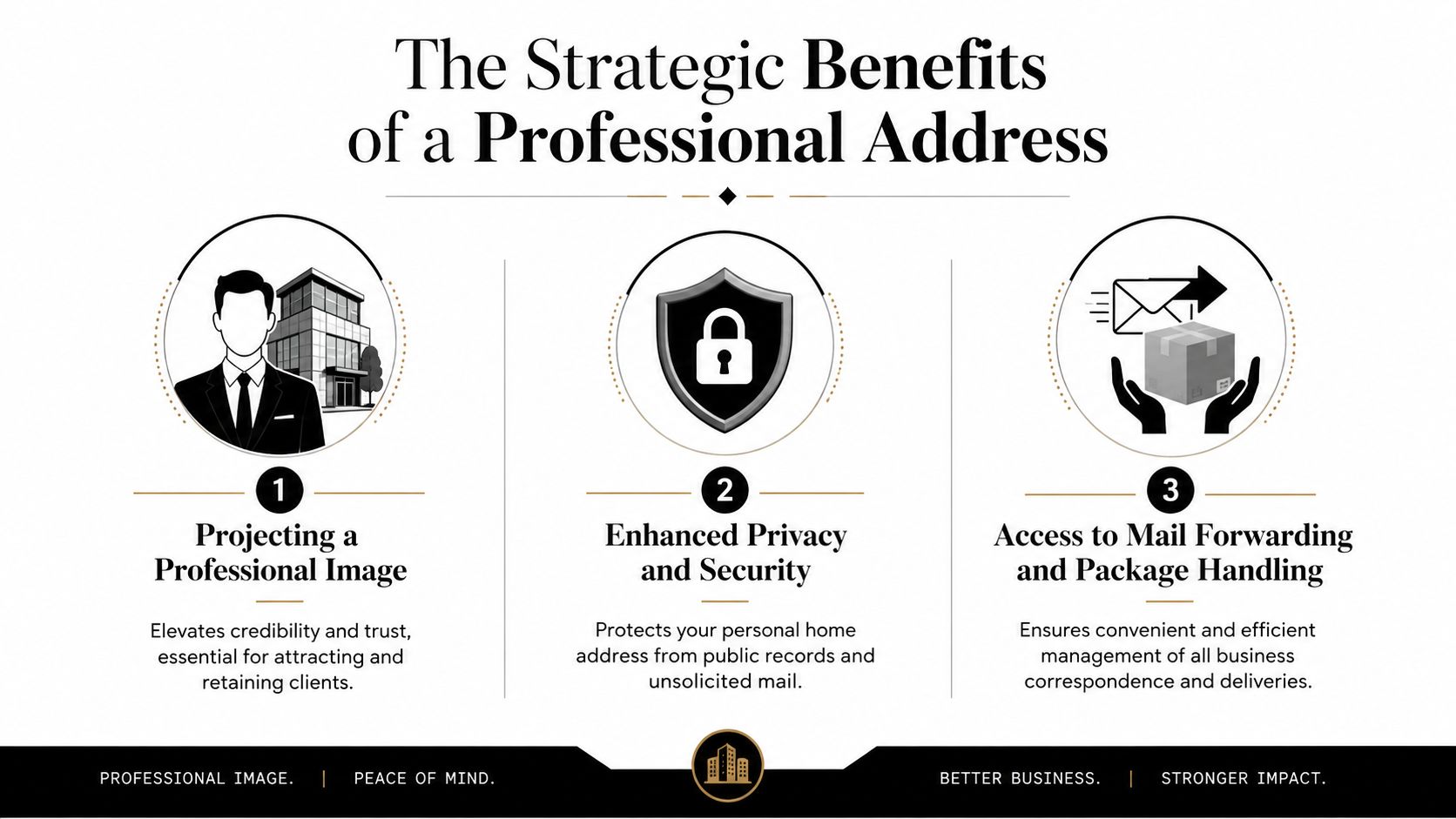
Professional image that matches your work
Clients notice small signals. An address is one of them.
If you do solid work and respond quickly, a polished address supports that impression. It won’t win business by itself, but it can remove hesitation. That matters when a client is comparing vendors, reviewing proposals, or deciding whether your company feels established enough to trust.
A street address also tends to look cleaner on business cards, websites, invoices, and Google Business materials than a residential address or P.O. Box.
Better privacy with fewer awkward trade-offs
Many owners don’t think about privacy until they’ve already put their home address on forms, directories, or customer materials. Then they want to pull it back, which is much harder.
A separate business mail address helps you keep personal space personal. You don’t have to direct every return, document, or inquiry to your front door. If you work with customers you don’t know well, that separation matters even more.
Here’s the practical test. If you’d feel uncomfortable putting your address on a flyer, package label, or online profile, you probably need a dedicated business address.
Easier shipping and package handling
The difference between address types becomes very real. Product-based businesses, e-commerce sellers, and service companies that receive supplies need a mailing setup that can handle more than letters.
A professional mailbox service with a real street address is often the most useful option because it can support package receiving and mail handling in one place. That’s especially helpful if you’re out meeting clients, working remotely, or sharing responsibility with a team member.
- For online sellers: Returns and supplier deliveries are easier to manage.
- For consultants: Documents and client materials go somewhere secure.
- For growing teams: Staff can pick up, forward, or coordinate mail without using someone’s home.
The best mailing setup is the one that removes interruptions from your workday.
How to Set Up Your Business Mail Address in 4 Steps
Choosing an address is only half the job. The setup process is where many first-time users get delayed.
Step 1: Decide what kind of mail you actually receive
Start with your real habits, not your ideal future system.
Do you receive mostly letters, legal notices, and checks? Do you expect inventory, returns, or frequent packages? Do you travel and need forwarding? Do you want to view mail digitally before deciding what to do with it?
Those answers narrow the field quickly. A consultant with low mail volume may need something very simple. An online store usually needs package acceptance and more flexible handling. A remote founder may care most about digital notifications and forwarding.
Step 2: Pick the right provider model
A local business center and a national virtual mailbox company can both offer a business mail address, but they don’t serve the same kind of customer equally well.
If you want in-person pickup, package support, notary help, printing, or someone local to answer questions, a nearby provider usually makes life easier. If you’re almost never in town and want everything handled remotely, a virtual-first setup may fit better.
In Sugar Land, one local option is Business Mail Boutique LLC mailbox service, which includes private mailbox and virtual mailbox offerings along with related business-center services. That kind of setup can be useful if you want both mail handling and access to shipping, printing, or notarization in one location.
Step 3: Gather your identification before you sign up
Many entrepreneurs slow themselves down when they choose a plan first, only to realize they still need documents to activate service.
Most commercial mail receiving setups require identity verification. It’s smart to gather your documents early and confirm with the provider exactly what they’ll need. If your business has more than one authorized recipient, ask whether each person needs to be listed in advance.
A five-minute call before signup can save days of back-and-forth.
Step 4: Complete and notarize USPS Form 1583
This is the step people miss most often.
The US Post Office Form 1583 authorizes a Commercial Mail Receiving Agency to receive mail on your behalf. It must be notarized before the provider can legally receive or forward your mail. Recent data shows 30% of first-time users delay activation because they miss this step, according to this explanation of the USPS Form 1583 notarization requirement.
That delay catches new business owners off guard because they assume service starts the moment they pay. It doesn’t. Until the form is properly completed and notarized, the provider can’t legally act as your mail receiver.
A simple setup checklist
- List your needs first: letters only, package receiving, forwarding, or digital access.
- Call the provider: confirm business registration use, pickup process, and accepted carriers.
- Prepare IDs early: don’t wait until checkout.
- Handle Form 1583 immediately: treat notarization as part of signup, not a later task.
Don’t plan your launch around the day you order the mailbox. Plan around the day your paperwork is fully approved.
Local Advantages for Sugar Land Entrepreneurs
A local address doesn’t just receive mail. It can support how your business is perceived in the area and how easily you handle daily errands.

A Sugar Land address feels more grounded
If your clients, customers, or partners are in Sugar Land or nearby communities, a local address can feel more familiar than an out-of-area mailbox service. That doesn’t guarantee trust, but it reduces the “where are they located?” question that some buyers ask.
For service businesses, that local signal matters on proposals, printed materials, and everyday correspondence. It tells people you have a footprint here, not just a website.
In-person access still matters
A lot of entrepreneurs start by thinking only about forwarding. Then a package arrives, a form needs notarization, a client wants printed materials, or a return needs to go out the same day.
That’s where a local business center has a practical edge. You can pick up mail fast, drop off shipments, print what you need, and handle related tasks in one stop instead of spreading them across town. For some owners, that convenience is more valuable than remote features they rarely use.
Better fit for owners who need more than a mailbox
Some entrepreneurs don’t need a pure virtual provider. They need a local operating hub.
That may include private mailbox service, package receiving, printing, notary, passport photos, key duplication, or shipping support in one place. If that’s your style of business, a Sugar Land provider is often a stronger fit than a distant platform with no local staff.
A local street-address mailbox option can also be easier to understand before you commit because you can compare plans, ask questions, and see how pickup works. This overview of mailbox rental with a street address for business use is a good example of the kind of detail you should look for before choosing a service.
Frequently Asked Questions About Business Addresses
Can I use a virtual business address to establish state residency or get a driver’s license
Usually, no.
A common misconception is that a virtual business address can replace a legal residence. While virtual addresses are legally valid for LLC registration and business branding in most states, they cannot be used to establish state residency or obtain a driver’s license in most jurisdictions, as explained in this overview of how virtual addresses are used.
That distinction matters for home-based entrepreneurs who want privacy. A business address can help separate business identity from personal residence, but it doesn’t usually replace your legal home address for residency purposes.
Can I use my business mail address for LLC registration and bank accounts
Often, yes, but you should verify the exact requirements for your state, bank, and business structure before relying on it.
In practice, many owners use a commercial business mailing address for LLC filings, branding materials, customer correspondence, and routine business documents. The key is making sure the address type you choose is accepted for the purpose you need. A provider may be fine for receiving mail but not suitable for every legal or compliance scenario connected to your business.
If you’re unsure, ask two questions before signing up: “Can I use this address for my LLC filing?” and “Can I use this address on my banking documents?” Get the answer from the institution that will review the paperwork.
What’s the real difference between a virtual mailbox and a local CMRA
A virtual mailbox is mainly about remote management. A local CMRA is mainly about real-world receiving and on-site service. Some providers combine both, but the emphasis is different.
A virtual-first service is useful if you travel, work remotely, or want digital mail visibility before deciding what gets forwarded or discarded. A local CMRA is stronger if you want a real street address, staff who can receive packages, and the option to walk in for pickup or related services.
Which option is usually the safest choice for a new entrepreneur
If you want a simple answer, most new entrepreneurs do well with a real street address mailbox from a local commercial provider.
It tends to give you the best mix of privacy, professionalism, package handling, and flexibility without forcing you into office rent. It also leaves room to add forwarding or digital handling later if your business changes.
The best choice isn’t the fanciest one. It’s the one you’ll still be happy with after the first rush of launch is over.
If you’re comparing mailbox options in Sugar Land and want a setup that supports mail receiving, package handling, forwarding, and related business-center services, Business Mail Boutique LLC is one local option to review. It offers private and virtual mailbox services with a real street address, plus shipping, printing, and notary support that can make the setup process easier for new business owners.

Related posts

Custom Memorial Glasses Engraved in Three Hours in Sugar Land
When a customer needed eight personalized glasses for a memorial, Business Mail Boutique completed the engraving or...

Custom Martini Glass Engraving in Sugar Land, TX
Custom Logo Engraving on Martini Glasses in Sugar Land, Texas.
Business Mail Boutique recently completed a beautiful custom engravin...

Custom Engraved Wine Glasses for a Golf Club Event in Sugar Land, TX
Custom Engraved Wine Glasses for a Golf Club Event in Sugar Land.
Custom wine glass engraving in Sugar Land, TX at Business Mail Bouti...