
- Print Business Cards in Sugar Land – Same Day Service
- Copying Services
- Document Printing, Finishing & Lamination in Sugar Land
- Flyers
- Print Banner in Sugar Land | Same-Day Banner Printing Near Me
- Graphic Design
- Photo Printing
- Postcard Printing
- Document Printing
- EDDM Full Service Postcards
- FotoZoomer Large Format Printing


Businessmailboutique
11645 S. Hwy 6
Sugar land, Texas 77498 United States (US)
Email: info@businessmailboutique.com
Route
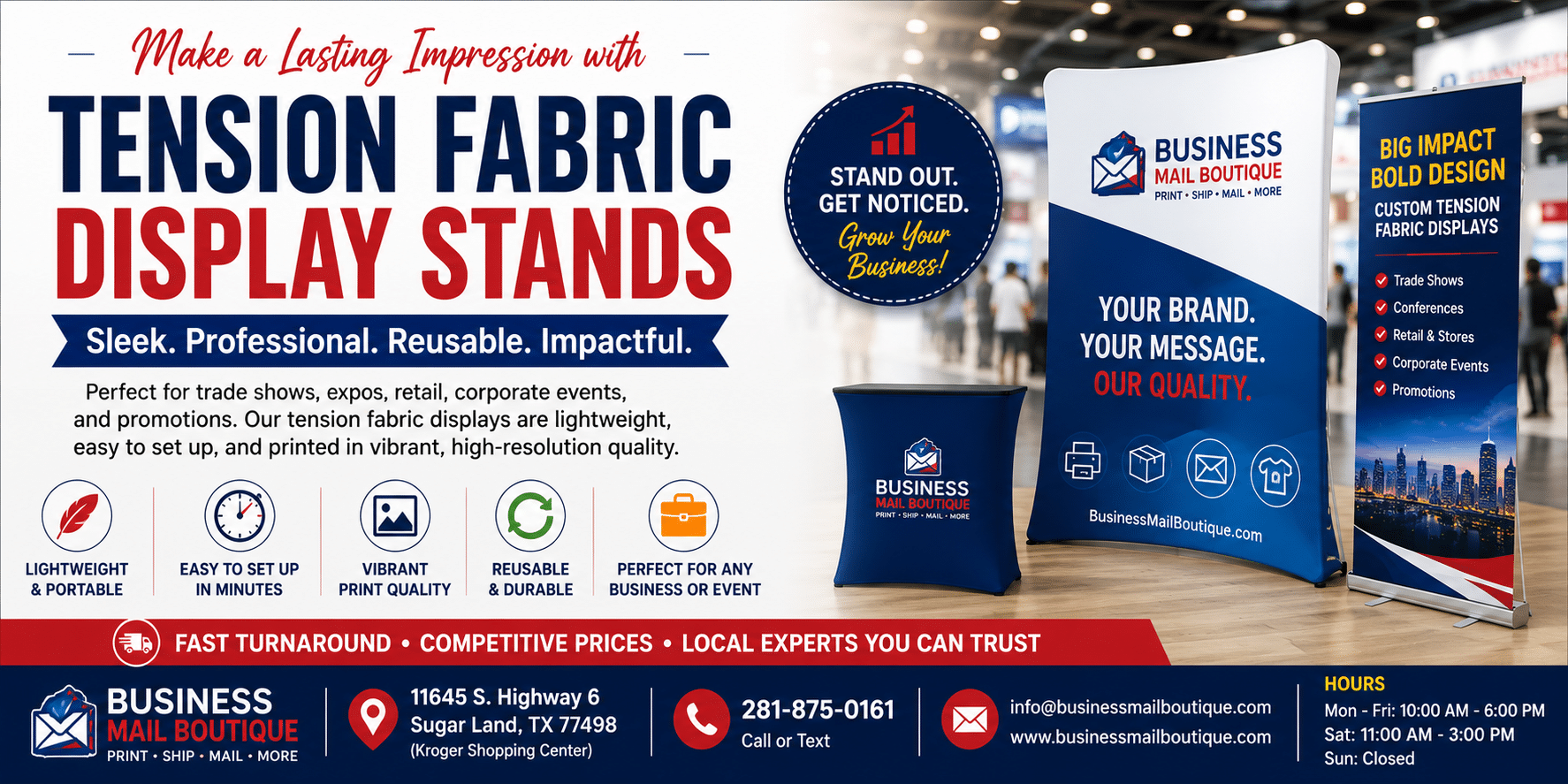
Tension Fabric Display Stands
You’re probably in the stage where the event date is getting uncomfortably close, your booth space is booked, and now you have to choose a backdrop that looks polished without turning setup day into a headache. That’s where a lot of small businesses get stuck. They want something that travels well, fits the brand, and doesn’t require a full crew to assemble.
Tension fabric display stands usually solve that problem well. They’re clean-looking, portable, and forgiving enough for repeat use if you choose the right frame and prepare the artwork correctly. The mistake I see most often isn’t buying a bad product. It’s buying the wrong format, sending weak artwork, or overlooking the shipping and handling side until the last minute.
What Are Tension Fabric Displays
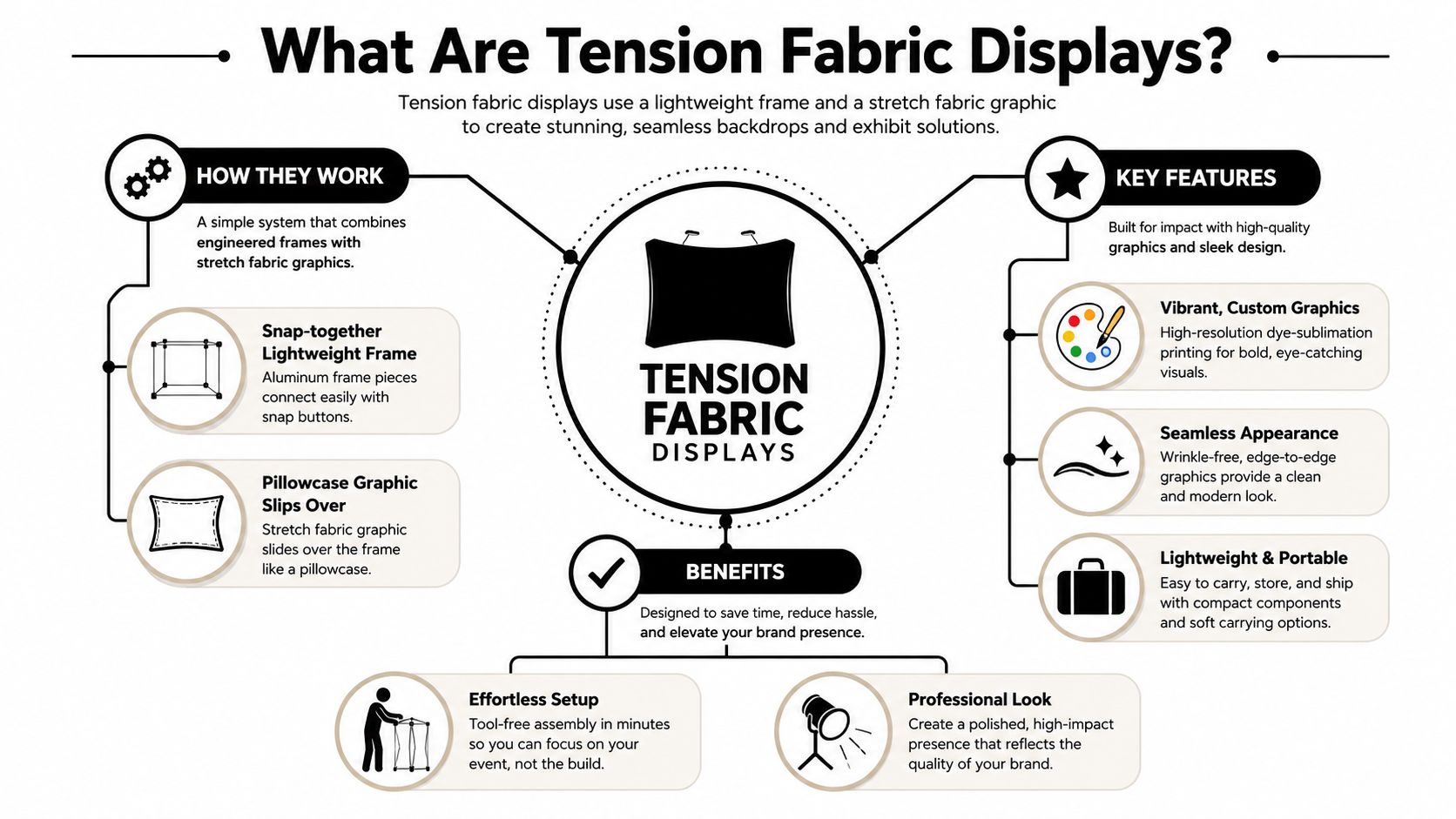
A tension fabric display is a lightweight frame covered by a printed fabric graphic that stretches tight across the structure. The easiest way to think about it is this: the frame is the skeleton, and the printed fabric is a fitted cover that slips over it like a pillowcase. Once it’s in place, the graphic pulls smooth and gives you one continuous branded surface instead of separate panels with visible joins.
That clean finish is a big reason these systems have become so common. The global fabric tension display stand market was valued at $1.2 billion in 2025 and is projected to reach $1.9 billion by 2034, with North America at $456 million in 2025, according to Market Intelo’s fabric tension display stand market report. That tells you plenty of businesses are choosing portable display hardware over bulkier exhibit options.
How the system works
Most tension fabric display stands use a lightweight aluminum frame and a dye-sublimated polyester fabric graphic. The fabric is printed in high resolution, then sewn to fit the frame shape precisely. Once installed, the tension in the fabric helps remove minor wrinkles and gives the display its smooth, finished appearance.
A webbing-and-hub system keeps the material taut. On some collapsible systems, the graphic is secured into hubs at the corners and can be assembled very quickly. What matters to a first-time buyer isn’t the engineering term. It’s that the system is built to look neat without a lot of fussy alignment.
Practical rule: If you want a backdrop that looks expensive without acting expensive, fabric tension systems are usually the first place to look.
Why so many businesses choose them
Rigid displays can still work, especially in permanent installations, but they’re less forgiving in transit. Tension fabric stands travel better, store more easily, and hide small handling issues better than panel-based systems. If someone folds the graphic carefully and packs the frame correctly, the display usually comes out ready for the next event without drama.
They also make branding simpler. One large graphic surface gives you room for a strong headline, a clear logo, and a product image without fighting seams, panel edges, or reflective glare. That’s especially useful for small businesses that need one display to do several jobs, such as trade shows, pop-up retail, speaking events, recruiting fairs, and media backdrops.
Choosing Your Stand Types and Sizes
The wrong stand shape can make a good design feel awkward. A backdrop should fit the booth, support the way people move through the space, and match what you need it to do. Some displays are built to create a clean wall behind a table. Others are meant to pull attention from an aisle or soften the look of a square booth.
Common shapes and where they fit best
Straight backwalls are the safest choice for most first-time buyers. They photograph well, work nicely behind a staffed table, and give you the most predictable graphic area. If you expect to use the display for both in-person events and photos or video, straight is usually the easiest format to manage.
Curved stands feel a little more dimensional. They can make a small footprint look more considered and less flat. They’re a good choice when you want a branded backdrop with a softer silhouette, especially in inline booth spaces where every visual cue matters.
S-shaped or sculptural formats are more niche. They can look great in retail activations or premium booth builds, but they also demand stronger design discipline. A weak layout gets exposed quickly on a shape that bends and twists.
A practical comparison
| Stand Type | Visual Impact | Best Use Case | Footprint |
|---|---|---|---|
| Straight | Clean, direct, easy to read | Trade shows, step-and-repeat style backdrops, presentations | Predictable and space-efficient |
| Curved | Softer, more dimensional | Inline booths, branded welcome areas, lobby displays | Slightly more visual depth |
| S-shaped | Distinctive and attention-grabbing | Activations, retail features, specialty promotions | Best where layout allows more expression |
A few practical sizing habits help.
- Start with the booth, not the catalog: If your booth is tight, don’t force a large wall just because it looks impressive online. You still need room for people, literature, and movement.
- Think about reuse: A display that works for one expo but not for chamber events, hiring fairs, or in-store promotions may not be your best buy.
- Match scale to message: If your brand message is short and bold, a larger backdrop can work well. If your content is dense, a smaller stand may read better because it forces discipline.
Most first-time exhibitors overestimate how much text visitors will read and underestimate how important open floor space is.
If you’re torn between two sizes, I usually recommend choosing the one you can manage confidently. A slightly smaller display that sets up cleanly and packs easily is better than a larger system that becomes a recurring logistical problem.
Key Benefits and Smart Use Cases
The biggest strength of tension fabric display stands isn’t just how they look. It’s how many problems they remove at once. You get a polished backdrop, easier transport, faster handling, and a system that can serve more than one marketing job.
Where the real value shows up
Weight matters more than most first-time buyers expect. Tension fabric systems can weigh up to 75% less than traditional pop-up displays, which directly helps with transportation and setup, according to Instant Promotion’s comparison of tension fabric and pop-up exhibition displays. That’s not just a comfort issue. It affects how easily one person can move the display, how stressful event day feels, and whether shipping becomes a budget problem.
The finish also works in your favor. A taut fabric surface looks more modern than older panel systems, especially when your design uses strong photography or large blocks of color. You don’t get the broken-up appearance that can happen when multiple rigid panels have to align perfectly.
If you’re comparing options broadly, this event display stand guide is useful because it frames display choices by use case instead of treating every stand like the same product.
Good fits beyond trade shows
Tension fabric displays earn their keep when you reuse them across different settings.
- Retail promotions: A boutique can use one as a seasonal feature wall near the entrance.
- Professional services: A realtor or mortgage team can bring one to open houses, local expos, or community sponsorship events.
- Recruiting and hiring events: Clean branding behind a table helps a small business look established and prepared.
- Media and speaking backdrops: A straightforward fabric wall can work behind interviews, presentations, and local press moments.
What doesn’t work as well? Overcomplicated booth plans. If you expect the backdrop to carry shelves, support heavy accessories, or act like a structural exhibit wall, tension fabric usually isn’t the right tool by itself. It shines when the goal is branding, speed, and portability. It struggles when people ask it to do the job of a custom hard-wall exhibit.
Designing Artwork for Flawless Fabric Printing
A fabric display can have excellent hardware and still look cheap if the artwork file is weak. Most print problems start before anything reaches the press. Low-resolution images, missing bleed, crowded text, and stretched logos are the usual culprits.
Files that print cleanly
Use vector logos whenever possible. Files such as AI or EPS keep edges sharp when scaled up, and that matters on a large backdrop. Raster logos pulled from a website often look acceptable on a laptop screen and rough on fabric at event size.
For photos, ask your printer what final file specs they want and build to that template. Don’t guess. Templates exist for a reason. They account for zipper placement, seams, curvature, and any non-visible wrap areas.
A few file habits save a lot of rework:
- Keep important text away from edges: Safe area matters because tension, seams, and finishing can affect what reads cleanly.
- Extend backgrounds fully: Bleed prevents thin white edges or awkward cropping.
- Limit tiny copy: Visitors won’t stand still and study a wall of text.
- Check logo contrast: A brand mark that looks fine on white can disappear on a mid-tone fabric field.
If you need a local team to handle large-format output and help catch file issues before print, wide-format printing services for Sugar Land businesses are worth reviewing before you commit to an online-only order.
Designing for in-person and on-camera use
Hybrid events complicate design choices. A backdrop that looks balanced to the human eye across a booth may not read the same way on a webcam or event stream. That matters because 68% of trade shows now incorporate hybrid elements, and guidance on safe-area placement and color choices for camera use is still limited, as noted in this discussion of hybrid event backdrop considerations.
That gap changes how I’d advise a small business to approach artwork. Keep your core message higher and more centered than you think you need. Camera framing often crops lower areas, side margins, or both.
Put the logo, headline, and one supporting message where a camera will actually see them. The lower corners are premium real estate in print, but they’re often dead space on video.
A few layout choices tend to hold up better:
- Use fewer elements: One strong headline beats several competing messages.
- Choose contrast carefully: Fabric can soften edges compared with what you see on a bright monitor.
- Avoid skinny fonts: Thin strokes can disappear under venue lighting or streaming compression.
- Test with a phone camera: Step back, record a short clip, and see what still reads.
That last step catches problems fast. If the message isn’t clear on a quick phone recording, it won’t improve under event lighting.
Setup Care and Maintenance Guide
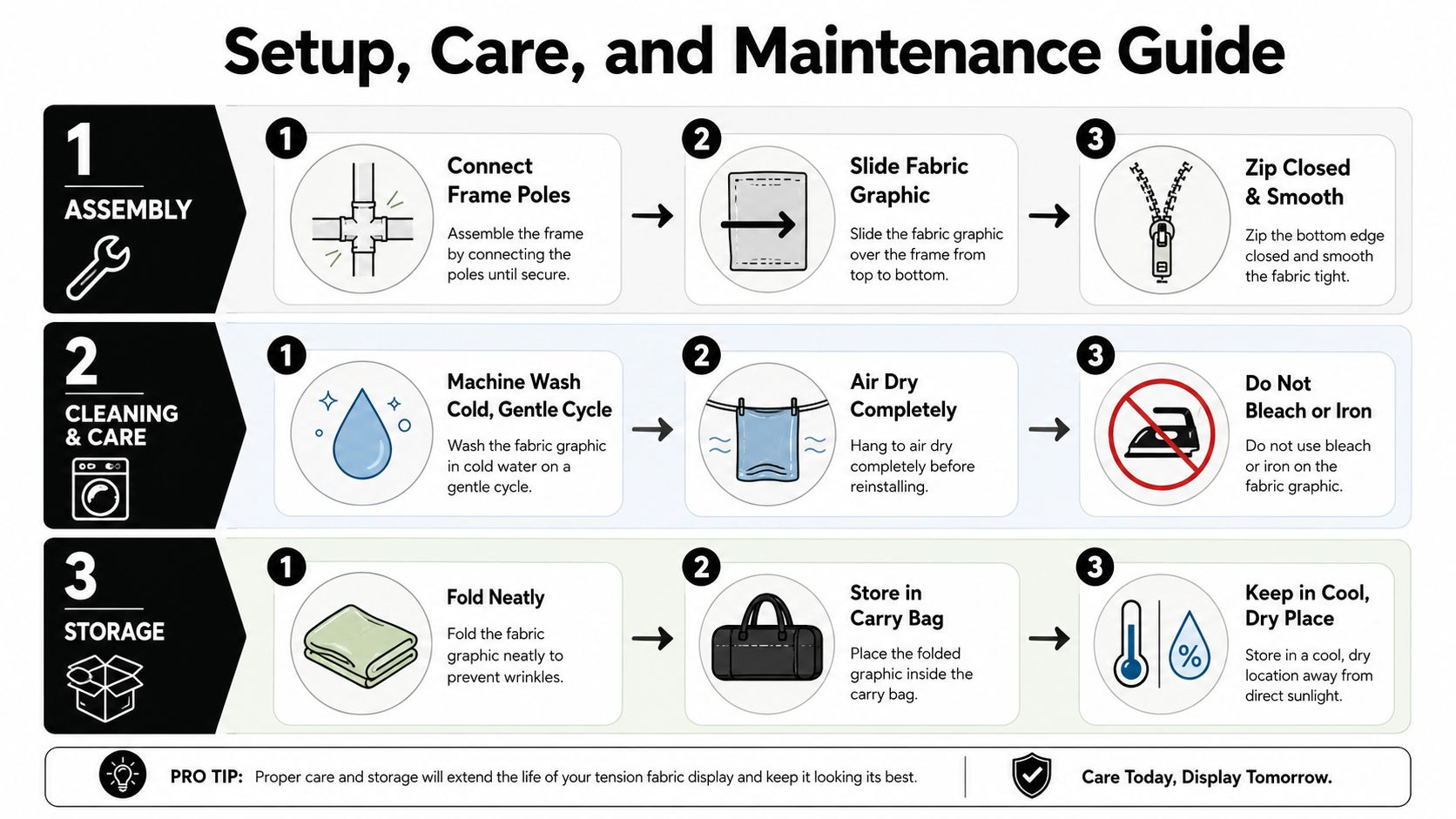
A good tension fabric display should feel manageable the first time you assemble it. If a system requires guesswork, tiny loose parts, or a lot of force, something is off. Most are designed around simple frame connections and a fitted graphic that closes neatly.
Assembly without the usual stress
Some collapsible tension fabric systems use a webbing-and-hub tensioning method over an aluminum frame, and certain models can be set up in under 10 seconds, as described on Loom Signs’ tension fabric stands page. That speed won’t apply to every product, but the takeaway is useful. These displays are built around quick assembly.
A simple setup routine works best:
- Lay out the frame parts first: Don’t start connecting pieces while the carry bag is still half full.
- Build the frame completely: Make sure each connection seats fully before the graphic goes on.
- Pull the fabric evenly: Don’t yank one corner hard and then fight the rest.
- Close or secure the graphic last: Once it’s in place, smooth the face by hand.
This walkthrough helps if you want to see a fabric display process before event day.
Cleaning and storing the graphic
Fabric graphics hold up well when people treat them like printed fabric, not like a tarp. Keep dirty hands off the image area during setup. If the venue floor is dusty, don’t lay the graphic down any longer than necessary.
For care between events:
- Wash gently if needed: Follow the printer’s care instructions for the specific fabric.
- Use a steamer carefully: That’s often the safest way to remove light wrinkles.
- Store dry: Packing damp fabric is how you create avoidable problems.
- Separate hardware from the print surface: Metal edges and zippers can snag if everything gets stuffed together carelessly.
A stand that’s packed neatly after each event usually keeps looking good far longer than one that gets rushed into a case at teardown.
Buying vs Renting and Shipping Logistics
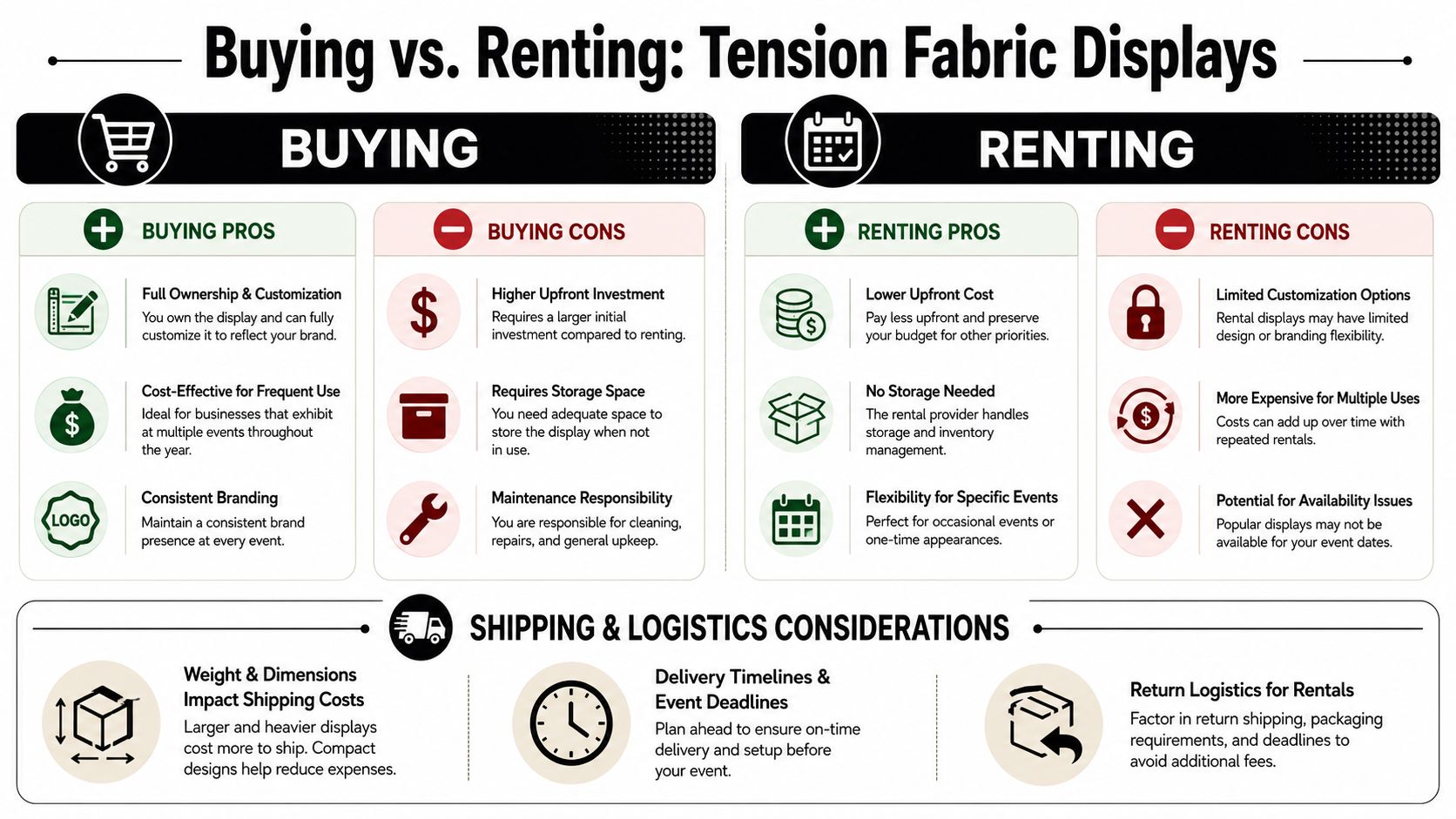
Many smart businesses save money by making a realistic decision instead of an emotional one. Buying feels permanent and professional. Renting feels lighter and less risky. Either can be right, depending on how often you’ll use the display and how much control you need over branding and timing.
When buying makes more sense
Buy if you expect repeat use, want consistent branding, and need the freedom to test the display in advance. Ownership also matters when your team attends different kinds of events and needs a system that can be packed, checked, reassembled, and reused without waiting on a rental house.
Rent if the event is a one-off, the booth concept is still experimental, or the event requires a size or shape you probably won’t use again. Renting can also make sense when the internal team doesn’t want to store hardware or manage post-show returns on owned materials.
Here’s the trade-off in plain terms:
- Buying works best when: You want control, repeat use, and consistent brand presentation.
- Renting works best when: You need flexibility, lower upfront commitment, or a trial run.
- Buying becomes a problem when: No one owns storage, upkeep, or shipping prep.
- Renting becomes a problem when: Deadlines are tight and replacement or availability issues show up.
Packing outdoor risk and freight planning
Shipping is where many display decisions get expensive. Cases need to be packed with the frame protected, the fabric separated from anything that can snag it, and the outbound label attached early enough to avoid scramble fees. If you’re not familiar with freight and carrier planning, a practical starting point is this freight shipping cost guide.
Outdoor use deserves special caution. A 2025 study found that 42% of outdoor tension fabric displays suffered visible creasing or material fatigue within 6 months due to environmental stressors, according to BannerBuzz’s tension fabric display resource. That’s a serious warning for anyone planning repeated outdoor pop-ups.
If the display will live outdoors more than occasionally, don’t assume the standard indoor system is good enough just because it survived one event.
That’s where buy versus rent gets sharper. If your event schedule includes outdoor festivals, street fairs, or open-air activations, renting can reduce the risk of owning hardware that takes environmental wear quickly. If you buy, go in knowing that weather exposure changes the return-on-investment equation and may create damage that warranties don’t cover.
Your Local Partner for Display Success in Sugar Land
Online ordering makes display buying look simple. Pick a size, upload a file, and wait for a box. In practice, most first-time event display problems happen in the gaps between those steps. The file needs proofing. The colors need review. The event deadline may change. The shipment may need professional packing instead of a basic carton job.
That’s why local support matters more than many businesses expect. When you work with a nearby print and shipping partner, you can solve problems before they leave the building.
Why local support changes the outcome
A local partner can review artwork with real-world print experience, catch layout issues that don’t show up on a laptop, and help you choose a display format that matches the event instead of just filling an online cart. That’s especially useful for small businesses buying their first major backdrop.
Proofing is another advantage. Seeing color, scale, and material direction before the final job moves forward reduces the chance of a bad surprise on setup day. If you’ve ever had a logo print darker than expected or a headline land too low on a backdrop, you already know why that matters.
What to expect from a local print and shipping partner
The best local shops don’t just print. They help connect the whole job. That includes file review, print production, hardware coordination, packing, and shipping support when the display needs to reach a venue or conference hotel on time.
If you’re weighing local versus online, this guide on choosing a local print shop in Sugar Land gives a useful framework for what to look for. A good local partner should make the display easier to manage, not just easier to order.
For a first major event, that kind of support can be the difference between a smooth launch and a rushed fix.
If you need help turning artwork into a professional event backdrop, Business Mail Boutique LLC can help with printing, proofing, packing, and shipping support in Sugar Land. It’s a practical option when you want local eyes on the project and fewer surprises before show day.

Related posts

Custom Memorial Glasses Engraved in Three Hours in Sugar Land
When a customer needed eight personalized glasses for a memorial, Business Mail Boutique completed the engraving or...

Custom Martini Glass Engraving in Sugar Land, TX
Custom Logo Engraving on Martini Glasses in Sugar Land, Texas.
Business Mail Boutique recently completed a beautiful custom engravin...

Custom Engraved Wine Glasses for a Golf Club Event in Sugar Land, TX
Custom Engraved Wine Glasses for a Golf Club Event in Sugar Land.
Custom wine glass engraving in Sugar Land, TX at Business Mail Bouti...