- Print Business Cards in Sugar Land – Same Day Service
- Copying Services
- Document Printing, Finishing & Lamination in Sugar Land
- Flyers
- Print Banner in Sugar Land | Same-Day Banner Printing Near Me
- Graphic Design
- Photo Printing
- Postcard Printing
- Document Printing
- EDDM Full Service Postcards
- FotoZoomer Large Format Printing


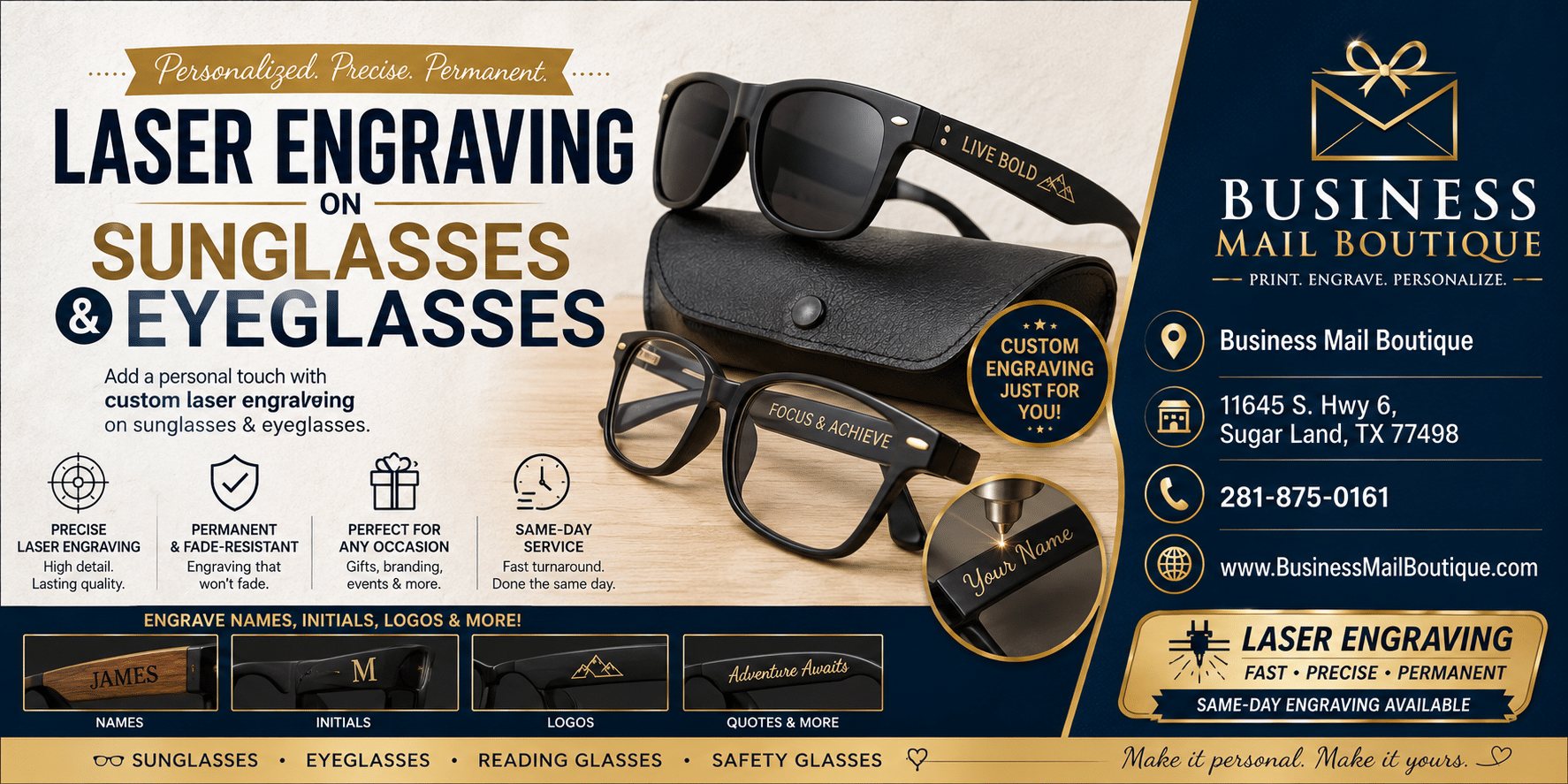
Laser Engraving on Sunglasses & Eyeglasses.
Discover how laser engraving on sunglasses & eyeglasses works, from materials to techniques, and learn how to personalize your eyewear.
Businessmailboutique
11645 S. Hwy 6
Sugar land, Texas 77498 United States (US)
Email: info@businessmailboutique.com
Route
You’re standing at the counter with a pair of sunglasses or prescription frames in your hand, and the question sounds simple enough. Can these be engraved, and will they still feel right on your face after the job is done?
The answer depends less on the artwork than on the material, the laser source, and where the mark will sit. On eyewear, a clean result is never just “put the logo on it.” It’s a material decision, a comfort decision, and sometimes a safety decision, especially when the frame touches skin every day and the work sits close to the eyes.
Table of Contents
- Walking In With a Pair You Want Personalized
- What Laser Engraving on Eyewear Means
- Which Frames Engrave Well and Which Fight You
- Laser Types, Wattage, and Settings That Actually Matter
- Preparing Your Artwork and the Frame for the Laser
- When Laser Engraving Is the Wrong Tool for the Job
- Comfort, Skin Contact, and Warranty Risks to Ask About
- Pricing, Turnaround, and How a Local Shop Quotes the Job
Walking In With a Pair You Want Personalized
A customer comes in with a pair of aviators, sets them on the counter, and says they want a name on the temple arm. That’s a normal request, but the first five questions matter more than the artwork. A shop has to know what the frame is made of, whether the mark goes on the outside or inside, whether the lenses stay in place, whether the finish is plated or painted, and whether the customer wants visible branding or a discreet ID mark.
That intake process sounds cautious because it is. On eyewear, the laser can be a clean finishing tool, but it can also expose base metal, haze a coating, or leave a rough feel if someone tries to force a deep mark into the wrong substrate. A frame that looks perfect on a screen mockup can behave very differently once it’s clamped in a fixture.
Practical rule: if the customer can’t name the frame material, the shop should pause and identify it before quoting the job.
A good walk-in also brings the right reference points. A clear photo of the exact frame style, the desired placement, and the artwork file if there’s a logo makes the conversation faster. If you’re trying to compare personalization options for a gift or branded item, it helps to look at how other shops handle customization on small products, including services like find farmhouse-style ornaments or a local trophy shop near me, because the same intake logic applies, material first, design second.
The right question isn’t, “Can you laser this?” It’s, “What material is this, where does the mark land, and what finish will still feel good after daily wear?” By the end of a proper consult, you should know whether the frame is a clean candidate, whether the lens engraving is a manufacturing mark instead of a consumer customization, and what the final result will look and feel like in real life.
What Laser Engraving on Eyewear Means
Two jobs get mixed up all the time
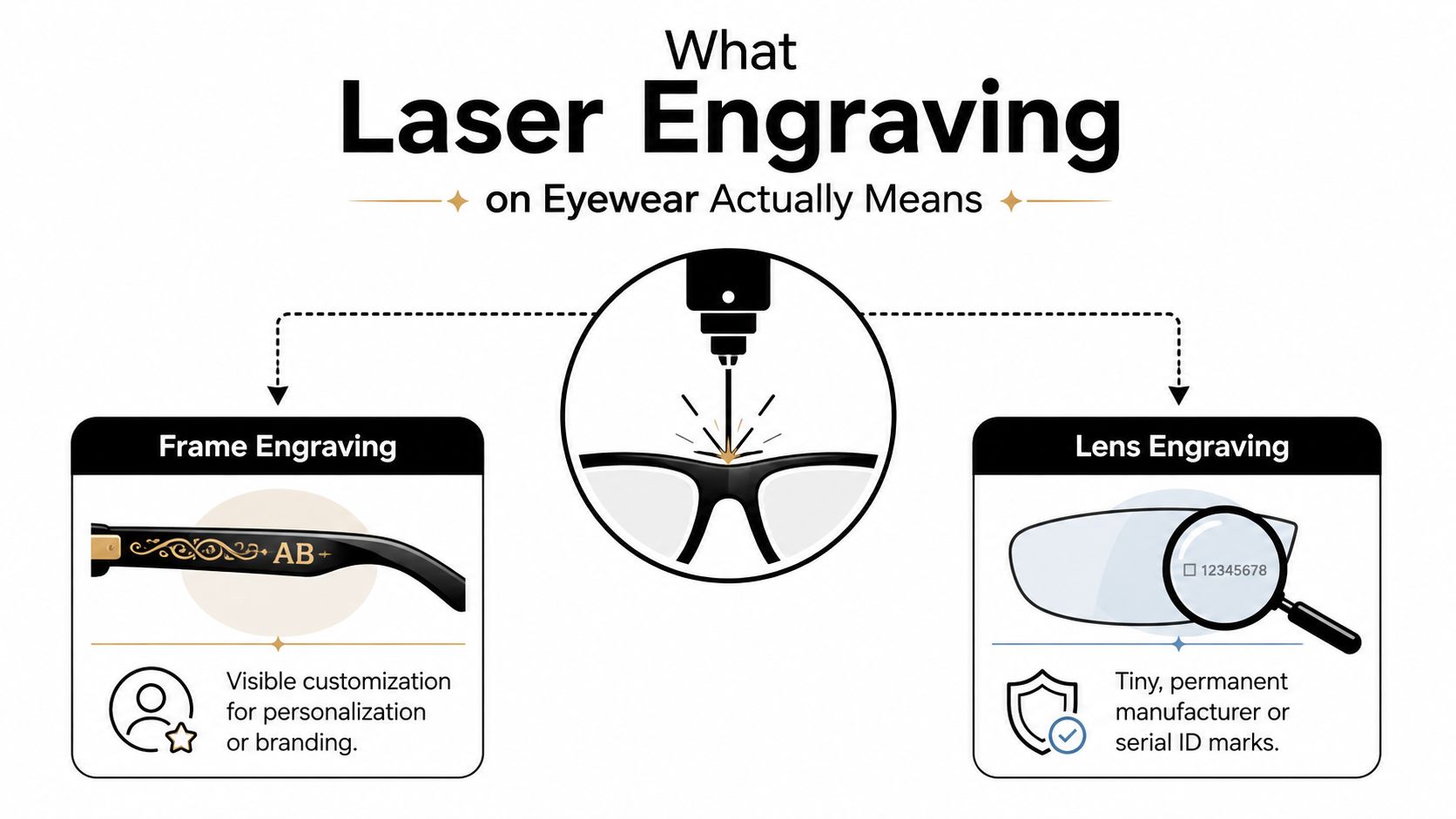
On eyewear, frame engraving and lens engraving are separate services. Frame engraving is the visible customization customers usually want, names, logos, serial numbers, or a small design on a temple arm, bridge, or other exposed part of the frame. Lens engraving is a tiny manufacturer or verification mark placed outside the viewing area, and it belongs to optical production rather than consumer decoration. The confusion is common because both jobs use a laser, but they solve different problems.
Frame engraving is a mark the wearer sees every day. Lens engraving is a traceability mark that sits on the lens and is usually meant for identification, not display. Independent eyewear references describe lens engravings as tiny ID marks, while frame engraving is a separate customization process, especially common on metal frames because it does not need tooling or printing plates.
How the Mark Is Made
A laser engraves by removing or changing a thin layer of material. That is why the result lasts, and why the substrate matters so much. A laser mark on a rigid metal arm, a coated frame, or a polymer lens does not behave the same way, even if the artwork is identical.
That material change is also why shops quote these jobs differently. A logo that looks easy on paper may need a different source, a different fixture, or a different finish pass depending on whether it goes onto a matte metal temple, a plated hinge area, or a transparent lens edge. The mark itself may be tiny, but the process around it is specific.
For eyewear, the useful distinction is simple. Frame engraving is about visible personalization and branding. Lens engraving is about microscopic identification. Once you know which job you are asking for, the rest of the conversation gets much clearer. If you want to compare frame styles that hold up well under the laser, start with find lightweight eyeglass frames, because frame shape, mass, and stability all affect how clean the mark comes out.
Which Frames Engrave Well and Which Fight You
The material decides the outcome
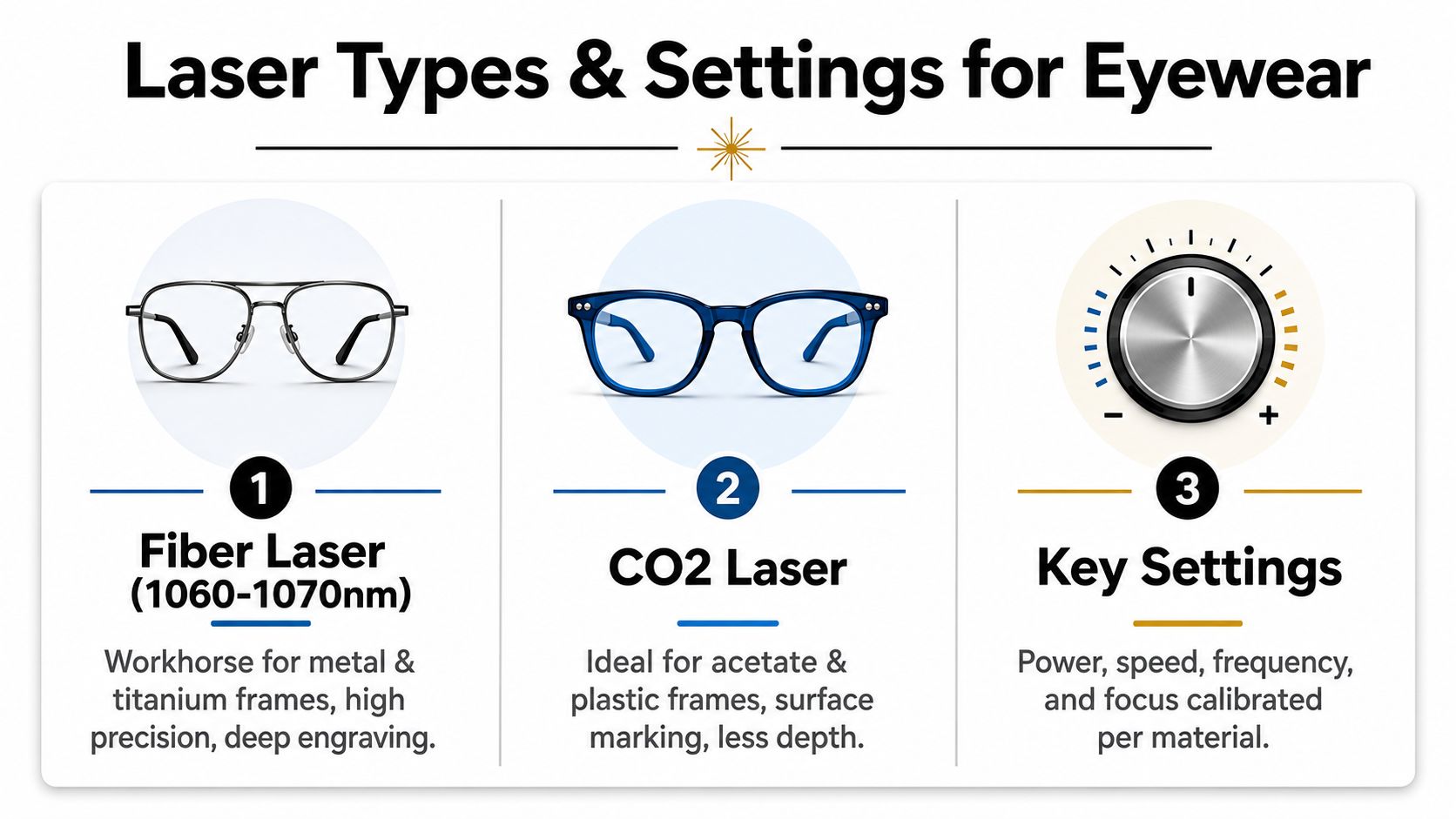
Metal frames are usually the easiest to personalize cleanly, especially titanium and other stable alloys. A fiber laser is the right match for that work, while plated metal needs extra care because the beam removes the top layer and exposes the base underneath. That can look crisp, but the contrast depends on both depth and the color difference between layers.
If you’re hunting for a frame style that tends to cooperate, it helps to start with lightweight designs and stable temples, not thin decorative wire that can flex during marking. A useful reference for frame selection is find lightweight eyeglass frames, because the frame shape and mass affect both fixture stability and how comfortable the final engraved pair feels.
A quick material-to-laser matchup
| Frame material | Recommended laser | Typical result |
|---|---|---|
| Metal | Fiber | Clean visible mark, good contrast |
| Titanium | Fiber | Crisp, precise engraving with stable edges |
| Plated metal | Fiber | Top layer removed, contrast depends on plating and depth |
| Acetate | CO2 | Surface mark, more risk if pushed too hard |
| TR-90 | CO2 or another plastic-suitable system | Light branding or ID marking, test first |
| Wood accents | CO2 | Can mark cleanly, but grain changes the look |
Thin wire rims deserve caution because they can distort in the fixture. Coated plastics also deserve a test mark, since a pretty finish can hide an unstable surface layer that chips or peels when the laser bites too hard. The frame that looks “simple” on the shelf is sometimes the one that needs the most restraint at the machine.
Shop-floor note: if the frame material or coating is uncertain, a hidden test mark beats a bold guess every time.
Laser Types, Wattage, and Settings That Actually Matter
Why wavelength matters more than hype
For metal and titanium eyewear frames, fiber laser systems are the normal workhorse, and production units often use a 1060 to 1070 nm Q-switched source. That wavelength is well suited to metal marking, which is why it’s the usual choice for sunglasses frames with metallic temples or bridge pieces. For organic eyeglass lenses and many plastics, the commercial ophthalmic setup uses a sealed CO2 laser at 10.2 to 10.8 µm, because the beam couples well with those polymers and can mark without wrecking the lens geometry. Those lens engravers are also built for enclosed operation and are certified as Class 1 laser products in that context, which matters in a shop that needs repeatable traceability and practical safety.
The wattage on a frame engraving machine doesn’t work like a magic upgrade. A 20 W, 30 W, or 50 W fiber setup can all be used in production, but the result still depends on focus, pass strategy, and the material underneath the finish. More power can help with speed or depth, but it can also make a mark look harsher than intended if the job only needed a light contrast line.
Depth and contrast are separate choices
A shallow mark gives subtle contrast. A deeper channel gives a stronger visible signature, which can help on low-contrast plated metals. Some shops post-fill those deeper marks with epoxy when the base metal alone doesn’t read clearly enough, especially on dark or low-contrast surfaces.
That’s the question to ask a shop, not “How powerful is your machine?” Ask what source they use, what the mark depth will be, and whether the final finish is meant to be subtle or highly legible. If the answer sounds vague, the setup probably isn’t tuned for eyewear.
The same logic explains why a local operator might mention services like engraving powder-coated tumblers, where coated surfaces also force the shop to think about layer removal, contrast, and finish behavior rather than just firing the beam.
Preparing Your Artwork and the Frame for the Laser
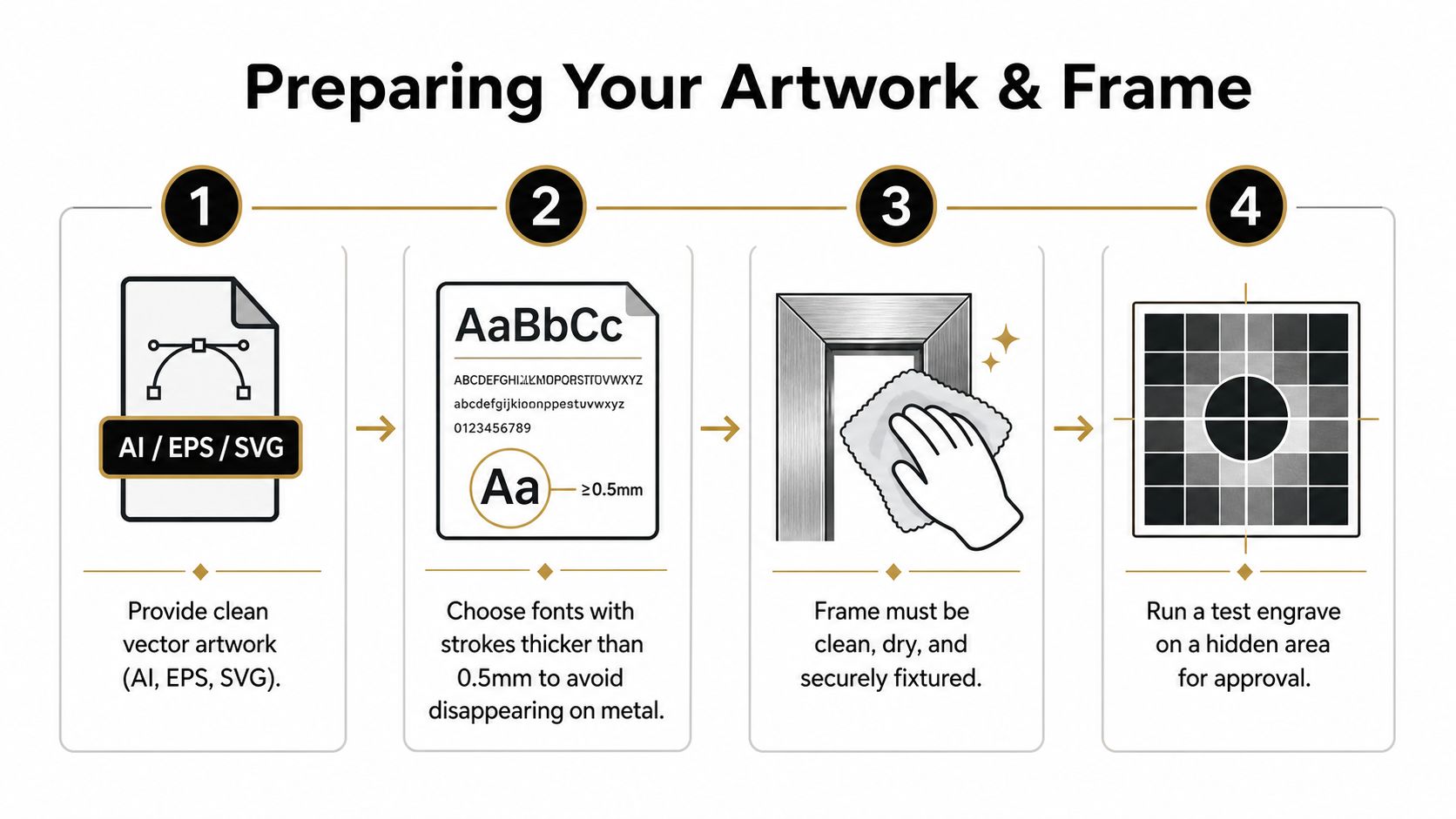
Clean files beat clever ideas
A clean vector file saves time and gives the laser a path it can follow. AI, EPS, and SVG files are the usual starting point because the machine reads linework cleanly, especially on a small temple arm where every detail has to fit the available flat area. Thin strokes are risky on metal, and lines under about 0.5 mm can disappear visually once the mark is reduced to eyewear scale.
Font choice matters more than most customers expect. A fancy script can look good on a mockup and then collapse into mush on a narrow arm. Thick, simple letterforms hold up better, and the artwork should be sized to the actual engraving zone, not the entire temple length, because the curved section won’t take the same result as the flat section.
Fixture, mask, inspect
The frame has to be clean, dry, and immobilized. Any movement during the pass can blur the mark or create a double edge, and any grit left on the surface can interfere with focus or leave residue around the engraved spot. Shops also mask lens areas or nearby reflective parts so stray energy doesn’t bounce where it shouldn’t.
Good habit: ask for a hidden test engrave before anyone commits to the final mark on a visible arm.
After the run, a careful shop brushes away residue, gives the area a light polish if needed, and checks the edge with a fingertip. That last step sounds old-fashioned, but it catches roughness that the eye can miss. If a mark looks sharp but feels sharp too, it’ll bother the wearer every time they put the glasses on.
Business shops that already handle branded items and quick-turn custom work, including laser engraving at places like Business Mail Boutique LLC, usually think in these same terms, clean files, secure fixturing, and a final tactile check before handoff.
When Laser Engraving Is the Wrong Tool for the Job
Laser engraving is permanent, but permanence isn’t always the goal. If a customer wants an exact Pantone color match, a bright white logo on dark acetate, or neon branding that jumps off the surface, pad printing or screen printing can be the better answer. Those methods also make sense for high-volume runs where the unit economics matter more than the permanence of a carved mark.
That’s the part many product pages leave out. Laser is excellent for subtle branding, names, serial numbers, and small-batch customization, especially on metal and titanium frames, but it isn’t the only finish that makes sense for eyewear. For full-color artwork, a shop may steer you toward a plate insert or another decorated component rather than engraving the frame itself.
The decision comes down to what has to survive. If the mark needs to resist wear and stay discreet, laser usually wins. If the mark needs to match a brand guide exactly or carry bright color, printing can do a better job with less compromise. A good vendor won’t force the laser answer just because the machine is available.
Comfort, Skin Contact, and Warranty Risks to Ask About
What can go wrong after the pair leaves the shop
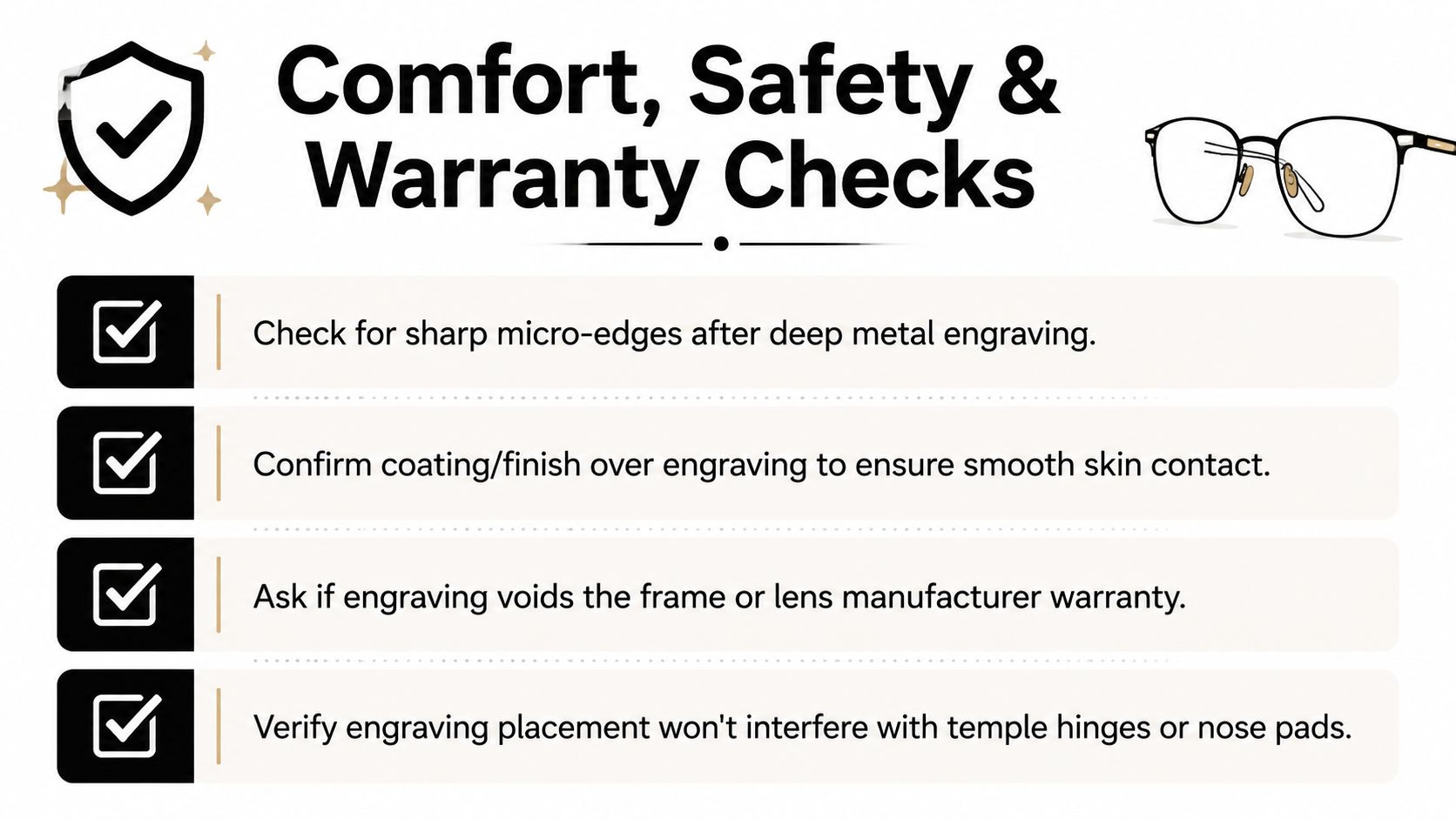
A deep metal engraving can leave a micro-edge if the finish isn’t cleaned up properly. That matters on temples, because the frame rubs against skin and hair all day. Acetate can chip if the laser is pushed too aggressively, and plated frames can show coating failure around the mark if the top layer starts lifting at the edges.
Daily wear changes the equation too. A logo that feels smooth on the bench can still become annoying if it sits near a hinge, nose pad, or temple point that contacts skin under heat and movement. The wearer doesn’t care how tidy the machine file looked, they care whether the frame feels the same after a full day.
Ask before you approve
- Edge finish: ask how the shop removes sharpness after engraving.
- Coating behavior: confirm whether the engraving will expose a different color layer or leave a raw surface.
- Placement: make sure the mark won’t interfere with hinges, nose pads, or temple contact points.
- Warranty: assume the frame manufacturer may treat engraving as a modification and limit coverage accordingly.
That last item is where a lot of buyers get surprised. If the frame or lens maker views engraving as an alteration, the warranty often stops being a clean safety net. A shop that understands eyewear should say that plainly before it touches the frame.
Pricing, Turnaround, and How a Local Shop Quotes the Job
A fair quote starts with the same questions every time, material, placement, artwork complexity, and whether the shop has to remove lenses or work around plated hardware. Small logos and short text are commonly quoted on a per-frame basis, but even fast laser runs can carry setup and art prep fees because the work is in fixturing and file cleanup, not just machine time. Same-day turnaround is possible when the art is ready, the frame is easy to hold, and the shop doesn’t need a test cycle that reveals a problem.
That’s why local storefronts often price custom eyewear differently from bulk work. A one-off pair for a wedding party or corporate gift can take more setup than the actual engraving, while a batch of identical frames is easier to standardize. For event-driven orders, the buying logic is similar to fast custom apparel for events, where the fastest quote is rarely the one with the least planning.
If you’re comparing quote styles, use this lens. A boutique optician might add engraving as a premium service. A brand or reseller may care more about authentication marks, serial numbers, or a discreet logo. A custom shop can also support wholesale and bulk engraving when the same frame style repeats across a run.
The best quote is the one that explains the outcome before the laser starts. You want to hear the material match, the finish expectation, the turnaround condition, and any limits on warranty or surface wear. If the shop can answer those without hand-waving, you’re probably dealing with someone who’s engraved enough eyewear to know where the traps are.
If you want help turning a pair of sunglasses, eyeglasses, or branded accessories into a clean, finished custom piece, visit Business Mail Boutique LLC and ask about their laser engraving services alongside their other shop services. They can help you sort out artwork, material fit, and a realistic turnaround before you commit to the job.

Related posts

Custom Memorial Glasses Engraved in Three Hours in Sugar Land
When a customer needed eight personalized glasses for a memorial, Business Mail Boutique completed the engraving or...

Custom Martini Glass Engraving in Sugar Land, TX
Custom Logo Engraving on Martini Glasses in Sugar Land, Texas.
Business Mail Boutique recently completed a beautiful custom engravin...

Custom Engraved Wine Glasses for a Golf Club Event in Sugar Land, TX
Custom Engraved Wine Glasses for a Golf Club Event in Sugar Land.
Custom wine glass engraving in Sugar Land, TX at Business Mail Bouti...