
- Print Business Cards in Sugar Land – Same Day Service
- Copying Services
- Document Printing, Finishing & Lamination in Sugar Land
- Flyers
- Print Banner in Sugar Land | Same-Day Banner Printing Near Me
- Graphic Design
- Photo Printing
- Postcard Printing
- Document Printing
- EDDM Full Service Postcards
- FotoZoomer Large Format Printing


Businessmailboutique
11645 S. Hwy 6 Sugar land, Texas 77498 United States (US)Phone: 281-875-0161
Email: info@businessmailboutique.com
How to Design Custom License Plate Frames That Last
Businessmailboutique
11645 S. Hwy 6
Sugar land, Texas 77498 United States (US)
Email: info@businessmailboutique.com
You’re usually looking at custom license plate frames for one of three reasons. You want a cleaner finishing touch on your own vehicle, you need branded frames for a company car or fleet, or you need a fast gift or promo item that doesn’t feel generic. The mistake most buyers make is treating the frame like a novelty add-on when it sits at the intersection of design, print production, material durability, and local plate-law compliance.
That matters even more when timing is tight. If you need a frame for an event, a dealership handoff, a school fundraiser, or a branded vehicle by tomorrow, the usual online ordering model starts to show its weaknesses. You can upload a file fast, but you can’t always catch fit issues, artwork crowding, or finish problems before the order ships. For custom work, speed only helps if the result is usable.
Table of Contents
- Why Custom Frames Are More Than Just an Accessory
- Selecting the Right Material for Durability and Style
- Preparing Your Design for Flawless Production
- Staying Compliant with License Plate Frame Laws
- Ordering Your Frames Same-Day Local or Online Supplier
- Installation Tips and Keeping Your Frame Looking New
Why Custom Frames Are More Than Just an Accessory
A license plate frame is small, but it’s one of the few branded or personalized pieces that stays on a vehicle full time. That gives it a different job than a window decal or a temporary magnet. It has to look intentional, fit correctly, and hold up in weather, car washes, and daily handling.
For business use, custom license plate frames work best when the message is simple. A company name, phone number, school name, team slogan, or short brand line usually reads better than a crowded layout. For personal use, the same rule applies. The strongest frames don’t try to say everything.

The category is larger than many buyers realize. The broader car license plate frame market was valued at approximately USD 1.2 billion in 2024 and is projected to reach about USD 2.1 billion by 2033, with North America holding about 35% of the market share, according to DataHorizzon Research’s car license plate frame market overview. That doesn’t mean every frame is premium or well made. It does mean vehicle personalization isn’t a side niche.
Practical rule: If the frame has a message, make it readable in a glance. If it has a logo, give the logo room to breathe.
There’s also a useful distinction between a frame that’s merely customized and one that’s properly designed. A rushed online template can put text where it technically fits but visually fails. A good frame balances four things at once:
- Brand visibility so the name or logo is clear
- Plate visibility so required information stays readable
- Material fit so the finish matches the vehicle and use
- Production realism so the artwork can be printed or engraved cleanly
That’s why the best custom license plate frames aren’t impulse accessories. They’re small-format identity pieces. When they’re done well, they look permanent. When they’re done poorly, they look cheap, crack early, or create legal headaches.
Selecting the Right Material for Durability and Style
Material choice decides whether the frame still looks good after heat, rain, road grime, and routine washing. Many buyers choose by finish alone. In practice, climate and use matter more.
Frame materials differ substantially in how they handle UV exposure, road salt, and car washes. Metal, chrome, and carbon fiber all trade off weight, finish quality, and corrosion resistance, which is why material choice has such a direct effect on long-term wear, especially in harsh conditions, as noted in this product coverage discussing license plate frame material trade-offs.

What each material does well
Plastic frames, especially ABS-style options, are usually the easiest place to start for full-color graphics and shorter lead times. They’re practical when you need bright branding, event runs, school boosters, or short-batch promotional pieces. The downside is that lower-grade plastic can fade, scuff, or look chalky sooner if the vehicle lives outside.
Metal frames feel more substantial in the hand and on the vehicle. They suit corporate branding, dealership-style presentation, and cleaner premium looks. If you’re comparing engraving or durable metal identification options, this overview of engraving metal blank tags in aluminum and stainless steel is useful for understanding how different metals behave in real production environments.
Silicone and softer protective styles solve a different problem. They’re less about a polished chrome look and more about flexibility, paint protection, and reduced rattling. They make sense for drivers who care about avoiding vibration marks or want a less rigid edge around the plate.
Here’s the practical view:
| Material | Best for | Watch out for |
|---|---|---|
| Plastic | Full-color graphics, quick custom jobs, lower-cost batches | Can show wear faster in sun and repeated washing |
| Metal | Premium branding, rigid structure, longer-term use | Finish quality varies, and poor coatings can age badly |
| Silicone | Anti-rattle use, paint protection, flexible fit | Less formal appearance for brand-forward designs |
| Specialty finishes | Style-focused builds and enthusiast vehicles | May prioritize appearance over everyday durability |
Choose by vehicle use, not just appearance
A garage-kept weekend car can carry a more style-driven frame than a work truck parked outside every day. Fleet vehicles need consistency and low maintenance. Gift frames often need fast turnaround and a finish that still looks good without a lot of upkeep.
Cheap frames don’t stay cheap if you replace them after one season.
That’s the total-cost question most generic buying guides skip. A lower upfront price can make sense for a short campaign or one-time event. It usually doesn’t make sense for a branded vehicle that represents your business year-round.
Three buying filters help:
- Sun exposure: Constant outdoor parking is hard on low-grade finishes and printed surfaces.
- Road conditions: Winter salt, dust, and grit punish decorative coatings quickly.
- Handling frequency: If the frame comes off often for plate changes or vehicle swaps, flexible or sturdier options reduce breakage.
If you’re ordering custom license plate frames for a client, staff vehicle, or resale display, choose the material first and the decoration method second. That order prevents a lot of rework.
Preparing Your Design for Flawless Production
Most production problems start in the artwork, not on the press. The file may look fine on a screen and still fail once it’s wrapped around a frame opening, mounting holes, and visible plate area.
A common technical pitfall is overfilling the design area. For standard 12″ x 6″ U.S. plates, copy or logos placed too close to the inner opening can hide registration data and create compliance issues, which is why full-scale proofing matters before production, as explained in this custom frame setup guide from Car Stickers.

Build the artwork around the plate opening
Design the frame opening first. Everything else follows from that. If you start with a logo centered in a flat template and add the opening later, text often ends up too high, too low, or clipped by the visible plate window.
Use a simple safe-zone mindset:
- Leave breathing room around the inner opening.
- Keep critical text away from screw holes.
- Avoid fine lines that need perfect alignment to read well.
- Don’t let decorative borders creep inward.
This matters most on top and bottom text treatments. Buyers love the idea of a long slogan across the bottom rail, but long copy often becomes tiny copy. The better move is fewer words in a heavier, cleaner typeface.
Full-scale proofing catches mistakes that screen previews hide.
Use files a print shop can actually produce from
Vector artwork is still the safest choice for logos, type, and simple shapes. AI, EPS, and press-ready PDF files usually scale cleanly and keep edges sharp. Raster files like JPEG or PNG can work for photographic or texture-heavy art, but they need to be high quality and prepared carefully.
If you’re supplying art for a local print run, this is the checklist I’d use before approving anything:
- Vector first: Logos and text should stay editable or be converted cleanly to outlines.
- Color mode: Build for print, not just screen appearance.
- Font handling: Outline fonts or embed them so substitutions don’t change spacing.
- Proofreading: Names, phone numbers, web addresses, and taglines need one more pass than you think.
- Material match: Some artwork looks better engraved, some UV printed, some cut from vinyl.
For graphics that rely on cut shapes, spot elements, or durable surface application, these engraved vinyl sheet options are a helpful reference for how simplified production-ready graphics translate better than fussy artwork.
A few things almost never work well on frames: thin scripts, low-contrast color combinations, tiny legal text, and busy background patterns. On a monitor, they can look polished. On a moving vehicle, they disappear.
If you want the cleanest result, build the file for legibility first and decoration second.
Staying Compliant with License Plate Frame Laws
A frame can be attractive, expensive, and well printed, then still be the wrong choice if it hides required plate information. That’s where many buyers get tripped up.

State rules on frame obstruction vary, and Texas is a good example of why details matter. Texas requires license plates to be “clearly visible and legible” and prohibits coverings or attachments that obscure plate information, as discussed in this Texas plate visibility explainer with legal context. A lot of drivers assume a frame is acceptable as long as the main numbers show. That assumption can be wrong.
Readability matters more than decoration
The risk isn’t only covering the plate number. A frame can also create problems if it blocks the state name, sticker area, or other identifying information. Thick borders, deep lips, decorative overlays, and novelty privacy concepts push a design into risk quickly.
The safest custom frames follow a plain rule. The plate should read as a plate first, frame second.
A short video overview helps show how enforcement concerns come up in real traffic stops and frame inspections:
What to check before you approve a frame
Before ordering or installing, verify these points against your local rules:
- Inner opening coverage: Make sure the frame edge doesn’t cut into visible plate information.
- Sticker clearance: Leave room around registration stickers and renewal marks.
- State identification: Don’t cover the state name or required jurisdiction text.
- Reflectivity concerns: Avoid attachments or finishes that interfere with normal readability.
If a frame needs explaining to an officer, it’s probably too aggressive.
For business vehicles, compliance matters even more because a ticket tied to a branded company car creates a preventable annoyance. A cleaner design with wider visible clearance usually looks better anyway.
Ordering Your Frames Same-Day Local or Online Supplier
The buying path splits. You can order from a large online supplier, upload your file, and wait for delivery. Or you can work with a local shop that can review artwork, catch issues, and in some cases turn the job around the same day.
When local production wins
Local production is strongest when speed and proofing matter more than rock-bottom batch pricing. If the frame is for a client meeting, vehicle wrap reveal, trade event, school presentation, or replacement job, being able to speak to someone directly matters.
The biggest practical advantage is error prevention. A local shop can look at your file and point out things an online cart won’t flag clearly enough:
- Artwork crowding: Text may fit the template but still sit too close to the opening.
- Finish mismatch: A metallic-looking design on screen may need a different substrate or process to look right in person.
- Hole alignment concerns: Production is one thing. Actual fit on the vehicle is another.
- Rush decision-making: If you need the frame today, it helps to choose a method the shop can produce reliably rather than optimistically.
For businesses that already use local vendors for signage, decals, or event materials, there’s another benefit. The frame can be matched visually with other branded pieces. If you’re also producing display graphics or promotional signage, it makes sense to coordinate through a shop that handles both, such as local providers offering sign printing services.
When online suppliers still make sense
Online suppliers are useful for larger runs, standardized repeats, and buyers who already have production-ready files. If the artwork is simple, the dimensions are confirmed, and the project timeline has slack, online ordering can be efficient.
But there are trade-offs:
| Option | Strongest advantage | Main drawback |
|---|---|---|
| Local same-day shop | Fast turnaround, real proofing, direct support | May not be the cheapest path for large uniform runs |
| Large online supplier | Convenient ordering and bulk-focused workflows | Less hands-on review, slower correction cycle if something is off |
A lot of people frame this choice as local versus online. In practice, it’s urgent custom work versus standardized reorder work. For custom license plate frames with design variables, local often saves time because it reduces mistakes before they become shipped mistakes.
Installation Tips and Keeping Your Frame Looking New
A well-made frame can still rattle, sit crooked, or wear prematurely if it’s installed carelessly. Most installation problems are simple. The frame wasn’t test-fit first, the screws were overtightened, or dirt got trapped behind the mounting surface.
Install carefully the first time
Start by removing the existing plate hardware and checking the mounting area. Wipe away dust, grit, and old residue before you position the new frame. If the frame uses the vehicle’s existing hardware, make sure the holes line up cleanly before tightening anything fully.
This order works well:
- Hold the frame and plate in place together.
- Start the screws loosely by hand.
- Confirm the frame sits level and doesn’t pinch the plate oddly.
- Tighten evenly, alternating sides.
- Stop when snug.
Plastic frames crack most often when someone keeps turning after the frame is already secure. Metal frames are more forgiving, but they can still distort or mark the plate if forced down unevenly.
Check fit before final tightening. Most rework starts with a small alignment miss, not a major production defect.
If the frame vibrates, a thin protective backing or anti-rattle support can help, provided it doesn’t interfere with plate visibility or mounting.
Clean for the material you bought
Maintenance should match the surface. That’s where people unintentionally shorten the life of custom license plate frames.
For printed plastic frames, use mild soap, water, and a soft cloth. Avoid harsh solvents and rough pads. Aggressive cleaners can dull the printed area or scratch the clear surface.
For metal frames, wipe off road grime before it sits too long, especially after bad weather or salted roads. If the finish is polished or plated, gentle cleaning preserves the appearance better than scrubbing. For silicone or flexible styles, regular washing is usually enough, but inspect the edges occasionally for trapped debris.
A few habits help any frame last longer:
- Wash residue off early: Road film is easier to remove before it hardens.
- Skip abrasive tools: Scrub pads and stiff brushes can damage printed or polished surfaces.
- Inspect hardware: Loose screws create rattling, wear marks, and uneven stress.
- Recheck after car washes: Repeated washing can expose small fit issues.
The best maintenance plan is simple. Clean it gently, keep it aligned, and replace hardware if the fasteners start to corrode before the frame does.
If you need custom license plate frames fast, or you want help catching artwork, material, or fit problems before they become expensive reorders, Business Mail Boutique LLC in Sugar Land is a practical local option. They handle same-day printing and custom production work with the kind of in-person support that’s hard to get from a large online vendor. That’s especially useful when you need a quick proof, a branded vehicle accessory, or a short-run custom job done right the first time.

Related posts
Online Printing Documents Services: Order & Pickup Today
Online Printing Documents Services: Order & Pickup Today
You've got a meeting tomorrow, a proposal still needs to be print...
Marketing Material Printing
Marketing Material Printing: A Small Business Guide
You're probably here because a real deadline is staring at you. A gr...
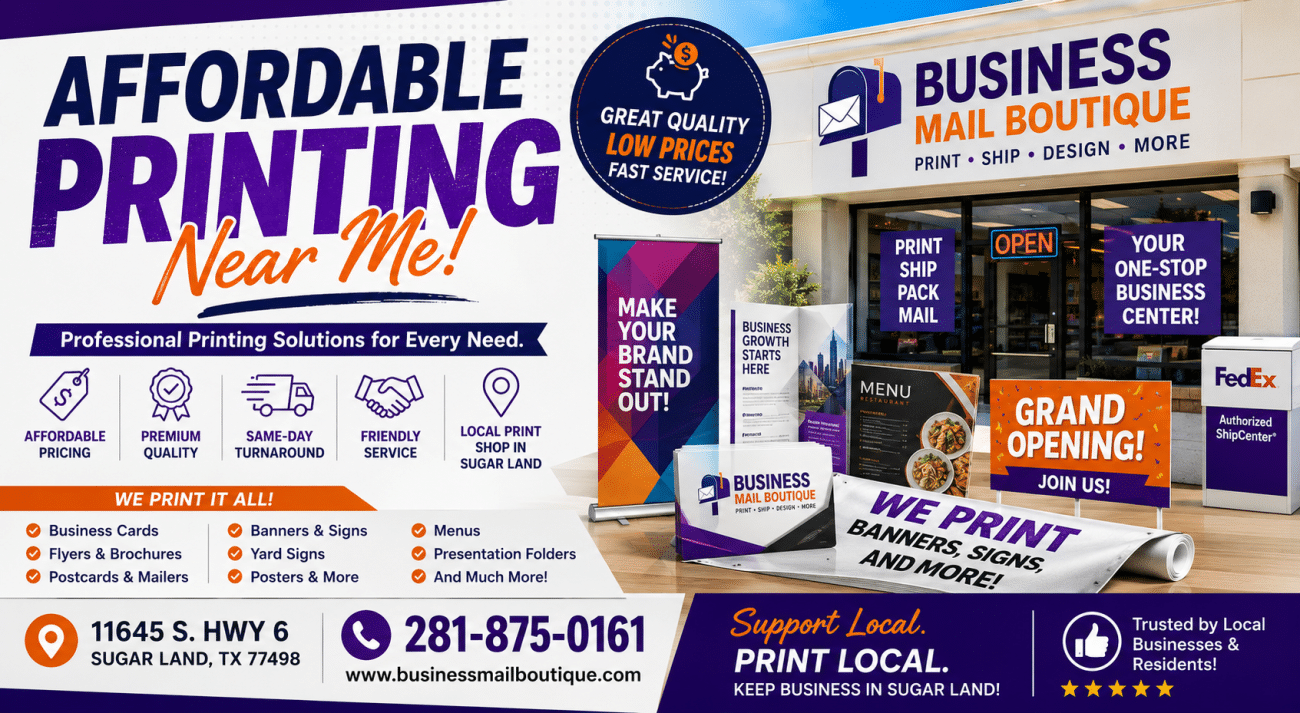
Affordable Printing Near Me – Professional Print Shop Services
Affordable Printing Near Me – Professional Print Shop Services at Business Mail Boutique in Sugar Land
When searching onli...