
- Print Business Cards in Sugar Land – Same Day Service
- Copying Services
- Document Printing, Finishing & Lamination in Sugar Land
- Flyers
- Print Banner in Sugar Land | Same-Day Banner Printing Near Me
- Graphic Design
- Photo Printing
- Postcard Printing
- Document Printing
- EDDM Full Service Postcards
- FotoZoomer Large Format Printing


Route
Businessmailboutique
Phone: 281-875-016111645 S. Hwy 6 Sugar land, Texas 77498 United States (US)
Email: info@businessmailboutique.com
You got the email, form, or onboarding packet. It says you need fingerprints on FD258 or FD1164 before you can start work, finish a license application, volunteer, or submit a background check. Then a key question arises: where do you go for fingerprinting in Sugar Land, what kind do you need, and do you have to book an appointment days in advance?
That confusion is normal. Sugar Land has more than one fingerprinting path, including commercial providers, retail-based locations, and appointment-based official channels. Some people need a fast walk-in. Others need a specific agency submission. The hard part usually isn’t the fingerprinting itself. It’s figuring out the right process before you show up.
Table of Contents
- Navigating Fingerprinting in Sugar Land
- Digital Live Scan vs Traditional Ink Cards
- Who Needs Fingerprinting Services and Why
- Your Best Bet for Walk-In Fingerprinting Business Mail Boutique
- Comparing Local Fingerprinting Options
- Your Pre-Appointment Checklist and FAQ
Navigating Fingerprinting in Sugar Land
Searching for fingerprinting in Sugar Land reveals a clear challenge, as providers and processes vary significantly. Sugar Land features a diverse range of fingerprinting options, including commercial sites like Certifix Live Scan at The UPS Store and authorized centers for IdentoGO by IDEMIA. This variety reflects the growing demand for efficient background check services in the region, a trend detailed by Business Mail Boutique’s Sugar Land fingerprinting overview.
That variety helps, but it also creates friction. One location may be set up for an employer-driven submission. Another may focus on FBI background checks. Another may only work well if you already have a service code, agency paperwork, or a pre-enrollment number.
The real trade-off
Generally, the choice comes down to three things:
- Agency requirement: Some employers or licensing boards tell you exactly which vendor or submission method to use.
- Convenience: If your instructions allow flexibility, walk-in availability can save time.
- Format: You may need digital live scan, an FBI submission, or a physical card for an out-of-state agency.
Practical rule: Don’t choose a fingerprinting location first. Check what your employer, board, or agency actually requires, then choose the location that matches it.
People run into trouble when they assume all fingerprinting services are interchangeable. They aren’t. A teacher candidate, a nurse applicant, a volunteer, and someone filing federal paperwork may all need fingerprints, but not necessarily through the same workflow.
That’s why a useful local guide has to do more than list addresses. It needs to help you match your requirement to the right service without wasting a trip.
Digital Live Scan vs Traditional Ink Cards
Today, individuals will typically encounter digital live scan, not the old ink-and-roll method. The easiest way to think about it is this: ink cards are like filling out a paper form and mailing it, while live scan is like submitting the same information electronically.
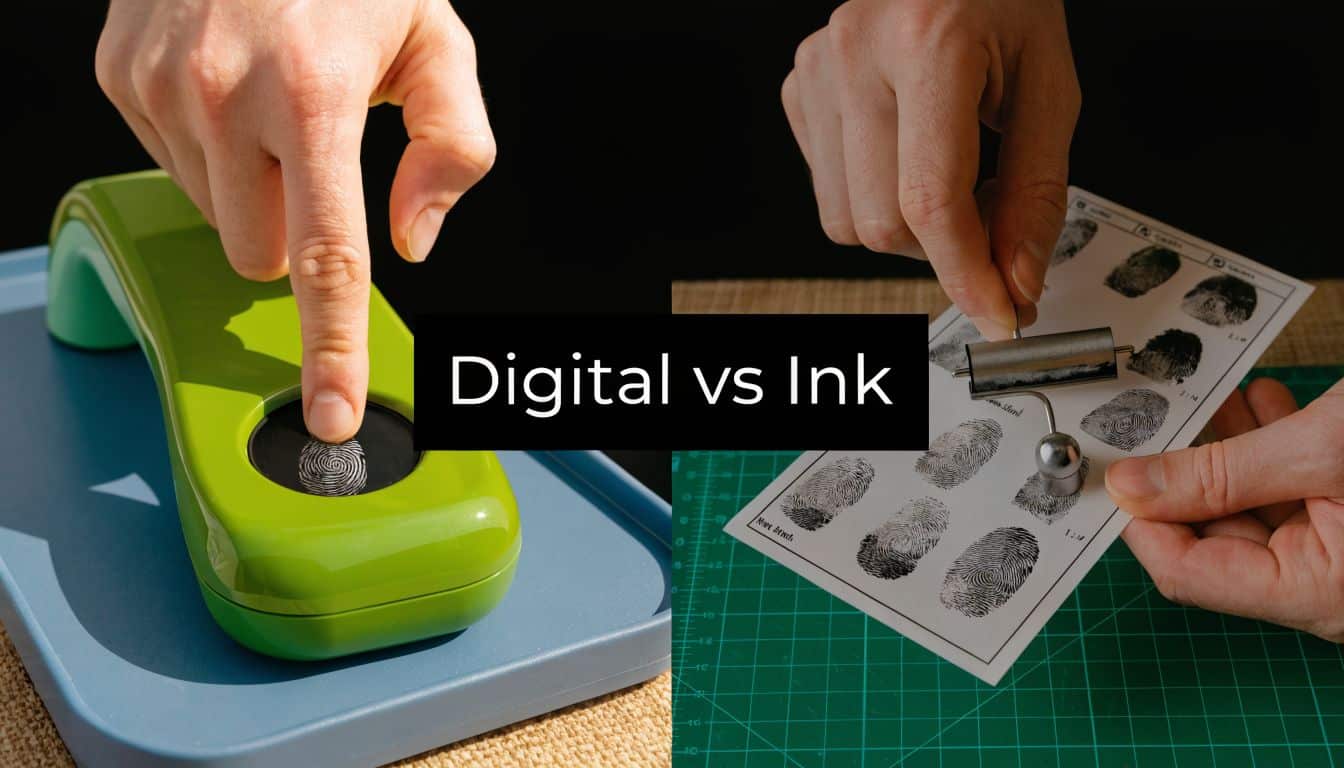
If you want a closer look at how modern scanning works, digital ink roll fingerprinting in Sugar Land shows the basic process and where digital capture fits in.
What live scan actually does
Live scan captures your prints electronically and sends them in the format required by the receiving agency when that workflow is supported. In practical terms, that usually means cleaner images, less mess, and fewer handling errors than traditional ink cards.
The biggest advantage is quality control at the time of capture. If a finger didn’t scan well, the technician can often catch it immediately instead of finding out later after a mailed card gets rejected.
Clean digital capture usually makes the process easier for both the applicant and the agency receiving the prints.
That matters because fingerprinting isn’t just about collecting prints. It’s about producing prints that the agency can properly use.
When ink cards still make sense
Ink cards haven’t disappeared. They still matter when an out-of-state board, a federal form, or a specific agency asks for a physical fingerprint card rather than an electronic submission.
Ink can work well, but it leaves less room for correction. Smudging, pressure problems, and uneven rolling can all create issues. If you’ve got dry skin, worn ridges, or scarring, that becomes even more important.
For most busy professionals, digital is usually the smoother option when allowed. But the correct answer isn’t “digital is always better.” The correct answer is “use the format your agency will accept.”
Who Needs Fingerprinting Services and Why
A lot of people assume fingerprinting is only for law enforcement or government jobs. In Sugar Land, the more common reality is everyday professional life. A hiring packet, a license renewal, a volunteer role, or a regulated application can all trigger the requirement.
Common local situations
One person needs prints before starting at a school. Another needs them for a healthcare credential. A real estate applicant may need them for a licensing step. Someone helping with a youth program may need a fingerprint-based background check before working with children.
For healthcare and licensing paths, nursing is one of the clearest examples. If that’s your situation, fingerprinting for the Board of Nursing in Sugar Land gives a practical look at how applicants usually approach that requirement.
Here are the most common buckets:
- Professional licensing: Nursing, financial compliance work, real estate, and other regulated fields often require fingerprint-supported screening.
- Employment onboarding: Schools, childcare settings, contracting roles, and certain corporate positions may ask for fingerprint-based checks before a start date.
- Volunteering: Some volunteer roles, especially those involving children or vulnerable groups, require fingerprints instead of a basic name-based check.
- Federal or specialized filings: Certain applications call for FBI-based processing or card-based submission tied to a federal agency.
Why the requirement changes by agency
The fingerprinting itself may feel similar from the customer side, but the receiving agency sets the rules. That’s why two applicants standing in the same line can need different forms, codes, or submission paths.
A teacher candidate may be directed into a district or state-specific system. A licensing applicant may need an approved vendor workflow. Someone submitting federal paperwork may need fingerprints captured in a format accepted by that agency.
That’s where people lose time. They hear “I need fingerprints” and think the task is simple. It is simple once the requirement is matched to the right method.
Your Best Bet for Walk-In Fingerprinting Business Mail Boutique
For people who need flexibility, a walk-in option is often the easiest path. That matters when you’re trying to fit fingerprinting between work, school pickup, client meetings, or a licensing deadline.

One practical local option is Business Mail Boutique LLC, which operates as an authorized PrintScan center in Sugar Land. That matters because the PrintScan setup supports electronic FBI Criminal History Record Information submissions and uses high-resolution capture technology with 98.5% match accuracy and a rejection rate of less than 1%, according to the PrintScan authorized Sugar Land location details.
What makes walk-in service practical
Walk-in fingerprinting helps when your main problem isn’t the fingerprinting itself. It’s scheduling. A lot of appointment-based systems work fine if your employer has already told you where to go and you’ve got time to wait for an opening. They work less well when you need to handle it on your own timetable.
The practical upside of a retail-style location is simple:
- You can fit it into a normal day: That’s useful for professionals who can’t build their week around a narrow appointment slot.
- You can handle related errands in one stop: Fingerprinting often comes with supporting tasks such as ID photos, notary work, document printing, or shipping forms.
- You can ask questions in real time: If your paperwork is unclear, it helps to sort that out before a bad submission creates delays.
What usually works best is arriving with your ID, agency instructions, and any service code or request details already in hand. What doesn’t work is showing up with only a vague email that says “get fingerprinted” and no clue where the results are supposed to go.
If your agency gave you a code, number, or vendor instruction, bring it. That detail usually matters more than anything else at the counter.
What the PrintScan setup changes
Not all fingerprint capture is equal. In practice, better equipment reduces the chance that quality problems will follow you downstream. The benefit isn’t abstract. It shows up when a technician can capture clearer prints and avoid the distortion issues that are more common with manual ink methods.
This is also where digital systems help applicants with tricky prints. If you have dry skin, faint ridges, or hands that don’t scan easily, the ability to review the quality during capture is a real advantage.
A short video can help if you want to see the process mindset before you go:
The one-stop angle matters more than people expect. Someone getting fingerprinted for a license application may also need to print forms, ship documents, notarize paperwork, or take compliant ID photos. When those services live in the same storefront, the whole errand gets simpler.
The main trade-off is that convenience only helps if the location supports your exact use case. Before you go, confirm whether your requirement is an FBI submission, a Texas-specific workflow, a card-based print, or an employer-directed vendor process.
Comparing Local Fingerprinting Options
Not every applicant should go to the same place. Some people need a structured, employer-specific process. Others need flexibility and a walk-in format. The useful comparison isn’t “which place exists.” It’s “which setup fits your requirement with the least friction.”
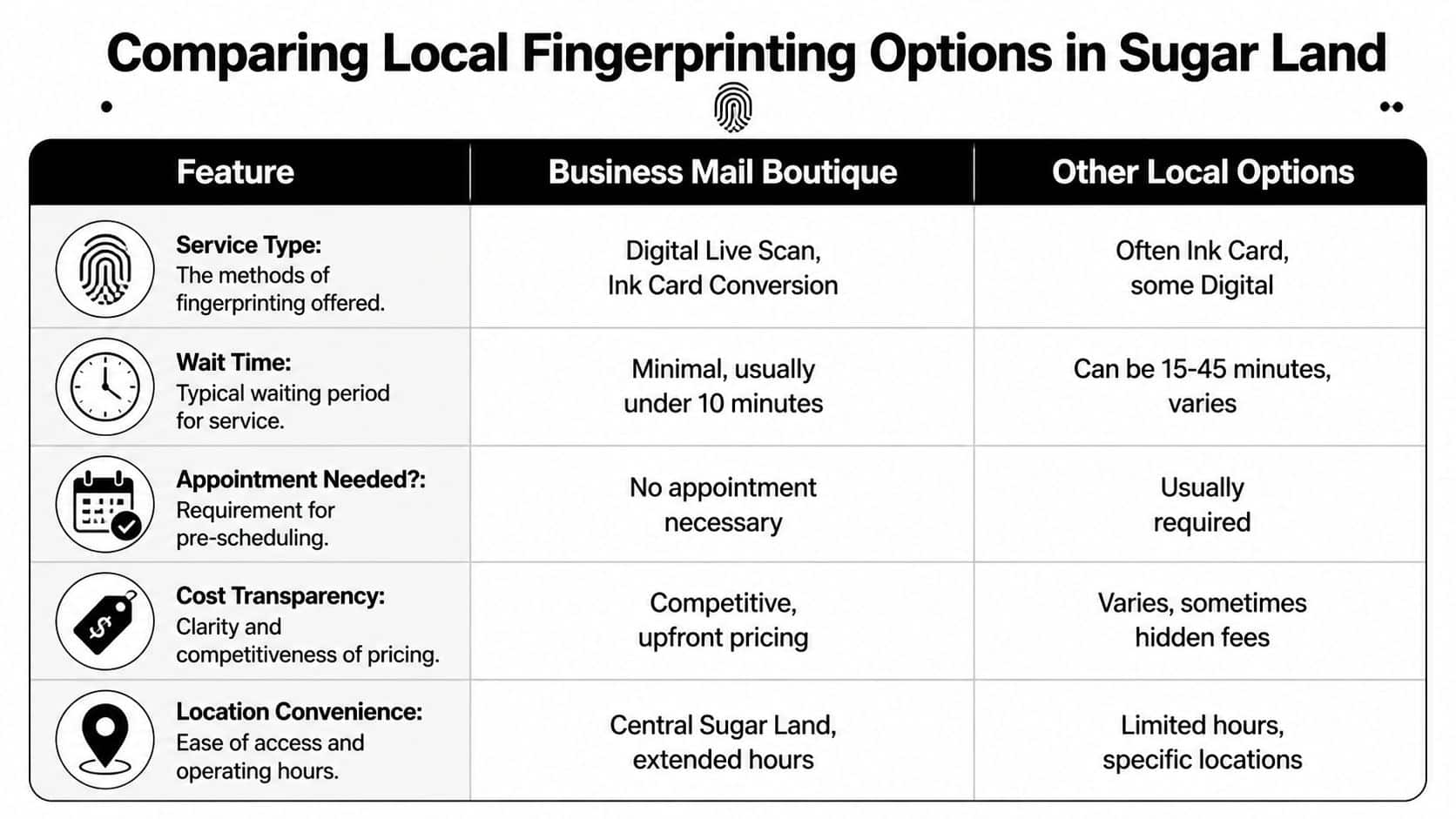
If you want a service-specific overview of digital capture options, fingerprint scanning services in Sugar Land gives additional context on local scanning workflows.
Fingerprinting in Sugar Land at a glance
One clear comparison point is Fort Bend ISD. The district operates an appointment-only digital fingerprinting facility at 16431 Lexington Blvd., Sugar Land, TX 77479 and charges $49.26 per fingerprint submission. Applicants need a pre-enrollment email with a Universal Enrollment ID, must arrive 15 minutes early, and payment must be made by a credit or debit card in the candidate’s name, according to the Fort Bend ISD fingerprinting page.
| Feature | Business Mail Boutique | Fort Bend ISD Facility |
|---|---|---|
| Access style | Walk-in oriented | Appointment only |
| Primary fit | Convenience-driven applicants who need flexibility | Applicants directed into a school-district style workflow |
| Submission style | Digital scanning options for supported workflows | Digital fingerprinting tied to its structured pre-enrollment process |
| Preparation needed | Bring ID and agency instructions | Pre-enrollment email and UEID required before scheduling |
| Payment setup | Confirm directly before arrival | Card payment in the candidate’s name |
A few practical conclusions follow from that:
- Choose Fort Bend ISD if your employer or district process specifically points you there.
- Choose a flexible retail-based option if your instructions allow choice and your schedule is tight.
- Confirm walk-in details before you leave home if your paperwork is unusual or tied to a less common agency.
The “right” location is usually the one that matches your agency instructions with the fewest extra steps.
Your Pre-Appointment Checklist and FAQ
A smooth fingerprinting visit usually comes down to preparation. Most delays happen before the scan starts. Missing ID, missing agency information, or unclear instructions cause more problems than the actual capture process.
What to bring
Use this checklist before you leave:
- Valid identification: Bring the ID your agency will accept. If your instructions mention specific identity documents, follow those directions exactly.
- Agency paperwork or service details: Bring any email, registration sheet, request form, service code, ORI information, or pre-enrollment instructions you were given.
- Payment method: Check accepted payment methods before arrival. Some locations have specific card rules.
- Basic hand prep: If your skin is very dry, take care of your hands beforehand. Dry skin can make ridge detail harder to capture.
- Time buffer: If you’re using an appointment-based site, don’t cut it close. Some systems expect early arrival.
Frequently asked questions
Many applicants worry about issues that local pages rarely explain. That concern is reasonable. One commonly cited FAQ set includes print rejection, which occurs in 5 to 10 percent of cases nationally, fingerprint validity that is often 6 months for Texas DPS, and practical concerns like dry skin, as noted by Certifix’s Sugar Land fingerprinting location page.
What if my prints are rejected?
It happens. Rejection is usually a quality issue, not a sign that you did anything wrong. If you’ve got dry skin, worn fingerprints, scars, or age-related ridge loss, tell the technician before scanning starts.
How long does it take to get results?
That depends on the receiving agency, not just the fingerprinting location. The local provider captures and submits the prints. The agency or background-check system controls the review timeline.
How long are fingerprints valid?
That depends on the purpose. Some Texas DPS-related uses are often treated as valid for 6 months in the FAQ context cited above.
Can I just walk in anywhere?
Only if your agency allows flexibility. Some employers, school systems, and boards require a specific enrollment process or approved vendor path.
What helps if I have difficult prints?
Clean hands, no heavy residue, and good hydration can help. If you have scarring or very faint ridges, mention it immediately so the technician can adjust the capture approach.
A good rule is simple: bring more documentation than you think you need, and don’t assume the fingerprinting provider can guess your agency’s process from a one-line email.
If you need a local place to handle fingerprinting along with shipping, printing, notary, passport photos, or other document tasks in one stop, Business Mail Boutique LLC is a practical Sugar Land option to check before you go.
Composed with the Outrank app

Related posts
How Does a Virtual Address Work? A Clear Guide
How Does a Virtual Address Work
You're probably dealing with one of these problems right now. Your business is new, so your home add...

Custom Engraved Coffee Mugs and Etched Mugs: A Guide
Custom Engraved Coffee Mugs and Etched Mugs: A Guide
You need a mug fast. Maybe it's a retirement gift for someone who's been drinki...
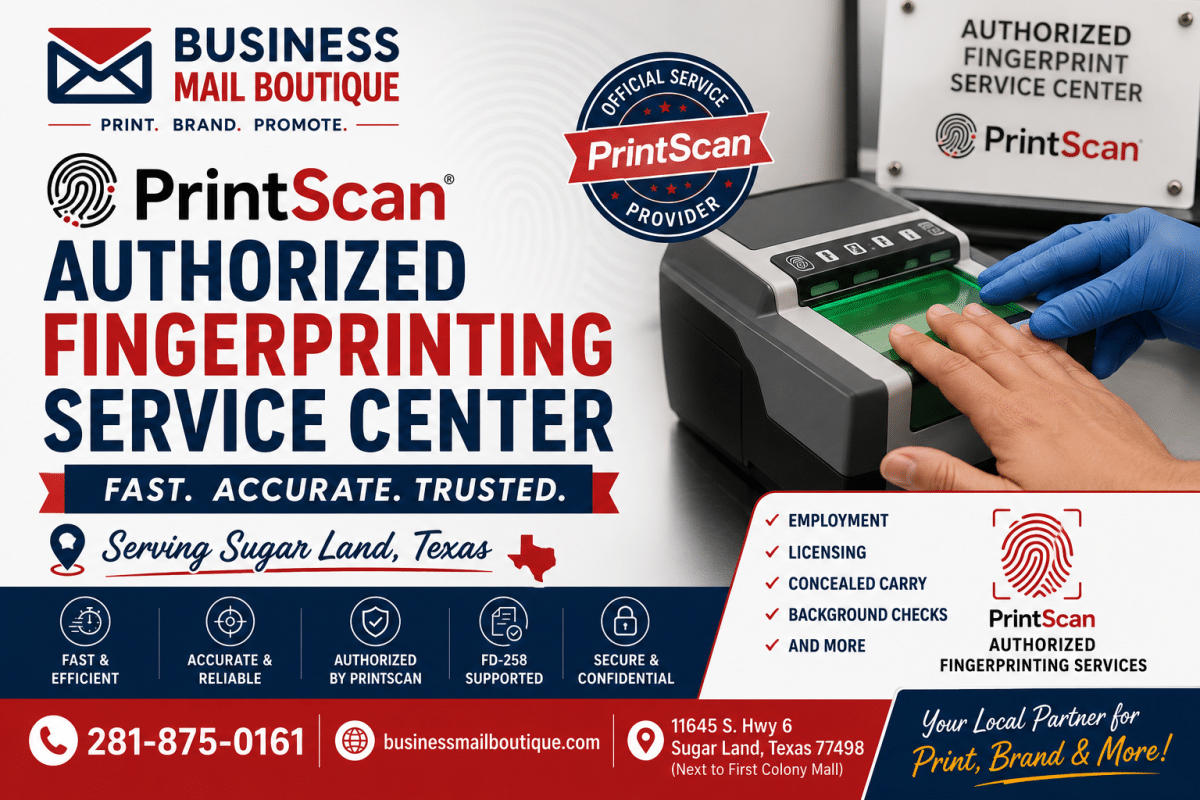
PrintScan Authorized Fingerprinting Service Center Guide
You've probably got a form in one hand and a deadline in the other. A new job wants a background check. A licensing board needs prints....