
- Print Business Cards in Sugar Land – Same Day Service
- Copying Services
- Document Printing, Finishing & Lamination in Sugar Land
- Flyers
- Print Banner in Sugar Land | Same-Day Banner Printing Near Me
- Graphic Design
- Photo Printing
- Postcard Printing
- Document Printing
- EDDM Full Service Postcards
- FotoZoomer Large Format Printing


FINRA Fingerprint Card
Get your FINRA fingerprint card submitted correctly. This covers how to obtain, fill out, and submit the FD-258, avoiding common errors.
Businessmailboutique
11645 S. Hwy 6
Sugar land, Texas 77498 United States (US)
Email: info@businessmailboutique.com
Route
You’re usually looking up a FINRA fingerprint card when something is already moving. A new hire needs to get registered. Compliance is waiting on a background check. An operations employee has access that suddenly puts them inside the fingerprinting rule. What slows everything down isn’t the fingerprinting itself. It’s the avoidable mistakes: sending the wrong card, missing a required field, mailing hard cards the wrong way, or learning too late that a non-registered employee still needed prints.
The cleanest way through this process is to treat it like a controlled submission, not a quick errand. Use the right card, complete it exactly as required, choose the right submission method for the person’s situation, and watch for the rejection triggers that cause rework.
Who Needs a FINRA Fingerprint Card
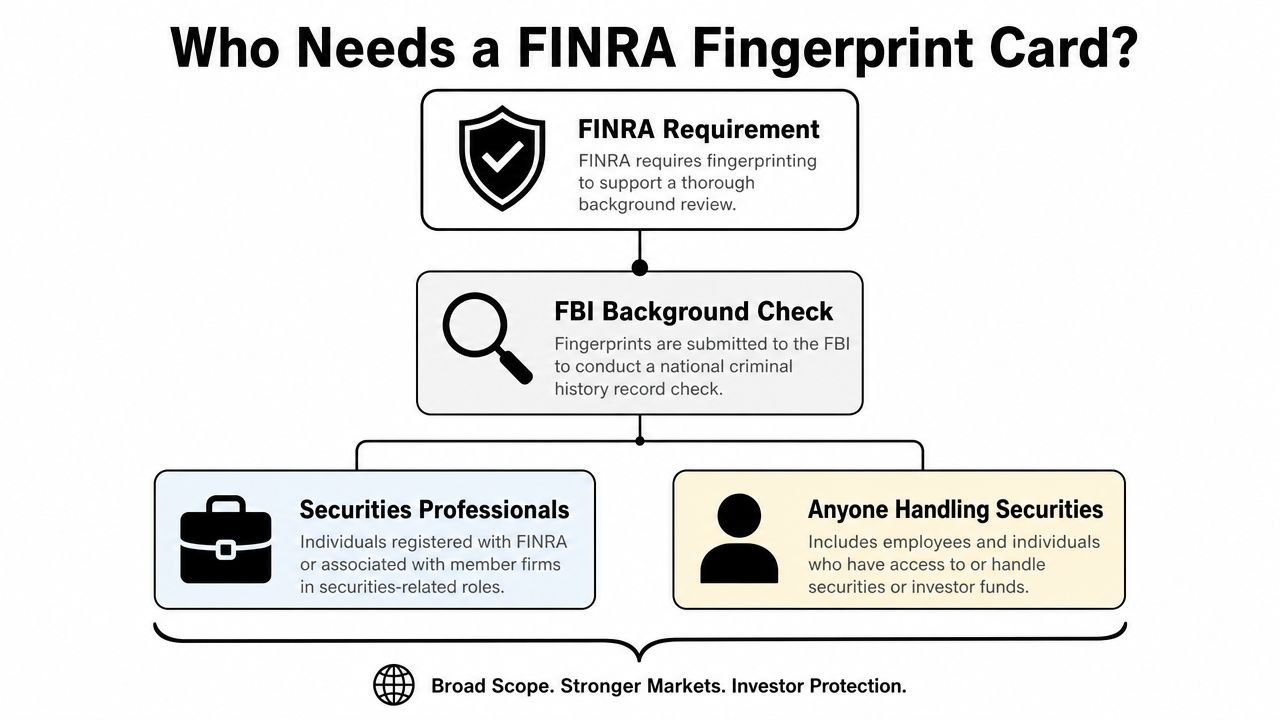
A FINRA fingerprint card is part of the FBI criminal background check process for people covered under securities industry fingerprinting requirements. FINRA’s fingerprint program requires new registered persons and associated persons of broker-dealers to submit fingerprints to the FBI under the Securities Exchange Act of 1934, and FINRA has enforced that program since its formation in 2007, as described in FINRA’s fingerprints quick reference guide.
The mistake I see most often isn’t bad fingerprint technique. It’s starting from the wrong assumption about who needs to be printed.
The rule firms miss most often
A common misconception is that only registered reps need fingerprinting. That’s not broad enough. Under SEC Rule 17f-2, “system access is the key”, and employees with login credentials to accounting, general ledger, or order management systems must be fingerprinted, including non-registered staff such as IT or bookkeepers, as explained by FirstMark’s overview of who must be fingerprinted.
If a person can open the general ledger or change financial records, treat that as a compliance question before treating it as a job-title question.
That changes how firms should review personnel. Titles don’t tell the whole story. Access rights do.
If you need a quick background refresher on what FINRA does, that context helps explain why the fingerprinting rule reaches beyond obvious front-office registration roles.
A simple way to decide
Use this short decision path when you review a hire or existing employee:
- Registered or being registered: Start with fingerprinting as part of the onboarding checklist.
- Non-registered but system-enabled: Review whether the person can access accounting, order management, or financial record systems.
- Role changed after hire: Re-check access permissions. A back-office promotion can create a fingerprinting obligation even when the original hire did not.
- Unsure at the branch level: Ask compliance before you schedule the appointment, not after a regulator asks why the person was omitted.
A lot of preventable confusion disappears when HR, operations, and compliance use the same intake checklist. If your team needs a broader plain-English reference on documents, IDs, and appointment prep, this fingerprinting FAQ guide is a useful companion.
Getting the Right Fingerprint Card
A lot of avoidable FINRA delays start before the applicant ever sits down for prints. The wrong card gets used, the firm wants a different routing path, or an international packet is assembled incorrectly. Good prints on the wrong paperwork still slow the filing.
Start with the sponsoring firm. In practice, firms often control the card format, where employer information is entered, and whether they want a hard card or an electronic capture workflow tied to their registration process. If you book first and ask later, you can end up redoing the appointment.
Confirm four points before you schedule:
- Which card should be used: Some firms issue the card themselves or require a specific version.
- Who completes employer information: Compliance or registration teams may want those fields entered in-house.
- Where the finished card should go: The applicant, fingerprinting site, and firm do not always use the same return route.
- Whether hard card or electronic capture is preferred: The answer can depend on office location, vendor setup, or internal review steps.
Use the exact card your firm approves. A generic card that looks close is still the wrong card if the firm will not accept it.
International submissions require even more care. International Transfer Agents and Clearing Agencies must use hardcopy FINRA-specific fingerprint cards, and those cards are ordered through Sterling FINRA Client Support at (833) 794-2009 or taoclientsupport@sterlingcheck.com. FINRA’s international fingerprint instructions also spell out a mailing rule that trips up batch senders. Do not place more than 200 hard cards in one inner envelope when sending cards to First Advantage Biometrics at 10220 SW Greenburg Rd, Suite 301, Portland, OR 97223.
That packaging limit matters. If a firm sends international cards in bulk and ignores the inner-envelope cap, the problem starts in the mailroom, not at the scanner.
For individual applicants, the takeaway is simple. Do not print your own substitute card, and do not build your own international packet from office supplies. Get the approved materials first, then follow the firm’s instructions exactly.
How to Complete Your Card Flawlessly
A FINRA card can be rejected even before anyone looks at the fingerprint pattern. In my experience, the preventable problems start with card prep. A skipped field, the wrong ink color, an ID mismatch, or rough handling after printing can all create delays that are harder to fix once the card is in transit.
A clean submission starts with complete, legible biographical data and a card that stays flat, dry, and readable from the moment you fill it out.
What must be on the card
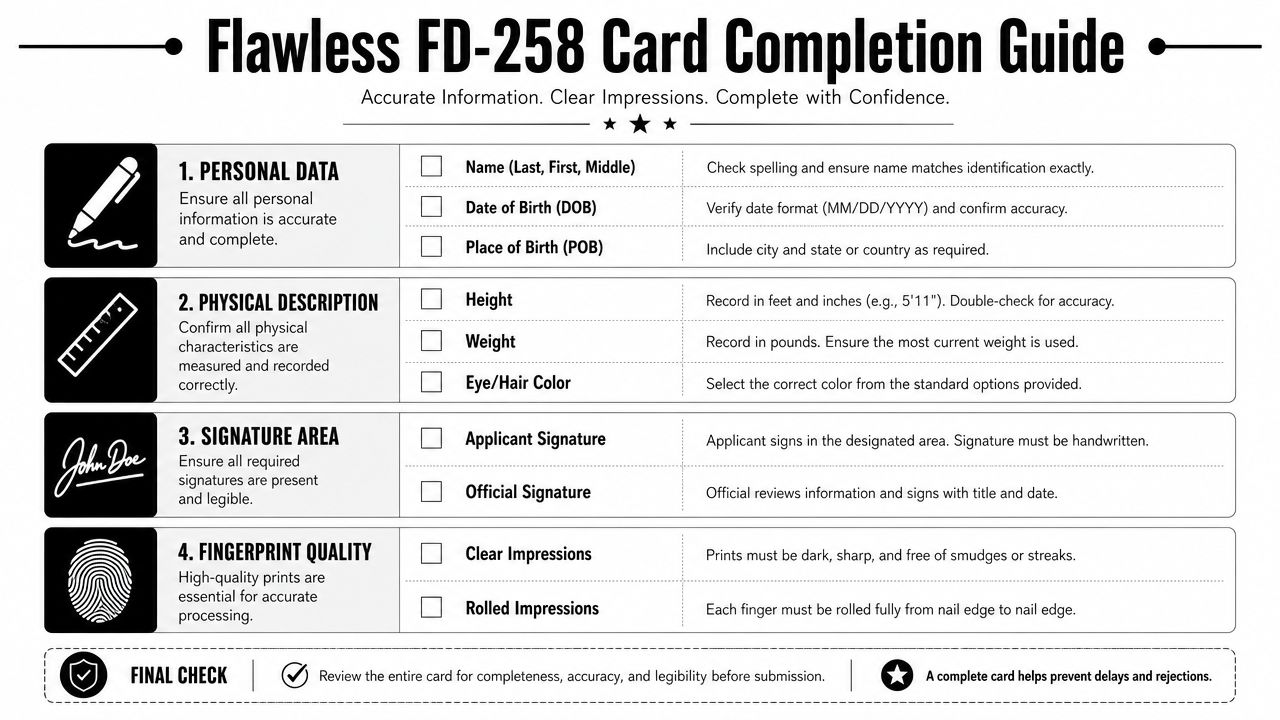
Every FINRA fingerprint card must be completed in black ink only and include the required demographic fields. Applicants should also bring two forms of identification, including one government-issued photo ID, according to Silver Oak Securities’ fingerprinting instructions.
Complete these fields before the appointment: full name, signature, residential address, employer name and address, aliases, date of birth, sex, race, height, weight, eye color, hair color, place of birth, and Social Security Number.
Accuracy matters more than speed here. If your ID says “Robert J. Smith,” do not write “Bob Smith” on the card. If you have no alias, confirm whether your firm wants that field left blank or marked “None.” If employer information is being entered a specific way by your compliance team, copy that format exactly.
A few habits prevent avoidable rework:
- Print clearly in black ink: Do not use blue ink, pencil, or mixed entries.
- Match your ID exactly: Keep name spelling, order, and suffixes consistent with your identification.
- Fill every required field carefully: Physical descriptors should be verified, not guessed.
- Keep the card clean: Do not fold, staple, or smudge it before submission.
- Review before prints are taken: Fixing a bad data field after capture often means starting over.
Many applicants find it helpful to watch a visual overview of the process before they arrive. This short guide to ink and LiveScan fingerprint capture shows what the appointment flow typically looks like.
What to bring to the appointment
Bring the documents and materials that let the technician complete the job without guessing or improvising:
- One completed fingerprint card
- A pre-addressed postage-paid envelope
- Two forms of identification
- One photo ID issued by government, such as a driver’s license or passport
- A second ID, such as a credit card
If your firm has given you a control number, routing sheet, or location-specific instructions, bring those too. Small omissions cause bigger delays than applicants expect.
For mail-in hard cards, packaging matters. Keep the card flat. Do not bend it into a small envelope. Do not clip extra paperwork over the fingerprint blocks. If the card is damaged in transit or the prints are later found illegible, FINRA can require a new submission, and firms often have to address that quickly because of the 30-day illegibility follow-up window.
Final review before submission
Before the card leaves your hands, run this check:
| Checkpoint | What to confirm |
|---|---|
| Ink | Black ink only |
| Identity | Name matches ID exactly |
| Required data | All listed fields are complete |
| Signature | Applicant signed where required |
| Card condition | No folds, smears, staples, or moisture damage |
| Support items | IDs and mailing materials are ready |
The best card is the one that goes through on the first pass. If you want to avoid handling mistakes, complete the card and prints in one visit at a staffed location that can review the fields, check the ID match, and package the hard card correctly before it leaves the counter.
Submitting Your Fingerprints Electronic vs Mail
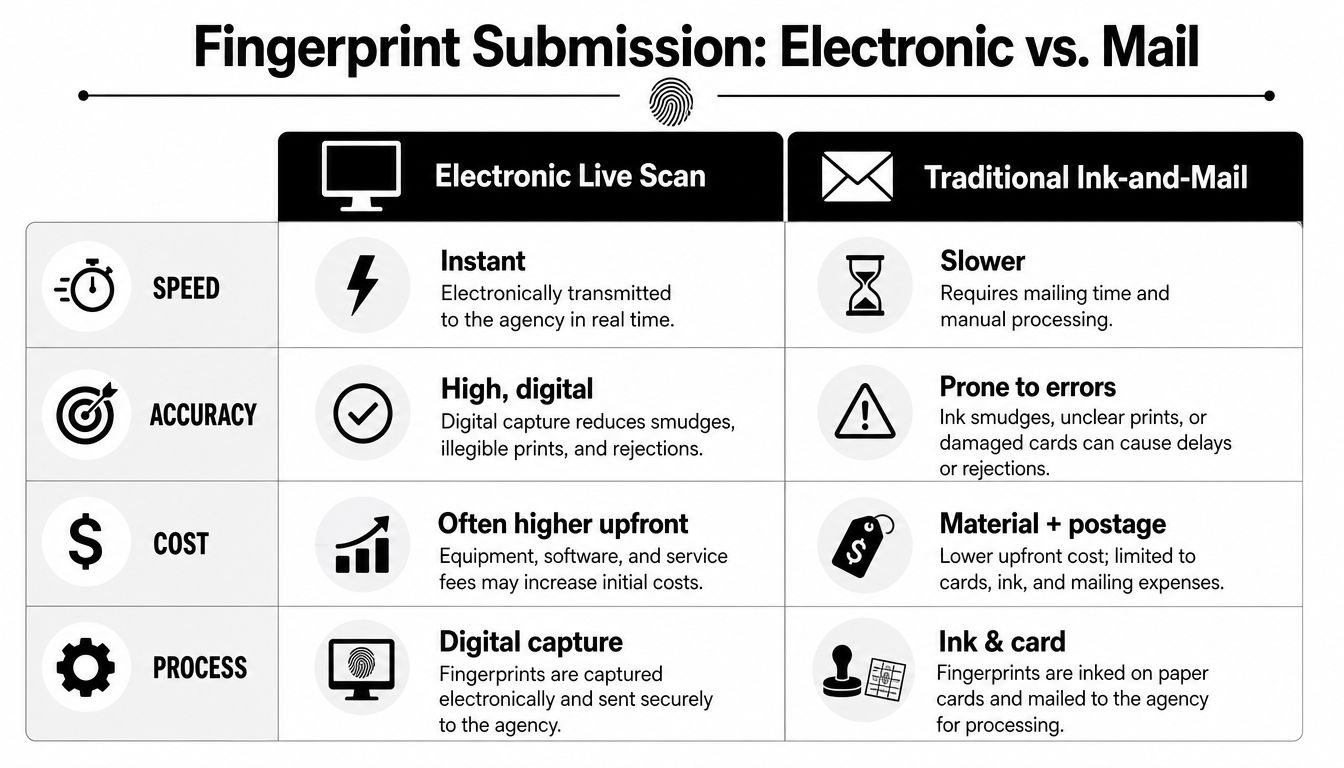
Once the card is complete, the next question is method. In practice, this is usually a choice between electronic capture and hardcopy mail submission. The right option depends on the applicant’s location, the firm’s workflow, and whether the individual falls into a hardcopy-only situation.
When electronic works better
Electronic capture is usually the cleaner operational choice when it’s available and accepted for the applicant’s case. It reduces handling steps. There’s no physical card to smudge after capture, no envelope prep, and less room for mailing errors.
In-store operators that handle both methods can also guide applicants who aren’t sure which route fits their firm. If you want a plain-language overview of the difference between the two processes, this guide to ink and LiveScan capture is useful.
A practical comparison looks like this:
| Method | Works well when | Main trade-off |
|---|---|---|
| Electronic | Domestic applicants with approved digital routing | Depends on vendor and case eligibility |
| Hardcopy-required cases, including some international workflows | More handling steps and packaging rules |
When mail is required
Hardcopy is still required in some situations. For international hardcopy submission, no more than 200 FINRA fingerprint cards may be placed in a secure inner envelope. That inner envelope is then sealed in an outer envelope from a Sterling-provided kit and mailed to FINRA, Document Services, P.O. Box 9495, Gaithersburg, MD 20898-9495 for express forwarding to Sterling, according to the international hard card process instructions.
That packaging rule matters most for firms mailing batches, but it also tells you something important about FINRA hardcopy handling. This process is procedural, not casual. If the shipment isn’t assembled the right way, you risk delay before anyone even looks at print quality.
Mail submission works when it’s required. It fails when applicants treat it like ordinary office mail instead of a compliance packet.
Common Rejection Reasons to Avoid
Applicants often worry about the fingerprint appointment itself. The bigger issue is rejection after submission. That’s what causes repeat appointments, extra follow-up, and stalled registration.
The rejection that causes the most disruption
The FBI marking fingerprints as “illegible” is a primary cause of rejection, and that designation triggers a mandatory re-submission within exactly 30 days of notification. If that deadline is missed, the application can be denied, and FINRA doesn’t grant exceptions, as explained in this summary of FINRA fingerprinting requirements.
That deadline is where firms lose time. Not because they don’t care, but because the notice sits too long, the candidate is traveling, or no one owns the resubmission step.
Mistakes you can catch before they leave your hands
You can prevent a lot of rework by checking the basics before submission:
- Poor print quality: Smudged or light impressions often come from rushed handling or weak technique.
- Incomplete card data: Missing demographic details create avoidable processing friction.
- Wrong ink or inconsistent entries: If the instructions say black ink, use black ink.
- Late reaction to notices: Rejections become much more serious when nobody acts quickly.
The practical fix is simple. Assign one person to monitor status notices and one person to contact the applicant immediately if a new capture is needed. A rejected card is inconvenient. A missed deadline becomes a compliance problem.
Your Local Fingerprinting Solution in Sugar Land TX
For applicants in Sugar Land, the easiest process is usually the one where the card, capture, and mailing prep all get checked in one stop. That matters with FINRA work because small handling mistakes create outsized delays.
At Business Mail Boutique LLC, applicants can handle fingerprinting on FINRA-specific cards, including FBI FD-258 and FD-1164 formats, through a business services center that already supports mailing, document handling, and in-store identity-related services. That setup is useful when someone needs ink fingerprinting on a hard card, wants help making sure the packet is ready to go, or needs a local option for electronic capture depending on the case.
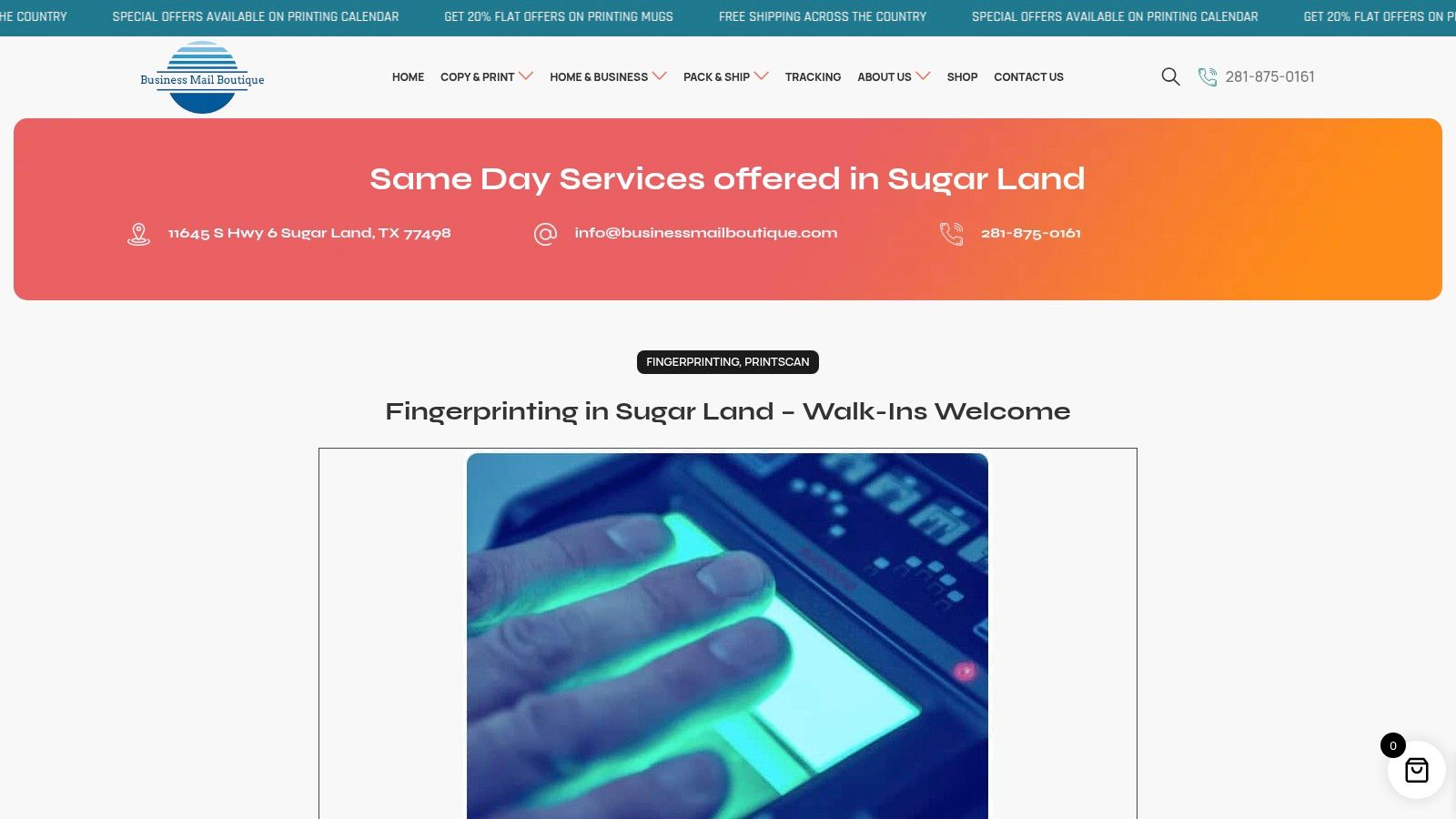
A typical smooth visit looks like this: the applicant arrives with ID, confirms the card type, completes or verifies the required fields, has fingerprints captured carefully, and leaves with the submission steps handled correctly. That’s the part people usually want. Less guesswork, fewer do-overs, and no scrambling to find packaging materials after the appointment.
If you need help with a FINRA fingerprint card, mailing prep, or fingerprint capture in Sugar Land, Business Mail Boutique LLC offers a practical local option for getting the process done cleanly and without unnecessary back-and-forth.

Related posts

Custom Memorial Glasses Engraved in Three Hours in Sugar Land
When a customer needed eight personalized glasses for a memorial, Business Mail Boutique completed the engraving or...

Custom Martini Glass Engraving in Sugar Land, TX
Custom Logo Engraving on Martini Glasses in Sugar Land, Texas.
Business Mail Boutique recently completed a beautiful custom engravin...

Custom Engraved Wine Glasses for a Golf Club Event in Sugar Land, TX
Custom Engraved Wine Glasses for a Golf Club Event in Sugar Land.
Custom wine glass engraving in Sugar Land, TX at Business Mail Bouti...