
- Print Business Cards in Sugar Land – Same Day Service
- Copying Services
- Document Printing, Finishing & Lamination in Sugar Land
- Flyers
- Print Banner in Sugar Land | Same-Day Banner Printing Near Me
- Graphic Design
- Photo Printing
- Postcard Printing
- Document Printing
- EDDM Full Service Postcards
- FotoZoomer Large Format Printing


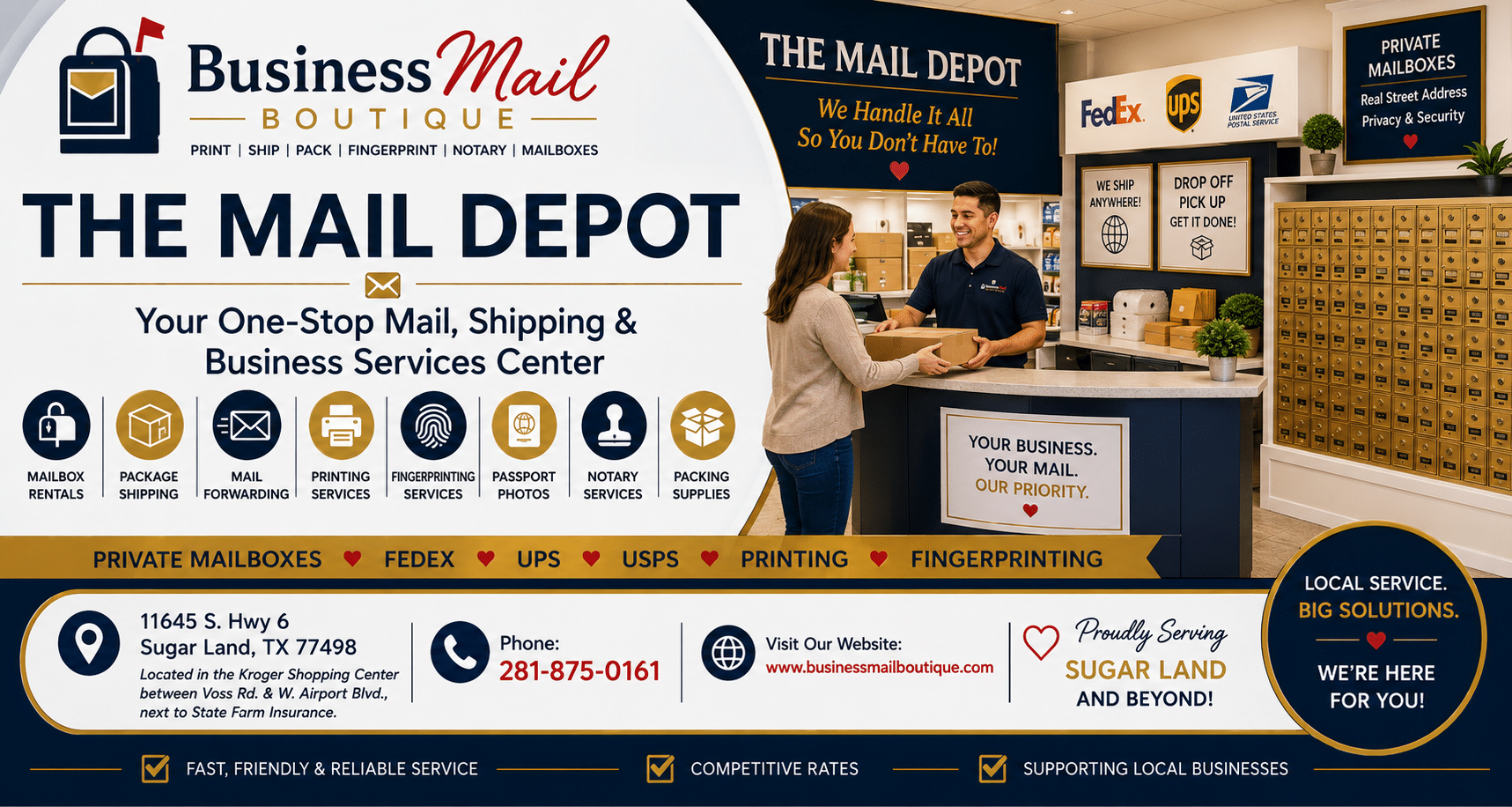
The Mail Depot.
Discover everything you need to know about The Mail Depot for local mail and shipping needs. Get tips, services, and more in this 2026 guide.
Businessmailboutique
11645 S. Hwy 6
Sugar land, Texas 77498 United States (US)
Email: info@businessmailboutique.com
Route
You’re trying to get three things done before the day runs away from you. One package needs to go out, your mailbox renewal is due, and the flyer proof still needs printing. A mail depot is the local place that lets you handle those errands in one stop instead of turning them into a half-day drive across town.
What makes that useful is simple. A mail depot bundles shipping, mailbox rental, packing, printing, and document services under one roof, so you can deal with a real person, compare options, and leave with the job finished. That model grew out of the long history of postal infrastructure, where centralized intake and timed handoffs made mail faster and more reliable for everyone, from businesses to households. For a practical overview of one local operator’s service style, see this copy and ship guide.
Table of Contents
- What a Mail Depot Actually Is and Why It Exists
- The History Behind Mail Depots and Postal Networks
- Core Services You Will Find at a Modern Mail Depot
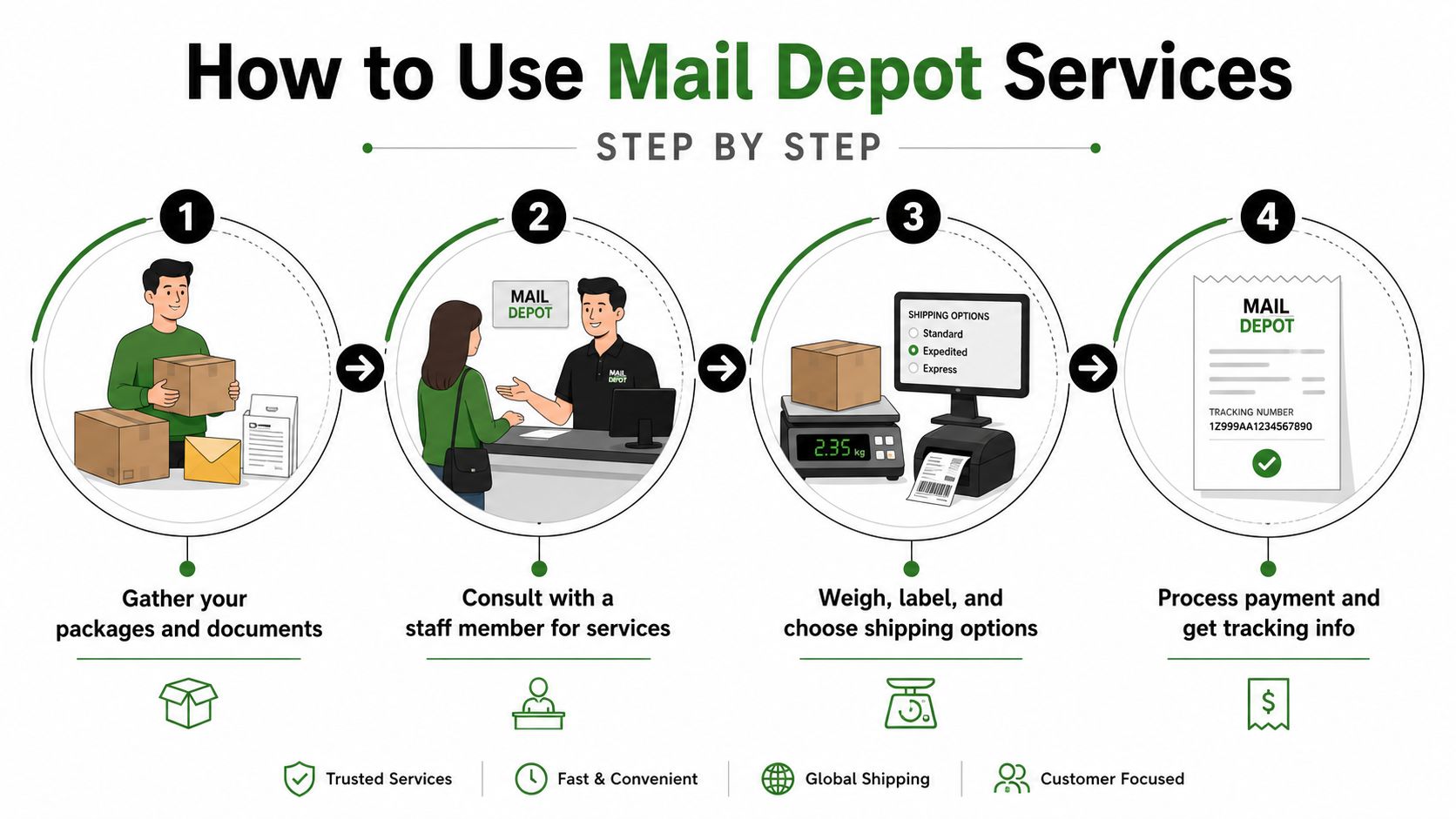
- How to Use Mail Depot Services Step by Step
- What to Look for When Choosing a Mail Depot
- Mail Depot vs USPS Retail and Standalone Mailbox Shops
- A Local Example Business Mail Boutique in Sugar Land
- Frequently Asked Questions About Mail Depots
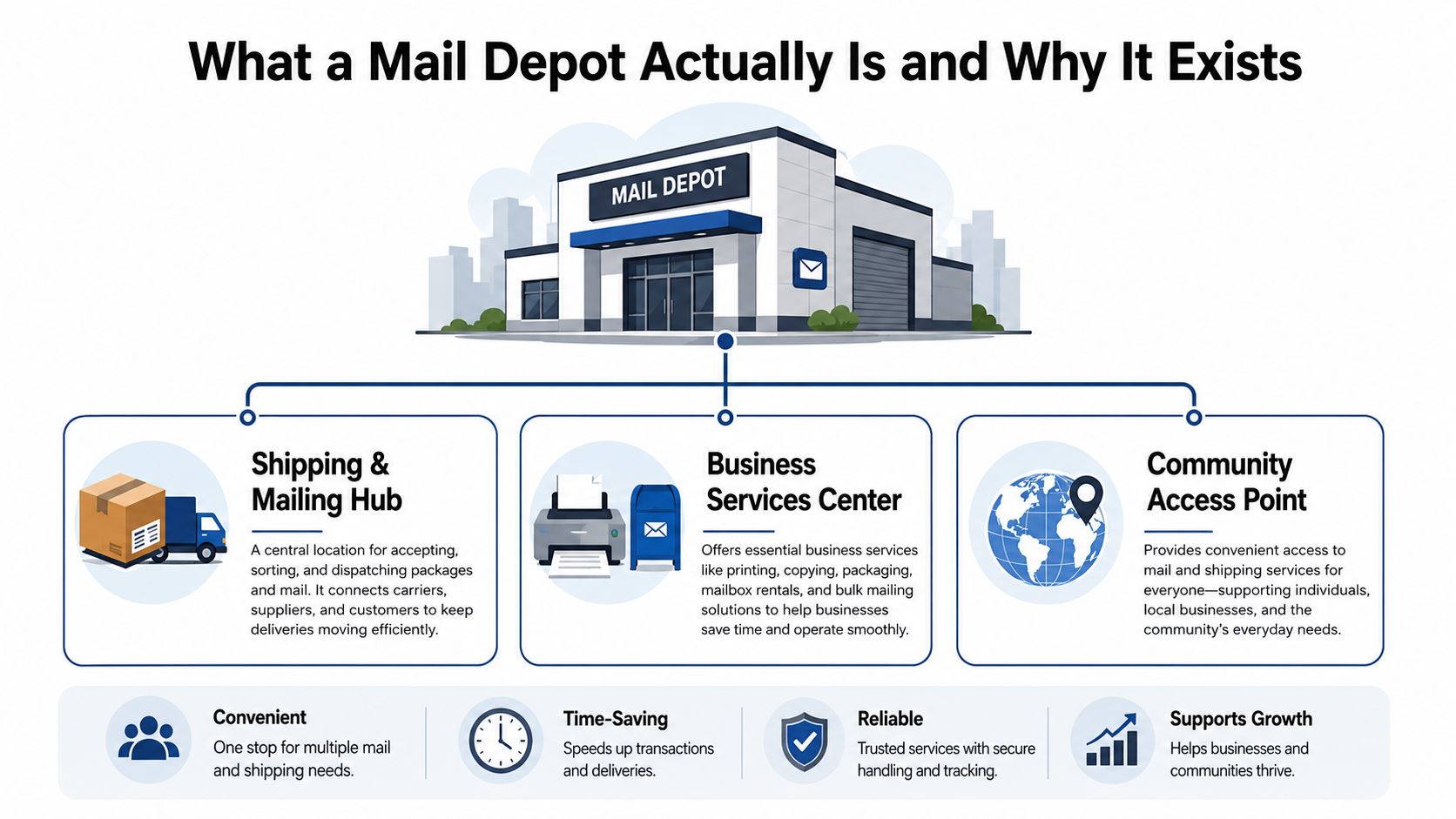
What a Mail Depot Actually Is and Why It Exists
A mail depot is a local storefront built for people who need more than a stamp and a counter. It usually combines shipping, mailbox rentals, packing, printing, and often document services like notary or fingerprinting. That mix matters because small-business tasks rarely arrive one at a time. They show up all at once, and they usually need to be handled before the afternoon ends.
The idea behind one-stop mail service
The value of a mail depot is convenience with choice. Instead of being tied to one carrier or one service desk, you can compare shipping options, drop off pre-labeled parcels, rent a mailbox with a street address, and ask staff to pack fragile items properly. For a freelancer, that might mean shipping a return, printing a proposal, and renewing a mailbox in the same trip. For an e-commerce seller, it can mean handling returns and outbound orders without juggling multiple locations.
Practical rule: If a task involves both mail and paperwork, a mail depot is often the easier stop because the staff can move you through multiple jobs in one visit.
These storefronts also fill a gap between public postal counters and specialized copy shops. A USPS retail unit is built for postal service. A copy shop is built for print jobs. A mail depot sits between them and adds flexibility, especially for people who need a real street address and a broader service stack.
The History Behind Mail Depots and Postal Networks
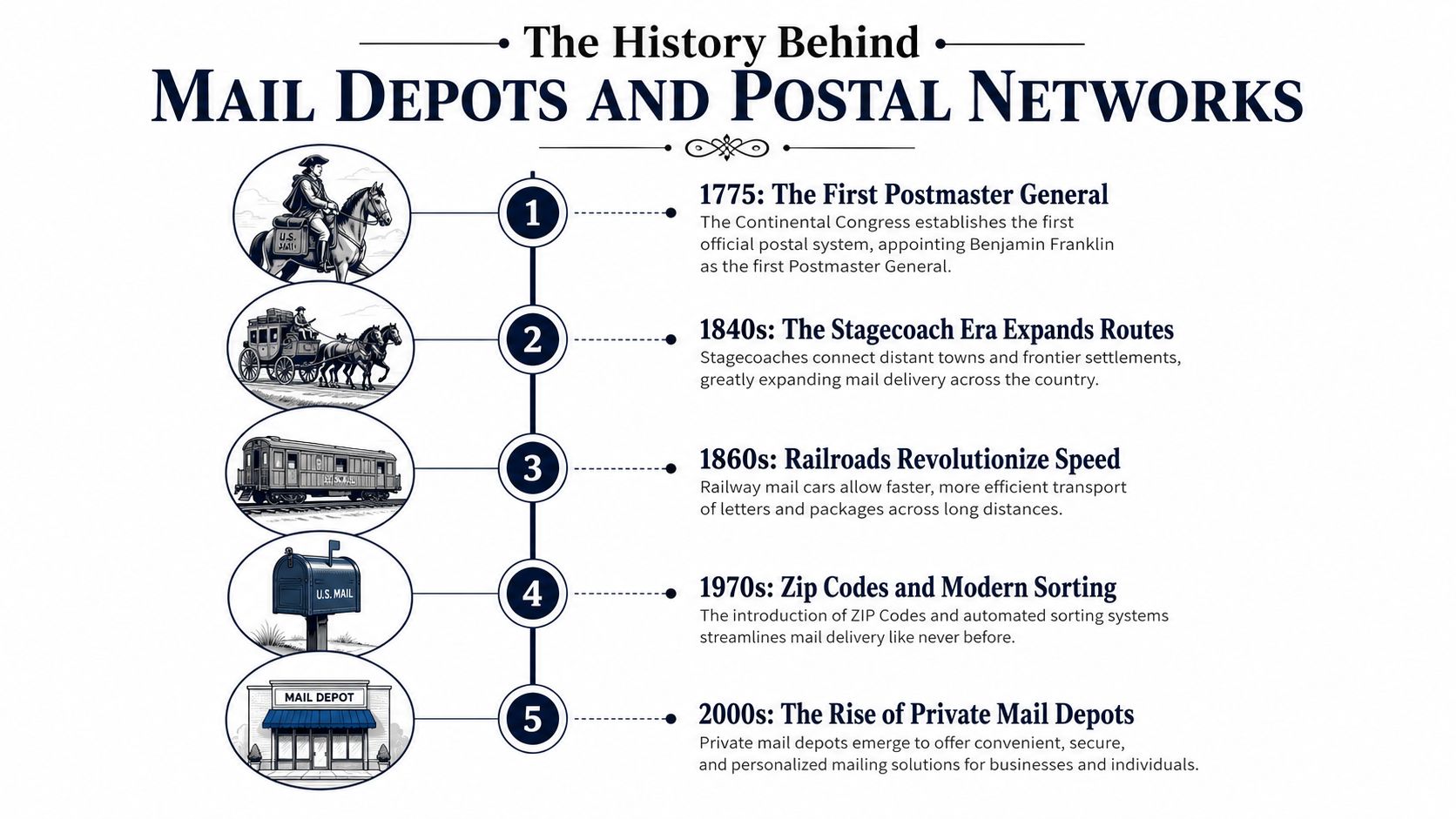
A mail depot makes more sense once you see how postal work grew from local handoffs into organized networks. The first American post office is commonly traced to 1639 in Boston. The Second Continental Congress then created a formal U.S. postal system in 1775 and appointed Benjamin Franklin as the first postmaster general. The Postal Service Act of 1792 established a national postal network with uniform postage rates, and the Postal Reorganization Act of 1970 created the modern United States Postal Service as an independent agency. Those milestones, described in the Archives Foundation history of mail in America, show the shift from scattered local handling to standardized logistics.
Centralized handoffs shaped today’s local counters
The same pattern shows up across postal history. The Pony Express ran from April 1860 to October 1861 and became known for fast relay handoffs across the western United States. Royal Mail traces its origins to 1516, public-service roots to 1635, and a postal law in 1660 that helped formalize service in England, as summarized by History Associates. Each system relied on a handoff point, a route, and a person who knew what came next.
That is the basic job a local depot still performs. Mail comes in, gets sorted, gets matched with the right carrier or service, and leaves with fewer delays than a customer trying to piece together shipping, printing, and mailbox handling across several stores. For a small business owner, that can feel like using one front desk instead of three separate counters.
Why this history still matters
These postal milestones are more than trivia. They explain why customers trust a counter that can accept mail, store it, route it, and document it. The process feels familiar because postal systems have long depended on the same core idea, a reliable place where mail changes hands before it keeps moving.
A mail depot lasts as a business model because it keeps one thing steady, a dependable receiving point, while the back end changes with carriers, tracking tools, and customer needs.
Core Services You Will Find at a Modern Mail Depot
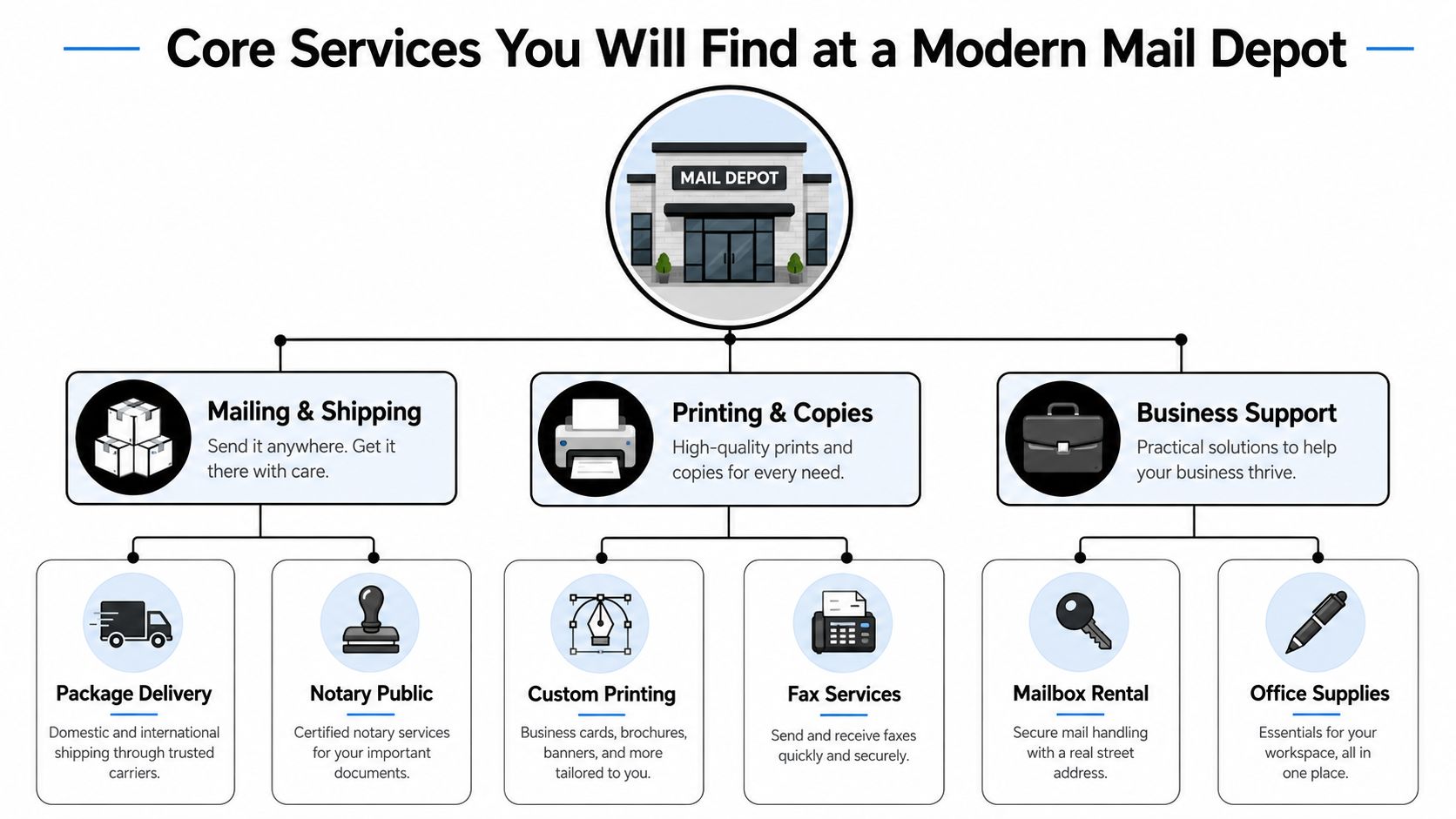
A mail depot makes more sense if you picture it as a small service hub, not a single counter. One customer may walk in with a box to ship. Another may need a mailbox, a printed banner, or a notarized form. The same storefront can handle those jobs because the services are built around the daily needs of small businesses and busy households.
Shipping and mailbox services
The service you’ll notice first is multi-carrier shipping. A good depot can help you compare carriers, print labels, pack fragile items, and handle returns. Mailbox rentals are the other main service, especially for anyone who wants a real street address instead of depending on home delivery or a P.O. box.
Mailbox services matter because they give you one steady place for mail when you move often, work from home, or want more privacy for business correspondence. If you want a closer look at how a storefront handles shipping and mailing work, this a detailed overview of shipping and mailing services at Business Mail Boutique explains the setup in practical terms.
Good fit: If you sell online, rent equipment, or run client-facing work from home, a mailbox plus shipping counter cuts repeat trips and keeps business mail separate.
Printing, documents, and business support
Mail depots often do much more than shipping. A print shop side can produce business cards, flyers, banners, yard signs, posters, decals, and wide-format blueprints. Many also offer passport photos, fingerprinting, public notary, remote online notary, lamination, and key duplication. That mix helps because the same customer who needs a legal form notarized may also need copies, a printed sign, or a small run of flyers.
Some of these services are easy to use without an appointment, while others may require scheduling or file prep. Notary work and fingerprinting usually go faster when you bring identification and know which form you need. Print jobs go more smoothly when you bring the right file and the correct dimensions. The more tasks one storefront can handle, the less time you spend repeating the same errand with a different specialist.
How to Use Mail Depot Services Step by Step
A first visit goes more smoothly when you show up with a plan. Say you need to ship three packages, rent a mailbox, print 50 flyers, and notarize one document. That’s the kind of day a mail depot is built for, but the order you do things in still matters.
Start with the items that need identification
Bring your ID, your packages, and any paperwork that has to be signed in front of a notary. If you’re opening a mailbox, expect to verify who you are before staff can hand over the keys or finalize the rental. If you’re shipping, have the destination address ready and know whether the parcel is going across town or across the country.
Then sort the shipping and printing details
For shipping, staff usually weigh the parcels, check dimensions, and help you pick the carrier or service level that fits the job. If you’re using professional packing, point out anything fragile, oddly shaped, or valuable. For printing, bring files in the right format and size, because the most common slowdown is not the printer, it’s the wrong file setup.
The same principle applies to flyers, banners, and signs. If you know the final dimensions before you walk in, the staff can steer you faster and avoid rework. That’s especially helpful for event organizers and small businesses that need a quick turnaround without driving to separate shops.
Finish with document services
Notary work usually comes last because the signature has to be handled in front of the notary. Fingerprinting and passport photos are similar. They go best when you already know which form, card, or photo style you need.
- Bring the right documents first: ID, forms, label info, and any required paperwork should be in your bag before you leave.
- Separate what must be signed on-site: Notary forms and some identity checks can’t be completed ahead of time.
- Ask about file prep early: Print jobs move faster when you confirm size, color, and quantity before the staff starts.
What to Look for When Choosing a Mail Depot
Choosing a mail depot is less about the logo on the door and more about whether the store matches the work you do. A location that’s fine for a one-time package drop may not be the right fit for regular business mail, printing, or long-term receiving. The easiest way to judge it is to compare the services, the rules, and the practical limits.
Mail Depot Selection Checklist
| Criterion | What to Look For | Why It Matters |
|---|---|---|
| Multi-carrier shipping | UPS, FedEx, USPS, and freight options | Lets you choose the right carrier for each job |
| Mailbox setup | Street address, forwarding, secure access | Helps with business identity and mail stability |
| Packing support | Fragile-item packing and clear handling policies | Reduces damage and confusion at drop-off |
| Printing capability | Fast print turnaround and file flexibility | Keeps marketing and office work in one stop |
| Notary access | Public notary or remote online notary | Saves separate trips for legal documents |
| Hours and cutoff times | Clear lobby hours and acceptance windows | Prevents missed same-day drop-offs |
A good location also publishes its terms clearly. That includes mailbox rules, package acceptance limits, and whether after-hours handling is available. If those details are fuzzy, the store may still be fine for an occasional task, but it’s harder to trust for ongoing business mail.
Red flags that slow people down
Look twice if staff can’t explain how package receiving works or if you’re asked to guess at extra fees. That uncertainty matters because a business owner needs a stable process, not a surprise at pickup. Security also matters, especially when you’re receiving checks, legal mail, or customer returns.
Buyer’s rule: If a storefront can’t explain how it handles mail, packages, and documents in plain language, keep looking.
Hours matter more than many realize. Public postal locations often separate lobby hours, retail hours, and last collection times, and local depots should be just as clear. If you rely on daily drop-offs or time-sensitive paperwork, a location with vague timing is a poor long-term fit.
Mail Depot vs USPS Retail and Standalone Mailbox Shops
A mail depot is not the same thing as a USPS retail counter, and it’s not just a mailbox shop with a fancier sign. The difference shows up in how you use the space. A small business that wants mailing, printing, and mailbox support in one place will feel the gap immediately.
Three models, three jobs
A USPS retail unit is built around postal services, stamps, and postal shipping. It can be the right place for basic mailing needs, but it usually won’t give you the broader business support stack. A standalone private mailbox shop gives you a street address and mail receiving, but often stops there.
A mail depot sits in the middle and adds the service layers many entrepreneurs need. That means shipping across more than one carrier, packing help, printing, and document services. If you’re comparing a private mailbox to a P.O. box, this private mailbox vs P.O. box guide is a helpful companion read.
What that means for a working business
If you run an online store, you may want a mailbox for returns, a shipping desk for outgoing orders, and a printer for inserts or labels. If you’re hosting an event, you may need a street address, yard signs, and a stack of flyers. A post office can cover some of that, but not all of it, and a mailbox-only shop usually won’t cover the print side.
The depot model wins on convenience because it reduces the handoffs between separate vendors. That doesn’t make it the answer for every task. It does make it the cleanest fit when your day mixes shipping, printing, and business mail management.
A Local Example Business Mail Boutique in Sugar Land
A customer walking into a mail depot usually wants a few different jobs handled in one stop, and Business Mail Boutique in Sugar Land shows how that works in real life. The storefront operates as a PackageHub360 Business Center and offers authorized UPS and FedEx shipping, USPS services, packing, a print shop, laser engraving, mailbox rentals, and fingerprinting in one place. The location is at 11645 S. Hwy 6, Sugar Land, Texas 77498, so local customers have a real street address to visit and remember.
Why a full-service storefront changes the errand list
The useful part is not only that these services exist. It is that they sit side by side under one roof, like tools laid out on the same workbench. A customer can drop a return, print marketing pieces, and ask about mailbox options without switching stores or repeating the same information three times. That is the difference between a store that moves one parcel and a depot that supports the whole workday.
For businesses that need clearer local visibility online, it also helps to understand how public listings work. A straightforward resource like the Google My Business UK guide shows why consistent location details matter when customers are trying to find a nearby service center.
Real-world uses that make the layout matter
An e-commerce seller may use the store for returns, packing, and shipping labels. An event organizer may come in for yard signs, banners, or quick print jobs. A freelancer may want a stable mailbox, passport photos, and a notary all in one run. That mix is what separates a basic mailing counter from a proper neighborhood service hub.
Business Mail Boutique LLC brings shipping, printing, mailbox, and document services together in one Sugar Land storefront, and that practical setup is exactly what a mail depot is meant to do. The point is not that every customer needs every service. The point is that a single storefront can absorb several small tasks at once, which is why the model works so well for local operators and busy owners.
Frequently Asked Questions About Mail Depots
What’s the difference between a private mailbox and a P.O. box? A private mailbox usually gives you a street address and is often easier to use for business correspondence, while a P.O. box is tied to the postal system and its rules. The right choice depends on whether you need mail receiving, forwarding, or a more business-friendly address format.
Can a mail depot handle returns? Yes, many do. That’s one of the main reasons people use them for e-commerce work, because returns are easier when the store can receive, log, and route packages.
How does remote online notary work? You complete the notarization through a secure remote process with identity verification and live interaction, instead of signing in the room with the notary. It’s useful when you can’t come in during normal hours.
Is package receiving secure? It should be, but the quality depends on the location’s procedures, access controls, and how clearly it explains pickup handling. Ask how items are logged and who can retrieve them.
What should I bring for fingerprinting or passport photos? Bring government-issued ID and any form or instruction sheet tied to the service. If the store offers both, ask which one happens first so you don’t waste a trip.
Business Mail Boutique LLC brings shipping, printing, mailbox, and document services together in one Sugar Land storefront, which is exactly what you mean when you talk about a practical mail depot. If you need a place that can handle packages, mail receiving, notary work, and everyday business errands without sending you all over town, visit Business Mail Boutique LLC and see which services fit your next stop.

Related posts

Custom Memorial Glasses Engraved in Three Hours in Sugar Land
When a customer needed eight personalized glasses for a memorial, Business Mail Boutique completed the engraving or...

Custom Martini Glass Engraving in Sugar Land, TX
Custom Logo Engraving on Martini Glasses in Sugar Land, Texas.
Business Mail Boutique recently completed a beautiful custom engravin...

Custom Engraved Wine Glasses for a Golf Club Event in Sugar Land, TX
Custom Engraved Wine Glasses for a Golf Club Event in Sugar Land.
Custom wine glass engraving in Sugar Land, TX at Business Mail Bouti...