- Print Business Cards in Sugar Land – Same Day Service
- Copying Services
- Document Printing, Finishing & Lamination in Sugar Land
- Flyers
- Print Banner in Sugar Land | Same-Day Banner Printing Near Me
- Graphic Design
- Photo Printing
- Postcard Printing
- Document Printing
- EDDM Full Service Postcards
- FotoZoomer Large Format Printing


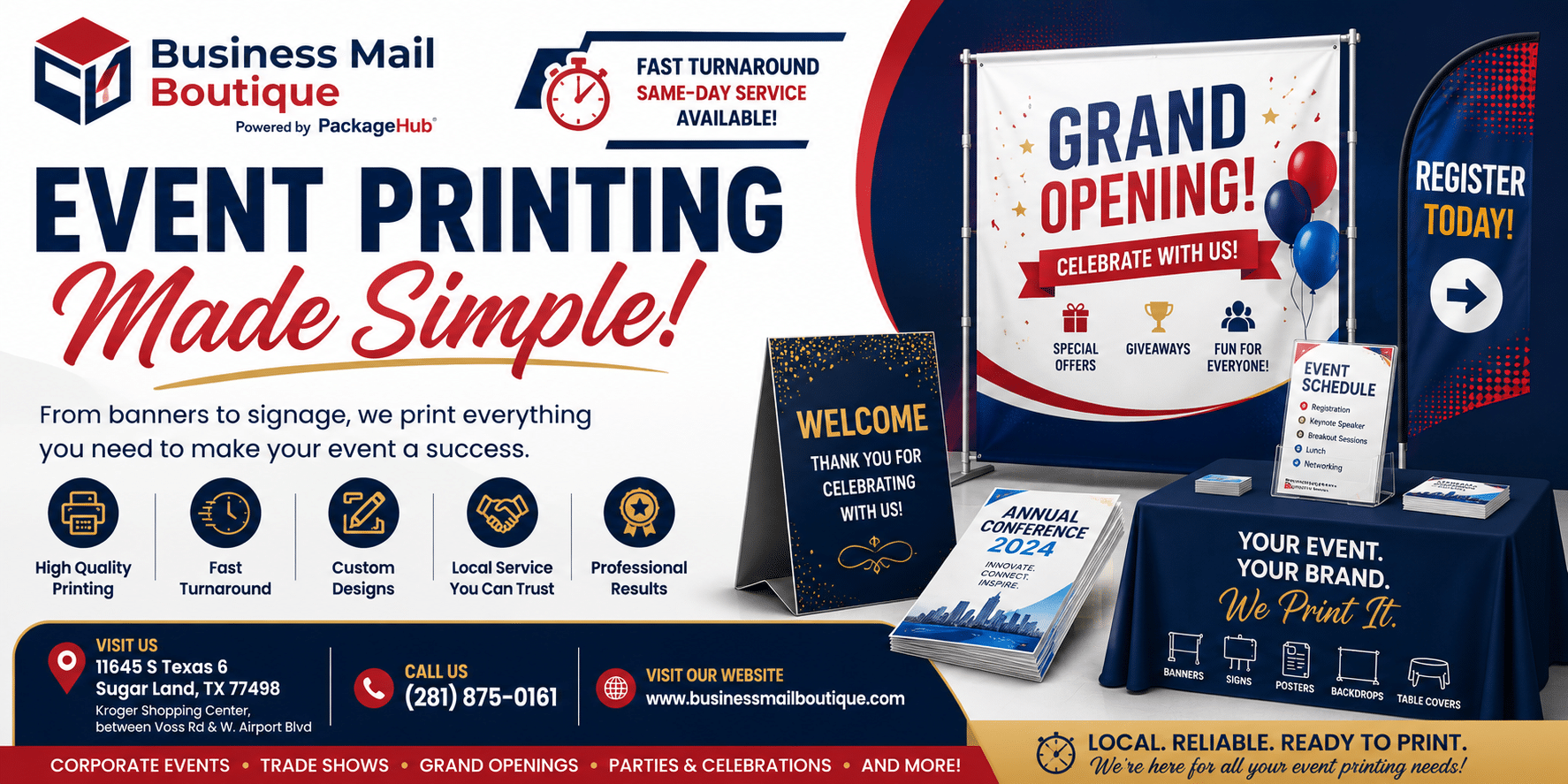
Event Printing Made Simple.
Plan and order event printing in 2026 with confidence. Learn sizing, materials, artwork prep, timelines, pricing, and local same-day pickup tips.
Businessmailboutique
11645 S. Hwy 6
Sugar land, Texas 77498 United States (US)
Email: info@businessmailboutique.com
Route
You’ve got an event date, a venue, a logo, and a growing list of things that need to be printed. Then someone asks whether the banner needs grommets, whether the QR code has been tested, and whether the files are ready for production. Suddenly, the artwork feels like the easy part.
Good event printing is a logistics decision disguised as a design project. The product, substrate, file setup, proofing method, production schedule, pickup plan, and installation details all affect whether your materials support the event or create a last-minute problem. This guide treats those decisions as one connected workflow, so you can place an order a print shop can produce accurately and on time.
Table of Contents
- Starting with What You Actually Need
- The Core Products Most Event Planners Order
- Choosing Sizes and Materials That Hold Up
- Preparing Artwork Files That Print Right the First Time
- Timing, Turnaround, and Same-Day Options
- Why a Local Print Store Changes the Equation
- Pricing, Pickup, and Installation Logistics
Starting with What You Actually Need
At 4 p.m. on the week before an event, an organizer often discovers that “we need some signage” means entrance banners, sponsor panels, directional arrows, table cards, booth graphics, handouts, badges, and branded giveaways. The instinct is to start designing immediately. That usually creates duplicate pieces, missing information, and an order built around attractive artwork instead of attendee behavior.
Start with the event’s jobs. A sign might need to direct people, identify a sponsor, promote an offer, decorate a room, or provide information at a registration desk. Those jobs require different formats. A large directional banner should be readable from across a venue, while a handout or business card needs to work at arm’s length.
Write the brief before opening the design file
Create one page with these fields:
- Event purpose: Is the priority wayfinding, lead capture, promotion, sponsor visibility, atmosphere, or attendee convenience?
- Placement: Note entrances, registration, aisles, stages, booths, parking areas, tables, and walls.
- Environment: Mark each item as indoor, outdoor, sheltered, or exposed to wind and weather.
- Viewing distance: State whether guests will see it up close, from a booth aisle, or across a large room.
- Reuse plan: Identify what can be used again and what contains a date, venue, or time-sensitive offer.
- Quantity logic: Start with attendance, distribution points, staffing needs, and replacement needs rather than ordering a random surplus.
That last point matters. A reusable sponsor banner and a date-specific flyer shouldn’t be planned the same way. A short event may need fewer durable pieces, while an outdoor activation may need sturdier finishing even if it lasts only one day.
Use attendee movement to set quantities
Walk through the venue in the order a guest will experience it. Ask where confusion could occur, where a message needs repetition, and where a printed item leaves the building with the attendee. This turns “how much should we order?” into a practical question about locations and interactions.
Practical rule: Every printed piece should have a job, a location, an owner, and a plan for what happens to it after the event.
Finish the brief with a delivery requirement, including the event date, setup time, pickup or delivery preference, and the latest acceptable proof approval. A print shop can quote accurately when those details are settled before design begins.
The Core Products Most Event Planners Order
The right product depends less on what looks impressive in a catalog and more on what attendees need to see, follow, remember, or take away. A retractable banner can establish a booth presence without permanent installation, while a yard sign can guide drivers outside but would look out of place in a polished indoor reception.
Match the product to the job
Banners work for entrances, sponsor recognition, photo backdrops, booth walls, and stage-adjacent branding. Vinyl is practical for many short-term applications, while fabric can create a softer appearance and reduce glare in some indoor spaces. A roll-up banner is easier to transport and store, but its visible area and base design differ from a hanging or pole-mounted banner. For a closer look at display formats and graphic considerations, use this Creative Graphic Solutions display guide.
Posters suit schedules, menus, speaker information, promotional messages, and room identification. They’re inexpensive to place at multiple points, but they need a suitable mounting surface and won’t command attention like a large suspended graphic.
Yard signs earn their place at outdoor entrances, parking areas, election-style promotions, construction-adjacent events, and directional points. Add stakes where needed, and don’t assume a lightweight sign will remain stable in exposed conditions.
Decals can label doors, floors, windows, equipment, or branded activation areas. Confirm whether the surface is smooth, clean, removable, painted, textured, or exposed to moisture before ordering.
Business cards support sponsor introductions, vendor networking, service follow-up, and staff identification. They’re useful when the event creates conversations that continue after guests leave.
Event swag includes printed or decorated items such as shirts, mugs, plaques, key chains, and other takeaways. These products can reinforce a memorable interaction, but they deserve a quantity and distribution plan so the budget doesn’t disappear into unused inventory.
For a portable booth setup, compare a standard display with retractable banner printing in Sugar Land before committing to a format.
| Product | Best fit | Watch for |
|---|---|---|
| Banner | Entrance, booth, sponsor, backdrop | Mounting, wind, transport |
| Poster | Information and repeated messaging | Readability and wall access |
| Yard sign | Outdoor directions and visibility | Stakes and ground conditions |
| Decal | Surface branding and labels | Adhesion and removability |
| Business card | Networking and follow-up | Current contact details |
| Swag | Takeaway or interactive promotion | Quantity and storage |
The table should become a shopping list, not an automatic order. If a product doesn’t support a defined attendee action, remove it or redesign its purpose.
Choosing Sizes and Materials That Hold Up
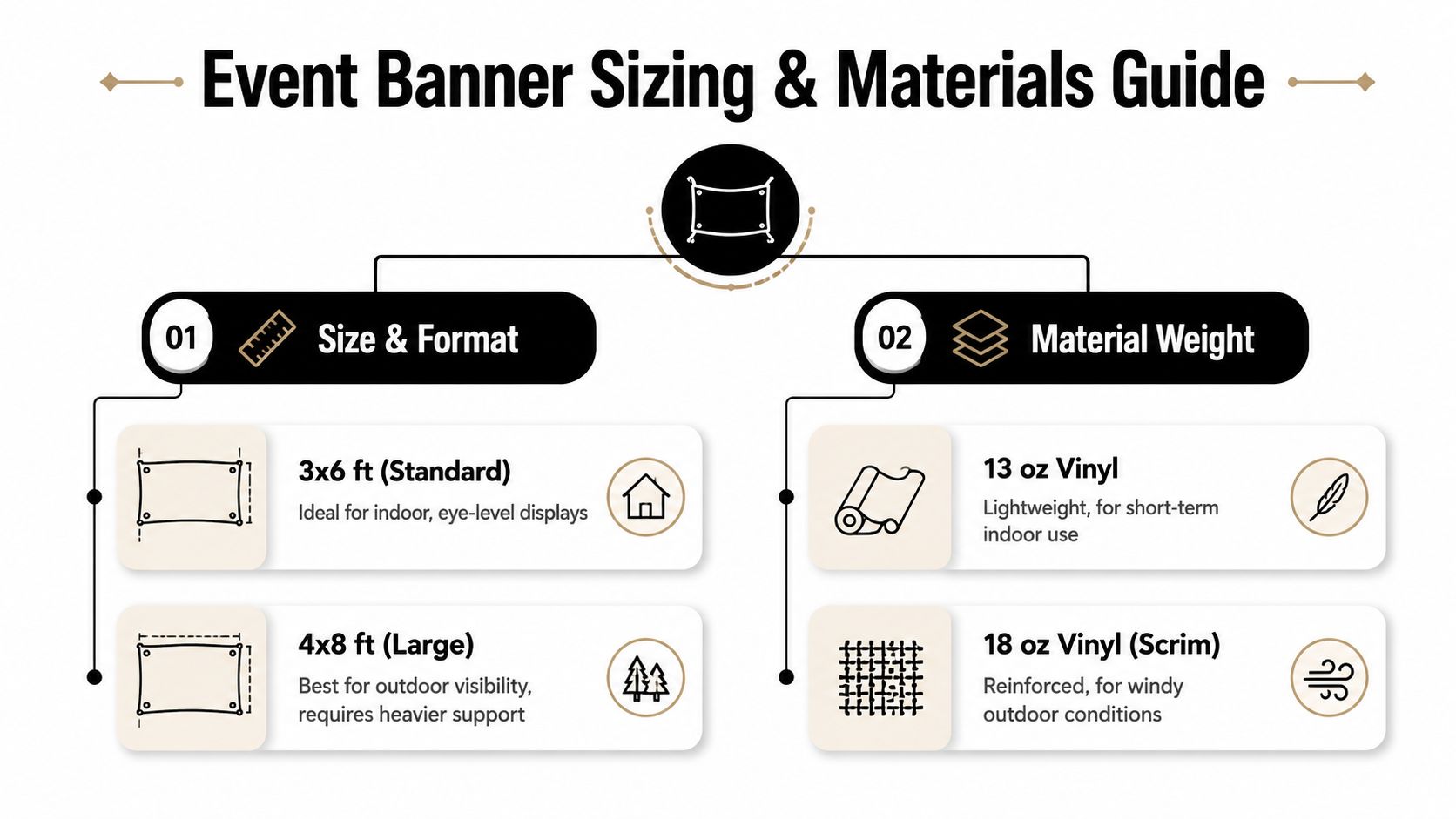
A banner’s dimensions affect readability, transport, mounting, and material stress. A 3-by-6-foot banner can fit an indoor wall or eye-level display, while a 4-by-8-foot banner creates more visual presence but needs stronger support and more planning for movement through doors, elevators, and storage areas.
Start with distance and placement
Use the viewing distance to decide how large the type and logo should be. A small poster beside a registration table can carry more detail than a banner intended to be seen from the far end of a venue. Keep the primary message simple, and let the size do the visibility work instead of filling a large canvas with dense copy.
For vinyl, 13 oz material can suit lightweight, short-term indoor use. An 18 oz scrim material has reinforcement that makes it more appropriate for demanding outdoor conditions, particularly where wind could pull against the finished edges. The right choice depends on exposure, mounting method, and how often you’ll reuse the piece.
Specify finishing, not just the sheet
Ask the printer about:
- Grommets: Metal-reinforced holes support rope, hooks, or zip ties.
- Hemming: Folded and reinforced edges can reduce tearing around mounting points.
- Pole pockets: These create channels for poles or display hardware.
- Mesh options: Perforated construction can reduce wind resistance where appropriate.
- Weather suitability: Confirm whether the selected ink, substrate, and finishing method fit the expected exposure.
Posters, yard signs, and decals need their own logic. Foam board is rigid and presentable indoors but isn’t a general outdoor substitute. Review this foam board printing guide for signs, photos, and displays when you’re choosing a stiff presentation surface. Yard signs need compatible stakes and a placement plan. Window decals need clean glass and a decision about inside or outside application.
The sensible middle ground is usually a material matched to the environment, not the cheapest available stock and not the most rugged option by default. Tell the printer how long the piece must last, how it will be mounted, and whether you’ll reuse it. Those answers matter more than selecting a material by name alone.
Preparing Artwork Files That Print Right the First Time
A file can look perfect on a laptop and still produce a disappointing banner. The most common failures come from low-resolution images, missing bleed, unconverted fonts, incorrect color expectations, and QR codes that were reduced until phones struggle to read them.
Build the file for the finished size
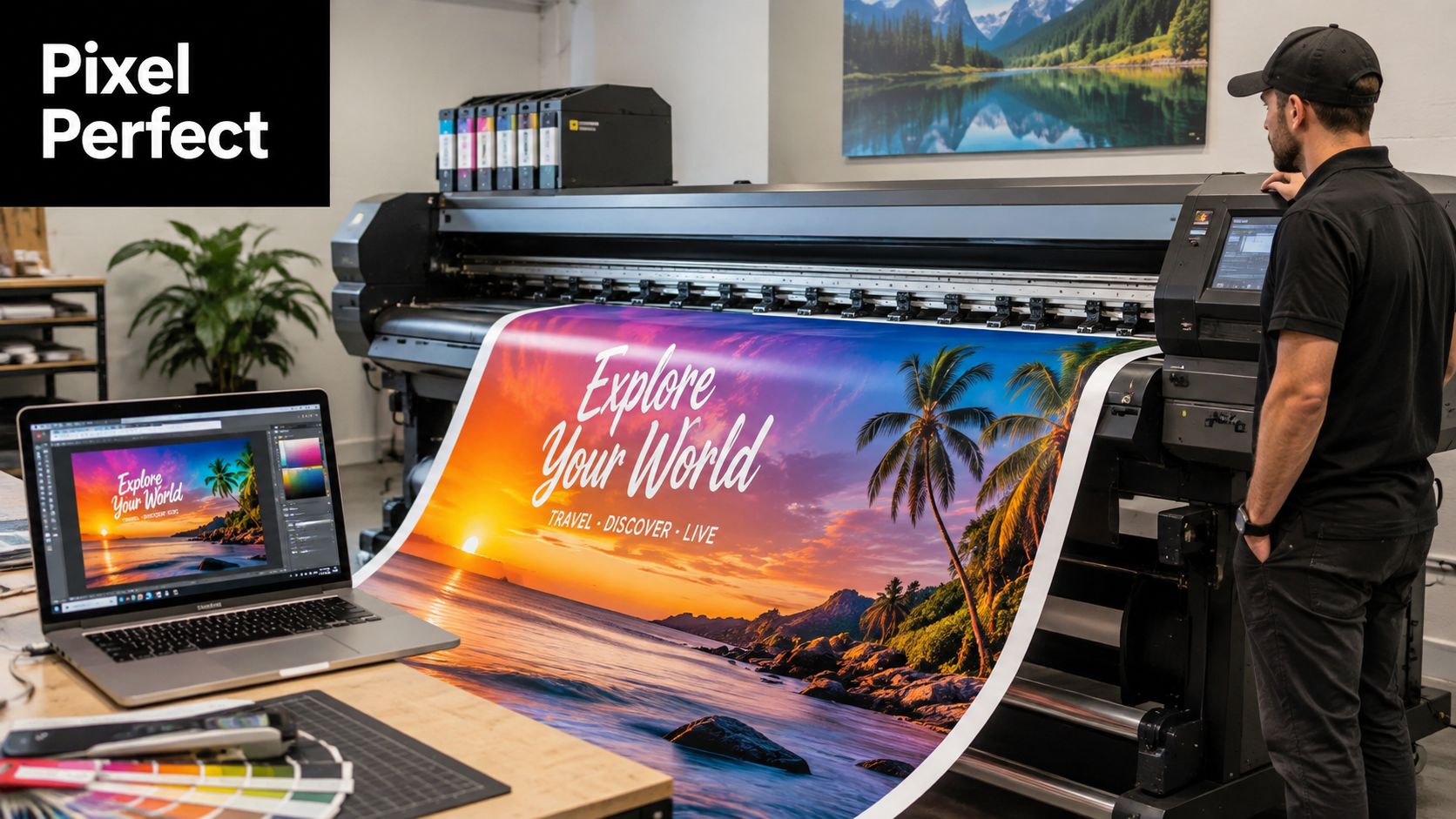
For many large event graphics, designers commonly prepare artwork at approximately 150 DPI at final size, but the printer should confirm the preferred specification for the product and viewing distance. A social-media image may look sharp on a phone and still be unsuitable for a large banner because it contains too little usable image data.
Keep important text, logos, phone numbers, and QR codes inside a safe area away from trimming, hemming, grommets, pole pockets, and edge folds. Add bleed where the printer requests it. Don’t place a sponsor logo near a corner because the design looks balanced on screen. Hardware and finishing can consume that space.
Control color and typography
Ask whether the shop wants RGB artwork, CMYK artwork, or a particular color profile. Don’t assume that a screen color will reproduce identically on vinyl, paper, fabric, foam board, or another substrate. For brand-critical work, request a proof and judge it under controlled, suitable lighting rather than relying only on a monitor.
A print-ready PDF is often a practical delivery format, provided the shop’s specifications are followed. Outline fonts or embed them, package linked images, and keep a native working file available in case corrections are needed. A flattened file can be acceptable for production, but it may limit the printer’s ability to correct a small text error.
Run this preflight before submission
- Dimensions: Confirm the finished width, height, orientation, and scale.
- Images: Check that every placed image is suitable for its physical size.
- Bleed and safety: Keep critical content clear of trim and finishing areas.
- Text: Verify spelling, dates, addresses, URLs, and sponsor names.
- Fonts: Outline or embed fonts as requested.
- Color: Confirm the requested color mode and profile.
- QR codes: Test the final-size code from a printed proof or sample.
- Approval: Have one named person approve the exact production file.
QR testing deserves a separate sign-off. Independent event-software guidance identifies unclean attendee data, unreadable layouts, incorrect printer scaling, untested codes, and skipped test prints as recurring badge-printing failure points in this badge printing checklist. The same discipline applies to flyers, posters, and signs.
Timing, Turnaround, and Same-Day Options
Turnaround isn’t a magic speed setting. It depends on the product, material, finishing, artwork condition, proof cycle, current production load, and whether the order needs delivery or pickup. A shop may produce a simple poster quickly while a custom-finished outdoor installation takes longer, even when both are called “signage.”
Work backward from the event
Set the event date first, then reserve time for approval, production, inspection, pickup, transport, and setup. Standard work should be submitted early enough to leave room for a correction. Fast-track service may be available for selected products, while same-day work generally depends on stocked materials, a clean file, a firm approval, and a realistic pickup window.
Same-day printing can be useful for business cards, flyers, posters, banners, yard signs, decals, and photo products when the shop offers those services and receives the order before its production cutoff. It isn’t a substitute for planning complex quantities, specialty substrates, unusual finishing, or multi-location delivery.
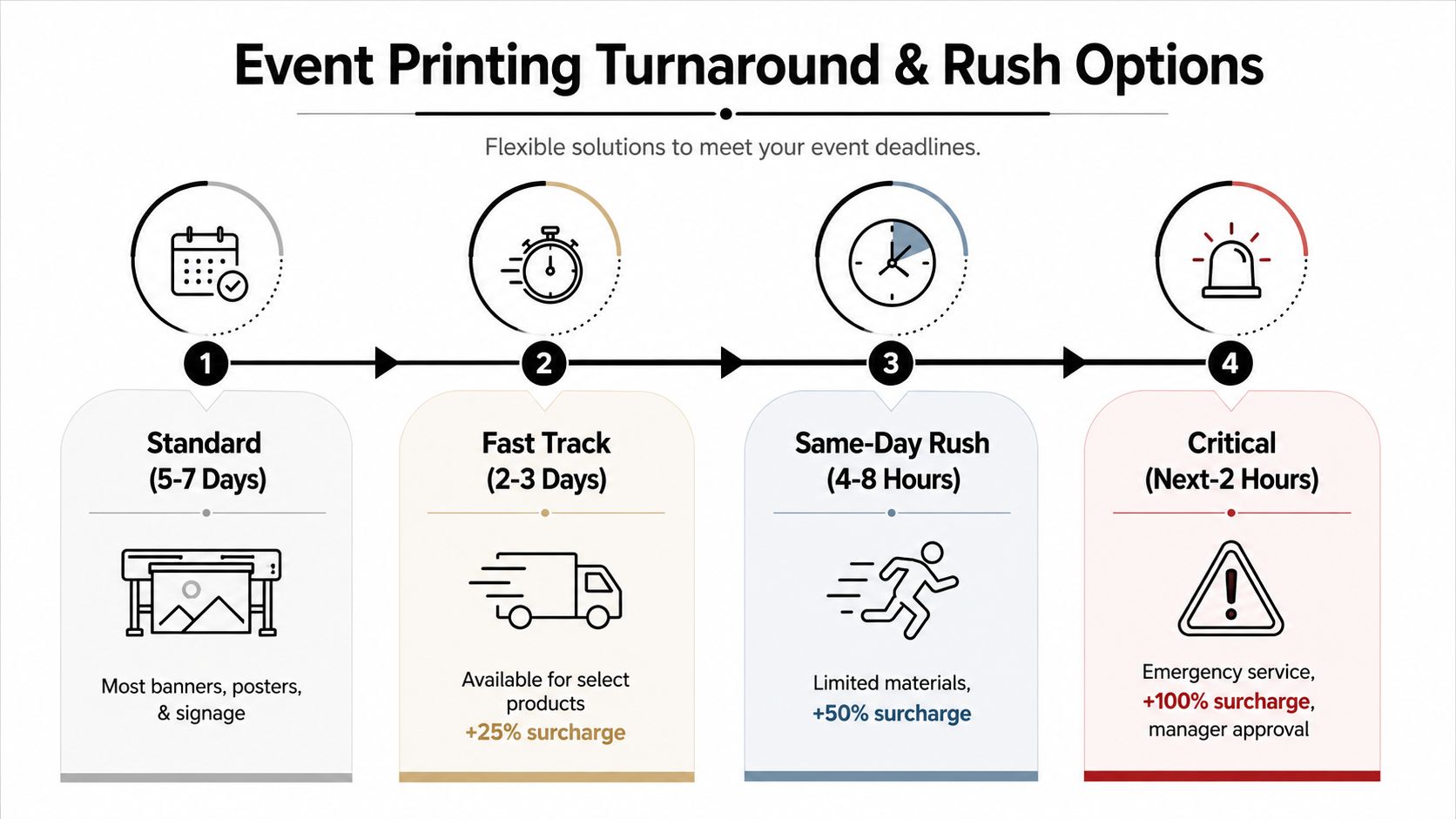
Ask these questions before paying a rush fee:
- What is the actual cutoff? Confirm the local time and whether it applies to file submission or approval.
- When does production begin? Some shops don’t start until payment and proof approval are complete.
- Which materials are stocked? Same-day options often depend on available media.
- What finishing is included? Cutting, hemming, grommets, mounting, and assembly can change the schedule.
- When can I physically collect it? A finished item is not useful if pickup occurs after setup begins.
For a local option, review quick turnaround printing services and confirm the current cutoff before relying on a same-day plan.
The safest rush order is a simple product with a production-ready file and one decision-maker available by phone. Every extra revision, specialty request, and delivery handoff removes flexibility.
Why a Local Print Store Changes the Equation
Online-only vendors can work well when specifications are fixed, the artwork is approved, and shipping time is comfortable. Event work often has less margin for uncertainty. A local print store gives you a person who can inspect the file, discuss the substrate, show a physical sample, and tell you whether the finished piece will fit the venue.
That matters when the problem is physical rather than artistic. A sponsor logo may reproduce differently on vinyl than expected. A booth banner may be too tall for the allocated space. A yard sign may need a different stake arrangement. A proof viewed on a screen won’t reveal every mounting or transport issue.
Proofing is a conversation
A local counter makes it easier to ask focused questions:
- Will the banner be read from the entrance or only beside the booth?
- Does the selected material suit the lighting and surface?
- Should the design allow space for grommets or a pole pocket?
- Can the shop produce a small test before committing to a larger run?
- Is pickup realistic before the venue’s loading window closes?
Those questions prevent a common mistake, ordering from a product menu before explaining the conditions of use. An online form can capture dimensions and quantities, but it may not catch a mismatch between the file and the venue.
A shipping label proves that an order left the vendor. It doesn’t prove that the order will arrive usable, undamaged, and early enough for setup.
Pickup removes a handoff
Local pickup eliminates a carrier handoff between production and your event. You can inspect the order at the counter, ask for a correction while the production context is still fresh, and transport the materials yourself when the event schedule is tight.
A full-service local store can also consolidate related tasks. Business Mail Boutique LLC offers printing for banners, posters, flyers, yard signs, decals, business cards, and photo products, along with packing and shipping services at its Sugar Land storefront. That type of one-location workflow can be useful when printed materials, outgoing packages, returns, or event supplies need coordinated handling.
The local option isn’t automatically cheaper or better for every order. If your artwork is locked, production is standardized, and delivery has plenty of time, an online vendor may be suitable. For a deadline-sensitive order with physical fit, proofing, and pickup concerns, direct access to the producer often has greater practical value than a small difference in unit price.
Pricing, Pickup, and Installation Logistics
A quote becomes useful only when every vendor is pricing the same finished item. Compare the dimensions, substrate, ink process, quantity, finishing, proofing, packaging, tax, delivery, installation, and turnaround. A low base price can become expensive after you add grommets, mounting, rush handling, or a delivery window that requires special coordination.
Read the quote as a production plan
Ask the printer to identify what is included. For a banner, that might mean the material, edge finishing, grommets, color production, and packaging. For a poster, it could include trimming or mounting. For yard signs, confirm whether stakes are included. For decals, clarify whether the price covers transfer tape, contour cutting, or application.
Rush work can add cost because the shop must rearrange production, reserve labor, or use available stock rather than the most economical production path. Delivery can also add complexity when the venue has restricted receiving hours, loading-dock rules, or a required contact person. Pickup is often simpler, but only if someone can collect, inspect, transport, and protect the materials.
Plan installation before the boxes arrive
Installation is part of the order, not an afterthought. Confirm who will bring ladders, fasteners, zip ties, weights, stakes, scissors, tape, cleaning supplies, and protective sleeves. Ask the venue whether it permits adhesives, wall anchors, hanging hardware, or floor decals. A beautiful banner can become unusable if the venue prohibits the planned mounting method.
Stage the materials by location and installation order. Labeling a package “registration,” “entrance,” or “sponsor wall” saves time when several similar pieces arrive together. Keep a photo or simple placement map on the event lead’s phone so volunteers don’t have to interpret the design while guests are arriving.
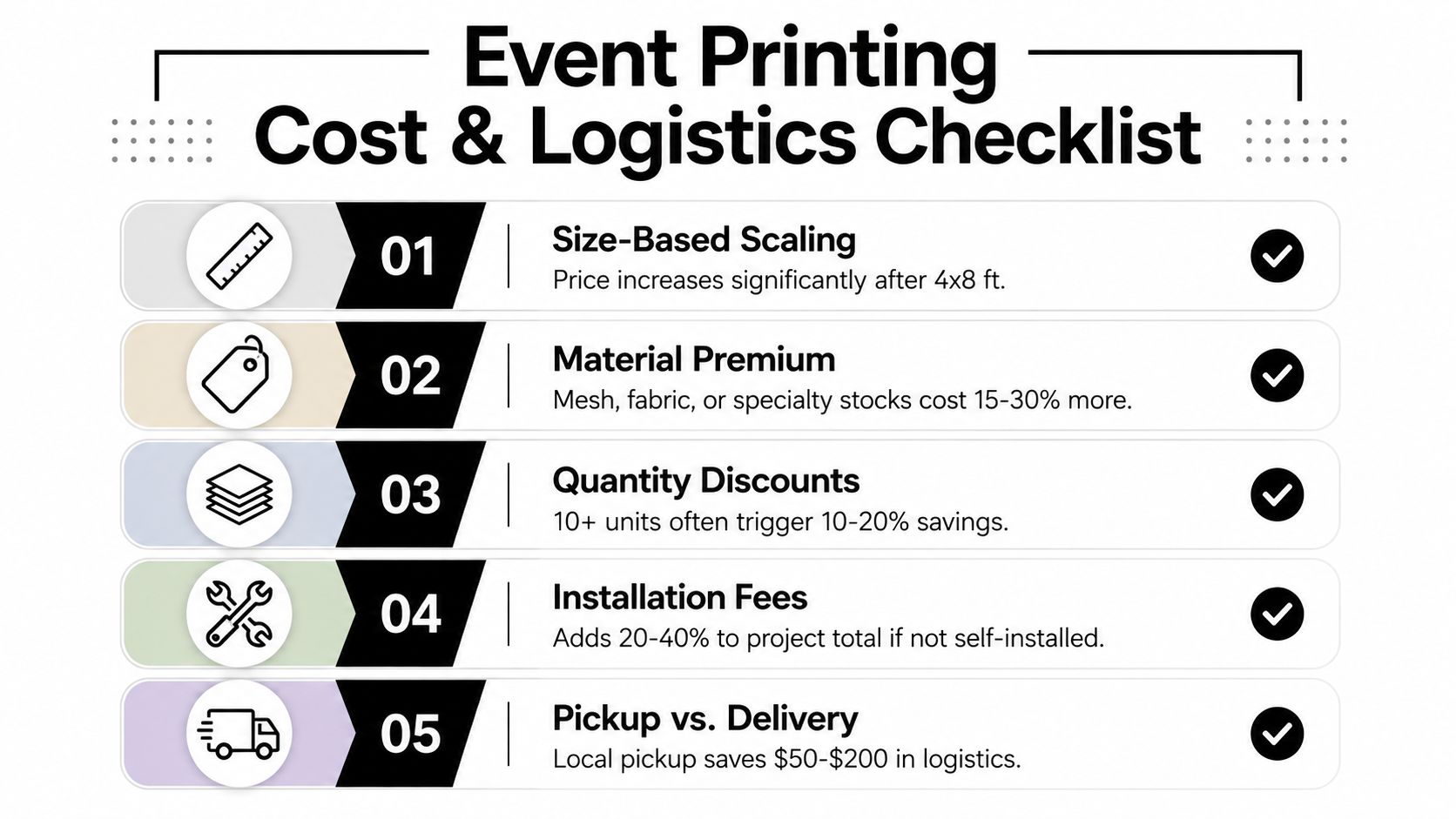
Use a deadline checklist
Two weeks out
- Finalize the product list and one-page placement brief.
- Confirm indoor or outdoor conditions, viewing distance, and reuse needs.
- Request comparable quotes with finishing and pickup details included.
- Submit artwork for preflight and identify one approver.
One week out
- Approve the proof only after checking names, dates, URLs, logos, dimensions, and QR codes.
- Reconfirm quantities against the registration list, distribution plan, and venue layout.
- Confirm the production cutoff, pickup time, delivery contact, and installation responsibilities.
- Ask how the shop will package large or delicate pieces for transport.
The day before
- Pick up early enough to inspect every item without event-day pressure.
- Count pieces by product and location, then photograph anything requiring special placement.
- Pack a small spare kit with zip ties, removable tape, scissors, hooks, stakes, cleaning cloths, labels, and backup printed directions.
- Keep banners rolled correctly and protect rigid boards from bending or surface damage.
Day of the event
- Load materials in installation order, with entrance and registration pieces accessible first.
- Walk the attendee route before opening doors and check that signs are visible from the intended distance.
- Test every displayed QR code with a phone under the venue’s actual lighting.
- Keep spare handouts, badges, business cards, and repair supplies in a known location.
The cheapest quote isn’t the lowest project cost if a missing finish, failed scan, late pickup, or installation problem forces a replacement. Treat the printer as part of the event logistics team, provide a complete brief, and make the pickup appointment as deliberately as the venue booking.
Business Mail Boutique LLC offers same-day banners, posters, flyers, yard signs, decals, business cards, and other print services from its Sugar Land storefront, with packing and shipping support for event materials. Visit Business Mail Boutique LLC with your event date, finished dimensions, artwork, quantities, and pickup needs to discuss a practical production plan.

Related posts

Perfume Bottle Engraving Sugar Land | Same-Day Service
Same-Day Perfume Bottle Engraving in Sugar Land.
Custom Perfume Bottle Engraving in Sugar Land — Same-Day Personalized Gifts
Make a...

Leather Portfolio Engraving in Sugar Land | Custom Initials
Custom Leather Portfolio Engraving in Sugar Land: Personalized Initials for Corporate Gifts
A professional portfolio is something ...

Corporate Watch Engraving in Sugar Land | Business Mail Boutique
Custom Watch Engraving in Sugar Land: Meaningful Gifts for Employee Appreciation
A personalized watch can turn a company’s thank-you i...