
- Print Business Cards in Sugar Land – Same Day Service
- Copying Services
- Document Printing, Finishing & Lamination in Sugar Land
- Flyers
- Print Banner in Sugar Land | Same-Day Banner Printing Near Me
- Graphic Design
- Photo Printing
- Postcard Printing
- Document Printing
- EDDM Full Service Postcards
- FotoZoomer Large Format Printing


Foam Board Print Guide: For Signs, Photos & Displays
Businessmailboutique
11645 S. Hwy 6
Sugar land, Texas 77498 United States (US)
Email: info@businessmailboutique.com
Route
Your complete guide to a foam board print. Learn about materials, file prep, and how to get durable, high-quality prints for your business in Sugar Land today.
You’ve got an event coming up, a storefront promo that needs to go up fast, or a presentation board that can’t look homemade. The file may already be done. What usually isn’t settled is the material. A paper poster feels too flimsy. A heavier rigid sign can be overkill. You need something that looks clean, travels easily, and sets up without drama.
That’s where a foam board print usually makes the most sense. It’s one of the most practical indoor display materials in a print shop because it gives you a rigid, professional result without the weight and handling issues that come with denser sign panels. The catch is that not every foam board order is produced the same way, and that difference affects sharpness, durability, and how polished the final piece looks.
Table of Contents
Your Go-To for Professional Lightweight Signage
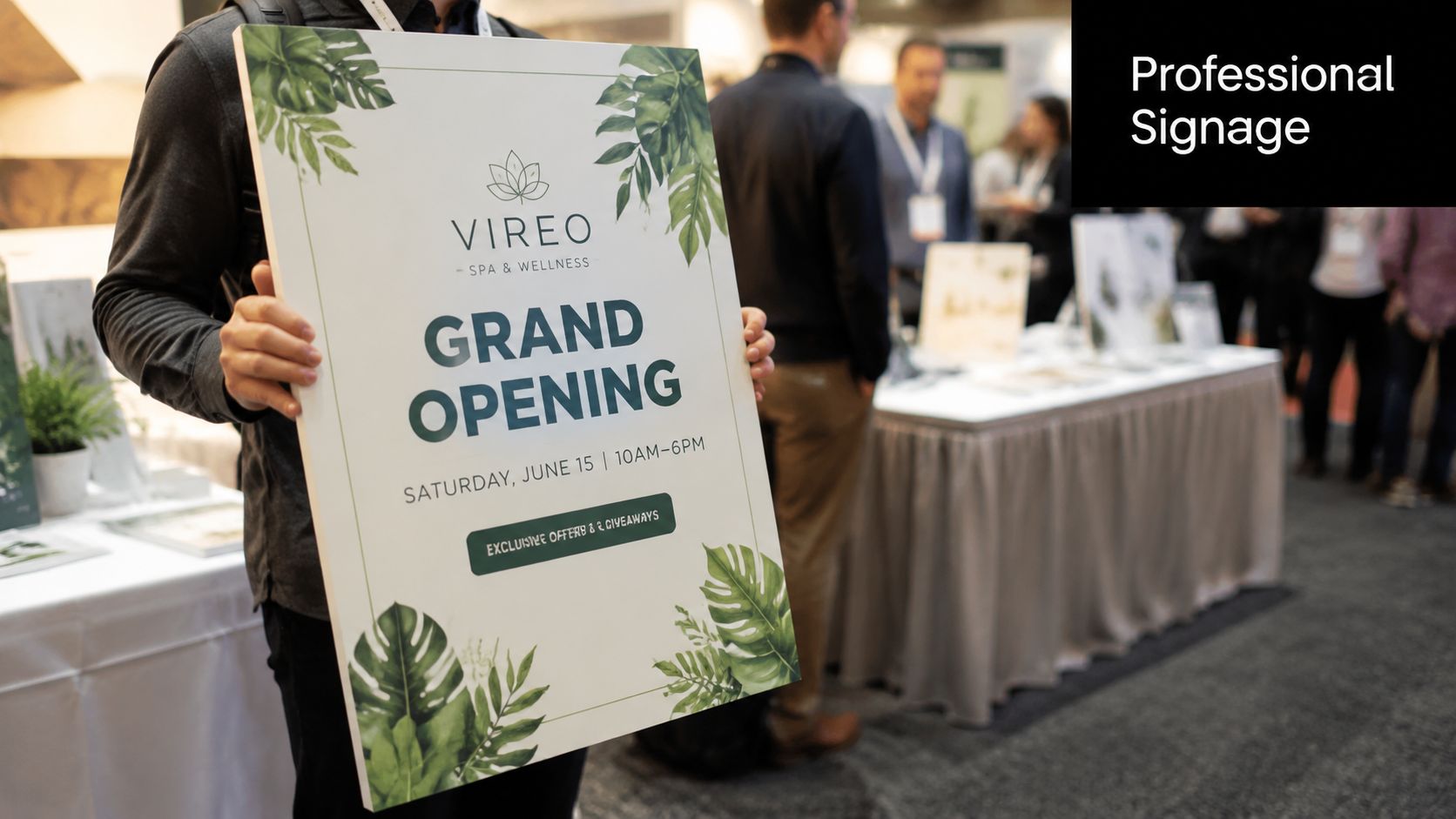
A common rush order looks like this. A business owner needs a welcome sign for a grand opening, a tabletop display for a networking event, and one oversized visual for a weekend expo. They want it to look finished, not temporary, but they also need something one person can carry in and set on an easel.
That’s the lane where foam board performs well. It gives you a rigid face for graphics, stays flatter than a simple poster, and doesn’t fight you during setup. For indoor promotions, presentations, photo displays, and event signage, it’s one of the most dependable ways to get a polished result quickly.
Foam board has been part of the graphic arts world for a long time. Foam board, also known as foamcore or paper-faced foam board, was first commercially manufactured in standardized thicknesses of 1⁄8 inch and 3⁄16 inch starting in 1961 by Monsanto for the graphic arts industry, according to the Foamcore history summary on Wikipedia. That early standardization matters because it helped turn foam board into a reliable production material, not just a niche mounting surface.
Why small businesses keep choosing it
For most indoor jobs, the appeal is practical:
- It’s easy to move: staff can carry it from the shop to the car to the venue without special hardware.
- It presents well: graphics look structured and intentional, not floppy or improvised.
- It works fast: foam board is a strong fit for short-turnaround event signage and in-store promotion.
Practical rule: If the sign needs to look professional indoors and be handled by one person, foam board is often the right first option.
That doesn’t mean every foam board print is equal. The board itself matters. The print method matters even more. Those are the two decisions that separate a clean event-ready sign from something that looks like a poster glued to a backing board at the last minute.
What Is a Foam Board Print
A foam board print isn’t just a poster on a stiff backing. Think of it as a lightweight structural panel made for display graphics. That distinction helps buyers make better choices because the material behaves very differently from standard poster stock.
Structurally, foam board is built like a sandwich. The middle is foam. The outer faces provide a printable surface. This combination makes it useful in print production.
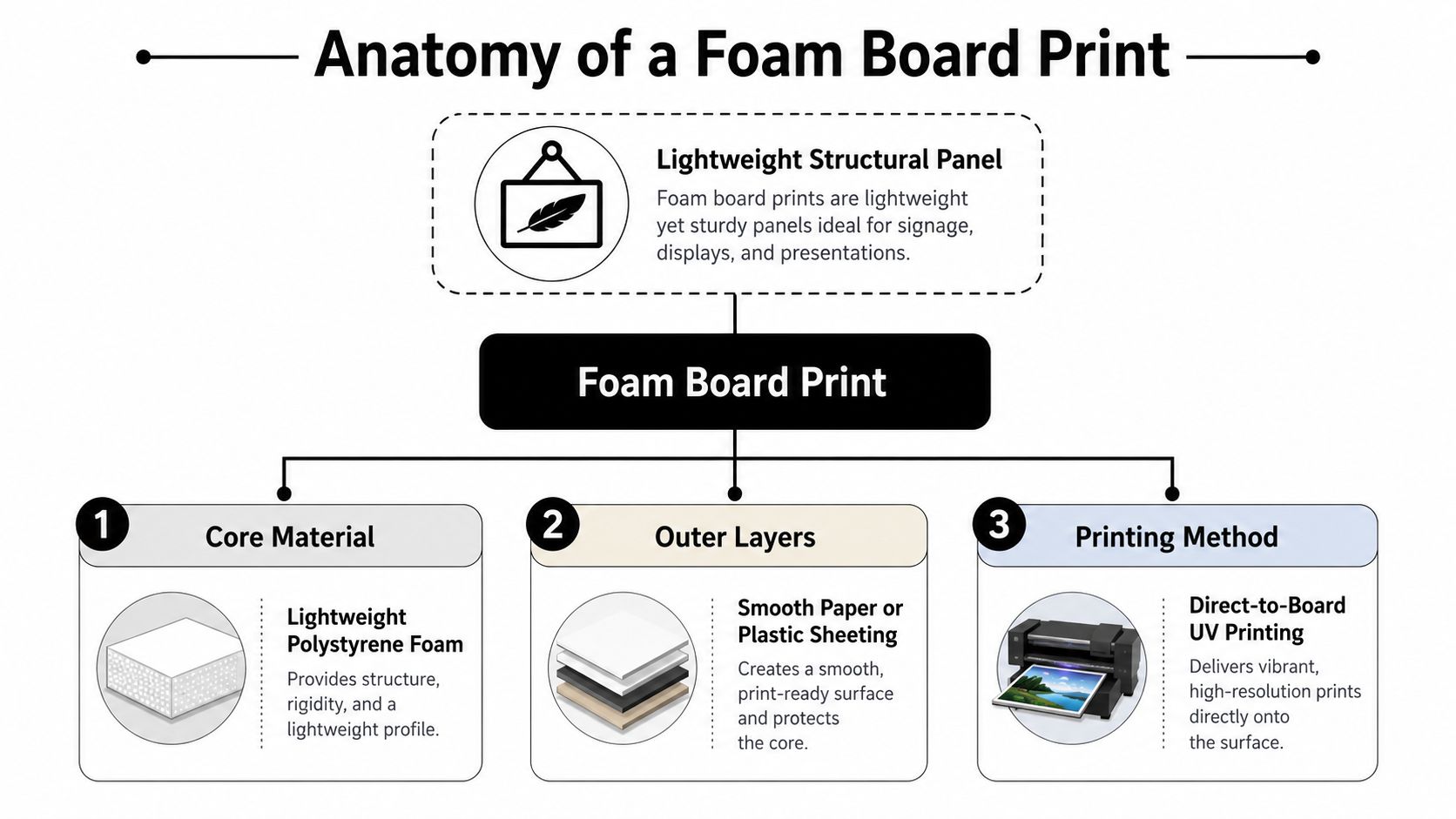
Foam board is a three-layer composite material consisting of a polystyrene foam core that is 95–98% air, sandwiched between two outer sheets of paper, which makes it both rigid and lightweight, as described by Frame Destination’s comparison of poster board and foam board.
Why the structure matters
That air-filled core is the reason the board feels substantial without getting heavy. You can display a fairly large graphic panel and still move it around with minimal effort. For indoor business use, that’s a major advantage.
The outer sheets matter too. They create the smooth printable face and give the board enough skin strength to stay presentable during normal handling. When the file is prepared well and the print is produced correctly, the result looks crisp and clean from a normal viewing distance.
Foam board versus poster board
Poster board and foam board don’t solve the same problem.
Poster board works when you’re pinning, framing, or taping up something temporary and flat support isn’t a priority. Foam board works when the print itself needs to hold shape and stay visually composed on its own. Menu displays, presentation boards, retail promos, event welcomes, and mounted photos all benefit from that rigidity.
A simple way to consider this:
- Poster board: lightweight sheet material that still behaves like paper.
- Foam board: lightweight panel material that behaves like a sign.
A good foam board print should look like one finished object, not a graphic that still needs help standing up.
That’s why the material keeps showing up in offices, showrooms, lobbies, pop-up events, and reception displays. It has enough structure to feel professional without forcing you into a heavier board category.
Choosing the Right Board for Your Project
Buyers often ask for “foam board” as if there’s only one version. In practice, the right board depends on how large the piece is, how it will be displayed, and whether it needs to travel more than once.
Foam board is commonly available in thicknesses ranging from 0.125″ up to 1 inch, and 24″ × 36″ is the most popular dimension for custom foam board printing, according to Iowa State University’s wide-format material guide. That size is popular for a reason. It’s large enough to read well in a room, but still manageable for easels, counters, and car transport.
Thickness matters more than most buyers expect
Thinner boards work well for lighter-duty jobs. They’re easier to carry and often fine for short-term use on an easel or wall. Once the sign gets larger, travels frequently, or will be handled by multiple people, thickness starts to matter more.
A board that looks fine in the shop can still disappoint if it flexes too much during transport. That’s especially true for event signs, traveling presentation graphics, and welcome boards that need to survive setup, teardown, and another trip next week.
A quick comparison by use case
| Thickness | Best For | Key Feature |
|---|---|---|
| 0.125″ | Short-term indoor signs, lightweight presentation boards | Easy to carry and simple to display |
| 3/16″ | Most business promos, photo displays, event signage | Good balance of rigidity and portability |
| Thicker foam board options | Larger indoor panels and displays needing more body | Added stiffness for bigger formats |
| Denser rigid alternatives | Repeated transport and higher handling stress | Better resistance to bending and dents |
The safest choice for many small business jobs is the middle ground. It gives you enough structure without making the board feel bulky.
For companies planning multiple kinds of signage, it also helps to compare foam board with other durable sign material options so you don’t use an indoor panel where a tougher substrate belongs.
When to step up to a denser board
Standard foam board is a strong indoor option, but it has limits. If the piece will travel often, get packed tightly with other booth materials, or be reused for a long run of events, a denser board may hold up better. Some shops recommend Gator board for those situations because it’s more resistant to bending, denting, and warping than standard foam core.
That doesn’t make standard foam board the wrong choice. It just means you should match the material to the job instead of forcing one board to do everything.
If you’re ordering event graphics, posters, or presentation pieces together, a local wide-format printing service for Sugar Land businesses can help line up the right substrate across the full set instead of choosing board thickness one sign at a time.
How to Prepare Your Design File for Printing
A business owner brings in artwork that looked sharp on a laptop, then sees the finished board under lobby lights and notices soft logos, cramped margins, or mounting flaws along the edge. That problem usually starts long before production. It starts with a file that was not set up for the way the piece will be made.
For foam board, production method matters as much as artwork quality. A direct foam board print is printed straight onto the board. A mounted poster is printed on a separate sheet, then applied to foam core afterward. Both can serve a purpose, but they do not produce the same finish, and that difference shows up fast on client-facing signage.
Direct printing and mounting are not the same thing
Direct printing removes a full step from the process. Ink goes onto the board surface itself, so there is no separate print to align, no adhesive layer to manage, and fewer chances for silvering, bubbles, or edge lift. For presentation boards, indoor signs, and sales displays, that cleaner production path usually gives a more polished result.
Mounted posters still have a place, especially for lower-cost temporary pieces or jobs where the graphic may be swapped out later. The trade-off is consistency. If mounting is slightly off, people notice it in the corners, along the trim, or anywhere the surface catches light.
That is why I tell clients to decide on the production method before they export the file. A board made for a front desk, investor meeting, or trade show should be prepared for the finish standard you expect in the room. Shops producing exhibition displays deal with this all the time because presentation flaws become obvious the moment the graphics go up.
For a quick visual overview of print prep basics, this walkthrough is useful before you export final artwork:
File setup that avoids expensive mistakes
Good foam board printing starts with a file built at the final size, not a small design that gets enlarged at the last minute.
These settings matter most:
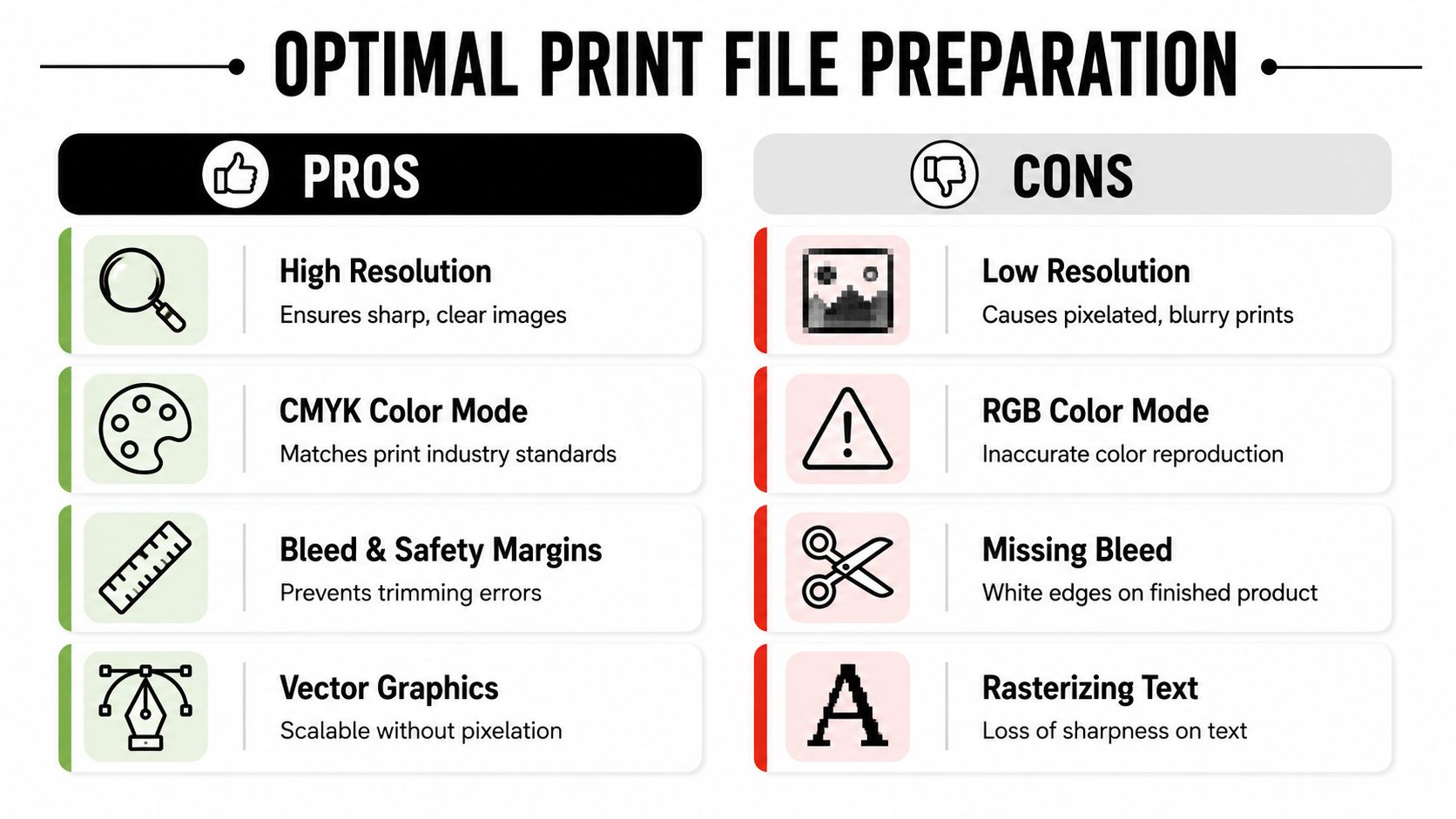
- Build at final size and 300 DPI: large boards expose low-resolution images quickly, especially in logos, faces, and product photos.
- Add 1/8-inch bleed: bleed protects background color and images when the board is trimmed.
- Keep text inside the safe area: headlines, pricing, and contact details need breathing room away from the cut edge.
- Work in CMYK when possible: that reduces surprises when bright screen colors print flatter on a physical board.
- Use original image files: web graphics, screenshots, and pulled social media images often break down on rigid signage.
- Watch thin fonts and fine rules: what looks crisp on screen can fade out from a few feet away.
If the board will sit on a counter or easel, file composition matters too. A welcome sign needs stronger top-to-bottom hierarchy than a wall piece viewed straight on. For tabletop or lobby use, it helps to review common foam board signs with easel back options before locking in the layout.
Before you send the file
Use this checklist before approval:
- Confirm the finished dimensions
Design for the actual board size from the start.
- Inspect every logo and photo at 100% zoom
Pixelation that seems minor on screen becomes obvious on print.
- Check edge spacing
Bleed is not a safety zone. Keep important content away from the trim.
- Export a print-ready PDF if your shop requests it
That usually holds fonts, alignment, and image placement more reliably.
- Ask how the piece will be produced
File prep for direct-to-board printing and file prep for a mounted poster may look similar, but the finish expectations are different.
Shop-floor advice: The fastest way to waste a strong design is to send it in a format that does not match the production method.
Clients get better results when the file, board, and display plan are decided together. That is how you avoid the common mistake many online guides skip over. Treating direct-to-board printing and basic poster mounting like the same product, when they are not.
Finishing Touches and Display Options
A foam board print can have good artwork and still feel unfinished if the final presentation is sloppy. Edges, surface protection, and display hardware are what turn a printed board into a piece that looks ready for a store, booth, or office wall.
Edge finish and surface protection
The edge is small, but people notice it. A clean white edge works well for most business graphics because it looks neutral and doesn’t compete with the design. A black edge can make artwork feel more framed and deliberate, especially with dark branding or photo-heavy layouts.
Surface protection matters when the sign will be handled, carried, or displayed in a busy area. A clear coat or laminate can help guard against scuffs and light moisture exposure while also changing the look of the print. Matte finishes reduce glare. Gloss finishes add pop, but they can reflect overhead lights aggressively in lobbies and event halls.
Choose the finish based on the viewing environment, not just what looks best on the sample swatch.
Display methods that work in the real world
Some display methods are reliable. Others look fine for ten minutes and then start sliding, bowing, or leaning.
These options tend to work best:
- Easel display: strong for welcome signs, presentations, and event check-in graphics.
- Wall mounting: good for office branding, menu-style boards, and interior promotional signage.
- Countertop support: useful for reception desks, retail tables, and point-of-sale messaging.
- Temporary event placement: practical for expos and short-term activations where setup speed matters.
If you’re planning a larger booth or branded event area, looking at professional exhibition displays can help you coordinate foam board pieces with the rest of the display system.
For smaller signs that need to stand neatly on their own, an easel back sign option is often the simplest finish. It avoids extra hardware and keeps setup easy for staff who just need to place the sign and move on.
The best display method is the one your team can set up correctly the first time, without tools, guesswork, or a last-minute fix.
Get Your Foam Board Print Today in Sugar Land
Online ordering works when the job is simple and timing is loose. It’s much less forgiving when the file needs a quick review, the color has to look right, or the sign has to be ready for pickup on a tight local deadline.
That’s why local production matters for foam board prints. A nearby shop can catch issues before they hit the board, confirm whether your piece should be direct printed or mounted, and help you choose the right thickness for how the sign will be used.
Why local production matters
When a customer is in Sugar Land and needs event signage fast, the biggest advantage isn’t just speed. It’s feedback. A local team can look at the file, spot low-resolution graphics, check trim safety, and flag production choices that would hurt the final result.
That hands-on review is especially important for boards used in presentations, storefront promotions, welcome signage, and event photography displays. Those are the jobs where “good enough” usually looks obviously not good enough.
What to bring for a smooth order
A foam board order goes faster when you have the basics ready:
- Final artwork: ideally a print-ready PDF or a properly sized design file.
- Display plan: easel, wall, counter, or handheld use.
- Timing: whether this is same-day, next-day, or part of a broader event package.
- Usage details: one event, multi-event travel, photo display, or interior signage.
If the job is urgent, local same-day posters and banners printing in Sugar Land can also help when your foam board print is part of a larger rush order with matching event graphics.
Frequently Asked Questions About Foam Board Prints
How sharp does my file need to be
A foam board print only looks as good as the file behind it. For a presentation-ready result, send artwork built at final size with proper bleed and enough resolution to hold crisp text, clean logos, and natural-looking faces. If the original file is soft, pixelated, or pulled from a website screenshot, that weakness will still show in print.
We check files before production because this is one of the biggest differences between a professional board and a rushed mounted poster job. A sharp file printed directly to the board usually looks cleaner and more intentional right away.
Is foam board good for outdoor use
Foam board works best indoors. It handles short-term business displays well, especially for presentations, retail promos, welcome signs, and event graphics.
Outside, moisture, wind, sun, and repeated handling create problems fast. For exterior use, a more durable sign material is usually the better call.
What size should I order
Order the size based on viewing distance, display method, and how you will transport it. A board that looks impressive on an easel can become a headache if it does not fit in your vehicle or keeps getting bumped on the way to the event.
For many business uses, medium-format boards are the safest choice because they balance readability and portability. If you are unsure, we usually recommend starting with the display location first, then choosing the largest size that still travels safely.
How should I store and handle it
Store foam board flat in a clean, dry space. Keep it away from heat, moisture, and rough surfaces that can dent the edges or scuff the print.
Larger boards should be carried with two hands. If the piece will travel to more than one event, use a sleeve or place a clean sheet between boards so the faces do not rub together during transport.
Should I choose direct print or mounted poster
For most business clients, direct-to-board printing is the better finish. It skips the extra mounting step, so you avoid common issues like bubbles, silvering, adhesive marks, and slight misalignment near the edges.
Mounted posters can still work for short-term use or lower-budget displays, especially if the print is already produced and just needs backing. But if the goal is a polished board for a meeting, storefront, trade event, or photo display, direct print usually gives the cleaner result and the more reliable finish.
Business Mail Boutique LLC handles foam board prints, posters, banners, and other fast-turn print projects for local customers who need reliable results without the back-and-forth of distant vendors. If you need a polished display piece for a store, event, presentation, or photo board, contact Business Mail Boutique LLC for local help with file checks, production, and pickup in Sugar Land.

Related posts

Custom Memorial Glasses Engraved in Three Hours in Sugar Land
When a customer needed eight personalized glasses for a memorial, Business Mail Boutique completed the engraving or...

Custom Martini Glass Engraving in Sugar Land, TX
Custom Logo Engraving on Martini Glasses in Sugar Land, Texas.
Business Mail Boutique recently completed a beautiful custom engravin...

Custom Engraved Wine Glasses for a Golf Club Event in Sugar Land, TX
Custom Engraved Wine Glasses for a Golf Club Event in Sugar Land.
Custom wine glass engraving in Sugar Land, TX at Business Mail Bouti...