
- Print Business Cards in Sugar Land – Same Day Service
- Copying Services
- Document Printing, Finishing & Lamination in Sugar Land
- Flyers
- Print Banner in Sugar Land | Same-Day Banner Printing Near Me
- Graphic Design
- Photo Printing
- Postcard Printing
- Document Printing
- EDDM Full Service Postcards
- FotoZoomer Large Format Printing


Businessmailboutique
11645 S. Hwy 6 Sugar land, Texas 77498 United States (US)Phone: 281-875-0161
Email: info@businessmailboutique.com
Wide Format Printing: A Practical Business Guide
Businessmailboutique
11645 S. Hwy 6
Sugar land, Texas 77498 United States (US)
Email: info@businessmailboutique.com
You need a banner for a sidewalk event on Friday. Your storefront window looks empty. Your trade show table is booked, but the backdrop still isn’t handled. Or you’ve got a set of plans that are impossible to review on a standard office printer. That’s usually when small business owners first run into wide format printing.
The good news is that it isn’t some mysterious commercial process reserved for giant brands. It’s the category of printing built for oversized visuals and technical documents that need to be seen clearly at full scale. If you’re ordering a banner, poster, yard sign, mural, display panel, or blueprint, you’re already in this world.
What matters most isn’t memorizing printer models or ink chemistry. It’s knowing how to choose the right material, submit a clean file, and ask your local print shop the questions that prevent delays, color surprises, and wasted money. That’s where most projects go right or wrong.
Table of Contents
- Make a Big Impression with Wide Format Printing
- What Exactly Is Wide Format Printing
- Exploring Wide Format Printing Technologies
- From Banners to Blueprints Top Applications
- Preparing Your Files for Flawless Results
- Understanding Costs and Turnaround Times
- Choosing Your Wide Format Printing Partner
Make a Big Impression with Wide Format Printing
Most small businesses don’t lose attention because their offer is weak. They lose attention because people never notice them in the first place. A sharp banner, a clear storefront graphic, or a polished event display fixes that problem fast.
That’s where wide format printing earns its keep. It turns one message into something people can read from across a room, across a parking lot, or while walking past your window. For a local business, that can mean promoting a seasonal sale, introducing a new service, guiding visitors at an event, or making your brand look more established than a basic taped-up flyer ever could.
This isn’t a niche corner of printing anymore. The global large-format printer market was estimated at $9.11 billion in 2023 and is projected to grow to USD 12.43 billion by 2029, which shows how central it has become in advertising, retail, and events for businesses of all sizes, according to Craftsmen Industries on large-format printing trends.
Why small businesses use it
A good wide format piece does one of three jobs well:
- Pulls people in: Sidewalk signs, posters, and window graphics help foot traffic understand what you offer before anyone steps inside.
- Supports sales conversations: Trade show backdrops, mounted boards, and presentation graphics give your team something concrete to stand beside and explain.
- Keeps operations moving: Plans, schematics, and oversized reference materials are easier to review when they’re printed at readable scale.
Practical rule: If the message needs to be noticed from a distance, shared by a group, or reviewed at full size, standard printing usually isn’t the right tool.
The biggest mistake I see is treating large graphics like oversized flyers. They’re not. A banner has to read quickly. A poster has to hold up from several feet away. A blueprint has to stay legible where detail matters most. When the format changes, the design and material choices have to change too.
What Exactly Is Wide Format Printing
Wide format printing means producing graphics on material that is larger than a standard office printer can handle. For a small business owner, the practical cutoff is simple. If the piece is too large for your desktop printer or copier, it usually falls into wide format territory.
In everyday shop use, output wider than about 17 to 18 inches is generally treated as wide format, according to Ricoh’s wide format printer glossary. That includes the products customers ask for all the time: posters, banners, window graphics, mounted signs, blueprints, and event displays.
A desktop printer is built for stacks of small sheets. A wide format machine is built to handle larger material sizes, longer runs, and a broader range of media, from paper and vinyl to canvas and rigid boards.
That difference affects the final result more than many buyers expect.
A large print has to stay clean across a much bigger surface. Colors need to remain even from edge to edge. Materials need to feed straight, dry properly, and hold up in the way the job requires. File setup matters more too, especially if the piece will be viewed up close or installed in a space where any flaw is easy to spot. If you want a clearer sense of how oversized prints are typically used and displayed, this guide to large format prints is a useful reference.
Why that matters to you as a buyer
You do not need to learn the mechanics of the press. You do need to order the right kind of print for the way it will be used.
Here is where buyers usually save time and money by asking the right questions early:
- A poster should be sized for its viewing distance, so text and images still look sharp where people will stand.
- A banner needs the right material weight and finishing, such as hems or grommets, so it hangs properly instead of curling or tearing.
- A blueprint depends on line clarity and accurate scale. Surface finish matters far less than readable detail.
- A mounted sign needs a board that stays flat, suits the display environment, and does not feel flimsy once it is on the wall or easel.
Wide format printing is less about one specific machine and more about the job itself. The piece is larger, the material choice matters more, and the print has to perform well in the real world.
That is why a good print shop will ask where the graphic will live, how long it needs to last, and how people will view it before recommending a spec. Those questions are not upselling. They are how you avoid ordering a glossy indoor poster for a sunny window, or a lightweight banner for a windy outdoor setup.
The category grew as digital printing made oversized graphics faster and more practical to produce. Britannica’s overview of printing notes how printing technology continued to evolve from traditional processes into digital methods that expanded what could be produced efficiently. For customers today, the useful takeaway is straightforward. Large-format printing is no longer rough or limited. With a solid file and the right material, it can look polished, sharp, and fully on-brand.
Exploring Wide Format Printing Technologies
Customers usually hear ink terms before they hear plain-English explanations. That’s backward. The practical question is simple: what are you printing, where will it live, and what surface needs the image?
A print shop may guide you toward aqueous inkjet, solvent, latex, or UV printing. You don’t need a chemistry lesson. You need to know what each one tends to do well.
A quick visual helps sort the choices:

The four options most customers hear about
Aqueous inkjet is commonly used for indoor graphics and photo-style work. If your piece will live inside and appearance is the main priority, this is often part of the conversation.
Solvent is the workhorse option when outdoor durability matters. If you’re talking about tougher signage or vehicle-oriented graphics, shops often lean this direction because the output is built for harsher conditions.
Latex has become an important option for customers who want flexibility across indoor and outdoor uses. The industry shift toward greener production has boosted technologies like Latex and UV printing, and those options have different performance and environmental profiles depending on whether your priority is outdoor durability, indoor air quality, or short-run event signage, according to DEX Imaging’s review of wide format trends.
Later in the discussion, it helps to see the equipment in action:
UV-cured printing is especially useful when you need to print on a wider variety of materials, including rigid pieces. That makes it a common fit for display boards, signage panels, and specialty surfaces.
If you want to see how oversized photo and poster work fits into the larger category, this FotoZoomer guide to large format prints gives a customer-friendly example of where these services overlap.
A simple comparison you can use in the shop
| Technology | Best For | Durability | Key Feature |
|---|---|---|---|
| Aqueous Inkjet | Indoor posters, photo prints, presentation graphics | Better suited to indoor use | Strong visual quality on indoor media |
| Solvent | Outdoor signage, tougher graphics, vehicle-related applications | Strong for outdoor conditions | Built for weather-resistant output |
| Latex | Mixed indoor and outdoor graphics | Versatile depending on material | Balances flexibility with greener production goals |
| UV-cured | Rigid signs, boards, specialty surfaces | Durable for many display uses | Adheres to diverse rigid and flexible materials |
A common buyer mistake is asking for “the best” technology. There isn’t one universal winner. There’s only the right fit for the job.
If you need a short-run event graphic that will be seen indoors for a weekend, that’s a different conversation from a permanent exterior sign. If you need mounted boards, that’s different again. Good shops don’t start with the machine. They start with the use case.
From Banners to Blueprints Top Applications
A customer walks in needing one banner for a weekend sale. Five minutes into the conversation, it became clear they also needed a window graphic, two foam board signs, and a mounted poster for the checkout counter.
That happens all the time. Wide format printing is less about one product and more about matching the format to where people will see it, how long it needs to last, and what kind of handling it will take.

Marketing pieces people notice first
Banners are usually the first order because they solve a simple problem fast. They are easy to read from a distance, easy to hang, and useful for grand openings, school events, church functions, sidewalk promotions, and short-term sales. Vinyl is a common choice because it travels well and holds up better than lighter indoor stocks.
Posters make more sense when the setting is controlled and the presentation matters. Restaurants use them for menu visuals. Retail shops use them for promotions. Offices use them for branded décor, presentations, and temporary campaigns. The right stock depends on the job. Paper is cost-effective, synthetic media handles more wear, and mounted boards give the piece a more finished look.
Trade show graphics need to work in a busy room. Small details get lost. Clear headlines, strong contrast, and a layout people can understand in a few seconds usually outperform crowded designs. If the display will be packed, shipped, and reused, material choice matters as much as the artwork.
Operational prints that need accuracy
Wide format also covers the pieces that help a business run.
Blueprints and engineering drawings are a good example. Full-size output keeps line weights, labels, and scale readable. That matters on a job site, in a planning meeting, or during markup review, where several people may need to look at the same sheet at once.
Site plans, schematics, and presentation boards fall into the same category. Architects, contractors, interior designers, real estate teams, and facilities managers use large prints because screen sharing is not always practical in the field or around a conference table.
Here are some of the most common application groups local shops handle:
- Storefront and retail
- Window graphics
- Promotional posters
- Foam board displays
- Counter cards
- Events and mobility
- Trade show backdrops
- Retractable banner graphics
- Directional signs
- Vehicle graphics
- Workspace and décor
- Wall murals
- Canvas prints
- Branded office panels
- Temporary campaign signage
- Technical and construction
- Blueprints
- Engineering drawings
- Planning sheets
- Full-scale markup sets
The best choice depends on use, not size.
A poster behind glass, a banner outside in the wind, and a presentation board carried into client meetings may all use the same artwork, but they should not be printed the same way. Good print shops help you sort that out before production starts.
If you need outdoor signage fast, this same-day outdoor banner printing service for local businesses is a good example of the kind of deadline-driven option businesses often ask for.
Preparing Your Files for Flawless Results
Most print problems start before anything is printed. They start in the file. A banner with fuzzy logos, a poster with unexpected color shifts, or a sign with text trimmed too close to the edge usually comes from setup issues, not from the printer itself.
That’s good news, because file problems are preventable.

The file issues that cause most rework
Low-resolution images are the biggest one. If you drag a small web image into a large banner layout, it may look acceptable on screen and fall apart in print. Logos are safest as vector files when available because they scale cleanly.
RGB artwork can also cause surprises. Screens display color differently from print, so files prepared for digital viewing don’t always translate neatly to printed output. If color matters, ask the shop what format and color setup they prefer before final export.
Missing bleed and tight margins create trimming problems. Think of bleed like extra background area that extends beyond the final cut line. It gives the finisher room to trim cleanly without leaving an unintended white edge. Safety margins matter too. Don’t park important text right at the border.
A clean handoff checklist
Before you send a file, run through this short list:
- Use the final size: Build the artwork to the intended print dimensions, or to the scale your printer requests.
- Check image quality: Make sure photos and raster graphics are suitable for large output.
- Convert or embed fonts: That prevents substitution issues if the shop doesn’t have your exact typeface.
- Prefer print-ready PDFs: They usually travel well and preserve layout better than editable design files.
- Flag any critical colors: If a logo color is sensitive, say so before production starts.
Shop-floor advice: If your design includes tiny text, thin rules, or detailed QR codes, ask for a proof review before the full run. Those details are where small file problems show up first.
A simple file package saves time for both sides. Include the final artwork, any linked images if requested, and a plain note with quantity, size, material preference, finishing needs, and deadline. That one habit prevents a lot of back-and-forth.
Understanding Costs and Turnaround Times
Customers usually ask one question out loud and one they keep to themselves. Out loud, it’s “How much?” The question they keep to themselves is, “Why does this job cost more than that one when they look similar?” The answer is usually material, finishing, and labor.
What actually changes the price
Size matters, of course, but it’s only part of the quote. Two prints at the same dimensions can price differently if one is on paper and the other is on vinyl, fabric, or rigid board. Finishing also changes the job. Grommets, trimming, mounting, lamination, contour cutting, and packing all add steps.
Turnaround depends on more than machine time. Shops also have to account for file checking, scheduling, material availability, drying or curing needs for some workflows, and finishing. A simple poster order can move quickly. A mounted event set with multiple pieces takes longer because more hands touch it.
A smart way to ask for a quote is to provide these details up front:
- Exact use case: Indoor display, outdoor promotion, trade show, blueprint review, or presentation board
- Finished size: Not “large,” but the actual dimensions you need
- Material preference: If you know it, say it. If not, describe where and how the print will be used
- Deadline: State the actual in-hand date, not just the event date
- Finishing needs: Grommets, lamination, mounting, trimming, or packaging
When outsourcing makes more sense
A lot of small business owners wonder if they should eventually buy their own wide format equipment. Sometimes that makes sense. Often, it doesn’t.
While wide format printing can be cost-effective, a machine’s low per-print cost can be misleading if utilization is low. For many small businesses, outsourcing remains cheaper and less risky because of hidden costs like ink, maintenance, and substrate waste, as noted in this guide to understanding large format printing.
That tracks with what happens in real shops. Owning the machine is only part of the equation. Someone still has to maintain it, calibrate it, load the right media, troubleshoot bad files, manage waste, and finish the job properly. If you print occasionally, outsourcing usually buys you flexibility without the overhead.
Choosing Your Wide Format Printing Partner
The right print partner will save you more than money. They’ll save you revisions, delays, and preventable mistakes.
Start by looking for signs of practical competence, not flashy jargon. Ask what kinds of projects they produce most often. Ask what materials they recommend for your use case. Ask whether they review files before printing and whether they handle finishing in-house. A useful shop will answer in plain language and steer you away from bad-fit materials even if it means a different ticket than you expected.
What to check before you place the order
- Relevant samples: A shop might be excellent at posters and less experienced with mounted boards or plan sets.
- Clear proofing process: You want to know when they’ll flag file issues and how approvals are handled.
- Realistic turnaround promises: Fast service matters, but honest timing matters more.
- Breadth of service: If you need shipping, signage, blueprint printing, and finishing in one stop, that affects convenience.
For local businesses comparing providers, this Sugar Land print shop guide for businesses is a practical place to evaluate service fit. One local option is Business Mail Boutique LLC, which offers same-day banners and posters along with wide-format engineering blueprint printing through FotoZoomer, plus related business services in the same storefront.

A good shop doesn’t just ask, “What size do you want?” They ask where the piece will be used, how long it needs to last, how it will be displayed, and when you need it in hand. Those questions usually tell you you’re dealing with people who know the work.
If you need help choosing the right material, preparing a print-ready file, or placing a rush order for banners, posters, or blueprints, contact Business Mail Boutique LLC. They provide wide-format printing and related business services from their Sugar Land location, with practical support for small businesses that need clear answers and dependable turnaround.

Related posts
Online Printing Documents Services: Order & Pickup Today
Online Printing Documents Services: Order & Pickup Today
You've got a meeting tomorrow, a proposal still needs to be print...
Marketing Material Printing
Marketing Material Printing: A Small Business Guide
You're probably here because a real deadline is staring at you. A gr...
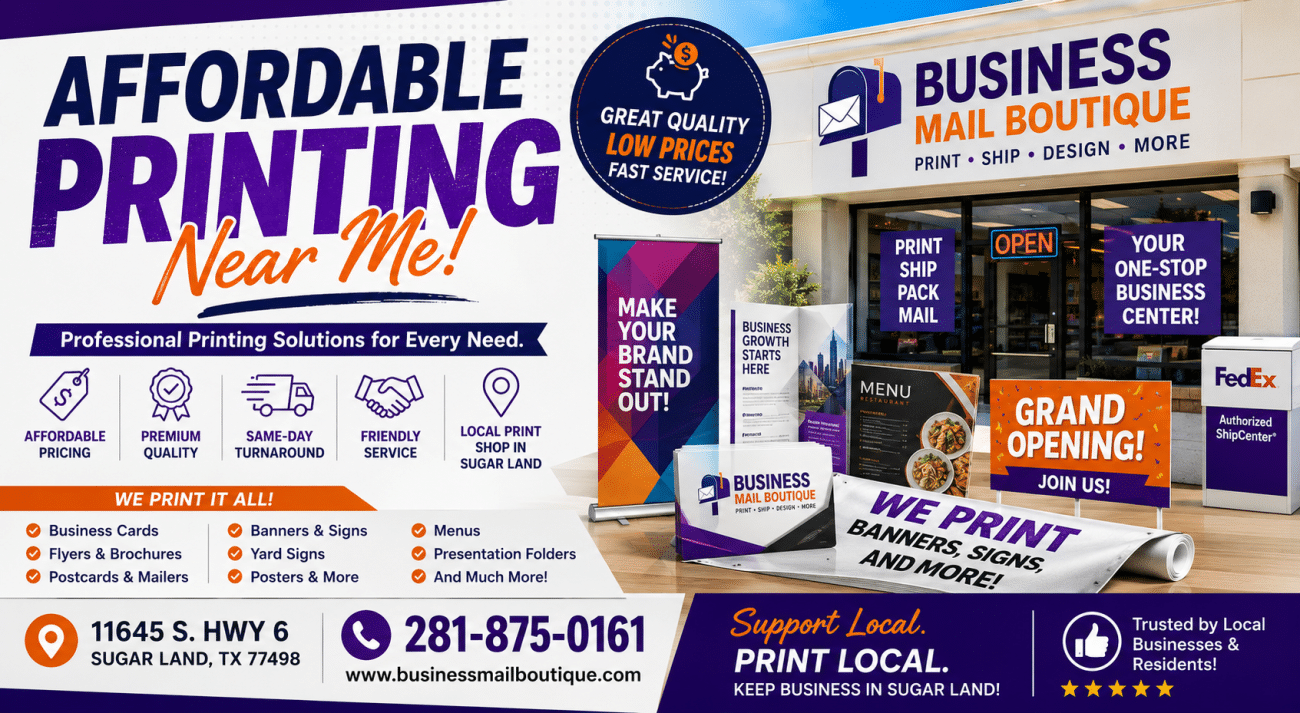
Affordable Printing Near Me – Professional Print Shop Services
Affordable Printing Near Me – Professional Print Shop Services at Business Mail Boutique in Sugar Land
When searching onli...