
- Print Business Cards in Sugar Land – Same Day Service
- Copying Services
- Document Printing, Finishing & Lamination in Sugar Land
- Flyers
- Print Banner in Sugar Land | Same-Day Banner Printing Near Me
- Graphic Design
- Photo Printing
- Postcard Printing
- Document Printing
- EDDM Full Service Postcards
- FotoZoomer Large Format Printing


Businessmailboutique, 11645 S. Hwy 6, Sugar land, Texas 77498 - Phone: 281-875-0161 Email: info@businessmailboutique.com Your Guide to Business Printing in Sugar Land
You’re running a business in Sugar Land, you’ve got a promotion starting tomorrow, and you just realized the table at your networking event looks bare. No flyers. No business cards. No banner. The website is live, your Instagram is active, but when people meet you in person, there’s nothing tangible to hand them.
That’s where printing still does work that digital alone can’t do. A clean rack card, a sharp yard sign, a stack of business cards that feels substantial in the hand, these things help people remember you after the conversation ends. For a local business, that matters. Sugar Land customers meet brands at school fundraisers, chamber events, pop-ups, church events, trade counters, real estate open houses, and restaurant counters. Print shows up in all of those moments.
Print has been solving this problem for a very long time. Johannes Gutenberg’s press emerged around 1440, and its productivity changed communication at a completely different scale. A single Renaissance press could produce up to 3,600 pages per workday, compared with about 40 pages by hand, and by 1500 more than 20 million volumes had been produced across Europe, as summarized in Wikipedia’s history of the printing press. The tools have changed, but the core value hasn’t. Print helps ideas travel.
Table of Contents
- From Idea to Impact with Local Printing
- Decoding the Tech for Your Business Needs
- Your Print Product Arsenal for Brand Growth
- Preparing Your Files for Perfect Prints
- Choosing Materials and Finishes That Impress
- Navigating Turnaround Pricing and Same-Day Service
- How to Choose Your Sugar Land Print Partner
From Idea to Impact with Local Printing
A typical local rush job starts with something small. A coffee shop is sponsoring a Saturday event and needs table tents, a few counter flyers, and fresh menus. A contractor wants yard signs before crews head out. A realtor needs postcards and a pull-up banner before an open house. The request sounds simple, but the core problem usually isn’t the printer. It’s timing, file readiness, and choosing the right piece for the situation.
That’s why local printing works best when it’s treated as part of business operations, not as an afterthought. The piece has to match the moment. If you’re standing face-to-face with prospects, business cards and sell sheets matter more than a long brochure. If cars are passing by, banner visibility and yard sign readability matter more than clever copy.

Local printing solves local timing problems
Sugar Land businesses don’t always have the luxury of long lead times. Community calendars move fast. School groups add sponsors late. Restaurants update seasonal offers. Service businesses book booths after they finally get confirmation from an organizer.
Practical rule: If the material supports an in-person event, order it as if the deadline is earlier than the event date. Delivery delays aren’t the only risk. File fixes and proof changes are what usually eat the clock.
The strongest print jobs also do one thing well. They don’t try to say everything. A flyer should point the reader to a clear next step. A banner should be readable from a distance. A business card should make follow-up easy. That sounds obvious, but plenty of wasted print budgets come from trying to fit a full website onto one sheet.
Print still gives small businesses leverage
Print is old technology, but it’s not outdated technology. It remains useful because it creates presence. You can ignore an email. It’s harder to ignore a clean sign at a busy intersection, a polished packet in a sales meeting, or a direct handoff after a real conversation.
For small and medium businesses, that’s the practical point. Printing isn’t just about ink on paper. It’s about showing up prepared, looking credible, and making it easier for customers to remember what you do.
Decoding the Tech for Your Business Needs
A Sugar Land business owner usually asks a practical question, not a technical one. “I need 200 flyers for Saturday, a banner for the booth, and I may need to change the offer tonight.” The right print method answers that kind of real deadline, budget, and quantity problem.
For most SMBs, the first decision is digital printing versus offset printing. The difference is simple. Offset uses plates and rewards larger, stable orders. Digital skips plate setup, which makes it a better fit for smaller quantities, quick edits, and variable content, as explained in this production printing guide from Woodhull.
Digital printing when speed and flexibility matter
Digital printing is the workhorse for everyday business jobs. It handles short runs well, keeps setup light, and lets you revise details without rebuilding the whole project.
Digital is usually the right call when you need:
- Short runs: Flyers, postcards, menus, sales sheets, or handouts in modest quantities.
- Frequent updates: Pricing changes, date corrections, staff changes, or seasonal promotions.
- Personalization: Mailers or leave-behinds with different names, locations, or offers.
- Fast turnaround: Jobs that need to be printed this week, tomorrow, or in some cases the same day.
For many Sugar Land businesses, this is the default choice for event handouts, business cards, presentation inserts, and smaller brochure orders. It is also the safer option when the details may change after you place the order.
Offset printing when the run is locked and the volume is high
Offset printing makes sense when you know the content is final and you need enough pieces to spread the setup cost across the run. That is why it tends to work better for established materials than for fast-changing promotions.
Use offset when the project checks three boxes. The quantity is high. The design is stable. The piece does not need variable data from one copy to the next.
That often fits longer brochure runs, inserts, forms, or marketing collateral your team will use for months. If you are still debating prices, dates, or service details, digital usually protects you from waste.
Digital favors flexibility and shorter runs. Offset favors consistency and volume.
Wide format and specialty work
Many business print jobs do not belong in the digital-versus-offset conversation at all. Storefront banners, window graphics, yard signs, posters, decals, trade show displays, and construction prints require different equipment, different inks, and different finishing steps.
If you are sizing up signage for a retail promotion, school fundraiser, church event, or chamber gathering, review what wide-format printing services typically cover. That helps clarify what is possible before you commit to the wrong material or size.
Specialty work follows the same logic. Labels, packaging pieces, branded promo items, and durable markings are chosen based on where the piece will be used, how long it needs to last, and what surface it needs to stick to or print on. For an SMB, that trade-off matters more than the machine name. A menu insert has different requirements than a window decal. A temporary event sign has different requirements than a permanent branded display.
Choosing the Right Printing Method
| Method | Best For | Turnaround | Cost Profile |
|---|---|---|---|
| Digital | Business cards, flyers, short-run brochures, personalized pieces | Fast | Strong for short runs and frequent updates |
| Offset | Large-volume standardized jobs | Slower setup, efficient once running | Better fit when the run is large enough to absorb plate setup |
| Wide format | Banners, posters, signs, decals, blueprints | Varies by material and finishing | Driven by size, substrate, and finishing needs |
| Specialty processes | Labels, engraved items, some promotional products | Varies by application | Best evaluated by durability and material requirements |
Your Print Product Arsenal for Brand Growth
Small businesses usually don’t need more print products. They need the right mix. The better way to think about printing is by business function. What helps you get noticed, what helps you close, and what helps customers come back.

Everyday essentials that keep your brand visible
These are the pieces people underestimate because they’re common. They still matter because they show up in daily interactions.
A strong business card is still one of the simplest credibility tools a local business can carry. It gives prospects something immediate to keep. If you’re evaluating options, looking at dedicated business card printing helps clarify stock, finish, and quantity choices before you order.
Then there’s custom stationery, invoices, presentation folders, and branded handouts. These aren’t flashy, but they shape how your business feels in routine communication. A clean estimate sheet or branded insert can make a smaller company look more organized and more established.
Marketing pieces that start conversations
Flyers, brochures, postcards, and door hangers do different jobs. They shouldn’t be treated as substitutes.
- Flyers: Good for quick offers, event promotion, and broad neighborhood distribution.
- Brochures: Better when you need structure, service detail, or a small sales narrative.
- Postcards: Useful when you want a simple message with local reach and no folding.
- Door hangers: Strong for route-based service businesses that want neighborhood visibility.
The mistake here is trying to force one product into every campaign. A landscaping company promoting seasonal cleanup may do better with door hangers. A med spa introducing multiple services may need a brochure. A bakery announcing a grand opening may only need postcards and counter flyers.
The best print piece is the one your customer can understand in a few seconds, in the place where they actually encounter it.
Event and operational products that solve real problems
This category includes banners, yard signs, posters, menus, tabletop signs, blueprints, manuals, and instructional materials. Some are promotional. Some are operational. Both matter.
Use banners and posters when you need visibility across a room or from the road. Use yard signs when you need repeat local exposure. Use manuals or printed guides when customers or staff need something they can reference without opening a screen.
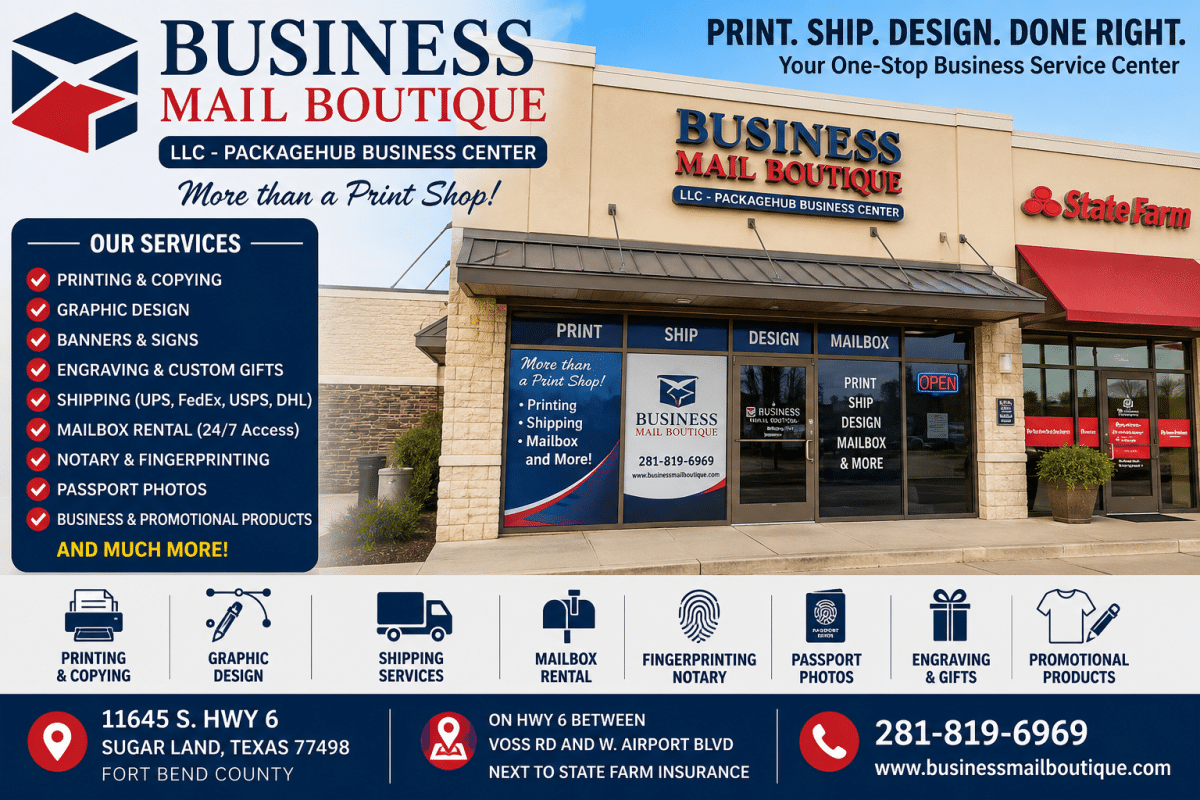
A local shop can also handle more than traditional marketing materials. Business Mail Boutique LLC, for example, offers same-day business cards, flyers, banners, posters, yard signs, decals, photo prints, and wide-format engineering blueprints in Sugar Land. That matters for businesses that want one place for both customer-facing materials and day-to-day operational print needs.
Build a print mix instead of ordering in isolation
A business grows faster when its print materials work together. A card leads to a brochure. A yard sign supports a landing page. A banner pulls people toward the table where your flyers and sign-up sheet are waiting.
That’s the difference between ordering products and building a print system. One is reactive. The other supports sales, events, operations, and retention at the same time.
Preparing Your Files for Perfect Prints
Most disappointing print jobs don’t fail on the press. They fail before production starts. The logo was pulled from a website. The background image looked fine on a phone but printed soft. The file had no bleed, so the trim cut too close. These are common problems, and they’re fixable.
A good file doesn’t need to be fancy. It needs to be production-ready.

The files print shops actually want
For most business printing, a press-ready PDF is the safest handoff. It locks in layout better than editable office files and reduces font problems. Native design files from Adobe Illustrator, InDesign, or Photoshop can also help when edits are still in progress, but they need to be packaged correctly.
The files that cause trouble most often are Word documents, PowerPoint slides, screenshots, and logos copied from websites. Those formats may be fine for internal review. They’re often not fine for final production.
Use this checklist before you send artwork:
- Match the final size: Build the document at the actual trim size.
- Keep logos sharp: Use vector art when possible for logos and icons.
- Embed or outline fonts: Don’t assume the print shop has the same font files you do.
- Export carefully: A high-quality PDF is usually the safest final format.
Why color mode bleed and image quality matter
Screen color and print color don’t behave the same way. Files designed in RGB can shift when converted for print. That doesn’t mean the job is wrong. It means the screen was showing light, while print uses ink on a surface. If color precision matters, ask for a proof and set expectations before production begins.
Bleed matters too. It’s the extra image area that extends past the trim line so you don’t get thin white edges after cutting. Safety margin is the opposite concern. Keep text and logos away from the cut edge so they don’t end up looking cramped or getting clipped.
This is one of those technical areas where expert review earns its keep. In screen printing, halftone screen angle choices affect gradients and visual interference, and clean output often depends on testing with the actual setup, as discussed in this halftone printing article from T-Biz Network. Different process, same lesson. Small technical decisions change the final result.
A quick visual walkthrough can help before you approve files:
Use a proof before you approve production
Proofing is where you catch the expensive mistakes. Not after pickup.
Check phone numbers, suite numbers, URLs, event dates, and QR codes one more time. Design errors matter, but contact errors are the ones that usually waste a full run.
Also check alignment, margins, fold panels, and image crop. A proof won’t fix every upstream design issue, but it gives you one clean chance to catch what your eye skipped over on screen.
Choosing Materials and Finishes That Impress
A Sugar Land business owner ordering postcards for a Saturday community event has a different job than someone restocking forms for the front desk. One piece needs to catch attention fast. The other needs to hold up to daily use and stay easy to write on. Good material choices start with that real-world job, not with a sample book full of nice-looking options.
Customers judge print with their hands before they read a word. Paper weight, surface feel, stiffness, and finish all shape whether your brand feels polished, practical, premium, or forgettable.

Paper changes the message
Paper stock sets expectations right away. Lightweight flyer paper works well for door drops, trade show handouts, and short-term promotions where volume matters more than durability. Heavier cardstock fits pieces that represent your business one-on-one, like business cards, appointment cards, presentation covers, and leave-behind postcards for sales visits.
Surface matters just as much.
Coated stock gives photos and color blocks a cleaner, sharper look. Uncoated stock feels more natural and is usually the better choice when customers or staff need to write on the piece. Textured options like linen or felt can add personality, but they also affect legibility, color accuracy, and cost. I usually tell SMB owners in Sugar Land to match texture to the brand and the setting. A boutique may benefit from a tactile finish. A medical office or contractor often does better with something clean, readable, and durable.
Finishes should support the job
The finish should make the piece easier to use and more effective in the field.
- Gloss: Strong for colorful mailers, photo-heavy flyers, and promotional pieces that need visual punch.
- Matte: Better for readability, a more restrained look, and pieces handled under office or retail lighting.
- Lamination: Helps menus, price sheets, signage, and other frequently handled items last longer.
- Writable coatings or uncoated stocks: Best for appointment cards, estimate forms, loyalty cards, and anything that needs notes.
A bad finish creates friction. Gloss can throw glare under lobby lights. Soft-touch can look great on a premium card, but it may not fit a high-volume handout. Lamination adds durability, but it also adds cost and can slow turnaround on rush jobs. If you may need reprints for a local event with little notice, a simpler spec can be the smarter business decision. Shops that handle same-day printing for urgent business needs usually have to balance speed against more specialized finishing.
Durability starts with the material itself
Paper is only part of the conversation. Banners, window decals, labels, yard signs, countertop displays, and promotional products all depend on choosing the right substrate for the environment. Indoor signage has one set of demands. Outdoor signage in heat, humidity, and rain has another.
Start with a few practical questions. Will this sit in direct sun? Will customers touch it every day? Does it need to resist moisture, scuffing, or frequent cleaning? Is it temporary, seasonal, or meant to stay in place for months?
Those answers narrow the options quickly. A banner for a school fundraiser, a window graphic for a grand opening in Sugar Land, and a product label for shelf use should not be produced on the same material just because the artwork looks good on screen.
The best results usually come from treating your print shop like a planning partner. A good shop will tell you when a cheaper stock is perfectly fine, when a premium finish is worth paying for, and when a durable substrate will save you from replacing the piece two weeks later. That advice helps SMBs spend where it counts and avoid paying for features that do not help the job.
Navigating Turnaround Pricing and Same-Day Service
A Sugar Land business owner finds out on Thursday that turnout for Saturday’s event will be bigger than expected. The table banner is outdated, the flyers still show last month’s offer, and the signup sheets are nowhere near ready. That is when turnaround time stops being a line item and starts affecting sales, foot traffic, and how professional the business looks in person.
Print pricing is usually straightforward once you know what changes the production plan. Quantity matters. Size matters. Paper or substrate matters. Finishing matters. Speed matters too, because rush jobs often require a shop to reorder the schedule, move equipment time, and review files faster than usual.
What Affects the Price
Two jobs can look similar on screen and cost very different amounts to produce. A basic flyer run is one path. Thick cards with lamination are another. A banner that needs grommets or mounting takes a different path again. The quote reflects labor, machine time, materials, and whether the shop has room to produce it on a standard schedule or has to make space for it fast.
A useful way to judge cost is to look at the business decision behind the order:
- How many pieces will your team use before the information changes: A shorter run often makes more sense for menus, event handouts, staff sheets, or promotional pieces tied to a specific offer.
- What happens if you run out: Reordering a small batch at the last minute can cost more than ordering a practical buffer from the start.
- How will the piece be used: A handout for a one-day event and a sign that sits outside for weeks should not be priced the same way.
- Which finishing steps are part of the final product: Folding, cutting, binding, laminating, drilling, mounting, and packaging all add time and handling.
For small and mid-sized businesses, the cheapest quote is not always the lowest real cost. If a piece has to be reprinted because the quantity was too tight or the turnaround was unrealistic, the original savings disappear quickly.
When Same-Day Service Is Worth Paying For
Same-day service makes sense when the printed piece supports a near-term business goal. Community events in Sugar Land are a good example. A sponsor gets added late. A vendor booth needs updated signage. A restaurant changes prices before a weekend rush. A realtor needs open house signs before traffic starts. A contractor wants door hangers ready for a neighborhood push after weather clears.
In those cases, local service has practical value. Fast file review helps catch problems before they turn into a wasted run. Pickup is easier to control than shipping. A quick phone call can settle questions about size, stock, or finishing in minutes. For businesses weighing whether a rush order fits the moment, this guide to same-day printing for urgent business needs gives a useful framework.
Same-day printing is most valuable when a delay would cost you an opportunity, not just when planning ran late.
The smart move is to match the job to the deadline. If the event starts tomorrow, a simpler spec with a fast turnaround often serves the business better than a more polished option that arrives too late. That is one reason a good local print shop does more than take orders. It helps SMBs in Sugar Land choose the version of the job that can be produced on time, within budget, and with the least risk.
How to Choose Your Sugar Land Print Partner
The wrong way to choose a printer is by asking only one question. “What’s your price on 500 flyers?” That question matters, but by itself it doesn’t tell you much.
A useful print partner helps you avoid mistakes, not just submit orders. They catch low-resolution logos. They point out when a fold will land on copy. They ask where the banner will hang, whether the sign will be indoors or outdoors, and whether the quantity makes sense for the campaign. That kind of guidance is worth more than a small difference in unit cost.
Ask better questions before you place the job
When you’re comparing shops in Sugar Land, ask questions that reveal how they work.
- Can they handle both quick jobs and repeat jobs: You want someone who can print a rush banner today and support a larger recurring need later.
- Do they review files before production: A shop that flags issues early can save you from paying for avoidable reprints.
- Do they offer multiple print categories: It helps when one provider can handle cards, flyers, signs, blueprints, and finishing instead of sending you to different vendors.
- Is pickup convenient for your schedule: Local convenience matters when your team is juggling events, shipping, and customer appointments.
Choose a partner not just a machine
The best local relationship is practical. You don’t need a sales speech. You need someone who can tell you, plainly, when digital is enough, when a heavier stock is worth it, when same-day is realistic, and when your file needs work before the job should go on press.
That matters even more for growing businesses. As your needs expand, printing starts to overlap with shipping, fulfillment, signage, direct handouts, mailbox needs, and event logistics. A shop that understands how those services connect can be easier to work with over time than a vendor that only handles one narrow category.
The goal isn’t to find a shop that says yes to everything. It’s to find one that gives accurate advice, produces consistently, and helps you choose the right print piece for the actual business problem in front of you.
If you need a local place in Sugar Land that can handle printing alongside shipping, mailbox, and office-service needs, Business Mail Boutique LLC offers one-stop support for business cards, flyers, banners, posters, yard signs, decals, blueprint printing, and more. For small businesses juggling deadlines, walk-in needs, and day-to-day operations, having those services in one storefront can simplify a lot of moving parts.

Related posts
The Sugar Land Print Shop Guide for Businesses
The Sugar Land Print Shop Guide for Businesses
You’re probably here because something is due soon. The networking event is tomorrow. T...
Same Day T Shirt Logo Printing in Sugar Land
Seeking same-day T-shirt logo printing services in the Sugar Land area? Look no further than PackageHub 360, conveniently situated insi...