
- Print Business Cards in Sugar Land – Same Day Service
- Copying Services
- Document Printing, Finishing & Lamination in Sugar Land
- Flyers
- Print Banner in Sugar Land | Same-Day Banner Printing Near Me
- Graphic Design
- Photo Printing
- Postcard Printing
- Document Printing
- EDDM Full Service Postcards
- FotoZoomer Large Format Printing



Heat Transfer Printing a Guide to Custom Apparel and Gifts
11645 S. Hwy 6
Sugar land, Texas 77498 United States (US)
Email: info@businessmailboutique.com
Route
You might be here because you need branded shirts for a staff event, a handful of polos for a new team member, custom tote bags for a local fundraiser, or one polished gift that looks more professional than something bought online at the last minute. You know what you want the item to do. Look sharp, match your brand, and hold up in real use. What’s less obvious is which print method makes sense when your order isn’t massive.
That’s where heat transfer printing usually enters the conversation. It’s one of the most practical options for short runs, personalized pieces, and designs that would be awkward or inefficient with traditional mass-production methods. For a small business owner, that matters. You don’t want to pay for a process built for volume if your actual need is a limited batch done well.
The tricky part is that “heat transfer” gets lumped together with everything from basic craft iron-ons to professional commercial decoration. Those are not the same thing. A shop using calibrated equipment, tested materials, and repeatable press settings can produce a very different result from a home setup.
Table of Contents
- What Is Heat Transfer Printing
- The Main Methods of Heat Transfer Printing
- Suitable Materials and Garments
- The Production Process from Start to Finish
- Pros and Cons of Heat Transfer Printing
- Care Instructions and Troubleshooting Common Issues
- When to Choose Heat Transfer Printing for Your Project
What Is Heat Transfer Printing
Heat transfer printing is a print method that uses heat and pressure to move a design onto a surface such as a shirt, tote bag, hat panel, or promotional item. If you want a simple mental model, think of it as a professional, highly controlled version of an iron-on. The difference is the equipment, the materials, and the consistency.
In a commercial setting, the design is first prepared on a transfer material or film. Then a heat press applies the design to the final item using carefully controlled settings. That control matters because the press has to deliver the right combination of temperature, time, and pressure for the transfer to bond properly.
This isn’t a new or experimental idea. Heat transfer printing has roots in the late 19th and early 20th centuries, and a major milestone in the related thermal-transfer field came in 1981, when SATO produced the world’s first thermal-transfer label printer, the M-2311, helping move heat-based transfer into viable commercial workflows, as noted in this history of heat printing.
Heat transfer printing is often the method people choose when they need customization without the overhead of a large production run.
For buyers, the practical takeaway is simple. Heat transfer printing is less about one single product and more about a family of methods. Some transfers are best for names and numbers. Some handle detailed logos better. Some are ideal for polyester performance wear or hard goods like mugs and plaques. The service provider’s job is to match the artwork and item to the right transfer type, so the finished piece looks intentional rather than improvised.
The Main Methods of Heat Transfer Printing
Not all heat transfer printing works the same way. If you’re ordering custom apparel or promotional pieces, the method shapes how the print looks, how it feels, and what materials it can go on.
A simple way to think about the options
Heat Transfer Vinyl (HTV) is usually the cleanest choice for simple graphics. Think names on jerseys, bold one-color logos, basic shapes, and straightforward lettering. The material is cut from colored vinyl and then pressed onto the garment. It tends to produce a defined, graphic look. On fabric, you can usually feel it.
Digital transfers are better when the design has multiple colors, gradients, small details, or photo-like artwork. This is the option many buyers end up needing when their logo isn’t just one flat color. It gives more flexibility with complex art, especially for short runs where traditional setup-heavy methods don’t make sense.
Sublimation works differently from the methods above. Instead of laying a design on top of the item, it transfers dye into the surface. That’s why it’s often favored for polyester apparel and coated hard goods. On the right product, the finish can feel very natural because the image becomes part of the material. If you want a deeper look at that category, this guide to sublimation printing is a useful reference.
Screen-printed transfers sit somewhere in the middle. They combine the familiar visual style of screen printing with the convenience of applying a transfer later by heat press. For some business orders, that can be a smart fit when you want a classic printed look but need the flexibility of transfer application.
One related technology worth knowing about is thermal-transfer printing for labels and barcodes. That’s a ribbon-based process where a heated print head melts wax, wax-resin, or resin ink from a ribbon onto a substrate. Because the image is bonded to the receiving surface, it’s often preferred for durable labels and high-quality barcodes used in shipping, inventory, and identification, as described in Wikipedia’s thermal-transfer printing overview. It’s not the same as garment decoration, but it helps explain how broad the heat-transfer family really is.
Heat transfer method comparison
| Method | Best For | Feel on Fabric | Durability | Material Compatibility |
|---|---|---|---|---|
| HTV | Names, numbers, simple logos, bold graphics | Noticeable surface feel | Good when matched to the right garment and applied correctly | Broad fabric compatibility |
| Digital Transfers | Full-color logos, detailed artwork, small custom runs | Varies by transfer type and artwork coverage | Good, with results tied closely to application quality and care | Broad compatibility across many apparel items |
| Sublimation | Polyester garments and coated hard goods | Very soft or nearly unnoticeable on suitable substrates | Strong on the right substrate because the image becomes part of the surface | Best on polyester and compatible coated items |
| Screen-Printed Transfers | Orders that want a familiar printed look with transfer flexibility | Depends on ink coverage and design structure | Good when properly produced and applied | Commonly used on apparel and promotional goods |
Practical rule: Don’t choose the method by name alone. Choose it by the item, the artwork, and how the finished piece needs to feel in real use.
For small businesses, that decision usually comes down to this. If your design is simple, HTV may be enough. If your logo has color variation or fine detail, digital transfers are often the safer route. If you want decorated polyester activewear or branded mugs, sublimation may be the better fit. A good print shop should ask questions before recommending a method.
Suitable Materials and Garments
A shirt that looks perfect in a mockup can become a poor fit for heat transfer if the fabric, shape, or surface texture work against the design. For a small business placing an order, this is one of the biggest buying decisions. The right item helps your logo look clean, last well, and feel appropriate for how the piece will be used.
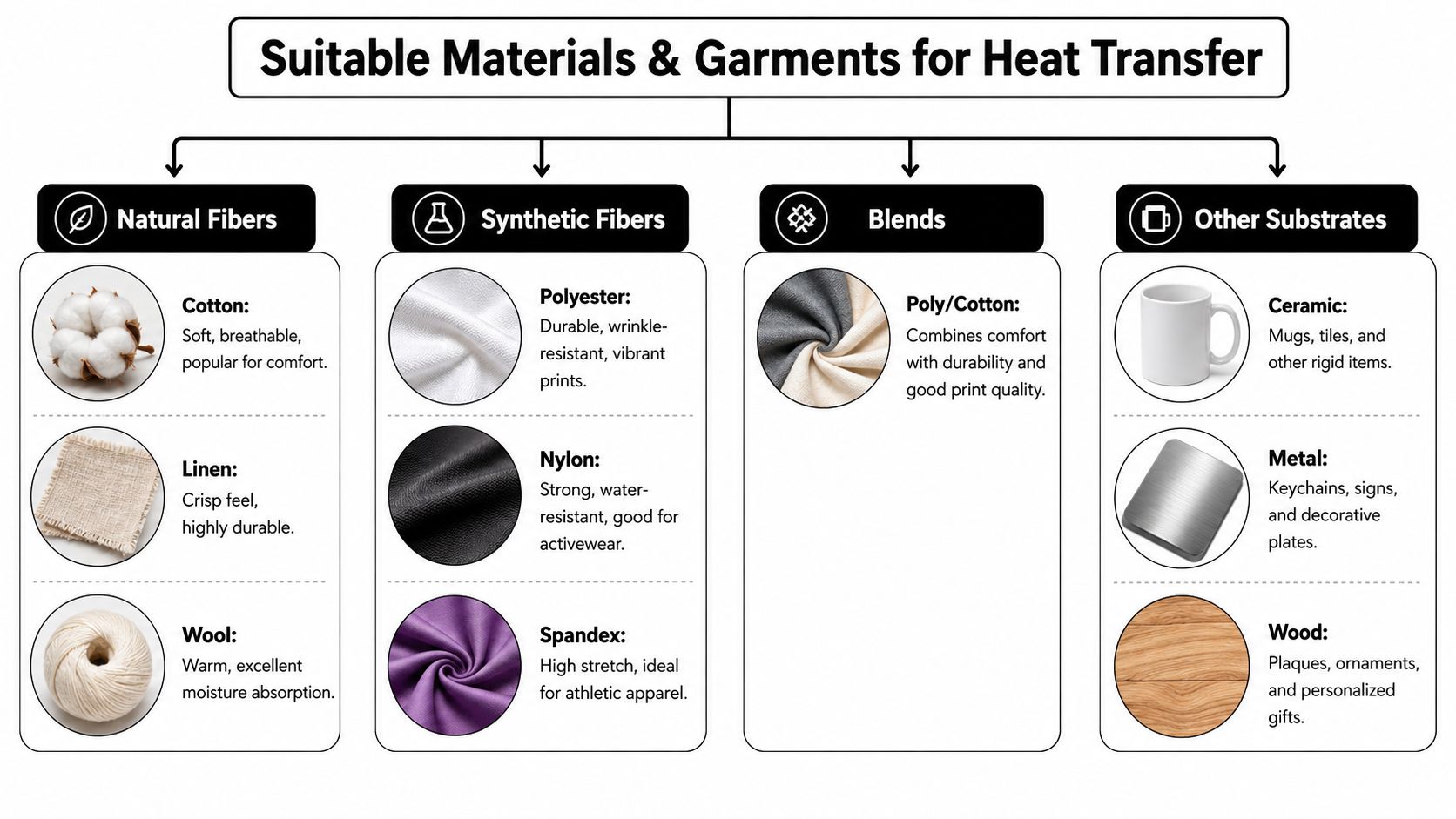
Fabrics people ask about most
Cotton shirts are often the safest starting point for staff tees, event apparel, and everyday branded merchandise. Cotton is familiar, comfortable, and generally forgiving across many transfer types. If your goal is a shirt people will wear casually after the event, cotton is often a practical choice.
Polyester garments need closer attention. Performance polos, athletic shirts, and moisture-wicking uniforms are popular with businesses, but polyester reacts to heat differently than cotton. That does not make it a bad option. It means your print provider should match the transfer method and press settings to the garment, especially if you want crisp branding on activewear or team pieces.
Blends sit in the middle. A cotton-poly shirt often gives you some of the softness of cotton with better wrinkle resistance and shape retention. For many organizations ordering uniforms, fundraiser apparel, or promotional wear, blends strike a good balance between comfort, appearance, and budget.
Fabric texture matters too. A smooth fashion tee gives a transfer a flatter surface to bond to. A fleece hoodie, ribbed knit, or heavily textured item can change how edges sit and how fine detail appears. If your logo includes small text or thin lines, ask your shop whether the garment surface supports that level of detail before you approve the order.
Special effects can also change the buying decision. Metallic and reflective finishes are useful for fashion drops, promotional campaigns, or designs that need extra contrast under light. For example, Embellish heat transfer foil shows the type of foil finish sometimes used for accent graphics. It looks striking, but it is usually best as a deliberate design choice rather than the default for a company logo.
Beyond shirts and hoodies
Heat transfer printing works on more than basic tees, but each item brings its own limitations.
- Tote bags: A strong option for retail add-ons, conference giveaways, school programs, and community events. Canvas and similar fabrics often suit simple branding well.
- Hats: Caps can be excellent for uniforms and merch, but curved panels, seams, and front structure affect placement and method choice. Shops that offer custom hats with logo can review whether your artwork is better suited to the front, side, or back of the hat.
- Mugs and rigid gift items: These usually call for substrates made for heat decoration, often with coatings designed to accept the image.
- Signs and promotional pieces: Some heat-based decoration methods also work on specialty promotional products, as long as the surface is compatible.
A simple way to judge fit is to start with use, not print terminology. Ask what the item needs to do. Will staff wear it all day? Will customers wash it often? Does it need a polished retail look, or is it meant for a one-day event?
That approach helps a professional printer guide you to the right blank before production starts, which saves time, avoids mismatched expectations, and leads to a better finished product.
The Production Process from Start to Finish
You approve a mockup for staff shirts on Tuesday and need the finished order to look consistent by the event. From your side, the process should feel simple. Send the logo, confirm the details, and receive apparel that looks clean and uniform. The shop, however, has several checkpoints to get right before a single shirt goes under the press.
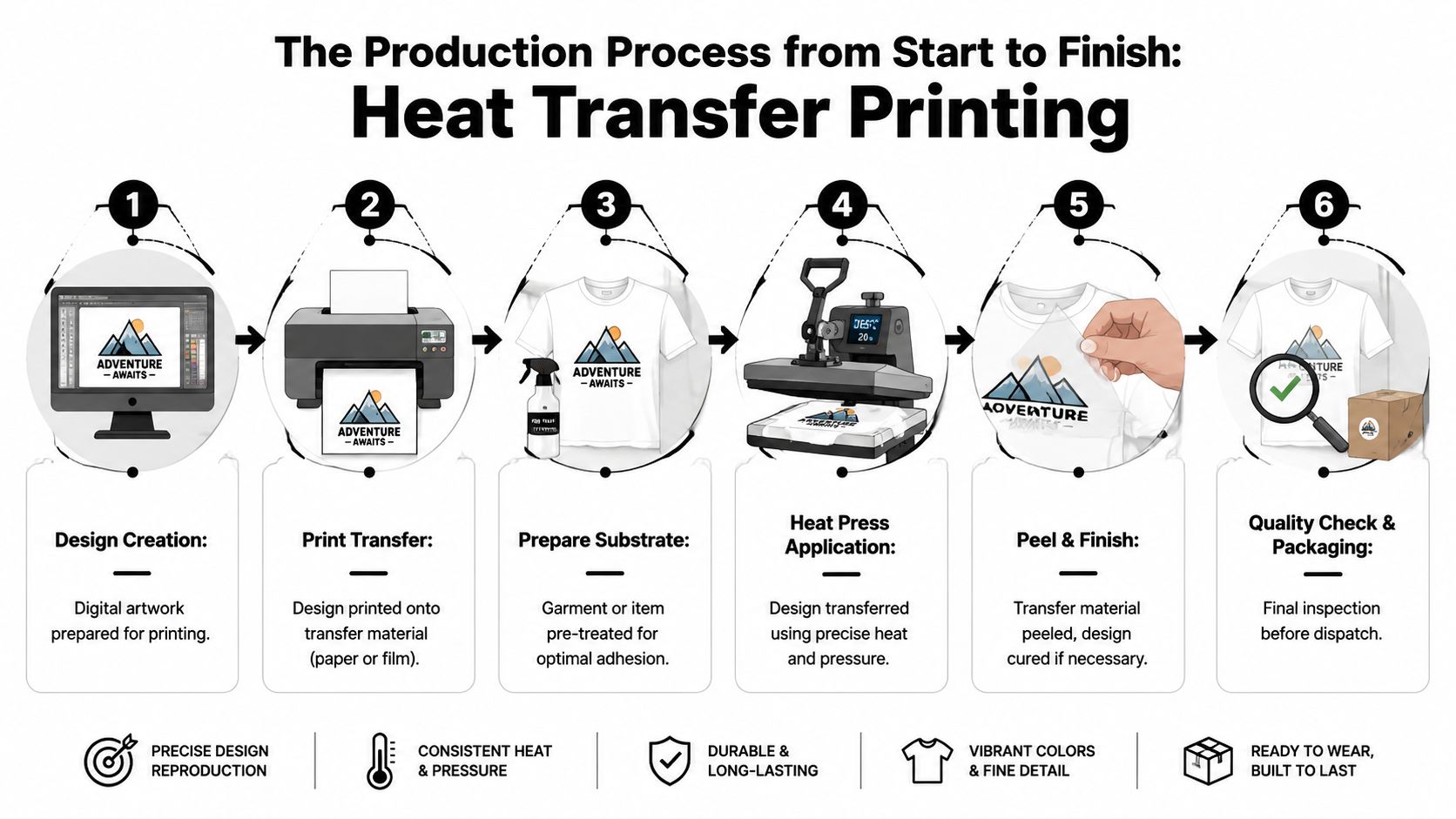
What happens before the press closes
The first checkpoint is artwork review. A professional printer checks file quality, print size, line thickness, text legibility, and any effects that may not reproduce well on fabric. Small business buyers often run into trouble here because a logo that looks sharp on a website may be too low-resolution for apparel. If you want a quick explanation of why that happens, this guide on what 300 DPI means for sellers gives a useful plain-English overview.
Next, the shop prepares the transfer itself. That can mean printing onto transfer film, cutting heat transfer vinyl, or producing a screen-printed transfer sheet. Some methods also require weeding, which is the removal of extra material around the design, similar to peeling away the backing around a sticker so only the intended shape remains.
Then the garment is prepped. Shops often pre-press the item for a few seconds to flatten the surface and remove moisture. It sounds like a small step. It prevents a surprising number of problems, including wrinkles under the design, lint trapped in the print area, and uneven contact during pressing.
Where professional quality shows up
Pressing is the stage where consistency is won or lost. Heat transfer printing depends on three settings working together: temperature, time, and pressure. If one is off, the transfer may not bond correctly, the fabric can scorch, or the print may peel sooner than expected. A good shop treats those settings like a recipe that has to match both the transfer type and the garment.
For polyester garments, some transfer products call for settings in the range of 325 to 335°F for 10 to 12 seconds with medium to firm pressure, as noted earlier. Those details matter because polyester reacts differently than cotton, especially on performance wear used for teams, staff uniforms, and branded event apparel.
After the press cycle, the carrier sheet may need to be peeled while hot, warm, or cool, depending on the product being used. The item is then checked for alignment, edge adhesion, surface finish, and overall appearance. That final inspection is where a shop catches small issues before they become a full-box problem for the customer.
For business orders, the best results usually start before production day. A provider with experience in professional t-shirt printing services can review your logo, garment choice, order size, and intended use together, which helps you avoid preventable mistakes and get a result that fits the job the apparel needs to do.
A polished order usually comes from routine shop habits. File checks, test applications, and calibrated equipment protect quality long before the finished shirts are folded and packed.
Pros and Cons of Heat Transfer Printing
Heat transfer printing solves real business problems, but it isn’t automatically the best answer for every order. The value comes from knowing where it performs well and where tradeoffs show up.
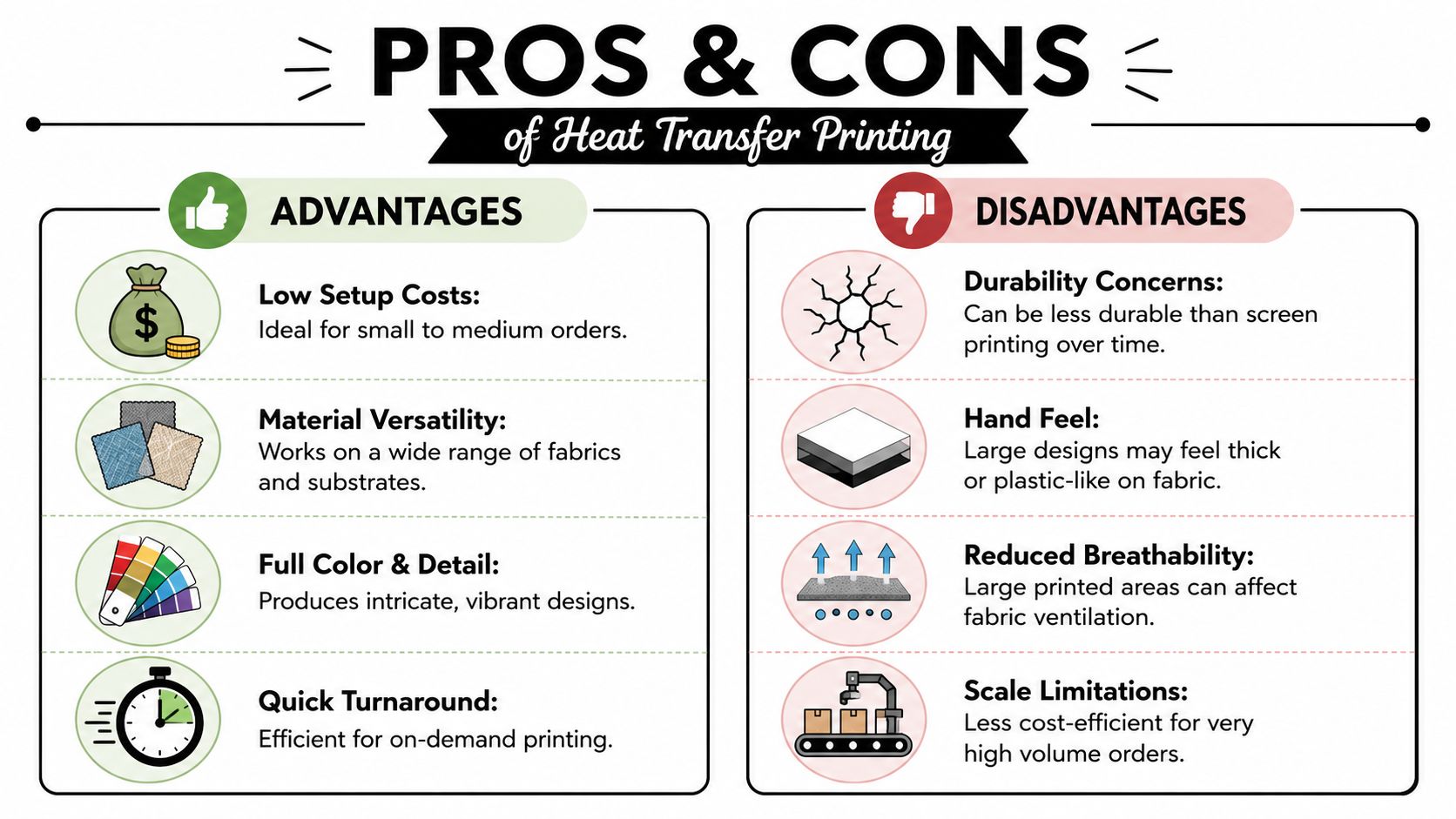
Where heat transfer printing shines
For many buyers, the biggest strength is flexibility. You can order a small batch, personalize names or departments, and decorate a mix of items without committing to a large production model. That makes heat transfer especially practical for staff uniforms, event runs, seasonal promotions, and gift items.
It also handles design complexity well. If your logo has multiple colors, gradients, or fine detail, transfer-based methods can often reproduce it more easily than methods built around simpler spot-color production.
Another advantage is speed in the buying process. Because many transfer methods avoid the kind of setup associated with traditional mass-production printing, they’re often a strong fit when you need a short run turned around efficiently.
Where buyers should be careful
The most common concern is hand feel. Some transfers feel soft and refined. Others feel heavier, especially when the artwork includes large solid blocks of color. That’s not just about the machine. It’s often about the transfer type and the structure of the design itself.
According to Anatol’s guide on getting softer prints with heat transfers, softer results usually depend on transfer choice and artwork decisions such as using more negative space or distressed elements instead of large dense fills. That’s an important buying point if you’re ordering retail-style apparel rather than basic event shirts.
You should also think about scale. Heat transfer printing is often excellent for smaller or customized orders, but if you’re producing very large runs of one simple design, another method may be more efficient.
A balanced way to evaluate the method is to ask these questions:
- How many items do you need: If the run is small or personalized, heat transfer is often a practical fit.
- How detailed is the artwork: Complex logos and full-color art often lean toward transfer methods.
- How important is softness: If hand feel is a top priority, ask to see samples and discuss design coverage.
- What will the items go through: Uniforms, team gear, and promotional pieces may have different wear expectations.
A good order isn’t just about getting the logo onto the item. It’s about matching the decoration method to how the item will actually be worn, washed, and judged by the person receiving it.
Care Instructions and Troubleshooting Common Issues
Once the items are delivered, proper care helps protect the print and the garment. Even a well-produced transfer can wear out early if it’s washed roughly or exposed to too much heat.
How to help the print last
Use these habits unless your print provider gives item-specific instructions:
- Wait before the first wash: Give the print time to fully settle after production.
- Turn garments inside out: That reduces abrasion against other items in the wash.
- Use cold water: Cooler washing is gentler on both fabric and transfer.
- Skip harsh chemicals: Bleach and aggressive detergents can shorten print life.
- Dry on low or hang dry: High dryer heat is hard on decorated garments.
These steps are simple, but they make a difference for branded apparel that needs to stay presentable beyond the first few wears.
What common problems usually mean
If you see peeling edges, the issue may come from either poor care after purchase or poor application during production. Transfers need even contact and proper pressing conditions to bond well.
If the design looks crooked or inconsistent across a batch, that points to placement control rather than artwork quality. Professional troubleshooting often involves folding transfers to find center and using garment seams as guides, as shown in this alignment and placement troubleshooting video. Those habits are one reason shop-applied work tends to look more consistent than casual DIY results.
If the print starts to crack or feel rough sooner than expected, ask two questions. Was the item cared for correctly, and was the design overly dense for the garment type? Large solid graphics can feel heavier and may show wear differently than lighter, more open artwork.
If there’s discoloration or partial adhesion, the cause can be press-related. Some machines develop pressure inconsistencies or cold spots, which means one area of the platen may not perform like another. That’s why reliable shops test equipment instead of assuming every area of the press behaves the same way.
When to Choose Heat Transfer Printing for Your Project
Heat transfer printing makes the most sense when your project needs customization, flexibility, or a shorter run. If you’re ordering apparel for a small staff, a church group, a school club, a pop-up event, or a limited promotional campaign, it often fits the job well.
It’s also a strong choice when the artwork is too detailed for a basic one-color treatment. Full-color logos, small-batch name personalization, and mixed-item orders are where heat transfer printing often earns its place. The method became commercially important because it’s economical for small orders and custom one-off designs, especially when traditional mass-production approaches aren’t financially practical, as explained in this overview of thermal printing’s evolution.
What matters most is matching the process to the project, not forcing the project into a familiar process. If you only need a limited quantity, need multiple names or versions, or want different items under one visual identity, heat transfer printing is often the more sensible route.
For buyers, the smart next step is to bring practical details into the conversation. Show the logo. Name the garment. Explain who’ll wear it and how. That lets a professional recommend a transfer method based on use, not guesswork.
If you’re ready to order custom apparel, promotional items, or personalized gifts, Business Mail Boutique LLC can help you choose the right decoration method for the job. Their Sugar Land team handles professional printing, branded products, and custom gift services in one place, so you can get practical guidance, fast turnaround, and finished pieces that look ready for business.

Related posts

Custom Memorial Glasses Engraved in Three Hours in Sugar Land
When a customer needed eight personalized glasses for a memorial, Business Mail Boutique completed the engraving or...

Custom Martini Glass Engraving in Sugar Land, TX
Custom Logo Engraving on Martini Glasses in Sugar Land, Texas.
Business Mail Boutique recently completed a beautiful custom engravin...

Custom Engraved Wine Glasses for a Golf Club Event in Sugar Land, TX
Custom Engraved Wine Glasses for a Golf Club Event in Sugar Land.
Custom wine glass engraving in Sugar Land, TX at Business Mail Bouti...