
- Print Business Cards in Sugar Land – Same Day Service
- Copying Services
- Document Printing, Finishing & Lamination in Sugar Land
- Flyers
- Print Banner in Sugar Land | Same-Day Banner Printing Near Me
- Graphic Design
- Photo Printing
- Postcard Printing
- Document Printing
- EDDM Full Service Postcards
- FotoZoomer Large Format Printing


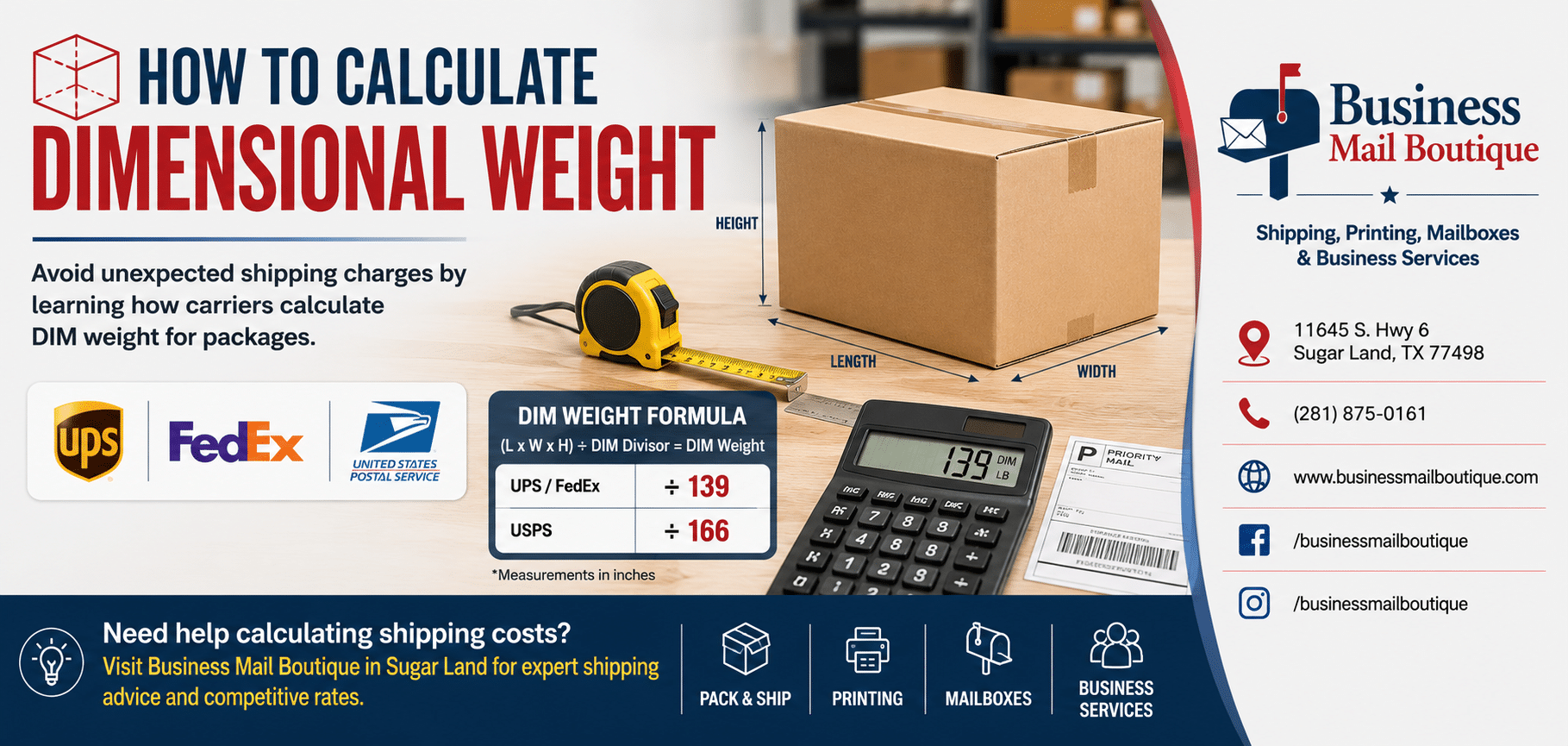
How to Calculate Dimensional Weight
Learn how to calculate dimensional weight with our simple guide. Find carrier divisors (UPS, FedEx, USPS), see examples, and avoid surprise shipping fees.
Businessmailboutique
11645 S. Hwy 6
Sugar land, Texas 77498 United States (US)
Email: info@businessmailboutique.com
Route
You box up an order, weigh it, buy the label, and feel done. Then the carrier invoice lands and the shipment somehow “weighed” more than the scale said it did.
That surprise usually comes from dimensional weight, not a bad scale reading. If you run a small business, ship online orders, or send returns regularly, learning how to calculate dimensional weight is one of the fastest ways to stop avoidable shipping fees. It’s also one of the most misunderstood parts of parcel shipping because the box’s size can matter just as much as the number on the scale.
Most guides stop at the formula. That’s not enough in real shipping. You also need to know how carriers measure, when DIM rules apply, where people make expensive mistakes, and when it’s smarter to get hands-on help locally instead of guessing.
Why Your Package Weighed More on the Bill
Carriers don’t price every package by actual weight alone. They also price for space used in the truck or aircraft. A box of pillows may be light, but it still takes up room that could have held other freight. That’s why a shipment can bill higher than expected even when your scale reading looks right.
This matters most when you ship items that are light, soft, or oddly sized. Think apparel in oversized cartons, gift baskets, décor, bedding, marketing kits, or boxed items with a lot of empty fill. The package isn’t heavy in the usual sense, but it occupies valuable cubic space.
Practical rule: If a box feels “too light for its size,” check dimensional weight before you buy the label.
The surprise often hits after the carrier scans the package with its own equipment. If your measurements were off, or if the box bulged outward after packing, the billed weight can change after drop-off. For many small businesses, that’s where margins disappear. One shipment isn’t a disaster. Repeated across weekly orders, it becomes a pattern.
A lot of owners also assume they can solve this by bargain hunting on rates alone. Better rates help, but box choice and measurement discipline usually matter first. If you’re trying to lower parcel costs locally, this Sugar Land guide to shipping packages for less is useful because it focuses on the practical side, not just label prices.
Why dimensional weight exists
Dimensional weight is the carrier’s method for charging based on package volume. In plain terms, the carrier compares two numbers:
- Actual weight from the scale
- Dimensional weight from the package size formula
The higher of the two becomes the billable weight.
That’s why a big lightweight carton can cost more than a compact heavy one. Once you understand that, the rest of the process gets much easier to manage.
The Core Formula for Dimensional Weight
The formula itself is simple. What causes problems is how people measure the box before using it.
Measure the package the way carriers do
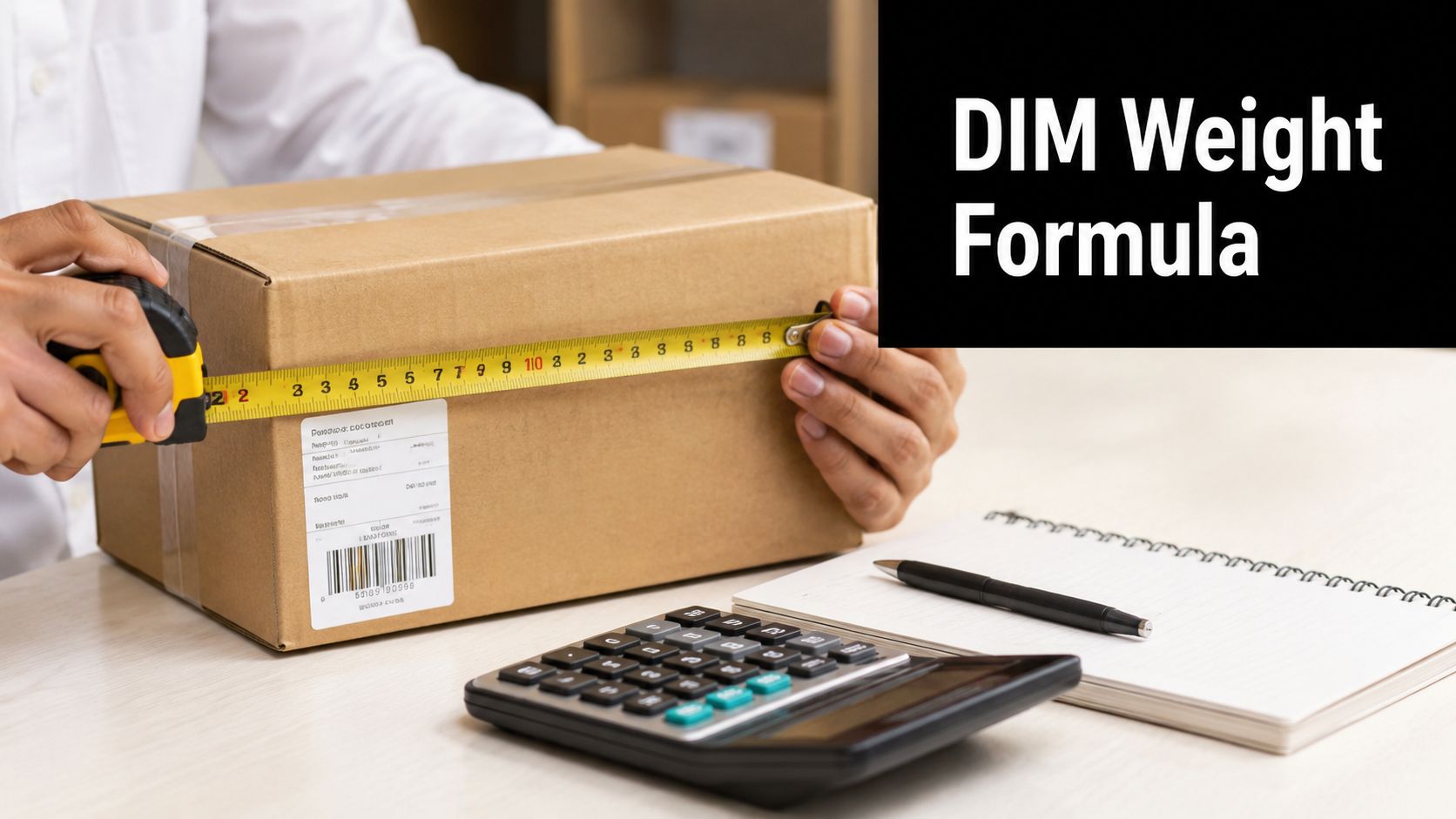
The correct method is to measure length, width, and height at the package’s absolute extremes in inches, round each measurement to the nearest whole number, then multiply those dimensions before dividing by the carrier’s DIM divisor, as explained in this dimensional weight calculation guide.
The phrase “absolute extremes” carries particular weight. You don’t measure the printed box size from the manufacturer. You measure the packed shipment as it sits in front of you. If one side bows out, that bulge counts. If tape or overstuffing changes the shape, that counts too.
Use this order:
- Measure the longest side of the packed box for length.
- Measure the next side for width.
- Measure top to bottom for height.
- Round each one to the nearest whole inch before multiplying.
- Multiply L × W × H to get cubic inches.
- Divide by the correct carrier divisor.
- Compare DIM weight to actual weight and use the higher number as billable weight.
Don’t round after multiplying. Round each dimension first. That’s how carrier rules are applied.
Apply the formula correctly
The working formula is:
(Length × Width × Height) ÷ DIM divisor = dimensional weight
A quick example without getting too deep into carrier-specific rules:
- Box dimensions after packing and rounding: L × W × H
- Cubic size: multiply all three
- Divide by the carrier’s divisor
- If DIM weight is higher than scale weight, that’s the number that usually bills
The most common mistakes happen before the math even starts. People use product dimensions instead of packed-box dimensions. They forget to round correctly. Or they measure a carton before adding void fill and tape, then ship a slightly larger final package.
Manual tape measurements can work, but they leave room for inconsistency. A more controlled setup gives better repeatability, especially if you ship many orders.
The measurement habits that save money
If you want fewer adjustments, keep these habits:
- Measure after sealing: Final packed shape is what matters.
- Check all edges: Slight bulges change the result.
- Write dimensions on the carton: It helps if you audit invoices later.
- Use the same process every time: Consistency beats speed when fees are on the line.
That’s the core of how to calculate dimensional weight correctly. The next piece is knowing which divisor and threshold apply to the service you’re using.
Carrier Specific Divisors and Rules
Generic advice becomes insufficient. The formula stays familiar, but the divisor and trigger rules change by carrier and service.
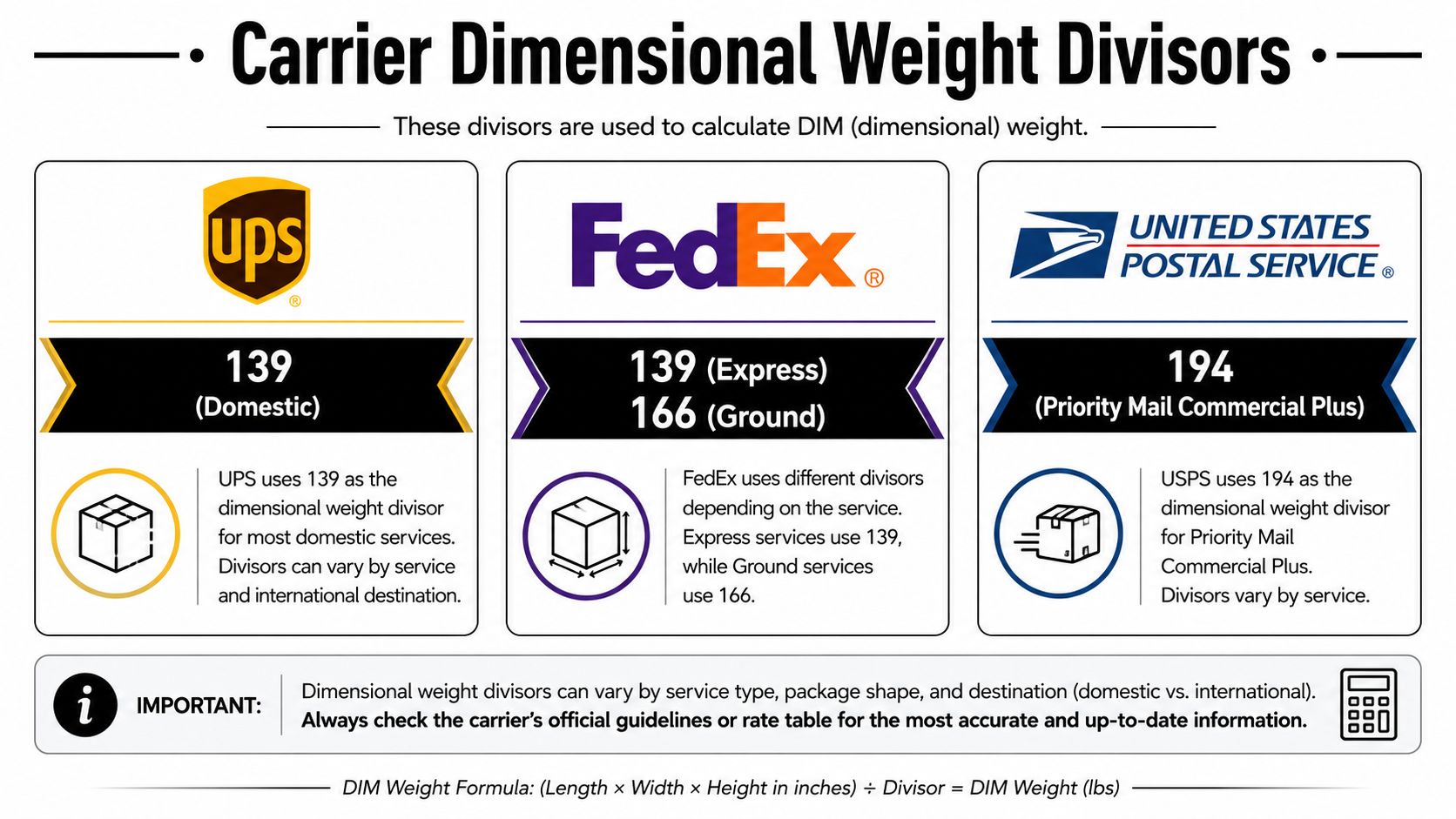
A quick comparison table
| Carrier or service context | DIM divisor | When DIM pricing applies |
|---|---|---|
| UPS | 139 | For UPS ground services, DIM pricing triggers only when cubic size exceeds 3 cubic feet (5,184 cubic inches) |
| FedEx | 139 | For FedEx ground services, DIM pricing triggers only when cubic size exceeds 3 cubic feet (5,184 cubic inches) |
| USPS domestic retail rates | 166 | USPS domestic Priority Mail packages exceeding 1 cubic foot (1,728 cubic inches) |
| USPS domestic daily rates | 194 | USPS domestic Priority Mail packages exceeding 1 cubic foot (1,728 cubic inches) |
| International air shipments | 139 | Use the carrier-specific service rules for qualification |
| USPS international | 166 | Use USPS international service rules |
The threshold detail matters. For UPS and FedEx ground, dimensional pricing doesn’t kick in until the package volume goes past 5,184 cubic inches, which equals 3 cubic feet. USPS is stricter on size trigger for domestic Priority Mail, applying DIM to packages over 1,728 cubic inches, or 1 cubic foot, based on the dimensional weight rules summarized in this carrier overview.
Where people get tripped up
The biggest assumption error is thinking one divisor applies everywhere. It doesn’t. A widely missed update is that USPS now uses 194 for domestic shipments and retains 166 for international, creating a real pricing split that many shippers miss, as noted in this dimensional weight reference.
That means the same box can calculate differently depending on destination and service type. If you mail a lot of orders, returns, or replacement shipments, that difference changes quoting, checkout expectations, and margin planning.
If you switch between UPS, FedEx, and USPS, treat DIM as a carrier rule set, not a universal formula.
Another practical issue is service selection. A package that looks expensive under one carrier’s DIM rule may be less painful under another service because of threshold differences. If you routinely compare options, this Sugar Land guide to UPS shipping helps clarify one part of that decision.
Worked Examples From a Real Shipper
The easiest way to understand dimensional weight is to run it against real package types you probably ship already.
Example one with a light but bulky item
Take a decorative throw pillow packed in a box that ends up large but not heavy. The actual weight might be low, but the package takes up a lot of room. That’s exactly the kind of shipment where DIM weight can overtake scale weight.
Let’s say you:
- pack a soft item in a roomy carton
- measure the sealed box at its outermost points
- round each dimension correctly
- divide by the right carrier divisor
If the DIM result comes out higher than the scale reading, the carrier bills the DIM number. This is common enough that 68% of e-commerce parcels are shipped as light but bulky items where dimensional weight exceeds actual weight by 2 to 8 pounds, leading to an average 12 to 18% increase in shipping costs when carriers apply DIM pricing, according to Shipwire’s overview of dimensional weight mistakes and benchmarks.
That’s why soft goods deserve extra attention. Apparel, pillows, plush products, and bedding often look cheap to ship until the carton size tells a different story.
Example two with a small dense shipment
Now flip the scenario. Ship a compact, dense item such as a textbook, machine part, or stack of printed materials in a snug box. The package volume stays modest, so DIM weight may calculate lower than the actual scale weight.
In that case, the carrier usually bills the actual weight instead. The size matters less because the package doesn’t consume much space compared with what it weighs.
The lesson from both examples is simple:
- Large and light often triggers DIM as the billing driver.
- Small and heavy often bills by actual weight.
- Same formula, different result depending on density.
Dense items reward tight packing. Bulky items punish extra air.
That’s why experienced shippers don’t just ask, “How much does it weigh?” They ask, “How much space am I paying for?”
Smart Packing Strategies to Reduce DIM Weight
The best way to lower DIM charges is to reduce wasted space without putting the product at risk. That means smarter packing, not just smaller packing.

Packing choices that usually help
Start with box selection. If you use one “standard” carton for many products, you’re probably paying to ship air. A better approach is keeping several box sizes on hand and matching the product to the smallest safe option.
Some reliable adjustments:
- Use a tighter carton: A close fit reduces empty cubic space.
- Switch to poly mailers when appropriate: Soft, non-fragile goods often don’t need a rigid box.
- Compress soft items carefully: Apparel, linens, and similar items often ship better in reduced-volume packaging.
- Match void fill to the product: Too much fill can enlarge the final shape and push dimensions outward.
If you sell online, packaging choices affect more than shipping labels. Product presentation, protection, and fulfillment speed all matter too. This expert guide for Amazon sellers on packaging is a useful companion read because it looks at packaging from the seller’s side, not just the carrier’s.
What doesn’t work
A few habits create preventable billing problems.
First, don’t rely on manufacturer box dimensions if the packed carton bulges or warps. Measuring manufacturer-box dimensions instead of actual bulged or warped package extremes causes an estimated 15 to 22% of shipments to incur unexpected charge corrections due to under-measured cubic volume, according to Shipwire’s DIM calculation guidance.
Second, don’t assume “close enough” measuring is fine. In shipping, small errors stack up. A slightly oversized box, loose fill, and a rushed tape-measure reading can push a package into a higher billed weight even when the product itself hasn’t changed.
Third, don’t buy shipping supplies with only convenience in mind. Size variety matters. If you’re reworking your supply setup, this Sugar Land guide to shipping supplies is helpful for thinking through box selection, fillers, and day-to-day packing needs.
A practical packing standard is simple: protect the product, remove excess air, and measure the final packed shape, not the box you hoped it would be.
When to Ask for Professional Help in Sugar Land
At a certain shipment volume, DIY stops being efficient. You can absolutely learn how to calculate dimensional weight on your own, but running that process correctly across daily orders, returns, custom packaging, and multi-carrier choices takes time.

Good reasons to stop doing it all yourself
Professional help makes sense when:
- Your packages vary a lot: Irregular products are harder to measure consistently.
- You’re getting invoice corrections: That usually points to a process problem, not bad luck.
- Your staff packs differently: Inconsistent methods create inconsistent costs.
- You ship gifts, returns, or fragile items: Protection and size control have to work together.
There’s also a practical limit to what small teams can keep track of. Carrier rules change, service choices vary, and international shipments add customs paperwork on top of packing decisions. If Canadian shipments are part of your workflow, this explainer on navigating Canadian customs is worth reading because border paperwork can complicate the shipping process beyond the label itself.
Where outside help matters most
Hands-on shipping support helps most when the package needs to be both safe and compact. That includes fragile retail goods, high-value items, awkward product shapes, and return shipments where the original packaging is missing.
A skilled counter team can usually spot problems fast:
- the box is one size too large
- the item could ship in a mailer instead
- the fill is creating a bulge
- the service choice doesn’t match the package profile
That kind of judgment is hard to automate with a tape measure and a browser tab. It’s especially useful for local business owners who don’t want shipping to become a second job.
If you’d rather get dimensional weight, packing, and carrier choice handled correctly in one stop, Business Mail Boutique LLC is a practical local option in Sugar Land. They offer packing, shipping, mailbox, printing, and business services, which makes them especially useful for small businesses that need hands-on help without building an in-house shipping department.

Related posts

Custom Memorial Glasses Engraved in Three Hours in Sugar Land
When a customer needed eight personalized glasses for a memorial, Business Mail Boutique completed the engraving or...

Custom Martini Glass Engraving in Sugar Land, TX
Custom Logo Engraving on Martini Glasses in Sugar Land, Texas.
Business Mail Boutique recently completed a beautiful custom engravin...

Custom Engraved Wine Glasses for a Golf Club Event in Sugar Land, TX
Custom Engraved Wine Glasses for a Golf Club Event in Sugar Land.
Custom wine glass engraving in Sugar Land, TX at Business Mail Bouti...