
- Print Business Cards in Sugar Land – Same Day Service
- Copying Services
- Document Printing, Finishing & Lamination in Sugar Land
- Flyers
- Print Banner in Sugar Land | Same-Day Banner Printing Near Me
- Graphic Design
- Photo Printing
- Postcard Printing
- Document Printing
- EDDM Full Service Postcards
- FotoZoomer Large Format Printing


Employee Recognition Awards.
Plan meaningful employee recognition awards for 2026. Explore award types, budgeting tips, ROI metrics, and how a local partner handles customization.
Businessmailboutique
11645 S. Hwy 6
Sugar land, Texas 77498 United States (US)
Email: info@businessmailboutique.com
Route
You’ve got the reminder open, the anniversary date is on the calendar, and somebody on your team just asked what you’re doing for the quarterly awards lunch. That’s usually the moment leaders realize employee recognition awards have turned into a last-minute scramble instead of a working system. If you’re pulling together plaques, certificates, or gifts on the fly, you don’t have a recognition program, you have a recurring fire drill.
The fix is simple in principle and operational in practice. Treat recognition as a program with a purpose, a budget, a presentation standard, and a fulfillment plan. Gallup’s 2024 research makes the business case bluntly, employees who receive recognition meeting at least four of five strategic pillars are nine times as likely to be engaged, 45% less likely to have turned over after two years, and 65% less likely to be actively looking or watching for another job than those getting weaker recognition Gallup research. That’s not decoration, that’s operations.
For a practical inspiration point, some teams also browse ideas beyond the usual trophy-and-plaque routine, including luxury floral rewards for top talent from Fiore. The point isn’t to make awards fancy, it’s to make them deliberate.
Table of Contents
- Why Recognition Awards Deserve a Real Strategy in 2026
- What Employee Recognition Awards Are
- The Main Award Types and When Each One Fits
- How to Choose the Right Award for the Moment
- Budgeting Recognition Awards Without Overspending
- Award Messages and Presentation Tips That Land
- Measuring the ROI of Your Recognition Program
- Working With a Local Partner for Custom Awards and Fulfillment
Why Recognition Awards Deserve a Real Strategy in 2026
The problem usually shows up the same way. A five-year anniversary sneaks up. A top performer has gone quiet. The awards banquet is two days away, and somebody is scrambling for something that will look respectable on stage. That is not a recognition strategy. It is a calendar problem with a purchasing problem attached.
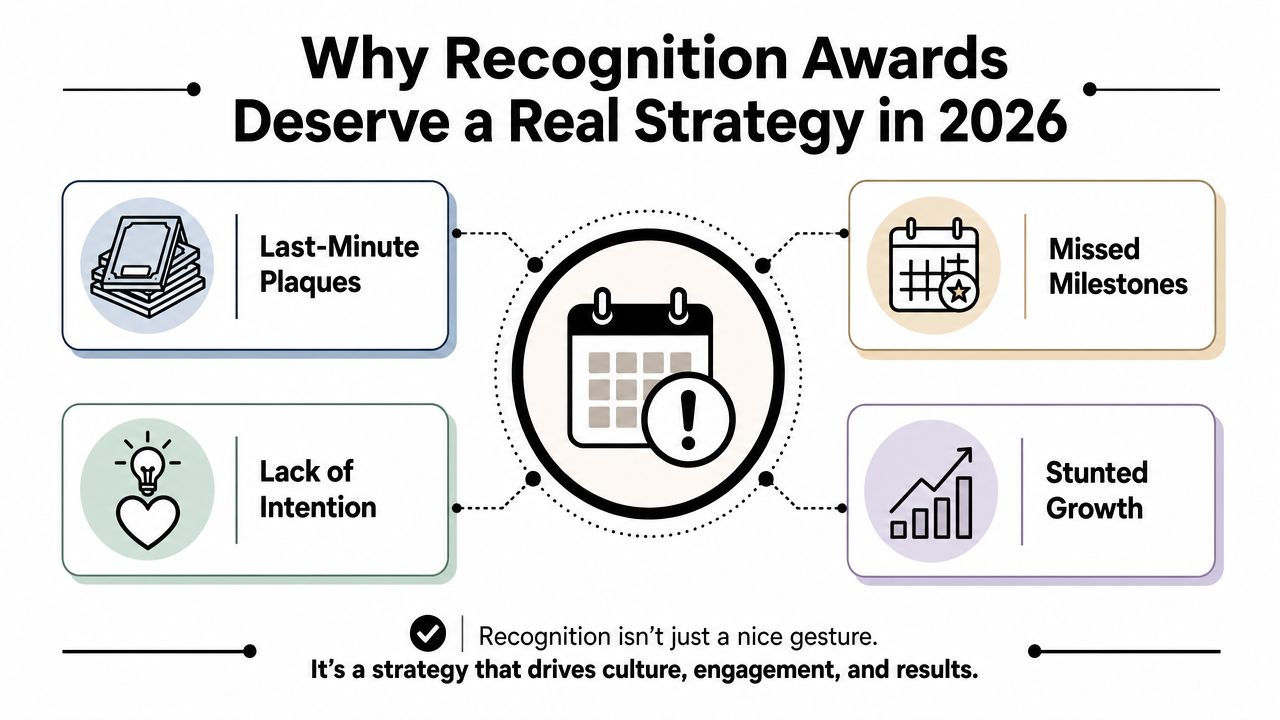
Recognition works when it’s built into the cadence
Gallup recommends recognition every seven days because infrequent praise does not stick Gallup recognition guidance. That does not mean you hand out awards weekly to the same few people. It means your recognition system needs a rhythm, so the right moment does not depend on someone remembering it at the last minute.
Practical rule: If recognition only happens at anniversaries and holiday parties, it is too thin to shape behavior.
The 2026 workforce makes ad hoc recognition look even weaker. Hybrid schedules make it harder to notice wins informally. Multigenerational teams want different forms of acknowledgment. Tight budgets mean every purchased award needs to justify itself. That is why the right framing is operational, not sentimental.
Make four decisions up front
A usable program answers four questions before the first award goes out. What do we give. Who chooses it. How much do we spend. How do we know it helped. If those answers are vague, the program will drift toward generic plaques and inconsistent treatment.
The better move is to define the moments you will recognize, then match the award to the moment. That could mean a polished plaque for a tenure milestone, a certificate for peer praise, or a branded keepsake for a culture award. For a refined option on especially formal occasions, luxury floral rewards for top talent can fit when the gesture needs to feel considered without turning into waste.
The core point is blunt. Recognition awards are not extras. They are part of how you manage engagement, retention, and visible standards. They also require design, budgeting, procurement, and measurement. If you want the physical fulfillment side handled without chaos, a local print and engraving partner is often the smartest piece of the system.
What Employee Recognition Awards Are
A workplace can hand out all kinds of things, but only some of them count as recognition awards. Bonuses belong to compensation. Perks support the employee experience. Employee recognition awards are the visible items people see, receive, and remember because they mark a specific contribution.
The four traits that make something an award
An award is tied to a specific behavior, milestone, or result. It includes a presentation moment, even if that moment is small and internal. It carries the company’s message or brand in a visible way. And it is selected with intention, not pulled from storage or sent as a last-minute email attachment.
A $15 engraved plaque handed out in front of a team often lands harder than a $200 gift card buried in a quiet email, because the plaque gives the recipient a visible story. The card is useful. The award is memorable. That difference matters because recognition is social as much as it is material.
What recognition awards are not
They are not payroll. They do not replace fair compensation. They are not the same as a private “good job” from a manager, even though private praise still matters. They are also not perks with a fancier label.
Awards should name the behavior you want repeated. If the message is vague, the award is decorative.
That line keeps leaders honest. A reward for attendance at a meeting is not an award. A reward for a sales milestone, a safety intervention, or a service anniversary belongs in recognition territory. The clearer the connection to a meaningful contribution, the stronger the award becomes.
For teams that want their awards to feel permanent and well finished, a practical resource is this laser engraving plaques, awards, and trophies guide. Finish quality is part of the signal you send. A cheap-looking plaque weakens the message, while clean engraving and solid materials make the recognition feel deliberate and worth keeping.
The Main Award Types and When Each One Fits
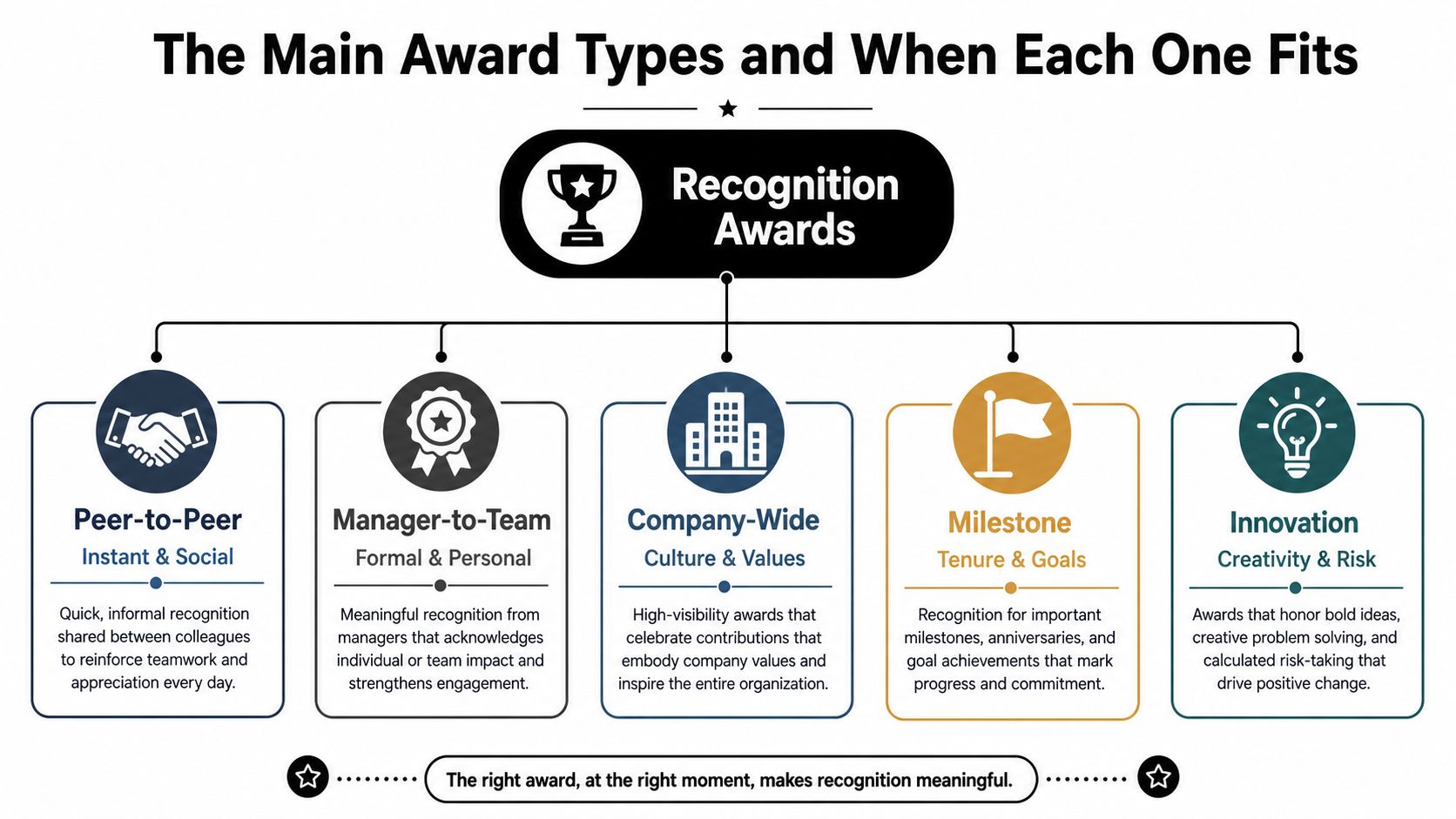
Most lists of award ideas are useless because they throw everything into one bucket. That’s not how real programs work. Different award types solve different operational problems, and if you match them badly, you get either overkill or under-recognition.
Peer and manager awards
Peer-to-peer awards work when the goal is fast, social acknowledgment. Two good examples are a handwritten kudos card from a teammate and a digital badge announced in Slack. These fit moments when the win is real but doesn’t need a formal stage.
Manager-to-team awards work when a leader wants to reinforce direction. A framed certificate at a team huddle and a branded acrylic award at a monthly meeting both fit here. They’re best when the message needs to come from leadership, not just colleagues.
Company-wide and milestone awards
Company-wide awards are for values and culture. A “customer first” trophy at an all-hands and a safety recognition plaque at a quarterly meeting tell everyone what the company respects.
Milestone and tenure awards are for time-based moments, including anniversaries and retirements. A keepsake plaque and a certificate with the start date both work when the purpose is to mark loyalty and continuity. These awards should feel durable, because the whole point is that the memory lasts.
Performance, innovation, and choice-based formats
Performance awards belong to outcomes. A sales challenge trophy and a goal-based engraved desk piece work when a result is concrete and public.
Choice-based awards fit distributed teams and mixed preferences. A curated catalog item and a physical-digital hybrid award let the recipient feel seen without forcing everyone into the same object. That flexibility matters, especially when your workforce doesn’t all sit in the same building.
A simple matching rule
If the moment is social, use something fast. If it’s formal, use something branded. If it’s tenure, make it lasting. If it’s performance, make the connection obvious. If it’s culture, make the message visible to everyone.
How to Choose the Right Award for the Moment
Choosing an award is not shopping. It’s matching. The wrong award can make a genuine achievement feel generic, and the same plaque given to everyone eventually reads as performative.
Use five filters, not one
Start with relevance. The award has to fit the achievement. A safety save and a closed deal shouldn’t get the same language or the same visual treatment.
Then look at personalization. Names, specific accomplishments, and a short manager note make a much bigger difference than people think. A plaque without a reason is just office decor.
Third is visibility. Some moments deserve a team meeting, some deserve an all-hands, and some should stay one-on-one. Public recognition is useful when it teaches the rest of the team what good looks like.
Fourth is durability. If the milestone matters, the object should last. If the win is temporary, a certificate or digital badge may be enough.
Fifth is culture fit. A flashy award in a modest company can feel off. A simple, well-made piece in a practical culture usually lands better.
Good rule: If the award could be given to anyone for anything, it’s too generic.
Two situations, two different answers
A sales rep who closes a landmark deal can handle a visible award with a sharp message, maybe a trophy or engraved plaque presented in front of the team. The point is to tie the object to the result and make the team see the standard.
A warehouse associate who prevents a safety incident needs a different tone. That recognition should be specific, credible, and respectful of the stakes. A formal award with a clear safety message often works better than something flashy, because the achievement is about judgment and care, not spectacle.
For a practical engraving partner resource, this local shop guide for plaques and trophies in Sugar Land is useful when you need the physical piece to match the moment.
Fix the authenticity gap
The most common failure is sameness. Same plaque. Same wording. Same applause. That gets read as lazy. Use a handwritten line, a manager-recorded video, or an engraved accomplishment statement to make the award feel earned rather than issued.
Budgeting Recognition Awards Without Overspending
Most programs fail because nobody built the budget first. Then leaders end up approving random purchases, which is how recognition starts to feel unfair and expensive at the same time.
Use the payroll benchmark first
Workhuman recommends recognition spending at about 1% to 2% of payroll and tracking turnover and productivity before and after launch to assess ROI Workhuman recognition guidance. That’s a clean planning anchor because it forces leaders to size the program before they order anything.
Split that budget across three buckets. Put about 40% toward peer-to-peer recognition, about 30% toward milestone and tenure, and about 30% toward performance and culture awards. That allocation keeps the program balanced instead of overfunding one annual event and starving everything else.
Recognition Budget Worked Examples for 2026
| Team size | Payroll | Recognition budget (1 to 2 percent) | Per employee per year | Typical mix |
|---|---|---|---|---|
| 10 employees | $4,000,000 | $40,000 to $80,000 | $4,000 to $8,000 | A mix of plaques, certificates, engraved gifts, and a few higher-touch awards |
| 50 employees | $20,000,000 | $200,000 to $400,000 | $4,000 to $8,000 | More frequent peer recognition plus formal milestone and performance pieces |
| 200 employees | $80,000,000 | $800,000 to $1,600,000 | $4,000 to $8,000 | Broader catalog, heavier milestone volume, and more consistent team-level recognition |
Set approval rules before spending
A simple rule works best. If an award request fits the budget bucket, the event calendar, and the recognition criteria, approve it. If it doesn’t, reject it or defer it. That keeps managers from improvising with random purchases.
For bulk needs, including standardized plaques and engraved items, wholesale and bulk engraving options are worth exploring when you need consistency across many recipients.
What the money should buy
At this level of planning, the budget buys more than objects. It buys predictability. It buys fairness. It buys fewer rushed orders and less internal debate. The best programs don’t spend more because they’re flashy, they spend more intelligently because they’re planned.
Award Messages and Presentation Tips That Land
The award itself matters, but the moment around it matters more. If the speech is generic, the object gets weaker. If the language is specific, the award suddenly feels earned.
Four message templates that actually work
Peer-to-peer thank-you: open with the exact help received, name the project or deadline, mention the impact on the team, and close with a direct thank-you. Keep it human.
Milestone anniversary: start with the tenure marker, mention one contribution that mattered over time, add a personal line from the manager, and close by tying the person to the company’s future.
Performance award: lead with the result, state why it mattered, name the behavior that drove it, and end with a clear statement of appreciation.
Culture or values award: open with the value, describe the visible behavior, show how it affected others, and close by reinforcing that this is what the company wants repeated.
If you need more tone ideas for formal wording, the powerful award wording examples for donor recognition are a useful reference point for phrasing, especially when the message has to sound polished without sounding stiff.
Presentation choices that raise the value of the award
Who presents it matters. A manager works for team-level wins. A senior leader works for visible performance and culture moments. A peer can present a social award and keep it authentic. Timing matters too. End-of-week presentations often feel like closure. Start-of-week presentations can set a tone for the days ahead.
Where you present it should match the scale. Team meeting for peer or performance awards. All-hands for culture or company-wide recognition. One-on-one for a sensitive milestone or a personal achievement.
Don’t over-script it. Specific language beats polished fluff every time.
The physical award should help tell the story. Hold the plaque while speaking. Show the certificate briefly. Put the recipient’s name where people can see it. That visual cue makes the recognition feel real instead of abstract.
Measuring the ROI of Your Recognition Program
If you can’t measure recognition, the budget gets cut the first time finance gets nervous. That’s not cynicism, that’s how organizations work.
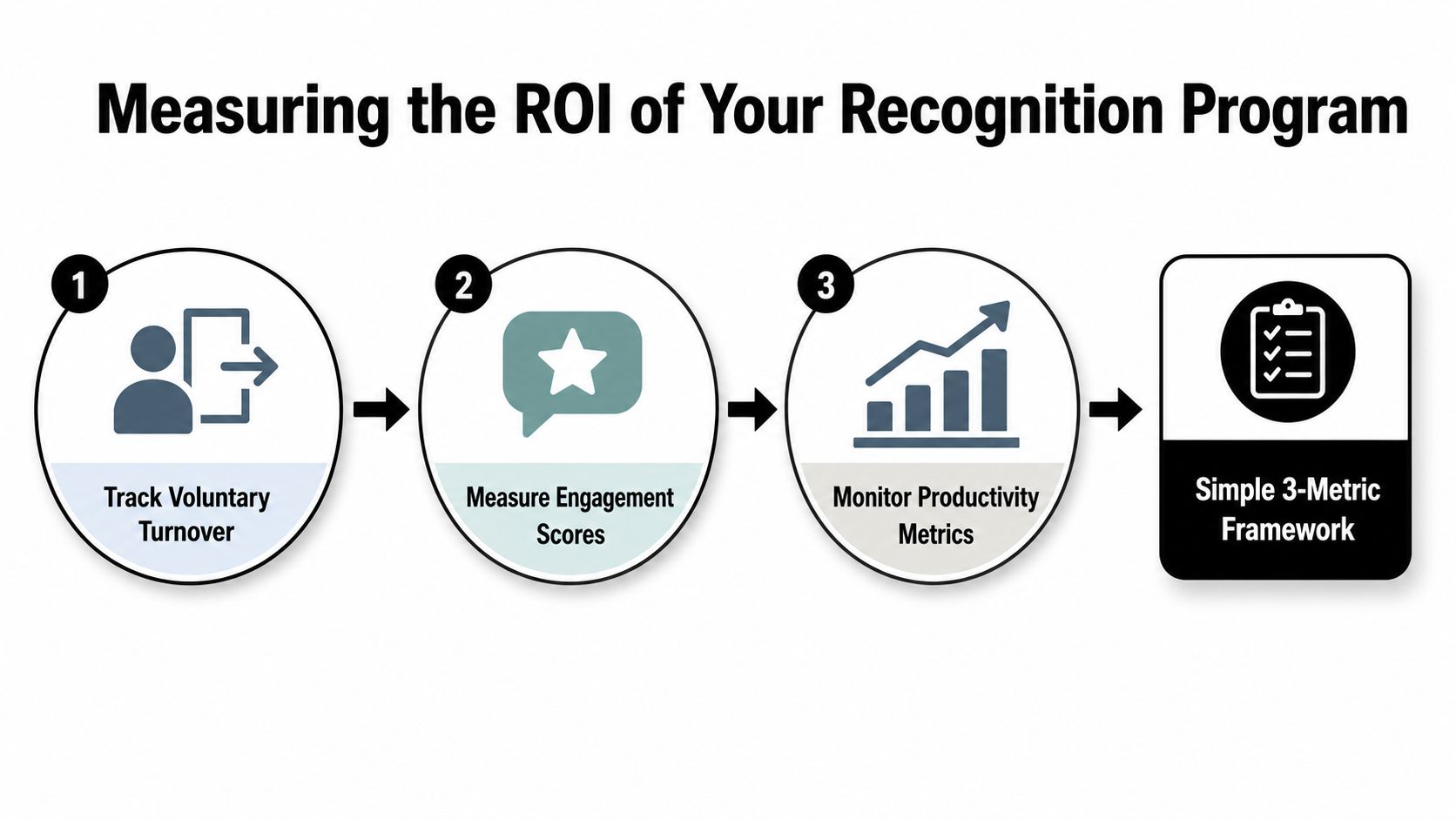
Track three things and nothing extra
First, track voluntary turnover. Measure the rate before launch, then compare it after 90 days and again after 180 days. Keep the comparison clean so no one can argue the baseline was fuzzy.
Second, track an engagement pulse score. Use one question on a quarterly rhythm. Don’t bury it in a long survey. You want a trend line, not survey fatigue.
Third, track a productivity proxy that matches the job. For sales, use sales per rep. For service teams, use tickets per agent. For logistics, use on-time delivery. Pick one metric that leaders already respect.
Keep the process simple
Set the baseline in the 30 days before launch. Don’t change three other programs at the same time if you can avoid it. Then review at 90 days and 180 days. If one metric improves while the others hold steady, you’ve got evidence. If nothing moves, the program probably needs a design change.
Measurement rule: If the team can’t explain what moved, the program won’t survive budget review.
Use a basic tracking table
| Metric | Baseline | 90 days | 180 days | Notes |
|---|---|---|---|---|
| Voluntary turnover | Compare against the same employee group | |||
| Engagement pulse score | Use the same question each time | |||
| Productivity proxy | Match the metric to the role |
A rough ROI conversation gets easier when you compare the cost of recognition with the cost of replacing people. You don’t need a complicated model to prove the point. You need a clean before-and-after story backed by numbers your leadership team already recognizes.
Working With a Local Partner for Custom Awards and Fulfillment
A recognition program breaks down fast when fulfillment is treated as an afterthought. Someone needs the name spelled correctly, the date verified, the logo approved, and the order rushed before the event. That’s where a local print and engraving partner earns its place in the process.
Why local beats fragmented
National award sites can be fine when you have time and a simple order. A local partner is better when you need speed, proofing, and the ability to fix mistakes without turning the whole thing into email chaos. If an anniversary date changes or a spelling correction comes in late, in-person service is often the difference between a polished award and a bad presentation.
For businesses weighing service levels, choosing a local print shop in Sugar Land is a practical read because the question is not price alone. It’s turnaround, reliability, and whether the partner can handle the full chain from mockup to handoff.
What a strong local partner should handle
A good fulfillment partner should cover laser engraving on plaques, trophies, and acrylic pieces, sublimation on mugs, keychains, and keepsakes, and certificate printing for formal recognition. It should also be able to help with ceremony materials like banners, yard signs, and business cards, plus finishing work like lamination for records.
That matters because recognition is rarely just one object. It’s the award, the message, the printed support pieces, and the presentation date all moving together. If one vendor can help coordinate those steps, your internal team spends less time chasing details.
A useful comparison point for giftable keepsakes can be found in custom wedding keepsakes, because the logic is similar, personalization turns an object into a memory. Recognition works the same way when the details are intentional.
The one-page checklist
- Define the moments: List anniversaries, performance milestones, values awards, and team celebrations.
- Set the budget: Decide what each award tier is allowed to cost before you shop.
- Draft the message: Write the exact wording before you order anything.
- Approve the mockup: Check names, dates, titles, and logo placement.
- Schedule the handoff: Lock in the presentation moment before the award is produced.
That’s the operational version of recognition. Not flashy. Not vague. Just repeatable, credible, and easy to run.
If you’re ready to stop improvising awards and start running recognition like a real program, work with Business Mail Boutique LLC to handle the engraving, printing, finishing, and presentation pieces that make employee recognition awards feel polished, on time, and worth keeping.

Related posts

Custom Memorial Glasses Engraved in Three Hours in Sugar Land
When a customer needed eight personalized glasses for a memorial, Business Mail Boutique completed the engraving or...

Custom Martini Glass Engraving in Sugar Land, TX
Custom Logo Engraving on Martini Glasses in Sugar Land, Texas.
Business Mail Boutique recently completed a beautiful custom engravin...

Custom Engraved Wine Glasses for a Golf Club Event in Sugar Land, TX
Custom Engraved Wine Glasses for a Golf Club Event in Sugar Land.
Custom wine glass engraving in Sugar Land, TX at Business Mail Bouti...