
- Print Business Cards in Sugar Land – Same Day Service
- Copying Services
- Document Printing, Finishing & Lamination in Sugar Land
- Flyers
- Print Banner in Sugar Land | Same-Day Banner Printing Near Me
- Graphic Design
- Photo Printing
- Postcard Printing
- Document Printing
- EDDM Full Service Postcards
- FotoZoomer Large Format Printing


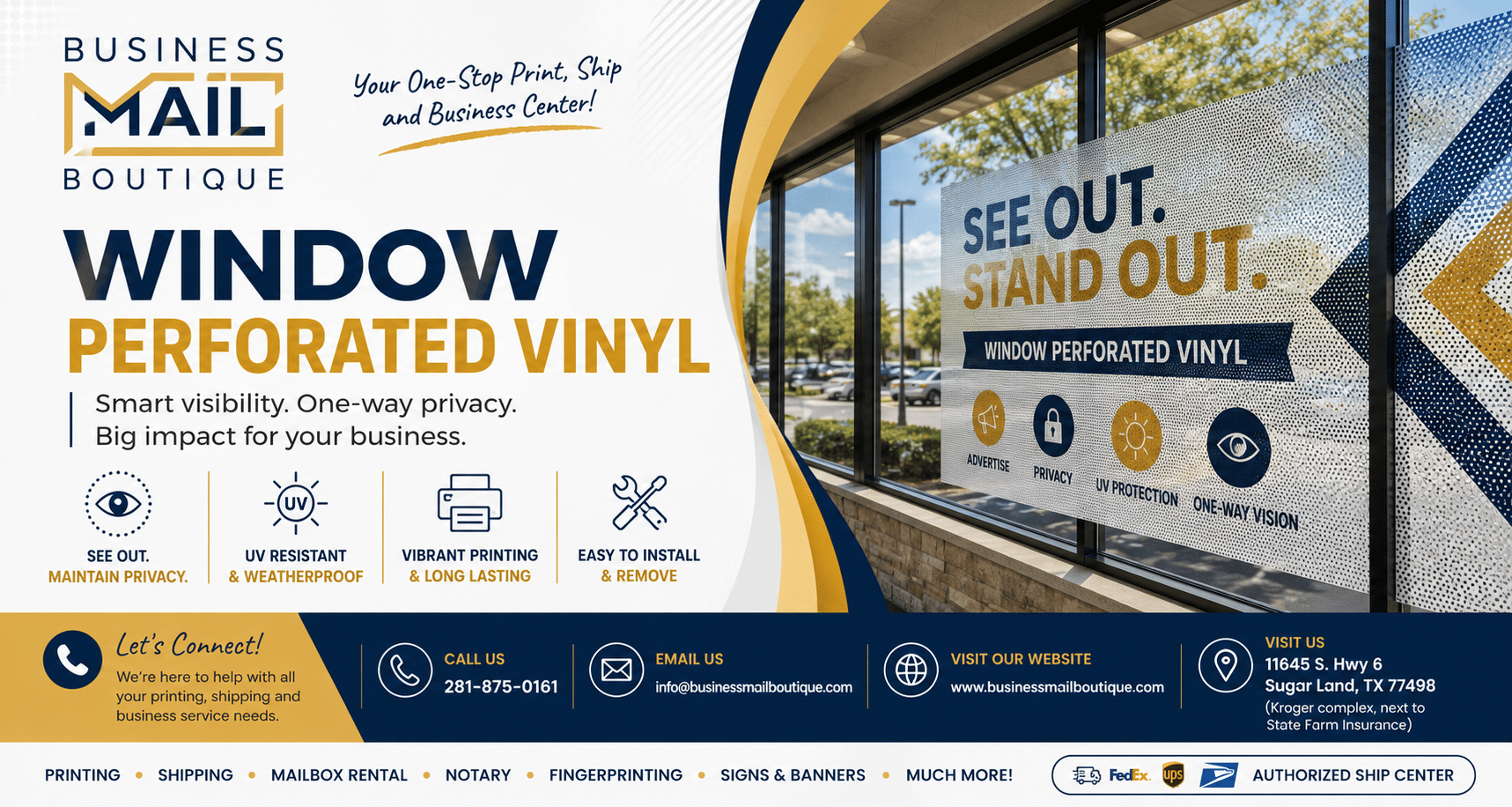
Window Perforated Vinyl.
Learn what window perforated vinyl is, how perforation ratios affect visibility, and tips for storefront and vehicle graphics.
Businessmailboutique
11645 S. Hwy 6
Sugar land, Texas 77498 United States (US)
Email: info@businessmailboutique.com
Route
You can stand on the sidewalk, look through a sun-washed glass storefront, and feel the problem immediately. The window needs to sell something, but the people inside still need daylight, privacy, and a clear view of who’s walking up. Window perforated vinyl exists for that exact tension, and in a hot market like Texas, that trade-off matters more than most buyers realize.
At the shop level, it’s one of those materials that looks simple until you’ve installed enough of it to see the difference between a good job and a bad one. The right perforation ratio, the right print prep, and the right maintenance routine decide whether a window graphic looks sharp for months or starts looking tired after the first stretch of brutal sun.
Table of Contents
- What Window Perforated Vinyl Is and Why It Exists
- How Perforation Ratios Affect Visibility and Light
- Where Window Perforated Vinyl Works Best
- Design Tips That Make Perforated Graphics Actually Read
- Installation and Maintenance Best Practices
- What Window Perforated Vinyl Actually Costs
- Visibility, Safety, and Heat Tradeoffs Buyers Overlook
- Ordering Window Perforated Vinyl Locally in Sugar Land
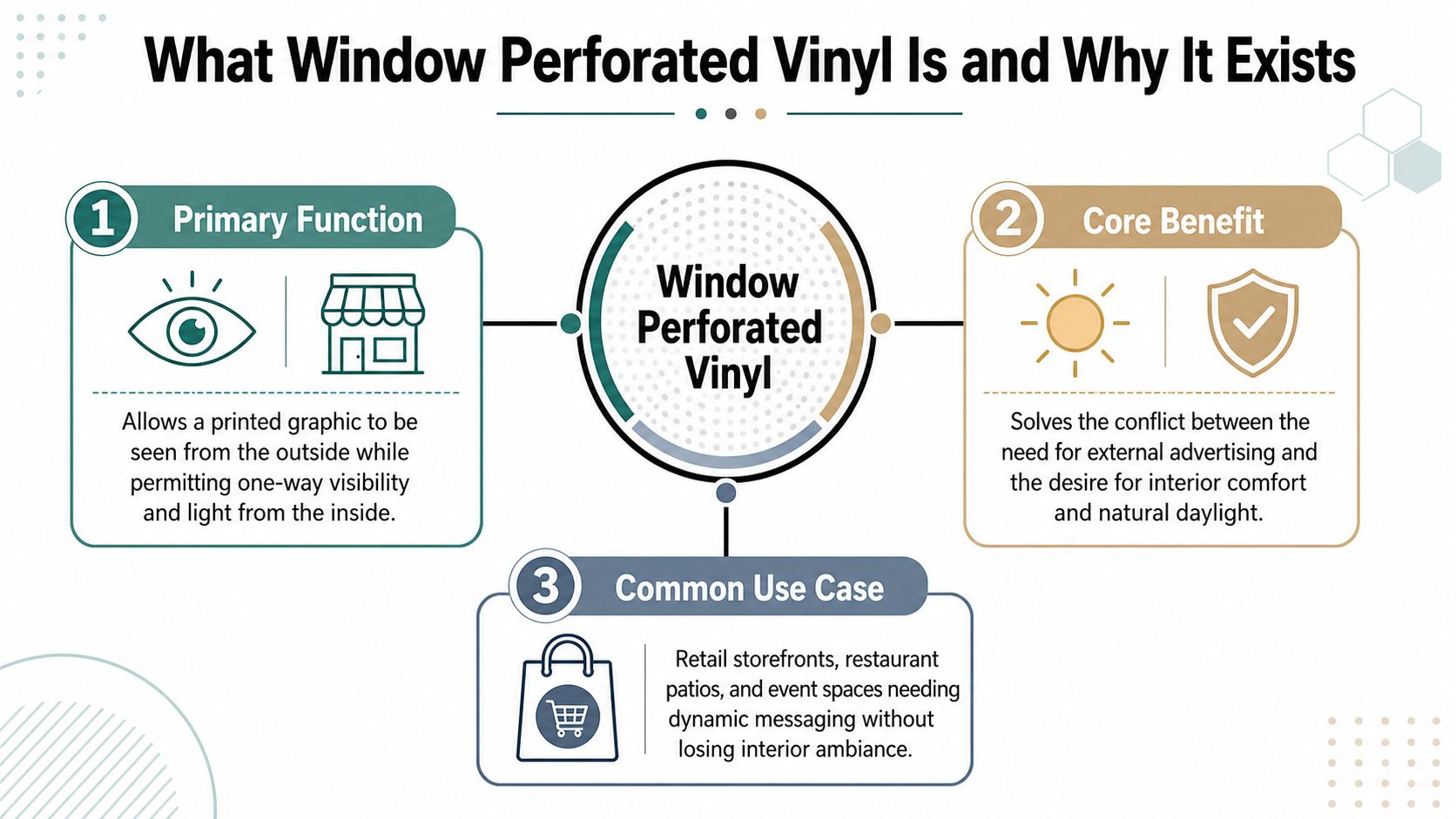
What Window Perforated Vinyl Is and Why It Exists
A lot of business owners first notice window perforated vinyl on a storefront they pass every day. From the street, the glass looks like a giant printed ad. From inside, the same window still lets in light and gives employees a usable view out. That’s the whole point of the material.
The basic build
This product is a one-way vision film with a printed face and a perforated liner-side pattern that preserves outward visibility and light transmission. The market for it is no longer small or experimental, either. The global window perforated vinyl market reached USD 1.56 billion in 2024 and is projected to reach USD 2.89 billion by 2033 at a 6.8% CAGR from 2025 to 2033, according to the market report from Growth Market Reports. That report also says North America and Europe account for over 60% of global revenue, while Asia Pacific is the fastest-growing region.
That scale tells you something practical. This isn’t a niche gimmick anymore, it’s a standard graphics material used on storefront windows, vehicle rear glass, and other glass surfaces where visibility still matters.
Practical rule: if the space needs to advertise and still feel open from the inside, perforated vinyl is often the better fit than solid vinyl or heavy window blocking.
Why it exists at all
The best way to think about it is as a negotiated compromise. A plain decal blocks too much light. A bare window leaves marketing space unused. Window perforated vinyl splits the difference by trading part of the printable surface for see-through area, so the street sees the message while the inside keeps the daylight.
That’s why it became common for retail facades, vehicle rear glass, office partitions, and short-term campaign graphics. It solves a very specific problem cleanly: turn glass into advertising without turning the room into a cave.
How Perforation Ratios Affect Visibility and Light
Think of the film like a screen door on a bright day. You can see through it because of the open area, but the more tightly you cover that surface, the less clear the view becomes. Window perforated vinyl works the same way, only the balance is set by the hole pattern and how much of the face is printable.
Reading the ratios the right way
The common formats are 50/50, 60/40, and 70/30, where the first number is the printable area and the second is the perforation. In practical terms, 50/50 gives the best outward visibility but the weakest graphic density, 70/30 gives the boldest storefront image but trims the see-through effect, and 60/40 tends to land in the middle for most day-to-day storefront use. Industry guidance also notes hole sizes are often about 1.5 mm, with some campaign-grade films built for about 6 months of use in exposed conditions, according to the Wensco product guidance at Wensco Contra Vision WBMAG40D.
| Ratio | Printable Area | Best For | Trade-Off |
|---|---|---|---|
| 50/50 | 50% | Rear glass, high-visibility inside viewing | Strong see-through, softer image from the street |
| 60/40 | 60% | Most storefront windows | Balanced visibility and ad impact |
| 70/30 | 70% | Bold graphics, privacy-leaning applications | Stronger image, less outward clarity |
A buyer who’s looking at heat and glare in a Texas storefront should also think about the window itself, not just the film. A useful comparison point is cool your home with screens, because the same basic question comes up there too, how much light do you want to keep, and how much do you want to cut?
More open area means better light and visibility. More printable area means stronger graphics.
Where Window Perforated Vinyl Works Best
The best installations aren’t chosen by habit, they’re chosen by the job the glass has to do. A restaurant patio, a delivery van, and a conference room all need different balances of privacy, daylight, and message clarity.
Storefront windows
For retail glass, the material earns its keep fast. A 60/40 film usually makes the most sense when the owner wants a strong exterior ad and still wants staff to track foot traffic approaching the door. That’s the use case most small businesses picture first, and it’s where the material feels most natural.
The key is that the window stops being dead space. It becomes a branded surface without cutting the room off from daylight. For businesses on busy streets, that matters because people inside still need to see who’s arriving, and customers outside need a clean first impression.
Vehicle rear glass
Rear glass is a different animal. Drivers need usable mirrors and a less obstructed view, so 50/50 often makes more sense there than a denser pattern. The goal is not to blanket the glass, it’s to let the message ride on the back of the vehicle without making it feel like a blind spot.
Office partitions and conference rooms
Inside a building, perforated vinyl can work as a soft privacy layer. It doesn’t behave like solid frosting, and that’s the point. It preserves light better than an opaque treatment while still muting direct sightlines. In a conference room or internal partition, that can be enough to make a space feel more private without making it dull.
Event graphics
Short-term campaigns are where the material can be surprisingly efficient. Grand openings, seasonal promos, product launches, and pop-up events all benefit from a graphic that reads well from a distance and comes off when the campaign ends.
The wrong ratio on the wrong surface is where buyers get disappointed. Match the film to the viewing distance and the amount of interior visibility the space actually needs.
Design Tips That Make Perforated Graphics Actually Read
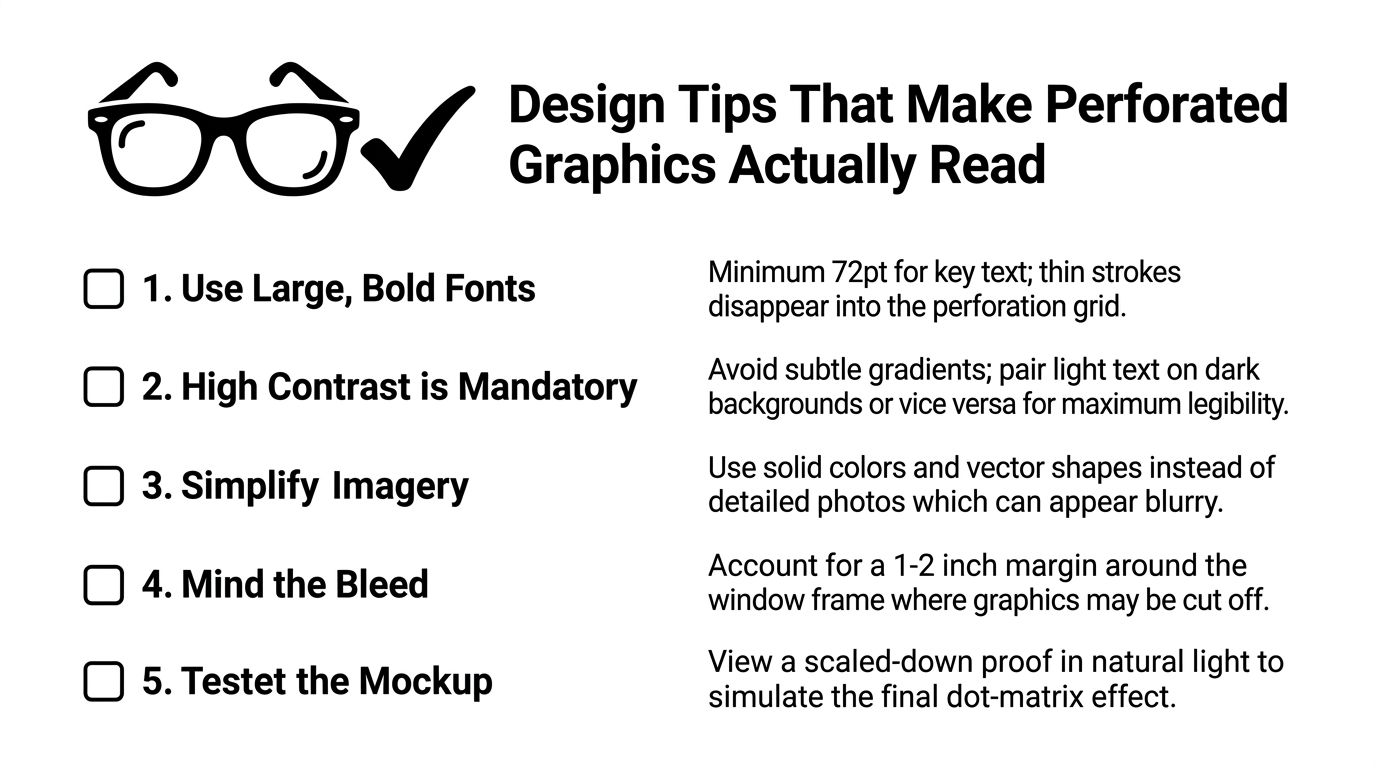
Perforated film punishes lazy artwork. On solid vinyl, weak design can still limp across the finish line. On window perforated vinyl, the hole pattern exposes every design mistake, especially small text and busy imagery.
File prep that saves jobs
Print-ready artwork should come in PDF format, in CMYK, with embedded fonts, vector logos and text, and raster images at 150–300 dpi. That guidance comes from industry artwork prep practices for wide-format output, and it matters because the film itself is a textured print surface, not a flat poster. The pattern will break up fine detail even if the file looks fine on a monitor, as noted in the guidance from CoolVU’s perforated vinyl guide.
What to simplify
Small type fails first. Thin strokes fail next. Phone numbers, URLs, and legal copy often disappear into the pattern when a designer tries to cram too much into a perforated panel.
Use this checklist instead:
- Use one focal point. Let the eye land on a logo, offer, or product image first.
- Keep contrast high. Light text on dark ground, or dark text on light ground, works better than subtle gradients.
- Choose bold weights. Thin fonts look elegant on screen and messy on perforated glass.
- Leave white space. The film needs breathing room so the image doesn’t turn into visual noise.
- Test the artwork at distance. A mockup viewed from 10 to 20 feet tells you more than a zoomed-in proof on a laptop.
The best perforated graphics aren’t the most detailed, they’re the clearest.
Installation and Maintenance Best Practices
A clean install starts before the film comes off the liner. The jobs that fail early usually fail because someone rushed the prep, not because the film itself was flawed.
The dry-application workflow
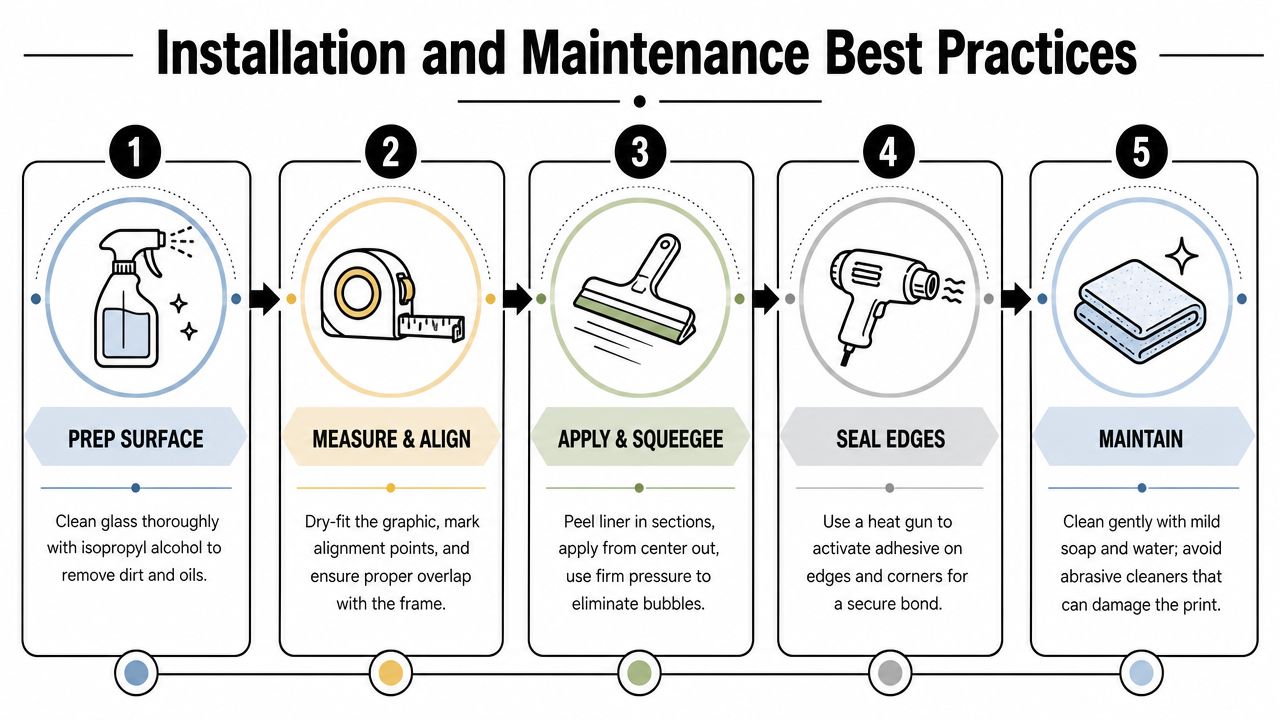
The standard method is dry application. Clean the glass with isopropyl alcohol, measure and align the panel, hinge it with tape, peel the liner, then squeegee from the center outward with overlapping strokes. That sequence keeps the panel straight and reduces trapped air, which is what gives poor installs their cloudy look.
Edge behavior matters too. Avery Dennison’s installation guidance for perforated window graphics notes that residue management and removal behavior are tied to the adhesive and edge-seal design, which is why long-term exterior use depends on how the perimeter is handled. You can read the manufacturer’s installation guidance in the special product information bulletin for perforated window films.
Caring for the finished graphic
The first few days are the sensitive window. Heat helps the adhesive settle, so waiting several hot sunny days before cleaning is the safer move. After that, use a soft microfiber cloth and mild soap, not ammonia-heavy glass cleaners, and don’t hit the surface with a power washer.
A few warning signs tell you the film is nearing the end of its professional life:
- Edge lift along corners and seams
- Silvering where trapped air or adhesive failure starts to show
- Haze that softens the printed image
- Dirty edges that keep reappearing after cleaning
Those are reprint signals, not repair invitations.
For a local business thinking about the full print workflow, the production side matters as much as the install side. A service like wide format printing services for Sugar Land businesses is relevant because the right substrate still needs proper output and finishing if you want it to survive outside.
What Window Perforated Vinyl Actually Costs
Buyers often ask for a price as if there’s one number. There isn’t. Window perforated vinyl pricing usually breaks into three parts, the printed film itself, any finishing that extends life, and the labor to install it cleanly.
What drives the total
A small storefront job usually ends up being shaped by size, access, and artwork complexity more than by the material alone. More square footage means more output. Multiple windows add handling time. Custom art takes longer than a template-based layout. And if the installer is sealing edges for weather resistance, that usually adds work because the perimeter has to be treated carefully.
That means a “cheap” quote can be misleading. A lower-cost unlaminated graphic might save money at checkout, but in a sunny climate it usually needs replacement sooner. A better-built graphic, paired with careful installation, is the one that holds its appearance longer and lowers the total replacement cycle.
How to compare quotes
When you compare vendors, ask what’s included in the printed price. Some quotes cover output only. Others include trimming, edge work, and installation. The key question isn’t just what it costs to buy, it’s what it costs to keep looking professional.
A storefront graphic that needs early replacement is rarely the bargain it looked like on paper.
Visibility, Safety, and Heat Tradeoffs Buyers Overlook
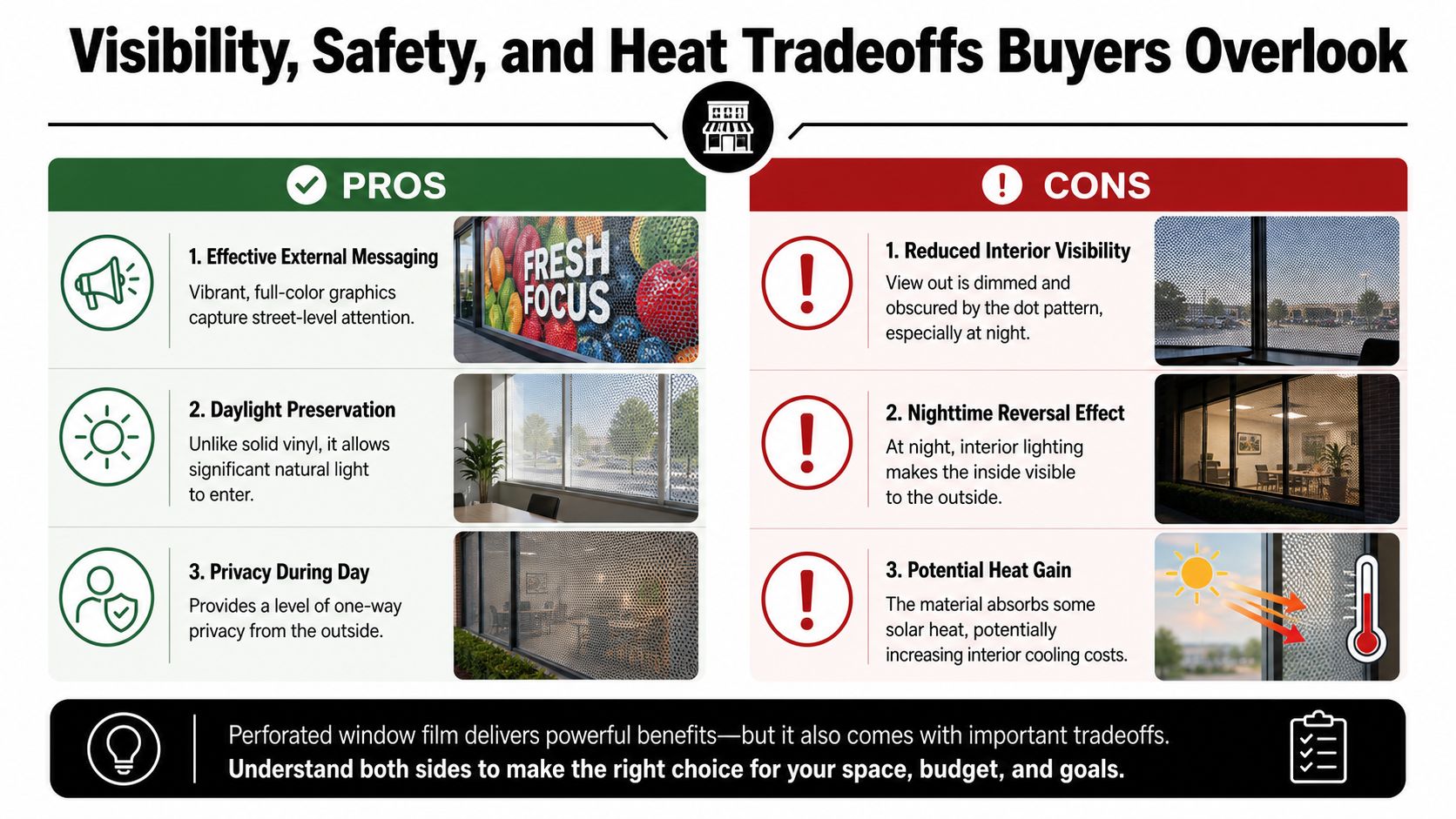
A lot of product pages talk as if perforated vinyl always gives you a clean see-out, show-out result. It doesn’t. The effect depends on the light on each side of the glass, so once the interior lights are stronger than the outside light, people outside can see in much more easily. At night, that balance can flip fast, and a storefront that felt private in daylight can feel exposed after sunset.
What the material does well
Perforated film gives a storefront a strong exterior message while still preserving more daylight than solid vinyl. That is the main business reason to use it, and in a bright climate it can also soften glare enough to make the interior feel less harsh. The result is a workable middle ground between open glass and full coverage.
The print still matters. If the artwork is too busy, too dark, or set up with weak contrast, the window can look heavy from the street and flat from inside. A shop that needs the panel to read cleanly in Texas sun should plan for that before the files are sent, because the wrong layout can make the material look cheaper than it is. For a broader look at managing solar heat, see how you can cool your home with screens.
Where the trade-offs show up
On vehicles, the safety conversation matters more. Perforated graphics are generally used on rear glass, because the driver’s need for visibility is different there than on the windshield or front side windows. Local rules can restrict where it’s allowed, so the installer and the buyer both need to treat compliance as part of the job, not an afterthought.
The heat question is more nuanced than many buyers expect. The film lets in more light than frosted or solid coverage, but darker graphics and tighter perforation patterns can still cut glare and change how a room feels in strong sun. A source that looks at the daylight and heat angle from a buyer’s perspective is this discussion of perforated window vinyl signage, which highlights the gap between decoration and real interior comfort.
For a storefront in Texas, that gap matters. The glass may look sharp at noon and tired by late afternoon if the print choice, adhesive behavior, and light balance were not planned together. If the goal is to improve comfort and keep the display looking professional, perforated vinyl should be treated as part of the window strategy, alongside tint, shade, or other exterior treatments. It also belongs in the same planning conversation as scrim vinyl outdoor banner printing, since both materials live or die on visibility, weather exposure, and how long they keep a clean finish.
Ordering Window Perforated Vinyl Locally in Sugar Land
The cleanest purchasing decision usually comes down to three choices. First, pick the right perforation ratio for the glass and the viewing distance. Second, make sure the artwork is print-ready and readable at street level. Third, insist on an install that treats the edges and curing time seriously.
For Sugar Land businesses that want one place to handle the whole job, window perf banner printing in Sugar Land is a practical place to start. Business Mail Boutique LLC at 11645 S. Hwy 6, Sugar Land, Texas offers custom wide-format printing for perforated window vinyl, finishing, same-day turnaround on many print products, and coordination of installation through their team, so a buyer can move from measurement to finished storefront without juggling multiple vendors.
Use this checklist before you order:
- Measure the glass carefully. Include the actual visible area, not just the rough opening.
- Decide on the ratio first. Don’t let the artwork drive the material choice.
- Send print-ready files. CMYK, embedded fonts, vector text, and strong contrast save time.
- Ask about edge sealing. That detail often decides how long the panel stays professional-looking.
- Plan for maintenance. Know how you’ll clean it, and when you’ll replace it.
If your storefront, office, or vehicle needs a cleaner way to advertise without giving up daylight, reach out to Business Mail Boutique LLC and ask about a perforated vinyl quote, print prep, and installation help before you commit to the wrong ratio or artwork size.

Related posts

Custom Memorial Glasses Engraved in Three Hours in Sugar Land
When a customer needed eight personalized glasses for a memorial, Business Mail Boutique completed the engraving or...

Custom Martini Glass Engraving in Sugar Land, TX
Custom Logo Engraving on Martini Glasses in Sugar Land, Texas.
Business Mail Boutique recently completed a beautiful custom engravin...

Custom Engraved Wine Glasses for a Golf Club Event in Sugar Land, TX
Custom Engraved Wine Glasses for a Golf Club Event in Sugar Land.
Custom wine glass engraving in Sugar Land, TX at Business Mail Bouti...