
- Print Business Cards in Sugar Land – Same Day Service
- Copying Services
- Document Printing, Finishing & Lamination in Sugar Land
- Flyers
- Print Banner in Sugar Land | Same-Day Banner Printing Near Me
- Graphic Design
- Photo Printing
- Postcard Printing
- Document Printing
- EDDM Full Service Postcards
- FotoZoomer Large Format Printing


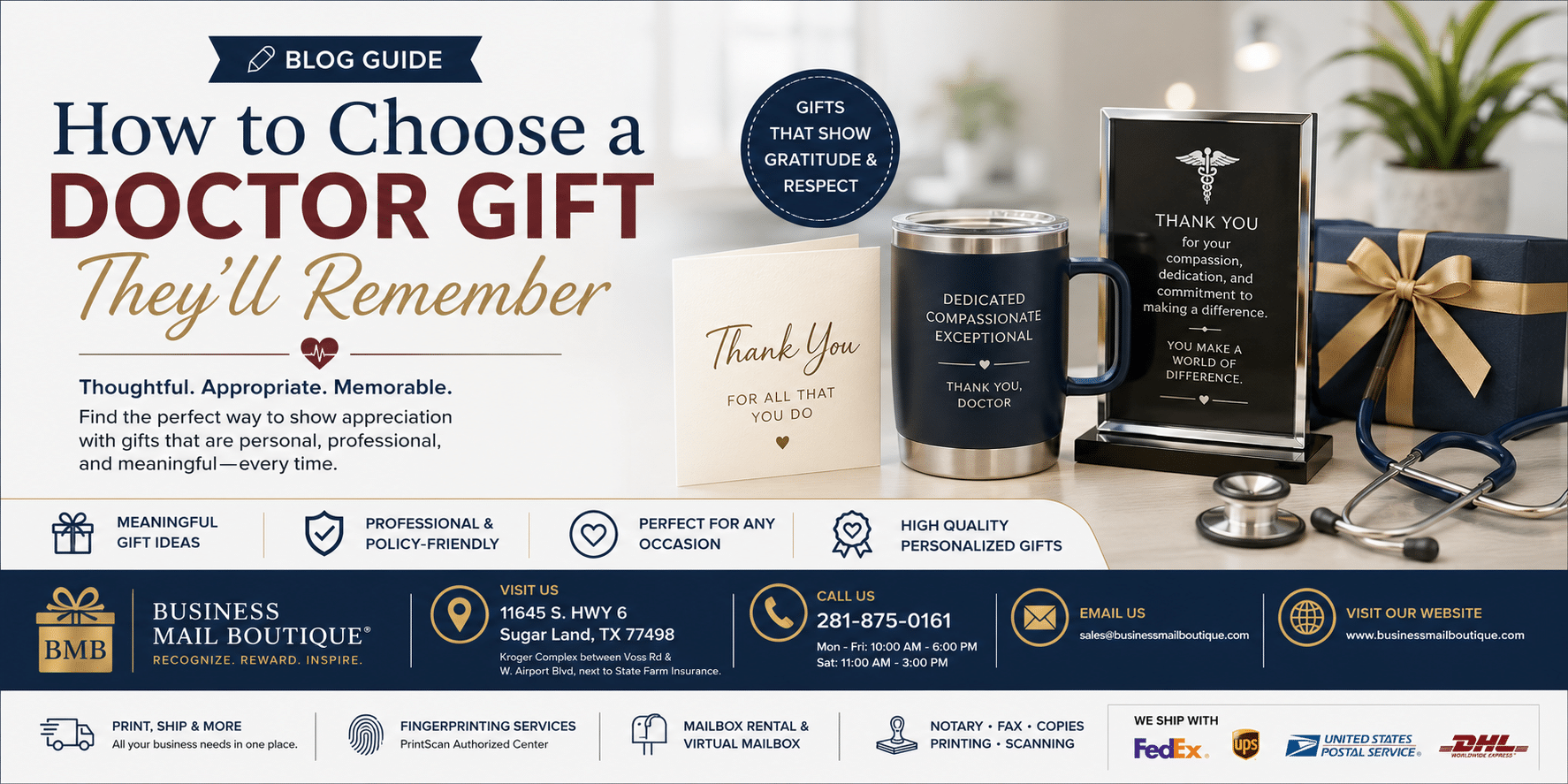
Doctor Gifts That Actually Land.
Find thoughtful doctor gifts for every occasion. Compare ideas by budget, recipient, and hospital rules, plus personalization and gift-giving etiquette tips.
Businessmailboutique
11645 S. Hwy 6
Sugar land, Texas 77498 United States (US)
Email: info@businessmailboutique.com
Route
You’re standing there with a greeting card, a wrapped gift, and one lingering question: Will this truly be appreciated, or will it end up on a shelf with all the other forgettable presents? That’s the challenge of choosing a gift for a doctor. The right gift should be more than just thoughtful—it should be appropriate for the professional setting, comply with workplace policies, and still feel personal enough to make a lasting impression rather than just another routine gesture.
| Gift Tier | Best Fit | What Usually Wins | What Usually Misses |
|---|---|---|---|
| Everyday use | Desk or clinic item | Useful, compact, easy to keep nearby | Decorative clutter |
| Personal keepsake | Engraved or customized item | Subtle personalization, practical keepsake value | Loud, overly sentimental custom art |
| Formal gesture | Milestone or team gift | Thoughtful, professional, easy to accept | Expensive items that create awkwardness |
Most doctor gifts fail for one of three reasons, they break a policy, they miss the moment, or they try too hard to be meaningful and end up feeling intrusive. A better approach is simple. First, identify who the gift is for. Second, check what the setting allows. Third, add just enough personalization that it feels deliberate without becoming a problem.
Table of Contents
- Why Choosing the Right Doctor Gift Is Harder Than It Looks
- Matching the Gift to the Recipient and the Occasion
- A Tiered Comparison of Gift Categories That Hold Up
- Personalization and Engraving Options That Actually Last
- Etiquette and Hospital Rules You Cannot Afford to Skip
- Packaging, Shipping, and Local Fulfillment in Sugar Land
- Recommendations by Budget and a Fast Decision Rule
Why Choosing the Right Doctor Gift Is Harder Than It Looks
The hard part isn’t finding something to buy. It’s figuring out whether the doctor can accept it, whether it will be used in a clinical life that’s already crowded with gear, and whether it will feel respectful instead of awkward. That’s why most doctor gifts lists are shallow. They give you objects, not judgment.
The three friction points that cause bad gifts
Policy friction is the first one. Doctors work inside hospitals, practices, and clinics that often have rules about what can be received, where it can be kept, and whether it needs to be logged. If a gift can’t pass that gate, the purchase never matters.
Budget friction is the second. A gift that feels modest to one person can feel excessive to another, especially when the relationship is patient to physician. That’s where the ethics piece matters more than the wrapper.
Personalization friction is the third. People want the gift to feel specific, but they don’t always know how to personalize without crossing a line. Too much text, too much sentiment, or the wrong material, and the item stops looking professional.
Practical rule: if you can’t explain the gift in one sentence without sounding defensive, it’s probably too complicated.
The market reality is that gifts are common, but they’re still controversial because they can affect trust and clinical judgment. A Drexel University discussion of a U.S. survey found that about 65% of respondents had seen a doctor in the past year who had received payments or gifts from pharmaceutical or medical-device companies, while only 5% knew their own doctor had received such payments, which shows how big the trust gap can be in this space. The point isn’t that every gift is suspect, it’s that perception matters as much as intention in medicine, and that’s why the safest gifts are usually modest, useful, and easy to decline or accept without drama, as summarized by Drexel University’s report on patient perceptions of doctor gifts.
The best way to think about doctor gifts is as a decision map, not a shopping category. Once you know who the gift is for, what the setting allows, and how much personalization makes sense, the options get much clearer.
Matching the Gift to the Recipient and the Occasion
The same object can be brilliant in one context and wrong in another. A thank-you gift after a tough procedure is not the same as a retirement present or a peer-to-peer gesture between physicians, and you should shop that way. The recipient relationship drives everything.
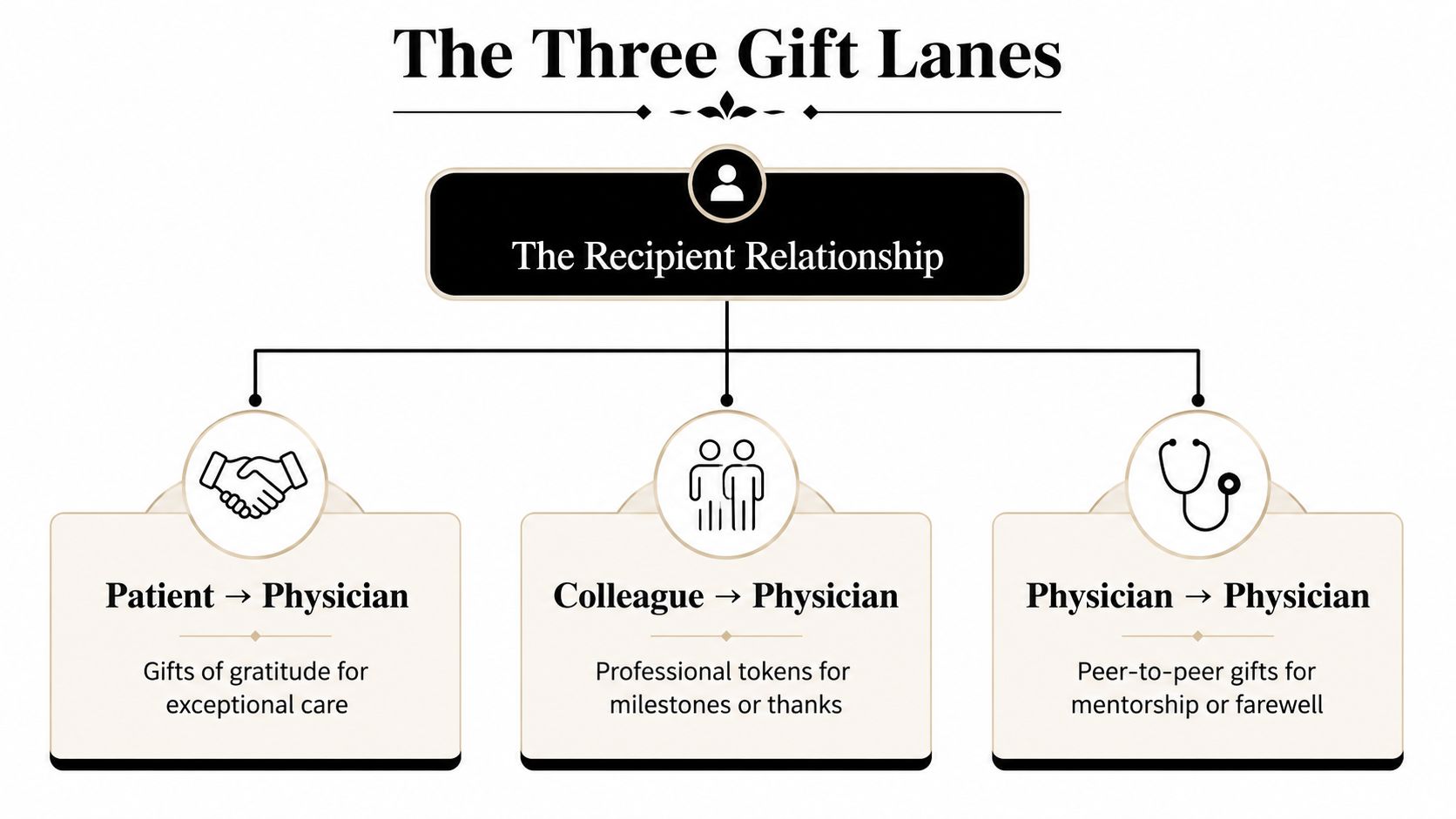
The three lanes that actually matter
Patient to physician is the most sensitive lane. Gratitude is real here, but the gift has to stay modest and clearly free of expectation. That’s why a simple note, a shared consumable for the team, or a practical desk item tends to work better than something luxurious.
Colleague to physician is easier, but it still needs restraint. A promotion, retirement, residency match, new practice opening, or service anniversary all call for something professional, not personal. In this lane, a useful keepsake usually beats a flashy gadget.
Physician to physician is the cleanest lane for personalization. Mentorship gifts, farewell gifts, and celebration gifts can be more specific because the relationship already exists inside the same professional culture. A subtle engraved item or framed commemorative piece fits here well.
Patient gifting isn’t some rare exception. A BMJ discussion noted that a survey published in 1980 found 20% of UK doctors had received a gift from a patient in the preceding three months, which is a useful reminder that this has been part of practice for decades. More recent professional reporting says the same thing in a different way, with an MDU survey of over 400 doctors finding 75% received a gift or thank-you message from a patient in the past year, while chocolates led at 41% and flowers and alcohol were each 10%. That’s why this isn’t a fringe etiquette issue, it’s a recurring one, and the MDU’s survey summary is the clearest public snapshot of how common gratitude gifts still are.
If you want a clean, practical angle on recipient matching, a plant gift can be a strong fit for some non-clinical settings, and find special plant gifts is a useful reference when you’re comparing something alive and low-key to a more traditional object.
For local execution, an engraved item can be handled through Business Mail Boutique engraving on stethoscope in Sugar Land, which is the kind of option that matters when you want the personalization done in one place instead of bouncing between vendors.
A Tiered Comparison of Gift Categories That Hold Up
The smartest doctor gifts aren’t the fanciest ones. They’re the ones that fit the way doctors live, on call, between appointments, in offices with too much paper, or at home trying to recover from a long shift. That makes tiering more useful than endless scrolling.
| Tier | Price Range | Default Pick | Best For |
|---|---|---|---|
| Desk and clinic accessory | Under $40 | Compact foot massager | Long shifts, break-time relief |
| Personalized keepsake | Moderate | Engraved pen or tumbler | Thank-yous, promotions, milestones |
| Commemorative gift | Higher-end | Framed or engraved item | Retirement, fellowship completion, major career changes |
The default pick for each tier
The under-$40 tier should be practical first. A compact foot massager is the standout because a medical professional highlighted a version with acupuncture nubs as something that fits under a desk and can be used during short breaks. That matters for doctors who spend long hours standing, and it makes the gift feel like a workday tool instead of a trinket. For the same reason, desk items that reduce friction, not add decoration, are the safe bet.
The moderate tier is where personalization earns its keep. An engraved pen, a leather notebook, or a quality insulated tumbler works because it stays in rotation. These gifts don’t ask the doctor to find storage space, and they don’t look like gifts that were chosen from a generic “for doctors” rack.
The higher-end tier should be reserved for real milestones. A framed certification, a commemorative plaque, or a carefully chosen engraved item makes sense here. The point isn’t size, it’s permanence.
A gift that lives on the desk gets used. A gift that only looks nice gets moved, stored, or re-gifted.
There’s one simple filter that helps when you’re choosing between options. If the item helps during a shift, it belongs in the first tier. If it looks better with a name, date, or message, it belongs in the second. If it belongs on a shelf, not in a drawer, it belongs in the third. That’s the cleanest way to avoid buying something that gets politely thanked and promptly forgotten.
Personalization and Engraving Options That Actually Last
Customization is useful only when the medium fits the item. People get stuck here because they want something personal, but they’re not sure whether the gift should be engraved, printed, embroidered, or left alone. The wrong method can make a good item look cheap.
Match the method to the material
Laser engraving is the safest choice for metal, wood, and many leather items. It gives you a clean, permanent mark, which is why it works well for pens, plaques, stethoscope ID tags, tumblers, and wooden desk pieces. It’s also the best choice when you want the personalization to survive daily handling.
Sublimation makes more sense for coated mugs, photo gifts, and some hard-surface items that are designed for full-color printing. If the gift depends on a logo, a photo, or a color-rich layout, this is usually the route to consider. It’s less about formality and more about visual flexibility.
Embroidery or patch-style branding fits soft goods like bags, aprons, or presentation cases. It’s not the right move for every doctor gift, but it can work when the item is meant to live in a professional bag or office setup.
Business Mail Boutique’s on-site engraving and print capabilities matter because they let one shop handle the object and the finishing step. That’s useful when you’re working with a metal tumbler, a wood plaque, a leather portfolio, a ceramic mug, or another item where the finish matters as much as the base product. Their engraved and sublimated items are a practical route for buyers who don’t want to coordinate a separate vendor for customization, as outlined on Business Mail Boutique’s engraving services page.
A few guardrails save time:
- Use text for permanence. Names, dates, titles, and short messages age better than novelty phrases.
- Keep images restrained. Photos and logos work best when the surface is designed for them, not forced onto every item.
- Pick one focal point. A name plus a date is usually enough. Overcrowded personalization looks busy, not thoughtful.
Turnaround matters too. Last-minute buyers need a shop that can finish, package, and hand over the item without sending it through three different channels. That’s where a one-stop personalization workflow beats ordering a gift, then sending it elsewhere for finishing.
Etiquette and Hospital Rules You Cannot Afford to Skip
It’s understandable to not want to offend a doctor. You want to express gratitude without making the doctor choose between appreciation and policy. That’s the right instinct, and it should shape the purchase from the start.
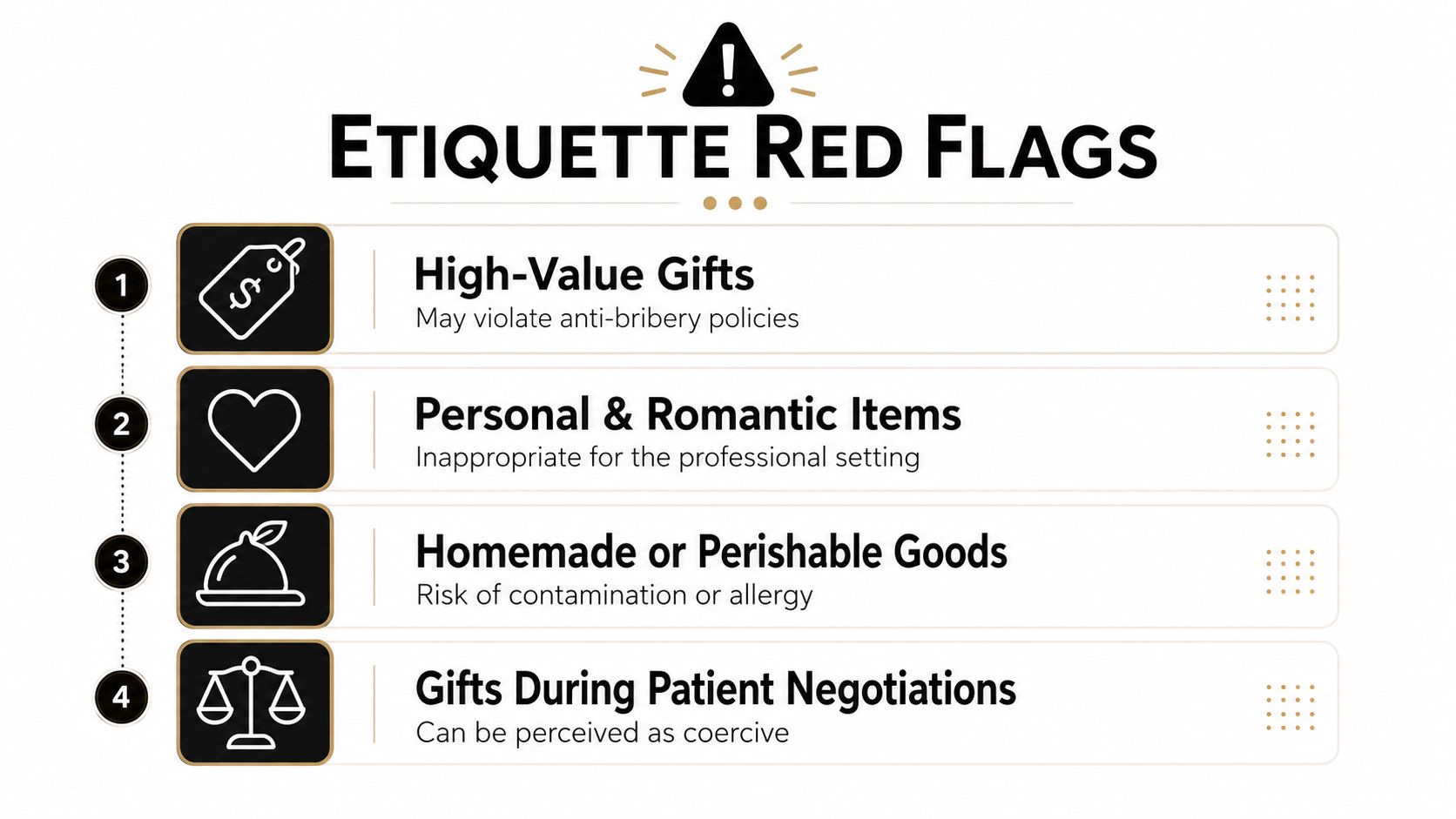
The red flags that should make you pause
Intimate or personal items are a bad fit. Anything romantic, flirtatious, or emotionally loaded belongs nowhere near a clinical relationship.
Excessively valuable gifts are risky because they can look like an attempt to influence care, even when that isn’t the intent. If you’re second-guessing whether the value is too high, it probably is.
Anything beyond the patient’s means deserves a rethink. A physician may feel uncomfortable accepting something that seems to strain the giver’s finances.
Anything that conflicts with policy is dead on arrival. A gift can be sincere and still be impossible for the doctor to accept.
Peer-reviewed guidance is blunt here. Physicians should reject gifts that are intimate, excessively valuable, or beyond the patient’s means, and they should document accepted or rejected gifts when motivation is unclear, according to the peer-reviewed guidance in PMC. That line matters because the ethics question is not just “Is this nice?” It’s also “Will this create a real or perceived problem?”
The best response to a tricky situation is usually one of three moves:
- Choose a charitable donation instead. If the relationship is sensitive, give in the doctor’s name or to a related cause.
- Keep the gift team-facing. A shared item for the unit is easier to accept than something personal.
- Add a simple note. A direct, restrained message often does more than a more expensive object.
If you’re writing the card, keep it plain. “Thank you for the care and time you gave our family” works. “Please accept this as a small token of our gratitude” works. Don’t add pressure, don’t imply obligation, and don’t make the gift sound like a transaction.
Doctors already live with public scrutiny around gifts and influence. That’s why perceived conflicts matter even when the giver means well. A clean, modest gesture beats a grand one every time.
Packaging, Shipping, and Local Fulfillment in Sugar Land
A good gift can still land badly if it shows up crushed, late, or awkwardly packed. Presentation matters, but logistics matter more. You want the doctor to receive something that looks intentional, not like it survived a chaotic shipping desk.
Start with the delivery path
If the gift is going to a hospital address, keep the outer packaging professional and easy to identify. If it’s going to a home address, add a protective box or padded mailer so the item arrives intact and doesn’t look like random retail overflow. If you’re hand-delivering, keep the package simple and respectful.
For flower-based gifts or mixed gift sets, it also helps to think like a florist. Barbara’s Flower Boutique advice on flower delivery service is a useful reminder that timing, address accuracy, and presentation can make or break a gift, especially when the item is fragile or meant for a specific moment.
A local ship-and-pack partner like Business Mail Boutique LLC in Sugar Land can handle the parts people usually cobble together from three places. It operates as a PackageHub360 Business Center, which means packing, shipping, and drop-off tasks can live under one roof, along with services like Authorized UPS and FedEx shipping, USPS drop-offs, returns processing, and on-site personalization. That setup is useful when the gift needs one last engraving pass, a clean box, and a professional label before it leaves the store. For buyers who want a single local stop, their ship center in Sugar Land is the kind of place that turns “I need this done today” into a real workflow.
Use the store as the final quality check
Wrap the item after engraving, not before. Confirm the spelling of the doctor’s name, title, or department before any finishing work starts. Then choose a box or mailer that protects the gift without making it look overdone.
A few practical rules help:
- Ship with tracking. Gifts fail when nobody knows where they are.
- Keep the receipt separate. The doctor should not see pricing details by accident.
- Avoid bulky outer packaging for office delivery. Reception desks like clean, compact parcels.
If you need the packaging, shipping label, and final handoff handled in one run, that kind of local fulfillment is exactly where a physical service counter earns its keep.
Recommendations by Budget and a Fast Decision Rule
The easiest way to stop overthinking is to choose by budget, then run the gift through a quick sensitivity check. That gets you from “I need a gift” to “I know what to buy” without a lot of wandering.
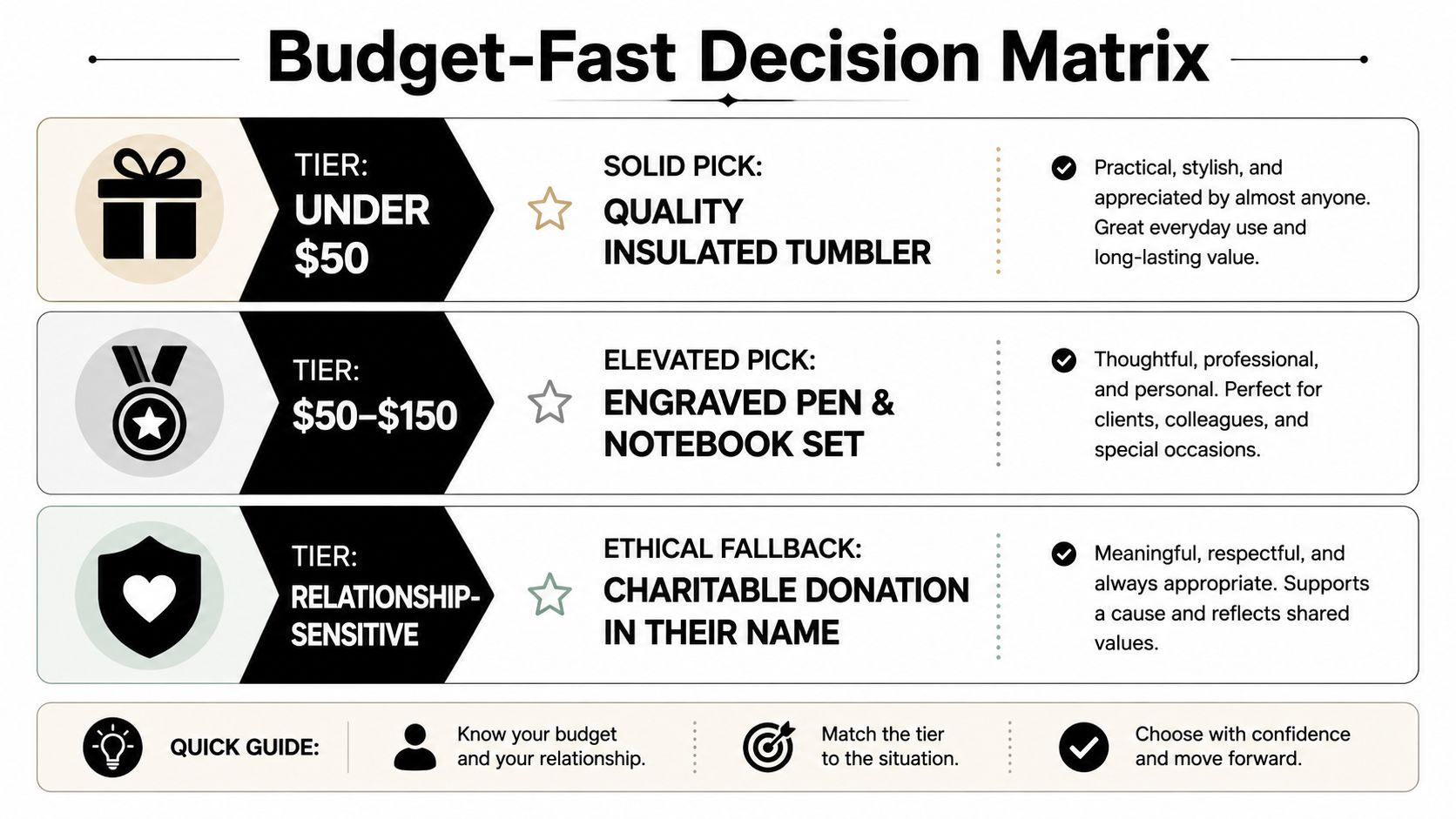
My default picks
Under $50: pick something useful and easy to keep nearby, like a quality insulated tumbler or another desk-friendly item. If it lives in the clinic, it has a better chance of being used.
$50 to $150: choose an engraved pen and notebook set, a personalized tumbler, or a modest framed keepsake. This is the sweet spot for something that feels custom without getting loud.
Relationship-sensitive gift: choose a charitable donation in the doctor’s name when the policy, power dynamic, or personal history makes a physical gift feel risky. That’s the cleanest option when you want gratitude without pressure.
The 60-second decision rule
Ask yourself four questions in order. Is this patient to doctor, colleague to doctor, or doctor to doctor? Is the occasion a thank-you, a milestone, or a farewell? Will the item stay useful on a desk, in a bag, or on a shelf? Does the personalization belong on metal, wood, leather, glass, or fabric?
If the answer points to a practical item, keep it practical. If the answer points to keepsake value, engrave it. If the answer points to hesitation, don’t push it. Choose a card or donation instead.
For buyers who want the object chosen, engraved, packed, and shipped in one place, Business Mail Boutique LLC handles that workflow from a Sugar Land storefront, which is exactly the kind of setup that makes doctor gifts easier to execute without turning them into a weekend project.
If you want a doctor gift that’s usable, start with the relationship, then choose the item, then finish it with clean personalization and packaging. Visit Business Mail Boutique LLC if you want engraving, packing, and shipping handled in one stop, especially when the gift needs to be ready fast and still look professional when it arrives.

Related posts

Custom Memorial Glasses Engraved in Three Hours in Sugar Land
When a customer needed eight personalized glasses for a memorial, Business Mail Boutique completed the engraving or...

Custom Martini Glass Engraving in Sugar Land, TX
Custom Logo Engraving on Martini Glasses in Sugar Land, Texas.
Business Mail Boutique recently completed a beautiful custom engravin...

Custom Engraved Wine Glasses for a Golf Club Event in Sugar Land, TX
Custom Engraved Wine Glasses for a Golf Club Event in Sugar Land.
Custom wine glass engraving in Sugar Land, TX at Business Mail Bouti...