
- Print Business Cards in Sugar Land – Same Day Service
- Copying Services
- Document Printing, Finishing & Lamination in Sugar Land
- Flyers
- Print Banner in Sugar Land | Same-Day Banner Printing Near Me
- Graphic Design
- Photo Printing
- Postcard Printing
- Document Printing
- EDDM Full Service Postcards
- FotoZoomer Large Format Printing


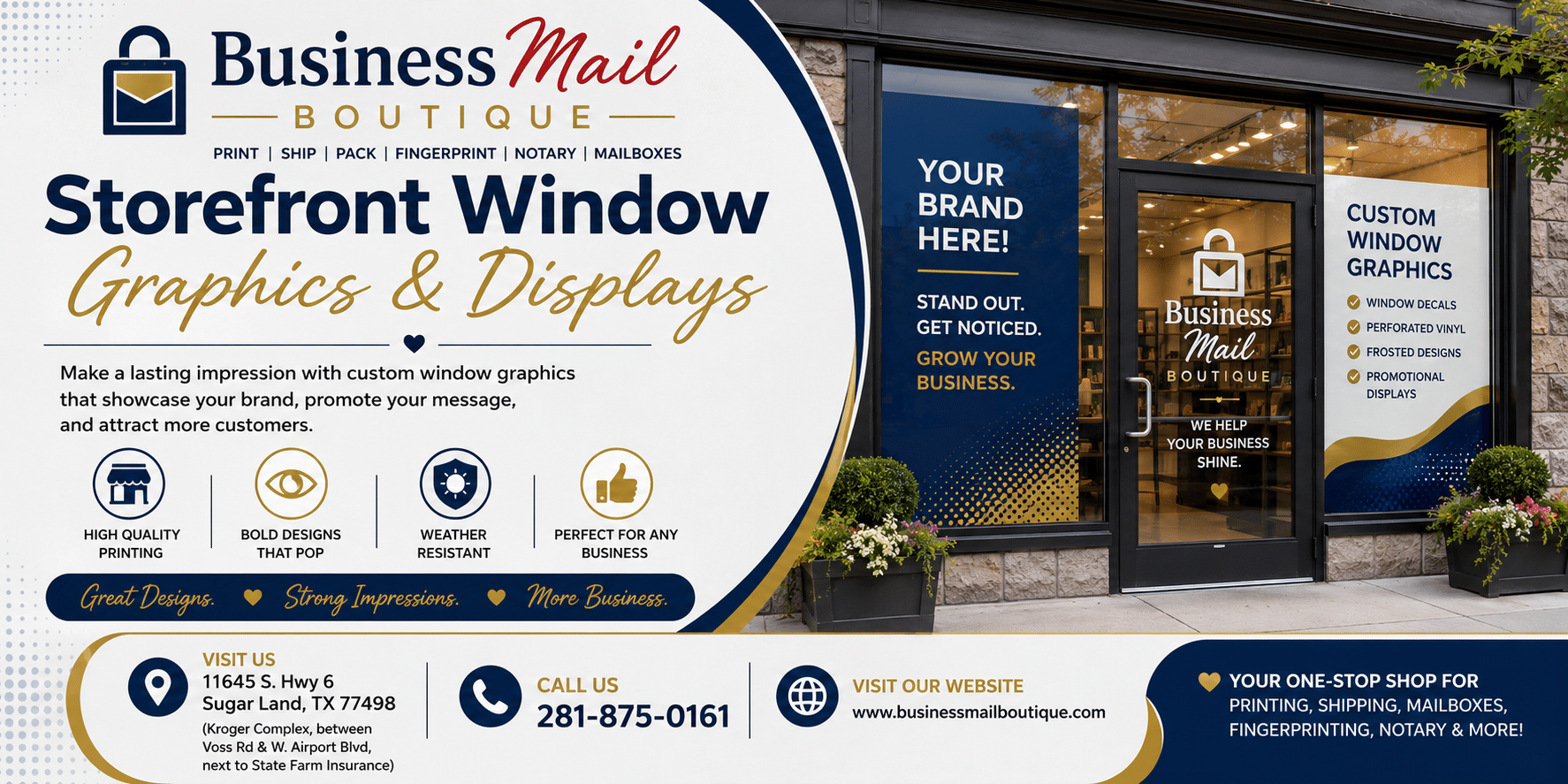
Storefront Window Graphics & Displays.
Learn how storefront window graphics & displays attract customers, reduce costs, and elevate your brand. Practical tips on design, materials, and installation.
Businessmailboutique
11645 S. Hwy 6
Sugar land, Texas 77498 United States (US)
Email: info@businessmailboutique.com
Route
You can stand at your own front door, look through the glass, and feel it immediately. The window is clean, the store is open, but nothing is doing the work of stopping people on the sidewalk and making them curious enough to step inside. That’s the gap storefront window graphics & displays fill, and in a same-day print shop, that gap is often closed before the day ends.
Table of Contents
- What Storefront Window Graphics and Displays Actually Are
- Why Storefront Window Graphics Matter for Sales and Foot Traffic
- Main Types of Window Graphics and In-Window Displays
- Materials, Vinyls, and Ink Choices That Hold Up
- Design and Measurement Best Practices for Real Storefronts
- Installation, Maintenance, and Compliance Essentials
- Pricing, Turnaround, and Ordering Locally in Sugar Land
What Storefront Window Graphics and Displays Actually Are
A lot of business owners think of the storefront window as dead space until the day they stand across the street and realize it’s doing almost nothing. A blank pane says the business is open, but it doesn’t say what the business is, why someone should care, or whether the store feels worth entering. A dressed window does all of that at once, using the glass as a working marketing surface.
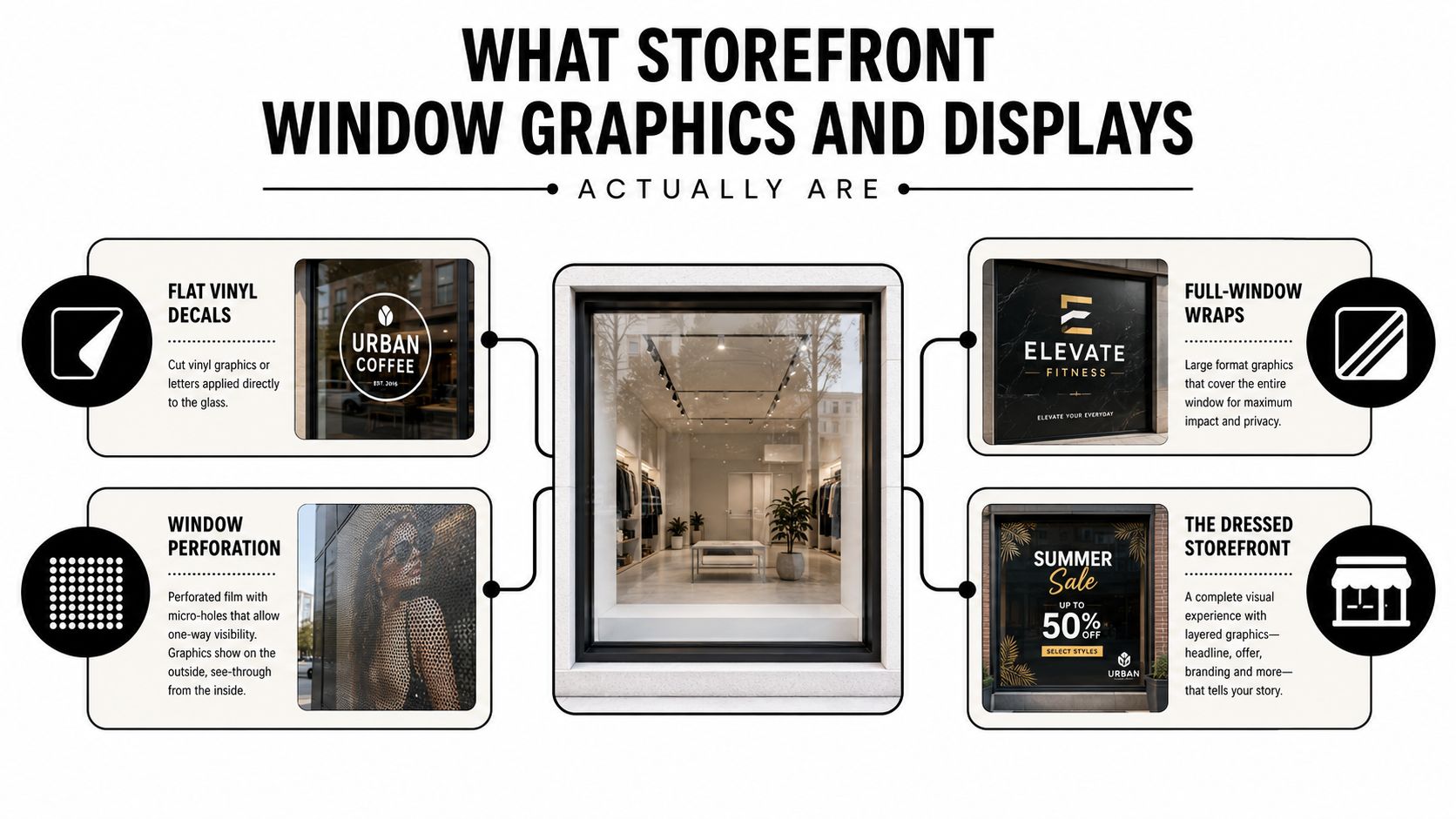
At the counter, the conversation usually starts with one of four needs. Brand identity means the glass carries the logo, colors, and look of the business. Sales promotion means the window pushes a short-term offer, event, or launch. Privacy means the owner wants to limit how much the public can see inside without making the space feel shut down. Seasonal energy means the window changes with holidays, sales cycles, or new inventory.
The main window options
Flat vinyl decals are the simplest version. They’re usually cut lettering, a logo, a phone number, or a short line of copy applied directly to the glass. They work best when the store wants a clean look and doesn’t need to cover much area.
Perforated window film is the practical middle ground for street-facing glass. From the outside, it reads like a full graphic; from the inside, it still lets people see out, which matters when the store wants to keep the interior feeling open. Full-window wraps are the boldest version, used when the goal is to create a near-total visual block and turn the window into a full campaign surface.
Freestanding and hanging displays placed in the window add another layer. Those can be seasonal props, product pedestals, mannequins, or branded pieces that work with the printed glass instead of replacing it. The best shops mix these layers carefully, so the window feels intentional rather than crowded.
A strong window doesn’t have to cover everything. It has to give people a reason to slow down.
Why Storefront Window Graphics Matter for Sales and Foot Traffic
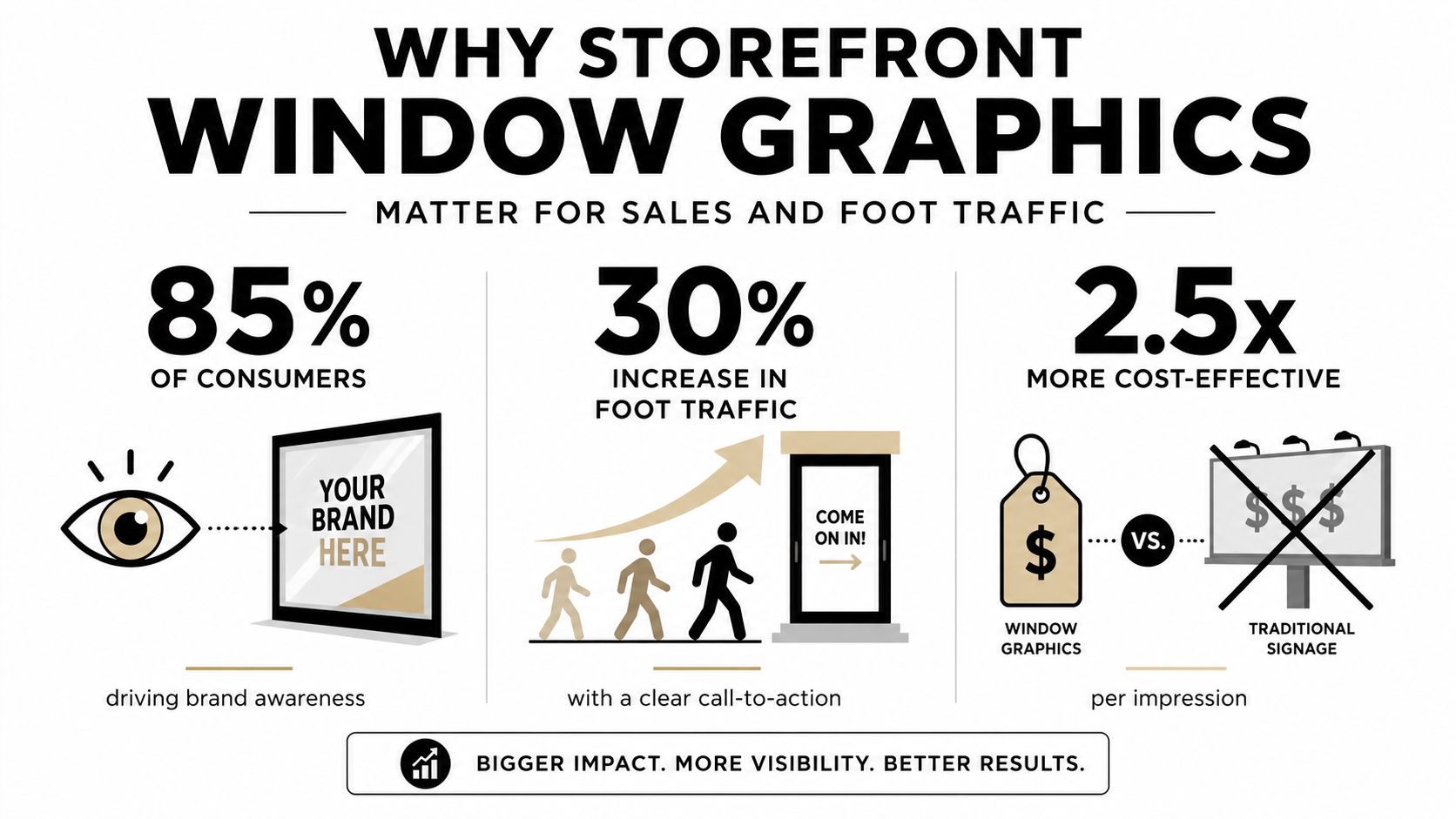
A customer can decide on a store before stepping through the door. Retail-signage research says about 76% of Americans have entered a new store because signs caught their attention, 68% have bought something because of a sign, and 60% are less willing to enter a store with a poor or unclear sign, according to the retail-signage research summarized at Supply55’s window graphics overview. That is why the storefront has to do real work before anyone speaks to a staff member.
The window also has very little time to earn attention. The same research summary describes window displays as accounting for about 25% of store traffic, with typical viewing time around 6 to 11 seconds. That short span has to carry the brand, the offer, and the reason to stop.
What the numbers mean in a real retail corridor
A storefront graphic has two jobs at once. It needs to compress the brand into a glance, which is why strong layout, clear contrast, and simple wording matter so much. It also filters traffic. A weak or unclear window tells people to keep walking, while a crisp one pulls attention from the sidewalk toward the door.
Modern industry summaries also describe well-designed storefront graphics as capable of increasing foot traffic by 20% to 30%, with some signage updates showing sales lifts around 10% and broader storefront-sign studies citing up to 15.6%, as compiled in a digital-window industry summary from UCSB’s storefront digital signage material. I treat those figures as direction, not a guarantee for every shop. The point is straightforward, the window is not decoration, it is a conversion surface.
That is also why design quality matters as much as placement. The same discipline that supports clean business graphics shows up here too, and the graphic design tips from DesignStack are useful because the basics carry over, clarity beats clutter, and hierarchy beats noise.
For a local shop, the payoff is practical. A business can walk in with a rough idea, a same-day print shop can turn that into a finished graphic, and the install can happen before the day ends if the artwork, measurements, and material choice all line up. Perforated film often works well in that kind of rush, especially when the store wants outside visibility and interior light, and our perforated vinyl guide explains why that material gets used so often on street-facing glass. If the store needs a louder launch piece, a cleaner brand panel, or a temporary promotion that has to be visible from the parking lot, the window becomes the fastest place to put the message where real foot traffic can see it.
Main Types of Window Graphics and In-Window Displays
A customer walking into a print shop usually doesn’t need a lecture. They need a menu. The right choice depends on what the glass has to do, how long it needs to last, and whether the store still needs daylight, visibility, or privacy behind it.
The common options and what they do
Full-coverage printed vinyl is the obvious choice when the window has to become the campaign itself. It works well for product launches, grand openings, and short-term branding pushes, especially when you want the outside to see one clear message.
Perforated window film is for storefronts that want the graphic outside and the view-through effect inside. If you’re trying to balance promotion with visibility, this is often the first thing I’d show you, and it’s the same material style discussed in this perforated vinyl reference.
Translucent vinyl creates a softer, more luminous look, especially when light is behind the glass. It’s useful for layered branding and for stores that want a more refined finish than a standard opaque decal.
Cut vinyl lettering and logos fit when the window only needs names, hours, a web address, or a short message. It’s clean, low-fuss, and easy to refresh without rebuilding the entire storefront.
Static clings are the fast-turnaround option. They’re the right answer for weekend promos, temporary announcements, or messaging that may need to come off the glass soon after it goes up.
Frosted and etched-look film gives privacy without making the store feel fully closed off. I like this for office suites, treatment rooms, and any business that wants a polished finish with a little separation.
Physical pieces inside the window do a different job. Mannequins, risers, hanging signs, or seasonal props create depth and help the window feel layered. That’s especially useful when the printed vinyl alone would look flat.
| Window Graphic Type | Best For | Durability | Typical Turnaround |
|---|---|---|---|
| Full-coverage printed vinyl | Bold promotions, grand openings | Medium to long-term | Same day to several days |
| Perforated window film | Street-facing branding with visibility | Medium to long-term | Same day to several days |
| Translucent vinyl | Soft-lit brand treatments | Medium | Several days |
| Cut vinyl lettering and logos | Hours, logos, minimal messaging | Medium to long-term | Same day to several days |
| Static clings | Short promos, temporary events | Short-term | Same day |
| Frosted film | Privacy, office glass, elegant separation | Medium to long-term | Several days |
Materials, Vinyls, and Ink Choices That Hold Up
The biggest mistake I see is treating material choice like a line item instead of a performance decision. A graphic can look great on screen and still fail early on glass if the vinyl is wrong, the print isn’t built for sun, or the edge finish is ignored.
Vinyl choice changes how the glass behaves
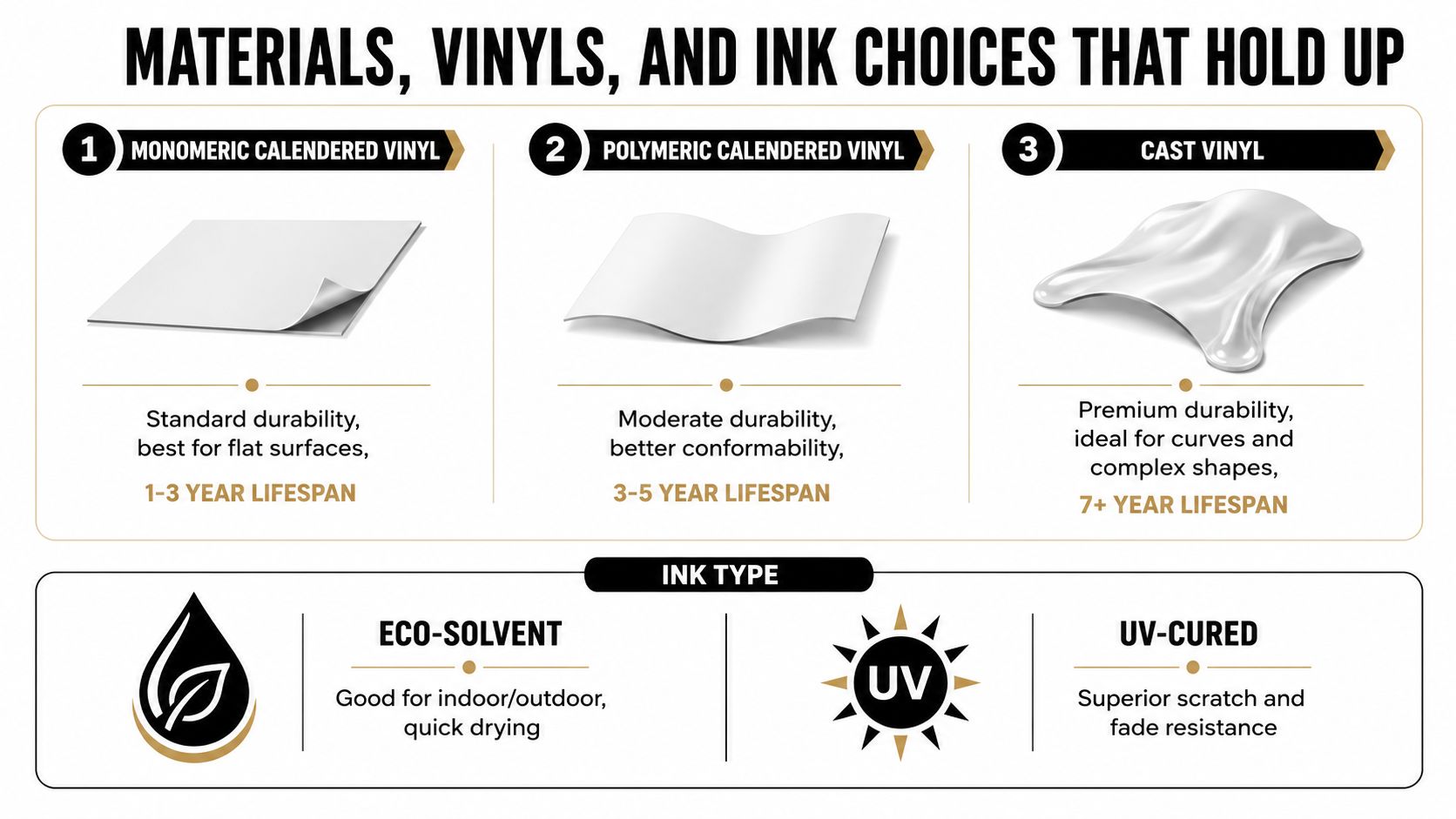
For flat surfaces, monomeric calendared vinyl is the basic workhorse. It’s the right fit when the project is straightforward and the life span doesn’t need to stretch into premium territory. Polymeric calendared vinyl gives you more conformability and better durability for work that needs to stay put longer or handle subtle glass variation. Cast vinyl is the premium choice when the application is more demanding, especially if the surface isn’t perfectly flat or the installation is expected to last.
Perforated window graphics add their own trade-off. Common retail setups use a 60/40 or 70/30 vinyl-to-hole ratio from the material guidance on perforated storefront vinyl. More printable area gives you a denser exterior image, while more open area preserves interior visibility and light. If the goal is privacy, you lean more opaque. If the goal is a welcoming storefront that still feels open, you don’t cover every inch.
Ink, finish, and file prep matter more than people expect
The same material guidance recommends CMYK artwork at 300 DPI at final output size so large-format window pieces don’t come out soft or banded. That matters because glass does not forgive blurry edges, especially on text and logos. It also notes that UV overlaminate and edge sealing improve durability, which is exactly where a lot of cheap-looking installs go wrong after the first wash-down or hot week.
If a storefront sits in strong sun, I’d rather slightly simplify the design and build the graphic to last than chase a complicated look that fails early.
For direct sun and harder-wearing jobs, the material choice has to account for the environment, not just the art. A separate production discussion on wide-format printing and finishing is useful because it reinforces a simple rule, the substrate and finish are part of the product, not an afterthought.
Design and Measurement Best Practices for Real Storefronts
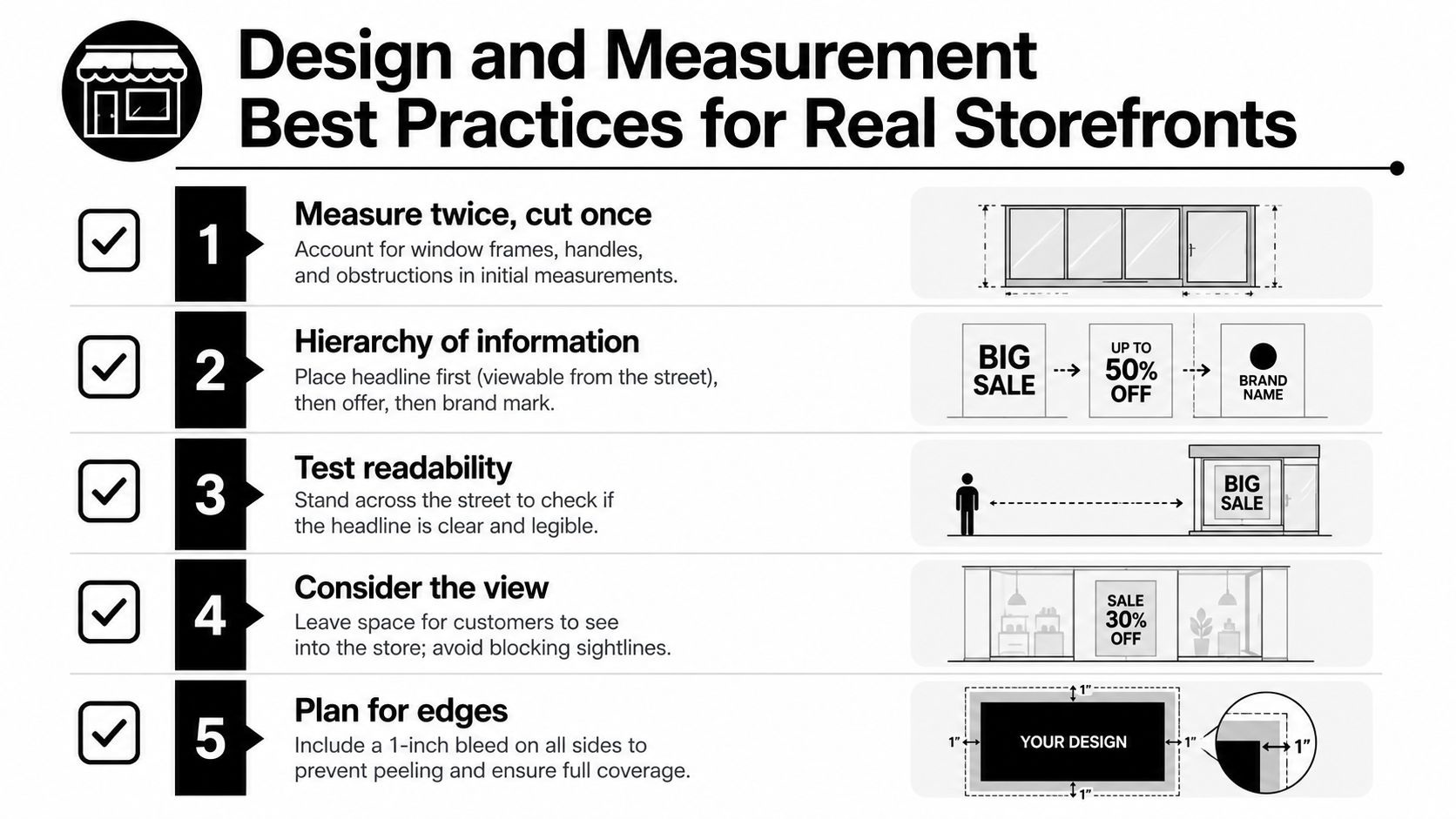
A lot of design advice sounds good until it hits actual glass. The test is whether someone walking, driving, or pausing at the door can understand the message fast enough to care. That means the headline has to work first, the offer has to support it, and the brand mark has to finish the job without crowding the face of the window.
Build the window for different viewing conditions
The storefront has to be read in motion. Pedestrians are close enough to catch details, drivers need bigger type and fewer words, and walk-up browsers often read the graphic after they’ve already slowed down. The same design can serve all three, but only if the hierarchy is disciplined.
Tint, glare, and viewing angle change how a graphic behaves through the day. Clear glass with thoughtful lighting generally gives you a better result than dark or textured glass, because the display stays visible without turning the storefront into a wall. A fully blocked window might protect privacy, but it can also kill the invitation to enter.
Measure the opening, not just the pane
The frame, handles, mullions, and any obstruction around the glass all matter. A design that ignores them often ends up with a logo crossing a seam or a headline hidden behind hardware. That’s why measurement has to happen on the actual opening, not just on a sheet of paper.
- Measure twice, cut once: Account for frames, handles, and obstructions before the file is built.
- Keep the hierarchy clean: Put the headline where a passerby sees it first, then the offer, then the brand mark.
- Test it from the street: Stand across the road and check whether the message still reads at a glance.
- Leave sightlines open: Customers should still feel that they can see into the store.
- Plan for the edges: Bleed and edge coverage keep the install from peeling early.
The best storefront graphics feel obvious once they’re up. That usually means the design was tested in the world before it ever touched the glass.
For a quick visual walkthrough of layout decisions, this embedded video is a useful reference.
Installation, Maintenance, and Compliance Essentials
Most DIY window projects don’t fail because the design was terrible. They fail because the glass wasn’t prepped, the graphic wasn’t aligned, or the edges were left vulnerable. A clean install starts with plumb and level measurements, a properly cleaned surface, and the right tools for squeegeeing, heating, and finishing the vinyl so it bonds correctly.
The other part people miss is maintenance. Sunlight, cleaning products, weather, and constant handling all wear on graphics, especially in hot, sunny markets. One practical guide recommends UV-stable inks and rigid substrates like Gatorboard for direct sunlight, which is a reminder that durability starts at production, not after the install, in this storefront display maintenance guide.
What to check before the graphic goes up
The compliance side is just as important. Municipal signage rules can limit what’s allowed, lease terms can restrict frosted or perforated film, and door visibility matters for both accessibility and emergency egress. If the graphic crosses into an entrance or exit area, the business needs to be more careful than it would on a simple side window.
Maintenance also includes removal. If a short-term decal has been on glass long enough to leave adhesive behind, sticker removal solutions for glass are worth reviewing before someone attacks the window with the wrong scraper or chemical. A bad cleanup can damage the next install, which makes the first project more expensive than it looked on paper.
The cheapest window is the one that installs cleanly and comes off cleanly.
Seasonal rotation is smart, too. Fresh creative keeps the storefront from looking stale, and a planned refresh schedule is easier on staff than letting the glass drift into a faded, outdated look.
Pricing, Turnaround, and Ordering Locally in Sugar Land
Pricing moves with size, material, print method, and install complexity. A simple cut-vinyl logo is usually the lowest-effort route, while full-coverage perforated film, layered graphics, or anything that needs precise on-site fitting adds time and cost. Same-day work is realistic when the layout is simple and the material is in house, while more complex graphics can stretch into a couple of weeks if the shop has to source special stock or coordinate a larger install.
The fastest path is local and simple. A business owner walks in with rough measurements, a phone photo, and a goal like “make this window look open, but more professional,” then the shop turns that into a proof, prints it, and schedules the install without dragging the project through email for days. If you’re weighing that route, choosing a local print shop in Sugar Land is usually the right starting point because proximity cuts delays and makes revision easy.
For small businesses, that same-day path matters more than perfection on a mood board. A storefront graphic that gets approved fast and installed cleanly has a better chance of influencing traffic than a beautiful file that sits unprinted while the sale weekend passes.
If you need storefront window graphics & displays that can move from rough idea to finished glass without losing the details, Business Mail Boutique LLC handles the kind of fast, practical print work small businesses need. Visit Business Mail Boutique LLC to talk through your storefront, get a proof started, and see how quickly your windows can start working harder.

Related posts

Custom Memorial Glasses Engraved in Three Hours in Sugar Land
When a customer needed eight personalized glasses for a memorial, Business Mail Boutique completed the engraving or...

Custom Martini Glass Engraving in Sugar Land, TX
Custom Logo Engraving on Martini Glasses in Sugar Land, Texas.
Business Mail Boutique recently completed a beautiful custom engravin...

Custom Engraved Wine Glasses for a Golf Club Event in Sugar Land, TX
Custom Engraved Wine Glasses for a Golf Club Event in Sugar Land.
Custom wine glass engraving in Sugar Land, TX at Business Mail Bouti...