- Print Business Cards in Sugar Land – Same Day Service
- Copying Services
- Document Printing, Finishing & Lamination in Sugar Land
- Flyers
- Print Banner in Sugar Land | Same-Day Banner Printing Near Me
- Graphic Design
- Photo Printing
- Postcard Printing
- Document Printing
- EDDM Full Service Postcards
- FotoZoomer Large Format Printing


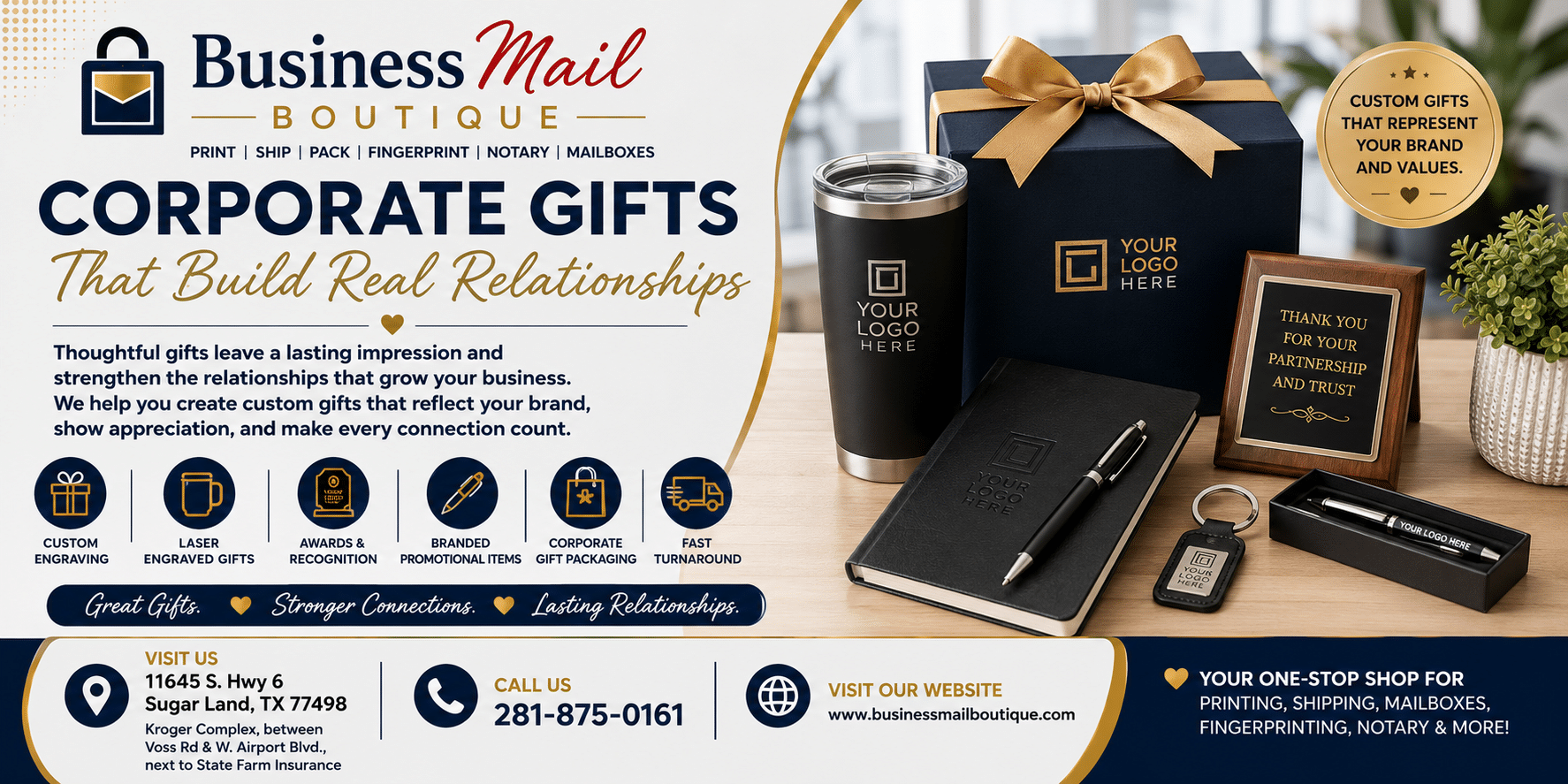
Corporate Gifts That Build Real Relationships.
Plan, personalize, and ship corporate gifts that build real relationships. A step-by-step guide for small businesses covering budgets and timing.
Businessmailboutique
11645 S. Hwy 6
Sugar land, Texas 77498 United States (US)
Email: info@businessmailboutique.com
Route
You’re probably staring at a list of clients, employees, vendors, and maybe a few prospects, and realizing the same old holiday mug won’t cut it. Most corporate gifts fail for a simple reason, they’re ordered late, chosen by habit, and shipped without a real plan. The good news is that a small business can still run a thoughtful gifting program without enterprise software, if the workflow is intentional from the start.
Table of Contents
- Why Corporate Gifts Deserve a Real Strategy
- Segmenting Your Recipients Before You Spend a Dollar
- Choosing Personalization Methods That Actually Impress
- Building a Fulfillment Workflow That Scales
- Timing Your Gifts for Maximum Impact
- Navigating Compliance and Inclusivity Requirements
- Measuring ROI and Improving Your Program Over Time
Why Corporate Gifts Deserve a Real Strategy
The worst gifting campaigns usually start with a familiar scramble. A small business owner opens a spreadsheet in late November, picks a few names at random, orders branded items, and hopes the boxes arrive before the office closes. That kind of rush rarely creates real connection, and it wastes money because the gesture is disconnected from the relationship it’s supposed to reinforce.
Corporate gifting is no longer a side task. One 2025 market estimate put the sector at $765.46 billion in 2023, with projections of $1.11 trillion by 2028 and $1.65 trillion by 2033. The same study says North America held 36.8% of global value in 2023, and larger firms still accounted for 63.6% of spending, which is why gifting is now a structured business line, not a holiday afterthought. That market estimate makes the scale obvious.
A smarter approach starts by treating gifts like recurring campaigns, not impulse buys. That means deciding who the gift is for, what outcome you want, and what the recipient should feel after it arrives. If the answer is unclear, the gift usually feels generic.
Practical rule: if you can’t explain why a recipient is getting a gift in one sentence, you probably don’t have a strategy yet.
The shift matters because corporate gifts now support client retention, employee recognition, and branded merchandise programs across large and small businesses. Even the delivery method matters more than people think, since a polished box of eco friendly corporate gifts can say more about your standards than a louder logo ever will. For businesses that want to keep the message broad but useful, a practical catalog of promotional items to give away can help separate true relationship gifts from throwaway swag.
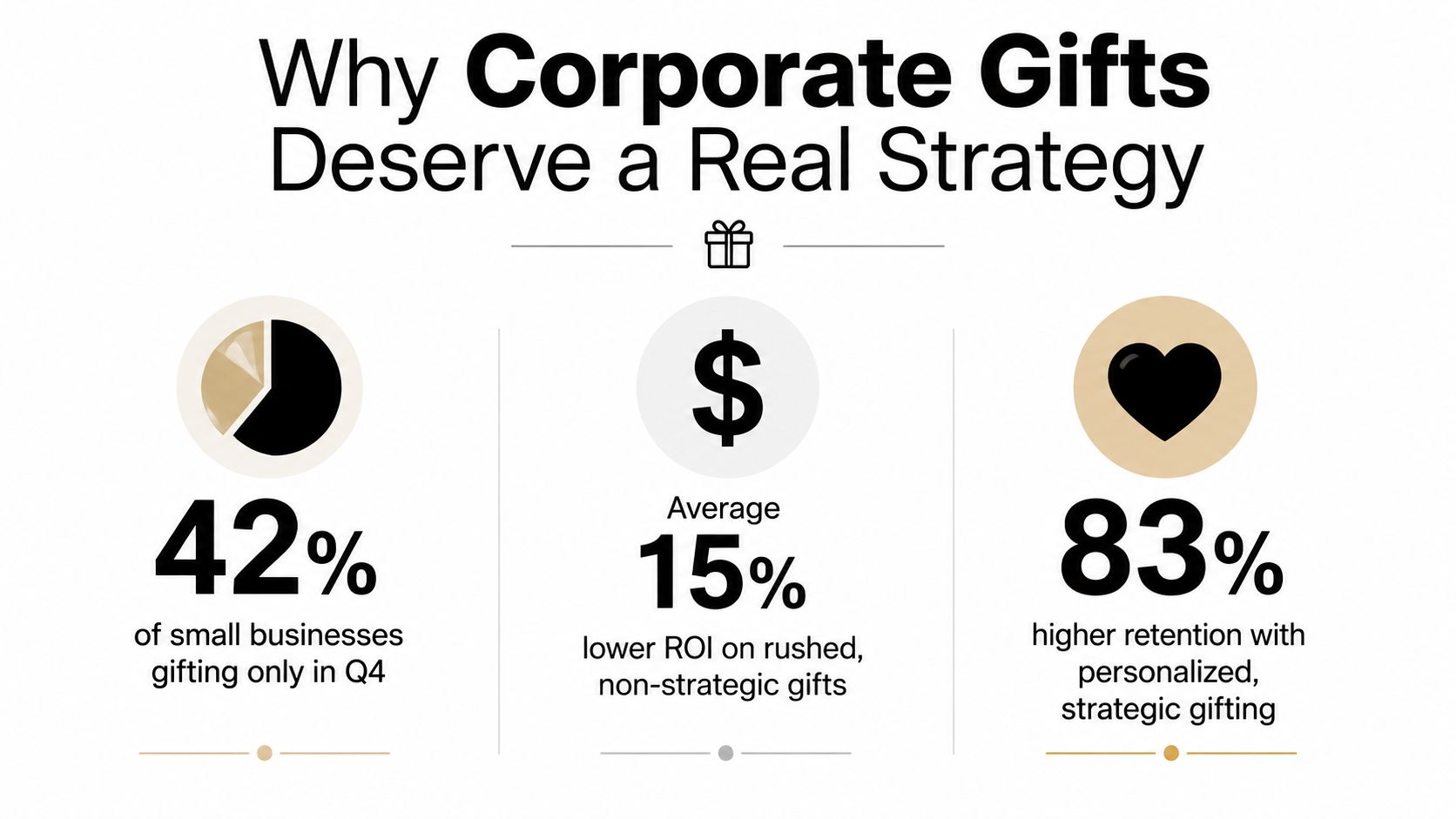
The best programs I’ve seen are built the same way a good sales process is built, with a defined audience, a repeatable spend plan, and clear follow-up. When those pieces are missing, the budget gets burned on things people barely remember. When they’re in place, the gift becomes part of how the business keeps relationships warm all year.
Segmenting Your Recipients Before You Spend a Dollar
The fastest way to waste a gifting budget is to buy one item for everyone. A long-term client, a new hire, a vendor partner, and a community sponsor don’t want the same thing, and they shouldn’t be treated like they do. The right gift depends on the relationship, the timing, and how much room you have for personalization.
Start with relationship type
I split recipients into five working groups before I spend anything. Top clients usually need something more polished and more personal. Employees often respond better to flexibility or recognition tied to their work, while vendors and referral partners usually need something tasteful and professional rather than expensive.
The market data backs up that segmentation matters. Recent industry guidance says promotional products account for 35% of spending, personalized gifts 28%, and sustainable gifts rose to 22% of total gifting spend in 2023, up from 14% in 2020. That mix tells you there isn’t one dominant format, there are different use cases with different expectations. The same source says client gifts commonly fall between $50 and $200, with enterprise gifts reaching up to $500, so a uniform budget is usually the wrong tool. That industry breakdown is useful because it points to the practical split between utility, personalization, and sustainability.
Match the gift to the recipient’s job to be done
A gift to a strategic client should reinforce trust, not advertise your logo. An employee gift should feel like recognition, not another piece of branded clutter. A partner or vendor gift should acknowledge the relationship without creating awkwardness or looking like a bribe.
| Recipient Segment | Gift Type | Budget Range | Personalization Level |
|---|---|---|---|
| Top clients | Premium physical gift, curated set, or choice-based gift card | Higher end of your client budget | High, but relevant to the account |
| Prospects | Light-touch branded item or flexible digital option | Modest | Low to moderate |
| Employees | Recognition gift, experience, or flexible option | Varies by milestone | Specific to the person or achievement |
| Vendors | Practical gift or thank-you item | Modest to moderate | Low, professional |
| Community partners | Shared-value gift or donated option | Moderate | Moderate, aligned to the partnership |
One mistake I see often is over-personalizing the wrong group. A $75 tumbler can land well with a client who already knows your business, but it can feel lazy for an employee who would have preferred choice or convenience. The better question is not “What’s a nice gift?” It’s “What outcome fits this relationship?”
A gift that fits the relationship almost always beats a more expensive gift that misses the point.
Choosing Personalization Methods That Actually Impress
A logo stamped onto a cheap item isn’t personalization, it’s decoration. Real personalization changes how the item is perceived, and that difference shows up in the finish, the material, and the way the recipient uses it later. If you’re choosing between laser engraving, sublimation, or custom packaging, the right answer depends on the object and the moment.
Compare the methods by outcome, not trend
Laser engraving works well on hard goods like tumblers, plaques, pens, cufflinks, and similar items because it looks permanent and clean. Sublimation is better for mugs, key chains, and other coated surfaces where color and full design matter. Custom packaging doesn’t change the gift itself, but it can turn a simple item into something that feels more deliberate, especially when the unboxing experience matters.
For executive-level gifting, it helps to think less about decoration and more about fit, finish, and message. A practical guide like how to choose executive gifts is useful because the challenge isn’t finding a “nice item,” it’s avoiding something that feels generic or out of place.
Use local production when timing matters
Small businesses often assume personalization means waiting on a distant vendor and hoping the proof comes back on time. That’s not always necessary. A local shop that offers engraving and print work can handle smaller batches faster, and that matters when a campaign is built around a milestone, a client win, or a recovery gesture after a missed deadline.
Business Mail Boutique LLC offers laser engraving on items like plaques, key chains, and mugs, which makes it a practical option when the goal is to personalize without managing multiple vendors. Their engraving powder coated tumblers custom laser engraving services in Sugar Land is a clear example of how a local workflow can support smaller runs that online ordering often handles poorly.
Practical rule: the more urgent the gift, the simpler the personalization should be. Complex customization looks impressive until it delays the whole campaign.
Turnaround also affects impression. A beautifully engraved item that arrives after the moment has passed often performs worse than a simpler gift delivered on time. That’s why packaging should be part of the personalization decision, not an afterthought. A clean insert, a handwritten note, and a professional finish can do more for perception than adding one more logo ever will.
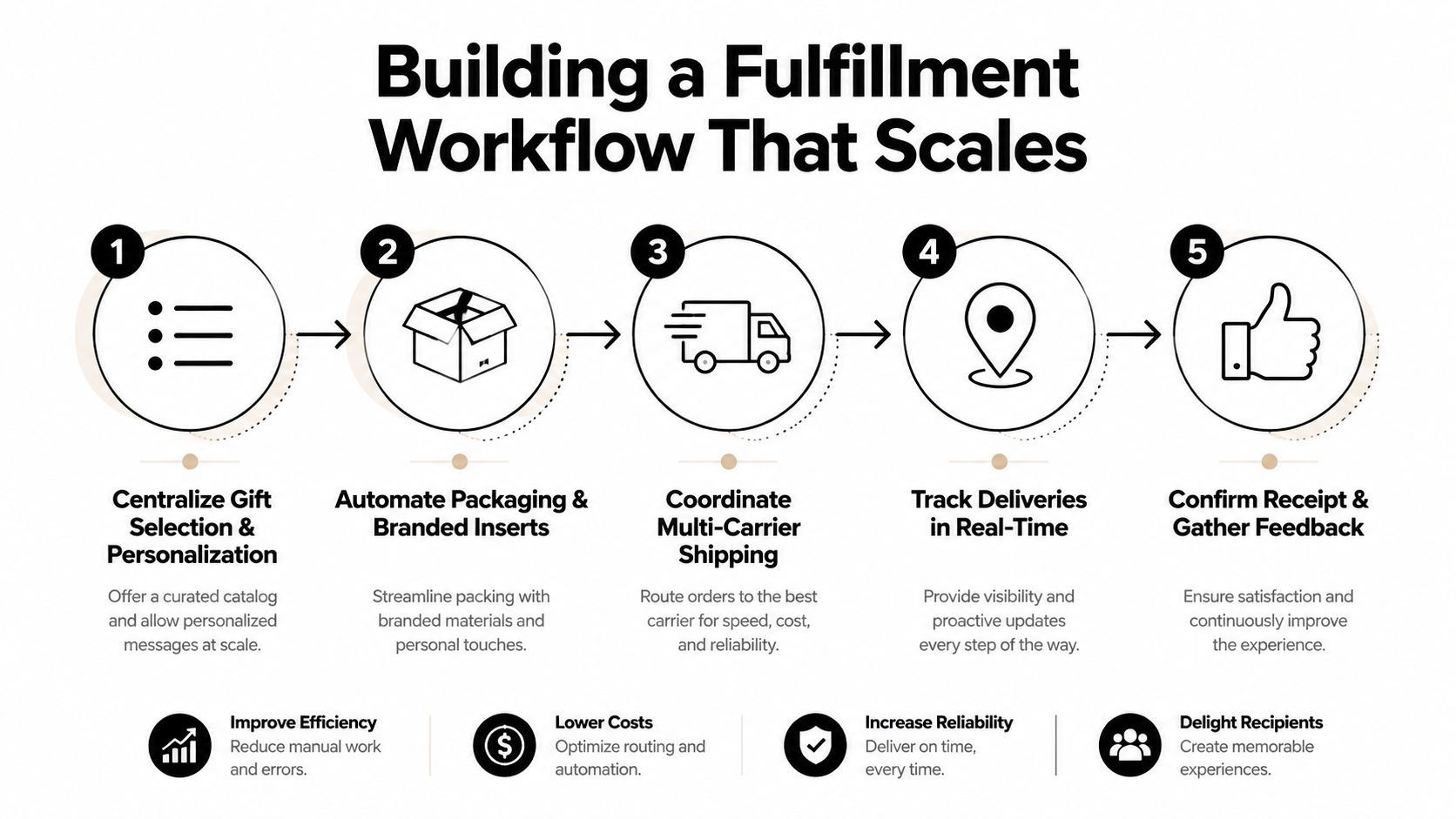
Building a Fulfillment Workflow That Scales
Ordering gifts is the easy part. The hard part is getting the right items packed, labeled, shipped, tracked, and received without someone in your office turning into a part-time warehouse manager. If you’ve ever juggled multiple addresses, carrier deadlines, and last-minute corrections, you already know the problem is logistics.
Centralize the moving pieces
Start by keeping selection, personalization, and shipping in one workflow. That doesn’t mean one employee has to do everything, it means one system should own the job from order placement to final confirmation. If your print vendor, engraver, packer, and shipper are all separate, every handoff adds time and error risk.
A local hub can simplify that. Business centers that handle packing, shipping, printing, and mailbox services can reduce the number of vendors you chase, especially when you’re sending to multiple recipients at different addresses. For multi-address programs, a service like holiday gifts set creating shipping can be the difference between a smooth rollout and a pile of delayed boxes.
Build a repeatable delivery flow
The easiest workflow is the one you can run twice a year without reinventing it.
- Lock the recipient list early. Clean addresses first, then assign each person to a segment.
- Approve the gift and message together. The note matters as much as the item, especially when the gift is meant to feel personal.
- Bundle packaging with shipping. Don’t let one team finish items while another team guesses on labels.
- Track every package. If a box goes missing, you need the carrier record, delivery status, and recipient contact in one place.
- Close the loop. Confirm receipt, then capture feedback while the gift is still fresh.
Don’t skip recovery steps
Returns and failures happen. Someone moved offices, a package was refused, or a handwritten address got mistyped. Have a plan for re-shipping and corrections before you launch the campaign, because the time you save on the front end disappears fast if you improvise on the back end. A small business doesn’t need a warehouse to do this well, it needs a clean process and a vendor that can keep the handoffs tight.
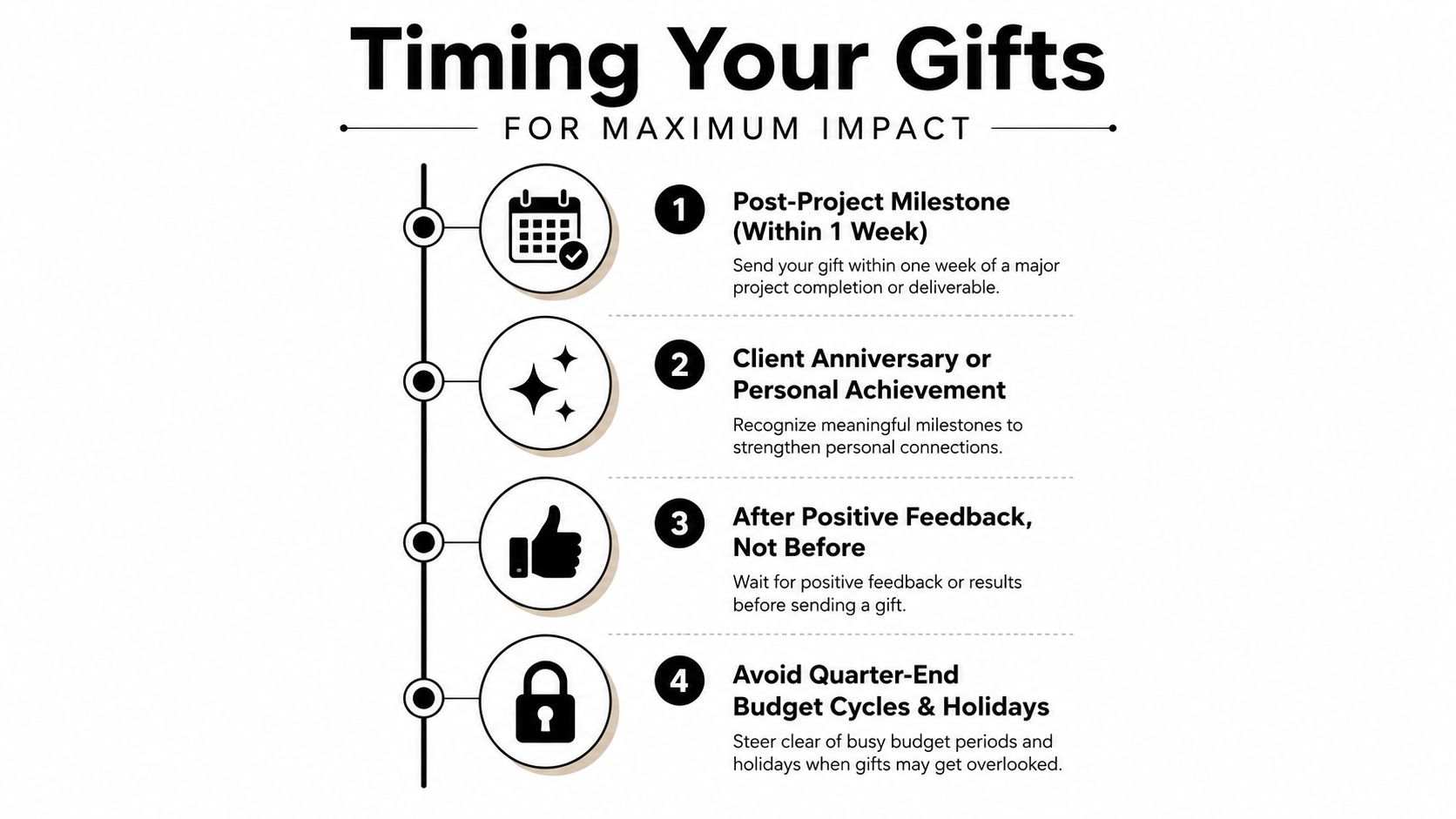
Timing Your Gifts for Maximum Impact
The most expensive gift can still feel flat if it lands at the wrong moment. Timing shapes how a gift is interpreted, and recipients notice whether it arrives as a genuine gesture or as a prelude to a commercial ask. A modest gift sent at a low-pressure moment usually creates more goodwill than a premium one sent under obvious pressure.
Give after the moment, not before the ask
Recipient behavior analysis from 10,000 corporate gifts found that the most appreciated gifts arrived at a low-pressure moment, weren’t tied to a commercial ask, and were followed by genuine human warmth, which is exactly why timing deserves more attention than item selection alone. That recipient analysis is blunt about the point, the sender’s intent is part of the gift.
That means the best windows are often the ones people forget to plan for. A project wrap-up, a client renewal celebration after the deal is done, or a work anniversary all feel cleaner than a box dropped on someone’s desk right before a negotiation. Gifts tied too closely to a pending ask can read like pressure, even if the item itself is well chosen.
Send the gift when the relationship feels warm, not when you need something.
Use a calendar that spreads the budget out
Holiday season gets crowded fast, and crowded timing reduces attention. Spreading your budget across the year gives you more moments that feel specific and less competition with everyone else’s December mailers. If you run a small team, it also makes the cash flow easier to manage.
A good annual cadence usually includes client milestones, employee anniversaries, post-launch thank-yous, and occasional recovery gifts after a tough service issue. For product-heavy teams, a practical sourcing guide such as the PureHQ Inc. wholesale guide can be useful when you’re evaluating categories that work better in volume and can be timed around a relationship milestone instead of a holiday rush.
If you only remember one rule, make it this one. The gift should make the recipient feel noticed, not managed. That’s the difference between relationship-building and disguised outreach.
Navigating Compliance and Inclusivity Requirements
Corporate gifting gets awkward fast when it ignores policy, culture, or dietary realities. A gift that is perfectly fine for one person can create discomfort for another, and a campaign that looks thoughtful on paper can still create risk if nobody checks the details. The safest programs are the ones that make it easy to say yes, or to opt out gracefully.
Build a pre-send checklist
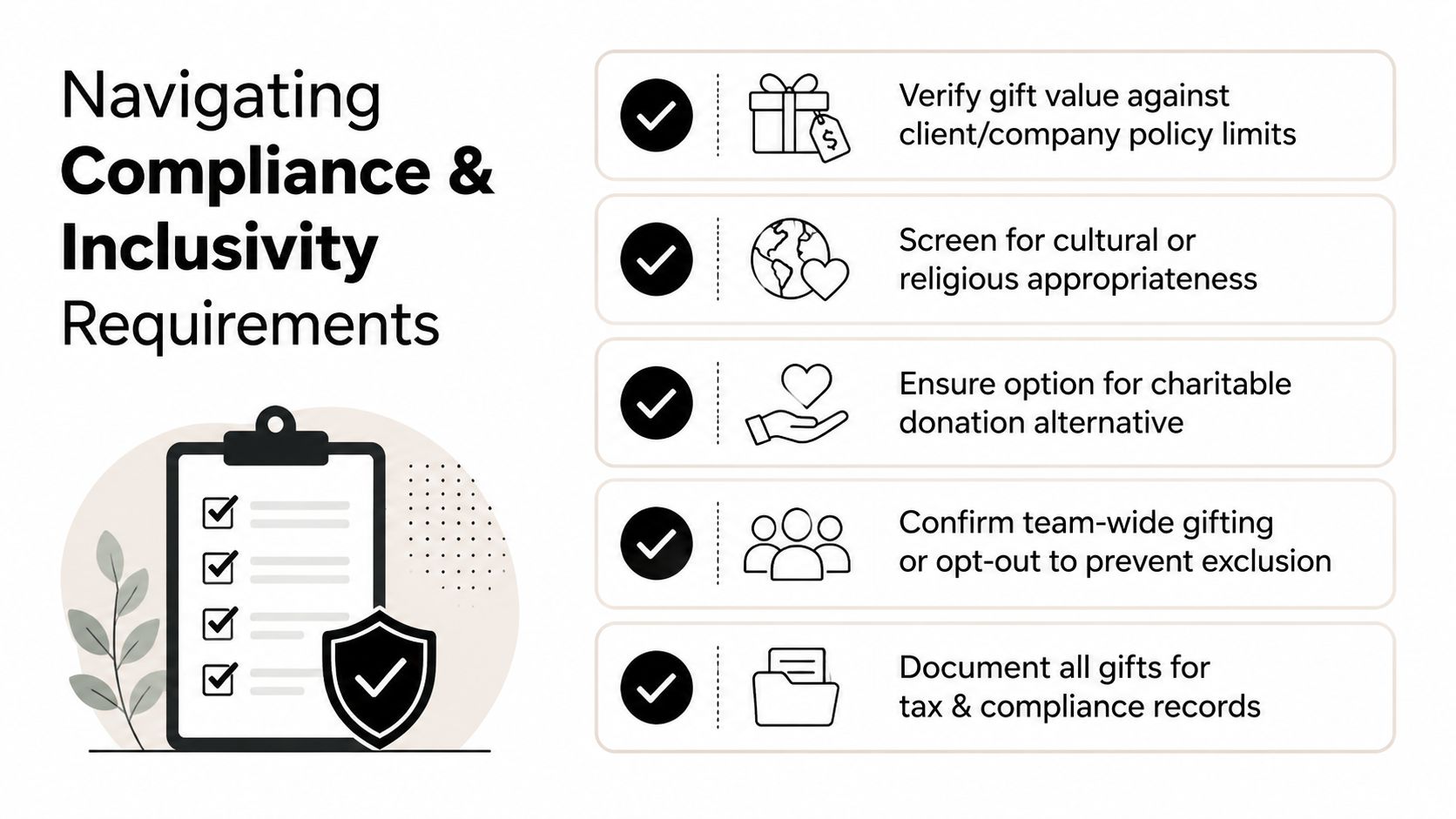
Before anything leaves the building, verify the basics. Check internal policy limits, confirm whether the recipient is in a regulated role, and make sure the gift won’t collide with active negotiations. Current etiquette guidance also warns against overly personal gifts, cheap logo-heavy swag, and expensive gifts during active contract talks, which lines up with what careful senders already know from experience. That 2026 etiquette guide is useful because it frames the issue as both social and operational.
Food gifts need extra care. Allergies, dietary restrictions, and religious observance can turn a generous gesture into an awkward one if the recipient can’t safely use it. That’s one reason a curated menu or choice-based option often works better than a surprise box.
Keep the program equitable and document it
The cleanest way to reduce friction is to give recipients a controlled choice. A menu of options, a digital gift card, or a charitable donation alternative can preserve goodwill without forcing everyone into the same format. That approach also helps with fairness, because employees and clients don’t have to compare a one-size-fits-all gift that favors one office or one region.
A practical checklist makes the process repeatable:
- Verify policy fit: confirm the gift matches company and client rules.
- Screen for culture and religion: check whether the item, message, or delivery timing creates conflict.
- Offer an alternative: include a donation or choice-based option where appropriate.
- Avoid exclusion: give teams a path to opt out or select a neutral option.
- Record the send: document the gift, recipient, date, and business purpose for tax and compliance files.
The tax side matters too. A business gift may be subject to a $25 per recipient per year deduction limit under the IRS framework discussed in the tax guidance, while incidental costs like engraving, packaging, shipping, and insurance are treated differently in that summary. That tax overview is the clearest reminder that a pretty box is still a recordkeeping event.
Measuring ROI and Improving Your Program Over Time
If you don’t measure gifting, you’re mostly guessing. The point isn’t to turn every box into a spreadsheet problem, it’s to learn which gifts actually help relationships move in the right direction. Small businesses already have enough signals to do this well without buying expensive enterprise tools.
Track the outcomes you already touch
Start with simple business outcomes, not vanity metrics. Client retention conversations, repeat orders, referral mentions, employee responses, and follow-up replies all tell you something about whether the gift did its job. If your team already uses a CRM, tie the gift note to the contact record so you can see whether a touchpoint followed a meaningful send.
The strongest pattern from recipient behavior is that the follow-up matters a lot. Gifts that are followed by genuine warmth tend to leave a better impression than gifts that are immediately converted into a sales nudge, which means the post-send message should be part of the measurement plan, not just the gift itself. That recipient analysis makes the follow-up point hard to ignore.
Review the program in simple quarters
A useful review doesn’t need a dashboard full of charts. It needs a short list of questions that your team answers candidly:
- Which segment got the strongest response?
- Which gift format was easiest to fulfill?
- Which timing window produced the warmest replies?
- Which recipients needed choice instead of a fixed item?
- Which sends created friction, confusion, or compliance issues?
Once those answers are in one place, the next round gets easier. You stop repeating weak campaigns, you reserve premium gifts for the relationships that justify them, and you use local fulfillment where it saves time.
Practical rule: a gifting program gets better when you keep the recipient record, the send date, and the follow-up response in the same place.
Over time, the goal is simple. Corporate gifts should become a documented part of how you retain clients, recognize employees, and stay memorable for the right reasons. If you can explain what worked and what didn’t after each cycle, the program stops being a cost center and starts becoming a repeatable relationship tool.
If you’re ready to make corporate gifts feel more personal and less improvised, Business Mail Boutique LLC can help with printing, packing, shipping, and personalization in one place. Visit Business Mail Boutique LLC to see how their local services can support engraved gifts, fulfillment, and mailbox-based delivery workflows for your next campaign.

Related posts

Perfume Bottle Engraving Sugar Land | Same-Day Service
Same-Day Perfume Bottle Engraving in Sugar Land.
Custom Perfume Bottle Engraving in Sugar Land — Same-Day Personalized Gifts
Make a...

Leather Portfolio Engraving in Sugar Land | Custom Initials
Custom Leather Portfolio Engraving in Sugar Land: Personalized Initials for Corporate Gifts
A professional portfolio is something ...

Corporate Watch Engraving in Sugar Land | Business Mail Boutique
Custom Watch Engraving in Sugar Land: Meaningful Gifts for Employee Appreciation
A personalized watch can turn a company’s thank-you i...