
- Print Business Cards in Sugar Land – Same Day Service
- Copying Services
- Document Printing, Finishing & Lamination in Sugar Land
- Flyers
- Print Banner in Sugar Land | Same-Day Banner Printing Near Me
- Graphic Design
- Photo Printing
- Postcard Printing
- Document Printing
- EDDM Full Service Postcards
- FotoZoomer Large Format Printing


Live Scan, FBI & FD-258 Fingerprint Cards.
Compare Live Scan, FBI & FD-258 fingerprint cards. Learn when each is required, submission workflows, costs, and processing times in Sugar Land.
Businessmailboutique
11645 S. Hwy 6
Sugar land, Texas 77498 United States (US)
Email: info@businessmailboutique.com
Route
You just got the fingerprint notice, and the instructions aren’t helping. One line says Live Scan, another mentions an FBI card, and a third asks for FD-258 with no explanation at all. If you’re standing there wondering which version you’re supposed to get, you’re not alone.
For a first-timer, the confusion is normal because Live Scan, FBI submissions, and FD-258 fingerprint cards solve different problems. Some agencies want electronic submission, some want a physical hard card, and some accept only one of the two. If you want a plain-English primer before you book anything, the Closer Innovation Labs Corp. identity tool is a useful place to see how identity verification fits into broader screening workflows, and a general fingerprinting FAQ guide can help you decode the basics.
Table of Contents
- Why Fingerprinting Requirements Confuse Most Applicants
- Live Scan Versus FD-258 Fingerprint Cards Compared
- Step-By-Step Fingerprint Submission Workflows
- Rejection Rates and Why Image Quality Matters
- What To Bring and How To Prepare For Your Appointment
- Processing Times and Costs For Each Fingerprinting Method
- Get Fingerprinted at Business Mail Boutique in Sugar Land
Why Fingerprinting Requirements Confuse Most Applicants
A customer walks in with a license packet, a hiring packet, or an immigration checklist, and the paper says “fingerprints required.” That is usually where the confusion begins. The request may not say whether the agency wants electronic Live Scan, a mailed FD-258 card, or a submission route tied to the state where the applicant lives.
The receiving agency controls the format, and that detail changes the appointment you need. One person may need Live Scan for an in-state license and an FD-258 card for a federal or out-of-state request. Applicants who rely on the wording alone often book the wrong service because the document names the need, but not the method.
Two paths, two different jobs
Live Scan is the digital option. A technician captures your prints electronically, checks quality on the spot, and sends the data to the receiving system when that workflow is accepted.
FD-258 is the FBI’s official hard-card format. The prints are placed on a physical card, then mailed or otherwise delivered according to the agency’s instructions. The card still matters because not every authority accepts electronic fingerprint submission.
Practical rule: if the instructions name a specific agency, form, or submission method, follow that exact instruction instead of assuming any fingerprinting office can “make it work.”
That is the point first-time applicants miss. The fingerprinting site can capture the prints correctly, but the agency still decides whether it wants a digital transmission or a paper card. If the request is unclear, ask three things before booking, whether the agency accepts Live Scan, whether it requires an FD-258, and whether the requirement changes based on your state or location. If you want help sorting out the wording before you book, the complete fingerprinting FAQ breaks down the common request types in plain language.
A good way to keep it straight is to separate the job from the format. Live Scan is a workflow, while FD-258 is a physical card. When the application says one thing and the submission site offers another, write down the agency name and submission method before booking, because that single step prevents the most common mistake. For cases where identity checks are part of the same process, the Closer Innovation Labs Corp. identity tool follows the same basic idea, confirm what the receiving party requires before you submit anything.
Live Scan Versus FD-258 Fingerprint Cards Compared
Live Scan and FD-258 both serve fingerprint-based background checks, but they solve different problems. Live Scan is the digital workflow, while FD-258 is the paper format that many federal, out-of-state, and non-electronic submissions still rely on. If you want a broader service overview, the fingerprinting ink and Live Scan capture guide is a helpful companion read.
The quick side-by-side view
| Feature | Live Scan (Digital) | FD-258 (Ink Card) |
|---|---|---|
| Format | Electronic capture | Physical FBI fingerprint card |
| Submission | Sent digitally when accepted by the agency | Mailed or physically delivered |
| Best fit | In-state electronic workflows | Out-of-state, federal, or non-electronic requests |
| Technician role | Captures and checks quality on-screen | Rolls prints onto the card, or prints a digital capture onto the card |
| Main advantage | Cleaner capture and faster transmission | Works when a hard card is required |
| Main limitation | Not accepted everywhere | Slower and more dependent on card quality |
The biggest difference is not the fingerprint itself. It’s the path the fingerprint takes after capture. Live Scan keeps the process electronic, which is why it’s the usual choice when the agency accepts digital submission. FD-258 exists for the cases where a physical card is still required, including many federal workflows and jurisdictions that don’t accept electronic fingerprinting.
Where each one fits in real life
A California applicant seeking an in-state license often gets sent to Live Scan. A person outside California who needs California licensing paperwork may be told to submit an FD-258 card instead. Federal vetting can also call for a card-based submission depending on the specific request.
A local technician can’t override the agency’s format rules, but they can save you from choosing the wrong path before you pay twice.
The useful way to decide is simple. If the agency accepts electronic fingerprints and you’re using an in-state workflow, Live Scan is usually the cleanest option. If the request says hard card, federal packet, or out-of-state submission without electronic acceptance, the FD-258 card is the safer assumption until you confirm otherwise.
Step-By-Step Fingerprint Submission Workflows
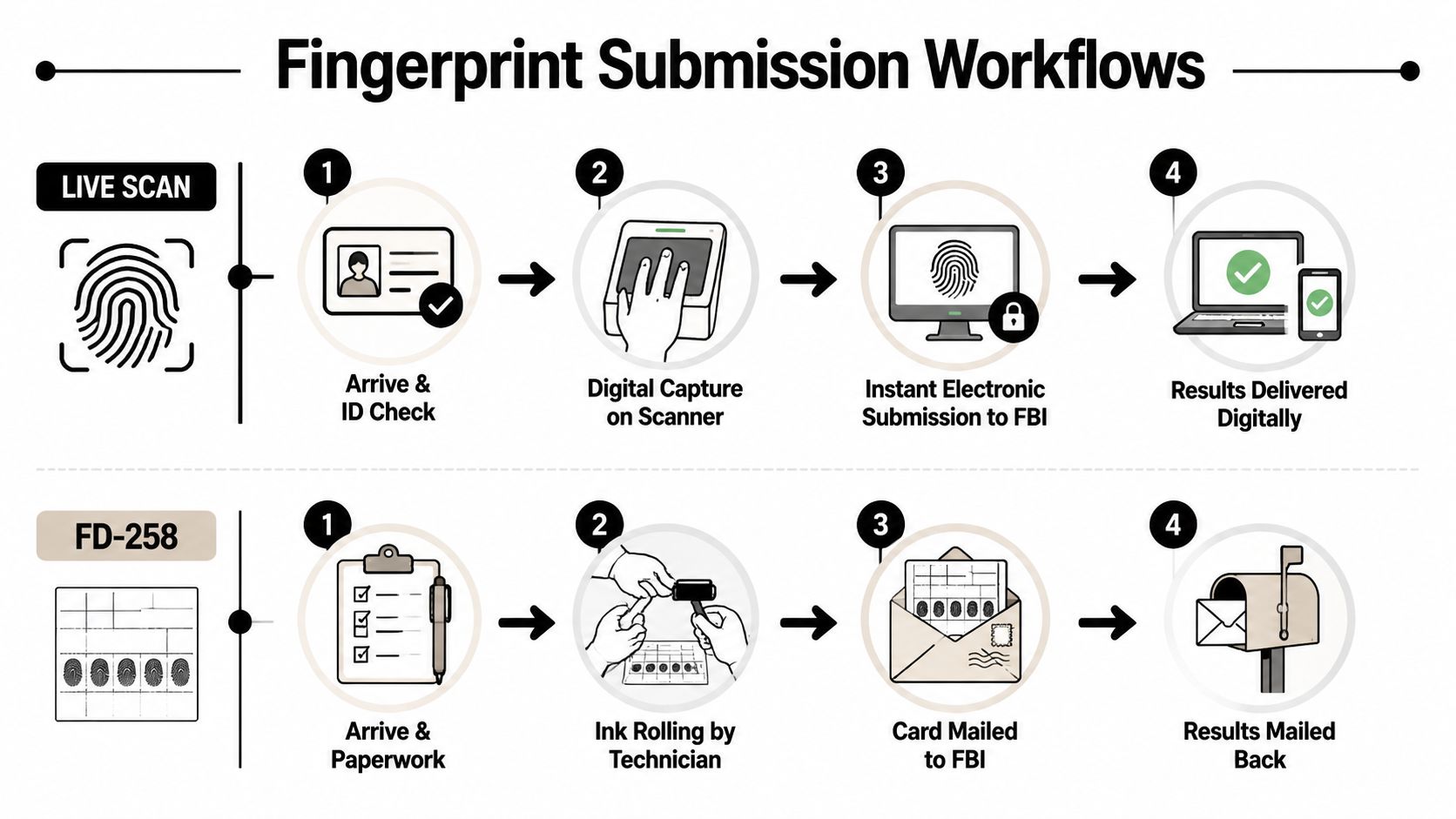
The process feels easier when you can see the handoff points. With Live Scan, the technician is checking your prints before you leave. With FD-258, the workflow extends past the appointment because the card has to be completed correctly and then sent on to the agency.
Live Scan from arrival to transmission
You check in, show your ID, and the technician confirms the request information. Your fingers are then rolled across the scanner and checked on-screen for clarity while you’re still there.
That on-the-spot review is the big advantage. If a ridge pattern is faint or a finger wasn’t placed cleanly, the technician can try again before the session ends. Once the image quality looks acceptable, the submission is sent through the accepted electronic channel.
FD-258 from card to delivery
The traditional route starts the same way, with identity verification and request details. After that, the technician rolls each finger onto the card, making sure the card fields match the request.
Some offices use a hybrid process. They capture prints digitally first, then print the result onto an FBI-approved FD-258 card. That keeps the paper format the agency wants while using digital quality checks to improve capture fidelity.
For people who need a visual walkthrough, this embedded video shows the fingerprinting flow in practical terms.
The final step for hard cards is the one that causes the most delay. The card has to be mailed or otherwise delivered, then logged by the receiving office before the background check moves forward. If you’re working against a deadline, that extra handoff is often the part that matters most.
Rejection Rates and Why Image Quality Matters
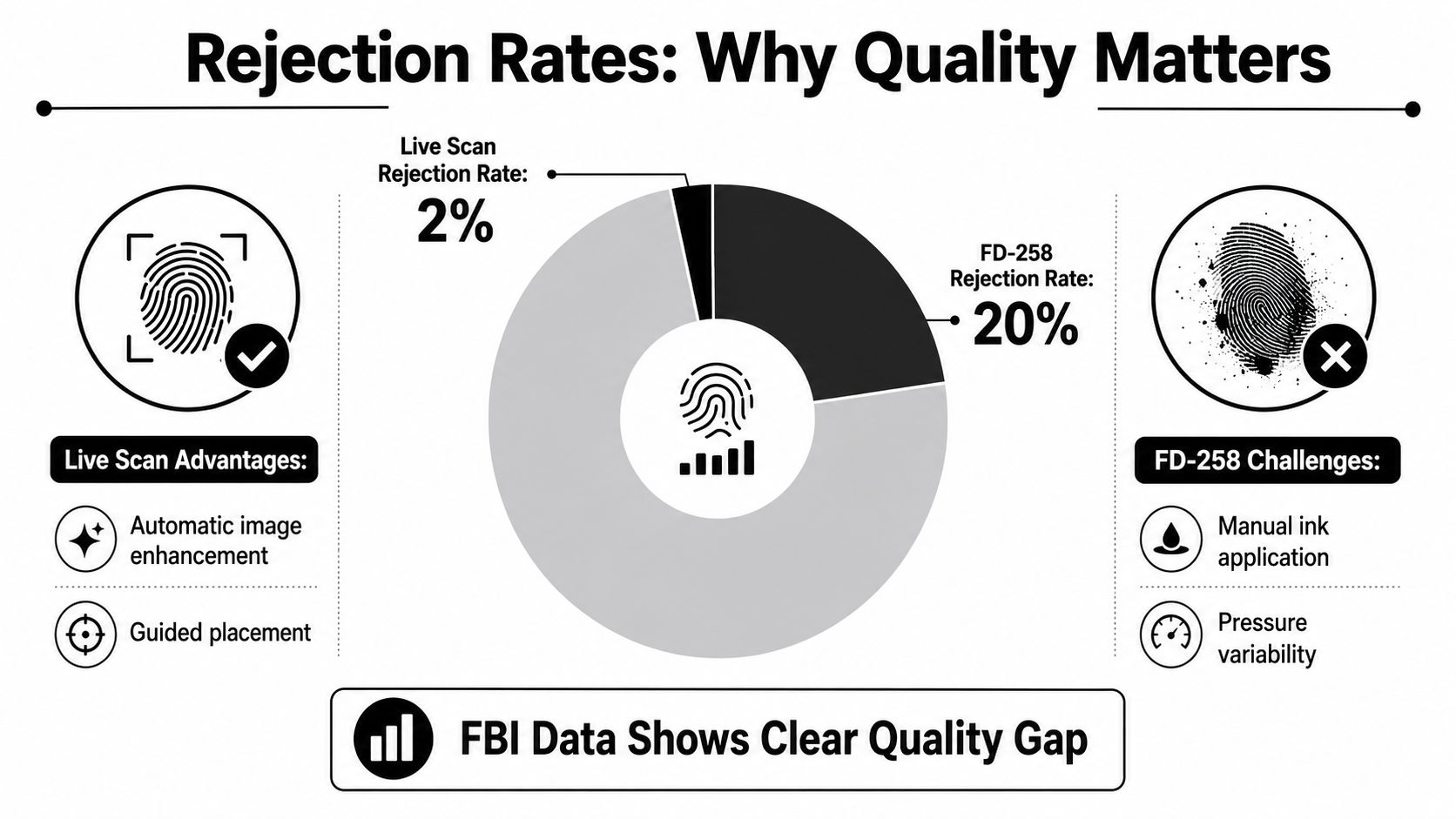
The reason technicians care so much about print quality is simple. A fingerprint that looks fine to the eye can still be unusable to the receiving agency if the ridges are smudged, incomplete, or too faint to read. When that happens, the applicant usually has to start over, which means more waiting and more paperwork.
The historical shift away from ink cards shows why this issue mattered so much. A National Institute of Standards and Technology paper reported that the FBI was already receiving over 1,000 live-scan-generated fingerprint cards per workday, and projected that volume to rise to over 20,000 per workday by 1997, while also rejecting about 2% of inked criminal cards and about 10% of inked civil cards because the prints were illegible. Those figures are in the NIST paper on FBI submission standards, and they help explain why digital capture took hold so quickly. NIST paper on FBI submission standards
Why the rejection gap exists
The difference comes down to control. Live Scan systems check image quality before the session ends, which reduces the chance of sending a weak image. Traditional ink cards depend more on hand pressure, ink coverage, finger rolling technique, and the paper itself.
That’s why a skilled technician matters. A careful operator can guide the fingers better, avoid over-inking, and catch a bad impression before it becomes a rejected card. The card-based route can still work very well, but it gives you less room to fix mistakes after the appointment.
The practical consequence for applicants
A rejected submission isn’t just an inconvenience. It can push back licensing, employment, or federal processing because the agency won’t move forward until it gets a readable set. If the applicant also chose the wrong format, the delay gets even worse.
The safest mindset is to treat quality as part of compliance, not just presentation. Good fingerprints don’t just look neat, they protect the timeline.
What To Bring and How To Prepare For Your Appointment
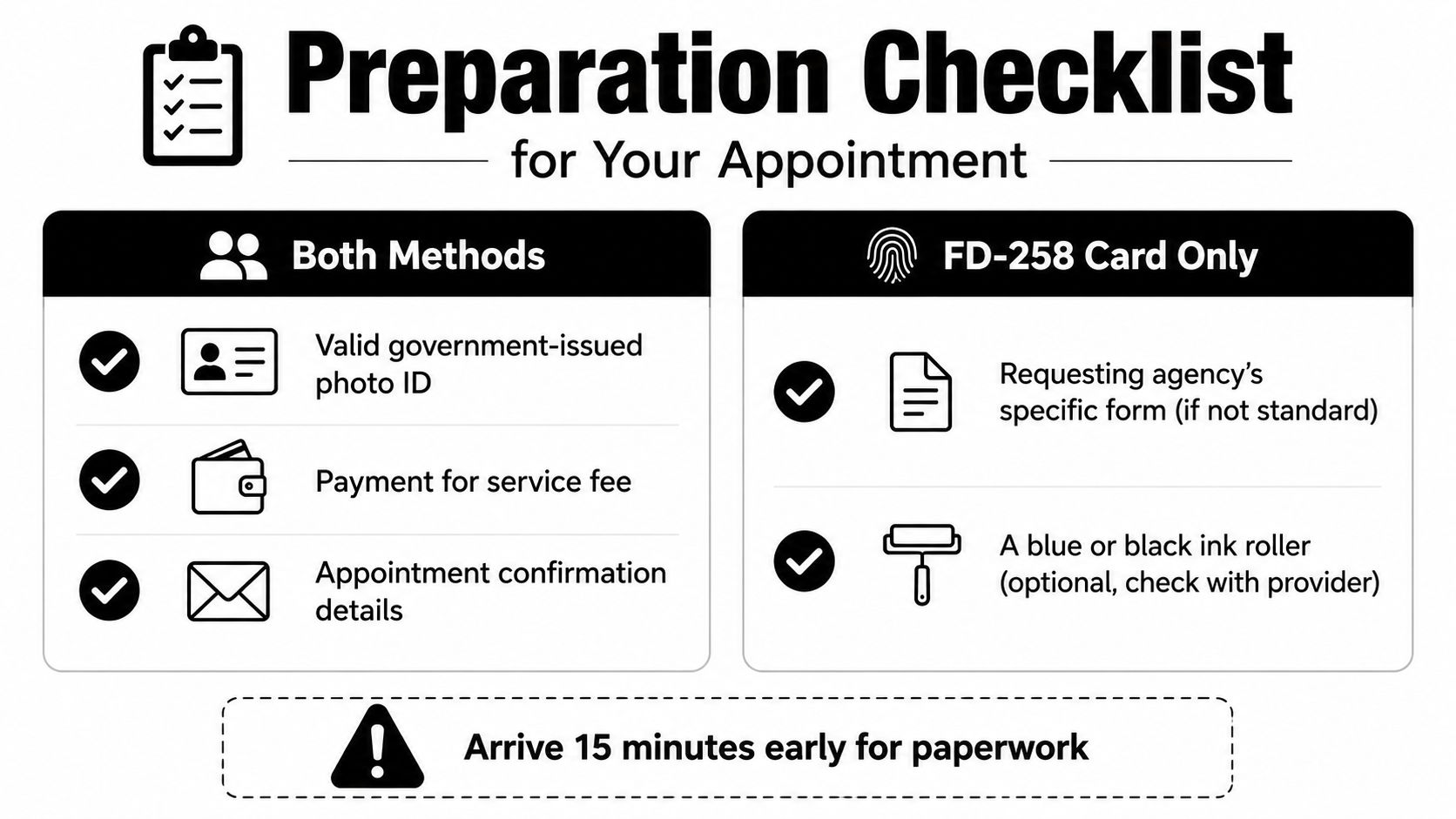
Preparation sounds simple until the technician asks for a form number you forgot to bring. The best appointments run faster because the applicant arrives with the request details already in hand. That means valid photo ID, the agency’s fingerprint instructions, and any form or reference number tied to the submission.
Before you walk in
Bring the exact information the requesting agency gave you. If they issued an ORI number, reference code, or special fingerprint form, that’s what the technician needs to enter or print correctly. If you’re unsure whether the agency wants Live Scan or an FD-258 card, don’t guess, confirm it first.
A few habits can also help with print quality. Dry hands can make ridges harder to capture, so mild moisturizing in the days before the appointment can help if your skin tends to crack. On the day of the visit, avoid heavy lotions or anything greasy that could interfere with the capture.
Practical rule: dry skin, cold hands, and rushed paperwork are the three most common avoidable problems at the counter.
For FD-258 cards, check the card before it leaves your hands
The card itself needs to be completed cleanly. Names, dates, and any agency-specific fields should match the request exactly. If the card has a signature line or other required fields, make sure those are filled out before mailing.
That matters even more for out-of-state applicants. California’s licensing instructions are unusually clear, applicants physically outside California must submit two FBI FD-258 cards and are not permitted to use out-of-state Live Scan for that purpose, while in-state applicants must use Live Scan and can see results in roughly 2–3 days versus 2–4 weeks for hard cards. California Bar fingerprint instructions
If you’re outside the state that issued the request, ask whether the submission must be paper-based. That one question can save you a second visit and a mailing delay.
Processing Times and Costs For Each Fingerprinting Method
A fingerprinting appointment can look simple from the outside, but the method you choose changes both the pace and the paperwork trail. Live Scan usually moves faster because the prints go straight into the digital submission process. FD-258 ink cards still solve the problem when a request calls for a physical card, especially for federal filings and for applicants who cannot use Live Scan because they are outside the accepted workflow.
That is why the first question is not, “Which option is easier?” It is, “Which format does the agency accept?” A local walk-in service can help you answer that before you hand over money or leave with the wrong form in your packet.
What usually adds time
Live Scan cuts out the mailing step, so the file can move forward without waiting for paper to travel. FD-258 cards take more coordination because the card has to be filled out, mailed, received, and then processed before the background check can advance.
That difference matters most when a deadline is close. A licensing file, a job start date, or a federal packet can all slow down if the fingerprint format does not match what the receiving office expects.
Costs work the same way in practice. You usually pay for the fingerprinting session itself, then any agency processing or mailing-related steps that apply to the hard-card route. If the wrong method is chosen, the bigger cost is often the second appointment and the delay that comes with it.
Why a local service can prevent an expensive mistake
A technician who works with both methods can check the request details before you leave the counter. That does not change the agency’s rules, but it can stop the common problem of arriving with the wrong format or an incomplete card. A local fingerprinting service can be a practical place to start if you want someone to review the paperwork with you first.
For people who need a single stop for related compliance tasks, the guide for notaries is a good example of how one visit often has to cover more than one requirement. Fingerprinting works the same way. The print card, the request form, and the destination agency all have to line up before you mail anything or submit electronically.
The choice gets simpler once you strip away the jargon. Use Live Scan when the agency wants electronic submission and you are inside the accepted workflow. Use FD-258 when the request calls for a physical card, especially in out-of-state and federal situations where hard-card submission is still the required format.
Get Fingerprinted at Business Mail Boutique in Sugar Land
If you are standing at the counter with a fingerprint request in hand, the first question is usually simple, which format does the receiving agency expect. Business Mail Boutique at 11645 S. Hwy 6 in Sugar Land, Texas 77498 is an authorized PrintScan location that offers Live Scan digital fingerprinting and FD-258 ink card services, and walk-ins are welcome. It sits in the Kroger Complex on Hwy 6 between Voss Rd and W. Airport Blvd, with hours Monday through Friday from 10:00 AM to 6:00 PM.
That setup helps when the paperwork is tied to a license, a government packet, or a federal card submission. A nurse, teacher, real estate agent, security guard, government contractor, or immigration applicant can all face the same point of confusion. The format has to match the request before the prints are taken, or the customer may leave with a card that the receiving office cannot use.
If you compare fingerprinting with other identity services, the guide for notaries shows how one visit often needs to cover more than one compliance task. Fingerprinting works the same way. The card, the request form, and the destination agency all need to fit together before anything is mailed or submitted electronically. For a local overview of the service, see the Business Mail Boutique fingerprinting page.
Call 281-875-0161 if you want to confirm whether your request calls for Live Scan or an FD-258 card before you arrive. If you are ready to finish the appointment and avoid a second trip, stop by Business Mail Boutique LLC and get the fingerprints done correctly the first time at Business Mail Boutique LLC.

Related posts

Custom Memorial Glasses Engraved in Three Hours in Sugar Land
When a customer needed eight personalized glasses for a memorial, Business Mail Boutique completed the engraving or...

Custom Martini Glass Engraving in Sugar Land, TX
Custom Logo Engraving on Martini Glasses in Sugar Land, Texas.
Business Mail Boutique recently completed a beautiful custom engravin...

Custom Engraved Wine Glasses for a Golf Club Event in Sugar Land, TX
Custom Engraved Wine Glasses for a Golf Club Event in Sugar Land.
Custom wine glass engraving in Sugar Land, TX at Business Mail Bouti...