
- Print Business Cards in Sugar Land – Same Day Service
- Copying Services
- Document Printing, Finishing & Lamination in Sugar Land
- Flyers
- Print Banner in Sugar Land | Same-Day Banner Printing Near Me
- Graphic Design
- Photo Printing
- Postcard Printing
- Document Printing
- EDDM Full Service Postcards
- FotoZoomer Large Format Printing


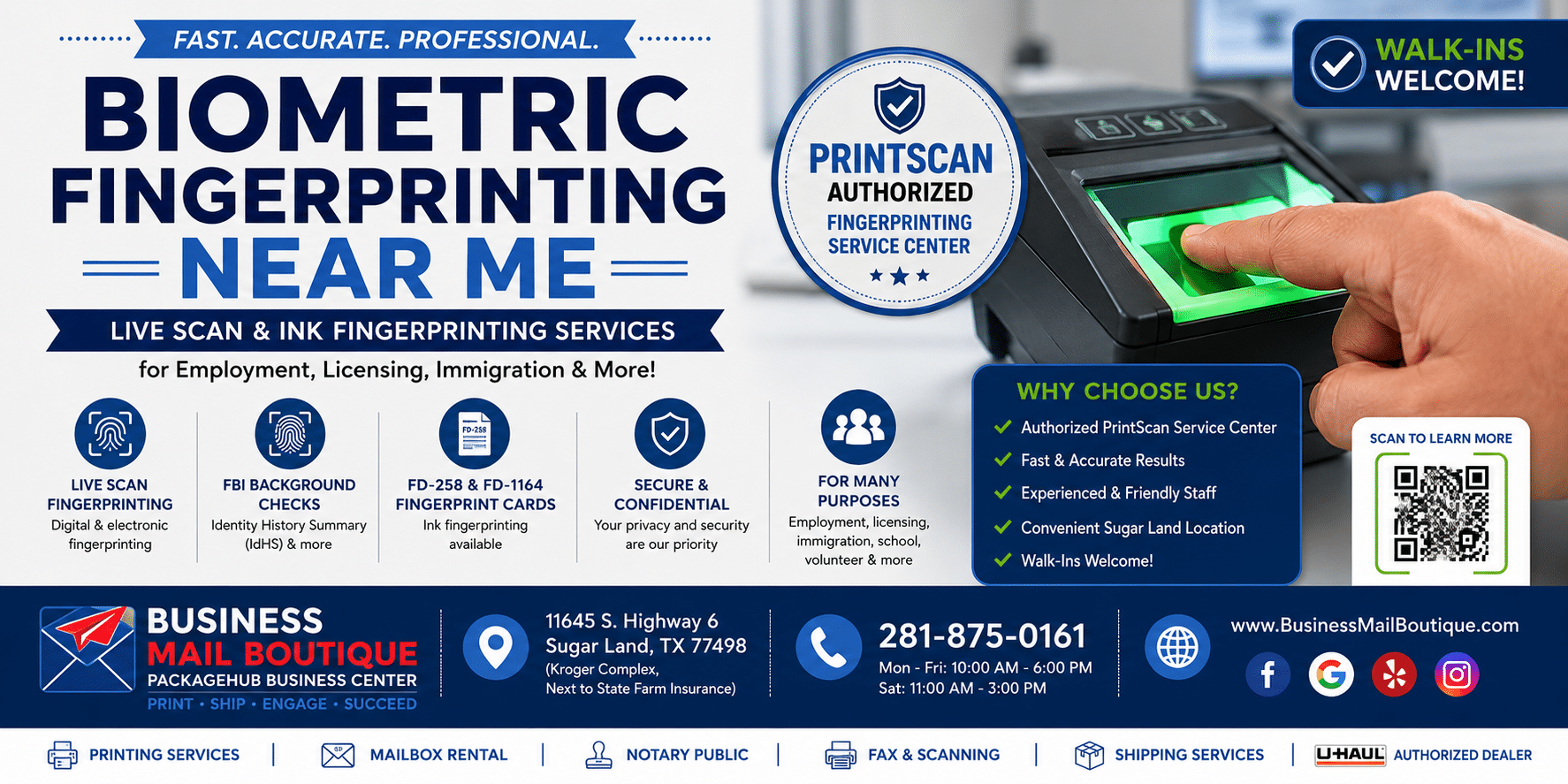
Biometric Fingerprinting Near Me.
Searching for ‘biometric fingerprinting near me’? Our guide covers Live Scan vs. ink, costs, and what to bring to your local Sugar Land appointment.
Businessmailboutique
11645 S. Hwy 6
Sugar land, Texas 77498 United States (US)
Email: info@businessmailboutique.com
Route
When you need biometric fingerprinting near me, you’re likely under a deadline. A job offer is waiting on a background check. A licensing board sent instructions that mention Live Scan. A school, hospital, volunteer program, or government office told you to get fingerprinted, and now every nearby listing looks the same.
That’s often the sticking point. The hard part usually isn’t the scan itself. It’s figuring out whether you need Live Scan or ink fingerprinting, whether the local location can handle your exact requirement, and whether your prints are likely to go through cleanly on the first try.
What Is Biometric Fingerprinting
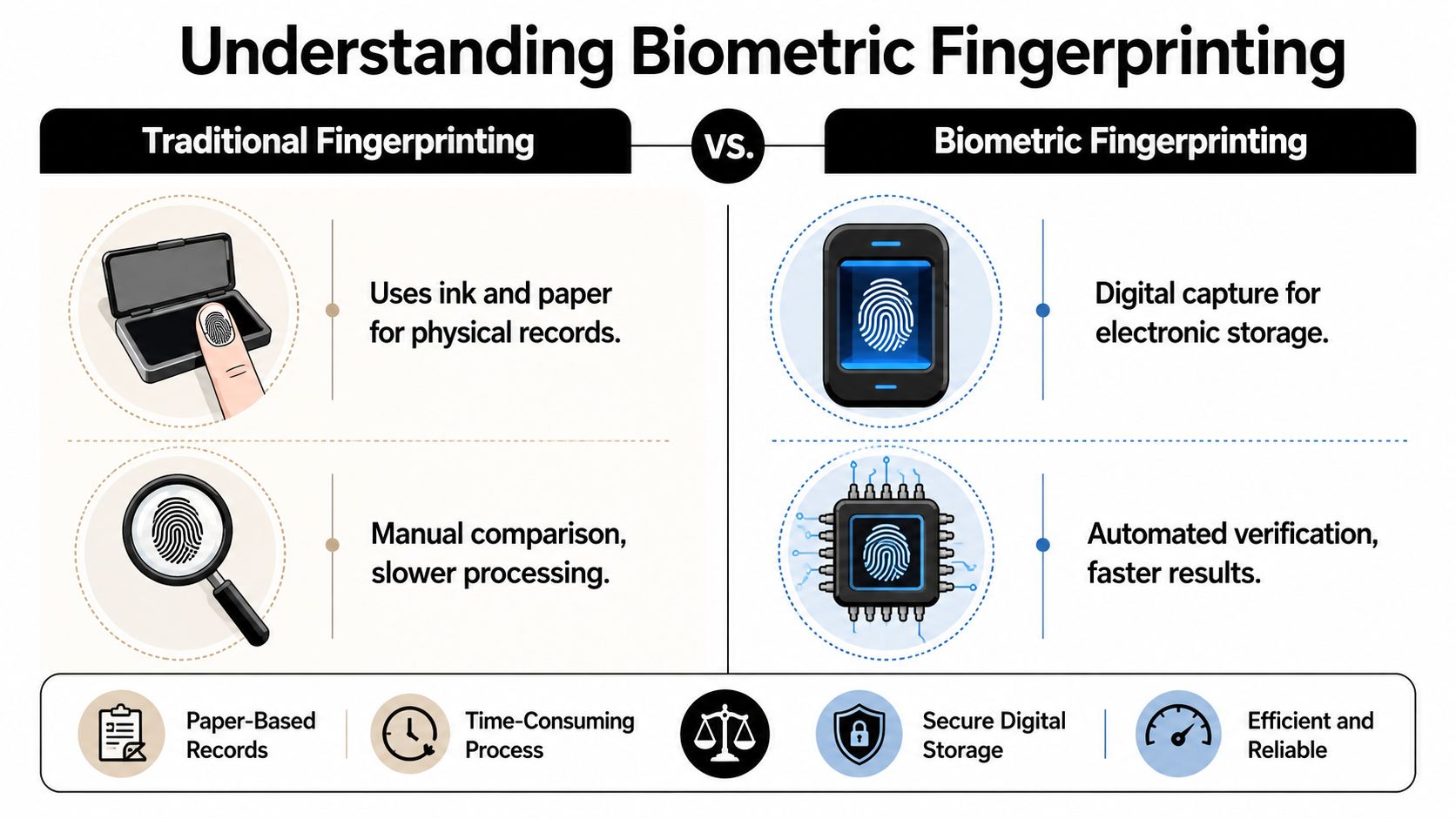
Biometric fingerprinting is digital identity verification based on the unique ridge patterns on your fingers. In practical terms, it means a technician captures your fingerprints with a scanner or on a card so an employer, licensing agency, or government office can use them for identity matching and background screening.
Fingerprint scanning remains a widely recognized and used standard. Fingerprint scanners are the most common technology used for biometric authentication globally, with 70% of Americans using fingerprint scanning as their preferred biometric method, according to the University of Texas identity trends report. That matters because it explains why fingerprinting is still the routine method for official identity documentation at the local level.
How biometric fingerprinting works
At the counter, the process is simple. A technician checks your ID, confirms the form or submission type you need, captures your prints, reviews image quality, and sends or prepares the record in the format your requesting agency requires.
For many customers, the phrase biometric sounds more complicated than it is. It’s usually just a cleaner, faster version of old-style fingerprint collection.
Biometric fingerprinting should feel routine. If the provider can’t clearly explain your submission type in plain language, pause before you start.
If you’re doing this for a nonprofit role, youth organization, or community program, it also helps to understand how the background-check side fits together. A plain-language guide to a volunteer criminal background check can help you see why some organizations ask for name-based screening while others require fingerprints.
Live Scan versus ink cards
This is the part that saves people the most time.
Live Scan is digital. Your fingerprints are captured electronically and submitted in the format required by many employers, agencies, and licensing boards. Ink fingerprinting uses a physical card. It’s still valid in some situations, but it isn’t interchangeable with a digital submission.
A lot of confusion comes from local listings that say “fingerprinting” without saying which type. If you need both formats explained side by side, this page on fingerprinting ink and LiveScan capture is a useful example of how providers separate the two services.
Here’s the practical rule:
| Need | Usually the right format |
|---|---|
| State licensing, regulated employment, agency-directed digital submission | Live Scan |
| Physical fingerprint card requested by a specific out-of-state agency or form packet | Ink card |
| You’re not sure what the requesting agency accepts | Call first and verify the submission type |
If your paperwork says Live Scan, don’t assume an ink card location can “convert it later.” That’s a common reason people make an unnecessary second trip.
How to Find the Right Fingerprinting Service
Typing biometric fingerprinting near me into a map app gives you locations, not clarity. The nearest result may offer the wrong service, limited submission types, or no help for difficult prints.
The extent of that gap is often underestimated. A local-search review from CMS Fingerprinting notes that Live Scan is mandated for over 95% of modern background checks, yet many local listings still fail to clearly distinguish digital Live Scan from ink-and-paper services. That’s why people show up at the wrong place with the right paperwork.
What to look for in local search results
A strong listing should tell you more than the street address. Look for wording that specifically mentions Live Scan, digital fingerprinting, FBI background checks, or agency-specific service types.
Good providers also make the next step easy. They explain whether you need an appointment, whether walk-ins are accepted, what ID to bring, and whether they handle both card-based and digital capture. If the page is vague, call before you drive.
One local example is Live fingerprint scan locations near me, which shows the kind of language people need when they’re trying to match a local provider to a real submission requirement instead of guessing.
Questions worth asking before you go
Before you book, ask a few direct questions:
- Do you offer Live Scan or only ink cards? If they hesitate, keep looking.
- Can you process the specific form or agency request I have? Read the form name exactly as written.
- Do you help with worn or hard-to-read fingerprints? This matters more than people realize.
- What happens if a print quality issue causes a rejection? Ask about the rescan policy before your appointment.
A reliable fingerprinting location answers these questions quickly. You shouldn’t have to decode the service menu yourself.
This sounds small, but front-desk communication matters. Businesses that handle appointment flow well tend to reduce confusion before the customer even arrives. If you’re comparing how service businesses structure phone coverage and customer intake, Heyline’s virtual receptionist guide is a useful reference for what responsive first contact should look like.
Preparing for Your Fingerprinting Appointment
The appointment itself is usually short. The preparation is what determines whether it stays short.
People often worry about the scanner, the privacy side, or whether they’re “doing it right.” In most cases, the technician guides every step. What helps most is arriving with the correct ID, the correct paperwork, and hands that are in good condition for capture.
What to bring
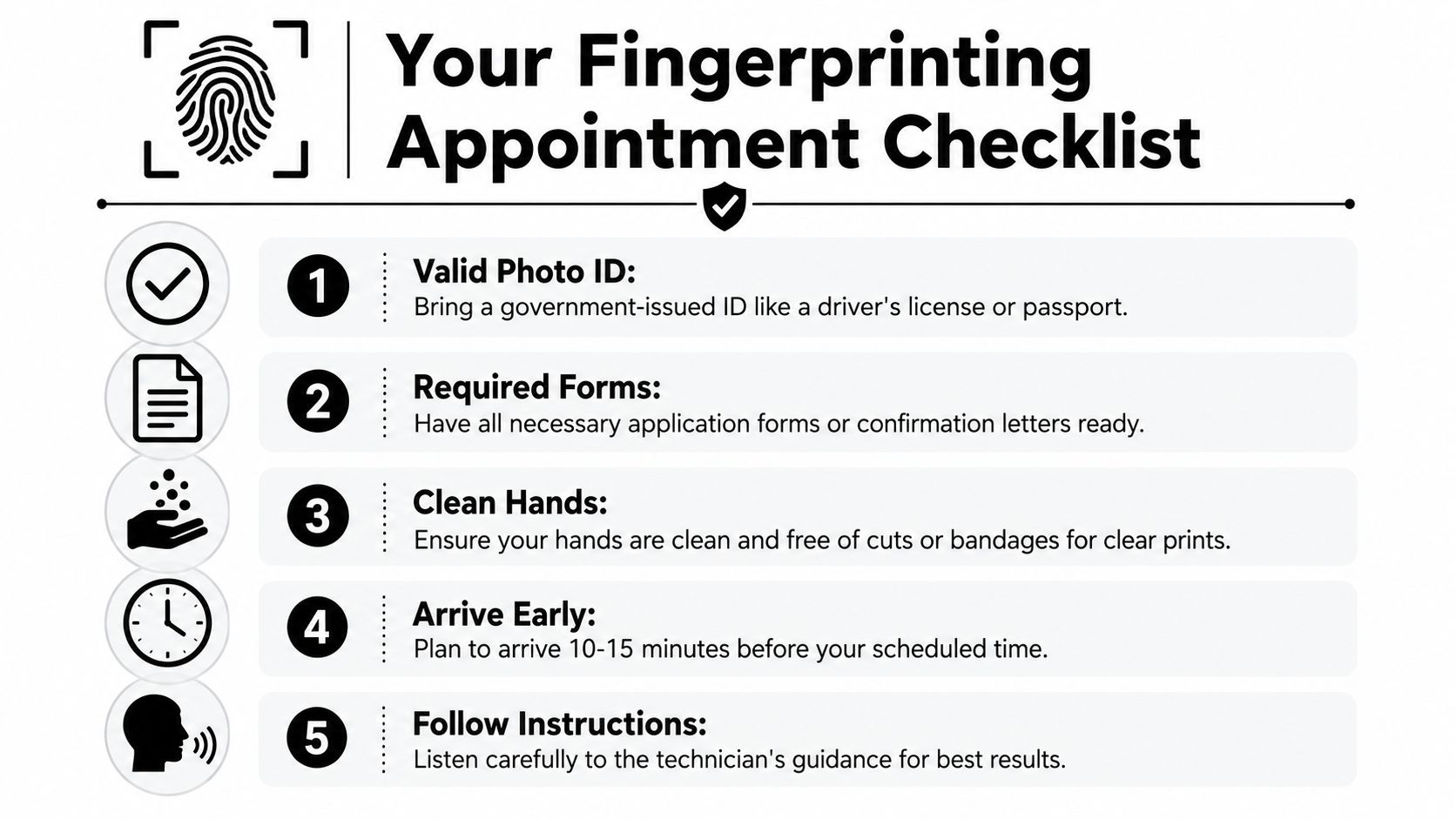
Bring the documents that connect you, the request, and the destination.
- Government-issued photo ID: A driver’s license, passport, or another valid ID the requesting agency accepts.
- Agency forms or request paperwork: If your employer, board, or agency gave you a Live Scan form, confirmation page, or instruction sheet, bring it.
- Any reference numbers: ORI numbers, request numbers, applicant IDs, or service codes should be available if your instructions include them.
- Payment method: Some locations accept cards only, some accept multiple forms of payment, and some separate service fees from government processing fees.
If anything on your form is unclear, don’t try to fill the gaps from memory. Call the requesting agency or the fingerprinting location first.
How to help the technician get a clean scan
Print quality matters. A lot.
According to Andrew Patrick’s review of fingerprint system performance, fingerprint recognition can achieve about 98% True Accept Rate at a 0.01% False Accept Rate with high-quality images, but the True Accept Rate can fall to 47% for low-quality images at the same threshold. The same source recommends practical capture habits: press the finger flat rather than tapping, roll the same print 4 to 5 times during enrollment, and use the cuticle area as an aiming point for consistent placement.
That sounds technical, but the takeaway is simple. Clean, consistent contact helps. Quick tapping usually doesn’t.
Practical rule: Wash and dry your hands before the appointment. If your skin is very dry, lightly moisturize earlier in the day, not right before the scan.
A few habits help on appointment day:
- Remove anything that blocks the fingers. Bandages, fresh glue, heavy dust, and oily residue can interfere with capture.
- Tell the technician if you work with your hands. Construction, warehouse work, healthcare sanitation routines, and repeated handwashing can affect ridge clarity.
- Follow the hand placement instructions exactly. The angle and pressure matter more than people think.
- Don’t rush the process. A careful recapture is better than a fast low-quality submission.
If a finger doesn’t read well on the first pass, that isn’t unusual. A good technician adjusts pressure, placement, and sometimes finger choice before concluding there’s a problem.
Typical Costs and Turnaround Times
Fingerprinting costs usually come in two parts. One part is the provider’s capture or rolling fee. The other part may be the processing fee tied to the agency receiving the prints.
That’s why one customer pays one amount and another pays something different at the same counter. The service may look identical from the outside, but the submission route, form type, and agency requirements can change the total.
What affects the price
A few common factors drive the price:
| Factor | Why it changes the total |
|---|---|
| Live Scan versus ink card | Digital submission and physical cards are different services |
| Agency requirements | Some requests involve added processing through state or federal channels |
| Number of cards or copies | Card-based jobs may require more than one completed card |
| Resubmission needs | Some cases require extra handling if an agency requests another capture |
The cleanest way to avoid surprises is to ask one very specific question when booking: What will I pay at the counter, and does that include every required processing fee for my submission type?
How long the process usually feels versus how long it actually takes
The fingerprint capture itself is usually quick. Most of the waiting happens before the appointment or after the submission, depending on who is reviewing the record.
That’s why customers sometimes think the fingerprinting location is “holding up the process” when the delay is with the receiving agency. The local technician captures and submits the prints. The background-check timeline depends on the destination system and the agency’s workload.
A practical way to plan is to avoid booking your fingerprinting appointment at the last possible moment. If a job start date, license deadline, or compliance deadline matters, build in buffer time for review, correction, or a possible rescan.
After Your Appointment What Happens Next
Once the capture is done, your role usually becomes passive for a while. The prints move through the submission path tied to your request, and the receiving agency continues the review.
That post-appointment stage is where many customers start checking email every hour. It helps to know what’s normal and what isn’t.

Where your fingerprints go
With Live Scan, the digital file is transmitted through the required channel for the agency that requested it. With ink cards, the prints usually travel as a physical record to the destination specified in your instructions.
In many cases, the results don’t come back to you directly. They go to the employer, licensing board, volunteer program, or government office that initiated the request. That’s why the fingerprinting provider often can confirm submission but can’t interpret the final background-check result for you.
If you’re waiting, keep your confirmation paperwork and any transaction details. If the requesting agency says they haven’t received your record, those details help trace where the submission stands.
What to do if your prints are rejected
Rejection for image quality can happen, especially with worn, thin, scarred, or hard-to-read ridges. The FBI guidance highlighted in Recording Legible Fingerprints notes that 12% to 18% of employment fingerprint attempts are rejected due to unreadable ridges in some cases, and it emphasizes the value of corrective techniques such as pressure adjustments for thin or worn ridges.
That doesn’t mean your case is dead. It usually means the receiving agency needs a better capture.
If you get a rejection notice:
- Read the notice carefully: Confirm whether the issue is image quality or something administrative.
- Contact the fingerprinting provider promptly: Ask whether they offer a rescan and what documentation to bring back.
- Show the technician the rejection notice: It helps them understand whether they need a different capture approach.
- Tell them about ridge wear or skin issues: Trained technique is especially important here.
A provider that handles difficult prints well will slow down, adjust finger pressure, and try to improve legibility instead of repeating the exact same failed method.
Frequently Asked Questions About Fingerprinting
A lot of customers reach this point after a simple problem. They searched for “biometric fingerprinting near me,” found several local options, and then realized the hard part is not booking. It is choosing the right fingerprinting method the first time. For official background checks, the difference between Live Scan and ink fingerprinting decides whether your submission moves forward or gets delayed.
People also worry that fingerprinting will be complicated. In practice, the appointment is usually straightforward when the provider checks your paperwork carefully, matches the capture method to the agency requirement, and knows how to work with faint or worn prints.
Common questions people ask at the counter
Can I get my fingerprints done as a walk-in?
Some locations accept walk-ins, and some work by appointment only. Availability often depends on staffing, the type of fingerprinting you need, and whether your documents need to be reviewed before capture. If you are working against a deadline, call first.
Do I need Live Scan or ink fingerprinting?
Follow the agency instructions exactly. Live Scan is digital and is often used for state-regulated background checks or submissions tied to a specific agency system. Ink or card-based fingerprinting is usually required when you must submit a physical fingerprint card, mail documents, or meet an out-of-state requirement. If your form lists an ORI number, requesting agency, or card type, bring that paperwork with you and ask the technician to confirm the format before starting.
Which one is better, Live Scan or ink?
Neither is “better” in every case. The right choice is the one your requesting agency accepts. Live Scan is faster for many electronic submissions and lets the technician review image quality on screen right away. Ink fingerprinting still matters when an agency requires a physical card, and a skilled technician can produce clean cards even for customers whose ridges do not read well on the first pass.
What if my hands are dry, worn, scarred, or hard to read?
Say that before the first finger is captured. Good technicians adjust pressure, placement, rolling technique, and pacing based on the condition of your ridges. In this situation, trained technique matters. That is one of the biggest reasons to choose a local provider with experience handling difficult prints instead of picking the closest name in a search result.
How long does the appointment take?
The fingerprint capture itself is usually quick. The total visit can take longer if your paperwork needs review, your ID needs to be checked, or the technician has to make extra passes to improve print quality.
Will I get the background check result myself?
Often, no. Many agencies send results straight to the employer, licensing board, school, or government office that requested the fingerprints. Your fingerprinting provider usually handles the capture and submission, not the final background check decision.
When it makes sense to call before you go
Some appointments are routine. Others need a quick phone call first.
Call ahead if any of these apply:
- Your paperwork is very specific. Agency codes, card types, and submission instructions need to match the service being performed.
- You were rejected before. A repeat attempt should not be treated like a standard first visit.
- Your fingerprints are hard to capture. Ask whether the staff regularly handles worn, faint, or damaged ridges.
- You are not sure whether you need Live Scan or ink. A two-minute call can prevent a wasted trip.
- Your deadline is close. Confirm hours, ID requirements, and whether your submission is sent electronically or leaves with you on a card.
If you want a plain-language reference that answers more appointment and paperwork questions, this complete FAQ fingerprinting guide is a helpful resource.
For local customers in Sugar Land, Business Mail Boutique LLC offers both digital and ink-roll fingerprinting along with other business-center services. The practical approach is simple. Bring your government-issued ID, bring the exact agency paperwork, and confirm the required fingerprinting format before the appointment. If you know your prints can be difficult to read, choose a provider that has the patience and technique to get the cleanest capture possible.

Related posts

Custom Memorial Glasses Engraved in Three Hours in Sugar Land
When a customer needed eight personalized glasses for a memorial, Business Mail Boutique completed the engraving or...

Custom Martini Glass Engraving in Sugar Land, TX
Custom Logo Engraving on Martini Glasses in Sugar Land, Texas.
Business Mail Boutique recently completed a beautiful custom engravin...

Custom Engraved Wine Glasses for a Golf Club Event in Sugar Land, TX
Custom Engraved Wine Glasses for a Golf Club Event in Sugar Land.
Custom wine glass engraving in Sugar Land, TX at Business Mail Bouti...