
- Print Business Cards in Sugar Land – Same Day Service
- Copying Services
- Document Printing, Finishing & Lamination in Sugar Land
- Flyers
- Print Banner in Sugar Land | Same-Day Banner Printing Near Me
- Graphic Design
- Photo Printing
- Postcard Printing
- Document Printing
- EDDM Full Service Postcards
- FotoZoomer Large Format Printing


Scrim Vinyl Outdoor Banner.
Get the perfect scrim vinyl outdoor banner for your business. Our guide covers materials, printing, finishing, and local ordering for maximum impact.
You need a banner fast.
Maybe the storefront window still looks empty a few days before your grand opening. Maybe your weekend sale needs to be visible from the road by tomorrow morning. Maybe you signed up for a community event and realized your table setup needs something larger than a foam board and a folding sign.
That’s when most small business owners start searching for a scrim vinyl outdoor banner. It’s a practical choice because it gives you big visibility without turning into a permanent signage project. It’s also one of those products that looks simple until you have to decide on material weight, finish, hems, grommets, wind exposure, artwork setup, and installation.
A good banner can pull attention to a local promotion, support your storefront presence, and help tie together your offline and digital campaigns. If you’re also thinking about optimizing banner and display ads, the same principle applies offline. Clear message, strong visual hierarchy, and the right placement matter as much on a sidewalk banner as they do on a screen. And if timing is tight, local turnaround matters. For businesses that need speed, same-day outdoor banner printing in Sugar Land can make the difference between promoting the event and missing it.
Table of Contents
Your Essential Tool for Local Marketing
A scrim vinyl outdoor banner works best when you need visibility now, not after a long sign permitting process or a custom fabrication timeline.
For local businesses, that usually means real situations. A restaurant announces a lunch special. A salon promotes a seasonal package. A retail shop needs a sidewalk-facing banner for a clearance event. These aren’t branding exercises in the abstract. They’re revenue decisions tied to foot traffic, timing, and location.
What makes scrim vinyl useful is the balance it strikes. It’s built to print bold color and clean text, and it’s practical for temporary or short-term outdoor use in the right setting. According to Brochure King’s banner material overview, scrim vinyl is a solid-surface banner material engineered with a woven scrim core that produces the sharpest, most vivid prints among vinyl options, which is why it’s commonly chosen for single-sided signage mounted against walls or used in low-wind environments such as storefronts and trade shows.
Why local businesses keep choosing it
If the install location is sheltered, scrim vinyl usually gives you the look people want. The color appears richer than what you typically get from more wind-oriented materials, and the banner feels substantial without being awkward to handle.
That matters in everyday jobs like these:
- Storefront promotions: Under awnings, against windows, or mounted to a wall.
- Event signage: Grand openings, school functions, vendor booths, and weekend specials.
- Temporary outdoor campaigns: Seasonal pushes where you want strong visuals without overbuilding the project.
Practical rule: Use scrim vinyl when your message needs to look sharp and the location doesn’t expose the banner to constant hard wind.
What business owners usually get wrong
They assume “outdoor banner” means “works anywhere outside.”
It doesn’t. A banner installed in a protected storefront area is a different job from a banner stretched across an open fence or a breezy roadside frame. Material choice isn’t just about budget. It’s about matching the banner to the location so it lasts long enough to do its job.
That’s where a solid scrim vinyl outdoor banner shines. It’s not the answer for every outdoor install, but in the right setting, it’s one of the most useful marketing tools a small business can order.
What Exactly Is a Scrim Vinyl Banner
A scrim vinyl banner is a reinforced banner material made in layers. The outer faces are PVC vinyl, and inside is a polyester scrim mesh insert. The internal scrim mesh acts similarly to rebar in concrete. Concrete provides shape and surface, and rebar contributes strength; the scrim serves an identical function within the banner.
That inner reinforcement is the difference between scrim vinyl and cheap unsupported vinyl. Without that woven core, the material is far more likely to stretch, tear, or fail around stress points during hanging.
What the material is made of
The construction is straightforward. Verified product guidance states that scrim vinyl banners use a polyester scrim mesh insert laminated between two layers of PVC. That internal scrim increases tensile strength by 300–400% compared with standard vinyl and helps distribute stress more evenly across the banner, especially around grommets.
That load distribution matters in real installations. The same verified data states that standard vinyl grommets can fail under 15–20 psi of tension, while scrim-backed versions maintain integrity up to 45 psi before delamination occurs.
The strength of a banner often has less to do with the printed surface and more to do with what’s holding that surface together once tension hits the corners and edges.
Why scrim vinyl became the standard choice for many banner jobs
It solves the main weakness of plain vinyl. Reinforcement lets the banner handle hanging forces better, especially when the job includes hems, grommets, and repeated setup.
That doesn’t mean every scrim vinyl outdoor banner is heavy-duty in every environment. It means the material is stronger than non-reinforced vinyl and suited to a broad range of promotional uses where good print quality and practical outdoor durability both matter.
Here’s the simplest way to think about common banner materials:
- Scrim vinyl: Best when you want sharp, vivid printing and a reinforced banner for sheltered or moderate outdoor use.
- Non-reinforced vinyl: Usually the budget option people regret when edges stretch or mounting points fail.
- Fabric banners: Better for indoor softness and presentation, not the first choice for weather exposure.
What it is not
It’s not mesh.
That distinction matters because scrim vinyl has a solid surface. It doesn’t allow wind to pass through the way perforated mesh material does. That solid face is part of why it prints so well. It’s also why location matters so much when you install it outdoors.
So if you’re ordering a banner for a wall, storefront, event tent, or indoor display area, scrim vinyl usually deserves serious consideration. If you’re ordering for an exposed fence line or a windy open lot, the next section is where the decision gets more important.
Choosing the Right Banner Material Specs
Most banner mistakes happen before printing starts. The artwork may be fine, but the material choice is wrong for the install.
If you’re comparing banner options, the core trade-off is simple. 13oz scrim vinyl is the economical workhorse for many promotional jobs. Heavier vinyl can make sense when you want a sturdier feel and a longer-term install. Mesh is the right move when wind exposure is the main problem.
According to Brochure King’s material guide, 13oz scrim vinyl is a solid-surface material with a woven core, preferred for vivid single-sided prints in outdoor settings with mild wind conditions like storefronts and trade shows. The same source notes that because it’s solid, it creates higher wind pressure and is vulnerable to tearing in strong winds, which limits its best use to locations with light to moderate wind, such as grand openings, sales events, and indoor displays. That guide also makes an important point: choosing material for high-wind outdoor signage is a choice based on structural requirements rather than marketing preferences.
If you’re comparing specs in person, it helps to review full-service wide-format printing for Sugar Land businesses so you can match the banner stock to the actual install site, not just the graphic.
The short version on 13oz, heavier vinyl, and mesh
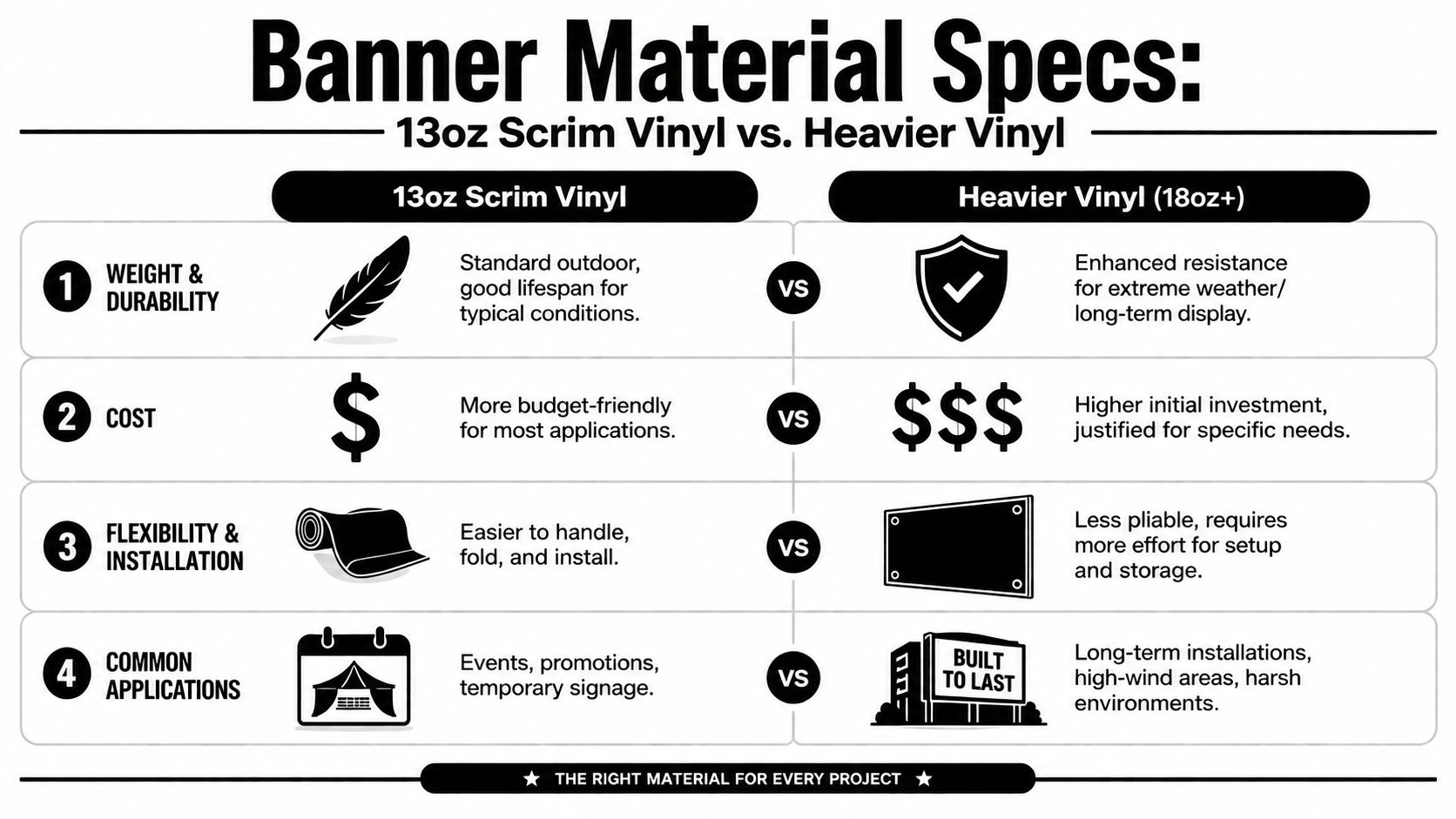
Use 13oz scrim vinyl when the banner is promotional, the timeline is short, and the location is reasonably protected.
Use heavier vinyl when the banner needs a sturdier build and you expect rougher handling or longer display time.
Use mesh when air movement is the main threat. Generic “heavy-duty” wording doesn’t solve a wind problem if the banner face still acts like a sail.
If the banner will hang in a place where wind regularly pushes against it, don’t shop by thickness alone. Shop by airflow.
Banner Material Comparison Scrim vs. Mesh
| Material | Best For | Print Quality | Wind Resistance | Durability |
|---|---|---|---|---|
| Scrim vinyl | Storefronts, wall-mounted promotions, trade shows, sheltered outdoor campaigns | Very strong, vivid color and sharp detail | Limited in exposed windy locations | Good when installed in protected settings |
| Mesh banner | Fences, open lots, breezy exterior installs, exposed event spaces | Lower visual smoothness than solid vinyl | Better suited for wind-exposed locations | Stronger choice when airflow matters |
A local business owner usually doesn’t need a complicated material lecture. They need the answer to one question: Where is this banner going?
If it’s against a wall or under cover, scrim often wins.
If it’s stretched across an open frame, fence, or breezeway, mesh is usually the safer call.
Finish matters too
Gloss versus matte is a smaller choice, but it still affects results. If sunlight or overhead lighting creates glare, matte is often easier to read from the street or sidewalk. If the banner is viewed in softer light and you want a little more pop, gloss can work well.
Other useful decision checks:
- Viewing distance: Large text and simpler layouts work better if people see the banner from a moving car.
- Installation surface: Brick wall, fence, storefront frame, and canopy structure all create different tension patterns.
- Length of use: A weekend promo and a longer display don’t need the same build.
One caution matters here. A source gap still exists around exact wind failure thresholds for different scrim weave densities and for when standard 13oz versus 18oz material begins to fail in gusty urban conditions, as noted in CenTex Printing’s vinyl banner guide. In practice, that means you shouldn’t rely on vague labels like “outdoor” or “heavy-duty” when the banner will face unpredictable weather.
The right spec isn’t the one that sounds toughest. It’s the one that matches the actual job.
Designing Your Banner for Maximum Impact
A strong material won’t rescue a weak file.
Most print problems on banners come from three things. The artwork is too low resolution, it was built in the wrong color mode, or the important text sits too close to the edge. All three are avoidable if you handle the setup before the file reaches production.
The three file mistakes that cause the most problems
Low resolution is the first issue. A logo pulled from social media or a screenshot from a website often looks acceptable on a phone but falls apart when enlarged. On a banner, that turns into fuzzy edges, soft photos, and text that doesn’t look professional at closer distance.
Wrong color mode is next. Banners print more predictably when the file is built for print, not for screens. If the artwork starts in RGB, the printed result can shift from what you expected. That doesn’t mean the banner will look bad. It means the color may not match your monitor.
Text too close to the edge causes avoidable trouble. Hems, grommets, and trimming can crowd the layout. A phone number or website pushed too close to the perimeter is one of the easiest ways to weaken a banner.
Use simple rules:
- Keep critical text inward: Leave breathing room so hems and grommets don’t interfere with contact details.
- Send the best logo you have: Vector files are ideal. If you don’t have one, use the cleanest original file available.
- Design for distance: Shorter headlines beat paragraph copy every time on an outdoor banner.
A banner isn’t a brochure. If people need to stop and study it, the layout is doing too much.
What reads well from a distance
Good banner design is mostly editing.
Use one message, one offer, or one event title. Add a phone number, website, QR code, or location only if it supports the main call to action. Too many competing elements flatten the whole piece.
Photos can help, but they need to support recognition, not clutter the design. If your brand relies on team photos, space photos, or product imagery, this guide on how to use corporate branding photos is useful because it focuses on images that reinforce identity instead of filling space.
A practical layout often follows this order:
- Top line: What the banner is announcing.
- Middle area: The strongest visual or core offer.
- Bottom line: Contact detail or action step.
If you’re unsure whether the banner is readable, step back from the screen. If the main message doesn’t register fast, simplify it. The best-looking banner isn’t the busiest one. It’s the one people understand in seconds.
Understanding Banner Finishing Options
Finishing determines whether the banner hangs correctly and whether it survives normal use. Two banners printed on the same material can perform very differently if one has the right finishing and the other doesn’t.
If you’re planning a vehicle-side or event-side install, it also helps to look at examples of custom vinyl banners for food trucks and cargo vehicles in Sugar Land, Texas because mounting style changes what finishing makes sense.
How hems and grommets actually help
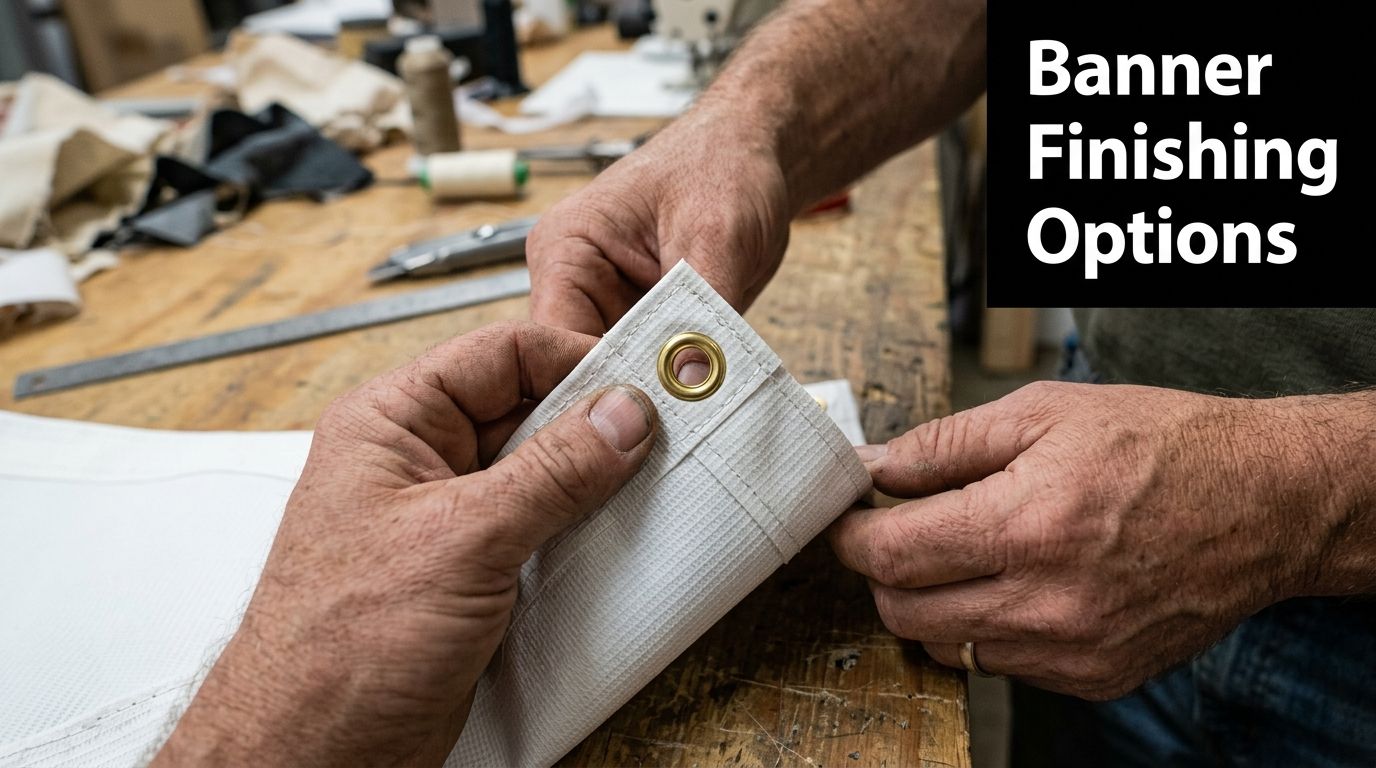
Heat-welded hems reinforce the edges. That matters because the perimeter takes the most abuse during hanging, transport, and tensioning. A hem gives the edge more structure and helps the banner resist premature wear.
Grommets are the metal-reinforced holes used for zip ties, rope, hooks, or bungees. They’re often the most stressed point in the whole banner. This is where scrim reinforcement earns its keep. Verified data states that the internal polyester scrim mesh increases tensile strength by 300–400%, allowing scrim-reinforced grommets to withstand up to 45 psi of tension before failing, while grommets in standard vinyl can fail under 15–20 psi.
That’s why cheap banners often fail from the corners first. The print may still look fine, but the mounting points give out.
When to choose pole pockets instead
Pole pockets are sleeves built into one or more edges so the banner can slide onto a rod, pole, or display hardware. They’re useful when the banner needs a cleaner presentation without visible ties across the face.
Choose pole pockets when:
- The banner hangs from a crossbar
- You need weighted support at the bottom
- The display system is built around rods or poles rather than perimeter tie-off points
Pole pockets don’t replace grommets in every case. They solve a different hanging problem. A street-pole display, indoor suspended banner, or framed event backdrop may benefit from pockets more than perimeter hardware.
Pick finishing based on how the banner will be mounted, not based on what seems standard.
Where wind slits fit
Wind slits are cuts placed into a solid banner face to relieve some pressure. They can help in limited situations, but they’re not a substitute for choosing the right material in the first place.
If the location is wind-exposed, mesh is the better answer. Wind slits also alter the look of the banner and can reduce the clean visual impact that many storefront promotions rely on.
A quick finishing checklist helps:
- Wall mount or fence mount in a sheltered area: Hemmed edges and grommets
- Rod or dowel display: Pole pockets
- Frequent setup and takedown: Reinforced finishing matters more because stress repeats over time
- Open windy site: Reconsider solid vinyl before choosing add-on fixes
Finishing isn’t decoration. It’s the part that lets the banner function.
Installation and Long-Term Banner Care
The best banner can still fail early if it’s hung unevenly, over-tightened, or cleaned the wrong way.
Installation should distribute stress across the banner, not force it into a few corners. Care should preserve the print surface without attacking the material itself.
A better way to hang the banner
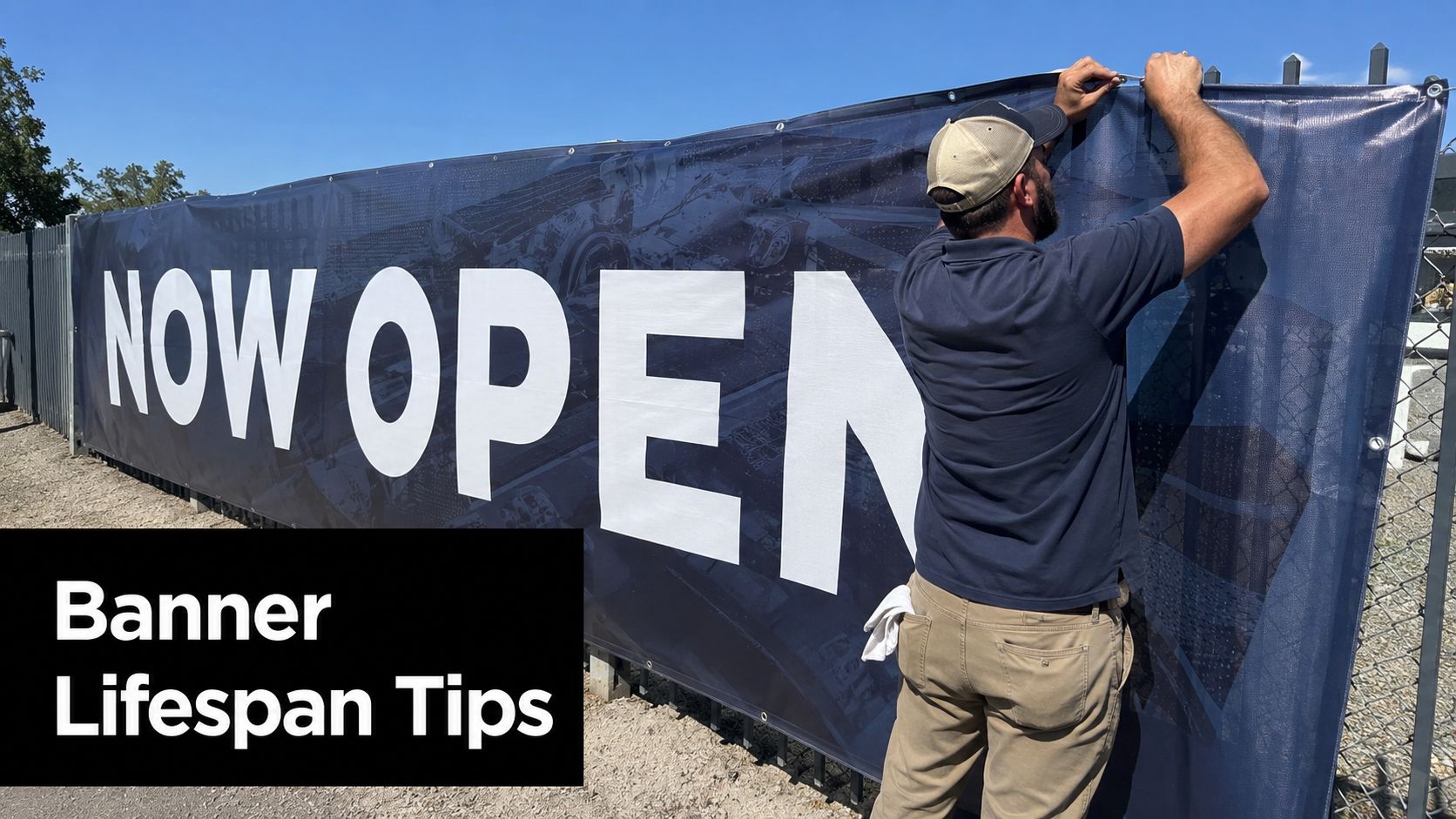
Start with all attachment points, not just the corners. The goal is a taut banner with balanced tension. If one side carries more load than the others, the hardware and edge finishing wear faster.
A simple install checklist works well:
- Check the surface first: Make sure the wall, frame, or fence is stable and free from sharp contact points.
- Attach evenly: Work around the perimeter instead of fully tightening one corner at a time.
- Keep tension firm, not extreme: The banner should look smooth, but you shouldn’t force the material to do all the work.
- Inspect after hanging: If one edge ripples heavily or one corner bears most of the pull, reset it before weather gets involved.
If you want a quick visual reference for setup, this video is useful:
Cleaning without ruining the print
Routine cleaning should stay gentle. Dust, surface dirt, and normal grime usually respond to soft handling and mild cleaning methods.
Verified maintenance guidance from NextDayFlyers’ vinyl banner care guide warns against harsh chemicals such as bleach and solvent on scrim vinyl. The same guidance highlights a real problem for businesses in high-traffic areas: oil-based grime, sticky adhesive residue, or tar often need more specific cleanup protocols because mild soap may not remove them safely.
So the practical rule is simple:
- Do use: Mild soap, water, soft cloths, and patient cleaning
- Don’t use: Harsh chemicals, aggressive scrubbing, or untested DIY solvent tricks
If the banner picks up adhesive, grease, or industrial grime, test any cleaning method carefully on a small inconspicuous area first, or ask the printer for material-specific advice before trying to dissolve the residue.
Dirty banners hurt the message. Damaged banners hurt the message more.
Storage that prevents early wear
Storage is where many otherwise good banners get shortened.
Roll the banner rather than folding it. Folding creates hard creases that can stay visible and eventually stress the print surface. Store it dry, and avoid crushing it under heavier items in a back room or vehicle.
For repeat-use banners, keep the hardware with the banner so setup is consistent each time. A banner that’s reinstalled with random ropes, mismatched ties, or improvised attachment points wears faster than one handled the same way every time.
Good care isn’t complicated. It’s mostly restraint. Don’t overtighten it, don’t attack it with chemicals, and don’t fold it into a box after the event.
Why Ordering Locally Matters for Your Business
The biggest advantage of ordering locally isn’t just speed. It’s better decisions before the banner is printed.
Online ordering works fine when the job is simple and the buyer already knows exactly what material, finish, and layout they need. Small businesses often don’t start there. They’re deciding between a storefront mount and a fence mount. They’re unsure whether the location is sheltered enough for scrim. They want to compare stock in person. They may need the banner today, not after a shipping window.
That’s where a local print partner changes the experience. You can look at actual material samples, feel the difference between lighter and heavier stocks, and talk through whether your location calls for scrim vinyl, heavier vinyl, or mesh. That conversation prevents expensive guesswork.
There’s also the issue of urgency. Local businesses often need banners for events that can’t be delayed. Weather changes. Promotions get extended. A last-minute sponsor gets added. Local turnaround and in-person proofing help when timing is tight and details still need attention.
A local shop also sees the environments your banner will face. That matters in a place like Sugar Land, where one install may sit under a protected storefront overhang and another may face a much more exposed setup. The right recommendation comes from looking at the job in context, not pushing every order through the same online template.
If you want a banner that fits the location, looks right, and doesn’t waste time or budget, local service is often the smarter route.
If you need a banner quickly and want help choosing the right material, finishing, and setup for your location, Business Mail Boutique LLC offers local printing support in Sugar Land with fast turnaround and practical guidance. Whether you need a short-term promotional banner, wide-format printing, or help getting artwork ready for production, working with a nearby team makes the process easier and more reliable.

Related posts

Custom Memorial Glasses Engraved in Three Hours in Sugar Land
When a customer needed eight personalized glasses for a memorial, Business Mail Boutique completed the engraving or...

Custom Martini Glass Engraving in Sugar Land, TX
Custom Logo Engraving on Martini Glasses in Sugar Land, Texas.
Business Mail Boutique recently completed a beautiful custom engravin...

Custom Engraved Wine Glasses for a Golf Club Event in Sugar Land, TX
Custom Engraved Wine Glasses for a Golf Club Event in Sugar Land.
Custom wine glass engraving in Sugar Land, TX at Business Mail Bouti...