- Print Business Cards in Sugar Land – Same Day Service
- Copying Services
- Document Printing, Finishing & Lamination in Sugar Land
- Flyers
- Print Banner in Sugar Land | Same-Day Banner Printing Near Me
- Graphic Design
- Photo Printing
- Postcard Printing
- Document Printing
- EDDM Full Service Postcards
- FotoZoomer Large Format Printing


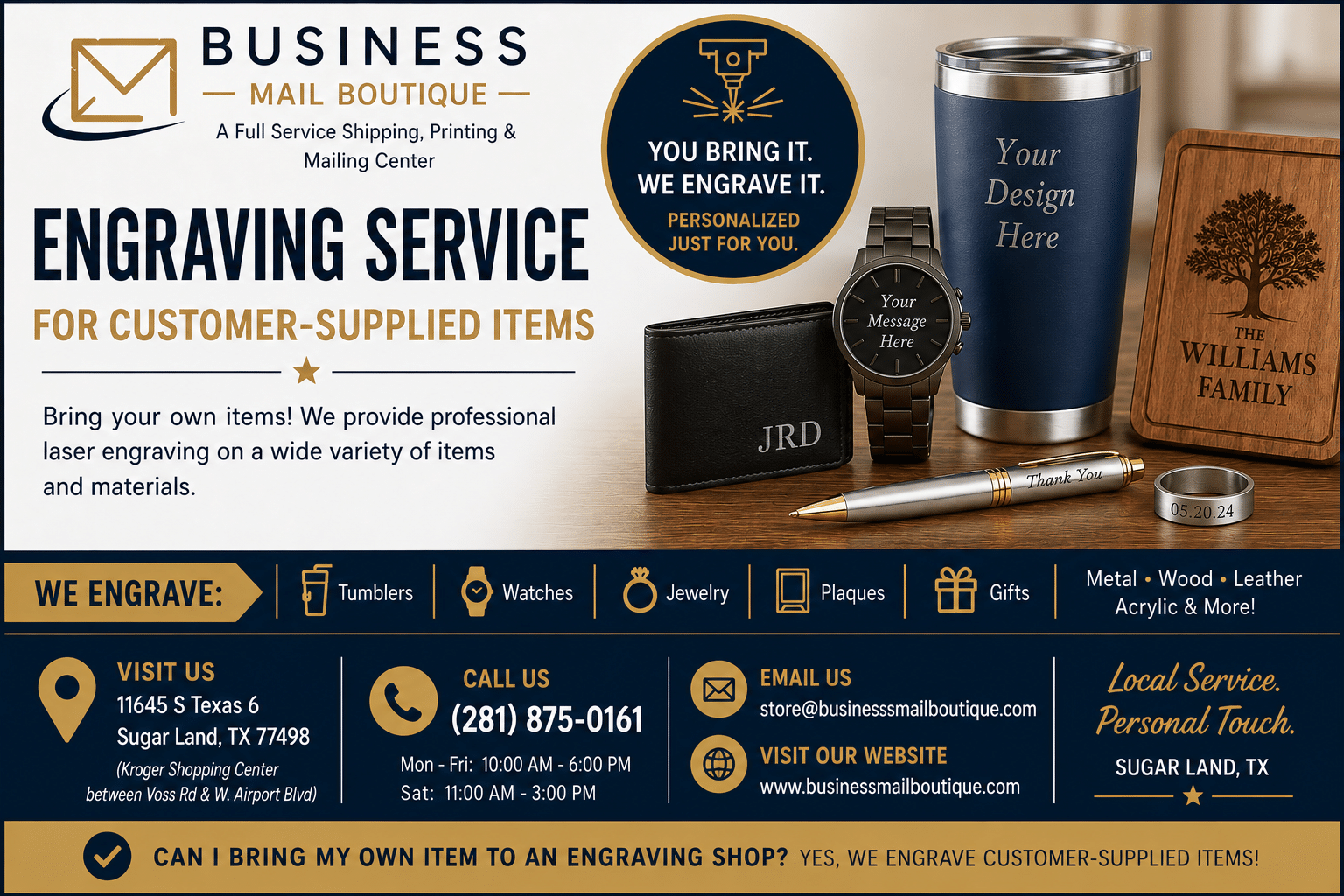
Can I Bring My Own Item to an Engraving Shop.
Can I bring my own item to an engraving shop? Learn what materials, sizes, and prep Business Mail Boutique requires for custom projects.
Businessmailboutique
11645 S. Hwy 6
Sugar land, Texas 77498 United States (US)
Email: info@businessmailboutique.com
Route
Yes, Business Mail Boutique accepts customer-supplied items for engraving, provided the material is compatible with its laser equipment and the item passes a quick in-store inspection. NASA’s laser-marking specification includes materials ranging from wood and glass to leather, stone, aluminum, titanium, and several steels, but compatibility alone doesn’t guarantee that every object is safe to process.
You’re probably asking because you already own the perfect item: a favorite tumbler, a wedding keepsake, a company award, or a cutting board that means more than a shop-supplied blank. Bringing your own piece can produce a more personal result, but it also means the engraver is working with an object whose coating, construction, shape, and heat tolerance may be unknown.
A responsible shop won’t just take the item, place it in the machine, and hope for the best. Staff should check the material, surface finish, dimensions, curvature, stability, and proposed design before accepting the job. That short inspection protects the item and gives you a realistic answer instead of an enthusiastic yes that ends badly.
Table of Contents
- Yes You Can Bring Your Own Item for Engraving
- Understanding Laser and Material Compatibility
- Acceptable and Unacceptable Items for Engraving
- How to Prepare Your Item and Design Files
- Popular Customer-Supplied Items We Engrave
- Pricing and Turnaround Expectations
- Understanding Risk and Liability for Your Item
- Getting a Quote and Visiting the Shop
Yes You Can Bring Your Own Item for Engraving
Business Mail Boutique welcomes customer-supplied items for laser engraving and sublimation, but acceptance depends on the item passing an in-store review. The practical answer to “Can I bring my own item to an engraving shop?” is yes, if the shop can identify the material, secure the object, focus the laser accurately, and use a process suited to its surface.
The inspection usually starts with the item itself. Staff may look for:
- Material composition: Wood, leather, glass, stone, acrylic, coated metals, and bare metals behave differently under laser energy.
- Surface treatment: Paint, powder coating, anodizing, plating, varnish, and unknown finishes can change the result.
- Shape and size: A flat, stable item is easier to position than a curved or oversized object.
- Design location: The engraving area needs enough clearance for the machine, fixture, and artwork.
- Condition: Cracks, loose parts, oils, residue, and fragile edges can create problems during setup.
Shop-supplied blanks have one important advantage. The operator usually knows the product’s material and has already worked out suitable settings or tested a similar piece. With a customer-owned item, the same-looking products may have different coatings or internal construction, so the operator has less certainty.
Practical rule: If the item is irreplaceable, test the process on a comparable material first or choose a shop-supplied blank instead.
A quick inspection doesn’t mean the shop expects trouble. It means the operator is checking whether the item can be engraved safely and repeatably. A decision to decline isn’t a judgment about the item’s value. It usually reflects a mismatch between the object and the available equipment, fixture, or process.
Understanding Laser and Material Compatibility
Material type matters more than appearance. Two objects may both look metallic, glossy, or plastic, yet require different laser technology because their surfaces absorb light differently.
A CO₂ laser is typically suited to organic materials and many nonmetals, including wood, acrylic, leather, glass, ceramic, and coated metals. A fiber laser is generally used for bare metals such as stainless steel, brass, titanium, and anodized aluminum, as outlined in this laser material compatibility guide.
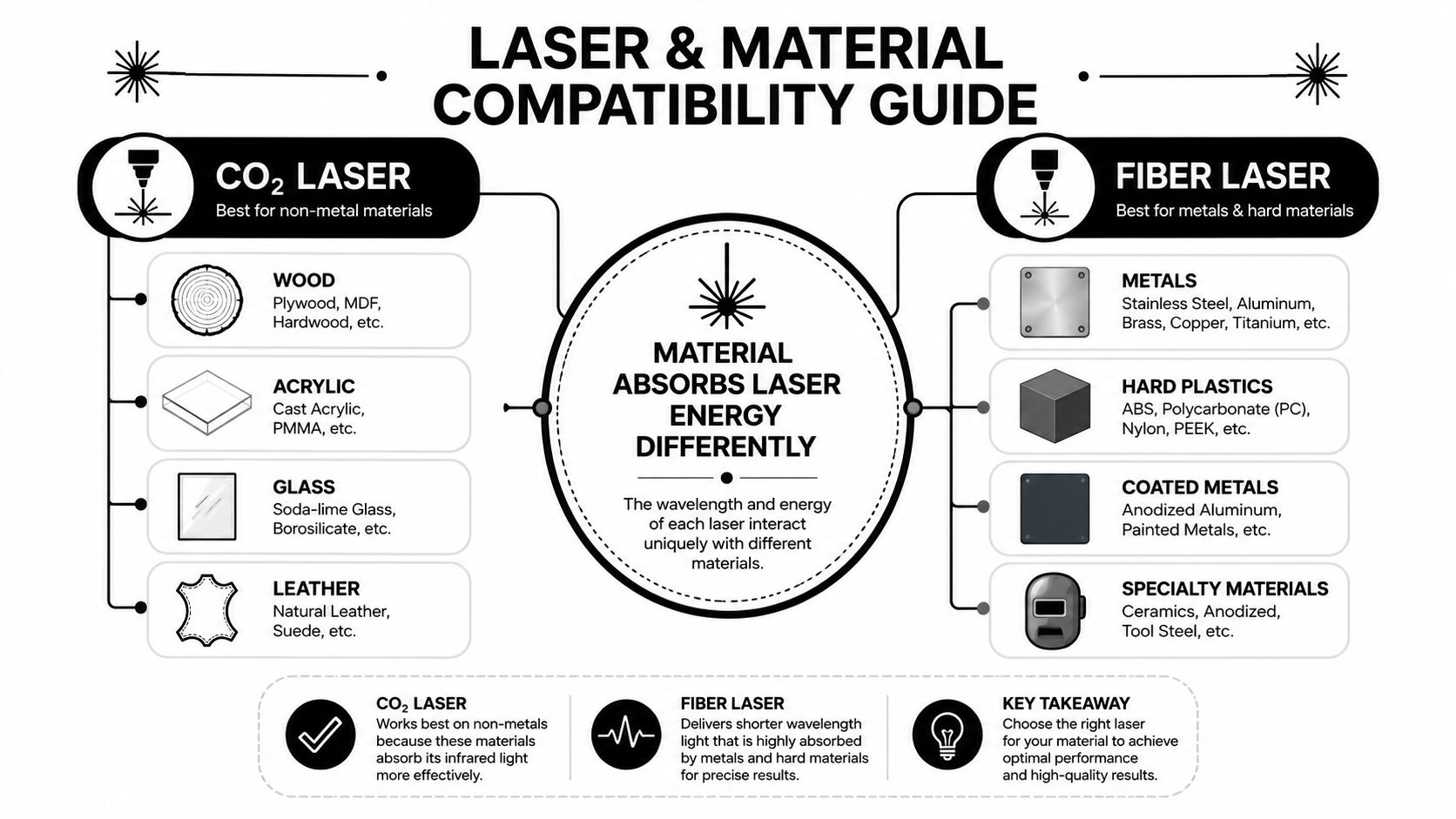
Think of the laser wavelength as a key and the material as a lock. The visible appearance of the object doesn’t tell you whether the key fits. A clear plastic may transmit the beam instead of absorbing it. A metal may need a fiber system, a coating, or a different marking method. A painted surface may mark cleanly while the same object in a different finish may melt, discolor, or show weak contrast.
What the operator checks
The operator may ask what the item is made from, whether you have its original packaging, and whether it has a coating or protective finish. A small test mark may be appropriate, especially when the material is unfamiliar or the engraving will affect a visible area.
For glassware, a specialist example such as this laser engraved glassware collection can help you visualize the frosted appearance customers often want. Stone and marble can also produce a permanent result, but the finish and surface texture still matter. Business Mail Boutique’s guidance on engraving on marble is useful when the item is a plaque, coaster, tile, or memorial piece.
The central question isn’t “Does this look engravable?” It’s “Can this material absorb the available laser energy in a controlled way?”
Acceptable and Unacceptable Items for Engraving
A customer-supplied item is usually a good candidate when its material is known, its surface is stable, and the operator can hold it securely. NASA’s laser-marking specification lists wood, acrylic, engraver’s plastic, glass, leather, stone, rubber, several steels, cobalt-based alloys, aluminum, titanium, and copper-based alloys among acceptable engraving substrates, although the required settings and equipment differ by material. You can review the laser-processing material specification for the broader substrate list.
| Material | Typically Accepted | Laser Type | Key Consideration |
|---|---|---|---|
| Wood cutting board | Yes | CO₂ | Oils, varnish, and uneven grain can affect contrast |
| Glass wine glass | Often | CO₂ | Curvature, focus, and thermal stress require care |
| Leather wallet | Often | CO₂ | Finish and tanning determine the mark and odor |
| Stainless steel tumbler | Often | Fiber, or suitable coated process | Bare and coated surfaces behave differently |
| Anodized aluminum bottle | Often | Fiber | The anodized layer may provide the contrast |
| Ceramic mug | Sometimes | CO₂ | Glaze, curvature, and heat response need inspection |
| Stone coaster | Often | CO₂ | Porosity and surface flatness influence detail |
| Unknown plastic | Often declined | Depends on composition | The operator must rule out unsafe or unsuitable plastic |
| Oversized or irregular object | Case by case | Depends on equipment | It may not fit or remain stable in the laser bed |
Items that commonly get declined
PVC-based plastics are a serious concern because unsuitable plastics can release hazardous fumes. Unknown coatings also create uncertainty. A product may be advertised as metal but carry a finish that melts, flakes, or produces an uneven mark.
Very thin, heat-sensitive, cracked, hollow, or unstable objects may be rejected even when the base material is technically compatible. The laser needs a predictable working distance and a secure fixture. If the piece shifts during engraving, the design can blur or land in the wrong position.
The most useful self-screening question is simple: Do you know what the item is made from, and can it sit still while the laser works? If either answer is no, send photos to the shop before making a trip.
How to Prepare Your Item and Design Files
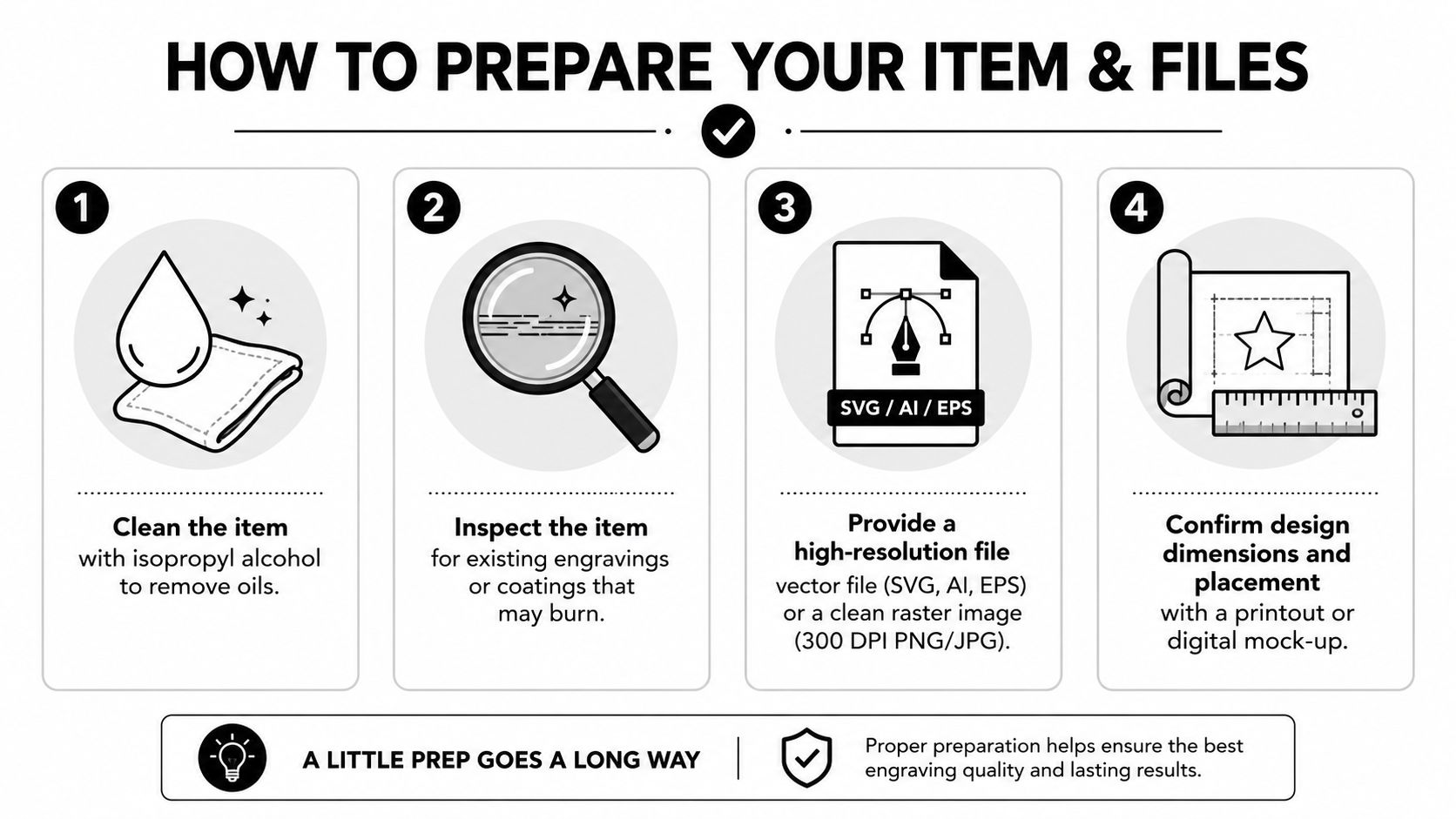
Good preparation reduces uncertainty before the item reaches the machine. Start by cleaning the intended engraving area with a suitable method, often a small amount of isopropyl alcohol on an appropriate cloth when the finish allows it. Remove fingerprints, oils, stickers, dust, and adhesive residue, but don’t use a solvent until you’re confident it won’t damage the item’s coating.
Measure the object, not just the proposed artwork. Record the usable flat or curved area, the item’s overall height and width, and the location where the design should sit. A tumbler may fit in a rotary fixture while a wide-handled mug or irregular bottle may not. Bring the original box, product label, or material documentation if you have it.
Prepare the artwork
Vector artwork is usually the cleanest starting point for logos, line drawings, and lettering. SVG, AI, and EPS files preserve sharp edges when the operator changes the design size. A clean, high-resolution PNG or JPG can also work for suitable artwork, especially when the image has strong contrast and minimal fine detail.
Give the shop the information that prevents guesswork:
- Text: Provide the exact spelling, capitalization, punctuation, and preferred font.
- Placement: Mark the intended location with a removable note or show it in a mock-up.
- Dimensions: State the desired width and height, not just “small” or “large.”
- Orientation: Identify the front, back, handle side, lid, or presentation face.
- Proof approval: Ask to see a digital proof before production begins.
A proof confirms layout, but it can’t guarantee the exact shade or depth of the finished mark because those depend on the material and settings. For a valuable or unfamiliar item, ask whether the shop can test a similar material before engraving the final piece.
Popular Customer-Supplied Items We Engrave
The most successful customer-supplied projects tend to share three traits: the material is identifiable, the engraving area is accessible, and the item has emotional or practical value that makes personalization worthwhile.
A stainless steel YETI or Stanley tumbler is a familiar example. The operator first checks whether the surface is bare, powder-coated, painted, or otherwise finished. A suitable metal process can create a crisp monogram, name, logo, or simple graphic, but the final appearance depends on the interaction between the surface finish and the laser.
Family cutting boards are another popular request. A flat wooden board can accommodate a wedding date, family name, recipe, or short message. The operator still needs to inspect for food-safe coatings, deep grain variation, handles, and uneven sections before positioning the artwork.
Leather journals and wallets usually work well when the leather has a consistent surface. Initials and compact logos are often more reliable than extremely fine artwork because the natural texture and finish can soften delicate details.
Glass awards and drinkware offer a different look. The result is generally a frosted or etched appearance rather than a dark printed image. Curved glass requires careful focusing and secure positioning, especially when the design wraps around the object.
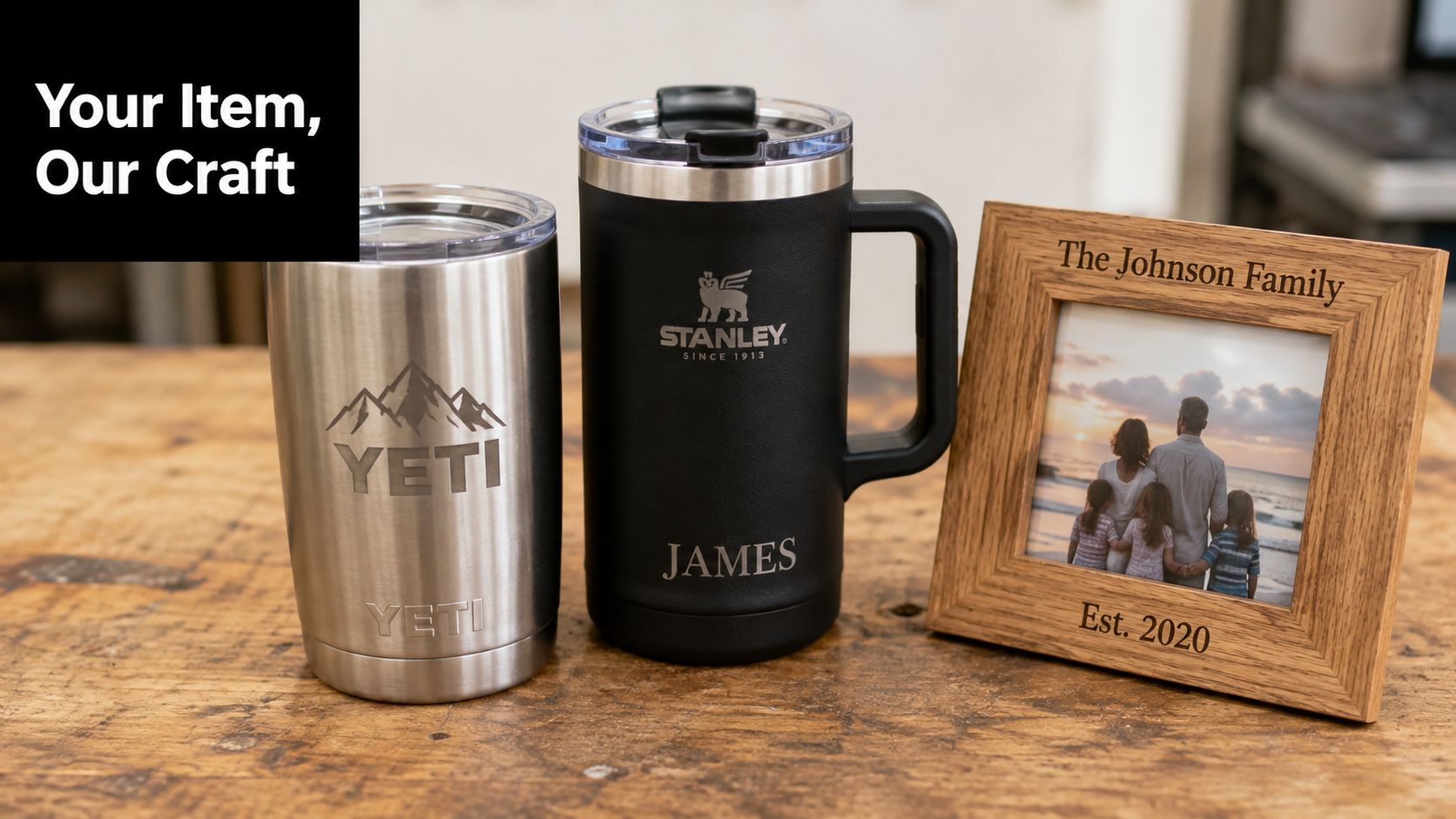
The item’s story may be personal, but the machine still needs a stable surface and a known material.
Demand for personalized products supports this kind of work. The global personalized gifts and cards market was valued at $38.6 billion in 2025, engraved gifts represented about 13.7% of market share, and that category was projected to grow at 9.3% annually from 2026 to 2034, according to this personalized gifts market report. For less typical dinnerware, reviewing titanium ceramic dinner plate options can help you understand why a product’s exact material construction matters.
For larger purchases, Business Mail Boutique’s information on engraving Stanley Cup tumblers provides a practical reference for preparing a recognizable customer item.
Pricing and Turnaround Expectations
Customer-supplied engraving isn’t priced only by the number of letters. The quote reflects the work required to make the item safe to process and the design accurate.
A simple name on a stable, compatible surface may require little setup. A curved tumbler, irregular award, or coated object can require additional positioning, masking, testing, or multiple passes. Design cleanup also affects the price when a logo needs tracing, simplification, or conversion before it can produce a clean mark.
The main pricing variables are:
- Material: Glass, leather, wood, stone, coated metal, and bare metal each require different handling.
- Engraving area: Larger artwork takes more machine time and may require more careful positioning.
- Artwork complexity: Fine logos and detailed illustrations need more preparation than plain text.
- Fixturing: Rotary attachments, jigs, supports, or repositioning add setup work.
- Risk and testing: Unknown finishes may require a test mark or a more cautious process.
- Quantity: Multiple identical items can share setup, while one-off pieces often cannot.
Customer-owned objects may carry a different price structure from shop-supplied blanks because the operator has to inspect and adapt to the item rather than start with a known product. That isn’t an arbitrary surcharge. It accounts for the time spent reducing uncertainty.
Turnaround depends on the item, design, current workload, and whether testing is needed. A straightforward project may be completed quickly, while an unfamiliar material or a complex batch needs more planning. If you’re comparing personalization services, the same principle applies when you compare AI tattoo design costs. The visible design is only one part of the service. Preparation and execution also shape the quote.
Give the shop your item type, dimensions, photos, quantity, design, and deadline. A precise request produces a more useful estimate than asking for a generic engraving price.
Understanding Risk and Liability for Your Item
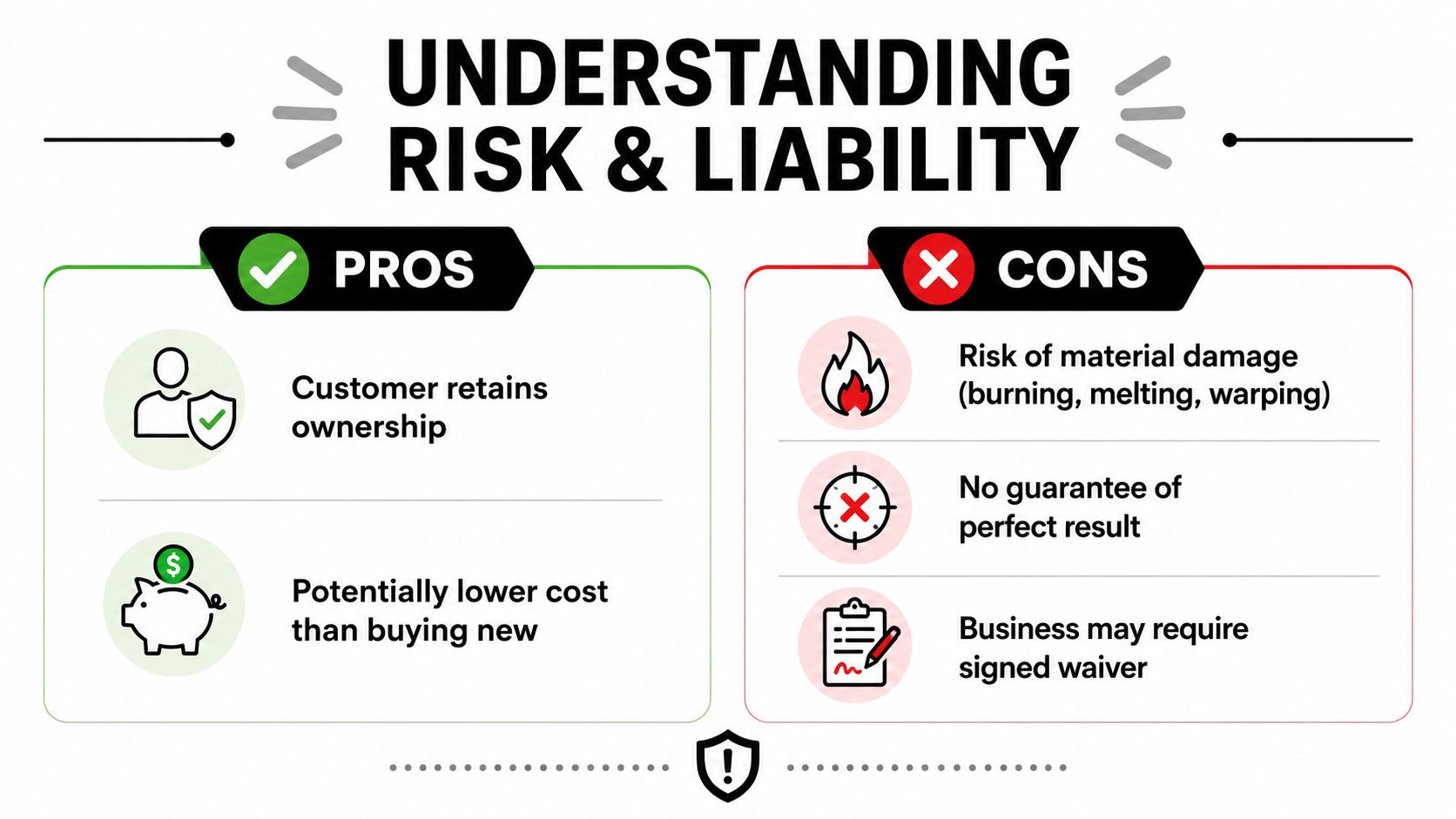
Bringing your own item means you retain ownership, but you also bring the risk associated with an object the shop may not have supplied or previously tested. Laser engraving uses concentrated energy, and a small error in material identification or settings can affect the surface.
Glass can crack from thermal shock when temperatures change too quickly. Acrylic can melt when the speed is too low, and leather can over-char when the energy is excessive, as explained in this laser engraving materials guide.
What a responsible shop should explain
Before production, the operator should tell you whether the item is familiar, whether testing is possible, and what risks remain. The shop may ask you to acknowledge that customer-supplied materials can behave unpredictably. A waiver doesn’t mean the operator can ignore reasonable care. It clarifies that an unknown item carries inherent risk even when the process is handled correctly.
Ask these questions before approving the job:
- Has this material been engraved before?
- Will the shop test a comparable surface?
- Where will the test mark go?
- What happens if the finish produces a different result than expected?
- Does the shop require a signed acknowledgment?
High-value jewelry, irreplaceable heirlooms, antique pieces, and objects with no replacement should receive extra caution. A shop may decline them because no engraving result can justify an unacceptable chance of permanent damage.
The best decision often involves a substitute. Reproduce the message on a compatible plaque, tag, plate, or new blank, and keep the original untouched. If you still want to proceed, review the shop’s questions about engraving services and make sure you understand the process before leaving the item.
Getting a Quote and Visiting the Shop
Send Business Mail Boutique photos of the item, its dimensions, the proposed engraving area, and your design or text before visiting. Include close-ups of coatings, labels, curved surfaces, and any existing marks so staff can judge compatibility more accurately.
For an in-person drop-off, bring the clean item, original packaging if available, and a clear description of placement and deadline. Simple projects may be suitable for walk-in discussion, but calling ahead is sensible during busy gift seasons or when the object is unusual.
The Sugar Land storefront on South Highway 6 can also handle related packing, shipping, printing, and gift-service needs, which may help when the engraved item is part of a larger order. Ask for a quote before production and approve the design placement before the laser touches the item.
Business Mail Boutique LLC offers customer-supplied laser engraving and sublimation on compatible items, including materials such as metal, wood, glass, and stone, after an in-store inspection. Bring photos or your item to Business Mail Boutique LLC for a practical compatibility review, design discussion, and quote.

Related posts

Custom Memorial Glasses Engraved in Three Hours in Sugar Land
When a customer needed eight personalized glasses for a memorial, Business Mail Boutique completed the engraving or...

Custom Martini Glass Engraving in Sugar Land, TX
Custom Logo Engraving on Martini Glasses in Sugar Land, Texas.
Business Mail Boutique recently completed a beautiful custom engravin...

Custom Engraved Wine Glasses for a Golf Club Event in Sugar Land, TX
Custom Engraved Wine Glasses for a Golf Club Event in Sugar Land.
Custom wine glass engraving in Sugar Land, TX at Business Mail Bouti...