
- Print Business Cards in Sugar Land – Same Day Service
- Copying Services
- Document Printing, Finishing & Lamination in Sugar Land
- Flyers
- Print Banner in Sugar Land | Same-Day Banner Printing Near Me
- Graphic Design
- Photo Printing
- Postcard Printing
- Document Printing
- EDDM Full Service Postcards
- FotoZoomer Large Format Printing


Mailbox Rental vs PO Box.
Mailbox rental vs PO box: which is better for small businesses? Compare costs, compliance, package handling, and privacy to choose the right option.
Businessmailboutique
11645 S. Hwy 6
Sugar land, Texas 77498 United States (US)
Email: info@businessmailboutique.com
Route
You’ve rented a USPS PO Box because it’s affordable, private, and easy to understand. Then your LLC filing asks for a street address. Your bank rejects the same address. A vendor ships inventory through UPS, and the package can’t reach your box. Suddenly, the “simple” option is creating work.
That’s the core issue in the mailbox rental vs PO Box decision. The monthly price matters, but so do address acceptance, carrier access, forwarding, identity verification, package handling, and the time you’ll spend correcting a choice that no longer fits. For most small businesses, a private mailbox rental is the stronger long-term option. A USPS PO Box still makes sense for a narrow use case, mainly secure USPS mail pickup at the lowest practical cost.
| Business need | USPS PO Box | Private mailbox rental |
|---|---|---|
| USPS letter delivery | Yes | Yes |
| Real street address | Usually no | Yes, with suite or private mailbox designation |
| Private-carrier packages | Limited or unavailable | Generally supported through a CMRA |
| LLC and corporation registration | Often rejected | Often accepted, subject to the receiving authority |
| Mail forwarding | USPS-controlled options | Provider-managed forwarding may be available |
| Best fit | Low-volume USPS mail | Businesses needing flexibility, privacy, and package support |
Table of Contents
- Why This Decision Matters More Than You Think
- Understanding the Core Differences Between PO Boxes and Mailbox Rentals
- Compliance and Registration Challenges You Need to Know
- Breaking Down the Real Costs Beyond Monthly Rent
- Package Handling and Carrier Acceptance Explained
- Which Option Fits Your Specific Business Model
- Setting Up Your Private Mailbox Rental the Right Way
Why This Decision Matters More Than You Think
A founder I’ll call Maya learned this the expensive way. She launched a consulting business from home, rented a PO Box, and used it while preparing her LLC paperwork. The filing office rejected the address because the application required a business street address. Her bank asked for a different address during account opening, and a prospective vendor wouldn’t complete onboarding with a PO Box as the company address.
Maya hadn’t made a reckless decision. She’d solved one problem, secure mail pickup, without checking the other problems her business would create. Changing the address meant updating filings, banking records, invoices, contracts, website details, and vendor profiles. The rent wasn’t the issue. The rework was.
A mailing address affects more than where envelopes arrive. It can influence:
- Compliance: Some registrations, financial institutions, licenses, and vendor systems expect a street address rather than a PO Box.
- Customer-facing credibility: A suite-formatted street address can look more established than a numbered box, especially on proposals and invoices.
- Package logistics: USPS mail and private-carrier shipments follow different delivery paths.
- Privacy: Home-based owners may want to keep their residential address off customer-facing materials.
- Operational time: Pickup hours, forwarding requests, package notifications, and rejected deliveries all consume attention.
If you’re starting an LLC or changing your business address, review the practical requirements in this business address guide for small businesses before renting anything. The right address depends on what your business must prove, receive, and publish.
Ask these three questions first
Will an authority accept the address? Check your state filing instructions, licensing forms, tax correspondence requirements, and bank onboarding process. Don’t assume that an address accepted for mail will be accepted as the business location.
Which carriers will your business use? If suppliers, marketplaces, or customers may send packages through FedEx, UPS, DHL, or another private carrier, a USPS-only solution can create immediate friction.
What will your mail routine look like? Consider access hours, package volume, forwarding needs, staff availability, and whether someone must sign for deliveries. A low-volume consultant and an online seller have very different requirements.
My recommendation is straightforward. If you only need a secure place for USPS letters and don’t need a street address, a PO Box is defensible. If the address will appear on business records or receive packages from multiple carriers, choose a private mailbox rental unless the relevant authority confirms that another arrangement works.
Understanding the Core Differences Between PO Boxes and Mailbox Rentals
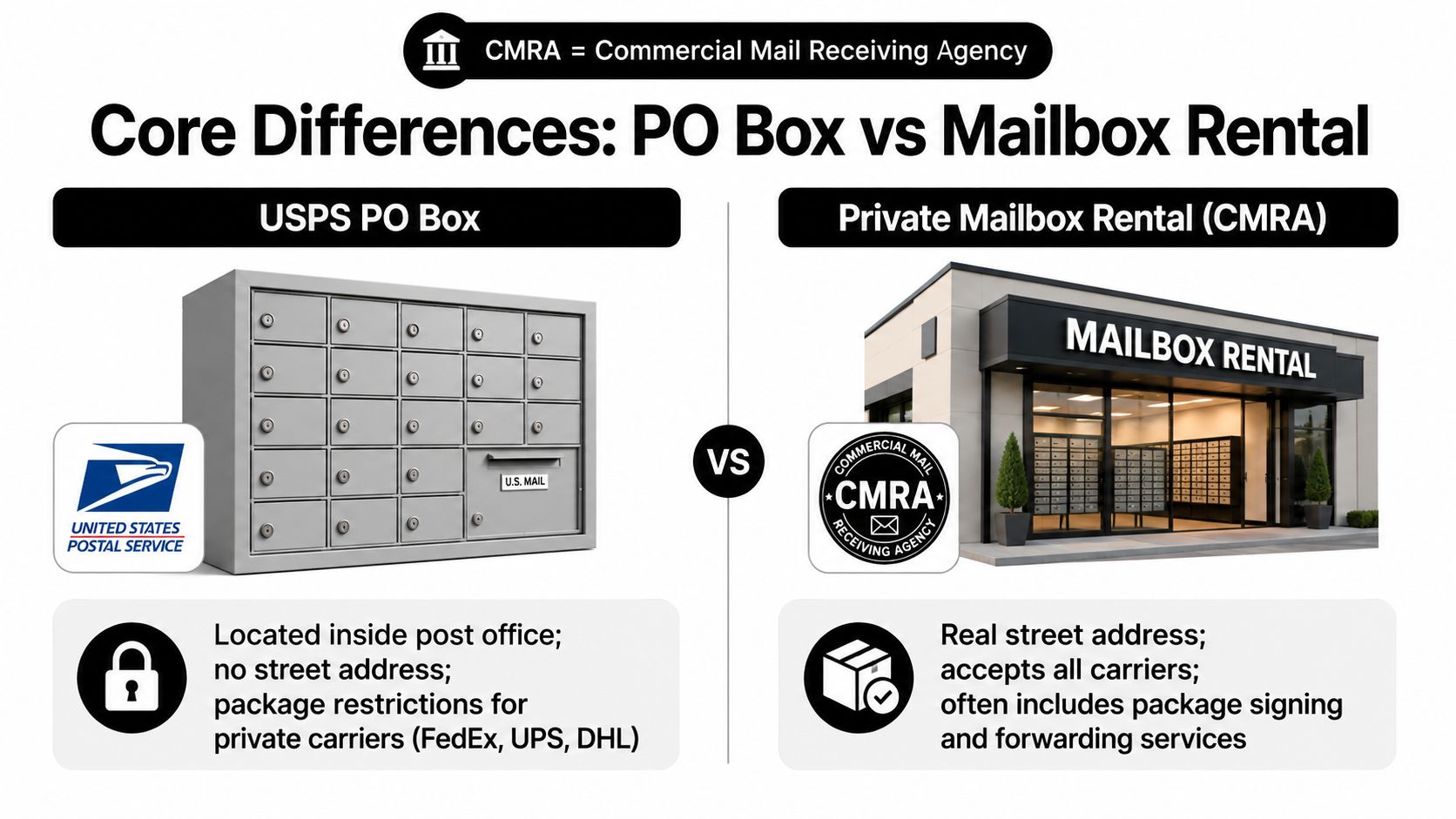
A USPS PO Box is a numbered box located inside a specific Post Office. USPS lets customers rent a box online, but the service remains tied to that location, and pickup requires in-person identity verification with two forms of identification before access is issued, as described in the USPS PO Box service guidance.
A private mailbox is different. It’s provided through a Commercial Mail Receiving Agency, or CMRA. The provider receives mail for you under USPS rules, and federal guidance requires an authorized USPS Form 1583 before the service can receive mail on your behalf. The resulting address uses the provider’s street address with a suite, unit, or private mailbox designation rather than the words “PO Box.”
Address structure changes how other systems treat you
USPS Postal Addressing Standards state that “PO BOX” or “POST OFFICE BOX” cannot be used on the delivery-address line. That distinction explains why a PO Box may work perfectly for personal mail but fail during LLC registration, banking, licensing, or vendor onboarding.
A private mailbox doesn’t turn a mailbox into a traditional office. It does give the business a street-formatted address that can be more usable in commercial systems. Acceptance still depends on the specific agency or company, so verify requirements before submitting a filing.
Location and access create different routines
A PO Box is accessed at the Post Office where it’s located. USPS notes that box access is available on the customer’s schedule, but the practical benefit remains location-dependent. You’ll need to visit that Post Office to retrieve mail and handle items that don’t fit inside the box.
A CMRA may provide a storefront, staff receiving, package holding, forwarding, and other services. Those features vary by provider and plan, so compare the written service terms rather than assuming every mailbox rental includes the same support.
For a detailed explanation of the USPS option, review this guide to renting a PO Box through USPS. It’s useful when you’re deciding whether a basic box meets your actual workflow.
Compliance and Registration Challenges You Need to Know
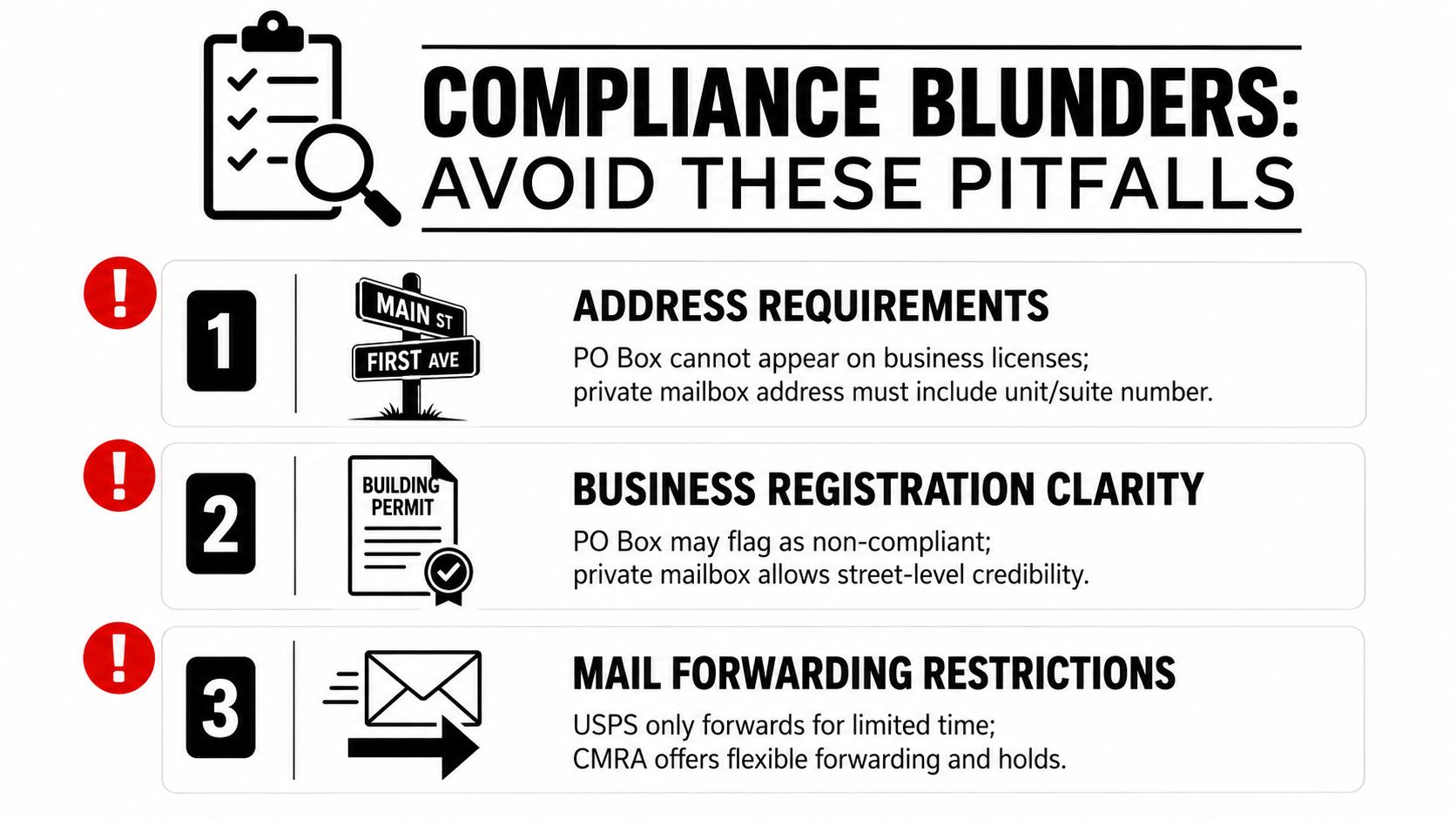
The most common mistake is treating a mailing address and a business location address as interchangeable. They aren’t always interchangeable, and the distinction can surface at the worst possible moment, after you’ve submitted formation documents or started a banking application.
A standard PO Box often fails when a form requires a physical or street address. That can affect LLC or corporation registration, business licenses, bank accounts, merchant-service onboarding, and vendor systems. A private mailbox may be accepted because it uses a street address, but you still need to confirm the receiving organization’s rules.
Premium PO Box service narrows the gap, but doesn’t erase it
USPS offers Street Addressing/Premium PO Box service at participating locations. Under that arrangement, a customer may be able to use the Post Office’s street address with a box or suite-style identifier, such as “500 Main Street #59,” as explained in USPS Publication 28’s street addressing guidance.
That feature can help with address presentation and may improve package-routing options in specific circumstances. It doesn’t automatically make the address acceptable for every LLC filing, bank, marketplace, license, or tax-related requirement. The authority reviewing your application decides whether the address satisfies its rule.
Compliance rule: A street-looking format isn’t the same as universal acceptance. Ask the filing office or bank before relying on Premium PO Box addressing.
Use this pre-rental compliance check
- Formation documents: Confirm whether your state accepts a PO Box, a PMB designation, or only a physical business location.
- Tax and licensing forms: Separate the address used for correspondence from any address field asking where the business operates.
- Banking: Ask the bank what it requires for the business address and what documents it uses to verify it.
- Merchant services: Payment processors can apply their own verification rules, even when a government office accepts an address.
- Vendor onboarding: Confirm whether suppliers will ship inventory and equipment to the address you provide.
- USPS authorization: A CMRA arrangement requires Form 1583 and identity documentation. This explanation of USPS Form 1583 can help you prepare the information a provider will request.
If your business handles regulated mail or special mailing programs, review this Ship Restrict guide to USPS mail permits before assuming a mailbox solves every postal requirement. A mailbox receives mail, but it doesn’t replace every permit, license, or operating-address obligation.
Breaking Down the Real Costs Beyond Monthly Rent
A PO Box usually wins the headline-price comparison. That doesn’t mean it always delivers the lower total cost for a business.
USPS PO Box fees vary by box size, Post Office location, and rental term. Recent independent coverage cites annual costs ranging from roughly $60 to more than $1,300 in some markets, while shorter rental periods generally cost more per month, as reported in this 2026 comparison of virtual offices and PO Boxes. Canada Post pricing also varies by location and box size, starting as low as $69 for three months, according to the same coverage.
Private mailbox rentals typically cost more than standard PO Boxes. One independent business-address comparison gives a market example of roughly $50 to $100 per month for a business-address mailbox in serviced workspace environments, while USPS PO Boxes can range from about $5 per month to over $100, depending on size and location, as summarized by Master Storage 365’s mailbox comparison.
Compare the costs that appear after checkout
The base rent is only one line item. Your real cost can also include:
- Travel time: Repeated trips to a Post Office or mailbox storefront.
- Forwarding: Postage, handling, and provider fees when you’re away.
- Package failures: Delayed or rejected shipments when a carrier can’t deliver.
- Missed business hours: Time spent collecting oversized items or arranging redelivery.
- Address changes: Filing updates and account corrections if the original address fails verification.
- Unneeded features: Paying for forwarding, scanning, or package handling you never use.
| Business profile | USPS PO Box annual cost | Private mailbox annual cost | Better value |
|---|---|---|---|
| Solo consultant, USPS letters only | About $60 to over $1,300, depending on market and box choice | Often higher than a PO Box | PO Box, if no street address is required |
| Home-based service business | Location-dependent | Often around $600 to $1,200 in serviced-workspace examples | Private mailbox, when privacy and address usability matter |
| E-commerce seller using multiple carriers | Location-dependent, plus operational limitations | Often higher base rent, with package services | Private mailbox, because carrier access has direct operational value |
The table uses broad market ranges, not a universal price list. Get the provider’s complete fee schedule, including forwarding, oversized-package handling, storage, scanning, and cancellation terms.
Cost test: Choose the cheapest option that satisfies your compliance and delivery requirements. Paying less for an address you can’t use is false economy.
Package Handling and Carrier Acceptance Explained
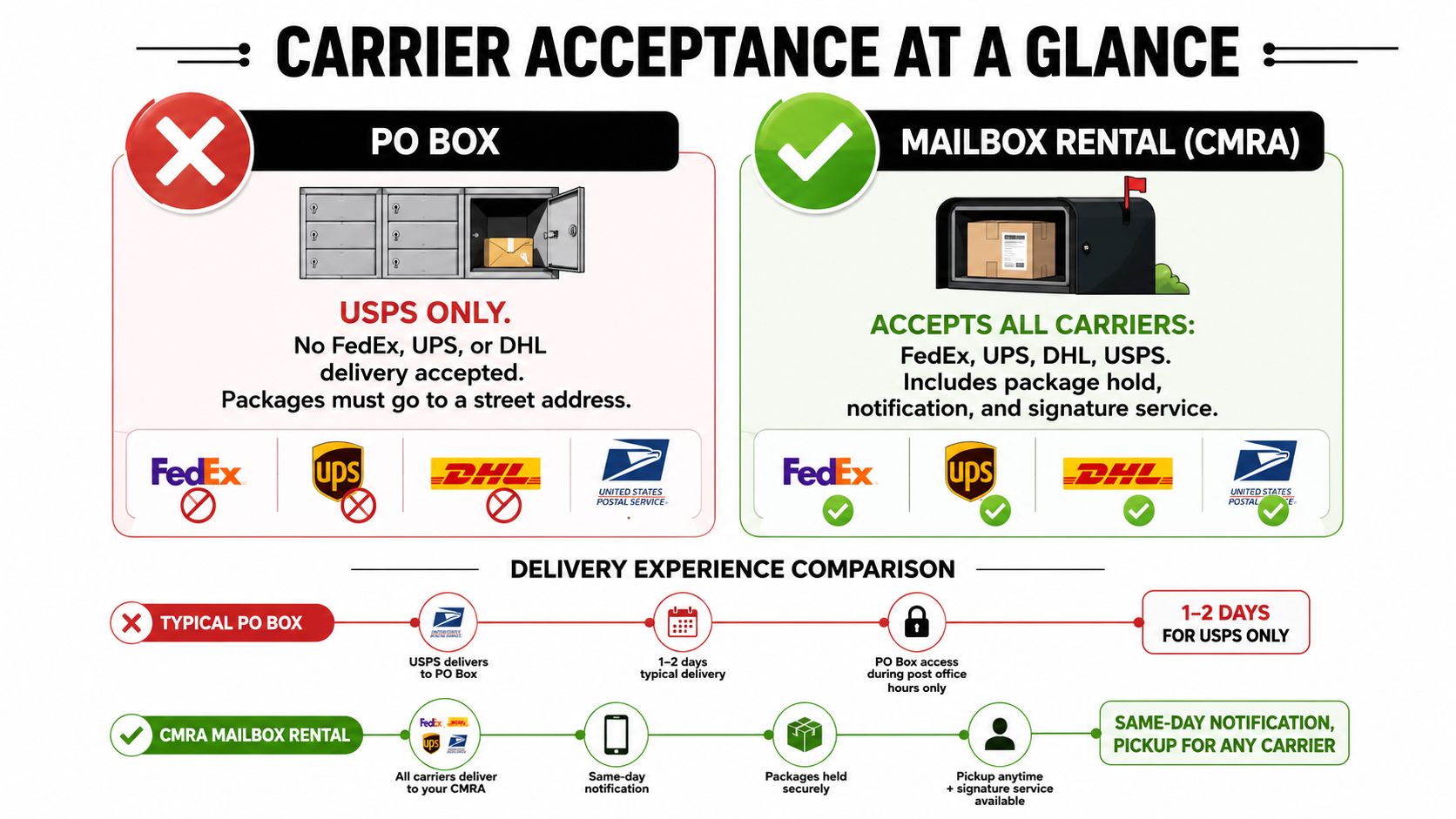
Package delivery is where a basic PO Box becomes a daily inconvenience for many small businesses. USPS mail goes to the Post Office box. Private-carrier shipments may not, because the address identifies a postal box rather than a conventional delivery location.
That matters for online sellers, consultants receiving equipment, and service companies whose vendors choose the carrier. If a shipment requires FedEx, UPS, DHL, or another private carrier, you need a receiving arrangement that can accept that delivery path.
What happens when a package arrives
With a PO Box, you’re responsible for monitoring the box and collecting items through the Post Office’s process. Packages that don’t fit may require a separate pickup, and carrier restrictions can force the sender to reroute or choose another address.
A CMRA is designed to receive mail for clients. Depending on the provider, staff may accept deliveries, sign for packages, notify you, hold items, and forward them. These services aren’t automatic across every plan, so ask direct questions:
- Carrier coverage: Will the location accept USPS, FedEx, UPS, DHL, and marketplace deliveries?
- Signature handling: Can staff sign for packages when you’re unavailable?
- Notifications: Are arrival alerts included, and are they sent by email, text, or another method?
- Storage rules: How long will packages remain available before fees apply?
- Oversized shipments: What happens to freight, large cartons, or deliveries requiring special handling?
- Forwarding: Can the provider consolidate and forward packages, and what charges apply?
Access is part of the delivery system
A mailbox that accepts a package but makes pickup difficult still creates friction. Compare public access, staff hours, after-hours availability, parking, notification speed, and the process for authorizing another person to collect items.
For a business receiving only letters, these details may not matter. For an e-commerce seller, they can determine whether the mailbox saves time or adds another logistics task. My practical view is simple: if your business depends on reliable package acceptance from multiple carriers, use a CMRA with documented receiving and notification procedures.
Which Option Fits Your Specific Business Model
The right choice depends on the work your business performs, not on which address looks cheaper in a search result.
A home-based consultant who receives contracts and occasional USPS letters may be fine with a PO Box if no filing, bank, or vendor requires a street address. If the consultant publishes an address on proposals, wants to keep a home address private, or expects equipment deliveries, a private mailbox is the more useful business tool.
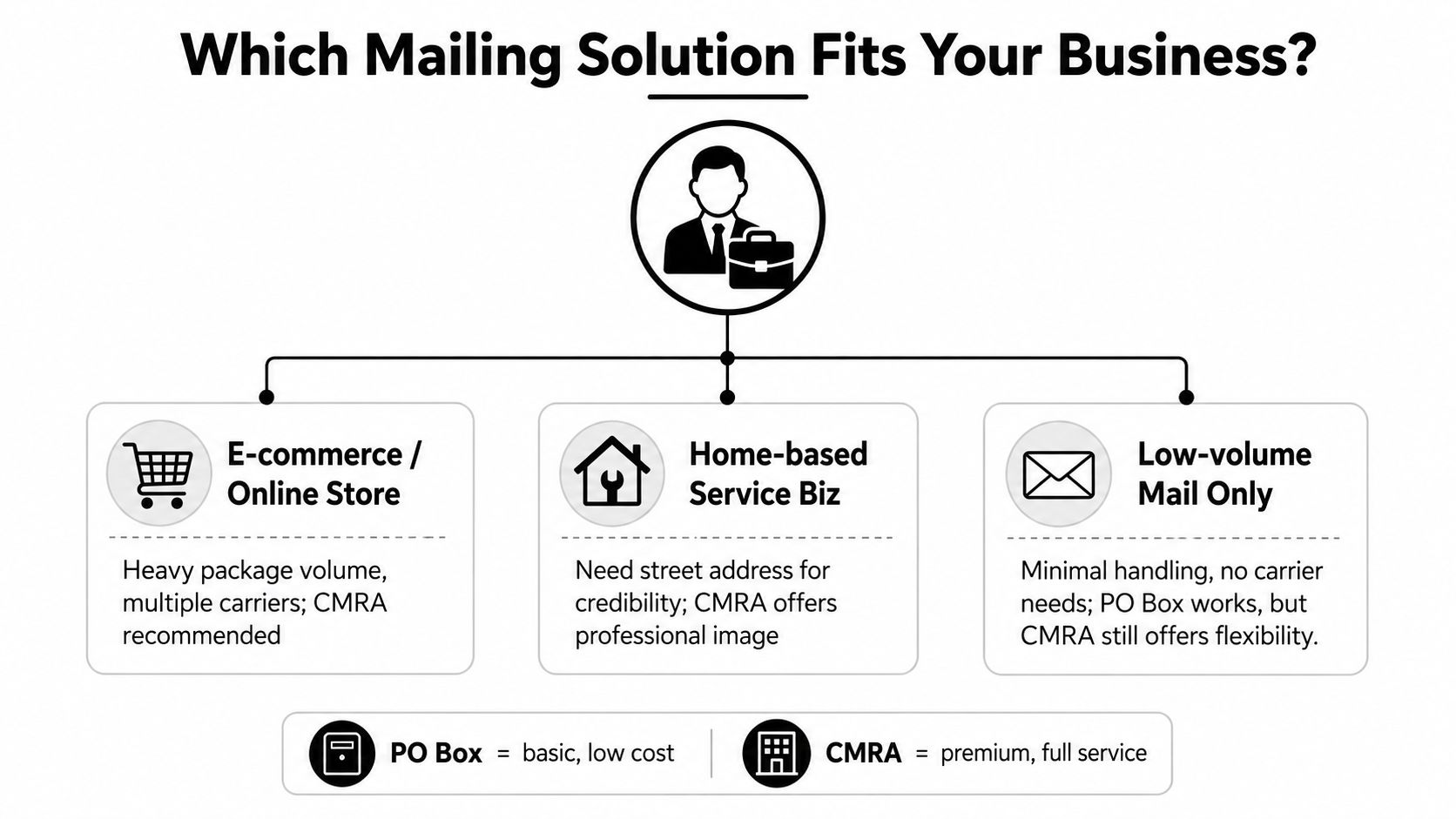
Match the address to the operating model
E-commerce and online stores should generally choose a private mailbox rental. Multiple carriers, returns, inventory samples, and customer shipments make staff receiving and package notifications more valuable than a low rental price.
Home-based service businesses usually benefit from a private mailbox when the owner wants a professional street address without publishing a residence. Prioritize address formatting, forwarding, package acceptance, and a clear pickup process.
Low-volume mail-only businesses can choose a PO Box. It’s a sensible fit when the business receives mostly USPS letters, has no street-address requirement, and doesn’t need private-carrier delivery.
Professional firms and startups should think ahead. If the business may open accounts, sign vendor agreements, apply for licenses, or expand its customer-facing presence, a private mailbox reduces the chance of replacing the address soon after launch.
A hybrid setup can be rational
Some owners maintain a PO Box for USPS correspondence and a private mailbox for packages and public business use. That approach adds another address to manage, so it only makes sense when the separation solves a specific problem.
Before opening a business bank account, review a resource on how to open a business account for a startup. Address requirements can vary by institution, and checking them before you commit prevents avoidable account-opening delays.
My recommendation by profile:
- USPS mail only: PO Box.
- Street address needed: Private mailbox, subject to acceptance confirmation.
- Multiple carriers: Private mailbox.
- Frequent travel or forwarding: Private mailbox with written forwarding terms.
- Uncertain growth plans: Private mailbox, because it gives you more operating flexibility.
Setting Up Your Private Mailbox Rental the Right Way
Choose the provider before you change every account. Ask for the complete address format, service agreement, forwarding terms, package policies, access schedule, notification process, and all recurring or optional fees.
A legitimate CMRA setup requires USPS authorization through Form 1583. You’ll need to complete the provider’s paperwork and present the required identity documents for verification. Don’t treat this as a minor administrative detail. If the form or identification record is incomplete, the provider can’t properly receive mail for you.
Follow a clean setup sequence
- Define the use case. List the registrations, banks, marketplaces, vendors, and carriers that will use the address.
- Confirm acceptance. Ask each important organization whether it accepts a private mailbox, PMB, or suite-formatted address.
- Compare providers. Check package receiving, forwarding, notifications, access, storage, scanning, and cancellation terms.
- Complete authorization. Finish Form 1583 and identity verification with the mailbox provider.
- Update records in batches. Change your website, invoices, vendors, banking profiles, licenses, insurance records, and customer communications.
- Test delivery. Send a low-risk letter and a trackable package before depending on the address for time-sensitive materials.
Business Mail Boutique LLC provides private and digital mailbox rentals with a street address, mail forwarding, mail receiving, and package receiving in its Sugar Land storefront. It also offers shipping, printing, notary, fingerprinting, identification photos, and document services, which can be useful if your address decision is part of a broader business setup.
Don’t select a mailbox by rent alone. Select the arrangement that your business can legally use, that your carriers can reach, and that you can operate without repeated trips and corrections.
Business Mail Boutique LLC offers private and digital mailbox rentals with a real street address, mail receiving, forwarding, and package receiving for home-based businesses and growing companies. Review the available services and choose a mailing setup that fits your compliance needs and delivery workflow by visiting Business Mail Boutique LLC.

Related posts

Custom Memorial Glasses Engraved in Three Hours in Sugar Land
When a customer needed eight personalized glasses for a memorial, Business Mail Boutique completed the engraving or...

Custom Martini Glass Engraving in Sugar Land, TX
Custom Logo Engraving on Martini Glasses in Sugar Land, Texas.
Business Mail Boutique recently completed a beautiful custom engravin...

Custom Engraved Wine Glasses for a Golf Club Event in Sugar Land, TX
Custom Engraved Wine Glasses for a Golf Club Event in Sugar Land.
Custom wine glass engraving in Sugar Land, TX at Business Mail Bouti...