
- Print Business Cards in Sugar Land – Same Day Service
- Copying Services
- Document Printing, Finishing & Lamination in Sugar Land
- Flyers
- Print Banner in Sugar Land | Same-Day Banner Printing Near Me
- Graphic Design
- Photo Printing
- Postcard Printing
- Document Printing
- EDDM Full Service Postcards
- FotoZoomer Large Format Printing



Custom Business Signage in Sugar Land: Your 2026 Guide
Businessmailboutique
11645 S. Hwy 6
Sugar land, Texas 77498 United States (US)
Email: info@businessmailboutique.com
You’re probably here because the sign question has stopped being theoretical.
Maybe your Sugar Land storefront looks fine from the parking lot, but people still walk past it. Maybe you’ve got a grand opening, weekend promotion, or community event coming up and need something visible fast. Or maybe your old sign has faded, the hours on the window are outdated, and the place no longer looks as polished as the service you provide.
That’s where custom business signage stops being “marketing stuff” and starts becoming part of daily operations. It helps people find you, decide whether to trust you, and understand what to do next once they arrive. It also comes with practical decisions that business owners often don’t get clear guidance on. Which sign type makes sense for the job? What size should it be? How many signs do you really need? What files does a print shop need? When do permits enter the picture?
A lot of local owners don’t need a branding lecture. They need a straightforward path from idea to installed sign. That’s what this guide is built to do for a Sugar Land buyer.
Table of Contents
- Your First Impression Starts on the Sidewalk
- Choosing the Right Sign Type and Material
- Strategic Placement and Smart Measuring
- Perfecting Your Design and Print Files
- Navigating Permits and ADA Compliance
- Understanding Costs and Turnaround Times
- Ordering Your Sign at Business Mail Boutique
Your First Impression Starts on the Sidewalk
A storefront sign does two jobs at once. It gets attention, and it tells people whether your business looks established enough to walk into.
That matters more than many owners expect. Consumer research reported that 50% of new customers are drawn in by on-premises signage, 68% believe signage reflects a business’s quality, and 60% avoid businesses with no signage or poor signage, according to these business signage consumer figures. In plain terms, your sign isn’t just decoration. It’s part of how people judge competence before they ever speak to your staff.
In Sugar Land, that judgment often happens quickly. A driver turns into a shopping center off Highway 6. A parent is running between errands. A customer is scanning a row of storefronts from a distance. If your message is buried, too small, or visually weak, you’re asking people to work too hard.
Practical rule: If someone has to slow down and decode your sign, the sign is doing too much and saying too little.
That’s why custom business signage works best when it solves a specific visibility problem. A banner can announce something timely. Window graphics can turn unused glass into branding space. A clean storefront sign can make a business feel stable and easy to find. Even a fast-turnaround option like same-day outdoor banner printing in Sugar Land can be the right move when the need is immediate and temporary.
The mistake is treating all signs as interchangeable. They’re not. The right sign depends on how long it needs to last, where people will view it from, and what decision you want them to make when they see it.
Choosing the Right Sign Type and Material
Some signs are built to catch attention for a short window. Others need to hold up day after day while looking consistent with your brand. Picking the wrong format usually creates one of two problems. You either overspend on a temporary need, or you underbuild something that should have been permanent.
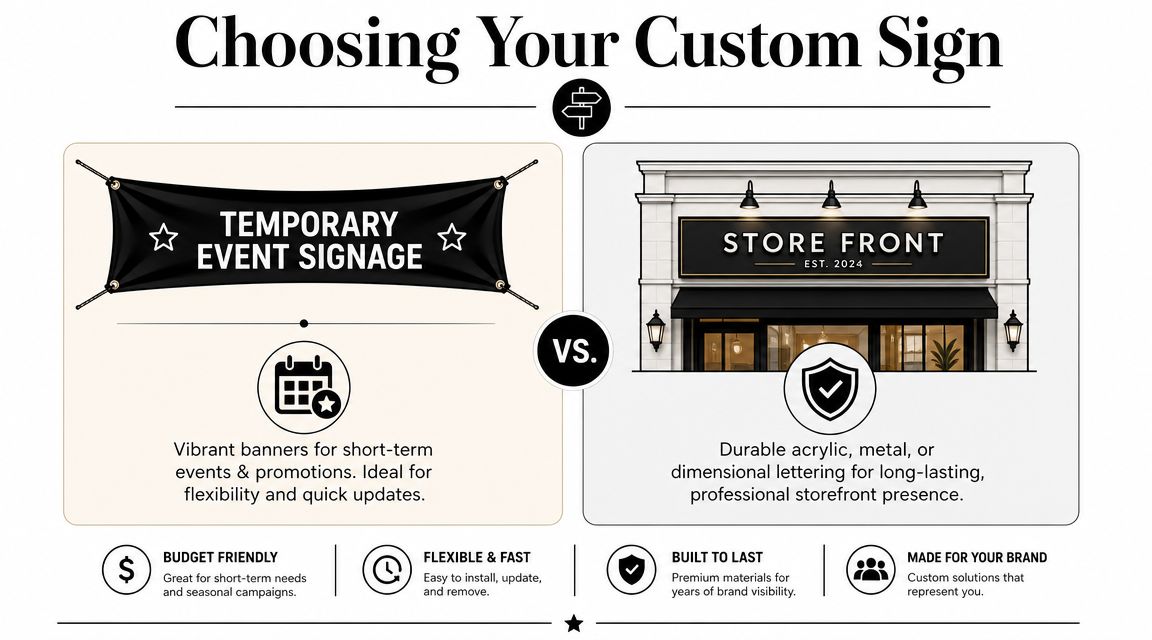
Match the sign to the job
For local businesses, these are the sign types that come up most often:
- Vinyl banners work well for grand openings, sales, church events, school functions, pop-ups, and seasonal promotions. They’re flexible, easy to hang, and simple to replace when the message changes.
- Yard signs are practical for directional messaging, real estate, contractor branding, event parking, and temporary roadside visibility. They’re especially useful when people need guidance before they reach your entrance.
- A-frame signs fit businesses with steady pedestrian traffic. Cafes, salons, boutiques, and service businesses use them to announce specials, hours, or walk-in availability.
- Window decals and window graphics help when your glass frontage is doing nothing for you. They can show branding, business hours, privacy elements, or promotional offers without taking up floor space.
- Rigid storefront signs are the better choice when you need a more permanent visual presence. That includes lobby panels, wall-mounted branding, directional boards, and polished exterior identity signs.
A good local print partner can produce several of these formats under one roof. If you’re comparing short-term and long-term solutions, it helps to look at wide-format printing options for signs and display graphics before choosing only by price.
Common Sign Materials at a Glance
| Material | Best For | Indoor/Outdoor | Durability | Relative Cost |
|---|---|---|---|---|
| Corrugated plastic | Yard signs, temporary directional signs, event signage | Indoor/Outdoor | Good for short-term use | Lower |
| Vinyl | Banners, flexible promotional signs, temporary outdoor messaging | Indoor/Outdoor | Good when properly finished | Lower to mid |
| Aluminum | Durable exterior signs, parking signs, long-term directional signage | Outdoor/Indoor | Strong for long-term use | Mid |
| Acrylic | Lobby signs, polished interior branding, professional wall displays | Indoor, some covered outdoor uses | Strong visual finish, more situational outdoors | Mid to higher |
If you want a broader material breakdown before you commit, this guide can help you compare durable outdoor sign options based on weather exposure and use case.
Where local businesses usually go wrong
Most bad sign purchases happen because the owner starts with appearance instead of function.
A glossy acrylic panel can look sharp in a lobby, but that doesn’t make it the right answer for a sun-exposed exterior wall. A banner may be perfect for a weekend activation, but it won’t replace a permanent identification sign. Window graphics can create a strong street presence, but they can also block too much light if the layout gets heavy.
Good signage feels obvious after it’s installed. The wrong signage creates maintenance, readability, or placement problems almost immediately.
The easiest way to stay out of trouble is to answer three questions before ordering:
- How long does this sign need to work?
- How far away will people be when they read it?
- Is the main goal identification, promotion, direction, or decoration?
Once those answers are clear, material choice becomes much easier.
Strategic Placement and Smart Measuring
A strong design can still underperform if it’s mounted too high, blocked by landscaping, or aimed at the wrong traffic flow.
That’s why placement should be decided before final artwork, not after. Sign readability changes with angle, distance, and approach path. Guidance on how viewing angle affects sign readability notes that both horizontal and vertical viewing angles affect legibility, and signs mounted high or off-axis can become hard to read even when the artwork itself is solid.
Build a small sign system
Many owners assume more signs automatically create more visibility. In practice, that often creates clutter.
One industry guide says that for storefront and permanent exterior signs, one to three well-placed signs usually cover the main viewing angles, as explained in this article on exterior business sign placement ideas. That’s a useful rule for Sugar Land strip centers, office parks, and roadside retail where customers typically encounter your business in stages.
A simple sign system usually works better:
- Approach sign for the first point of notice from the road or lot
- Entry sign at or near the storefront
- Decision sign for hours, suite details, directions, or current offer
That setup helps people move from “I think that’s the place” to “Yes, that’s exactly where I need to go.”
Measure before you design
Bad measurements create expensive delays. They also cause proportion problems that no amount of design polish can fix.
Use a basic measuring routine before requesting a mock-up:
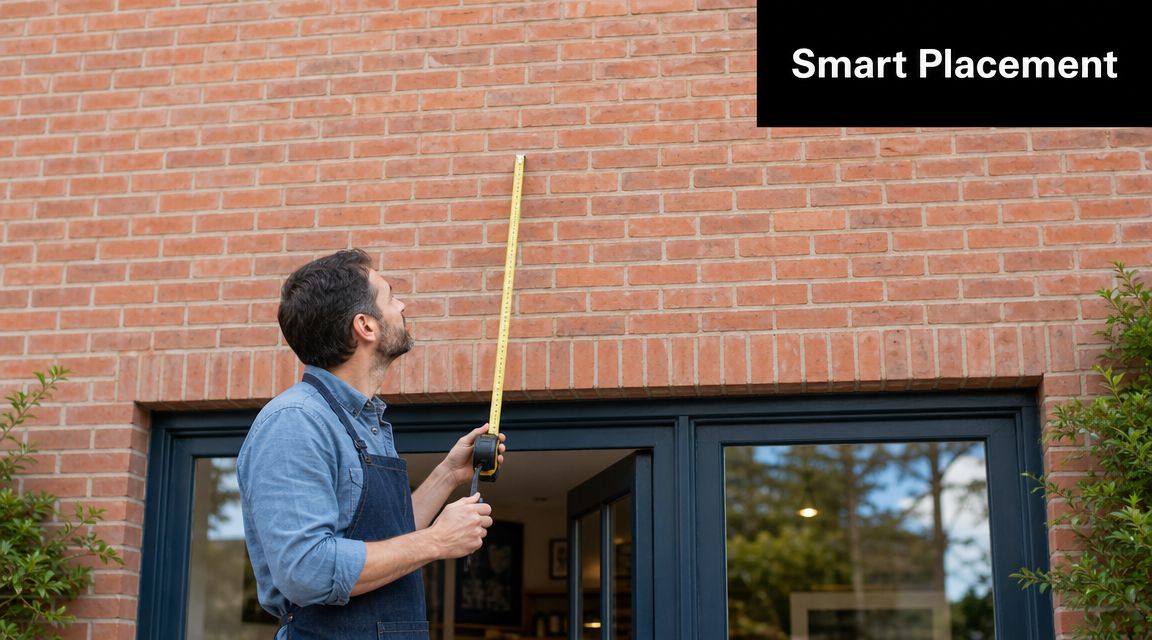
- Measure the full install area and then the usable area. Trim, lights, conduits, brick breaks, and door swings reduce the actual space.
- Photograph the wall straight-on and from the common customer approach path. Both views matter.
- Note obstructions like soffits, address numbers, awnings, light fixtures, and landscaping.
- Check the surroundings so the sign doesn’t fight visually with neighboring tenants.
On-site habit: Bring a tape measure, your phone, and a simple sketch. That small prep step saves a lot of revision time.
A quick visual walkthrough can help you think more clearly about fit, spacing, and install conditions:
Check the approach path
Don’t evaluate your sign location while standing directly in front of the wall. Customers rarely see it that way first.
Walk the route a customer takes from the street, the parking lot, and the sidewalk. Then ask practical questions. Are they reading while moving? Are they below the sign looking up? Are they approaching from one dominant side? Does glare hit the surface at the busiest time of day? Those details affect whether custom business signage performs in practice or only looks good on a proof.
Perfecting Your Design and Print Files
Most sign problems don’t begin on the press. They begin in the file.
The common issues are familiar. Low-resolution logos. Colors built for screens instead of print. Tiny text that looked fine on a laptop. A file that technically opens but isn’t production-ready. These aren’t creative mistakes. They’re handoff mistakes, and they slow everything down.
The signage workflow itself tends to break down at the transition from approved design to fabrication. Process guidance notes that the design-to-install handoff is often the most failure-prone step, and it specifically recommends vector-based artwork so graphics stay resolution-independent during production, as outlined in this overview of the signage production process from concept to installation.
Design for quick reading
A sign usually gets only a brief glance. That means the design has to prioritize clarity over cleverness.
Use these rules:
- Keep the message short. Business name, service, offer, or direction. Not all of them at once.
- Use strong contrast. Dark text on a light field, or light text on a dark field, is easier to read at distance.
- Choose simple typefaces. Decorative fonts often fall apart when viewed from a parking lot or through glass.
- Create a clear reading order. The eye should know what to read first, second, and last.
A good sign proof should feel almost plain up close. That usually means it will read well from farther away.
Files that print cleanly
If you’re supplying artwork, these file habits prevent most production trouble:
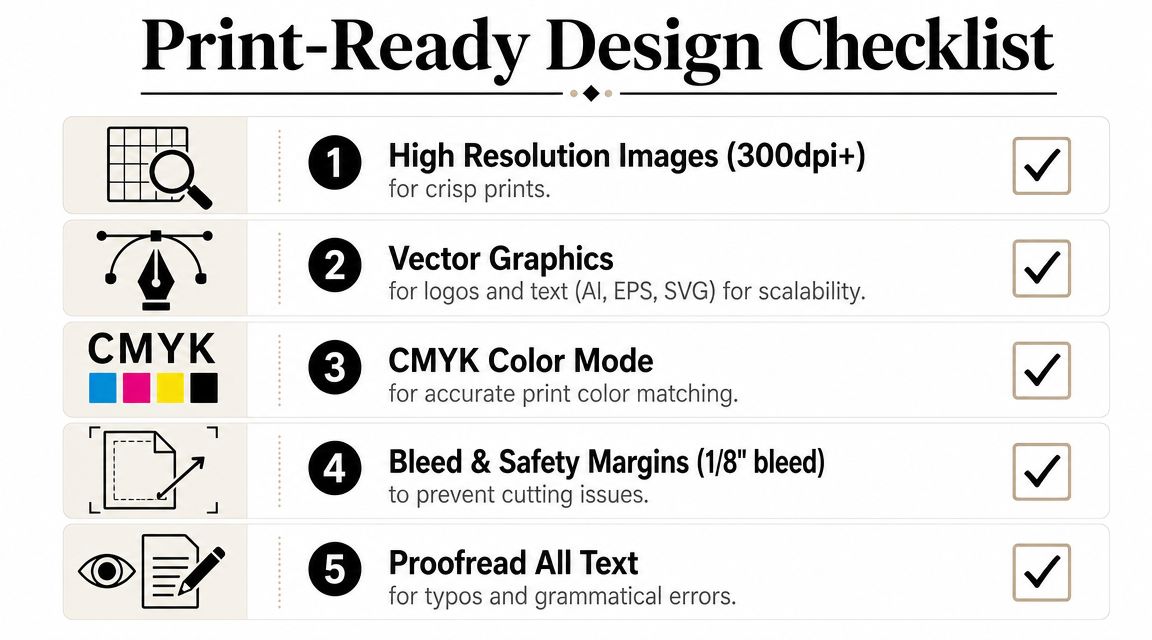
- Vector logos first. AI, EPS, SVG, and print-ready PDF files preserve edges and scale cleanly.
- Raster images only when necessary. JPG and PNG files can work for photos, but they shouldn’t carry your logo if a vector version exists.
- CMYK over RGB. Screens emit light. Printers apply ink. Those systems don’t translate perfectly.
- Bleed and safe margins matter. If color or imagery runs to the edge, the file needs extra area for trimming.
- Proofread every word. Phone numbers, suite numbers, service names, and hours cause more reprints than design does.
One detail people miss
Font licensing gets overlooked all the time, especially when a designer sends packaged files or converts work between systems. If your sign uses a commercial font, make sure your team has the right to use it in business materials. This explainer on Font Checker Pro’s licensing insights is worth a quick read before final production.
That issue won’t change how the sign looks, but it can create avoidable back-and-forth during artwork prep.
Navigating Permits and ADA Compliance
Temporary signage and permanent signage live in different worlds.
A yard sign for an event, a sale banner, or a short-run promotional display is usually a simpler print decision. A mounted exterior sign, illuminated sign, or permanent building sign is where code questions start to matter. In Sugar Land, that means you should check local requirements before ordering something that will be attached to the building or installed as a long-term feature.
When permits usually matter
Permanent exterior signs often trigger review because the city may care about placement, size limits, mounting method, lighting, and how the sign relates to the property. Landlords and shopping center managers may also have their own sign criteria. In many cases, their rules matter before the city’s rules ever do.
That’s why the smart move is to gather approvals in this order:
- Lease and landlord review if you’re a tenant
- Property management standards for center consistency
- City requirements for permit or code review
- Fabrication-ready measurements only after the above is confirmed
If your project includes required posted information for a development or construction context, these engraved plastic sign requirements for city posting can help you start the conversation with clearer expectations.
A beautiful sign that can’t be approved is still the wrong sign.
ADA signs are a separate category
ADA signage isn’t the same as general promotional signage. It applies to accessibility-related sign types inside many commercial spaces, such as room identification and certain directional or wayfinding situations. These signs may involve tactile lettering, Braille, contrast, and mounting location requirements.
The key point for a business owner is simple. Don’t assume that a nice-looking plaque automatically qualifies as an ADA sign. If the sign is tied to accessible navigation or room identification, confirm the specs before production. That protects you from reordering signs that look correct but fail on details like character style, height placement, or tactile elements.
For most owners, the practical answer is to ask early whether a sign is decorative, promotional, directional, or ADA-required. Each category follows a different set of rules.
Understanding Costs and Turnaround Times
Sign pricing isn’t mysterious, but it is variable.
Two signs can look similar in a thumbnail and cost very different amounts to produce. The reason usually comes down to material, finishing, mounting method, artwork prep, and whether the job is a simple print or a fabricated install item.
What changes the price
The biggest cost drivers are usually these:
- Size affects both material use and production handling.
- Material choice changes durability, finish, and fabrication complexity.
- Quantity can lower the per-piece cost on repeatable items like yard signs or decals.
- Design complexity matters when files need cleanup, resizing, redraw work, or proof revisions.
- Installation requirements add labor, hardware, and site coordination.
A temporary banner with standard finishing is a very different job from a cut acrylic lobby sign or a permanent exterior panel. That’s why experienced shops usually quote after they know the use case, not just the dimensions.
What affects the schedule
Turnaround time depends on whether the job is print-only or fabrication-based.
Simple promotional items can often move quickly if the file is ready and the material is in stock. Larger custom business signage projects usually take longer because there are more checkpoints. Measurements have to be confirmed. Proofs need approval. Mounting details must match the site. If the project needs permits or landlord sign-off, the calendar stretches before production even starts.
The global sign market was estimated at $114.51 billion in 2025 and is projected to reach $144.27 billion by 2030, a 4.9% CAGR, with Asia-Pacific listed as the largest regional market in 2025 according to global sign market reporting. That scale reinforces a practical point. Signage is a large, active production category, not a niche one-off purchase, so lead times and pricing naturally vary with materials, workflow, and demand.
If you’re ordering for an event, opening, or seasonal campaign, build in approval time. That’s the part owners most often underestimate.
Ordering Your Sign at Business Mail Boutique
By the time you’re ready to order, the hard part shouldn’t be guessing. It should just be choosing.
For a Sugar Land owner, a local order process usually goes more smoothly when you bring real information instead of a loose idea. A storefront photo, rough measurements, your logo file, and a short description of the sign’s purpose can answer most of the questions that otherwise create revision loops.
What to bring with you
Come in with these basics if you have them:
- A photo of the install area
- Approximate width and height
- Your logo in the best file format available
- The exact wording you want on the sign
- A target date
- Any landlord or property guidelines
If you don’t have all of that, you can still start. But the quote and proof process moves faster when those pieces are in place.
What the ordering flow looks like
At a practical level, the order usually moves through a short sequence. You discuss the purpose of the sign, the likely material, the size, and whether it’s temporary or permanent. Then a quote is built from those specs. After that comes the proof, revision if needed, and production once approval is final.
For local printing needs, Business Mail Boutique LLC handles products such as banners, yard signs, decals, and other print services from its Sugar Land location, which makes it a workable option when a business wants one place to discuss file setup, format, and print output.
The strongest orders tend to be the simplest. One clear objective. One primary audience. One message the customer can understand quickly. That’s true whether you’re ordering a grand-opening banner, a window decal, or a polished in-store sign panel.
If you’re ready to turn an idea into a finished sign, Business Mail Boutique LLC is a convenient local place to start in Sugar Land. Bring a photo of your space, your logo if you have it, and a rough sense of what the sign needs to do. From banners and yard signs to other printed display pieces, the team can help you turn those details into a practical next step.

Related posts

Custom Memorial Glasses Engraved in Three Hours in Sugar Land
When a customer needed eight personalized glasses for a memorial, Business Mail Boutique completed the engraving or...

Custom Martini Glass Engraving in Sugar Land, TX
Custom Logo Engraving on Martini Glasses in Sugar Land, Texas.
Business Mail Boutique recently completed a beautiful custom engravin...

Custom Engraved Wine Glasses for a Golf Club Event in Sugar Land, TX
Custom Engraved Wine Glasses for a Golf Club Event in Sugar Land.
Custom wine glass engraving in Sugar Land, TX at Business Mail Bouti...