
- Print Business Cards in Sugar Land – Same Day Service
- Copying Services
- Document Printing, Finishing & Lamination in Sugar Land
- Flyers
- Print Banner in Sugar Land | Same-Day Banner Printing Near Me
- Graphic Design
- Photo Printing
- Postcard Printing
- Document Printing
- EDDM Full Service Postcards
- FotoZoomer Large Format Printing



Different Fingerprint Patterns Explained and How to Capture.
Discover the different fingerprint patterns and learn how to capture them effectively for identification and analysis.
Businessmailboutique
11645 S. Hwy 6
Sugar land, Texas 77498 United States (US)
Email: info@businessmailboutique.com
Route
Loops dominate fingerprint records, yet they’re only one part of a classification system built to handle arches, whorls, ridge counts, subtypes, and imperfect impressions. In one study of 4,000 fingerprints, loops represented 57.2%, whorls 38.3%, and arches 4.5% (Journal of Medical Science and Clinical Research). That distribution matters beyond curiosity. It affects how examiners organize records, how automated systems narrow searches, and whether a fingerprint captured for a background check contains enough ridge detail to be useful.
Table of Contents
The Statistical Reality of Fingerprint Distribution
The most common fingerprint pattern is usually the loop, followed by the whorl, with the arch appearing least often among the three major classes. A separate study of 2,500 fingers found loops at 52.6%, whorls at 39.4%, arches at 7.3%, and composite patterns at 0.6% (government research report). The exact percentages shift between populations, but the ranking remains remarkably consistent.
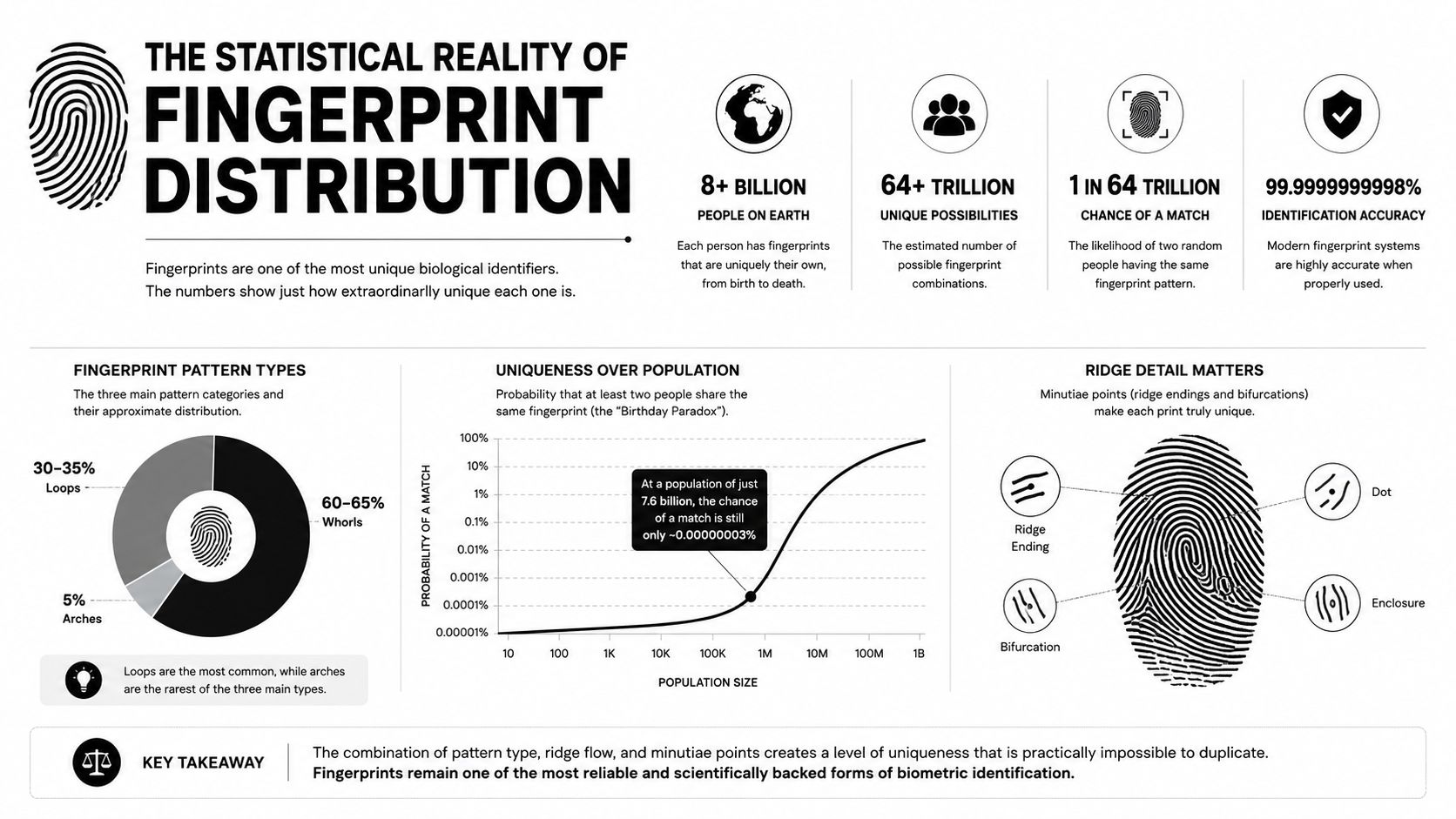
A separate community sample recorded loops on 52.71% of prints, whorls on 27.38%, and arches on 15.28% (community fingerprint study). That wider variation illustrates an important point: population data can change the precise distribution without changing the basic classification logic. Examiners still begin with the same broad question, does the ridge flow form a loop, a circular or spiral structure, or an arching pattern?
Why frequency shapes fingerprint workflows
Expert summaries commonly place loops in a broad global range of 60% to 65%, whorls at 30% to 35%, and arches at about 5% (Forensic Science Simplified). These figures aren’t a prediction for every person or every community. They’re a practical reminder that a screening system will encounter many more loops than arches.
That imbalance influences indexing and database design. A classification label can help sort a record, but it can’t identify a person by itself. Investigators need finer ridge information, including the arrangement of ridge endings, splits, cores, deltas, and other details. A common pattern may be useful for organizing a search, while the small features within that pattern provide much of the distinguishing information.
Practical rule: A pattern category narrows the field. Ridge detail does the real comparison work.
Why rare patterns attract attention
Rare patterns can seem more informative because they appear less frequently. An accidental whorl, for example, may deserve careful review because it doesn’t fit neatly into a simple loop, arch, or ordinary whorl description. Sample-based descriptions place accidental whorls at roughly 1% to 5%, but the operational value of a rare subtype depends on print quality, not rarity alone (Forensic Science Simplified).
A partial or smudged rare pattern may be less useful than a clear common loop. Classification helps an examiner describe what’s present, but a reliable comparison still depends on readable ridges and sufficient detail.
Identifying the Three Primary Pattern Classes
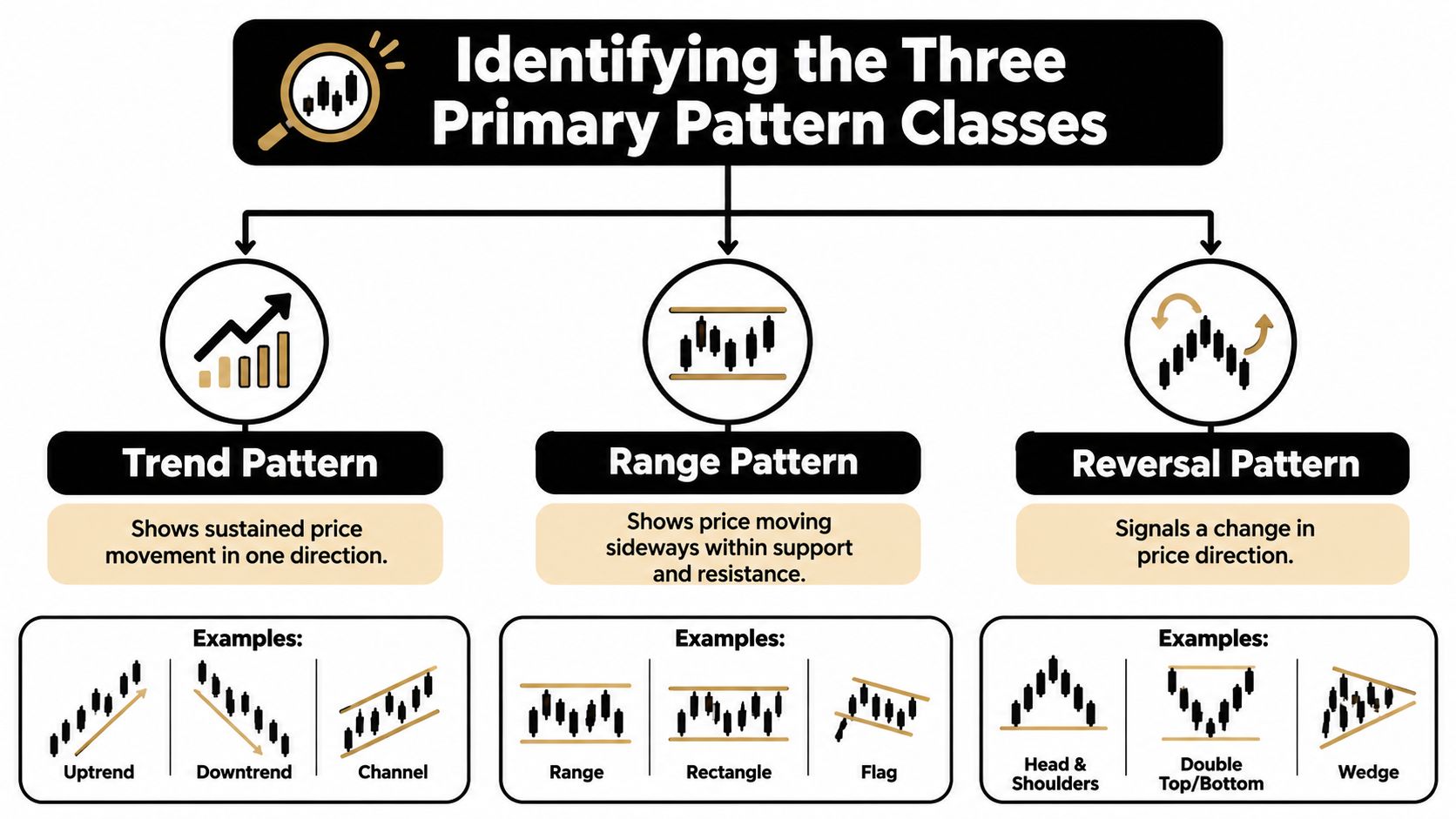
For a first look at a fingerprint, focus on the direction and shape of the friction ridges. The three primary classes are loops, whorls, and arches. You don’t need advanced equipment to understand the broad geometry, although professional classification requires training and a complete impression.
Loops turn back into the print
A loop begins on one side of the fingertip, curves around, and returns toward the side where it started. Most loops have one delta, also called a triradius, and one central area known as the core.
The loop’s direction helps create a more specific description. A radial loop opens toward the thumb side of the hand, while an ulnar loop opens toward the little-finger side. The direction can be difficult to judge on an isolated image, so examiners consider the finger and hand position rather than relying only on the visual orientation of a scanned image.
Whorls form circular or spiral movement
A whorl generally contains a circular, spiral, or concentric ridge formation. Whorls commonly show two deltas and two triradii, although the exact appearance varies among subtypes.
The central region may resemble a target, swirl, or irregular combination of curves. A plain whorl is relatively organized, while a double loop contains two loop formations within the same pattern area. Central pocket loops and accidental whorls require closer examination because their ridge paths can overlap or combine in ways that make quick classification unreliable.
Arches rise and leave
An arch is the simplest broad pattern. Ridges enter from one side, rise in the center, and leave through the other side without forming the recurving structure of a loop.
A plain arch has a smooth, wave-like rise. A tented arch has a sharper central upthrust, often resembling a narrow peak or tent pole. The distinction matters because arches have no triradius and therefore zero ridge counts, while loops have one triradius and one ridge count, and whorls have two triradii and two ridge counts (NIJ government report).
Watch the embedded demonstration for a visual explanation of ridge flow and classification:
Ridge counts make descriptions measurable
A ridge count isn’t just the number of lines visible across the whole fingertip. In classification work, an examiner counts the ridges crossing a defined path between a core and a delta, where those landmarks exist. That measurement gives two examiners a more standardized way to describe a print than words such as “large” or “tight.”
This is why a fingerprint record can contain both a pattern name and numerical observations. Visual category and ridge-count information work together, especially when a database needs to index many records consistently.
The Biological Origins of Ridge Formation
Fingerprints begin before birth, during embryonic development. The broad pattern reflects how the volar pads, the temporary fleshy elevations on developing fingers, form and change shape. Differences in the pads’ relative height and width influence whether the developing ridges follow an arch, loop, or whorl trajectory (review of fingerprint development and heritability).
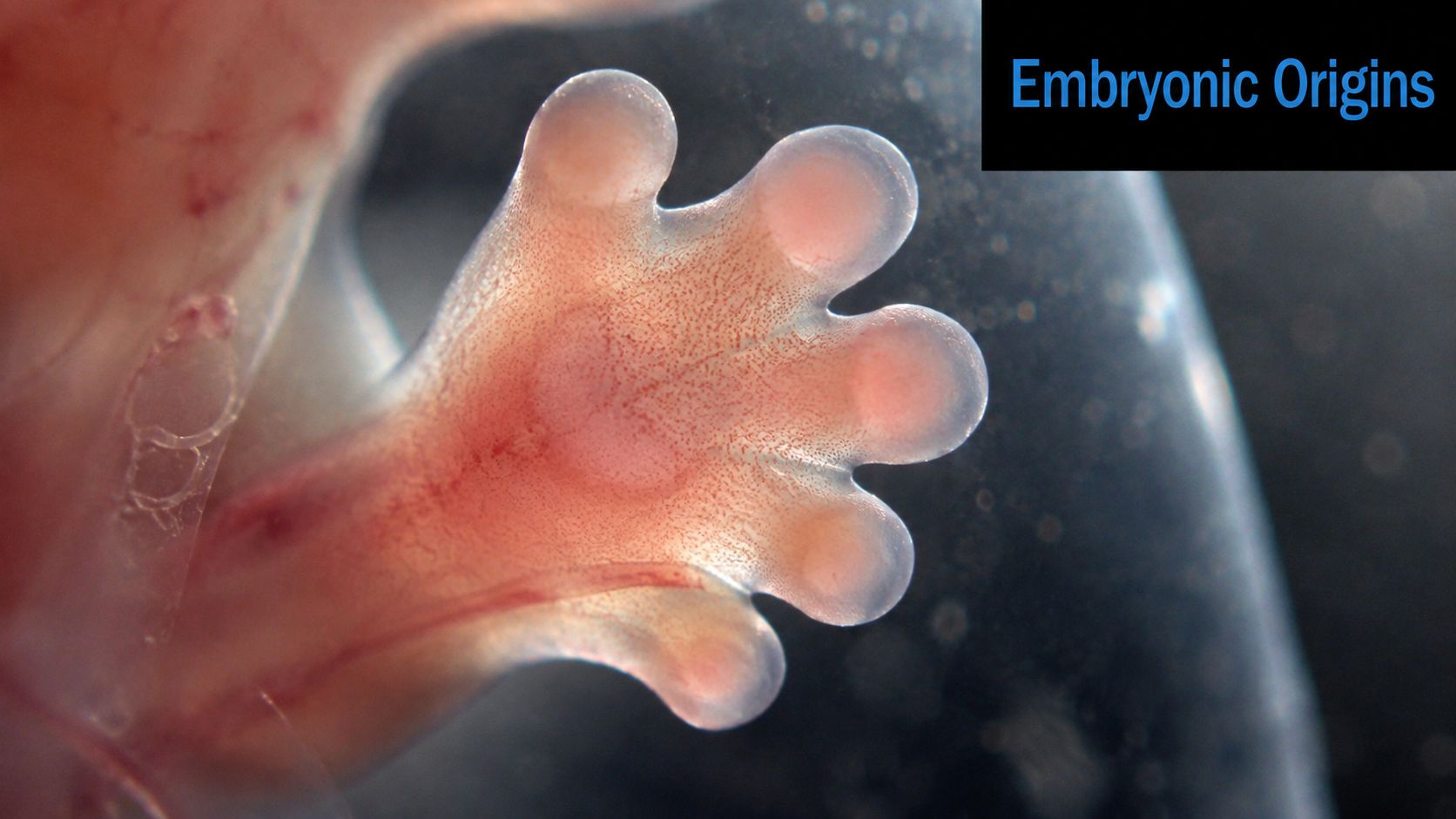
The process resembles a developing area whose surface is shaped by several conditions at once. As the finger grows, the pad changes relative to the surrounding tissue. Ridge formation responds to that changing geometry, which helps explain why even people with similar family traits don’t receive identical fingerprints.
Inheritance influences the architecture
Fingerprint variation is strongly heritable, but inheritance doesn’t produce a simple copy from parent to child. A large review reported heritability ranging from 59% for pattern intensity index to 77% for total finger ridge count (PMC review). Earlier studies cited in that review reported heritabilities as high as 0.65 to 0.96 for up to 12 dermatoglyphic traits (same review).
These findings support a substantial genetic contribution to ridge architecture. They don’t mean that a child’s print will match a parent’s print, or that relatives can be identified from pattern class alone. Genes help influence the broad design, while developmental conditions help shape the detailed arrangement.
Why fingerprints remain useful after formation
The skin’s friction ridges form a stable surface pattern, which is why fingerprint examination can compare impressions from the same person over time. The identifying value comes from the combined arrangement of ridge paths and smaller features, not merely from whether a finger has a loop or whorl.
That distinction matters during capture. A broad pattern can remain present while a poor impression hides its core, delta, or ridge endings. The biology may be stable, but the image presented to an examiner or scanner can be incomplete.
The pattern is formed before birth, but the quality of the evidence depends on what reaches the card or sensor.
Subtypes and Their Role in Forensic Databases
The three major classes provide a starting point, not a complete filing system. Operational workflows divide them into subtypes so examiners and automated systems can organize records with greater precision.
| Pattern Subtype | Estimated Frequency | Search Priority |
|---|---|---|
| Plain loop | Common within the dominant loop class | High |
| Radial loop | Less common loop direction | Targeted |
| Ulnar loop | Less common loop direction | Targeted |
| Plain whorl | Common whorl subtype | High |
| Central pocket loop | Uncommon relative to broad loop and whorl classes | Targeted |
| Double loop | Uncommon composite whorl form | Targeted |
| Accidental whorl | About 1% to 5% in sample-based descriptions (Forensic Science Simplified) | Review carefully |
| Plain arch | Commoner arch form | Targeted |
| Tented arch | Less common arch subtype | Targeted |
Whorls may be divided into plain whorls, central pocket loops, double loops, and accidental whorls. Arches may be classified as plain or tented, while loops can be described as radial or ulnar. Henry and NCIC-style systems also use ridge-based information to support filing and identification workflows (fingerprint classification study).
Rare doesn’t mean automatically decisive
An accidental whorl can attract attention because it combines features that don’t fit a simple visual label. Still, a rare subtype doesn’t replace comparison of the actual ridge detail. A distorted accidental whorl may be harder to interpret than a clean plain loop with clearly visible minutiae.
This is also where evidence handling becomes important. If an examiner is preserving a physical item or impression for later review, careful packaging helps protect the material from contamination and damage. Teams handling physical exhibits can review guidance on how to browse evidence bags when selecting suitable packaging supplies.
Classification supports, rather than replaces, examination
Automated systems use classification to narrow and prioritize searches, but they still depend on capture quality and feature extraction. A database can quickly organize a print by broad pattern, yet it can’t recover ridge detail that never appeared on the original card or sensor.
For employers and organizations ordering background checks, the practical lesson is straightforward. A clear, correctly completed record gives the downstream system more usable information than a rushed impression, regardless of whether the fingers show common or rare patterns. Businesses reviewing the broader process can also consult this overview of FBI criminal history checks for businesses to understand why accurate fingerprint collection matters.
Techniques for High-Quality Fingerprint Capture
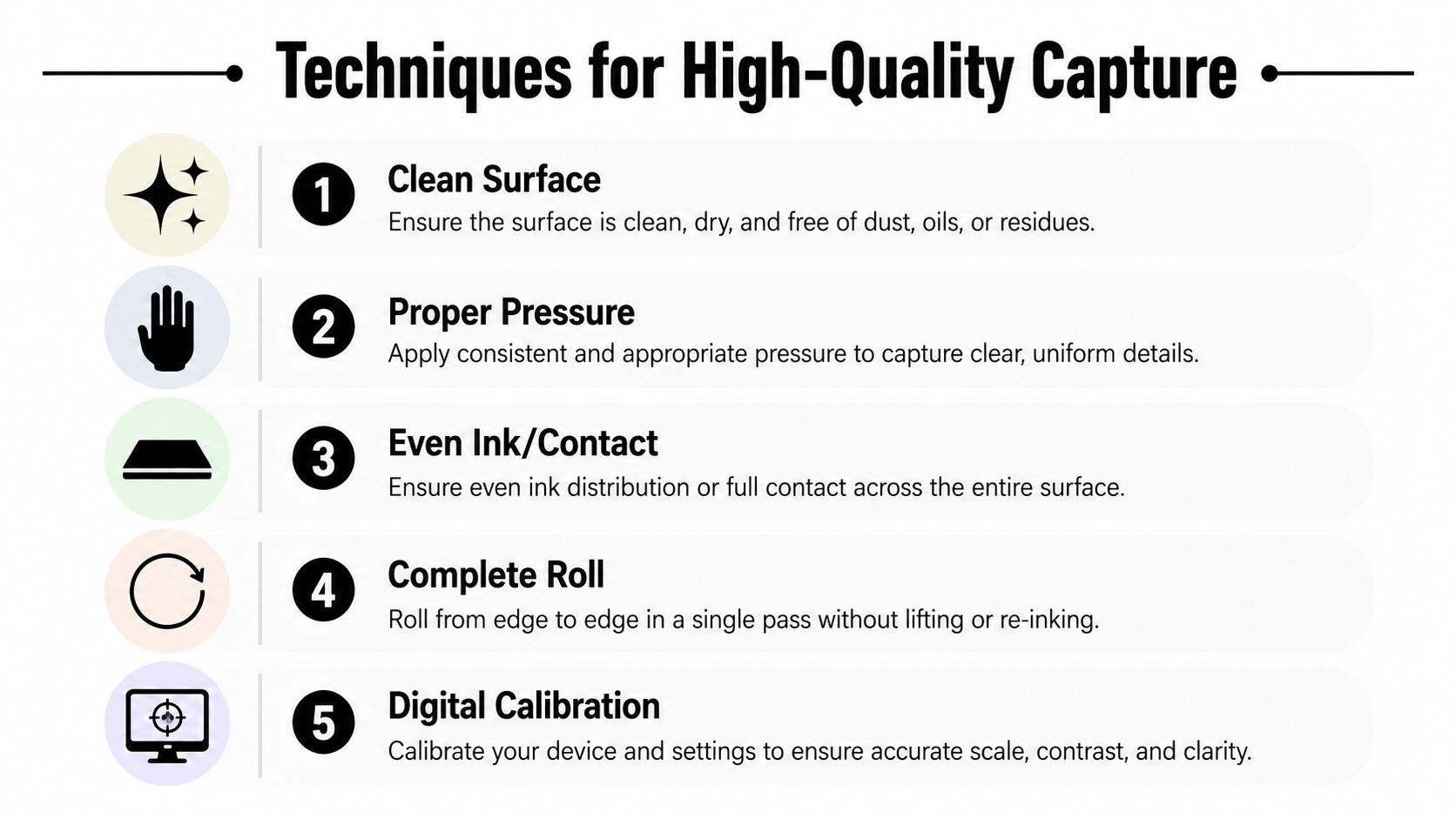
A loop, arch, or whorl is useful only when the impression captures enough ridge detail to classify and compare. Ink cards and digital scanners use different surfaces, but both require clean ridges, controlled contact, and an operator who can recognize smearing or missing areas.
Prepare the finger and surface
Start with clean, dry hands and a clean capture surface. Excess moisture can blur ridge boundaries, while overly dry or rough skin can prevent consistent contact. The operator should check the finger pad, remove residue, and follow the scanner or ink manufacturer’s instructions rather than applying extra pressure to compensate for a weak image.
For ink impressions, spread a thin, even layer of ink across the ridge area. Too much ink fills the valleys and creates a dark block. Too little ink leaves broken ridges that may hide the core, delta, or smaller identifying features.
Control movement during the roll
A rolled impression records the ridge surface from one side of the nail edge to the other. The operator should guide the finger smoothly through the roll instead of letting the subject twist independently. Uneven speed, excessive pressure, or stopping midway can produce a double edge, a smear, or an incomplete pattern.
A flat impression serves a different purpose. It records the central pad without the same side-to-side roll, so the operator must keep the finger level and avoid rocking. The goal isn’t to press harder. It’s to maintain even contact long enough to transfer the ridge detail cleanly.
A clean capture shows the pattern. A rushed capture shows pressure, motion, and gaps.
Recognize impression types and common failures
Fingerprint impressions are also described as patent, plastic, or latent. Patent prints are visible, plastic prints are three-dimensional impressions in a soft material, and latent prints are not readily visible without development or enhancement (fingerprint impression survey).
For official cards and digital background checks, inspect the result before the person leaves. Look for continuous ridge flow, complete fingertip coverage, and enough contrast to distinguish valleys from ridges. If the image is distorted, ask for a controlled second attempt rather than hoping an automated system will reconstruct missing information.
People who want a broader explanation of identity systems can review how biometric verification works. For a practical comparison of ink cards and Live Scan workflows, see fingerprinting ink and Live Scan capture.
Professional Fingerprinting Services in Sugar Land
Official background checks, licensing applications, and agency submissions often depend on a fingerprint card or digital record that meets specific technical requirements. A pattern can be perfectly normal, but an incomplete roll, excess ink, or poor digital contact can still create a rejected submission or require another appointment.
A trained technician watches for problems the person being printed may not notice. They can adjust finger placement, manage pressure, repeat a damaged impression, and check whether the card contains the required fields before the customer leaves. That practical review is especially useful when an agency requires a particular card format or a full set of rolled and flat impressions.
Choosing a local capture option
Business Mail Boutique LLC in Sugar Land offers digital and ink or roll fingerprinting, including collection on FD-258 and FD-1164 cards, as well as FBI fingerprinting and fingerprint card services. Customers who need a nearby option can review electronic fingerprinting near me in Sugar Land and confirm the format required by the requesting agency before arriving.
Bring valid identification and any instructions, forms, ORI information, card, or authorization details supplied by the employer, licensing board, or government office. Requirements vary, so checking the submission instructions first helps the technician collect the right impressions for the intended workflow.
Business Mail Boutique LLC offers digital Live Scan and ink fingerprint card collection in Sugar Land, along with related identity and document services. Visit Business Mail Boutique LLC with your agency instructions to arrange a capture that records your different fingerprint patterns as clearly and completely as possible.

Related posts

Custom Memorial Glasses Engraved in Three Hours in Sugar Land
When a customer needed eight personalized glasses for a memorial, Business Mail Boutique completed the engraving or...

Custom Martini Glass Engraving in Sugar Land, TX
Custom Logo Engraving on Martini Glasses in Sugar Land, Texas.
Business Mail Boutique recently completed a beautiful custom engravin...

Custom Engraved Wine Glasses for a Golf Club Event in Sugar Land, TX
Custom Engraved Wine Glasses for a Golf Club Event in Sugar Land.
Custom wine glass engraving in Sugar Land, TX at Business Mail Bouti...