
- Print Business Cards in Sugar Land – Same Day Service
- Copying Services
- Document Printing, Finishing & Lamination in Sugar Land
- Flyers
- Print Banner in Sugar Land | Same-Day Banner Printing Near Me
- Graphic Design
- Photo Printing
- Postcard Printing
- Document Printing
- EDDM Full Service Postcards
- FotoZoomer Large Format Printing


FBI Criminal History for Businesses
Get an FBI criminal history for businesses. Our guide covers the legal process, FCRA rules, costs, & fingerprinting for employee background checks.
Businessmailboutique
11645 S. Hwy 6
Sugar land, Texas 77498 United States (US)
Email: info@businessmailboutique.com
Route
You can’t get an FBI criminal history on a business. The FBI’s Identity History Summary Check is for individuals only, costs $18 per request, and requires fingerprints.
That distinction matters because many owners, office managers, and HR teams start in the wrong place. They search for “FBI criminal history for businesses” when what they need is a lawful, job-related process for screening an individual employee, contractor, volunteer, or license applicant. If you’re trying to protect your workplace, satisfy a regulator, or move a hire forward without delays, the practical question isn’t how to get an FBI file on a company. It’s how to run the right fingerprint-based check on the right person, with the right consent, through the right channel, and without creating compliance problems of your own.
Table of Contents
Why You Cant Get an FBI History on a Business
The phrase FBI criminal history for businesses sounds logical. Many people assume the FBI must have a national file for companies the same way it has criminal history records for people. It doesn’t.
The core misconception
The FBI states that it does not maintain a criminal history for businesses database. It provides Identity History Summary Checks for individuals, commonly called rap sheets, and those checks require fingerprint submission under a person-centric legal framework tied to the Privacy Act of 1974, as outlined in the FBI Identity History Summary Checks FAQ.
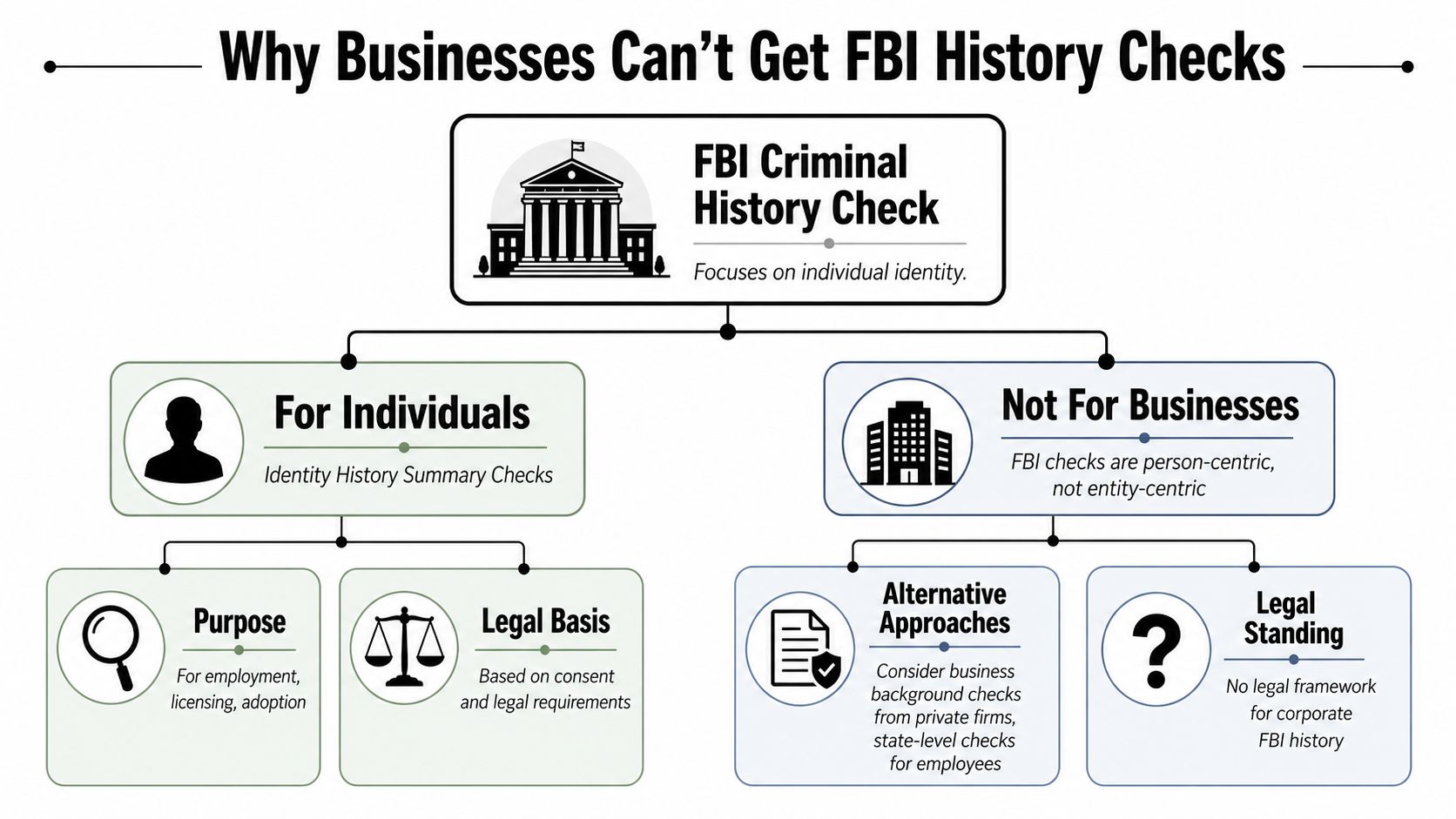
That means there is no FBI order form where you type in a company name and receive a national “criminal history” report for that entity. There’s no corporate version of an Identity History Summary Check. There’s no business pricing tier for it either.
Practical rule: If your goal is to vet a company, stop looking for an FBI business report. If your goal is to vet a person associated with your company, use the individual fingerprint-based process that actually exists.
Often, screening efforts encounter difficulties when a business wants to evaluate risk and reaches for the biggest federal acronym it recognizes. But FBI records are built around identity, fingerprints, and individual record matching, not entity-level reputation checking.
What businesses actually need instead
Most employers aren’t trying to investigate another business anyway. They’re trying to answer narrower questions:
- Hiring risk: Does this applicant have a record relevant to the job?
- Licensing compliance: Does a regulator require fingerprint-based review?
- Access control: Will this person work around children, elderly adults, money, medication, or sensitive systems?
- Contract requirements: Does a client or government program require an FBI-supported background step?
For those situations, the right move is usually an employee-level or applicant-level process. Depending on the position and legal authority involved, that may mean a fingerprint-based FBI check, a state criminal check, a private screening package, or some combination.
If you need to assess a business, the tools are different. Companies usually look at litigation history, licensing status, enforcement records, sanctions, secretary of state filings, OSHA records, or industry-specific databases. That’s a separate workflow from fingerprint-based criminal history.
A good screening process starts by defining the subject correctly. Person, or company. Once you get that right, the rest of the process becomes much easier to manage.
The Legal Gauntlet Navigating Consent and Compliance
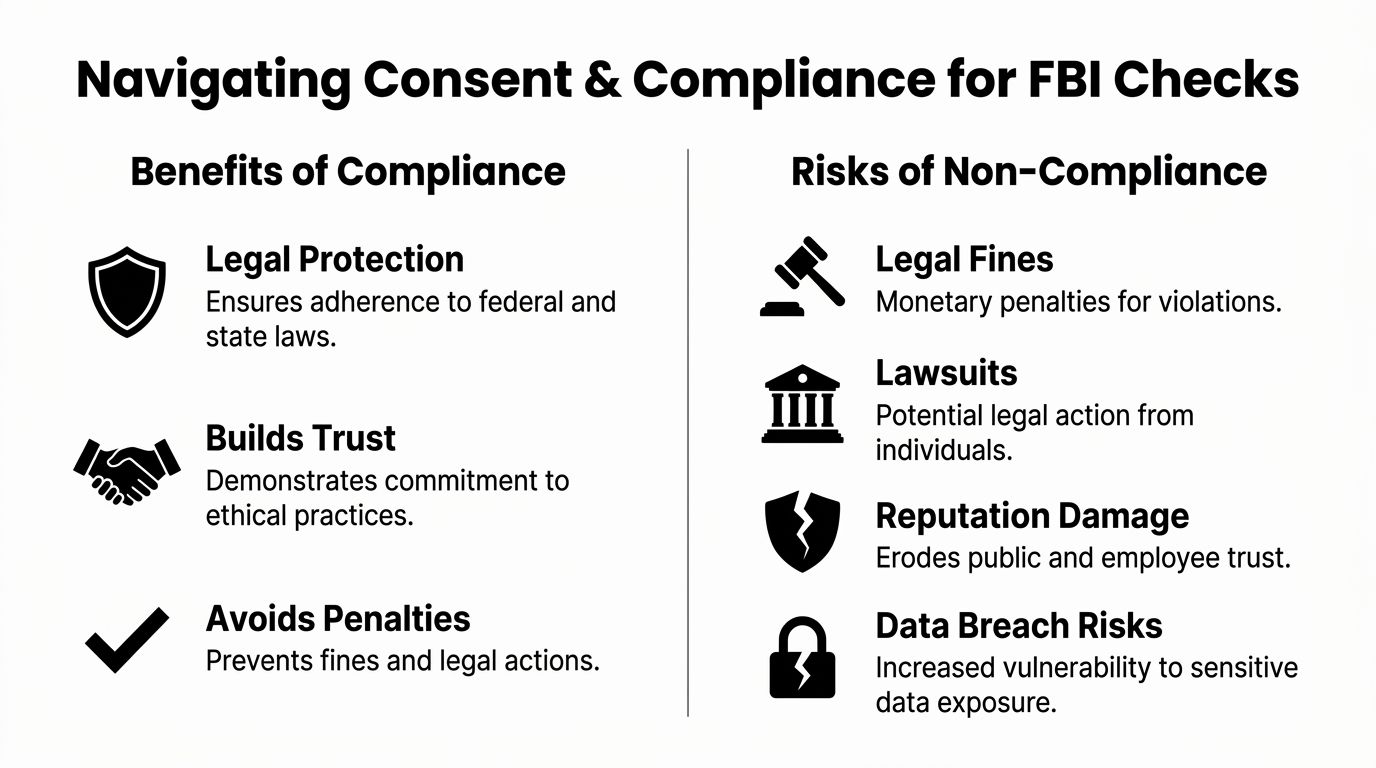
The legal risk in background screening usually doesn’t begin when results come back. It begins before fingerprints are ever taken. Businesses get in trouble because they move fast, reuse bad forms, or treat consent like a checkbox instead of a controlled process.
Three documents and decisions that matter
If you’re using a background report for employment purposes, your paperwork and timing have to be clean. In practice, three steps matter most.
- Use a standalone disclosure.
The applicant should receive a clear disclosure that a background report may be obtained. Keep it separate from liability waivers, broad policy language, and unrelated acknowledgments.
- Get written authorization.
Don’t schedule fingerprinting until the applicant has signed. Digital workflows help here because they create a better paper trail and reduce form-handling errors. Many HR teams streamline this step with e-signature solutions for HR teams, especially when candidates are signing disclosures and authorizations remotely.
- Handle adverse action correctly.
If a report may affect a hiring decision, don’t jump straight to a rejection notice. Give the applicant the required notices and a fair chance to review and respond before a final adverse decision is made.
That sounds basic, but businesses still make avoidable mistakes. They bury disclosure language in the application. They collect consent verbally. They tell a candidate, “Your background failed,” without using a consistent review process or allowing the person to challenge inaccuracies.
Clean compliance isn’t about sounding formal. It’s about creating a repeatable process that your hiring managers can follow under pressure.
Where businesses get into trouble
The hardest cases aren’t the obvious ones. They’re the mixed cases. An applicant has a record, but it’s old. Or the offense is serious, but unrelated to the actual duties. Or the report is incomplete and the candidate says the disposition is wrong.
A practical review should ask:
- Is the issue job-related? A driving offense matters differently for a delivery role than for a desk-based role.
- How much access does the role involve? Cash, keys, confidential records, medication, and vulnerable populations raise the stakes.
- What does your policy say? If your written standard and your real-world decisions don’t match, your process gets harder to defend.
- Did you document the reason? A hiring file should show why the decision made sense for that position.
A simple compliance checklist
Use this before you send anyone for fingerprinting:
- Verify authority: Confirm that the role or program supports a fingerprint-based criminal history process.
- Match the workflow to the role: Don’t use the same screening depth for every position without a reason.
- Control forms centrally: HR or compliance should own the latest disclosure and authorization forms.
- Train managers: Supervisors shouldn’t improvise explanations about criminal records or “automatic disqualification.”
- Protect the report: Criminal history information is sensitive. Limit access and store it carefully.
One more point matters in practice. State and local rules can be stricter than your federal baseline. Ban-the-box timing rules, notice rules, and occupational limits vary. If you’re hiring at scale or into regulated roles, legal counsel should review your process before you operationalize it.
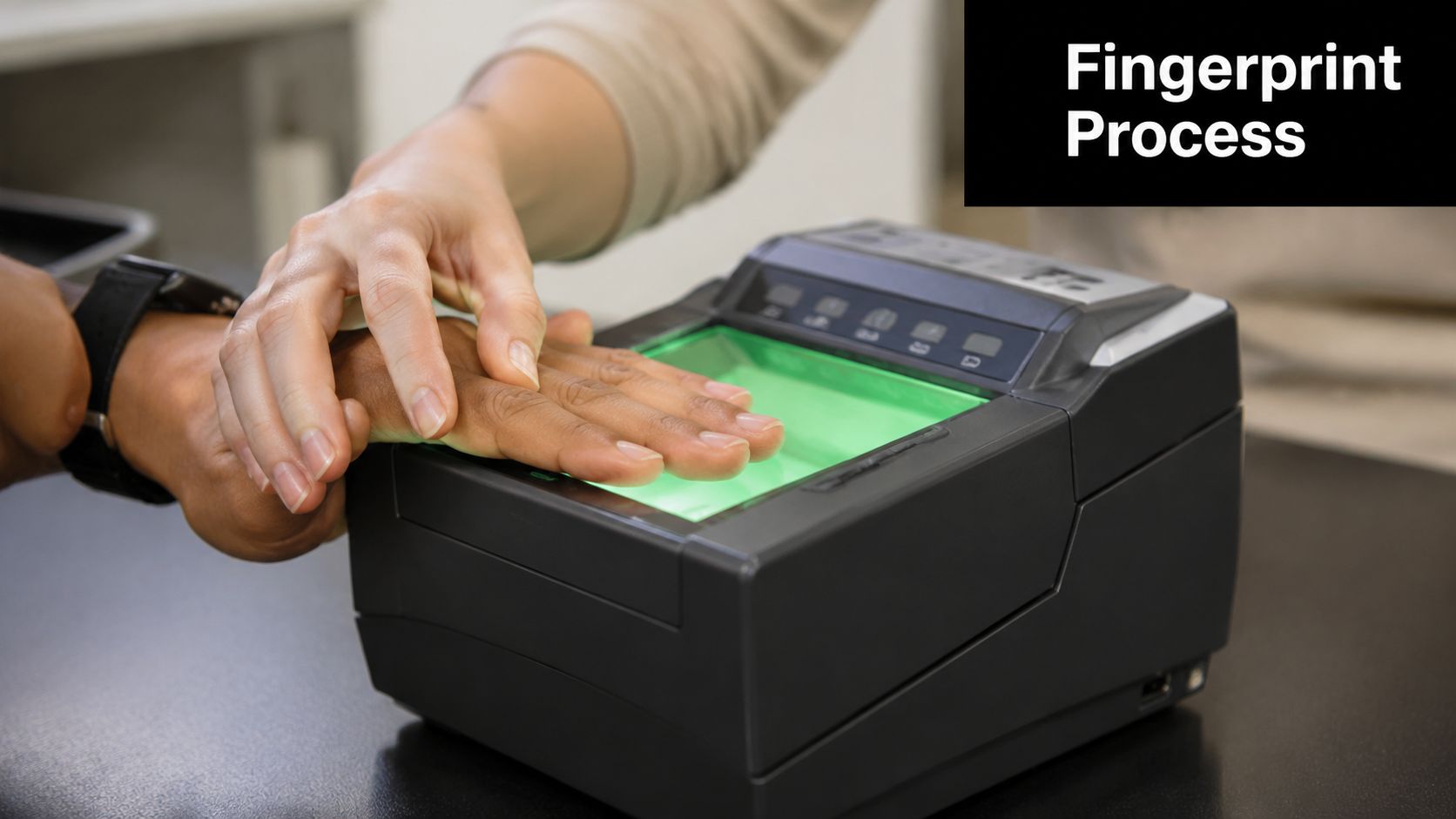
The Fingerprinting Process Live Scan vs Ink Cards
For most businesses, the fingerprint appointment is where theory meets reality. A clean policy can still fall apart if the candidate brings the wrong ID, uses the wrong service code, or submits prints that get rejected.
Why Live Scan usually wins
The practical choice is usually between Live Scan and ink cards. Both can work. They are not equal.
According to the FBI Compact Council guidance, electronic IAFIS ingestion via Live Scan reaches a 98.7% first-pass fingerprint acceptance rate, compared with 72% for traditional ink cards, and can reduce processing time from 30 to 45 days down to 3 to 5 business days, as described in the national fingerprint-based background checks steps for success.
That gap matters in hiring. If you’re trying to onboard a nurse aide, warehouse supervisor, caregiver, school contractor, or finance employee, rejected prints don’t just create annoyance. They create schedule slips, start-date uncertainty, and duplicate admin work.
Here’s the side-by-side view businesses usually care about most:
| Method | Best for | Main advantage | Main drawback |
|---|---|---|---|
| Live Scan | Most time-sensitive employment and compliance workflows | Faster submission and stronger first-pass acceptance | Requires access to an electronic capture location |
| Ink cards | Situations where cards are specifically required or electronic capture isn’t available | Flexible for mail-based workflows | More handling, more rejection risk, slower processing |
A lot of hiring teams still default to cards because that’s what they used years ago. In practice, Live Scan is usually the cleaner operational choice when the submission pathway allows it.
For businesses comparing capture options locally, this guide to fingerprinting with ink and LiveScan capture helps explain what each appointment type involves.
What applicants should bring
Candidates usually need three things to avoid a wasted trip:
- Valid identification: The name on the ID should match the application records.
- Correct authorization details: Service codes, agency identifiers, or request instructions must be accurate.
- Payment instructions: The payer should be clear before the appointment, especially when the employer is covering the cost.
The most common preventable problem isn’t the machine. It’s bad prep. Someone forwards a partial screenshot, the candidate shows up without the full code, or the name format doesn’t match the registration.
Later in the process, it helps to see the capture workflow itself in action:
Bring the exact registration details you were given. Fingerprinting centers can capture prints well, but they can’t fix a wrong authorization path after the fact.
Choosing Your Submission Path FBI Channelers or Direct
After fingerprints are captured, the next decision is submission. Businesses often assume there’s one standard route. There isn’t. The route you choose affects speed, administration, and how much support you get along the way.
Two valid routes with different trade-offs
Some applicants submit directly to the FBI. Others go through an FBI-approved channeler. The right choice depends on purpose and urgency.
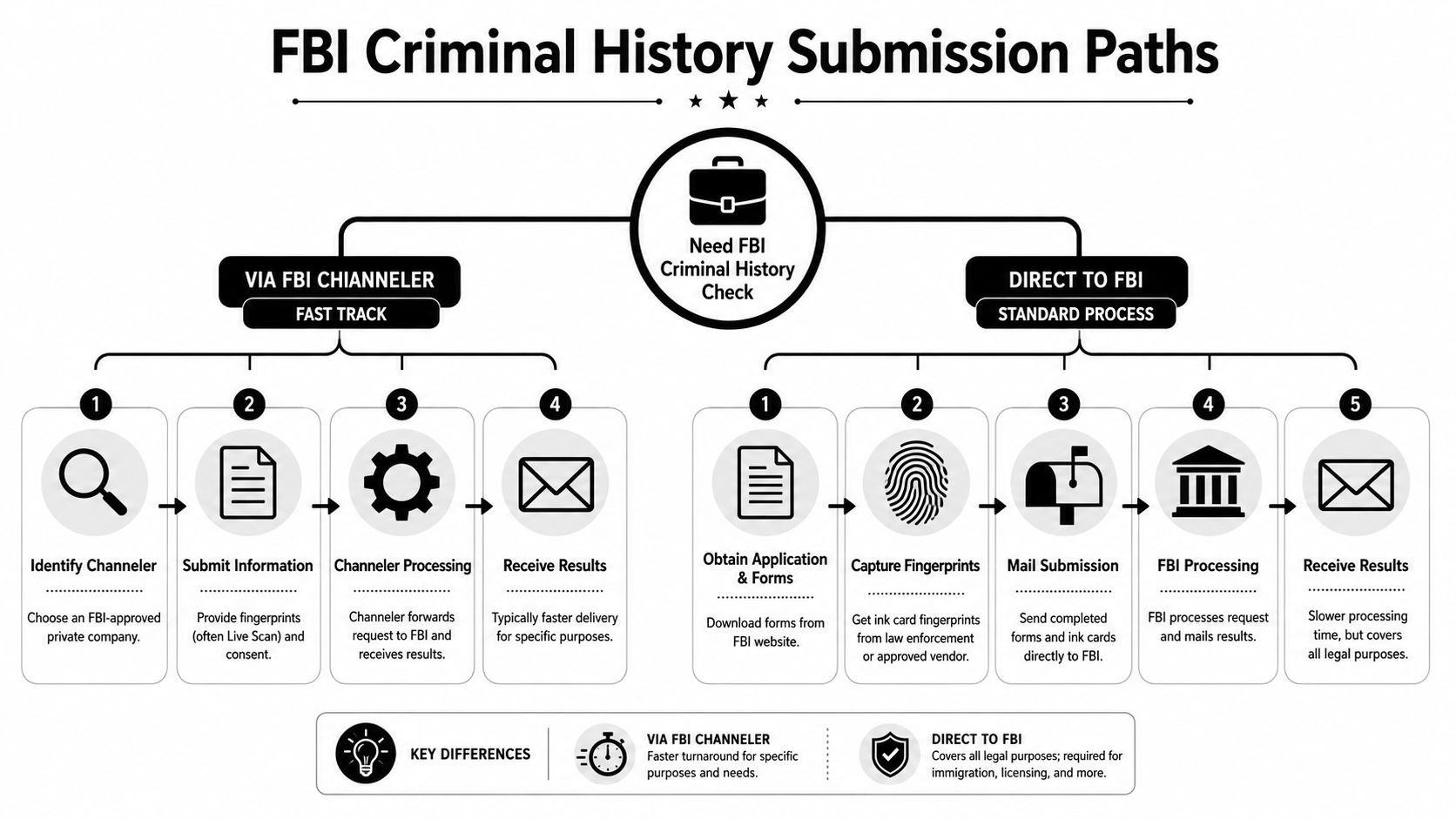
Direct submission is the more traditional path. It tends to fit organizations or individuals who want to work straight from the federal instructions and can tolerate a more manual process. It usually involves more self-management, especially if cards are being mailed.
A channeler sits in the middle and helps transmit the request through an approved private workflow. That can simplify logistics, especially when a business wants a smoother candidate experience, clearer tracking, or less back-and-forth with applicants.
For teams trying to sort out the process end to end, this overview on getting your FBI background check is a useful operational reference.
How to choose without wasting time
The best way to choose is to focus on constraints, not marketing.
Consider these decision points:
- Urgency: If the role is time-sensitive, an efficient channel may reduce operational friction.
- Volume: If you’re screening multiple people, consistency matters more than squeezing every step manually.
- Purpose: Some checks fit certain workflows better than others, especially when a regulator or agency has its own rules.
- Candidate support: If your applicants need scheduling help or clearer handholding, a channel-supported route may be easier to manage.
- Internal admin burden: Someone on your team has to own follow-up, reprints, and status questions.
A direct route can be perfectly valid for low-volume, non-urgent situations. A channeler often makes more sense when the business needs a tighter process and fewer moving parts. Neither option changes the underlying legal point from earlier. The FBI record is still about the individual, not the business.
Decision shortcut: If your team keeps asking “Who’s tracking this?” or “Why is this taking so long?”, your issue may not be the check itself. It may be the submission path you chose.
One more distinction helps. A full-service background screening company is not the same thing as the FBI. Those providers may bundle county searches, employment verification, identity review, and fingerprint steps into one package. That can be convenient, but it also means you should understand which part of the process is the actual FBI-supported fingerprint check and which part is the vendor’s broader screening product.
Interpreting Results and Making Fair Hiring Decisions
Once results arrive, businesses make one of two mistakes. They either overreact to any record at all, or they underestimate how sensitive the information is and pass it around casually. Both are bad habits.
What an FBI identity history can include
An FBI Identity History Summary is built from fingerprint-linked records. In practical terms, employers may see criminal history information tied to that person’s identity history rather than a broad narrative about whether someone is “good” or “bad.”
The operational reality is that most submissions now move through electronic capture because it’s faster. Pennsylvania’s guidance notes that the FBI’s Identity History Summary Check program relies on fingerprint-based submissions, with live-scan accounting for more than 90% of submissions, typically returning in 3 to 5 business days, while ink cards can take up to 30 days, as stated in Pennsylvania’s FBI criminal history background check guidance.
That speed is helpful, but speed shouldn’t shorten judgment. A report has to be read carefully. Arrest information, charge information, and disposition details can carry very different hiring implications.
For readers who also deal with resident screening, this primer on understanding tenant criminal screening is useful because it highlights a related point: what appears on a criminal background report and how that information should be interpreted are not the same thing.
How to make a defensible hiring decision
A fair decision usually follows a simple pattern.
First, match the record to the actual duties of the role. A position with unsupervised access to vulnerable people, financial authority, controlled inventory, or private data deserves a different level of concern than a limited-access role.
Second, look for context. One line on a report rarely tells the whole story. If something appears incomplete or unclear, pause before making a final decision.
Third, use consistency. Similar records in similar roles should be evaluated through the same standard. If one manager ignores an issue and another treats it as automatic disqualification, your process becomes hard to defend.
A practical hiring review often works best when documented in writing:
- Role risk: What does the employee control or access?
- Record relevance: Is the issue meaningfully related to those duties?
- Recency and pattern: Is this isolated, or part of a pattern that affects the role?
- Applicant response: Did the person explain or dispute the record?
- Final rationale: Why was the decision reasonable for this job?
Don’t make decisions from the headline of a record. Make them from the relationship between the record and the job.
Applicants should also have a fair opportunity to review and challenge inaccurate information. That’s not just good process. It’s one of the few safeguards that prevents a bad record match or incomplete disposition from turning into a bad employment decision.
Just as important, treat the report like confidential material. Limit access, avoid casual email forwarding, and dispose of copies securely under your internal retention rules.
FAQ About FBI Criminal History Checks
Can I run an FBI check on a company
No. The FBI doesn’t offer a criminal history product for businesses. The searchable concept people usually want is either an individual background check tied to fingerprints or a separate business due diligence process using other records.
What if an employee refuses fingerprinting
That depends on why the check is being required. If fingerprint-based screening is tied to a legal, licensing, contractual, or job-access requirement, refusal can stop the hiring or onboarding process. The key is to communicate that requirement clearly in advance and apply it consistently.
If the role doesn’t legally require fingerprinting, think carefully before imposing it. Use the least intrusive screening method that still fits the risk of the role.
How long is an FBI background check valid
There isn’t a universal shelf life that fits every employer or every regulator. Validity depends on the hiring policy, agency rules, client contract, or licensing body involved. Some organizations accept a recent report for a limited onboarding window. Others require a new submission when the person changes roles or has a break in service.
The safer approach is simple. Follow the rule that governs the role, then document that rule internally.
What typically shows up on an FBI criminal history check
An FBI identity history is built from fingerprint-linked criminal history information. In practice, that can include items such as arrests, charges, and dispositions that have been reported into the relevant system. It is not a business reputation report, and it is not the same thing as a credit report, civil litigation summary, or full employment screening package.
Where can I get fingerprinting in the Sugar Land area
If you need a reliable local starting point, use a provider that handles both appointment logistics and capture quality cleanly. Look for staff who regularly process fingerprinting, verify identification carefully, and can explain whether your request should be done through Live Scan or card capture.
A helpful local reference is this complete fingerprinting FAQ guide, especially if you need practical answers before sending an applicant in.
Is the FBI fee the same in every situation
Not always. The standard Identity History Summary Check fee appears in the FBI’s individual-request guidance, while certain background check categories can have different pricing structures through specific programs or state-administered pathways. What matters for employers is confirming the exact route tied to the person and purpose before registration starts.
If you need a convenient local place to handle fingerprinting and related business services, Business Mail Boutique LLC in Sugar Land is a practical option. They offer fingerprinting alongside notary, printing, shipping, mailbox, and office support services, which makes the appointment side of compliance much easier to manage when you’re juggling hiring, operations, and day-to-day admin.

Related posts

Custom Brass Plate Engraving in Sugar Land | Business Mail Boutique
Custom Brass Plate Engraving in Sugar Land: A Personal Tribute to Remember
A few carefully chosen words can turn a small brass plate i...

Silver Bracelet Engraving in Sugar Land | Business Mail Boutique
Personalize silver bracelets with names, dates, and hearts at Business Mail Boutique in Sugar Land. Call 281-875-0161 for a quote.
ers...

Graduation Gift Engraving Sugar Land | Business Mail Boutique
Graduation Gift Engraving Sugar Land | Business Mail Boutique.
A Personalized Texas A&M Graduation Gift: Custom Glass Engraving in...