
- Print Business Cards in Sugar Land – Same Day Service
- Copying Services
- Document Printing, Finishing & Lamination in Sugar Land
- Flyers
- Print Banner in Sugar Land | Same-Day Banner Printing Near Me
- Graphic Design
- Photo Printing
- Postcard Printing
- Document Printing
- EDDM Full Service Postcards
- FotoZoomer Large Format Printing


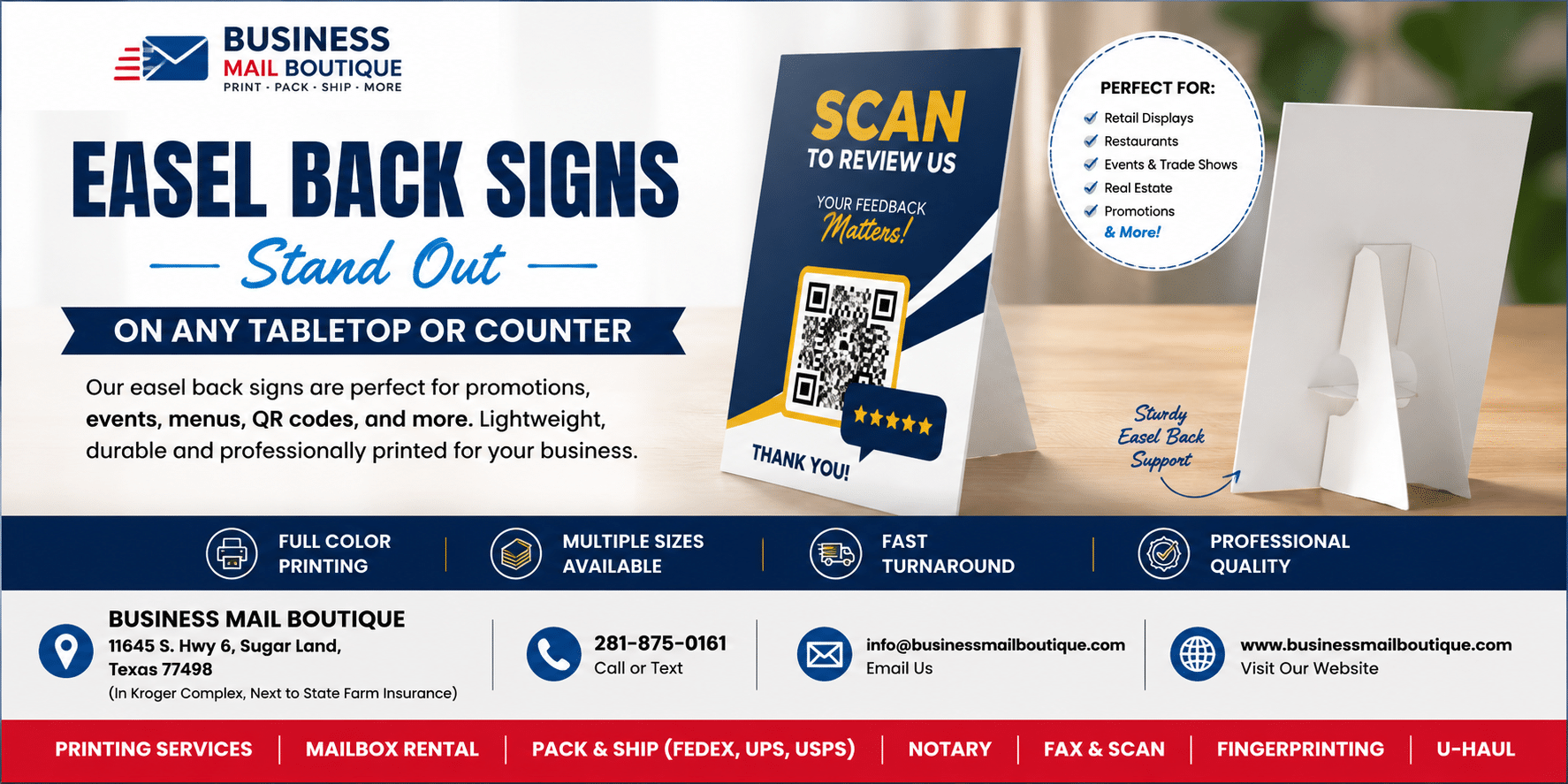
Easel Back Sign
Businessmailboutique
11645 S. Hwy 6
Sugar land, Texas 77498 United States (US)
Email: info@businessmailboutique.com
Route
Discover how an easel back sign can boost your sales and visibility. This guide covers best uses, design tips, and how to choose the right materials.
An easel back sign is one of the simplest yet most effective marketing tools you can have. Think of it as a small, self-standing billboard designed to sit on any flat surface, from a checkout counter to a trade show booth. It’s essentially a printed graphic with a fold-out stand built right into the back, making it incredibly portable and budget-friendly.
What Is an Easel Back Sign and How Does It Work?
You’ve definitely seen these signs before, even if you didn’t know their name. They’re the secret weapon of grab-and-go marketing. The magic is in the design: a high-quality printed graphic is mounted onto a sturdy board with a pre-scored cardboard stand attached. This all-in-one construction means there’s no need for separate frames, hardware, or supports. Just pop out the stand, and it’s ready to do its job.
This simple setup makes them perfect for grabbing attention in high-traffic spots.
- Checkout Counters: Use them to announce a flash sale or prompt loyalty program sign-ups.
- Reception Desks: Offer a warm welcome to guests or display the Wi-Fi password.
- Trade Show Tables: Highlight your core service or a special event-only offer.
- Restaurant Tables: Tempt customers with a photo of a new dessert or a seasonal drink special.
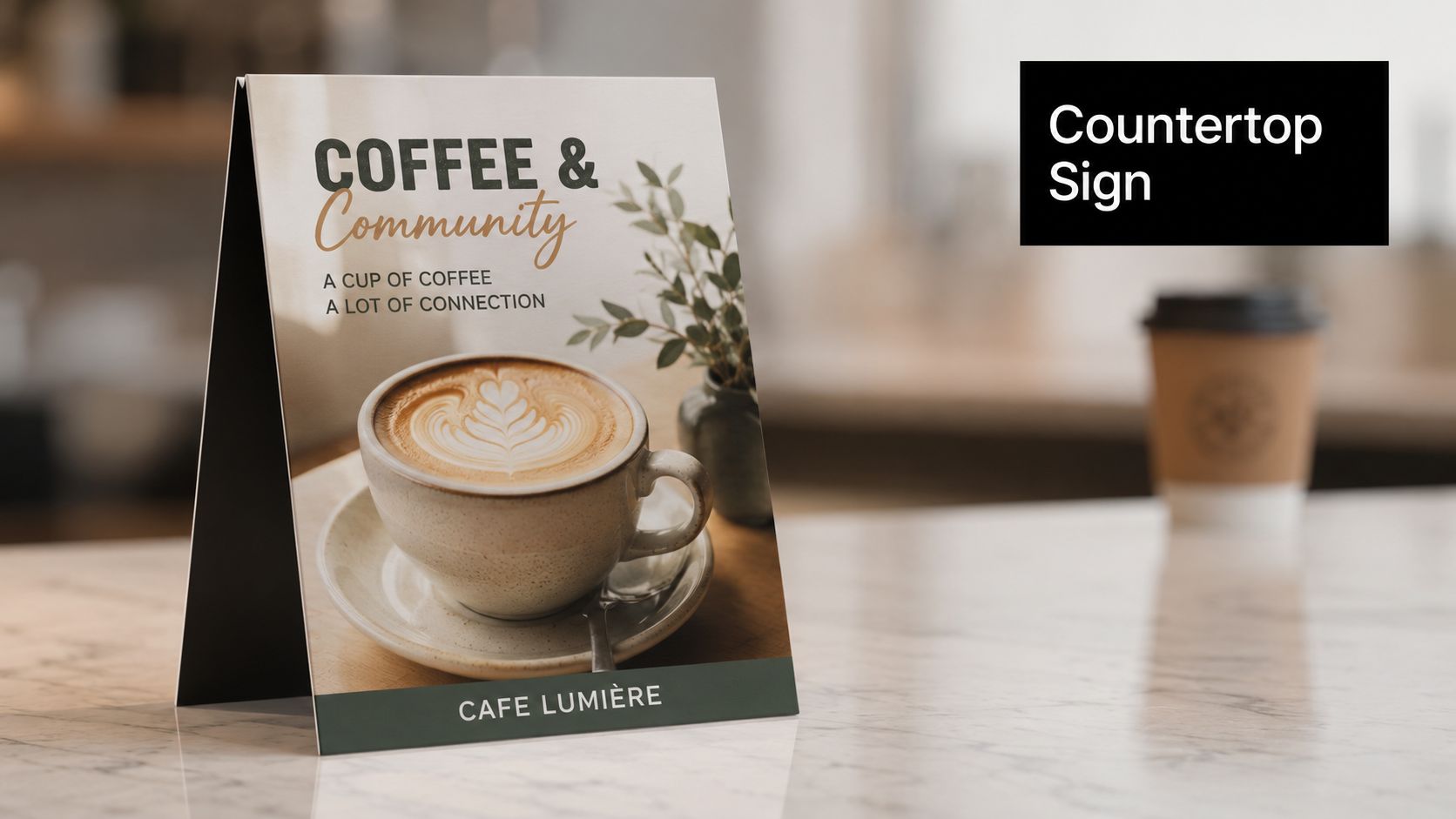
A Staple of Point-of-Purchase Marketing
The real genius of an easel back sign is its ability to sway decisions right at the point of purchase. Placing one on your counter isn’t just decoration; it’s a strategic move. Businesses love these signs because they deliver an immediate impact and are incredibly versatile. They’re light enough to be moved in a second but still look professional and hold up well.
Their effectiveness is no secret in the retail world. Easel back signs are a powerhouse in point-of-purchase advertising, typically printed on a lightweight but durable 16pt cardstock that’s easy to reposition for maximum visibility. In fact, an estimated 68% of grocery and convenience stores across the U.S. use these countertop displays for promotions running less than 30 days. You can see more examples of how they’re used in various display applications at Affordable Display Products.
An easel back sign is more than just printed cardboard; it’s a silent salesperson. It works tirelessly to communicate your most important messages directly to your audience, right where it counts.
By putting a compelling message directly in your customer’s line of sight, you transform an ordinary counter into a powerful marketing asset. Whether you’re announcing a sale, sharing a QR code, or just building brand awareness, the humble easel back sign is an essential tool for boosting engagement and driving sales.
It’s easy to take the simple easel back sign for granted, but these little workhorses of the marketing world have a surprisingly clever history. They weren’t just invented overnight; they evolved right alongside the changing needs of retailers, event planners, and businesses looking for an effective, affordable way to get their message across.
Think back to the post-war boom of the 1950s. Countertop displays were often clunky, heavy things made of wood or metal. While they were certainly durable, they were also expensive and a pain to ship or move around. This opened the door for something better—a smarter, more practical solution.
The Shift to Cardboard and Lamination
That’s where self-standing cardboard displays enter the picture. By the 1970s, manufacturers had refined the process, introducing key innovations that are still standard today. Using durable 16pt cardstock combined with protective heat lamination made these signs tough enough to resist moisture and daily handling. This design also eliminated the need for external supports, cutting production time by an impressive 35% compared to older methods. You can see more examples of these designs and their history over at Big Sign FX.
Suddenly, the easel back sign wasn’t just a flimsy piece of cardboard anymore. It was a reliable, professional-looking tool that could hold its own in a busy store or office, setting the stage for its next big moment.
An Essential for Events and Digital Printing
Fast forward to the 1990s. The explosion of trade shows, conferences, and corporate events created a huge demand for signage that was portable and easy to set up. The easel back sign was the perfect solution. You could pack dozens of them in a single box to place on registration desks, exhibitor booths, and information tables. They were lightweight, disposable, and incredibly convenient.
The easel back sign’s true power lies in its simplicity. It has consistently adapted to new technologies and business needs without losing its core function: to deliver a clear message, instantly.
Then came the real game-changer: the rise of digital printing in the 2000s. This cemented the easel back sign’s place as a marketing staple. High-quality, full-color printing with lightning-fast turnarounds became the norm. Businesses could now order custom-designed signs in small batches for specific sales or events, making them more versatile and accessible than ever. This powerful combination of durability, portability, and quick customization is why they remain a go-to for businesses of every size.
Choosing the Right Materials and Size for Your Sign
When you’re setting up an easel back sign, two things matter more than anything else: what it’s made of and how big it is. Getting these details right is the difference between a sign that looks professional and gets noticed, and one that just blends into the background. It’s like picking the right tool for a job—you wouldn’t use a tiny screwdriver on a massive bolt.
Let’s start with the foundation: the material. Most easel back signs are printed on thick, sturdy cardstock. This isn’t your average printer paper; it’s measured in points (pt), where a higher number means a more rigid board that won’t flop over.
- 16pt Cardstock: This is the go-to for most situations. It strikes a great balance between being tough enough for the job and staying budget-friendly. It’s perfect for short-term promotions, signs at a weekend event, or simple counter displays.
- 18pt Cardstock: If you want something with a bit more heft and a premium feel, 18pt is the way to go. That slight increase in thickness makes the sign feel more substantial, which is great for long-term displays in high-end shops or hotel lobbies where quality is part of the brand image.
Selecting the Right Finish and Dimensions
Once you’ve picked your cardstock, the next step is choosing a finish. A protective laminate is a must-have. It does more than just shield your sign from fingerprints, spills, and fading—it completely changes its look.
A gloss finish will make your colors look incredibly vibrant and eye-catching. On the other hand, a matte finish gives you a more subtle, sophisticated look that’s easy to read under bright lights because it doesn’t create a glare.
You can really see how far the production of these simple signs has come over the years. We’ve moved from flimsy, uncoated cardboard to the durable, polished signs we use today.
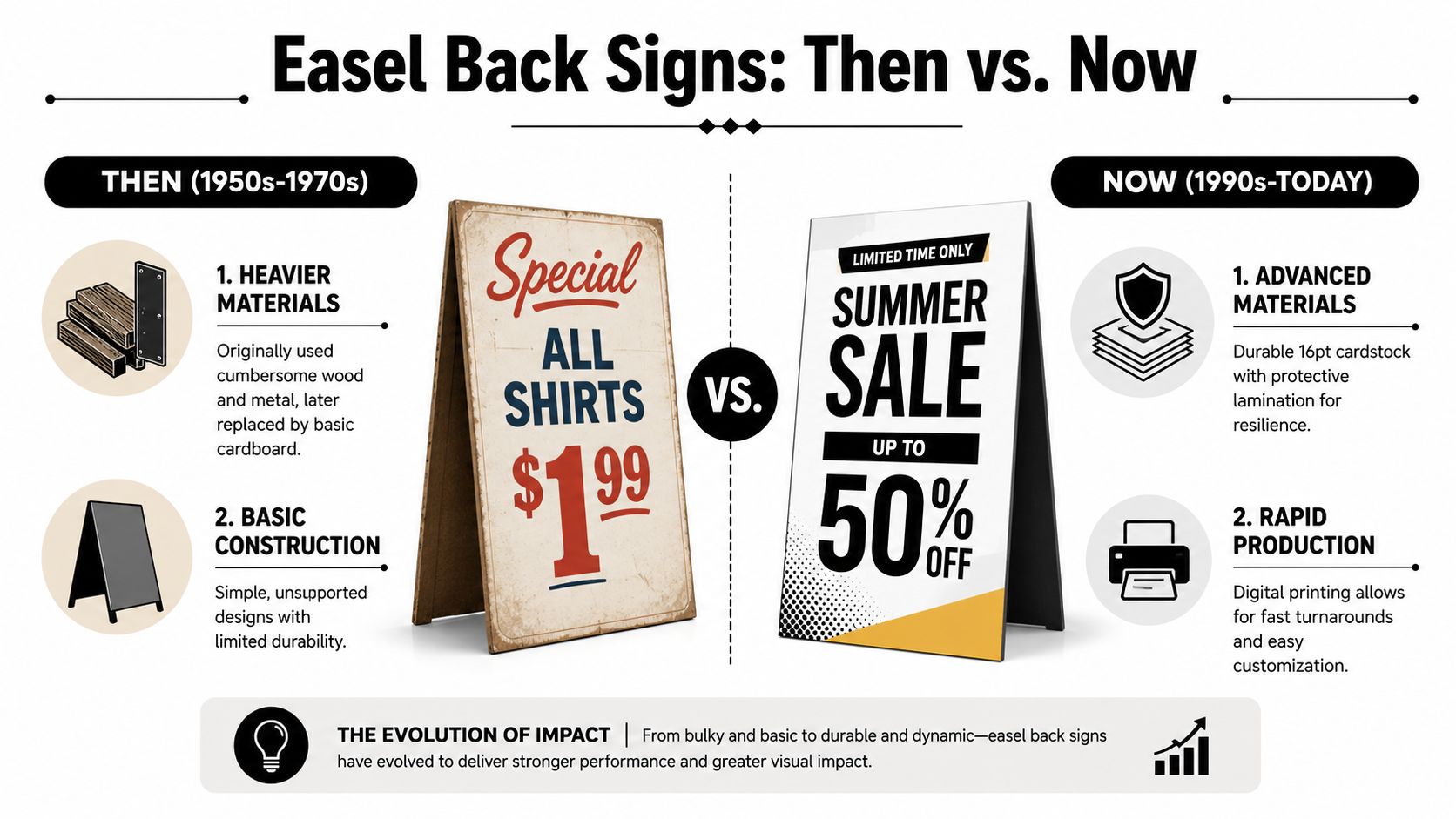
This evolution highlights how much more versatile and professional easel back signs have become, thanks to better materials and printing technology.
Finally, think about where your sign will live. A huge sign on a tiny counter looks clumsy, but a small one will get completely lost in a big, open lobby. Always consider how far away people will be and how much information you need to fit.
An easel back sign works best when its size and material are perfectly matched to its purpose. A small, sturdy sign on a busy counter is a silent salesperson, while a larger one in a reception area serves as a welcoming beacon.
For instance, a compact 5×7 inch sign is perfect for a crowded coffee bar menu, but a larger 9×12 inch format makes more sense for a hotel check-in desk where it needs to be seen from further away.
To help you decide, here is a quick guide matching common uses to the best sign specifications.
Easel Back Sign Size and Material Guide
This table helps you choose the perfect size and material for your easel back sign based on its intended use and environment.
| Common Use Case | Recommended Size (Inches) | Best Material/Finish | Why It Works |
|---|---|---|---|
| Retail Checkout Counter | 5×7 or 8×10 | 16pt with Gloss Lamination | Its compact size fits a limited space, and the gloss finish grabs attention for last-minute promotions. |
| Restaurant Tabletop | 5×7 | 18pt with Matte Lamination | It’s durable enough for frequent handling, and a matte finish reduces annoying glare from overhead lighting. |
| Reception or Lobby Desk | 8.5×11 or 9×12 | 18pt with Matte Lamination | The larger size is visible from a distance, and the premium material adds a professional touch to your welcome area. |
| Trade Show Booth | 8.5×11 | 16pt with Gloss Lamination | This size is a good balance between portability and visibility, with a glossy finish helping it stand out in a busy hall. |
Choosing the right combination of size, material, and finish ensures your message is not only seen but also felt, creating the exact impression you want.
Effective Ways to Use Easel Back Signs
Knowing what an easel back sign is one thing, but knowing where to put it for maximum impact is another entirely. Let’s get practical and look at how these simple displays can become some of your most effective marketing tools.
Because they stand on their own, easel back signs are perfect for any flat surface where you can grab someone’s attention, even for just a few seconds. The whole point is to hit them with a quick, targeted message that provides helpful info or nudges them toward a specific action.
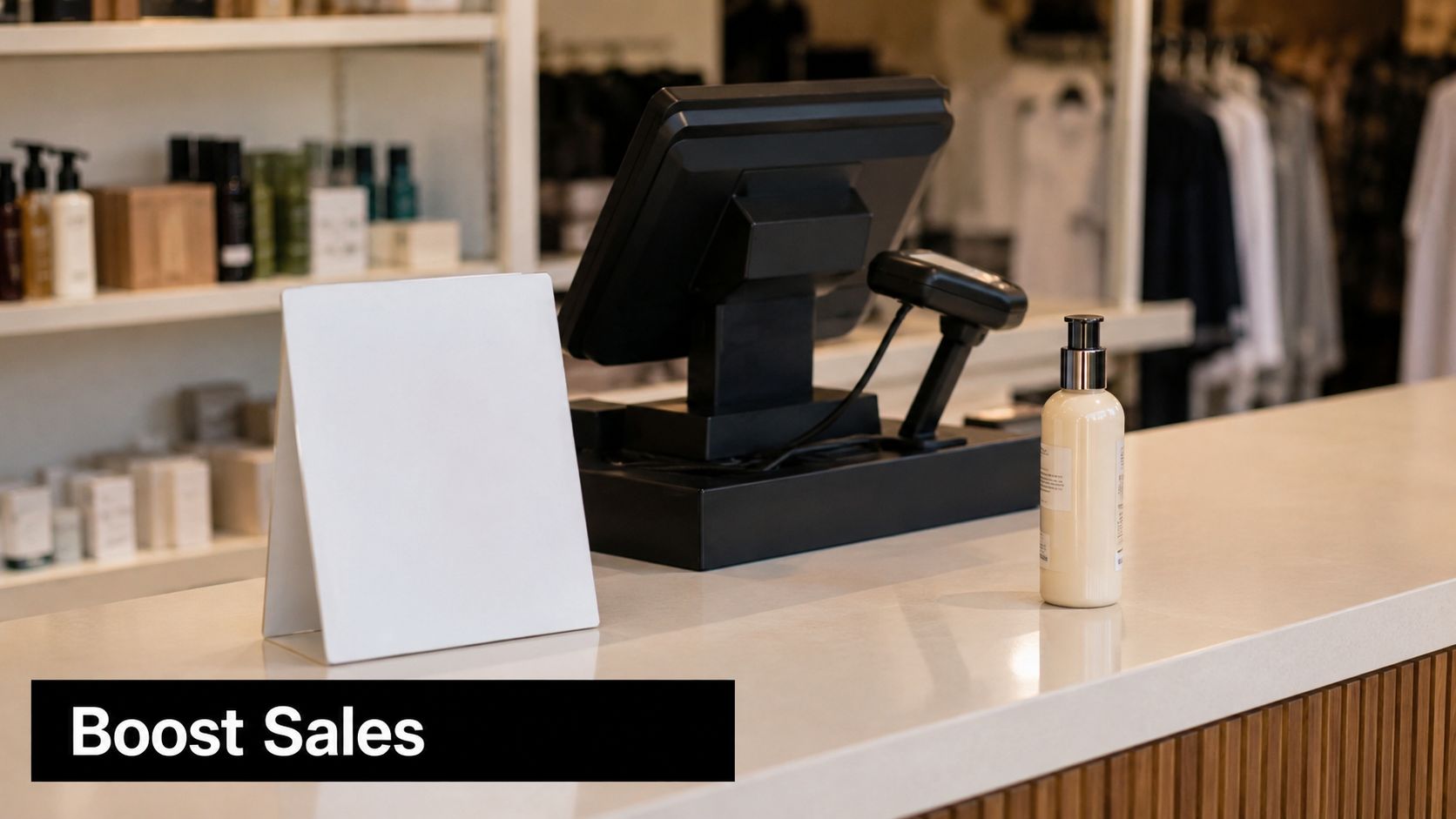
Boosting Sales at the Point of Purchase
The checkout counter is prime real estate for an easel back sign, and it’s arguably their most powerful placement. Think of it as your silent salesperson, giving customers one last nudge right before they pay.
- Tempt with Impulse Buys: Imagine a coffee shop with a colorful sign showing off a “Seasonal Pumpkin Spice Latte” right by the register. That visual is often all it takes to secure an easy upsell.
- Announce Flash Sales: A small boutique can create urgency with a sign that reads, “20% Off All Scarves Today Only!” This drives on-the-spot decisions.
- Grow Your Loyalty Program: While customers wait, a sign that says, “Join Our Rewards Program & Get a Free Gift!” with a simple QR code makes signing up feel effortless.
An easel back sign at checkout transforms a simple transaction into one last marketing touchpoint. It takes advantage of a moment of focused attention to drive last-minute sales and build customer loyalty.
Informing and Guiding in Professional Settings
These signs aren’t just for retail. In offices, lobbies, and event spaces, they are brilliant for communicating clear, simple information. They help manage traffic and answer common questions before they’re even asked, which makes for a much smoother experience for visitors and staff alike.
For instance, a tasteful sign on a reception desk can offer a warm welcome, share the guest Wi-Fi password, or politely ask visitors to sign in. It’s a small detail that makes a professional first impression and frees up your front desk team.
Enhancing Engagement at Events and Showings
At a busy trade show, conference, or even a real estate open house, an easel back sign acts as a mini-information kiosk. It gets key details across without a staff member having to repeat the same script all day long.
Just think of these scenarios:
- At a Trade Show Booth: Use a sign to list your key services, advertise a special show-only discount, or feature a QR code that links directly to your digital brochure.
- During a Real Estate Open House: A realtor can place signs in different rooms to call out special features like “Newly Renovated Kitchen” or “Original Hardwood Floors.”
- At Conference Check-In: Simple signs can guide the flow of traffic, pointing attendees to the right line for pre-registration or on-site payment.
From a quiet café counter to a bustling convention floor, the humble easel back sign consistently proves its worth by delivering the right message, in the right place, at exactly the right time.
Designing a Sign That Grabs Attention
An easel back sign isn’t just a piece of printed cardstock; it’s your silent salesperson. To make it work for you, your design needs to be strategic, guiding a customer’s eye exactly where you want it to go. A truly effective sign doesn’t just sit there—it communicates.
Think of your sign’s layout as a roadmap for the viewer. This concept, known as visual hierarchy, is all about controlling what people see first. Start with a single, compelling headline. It should be the biggest and boldest element on the sign, instantly communicating the most important piece of information. Everything else should be secondary.
Remember, these signs are usually viewed up close and quickly. Less is always more. Trying to cram in too much text is the fastest way to get your message ignored. Stick to one or two key ideas.

Using Color and Fonts Wisely
Color isn’t just about making things pretty; it’s about making them readable. High-contrast combinations are your best friend here. Think dark text on a light background, or the other way around. This simple trick ensures your message is legible, even from a few feet away or in a dimly lit corner.
Your colors also need to be consistent with your brand. When you use your established brand palette, you’re not just creating a sign; you’re building brand recognition and projecting a polished, professional image.
When it comes to typography, legibility is everything. There’s no point in a beautiful design if nobody can read it.
- Choose Clean Fonts: Stick with sans-serif fonts like Helvetica, Arial, or Montserrat. They’re clean, modern, and incredibly easy to read at a glance, which is exactly what you need for a countertop display.
- Avoid Overly-Scripted Fonts: While fancy script fonts have their place, a countertop sign isn’t one of them. They are often hard to decipher quickly, which defeats the entire purpose.
- Limit Font Variety: A common design mistake is using too many fonts. Stick to two at the absolute most—one for headlines and another for body text. This keeps the look clean and professional, not chaotic.
The Power of a Clear Call-to-Action
Here’s the most important part: your call-to-action (CTA). This is what turns your sign from a passive piece of information into a tool that drives action. The CTA tells your customer exactly what you want them to do next.
An easel back sign without a clear CTA is a missed opportunity. It answers the silent question every customer has: “What’s in it for me, and what do I do now?”
Your CTA needs to be direct, compelling, and incredibly simple. Forget vague phrases like “Learn More.” Instead, offer something specific that provides immediate value or a clear next step.
Examples of Strong CTAs:
- “Scan to Join Our VIP Club”
- “Ask Us About Today’s Special”
- “Follow Us on Instagram for 10% Off”
By combining a smart visual hierarchy, readable fonts and colors, and a powerful call-to-action, you’ll create an easel back sign that doesn’t just take up space—it gets results.
How to Get Your Signs Printed and Delivered
So, you’ve nailed down the perfect design for your easel back sign. Now what? Getting it from your screen into your hands is a pretty straightforward process, and knowing the steps will help you get exactly what you want without any guesswork.
First things first: getting your artwork ready. Most professional printers, including your local experts at Business Mail Boutique LLC, will need a high-resolution PDF file. This format is the industry standard because it locks in your fonts, images, and layout, ensuring the final print looks just as sharp and professional as it does on your computer. When you place your order, you’ll also confirm the key details—how many you need, the final size, the material, and your preferred finish, whether that’s a shiny gloss or a more subtle matte.
Choosing Your Printing Partner
You’ve really got two main paths for printing: using a massive online service or partnering with a local shop. While online printers can seem convenient, working with someone local has some serious perks, especially when you’re on a tight schedule. A local printer means you can get your signs much faster and sidestep the shipping delays that can throw a wrench in your marketing plans.
For example, a standard 9×12 inch easel back sign printed on 16pt cardstock can often be produced in just 24–48 hours. This kind of quick turnaround is one of the fastest in the printing world and aligns perfectly with the same-day service model we have at Business Mail Boutique LLC in Sugar Land. You can see how this compares to broader industry production standards for yourself.
Partnering with a local print shop gives you more than just speed; it gives you an expert in your corner. They can offer personalized advice on materials and finishes, ensuring your final product is flawless.
This kind of hands-on support is invaluable. Instead of clicking through a complex online ordering system and hoping for the best, you can have a real conversation with someone who can spot potential issues before they become expensive mistakes. The end result is a high-quality easel back sign, done right the first time, ready for you to pick up and put to work for your business immediately.
Frequently Asked Questions
When you’re thinking about ordering easel back signs, a few questions always seem to pop up. Let’s walk through the most common ones we hear, so you can feel confident you’re making the right choice for your business.
We get this question a lot: what are they made of? Most of the time, we recommend 16pt cardstock. It’s the perfect sweet spot between being sturdy enough to stand up straight and affordable enough for any budget.
If you need something with a bit more heft or a more premium feel, stepping up to an 18pt cardstock is a fantastic choice. Both options are plenty rigid for countertop use.
What Is the Best Size for an Easel Back Sign?
This really comes down to where you plan to put it. For a busy retail counter with limited space, a smaller 5×7 inch sign is often perfect. But if you have a wide-open reception desk, you can easily go bigger with an 8.5×11 or even a 9×12 inch sign to grab more attention.
The best advice I can give is to measure your space first. You want your sign to be seen, but you don’t want it to overwhelm the area or get in the way. Also, think about how far away people will be when they read it.
How Durable Are These Signs?
You’d be surprised how well these signs hold up, even in high-traffic spots. Their resilience comes from a combination of the sturdy cardstock we use and, just as importantly, the protective finish.
A laminated finish is your best friend for making a sign last. Think of it as a shield against fingerprints, dust, and the occasional coffee splash, keeping your sign looking sharp day in and day out.
Choosing a gloss or matte lamination will dramatically extend the life of your sign. While not fully waterproof, they can be wiped clean in a second, which is a lifesaver on restaurant tables or service counters.
Can Easel Back Signs Be Reused?
Absolutely! This is one of their biggest advantages. As long as your message isn’t tied to a specific date, you can use these signs over and over again. This makes them incredibly cost-effective for displaying information that doesn’t change, such as:
- Your Wi-Fi network and password
- Check-in instructions
- A reminder to follow you on social media
- Promotions for a core service or popular menu item
Because they’re so light, they store flat without taking up much room. You can just pack them away until you need them again, making them a great, sustainable option for seasonal promotions or recurring events. An easel back sign is a versatile workhorse you’ll be glad to have.
Ready to create a high-impact sign that gets noticed? The team at Business Mail Boutique LLC offers fast, expert printing services right here in Sugar Land. Get your custom easel back signs designed and printed quickly to start driving sales and informing customers today. Visit us online to get started.

Related posts

Custom Memorial Glasses Engraved in Three Hours in Sugar Land
When a customer needed eight personalized glasses for a memorial, Business Mail Boutique completed the engraving or...

Custom Martini Glass Engraving in Sugar Land, TX
Custom Logo Engraving on Martini Glasses in Sugar Land, Texas.
Business Mail Boutique recently completed a beautiful custom engravin...

Custom Engraved Wine Glasses for a Golf Club Event in Sugar Land, TX
Custom Engraved Wine Glasses for a Golf Club Event in Sugar Land.
Custom wine glass engraving in Sugar Land, TX at Business Mail Bouti...