
- Print Business Cards in Sugar Land – Same Day Service
- Copying Services
- Document Printing, Finishing & Lamination in Sugar Land
- Flyers
- Print Banner in Sugar Land | Same-Day Banner Printing Near Me
- Graphic Design
- Photo Printing
- Postcard Printing
- Document Printing
- EDDM Full Service Postcards
- FotoZoomer Large Format Printing


Fingerprinting Houston: Your 2026 Guide to Services
11645 S. Hwy 6
Sugar land, Texas 77498 United States (US)
Email: info@businessmailboutique.com
Route
You’ve probably landed here with a form in one hand and questions in the other. An employer, licensing board, school, agency, or background check service told you to get fingerprinted, but the instructions aren’t always written for normal people. They assume you already know the difference between Live Scan and ink cards, which office handles what, and what happens if you bring the wrong paperwork.
That confusion is normal. Fingerprinting in Houston is manageable once you turn it into a checklist. The fastest appointments usually go to the people who confirm the exact requirement first, bring the right documents, and choose the service format that matches the agency’s rules. The people who run into delays usually miss a small detail, such as the wrong card, the wrong provider, or an incomplete pre-enrollment.
Table of Contents
- Your First Step Understanding Your Fingerprinting Needs
- How to Prepare for Your Fingerprinting Appointment
- What to Expect During the Fingerprinting Process
- Your Fingerprinting Options in the Houston Area
- Common Use Cases for Fingerprinting in Houston
Your First Step Understanding Your Fingerprinting Needs
A lot of Houston appointments go off track before anyone touches the scanner or the ink pad. A customer walks in with a request letter, but the agency needed a different format, a service code, or a specific card. That is why the first step is not booking fast. It is confirming exactly what the requesting agency wants.
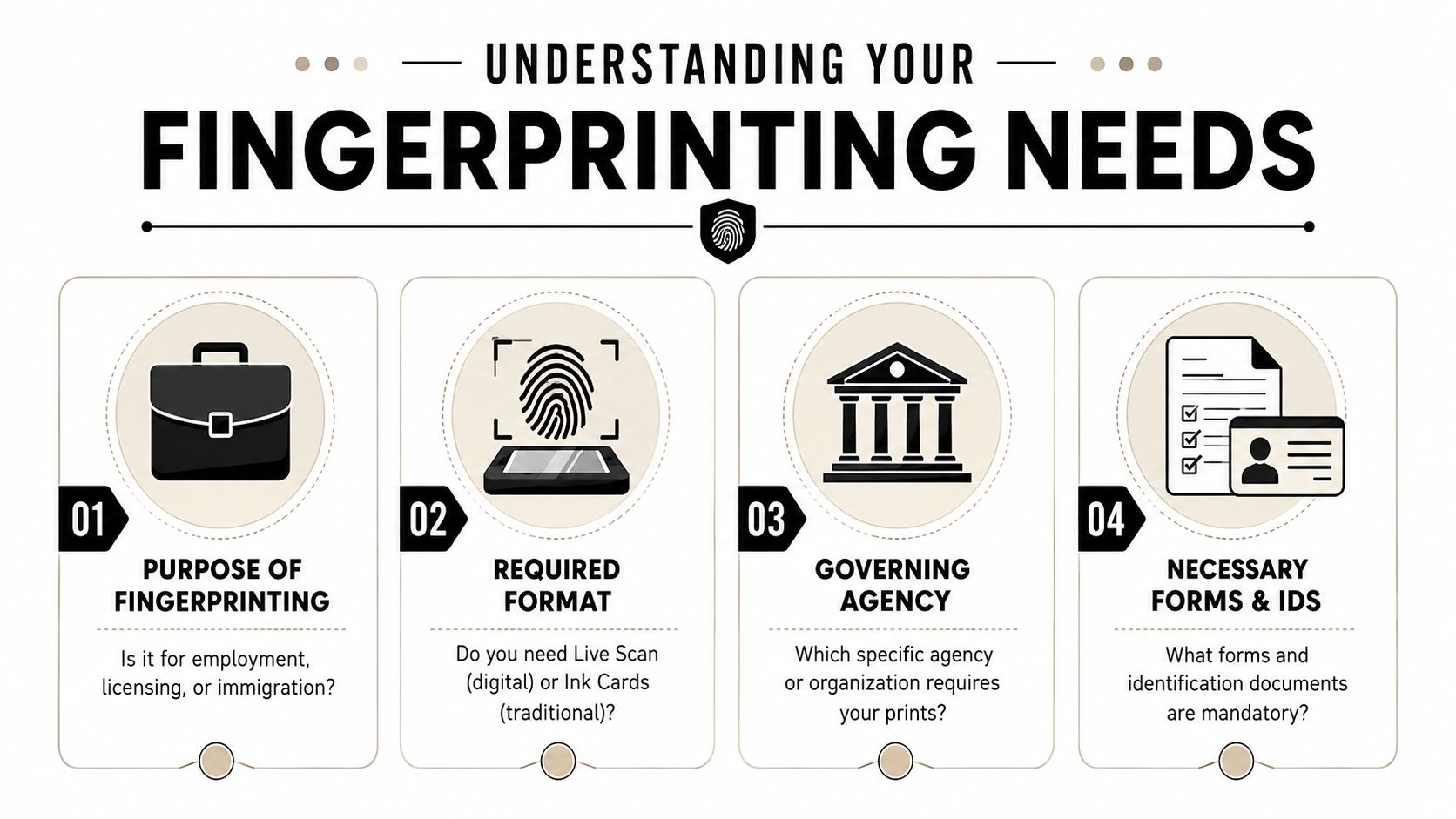
Start with the reason you were sent
Before you schedule, review your paperwork and pin down four details. This quick checklist saves time and prevents repeat visits.
- What is the purpose
Employment, licensing, certification, adoption, immigration, or another background check. - Which agency is requesting the prints
A Texas licensing board, a federal agency, and an out-of-state employer may all use different routing and form rules. - What format is required
Some requests must be submitted digitally through an approved system. Others require a physical fingerprint card, often an FD-258. - What instructions came with the request
Service codes, ORI numbers, pre-enrollment steps, and agency letters matter. A fingerprint technician can capture clear prints, but cannot guess missing agency requirements.
In practice, the agency requirement should drive every decision. If your notice mentions IdentoGO, Texas DPS, pre-enrollment, or a service code, read it line by line before choosing a location. Those terms usually mean the fingerprints must follow a specific state process, not a general walk-in request.
Practical rule: Match the format to the agency’s instructions. Do not start by choosing the format you prefer.
Know the difference between Live Scan and ink cards
For many applicants, digital Live Scan is the easier path because the system checks print quality during the appointment. If a finger needs to be recaptured, the technician can fix it on the spot. With ink cards, quality issues often appear later, after the card has already been mailed.
That trade-off matters. Live Scan works well for Texas licensing and other agency systems that accept electronic submission. Ink cards still have an important role for out-of-state boards, federal forms, and any request that specifically calls for a mailed card. According to Houston fingerprinting guidance on FD-258, SF-87, and FD-1164 workflows, digital capture is generally faster and produces fewer rejected submissions than traditional ink cards.
A simple comparison helps:
| Format | Best for | Main advantage | Main drawback |
|---|---|---|---|
| Live Scan | Texas licensing, employment, agency systems with digital routing | Fast submission and immediate quality review | Only works when the requesting agency accepts or requires it |
| Ink card | Out-of-state requests, federal forms, mailed submissions | Flexible for agencies that still need a physical card | More handling, more chances for smudges or incomplete prints |
If the instructions are unclear, stop and confirm before you book. A convenient service center can usually handle the fingerprinting itself, but the smart move is bringing the right request the first time. If you need help sorting out service codes, cards, or agency wording, this fingerprinting FAQ guide is a useful place to start.
How to Prepare for Your Fingerprinting Appointment
A smooth appointment usually comes down to preparation, not luck. The technician can guide the capture process, but you’re still responsible for arriving with the right identification, the right form, and any confirmation details tied to your request.
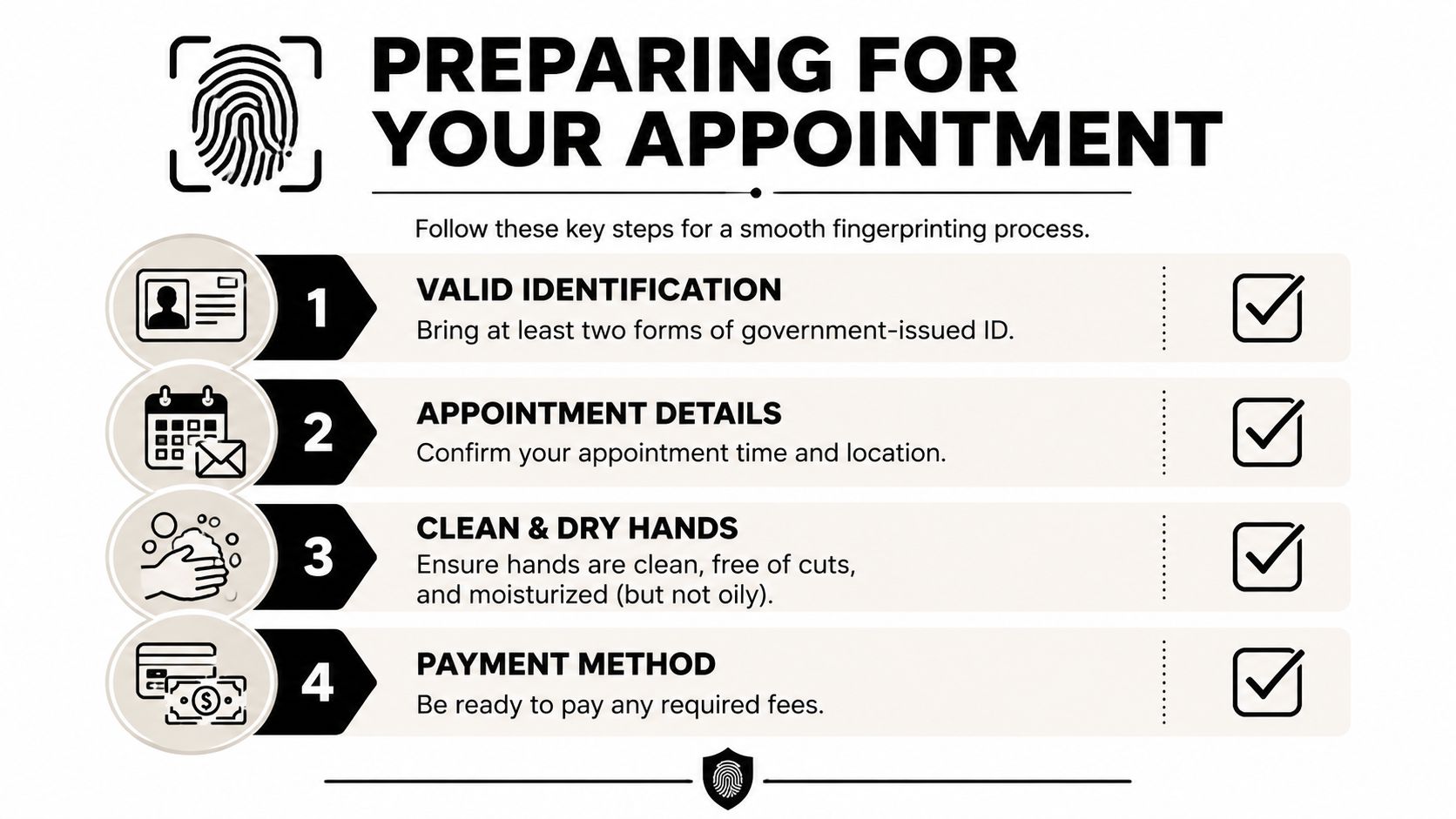
Bring the documents that actually matter
Most delays happen at check-in. The person arrives on time, but the paperwork doesn’t match the appointment.
Bring these items:
- Your government-issued photo ID. A valid driver’s license or passport is commonly requested. Bring the original, not a screenshot or photocopy.
- Your agency instruction sheet. This may include a service code, an ORI, a request letter, or a specific form number.
- Your confirmation details. If you pre-enrolled online, bring the confirmation email or registration information.
- Payment readiness. Some services are prepaid, some are not. Don’t assume.
If your agency requires a mailed card, check whether the official fingerprint card must come from that agency. Some boards and certification offices are strict about using their own documents.
Bring the exact paperwork you received, even if you think the technician won’t need all of it. The extra page you almost leave at home is often the page that answers the key routing question.
Mail-in applicants need to be especially careful. The Texas Education Agency notes that a common pitfall in card submission is failing to pay the required $10 processing fee during pre-enrollment with IdentoGO, which can cause the submission to be rejected and add weeks of delay, as explained in the Texas educator certification fingerprinting process.
If you know you need a card-based appointment, it helps to review a practical FD-258 card service overview in Sugar Land so you understand what to bring and what the card process looks like before you arrive.
Prepare your hands and appointment details
Fingerprint quality starts with your skin. Even the best equipment can’t make up for hands that are too oily, too dry, or covered in residue.
Use this quick prep list the day of your appointment:
- Wash and dry your hands. Remove dirt, ink, grease, and heavy lotion.
- Skip oily products right before the visit. Residue can affect capture quality.
- Check for cuts or peeling skin. If your fingertips are damaged, call ahead and explain the situation.
- Verify the location and time. Houston-area traffic can turn a simple appointment into a late arrival if you don’t check the route in advance.
The goal isn’t to make your hands look perfect. The goal is to make ridge detail easier to capture. Clean, dry fingertips usually produce the clearest result.
What to Expect During the Fingerprinting Process
The appointment itself is usually far less dramatic than people expect. Fingerprinting has been part of organized identification systems for a long time. The FBI created its Identification Division in 1924, and by the late 1920s that national repository had grown to roughly 5 million sets of fingerprints from 7,000 law-enforcement agencies, according to this history of fingerprint development and FBI adoption. Today’s customer-facing appointments are much simpler than that history might suggest.
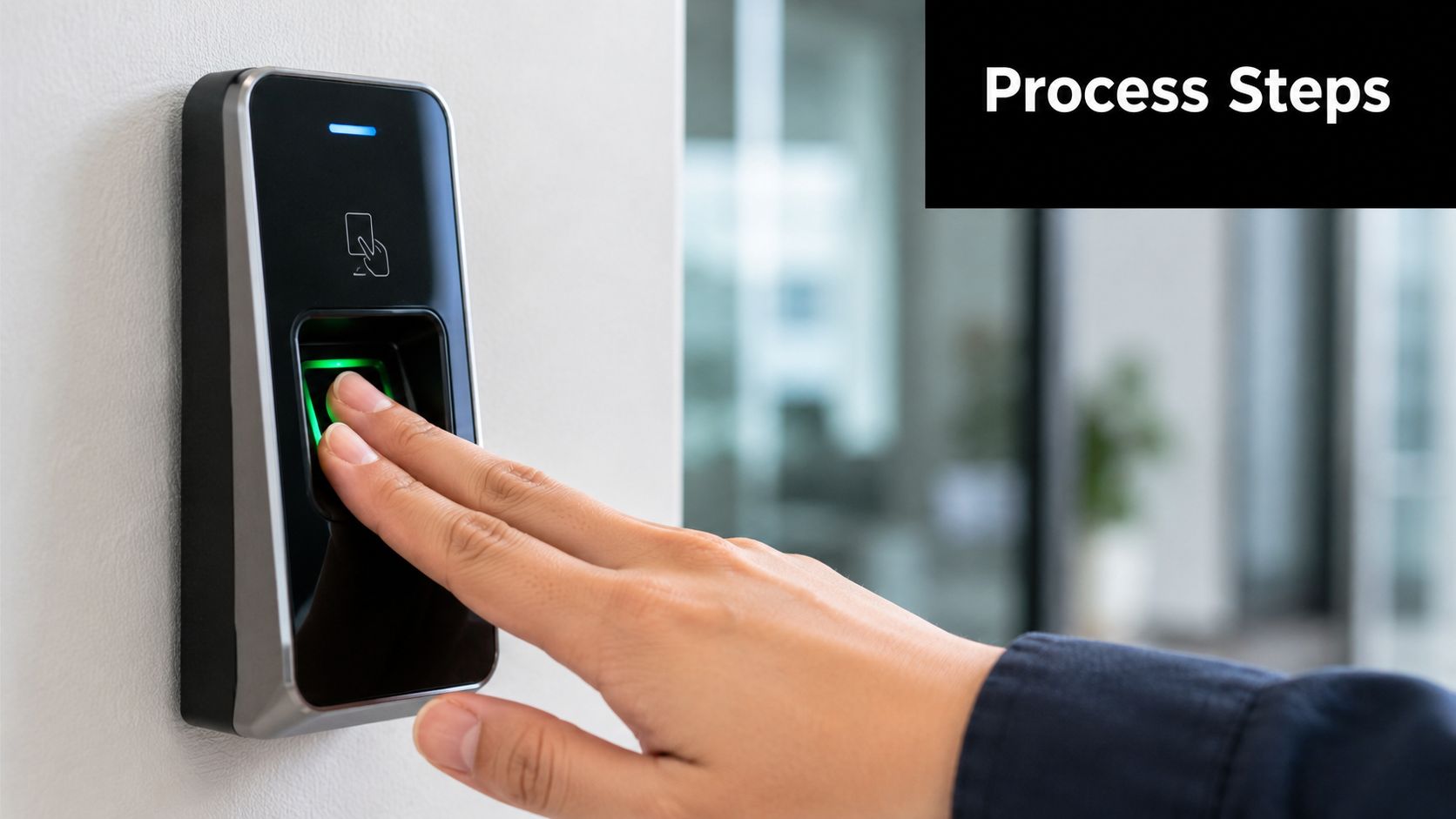
What happens when you arrive
You check in. The staff verifies your identification and reviews the service you requested. If something on the paperwork doesn’t line up, this is the point where a good technician catches it before the prints are taken.
The setting is usually calm and businesslike. You’re not walking into an interrogation room. For those seeking fingerprinting in Houston, it feels closer to a routine office service than anything connected to law enforcement.
Then the technician explains the capture method. With digital service, you’ll place each finger on a scanner as directed. With ink cards, each finger is rolled carefully onto the card in sequence.
A good fingerprint appointment feels organized, not rushed. The technician should check identity first, then confirm the format, then capture the prints.
What the technician does next
The technician watches finger placement, pressure, and image clarity. If you’re using a scanner, the system can often show immediately whether a print needs to be retaken. If you’re using a card, the technician focuses on keeping the impressions clean and complete.
Here’s a short visual overview of the process in action:
Before you leave, ask one practical question: what happens next?
For digital submissions, ask whether the prints are transmitted directly to the requesting system. For card submissions, ask who mails the card, who receives it, and whether you need tracking or extra documentation.
That final confirmation prevents a lot of unnecessary follow-up calls later.
Your Fingerprinting Options in the Houston Area
You have the agency email open, your ID in hand, and one question left. Where should you go so this gets done correctly the first time?
Houston gives applicants several workable options, but they are not interchangeable. Some locations are built for strict agency routing. Others are better for appointment flexibility, ink cards, mobile service, or basic customer support. The smart choice is the one that matches your paperwork and saves you from a second trip.
Comparing public offices and private providers
In Houston, fingerprinting usually falls into three buckets: police department locations, state-routed providers, and private fingerprinting businesses. Each has a place. The trade-off is convenience versus process control.
| Option | What it’s good for | What can be inconvenient |
|---|---|---|
| Police department locations | Familiar public setting and local access in some areas | Limited hours, stricter procedures, less flexibility for special cases |
| State system routed providers | Required for certain agency-specific digital submissions | You must follow the exact registration and routing instructions |
| Private fingerprinting providers | Flexible appointments, ink card service, practical guidance, and business-service convenience | You still need to confirm they offer the format your agency requires |
That difference matters more than many applicants expect.
A police department or government-facing site may work well if your instructions are simple and the location fits your schedule. A private provider is often the better fit when you need help confirming the service type, need ink cards instead of a live scan submission, or want a smoother appointment at a business service center instead of a public counter.
Some Houston-area providers also offer mobile fingerprinting for offices, job sites, and group appointments. That can save time for employers onboarding multiple hires and for applicants who cannot step away during standard business hours.

Why convenience matters more than people expect
The best option is usually the one that reduces mistakes, not the one closest to your house.
Many applicants need more than fingerprint capture. They need someone to confirm whether the request calls for digital submission or a fingerprint card, whether an appointment is needed, and what leaves with them after the appointment. That is where a full-service business center often has an advantage. The staff is used to handling documentation questions, timing concerns, and the small details that cause delays.
If you are comparing locations, start with a provider that clearly explains formats, appointment steps, and service coverage, such as this guide to live fingerprint scan locations near Sugar Land and Houston.
Best use of your time: Choose the provider that helps you complete the correct fingerprint process with the fewest handoffs, not just the shortest drive.
Common Use Cases for Fingerprinting in Houston
Individuals seeking fingerprinting in Houston typically aren’t dealing with criminal processing. They’re dealing with everyday professional requirements. Fingerprinting is part of the trust framework for jobs, licenses, and certifications where the public expects screening to happen before someone starts work or receives approval.
Licensing and regulated employment
Common examples include educators, healthcare workers, real estate professionals, security-related roles, and other applicants whose licensing boards or employers require a fingerprint-based background check.
In Texas, fingerprint-based criminal history checks are authorized for designated volunteers and for many employment and licensing applicants in different fields. That’s why so many people encounter fingerprinting during a career move rather than during any law-enforcement event. For a teacher, nurse, contractor, or regulated employee, this step is often as routine as submitting an application photo or verifying identity documents.
The practical point is simple. Your fingerprints are not being requested because your case is unusual. They’re being requested because your industry has a screening rule, and that rule has to be completed exactly as written.
Why this step isn’t optional
A lot of frustration comes from treating fingerprinting like an administrative side task. It isn’t. If the agency requires it, the application usually can’t move forward without it.
That’s especially true when the request is tied to a state process, a formal certification, or a regulated role working with children, patients, clients, money, or secure information. In those situations, fingerprinting is part of how the agency documents identity and background review.
The smartest approach is to treat the appointment as a compliance task, not an errand. Confirm the format, bring every required document, and use a location that can help you avoid preventable mistakes.
If you want a simpler way to handle fingerprinting along with other business services, Business Mail Boutique LLC in Sugar Land offers a convenient one-stop option for fingerprinting, shipping, printing, mailbox services, notary support, and other everyday office needs. For busy professionals, families, and small business owners, that kind of full-service setup can make an otherwise confusing appointment feel quick, organized, and easy to complete.

Related posts

Custom Memorial Glasses Engraved in Three Hours in Sugar Land
When a customer needed eight personalized glasses for a memorial, Business Mail Boutique completed the engraving or...

Custom Martini Glass Engraving in Sugar Land, TX
Custom Logo Engraving on Martini Glasses in Sugar Land, Texas.
Business Mail Boutique recently completed a beautiful custom engravin...

Custom Engraved Wine Glasses for a Golf Club Event in Sugar Land, TX
Custom Engraved Wine Glasses for a Golf Club Event in Sugar Land.
Custom wine glass engraving in Sugar Land, TX at Business Mail Bouti...