
- Print Business Cards in Sugar Land – Same Day Service
- Copying Services
- Document Printing, Finishing & Lamination in Sugar Land
- Flyers
- Print Banner in Sugar Land | Same-Day Banner Printing Near Me
- Graphic Design
- Photo Printing
- Postcard Printing
- Document Printing
- EDDM Full Service Postcards
- FotoZoomer Large Format Printing


Printing T-Shirt Near Me: A Local’s Guide for 2026
11645 S. Hwy 6, Sugar land, Texas 77498, United States (US) - Phone: 281-875-0161 Email: info@businessmailboutique.com
Route
You usually search for printing T-shirt near me when the need is real and the clock is already ticking. Maybe the staff shirts for your weekend pop-up still aren’t ordered. Maybe your family reunion organizer just realized nobody handled the shirts. Maybe your school fundraiser needs a small batch now, not after a long shipping window and a week of email back-and-forth.
That’s when local printing matters. You’re not just buying ink on fabric. You’re buying speed, a real conversation, a proof you can approve before production, and a chance to fix problems before they become a box full of unusable shirts. When people walk into a neighborhood print shop, they usually don’t need a lecture on printing theory. They need a practical answer: what shirt, what print method, what file, what turnaround, and how to avoid wasting money.
Table of Contents
- Why Local Printing Is Your Best Bet
- Choosing the Right T-Shirt Printing Method
- Preparing Your Artwork for Flawless Printing
- Understanding Pricing Turnaround and Same-Day Options
- How to Place Your Order at a Local Print Shop
- Pro Tips for Small Businesses and Event Organizers
- Frequently Asked Questions About Local T-Shirt Printing
Why Local Printing Is Your Best Bet
A local shirt order usually starts with urgency. Someone needs ten shirts for a restaurant promo, a church group needs event tees, or a contractor wants crew shirts before a jobsite photo. In those moments, online-only ordering can feel slow and risky because every question becomes another email thread.
Local shops solve a different problem than mass retail. They help people who need small-batch customization, fast turnaround, and direct communication. That’s a big reason this category keeps growing. The custom T-shirt printing market was valued at $5.16 billion in 2024 and is projected to reach $9.82 billion by 2030, reflecting an 11.5% CAGR, according to Printful’s T-shirt industry statistics.
That growth shows up in the kind of jobs neighborhood shops see every day. Buyers want shirts for staff uniforms, school clubs, birthday trips, family reunions, and one-off promotional runs. They don’t always need hundreds of pieces. They need the right blanks, a method that fits the artwork, and a realistic production plan.
Practical rule: If the event date is fixed, local printing usually beats guesswork. You can ask questions, review a proof, and confirm pickup instead of hoping a shipment lands on time.
Another advantage is simple but important. You can often look at sample garments, compare shirt weights, and talk through print placement with someone who’s handled real orders like yours. That matters more than people think. A design that looks fine on a mockup can feel too low, too small, or too stiff once it’s on an actual shirt.
If you’re searching for printing T-shirt near me, you’re usually not looking for the cheapest possible shirt on the internet. You’re looking for a result that arrives on time and doesn’t create a new problem.
Choosing the Right T-Shirt Printing Method
The print method decides more than just how the shirt looks. It affects the hand feel, how well the design handles fine detail, how the order scales, and whether the job makes sense for a rush timeline.
How shops actually match method to order
Most buyers don’t care about the machine name. They care whether the shirts will look good, last, and fit the budget. That’s the right way to think about it. Local shops often offer several methods, but the useful question is always the same: what’s the shirt for?
According to The Foundry Clothing’s overview of printing options, local print shops advertise multiple methods but rarely explain the tradeoffs clearly. The key is matching the method to the use case. DTF and DTG are gaining attention for detail and flexibility in small runs, while screen printing remains the standard choice for durability and cost-effectiveness in volume.
Here’s the plain-English version:
- Screen printing works well when you need a larger batch and a dependable, durable print.
- DTG is a strong option for detailed artwork, especially photo-like graphics on cotton and smaller quantities.
- HTV is useful for simple lettering, names, and numbered shirts where cut material makes sense.
- Sublimation shines on polyester when you want long-lasting color integrated into the garment rather than sitting heavily on top. If you want a straightforward explanation of that process, this guide on what sublimation printing is gives a good overview.
Don’t choose a method because it sounds modern. Choose it because it matches the fabric, artwork, quantity, and deadline.
T-Shirt Printing Methods Compared
| Method | Best For | Feel | Durability |
|---|---|---|---|
| Screen printing | Bulk orders, bold logos, event shirts | Usually smooth with ink sitting on the garment | Strong choice for repeated wear |
| DTG | Small runs, photo-style art, detailed cotton prints | Softer on many designs, especially with lighter ink loads | Good when artwork and garment match the process |
| HTV | Names, numbers, simple one-off personalization | More like a layer applied to the shirt | Can work well for specific uses, less ideal for large complex graphics |
| Sublimation | Polyester shirts, vivid all-over or performance-style graphics | Very light feel because color becomes part of the fabric | Excellent when used on the right garment |
A few decisions tend to work well in practice:
For business uniforms
Simple left-chest logos or clean front prints often benefit from methods that keep branding crisp and repeatable across multiple shirts. If the design is uncomplicated and the team size is larger, screen printing usually makes the most sense.
For family events and one-time gatherings
Smaller quantities with full-color artwork often push buyers toward DTG or DTF-style workflows because setup is simpler and you don’t need to force a bulk order just to make the job practical.
For sports and performance wear
Polyester changes the conversation. Cotton-first advice won’t help much if the shirt material is wrong for the print style. That’s where sublimation can be a better fit, especially when the goal is bright color and a lighter feel.
The mistake I see most often is choosing the cheapest method first and asking whether it fits later. That order should be reversed.
Preparing Your Artwork for Flawless Printing
Bad files slow down good shops. Most printing mistakes start before the shirt ever touches a press. The usual trouble spots are fuzzy logos, missing fonts, colors that were never clearly specified, and artwork that looked fine on a phone but falls apart when sized for a shirt.
Why vector files save time
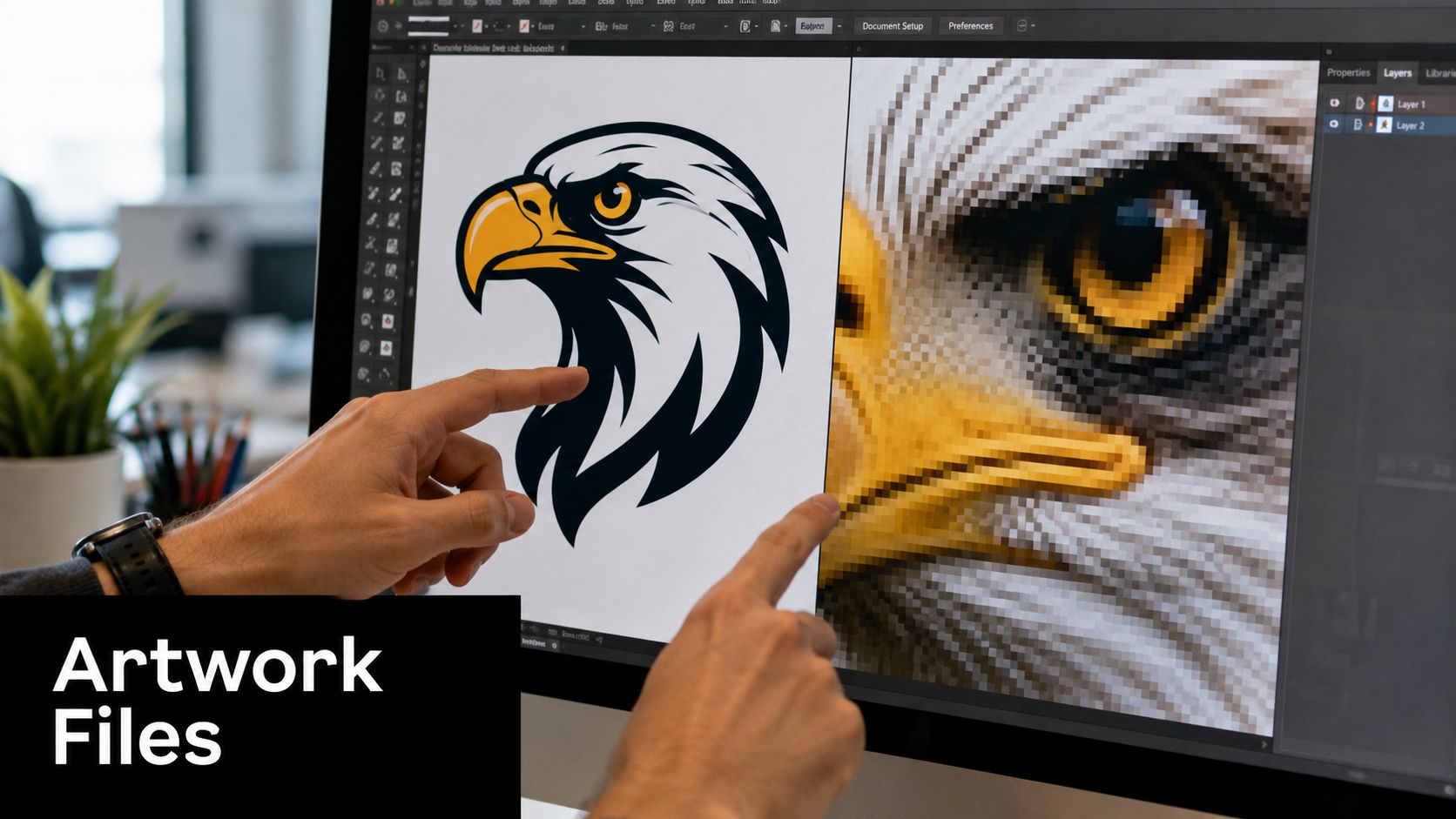
The cleanest workflow is simple. Submit vector artwork in AI, PDF, or EPS format and ask for a proof before production. That two-step approach reduces the biggest failure points: file misunderstandings and last-minute artwork errors, as noted in this step-by-step T-shirt printing workflow guide.
A vector file matters because it scales cleanly. A logo created in Adobe Illustrator or saved as a proper PDF can go from business card size to shirt size without turning jagged. A screenshot, social media image, or compressed JPG often can’t.
If your only file is a PNG or JPG, don’t panic. Sometimes it’s usable, sometimes it needs cleanup, and sometimes it needs to be rebuilt. The right move is to send the best version you have early, not the night before production.
A clean artwork checklist
Before you send the design, check these items:
- Use the original logo if possible. Brand kits, designer exports, and printer-ready PDFs are better than screenshots.
- Convert text carefully. If a font is unusual and not embedded properly, the printer may not see what you see.
- Be clear about colors. If color matters to your brand or event theme, say so before proofing.
- Size the design with the garment in mind. A logo that works on a standard tee may need adjustment for a youth shirt, women’s cut, or oversized blank.
- Ask for a proof every time. That’s where you catch spelling errors, wrong shirt colors, and placement issues.
The proof is the last cheap fix. After production starts, every mistake gets more expensive.
If you’re building the file yourself and want a practical reference, File Studio has a useful guide on create print-ready files. It’s helpful for understanding how to hand off artwork in a format a printer can use.
A few file habits cause repeat delays:
What doesn’t work well
- Photos of a shirt design drawn on paper
- Logos pulled from a website header
- Tiny files pasted into a document and exported without checking quality
- Sending one version for quote approval and another version after production is queued
What usually works
A single folder with the logo file, any linked art, clear notes on shirt color, quantity, sizes, and print location. That sounds basic, but it cuts down confusion more than anything else.
The phrase ‘printing T-shirt near me’ often leads to the assumption that finding a printer is the hardest part. In practice, the hard part is sending clean instructions. Good artwork makes everything downstream easier.
Understanding Pricing Turnaround and Same-Day Options
Price and speed are usually tied together, but not in the way buyers expect. The cheapest path is often slower and more standardized. The fastest path usually demands flexibility on garment choice, print method, or both.
What changes the price
The biggest drivers are usually the shirt itself, the print method, the artwork complexity, and the order quantity. A premium garment costs more than a basic tee. A simple one-location print is easier to produce than front-and-back artwork. A larger run spreads setup and labor differently than a very small batch.
Same-day and no-minimum service changed local expectations. One Coralville, Iowa shop at 906 2nd St #2, Coralville, IA 52241 explicitly advertises same-day pickup and no minimums, and another Iowa City location lists no minimum orders, showing how strongly buyers now value speed and flexibility in neighborhood printing, according to this local screen-printing listing.
That doesn’t mean every job qualifies for same-day. It means local shops increasingly build around urgent demand.
When same-day makes sense
Rush orders work best when the design is ready, the shirt is in stock, and the method fits a fast production lane. If the art still needs repair, the shirt style must be specially ordered, or the client hasn’t approved the proof, the timeline slips immediately.
For a practical look at how to think about urgent apparel jobs, Cobra DTF has a helpful article on getting fast printing services. It’s a good reminder that speed starts with preparation, not just paying a rush fee.
A local shop can often move much faster when you answer these questions upfront:
- Quantity needed
- Garment type and color
- Print location
- Artwork status
- Hard deadline
If you’re specifically trying to sort out a rush scenario, this guide to same-day printing near you is a useful reference for what makes an order realistic.
The common mistake is asking for a quote without the decision-making details. The more complete your request, the faster the answer.
How to Place Your Order at a Local Print Shop
Walking into a local shop with “I need shirts” is completely fine. Good printers are used to starting from rough ideas. What helps is knowing the event, the deadline, and whether you need one shirt, a staff batch, or something in between.
What the first conversation should cover
A useful order conversation usually starts with five points: quantity, garment style, print location, artwork, and due date. If one of those is still undecided, say so. A good shop can help narrow the options, but they can’t quote accurately if the basics keep changing.
In a one-stop storefront model, that process is even more convenient because printing doesn’t live in isolation. Business Mail Boutique LLC in Sugar Land is one example of a neighborhood business center that handles printing alongside shipping, mailbox services, and office support. That setup is practical for customers who need shirts produced and then picked up locally, shipped to another destination, or coordinated with other business materials.
Here’s what a smooth order usually looks like:
- You bring in the idea, logo, or event need.
- The shop helps narrow the shirt and print method.
- You receive a quote based on the actual job.
- Artwork gets submitted or cleaned up for production.
- A proof is reviewed before printing starts.
If the proof shows the wrong shirt color, placement, or spelling, stop there and fix it. Approval is the point where the job becomes real.
Proof approval pickup and delivery
Once the proof is approved, the rest becomes logistics. Local customers often choose pickup because it’s fast and simple. Others need the order shipped to a team member, event venue, or client. In a business center environment, that flexibility can be useful when printing is only one part of the project.
This short video gives a feel for the kind of multi-service storefront workflow some local customers prefer:
The biggest ordering mistake isn’t asking too many questions. It’s approving too quickly because you’re in a hurry. A few extra minutes during proofing can save an entire order.
Pro Tips for Small Businesses and Event Organizers
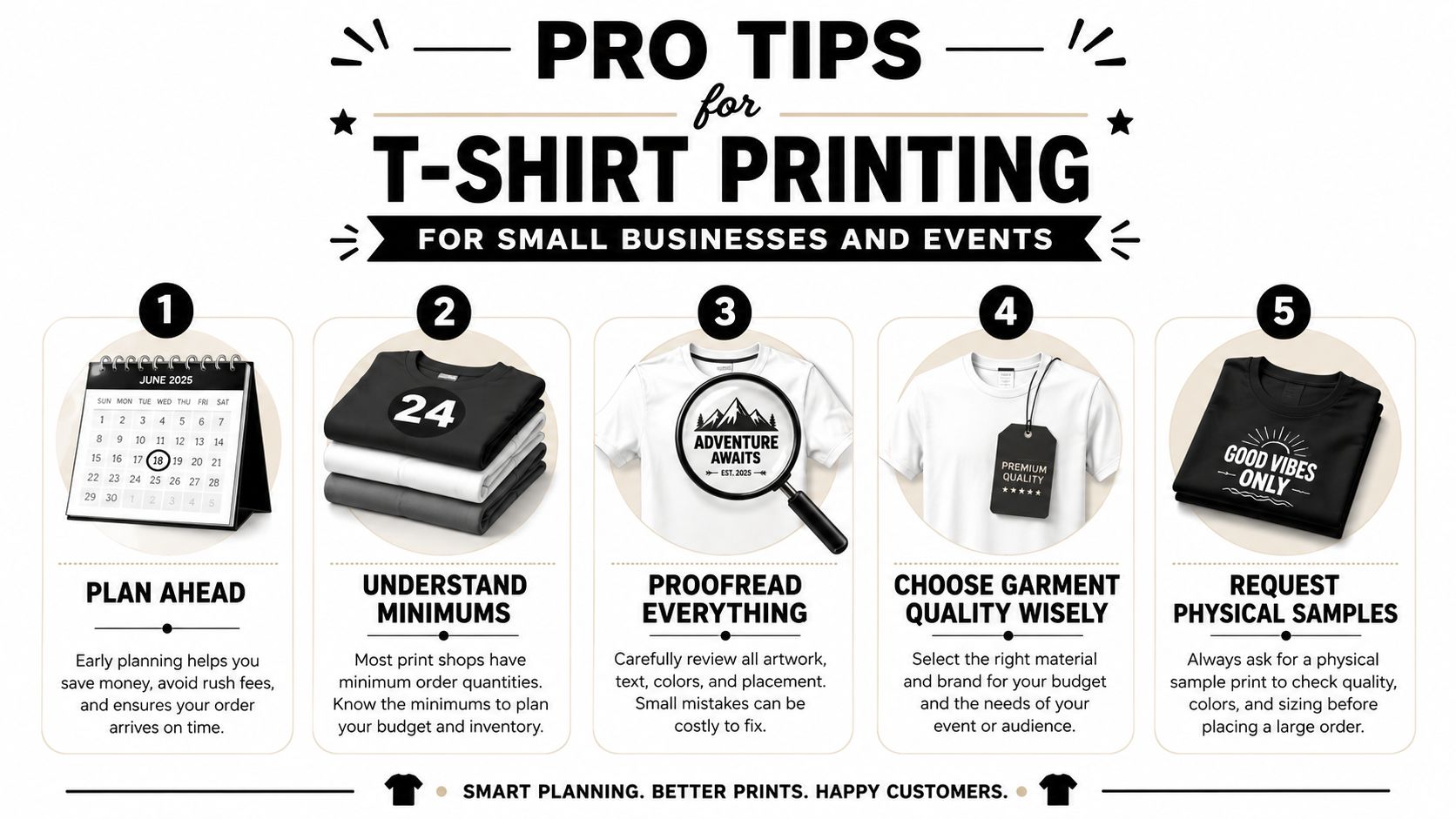
Local shirt orders often succeed or fail on details that don’t seem important at first. While the graphic often draws primary attention, printers focus on the graphic, the garment, and the placement together. That’s the difference between a shirt that feels professionally made and one that just feels printed.
Fit and placement matter more than most buyers think
For standard center-chest prints, a common benchmark is about 1.5 to 3 inches below the collar, often measured with a three-finger rule, based on hands-on placement guidance in this production video. That sounds like a small detail, but it changes how the whole shirt reads when someone wears it.
Oversized shirts need a different visual center than standard tees. The same guidance notes that maximum print widths often expand from about 9 to 10.5 inches on standard shirts to around 11 to 13 inches on 2XL to 3XL garments. If a shop uses the same art size across every blank, larger shirts can look under-scaled and awkward.
A few practical reminders help:
- Check the actual garment style. Cropped, oversized, and fashion blanks don’t follow the same visual rules as standard crew-neck tees.
- Don’t trust the carrier sheet alone. Placement should be judged from the graphic position on the shirt, not from excess liner or transfer margins.
- Pre-production questions matter. Ask whether the art size will be adjusted for larger sizes when appearance matters.
Small decisions that prevent expensive mistakes
For events and small businesses, the safest orders usually share the same habits.
- Order with wear in mind. Staff uniforms need different priorities than vacation shirts. Think about wash frequency, comfort, and whether the design needs to stay bright after repeated use.
- Choose shirt colors that hide stress. White shirts can look great, but they show every warehouse smudge, food spill, and setup mark. Mid-tones are more forgiving for active events.
- Proofread names and dates twice. Team shirts, reunion years, sponsor names, and web addresses are where avoidable errors show up.
- Ask about samples for important jobs. If the order is high-visibility, it’s smart to confirm the look before full production.
- Pair shirts with the rest of the event. If you’re already planning giveaways, signage, or handouts, coordinating the artwork across items creates a more polished result. For ideas beyond apparel, this collection of promotional items to give away is a practical reference.
A shirt can have great artwork and still look wrong if the size and placement ignore the garment shape.
The buyers who get the cleanest results usually aren’t designers. They’re the ones who slow down long enough to confirm the details.
Frequently Asked Questions About Local T-Shirt Printing
Can I order just one shirt locally
Sometimes yes, sometimes no. It depends on the print method and the shop’s workflow. Many local printers can handle one-offs or very small runs, especially when the design and garment fit a digital process. The best move is to ask for availability before you finalize the artwork.
Should I bring my own shirts
You can ask, but it’s not always the simplest path. Customer-supplied garments can introduce fit, fabric, color, and printability issues that the shop can’t control. If the shirt matters to the final result, it’s usually safer to let the printer source a blank that matches the chosen method.
What if I don’t have professional artwork
That’s common. Start with the highest-quality version of your logo or design that you have, plus a clear description of what you want on the shirt. A local printer can often tell you quickly whether the file is usable as-is, needs cleanup, or should be rebuilt before production.
If you need a local place to talk through custom shirts, proofs, pickup, shipping, or related print needs in Sugar Land, Business Mail Boutique LLC is a practical option to contact and discuss the job details before production starts.

Related posts

Custom Memorial Glasses Engraved in Three Hours in Sugar Land
When a customer needed eight personalized glasses for a memorial, Business Mail Boutique completed the engraving or...

Custom Martini Glass Engraving in Sugar Land, TX
Custom Logo Engraving on Martini Glasses in Sugar Land, Texas.
Business Mail Boutique recently completed a beautiful custom engravin...

Custom Engraved Wine Glasses for a Golf Club Event in Sugar Land, TX
Custom Engraved Wine Glasses for a Golf Club Event in Sugar Land.
Custom wine glass engraving in Sugar Land, TX at Business Mail Bouti...