
- Print Business Cards in Sugar Land – Same Day Service
- Copying Services
- Document Printing, Finishing & Lamination in Sugar Land
- Flyers
- Print Banner in Sugar Land | Same-Day Banner Printing Near Me
- Graphic Design
- Photo Printing
- Postcard Printing
- Document Printing
- EDDM Full Service Postcards
- FotoZoomer Large Format Printing


Businessmailboutique
11645 S. Hwy 6 Sugar land, Texas 77498 United States (US)Phone: 281-875-0161
Email: info@businessmailboutique.com
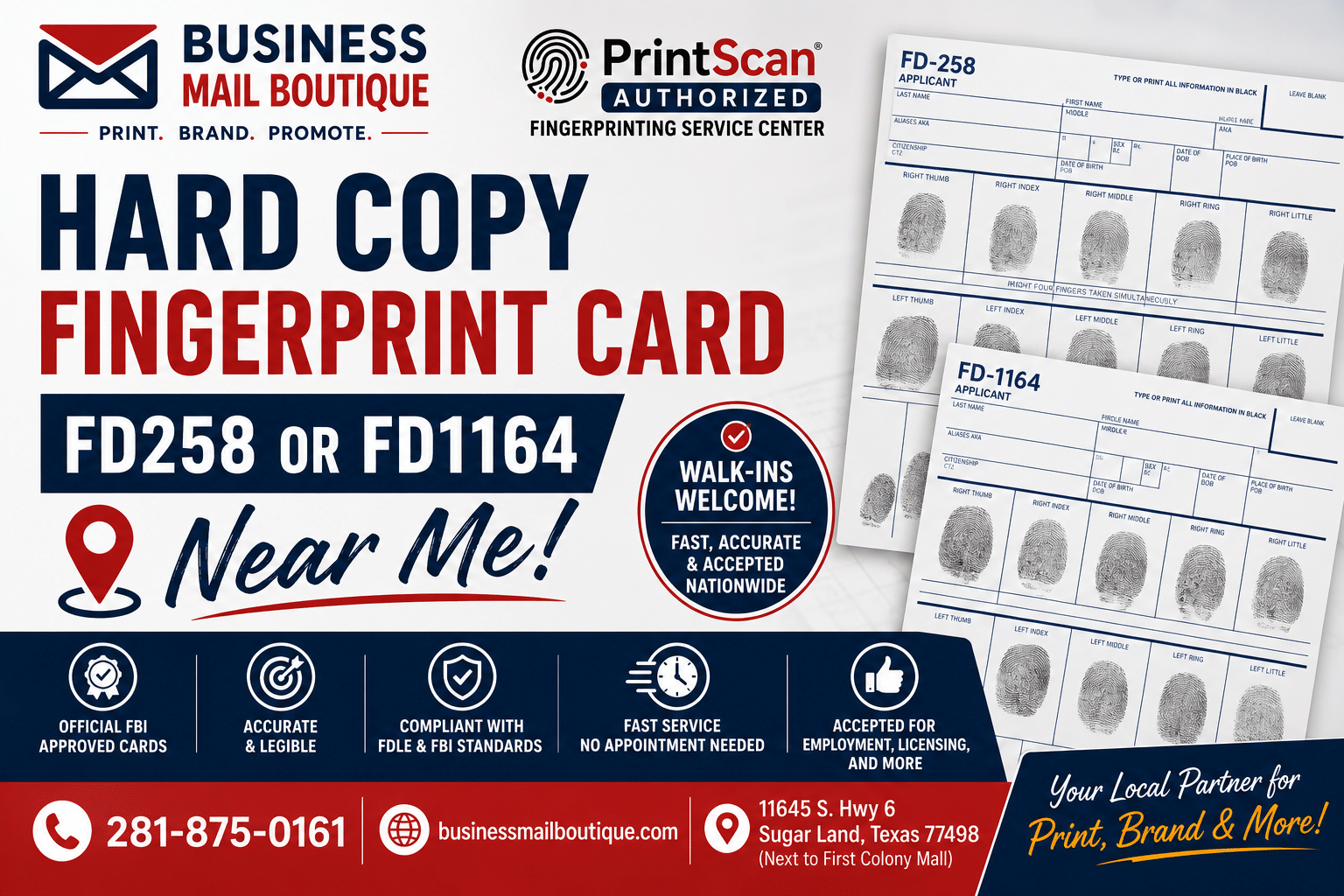
Hard Copy Fingerprint Card Near Me: 2026 Local Guide
Businessmailboutique
11645 S. Hwy 6
Sugar land, Texas 77498 United States (US)
Email: info@businessmailboutique.com
You’re usually searching hard copy fingerprint card near me when a deadline is already hanging over you. A licensing board emailed instructions. An employer told you to submit an FD-258 card. A state agency said your fingerprints have to be inked, mailed, or attached to a background check packet. At that point, applicants don’t need theory. They need to know where to go, what to bring, and how not to get turned away.
The good news is that this is a routine process. The hard part isn’t the fingerprint card itself. The hard part is avoiding small mistakes that cause delays, like showing up without the right ID, using the wrong card, or leaving off an ORI number. If you handle those details up front, getting fingerprinted nearby is usually straightforward.
Table of Contents
- Why You Need a Hard Copy Fingerprint Card
- How to Find a Fingerprinting Service Near You
- Preparing for Your Fingerprinting Appointment
- What to Expect During the Inking Process
- Typical Costs and Identification Requirements
- When to Consider Mail-In or Mobile Fingerprinting
Why You Need a Hard Copy Fingerprint Card
If an agency told you to get an FD-258 fingerprint card, that usually means they need a standard format they can review, file, mail, or convert for submission. It’s the card commonly intended when someone mentions a “hard copy fingerprint card.” You’ll see it used for licensing, employment screening, immigration-related paperwork, personal record requests, firearms-related submissions, and out-of-state applications where digital capture isn’t available.

The reason this card still matters is simple. It’s an accepted standard. The FD-258 fingerprint card has been a cornerstone of criminal justice and background check processes since its formal adoption by the FBI in 1945, and approximately 20 to 30% of FBI background checks are still processed via mailed cards annually, according to Certifix’s overview of fingerprint card services.
That’s why getting asked for one isn’t unusual or outdated. It’s often just the format the requesting agency requires.
Why agencies still ask for paper cards
Some agencies need a physical card because the applicant is out of state. Some use hard cards because the submission has to go through a mail-based process. Others require the card as part of a packet that includes notarized forms, identity documents, or licensing paperwork.
If you’re in a regulated field, this won’t be the last time you see fingerprint instructions. Healthcare applicants, students, license holders, and job candidates run into this regularly. If you need an example of how fingerprinting fits into compliance-heavy applications, this guide on criminal background check requirements for MD students and nurses fingerprinting shows how agencies build fingerprinting into approval steps.
Practical rule: Don’t substitute another card format unless the agency explicitly says it’s acceptable. “Looks close enough” is how people end up doing the appointment twice.
What this means for you right now
Your job is not to become a fingerprint expert. Your job is to leave with a clean, correctly completed card that matches the agency’s instructions. Once you think of it that way, the process gets easier. You need the right card, the right personal details, the right agency information, and a provider who knows how to roll prints clearly.
How to Find a Fingerprinting Service Near You
Searching hard copy fingerprint card near me works, but it’s often too broad. You’ll get a mix of live scan vendors, police departments, mobile providers, and business centers. That can waste time if your agency specifically needs an inked or printed FD-258 card.

A more useful search includes the exact service type. Try terms like:
- “FD-258 fingerprint card near me”
- “ink fingerprinting near me”
- “hard card fingerprinting near me”
- “walk-in fingerprint card service”
- “fingerprint card printing Sugar Land”
That matters because physical cards still fill a real gap. Physical cards account for 25% of FBI Interstate Identification Index checks where electronic Live Scan isn’t feasible, and industry surveys show convenience drives 70% of consumer preference, with walk-in locations cutting processing time to 15 minutes, according to NB Information’s fingerprinting location overview.
Search for the exact service you need
Start with the agency instructions in your hand. Look for words like FD-258, inked card, hard card, mail-in, ORI, or manual submission. Those terms tell you whether a general fingerprint shop is enough, or whether you need a provider used to handling card-based requests.
A practical local example is fingerprinting in Sugar Land, where a business center format can make the trip simpler because people often need more than one thing at once, such as copies, notary work, or shipping the completed packet the same day.
A good provider doesn’t just take fingerprints. They help you avoid preventable errors before the card leaves the counter.
Compare the provider types before you go
Different locations solve different problems. Police and sheriff offices may be appropriate if you want a traditional government setting. Private fingerprint agencies usually handle a wider mix of card types and appointment formats. Retail-style business centers can be the easiest option when you need convenience and nearby access.
| Provider Type | Best For | Typical Cost | Walk-ins Welcome? |
|---|---|---|---|
| Police departments | Applicants who prefer an official local agency setting | Varies by location | Sometimes |
| Private agencies | Licensing, out-of-state, and card-specific requests | Varies by provider | Often |
| Retail business centers | Fast errands, nearby access, and combined services like printing or shipping | Varies by provider | Often |
What works best depends on your situation:
- Need speed: A walk-in private location or business center is usually the first place to check.
- Need agency familiarity: A sheriff or police office may be worth calling first.
- Need one-stop convenience: A retail business center can save time if you also need copies, mailing, passport photos, or notarized paperwork.
Call before you go. Ask one direct question: “Do you do FD-258 hard copy fingerprint cards on-site?” That question filters out most wrong-fit locations immediately.
Preparing for Your Fingerprinting Appointment
Most rejected cards don’t fail because the person did something dramatic. They fail because one small detail was off. A missing field, a smudged print, or the wrong mailing destination is enough to slow everything down.

The biggest problem areas are already known. According to IdentoGO benchmarks and TDI reports, common pitfalls leading to card rejection include illegible ink, causing 20 to 30% of rejections, a missing ORI number with a 15% failure rate, or mailing the card to the wrong address, as described in the Texas Department of Insurance fingerprint instructions.
Bring the items that control whether your card is accepted
Before leaving home, gather everything into one folder. Don’t assume you’ll remember a code or agency address from your phone while standing at the counter.
Bring these:
- Your government-issued photo ID. A driver’s license, passport, or state ID is typically the first thing the technician checks.
- The fingerprint card or agency packet. If the agency sent a prefilled card or cover sheet, bring that exact paperwork.
- Your ORI number if required. This identifies the agency receiving the prints. If your instructions mention one, it is not optional.
- Any service code, confirmation email, or request form. Some agencies or vendors issue a reference number before the appointment.
- The exact recipient address. If you must mail the card after the appointment, confirm where it goes before the ink dries.
If you’re getting an FD-258 locally, this page on FD-258 card service in Sugar Land is a useful example of the kind of specific service description you want to find before making the trip.
Simple prep that improves print quality
Fingerprints are physical. Skin condition matters. So does timing.
Use this short checklist on appointment day:
- Wash and dry your hands well. Dirt and oils can blur ridge detail.
- Skip lotion right before the appointment. Lotion can create smearing.
- Treat cuts or cracked skin carefully. If your fingertips are damaged, call first and ask whether to wait or proceed.
- Review your personal details before the card is completed. Name order, date of birth, and other entries should match your documents.
- Leave extra time if you’re also mailing the packet. Rushing is how forms get stuffed into the wrong envelope.
Check the ORI number against the agency instructions one more time before the card is filled out. That single line causes more trouble than most people expect.
The goal is simple. One visit, one correct card, no do-over.
What to Expect During the Inking Process
The inking process is less dramatic than people imagine. In a typical appointment, you walk in, show ID, confirm the reason for fingerprinting, and hand over the card or instructions. The technician checks that the form matches the service you need.

What happens at the counter
First, the technician verifies your identity and reviews the card fields that need to be completed. If the card is blank, they may ask for your personal details and the requesting agency information before any ink is used. Missing paperwork usually shows up at this stage.
Then each finger is rolled carefully to capture the full pattern. Rolled impressions and flat impressions serve different purposes on the card, so the technician will guide your hand position rather than asking you to guess.
What the technician is looking for
A trained person isn’t just trying to get ink onto paper. They’re looking for clean ridge detail, proper placement, and impressions that aren’t too light or too dark. If a print looks poor, they may redo that finger before moving on.
From the customer side, the best approach is to relax your hand and follow instructions. Don’t press too hard. Don’t try to “help” by rolling your own finger unless asked. Good fingerprinting is controlled, deliberate, and usually finished quickly when the paperwork is already in order.
Keep your hand loose. Tension makes rolling harder and can distort the print.
When the card is complete, review the filled-in fields before you leave. Names, dates, agency details, and signatures are easier to fix on the spot than later.
Typical Costs and Identification Requirements
The pricing side of hard card fingerprinting is where people get frustrated. Two places in the same metro area can charge very different amounts for what sounds like the same service. That’s because you may be paying for different things: the fingerprint capture itself, the card, printing, mobile travel, or added help with forms and mailing.
Why prices vary so much
There isn’t one universal price for FD-258 service. Some UPS Stores charge $45 to $65, and mobile services can exceed $80, according to IdentoGO’s fingerprint card pricing page. That range explains why people search for cost before they book.
A practical way to compare prices is to ask what’s included:
- Is the FD-258 card included
- Is this ink-and-roll or scan-and-print
- Are duplicate cards extra
- Is mailing help part of the service
- Are walk-ins charged differently from appointments
Transparent pricing usually signals an organized provider. If the answer is vague, ask again before you commit.
What ID usually works
Most fingerprint providers want a valid government-issued photo ID. The safest options are:
- Driver’s license
- State identification card
- Passport
If your agency requires additional identification or supporting documents, bring those too. Some requests include a form, service code, or agency letter that matters just as much as the ID itself. The simplest rule is to bring more documentation than you think you’ll need, not less.
If you’re sending the card to another state or a federal agency, make sure the name on your ID matches the name on the application paperwork. Even small mismatches can create follow-up questions.
When to Consider Mail-In or Mobile Fingerprinting
Walk-in fingerprinting is the standard selection because it’s direct. You show up, get printed, and leave with the card. However, there are situations where that isn’t realistic.
Mail-in makes sense in specific situations
Mail-in options are usually used by people who are out of state or physically unable to be digitally printed. Many providers restrict mail-in physical fingerprint card handling to those groups, and the lack of clear instructions often creates confusion. That issue has grown as out-of-state queries rose 40% per Google Trends for 2025 to 2026, as noted on South Carolina IdentoGO’s site.
Mail-in can make sense if:
- Your agency allows a physical card to be mailed for processing
- You live far from the state that requested the prints
- You already have a properly completed card and need submission support
- Travel is harder than mailing documents
Mail-in is less forgiving than walk-in service. If the card is incomplete, you won’t find out immediately. That’s why it’s better for applicants who already have clear instructions and know exactly where the finished card must go.
Mobile service fits group or limited-mobility needs
Mobile fingerprinting is useful when the applicant can’t easily travel or when a business needs multiple people fingerprinted in one place. It’s also worth considering for office teams handling hiring, licensing, or credentialing for several employees at once.
The trade-off is usually cost versus convenience. You’re paying for the technician’s travel and scheduling flexibility. For an individual with easy access to a nearby location, walk-in service is usually simpler. For a group, a remote site, or someone with mobility constraints, mobile service can be the practical answer.
If you’re in Sugar Land and want a straightforward local option for FD-258 ink fingerprinting, shipping, printing, and related document help in one stop, Business Mail Boutique LLC offers those services from its business center setting.
If you need a hard copy fingerprint card done correctly without bouncing between multiple locations, contact Business Mail Boutique LLC. The store can help with FD-258 fingerprinting in Sugar Land and can also handle related needs like printing, copying, shipping, and notary services so you can finish the whole task in one trip.

Related posts

Custom Memorial Glasses Engraved in Three Hours in Sugar Land
When a customer needed eight personalized glasses for a memorial, Business Mail Boutique completed the engraving or...

Custom Martini Glass Engraving in Sugar Land, TX
Custom Logo Engraving on Martini Glasses in Sugar Land, Texas.
Business Mail Boutique recently completed a beautiful custom engravin...

Custom Engraved Wine Glasses for a Golf Club Event in Sugar Land, TX
Custom Engraved Wine Glasses for a Golf Club Event in Sugar Land.
Custom wine glass engraving in Sugar Land, TX at Business Mail Bouti...