
- Print Business Cards in Sugar Land – Same Day Service
- Copying Services
- Document Printing, Finishing & Lamination in Sugar Land
- Flyers
- Print Banner in Sugar Land | Same-Day Banner Printing Near Me
- Graphic Design
- Photo Printing
- Postcard Printing
- Document Printing
- EDDM Full Service Postcards
- FotoZoomer Large Format Printing


FBI Background Check Apostille.
Get your FBI background check apostille done right. Step-by-step instructions, fees, timelines, and pitfalls to avoid for a smooth international submission.
Businessmailboutique
11645 S. Hwy 6
Sugar land, Texas 77498 United States (US)
Email: info@businessmailboutique.com
Route
Maria has a French visa deadline approaching, an FBI Identity History Summary in one hand, and no clear answer about which agency should issue the apostille. From her home in Sugar Land, she’s trying to coordinate fingerprinting, a federal report, Form DS-4194, payment, shipping, and a foreign government’s document rules. The process becomes much easier once you separate the job into two decisions: how to obtain the FBI report and how to authenticate that federal report for use abroad.
An FBI background check apostille is a federal document-authentication process. The most common problems aren’t complicated legal questions. They’re practical errors, such as sending the report to a state office, altering a digitally issued file, leaving the destination country blank, or choosing a slow route for a deadline that doesn’t allow it.
Table of Contents
- What an FBI Background Check Apostille Does
- Choosing Your Route to the FBI Identity History Summary
- Getting Fingerprinted the Right Way
- Preparing the Apostille Submission Package
- Realistic Timelines and Total Costs
- Mistakes That Delay or Reject FBI Apostille Submissions
- Your Final Pre-Submission Checklist
What an FBI Background Check Apostille Does
A Sugar Land applicant may have a federal FBI Identity History Summary ready for an overseas visa, employment file, or licensing application, yet still send it to the wrong office for authentication. The deciding question is the record’s issuing authority. An apostille authenticates the origin of a public document under the 1961 Hague Apostille Convention. It verifies the authorized federal signature attached to the FBI report. It does not interpret the report, change its contents, or certify the fingerprint impressions themselves.
The Hague system covers 129 Contracting Parties. Algeria is expected to enter into force on July 9, 2026, and Viet Nam is projected to enter on September 11, 2026, according to the Hague Conference status document. Whether an apostille is sufficient still depends on the destination country and the receiving authority’s instructions.
Why the federal channel matters
An FBI Identity History Summary is a federal record, not a Texas record. The U.S. Department of State’s Office of Authentications handles apostilles for federal documents, including FBI and police records. Its requirements include the original report, Form DS-4194, and the country where the document will be used, as described in the U.S. Department of State’s criminal-record guidance.
A Texas Secretary of State, county clerk, or Sugar Land notary cannot apostille the FBI report itself. Those offices work with eligible state-level documents or provide notarization for documents that need it. A local walk-in shop can be useful for fingerprinting, document review, copying, or courier pickup, but the federal authentication must follow the federal route. For organizations that need business-use context, review this guide to FBI criminal history reports for businesses.
The apostille confirms the federal official’s signature on the Identity History Summary. It does not decide whether the report contains criminal-history information, and it does not replace the foreign authority’s review of the report.
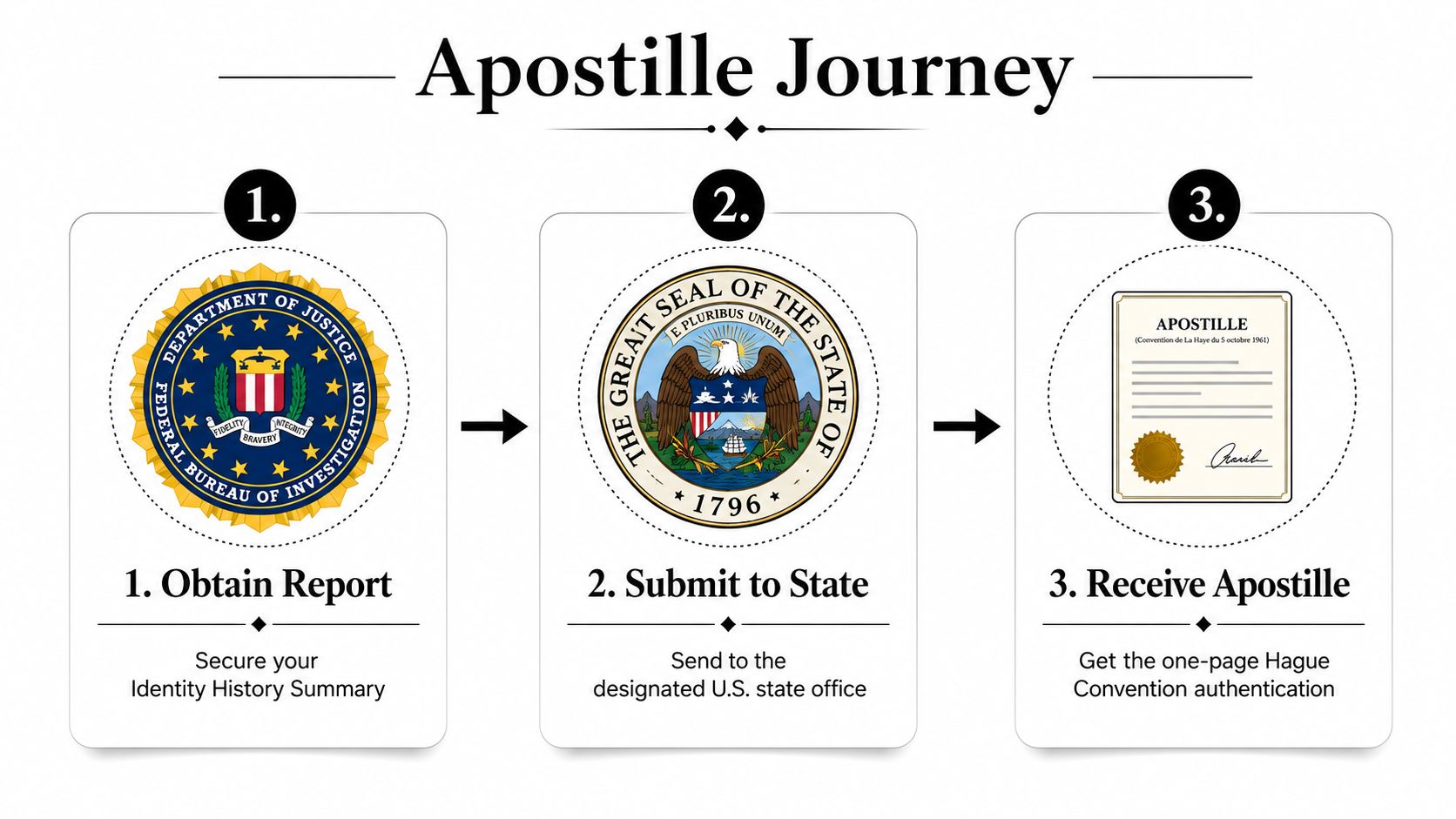
Apostille, legalization, and state authentication
An apostille is intended for documents used between countries participating in the Hague Convention. Legalization generally requires additional authentication and consular or embassy handling when the destination does not accept apostilles. State authentication is separate because it validates a state-level signature or document.
Before paying for shipping or a local service, confirm whether the recipient requires an apostille, embassy legalization, translation, or a report issued within a particular period. If the goal is personal screening rather than an immigration packet, you can also check a partner’s online footprint with PartnerScanX as a separate research step.
Choosing Your Route to the FBI Identity History Summary
Your apostille route begins with the report format. The U.S. Department of State needs an official FBI Identity History Summary in a form that can be authenticated. The fastest option isn’t automatically the safest if the provider gives you a file that gets modified, rescanned, or printed incorrectly.
Direct FBI submission
A direct request sends your fingerprints and application to the FBI. Applicants may use an approved fingerprint-card process or an electronic submission path where available. The FBI Identity History Summary fee is commonly cited at $18, and direct FBI submission is generally the lower-cost choice for applicants who have enough time, as reflected in this federal apostille process guide.
The trade-off is turnaround and logistics. A mailed report may arrive later than an electronically returned report, and you’ll have to protect the original paper document or print the official electronic file exactly as issued. Direct submission works well when the foreign authority’s deadline is comfortably ahead and you want to minimize service fees.
FBI-approved channeler
An FBI-approved channeler can coordinate fingerprint capture, transmit the request, and return the Identity History Summary through its own workflow. That convenience may shorten the report stage, but the channeler’s service fee is separate from the FBI fee. Ask exactly what you’ll receive, whether the result is an electronically signed PDF, and whether the provider gives instructions for printing it for federal apostille submission.
The critical issue is integrity. An electronically signed FBI report must be printed without editing, rescanning, re-saving, or adding marks. A forwarded or altered PDF can lose the signature information the authentication office needs to verify.
For a practical overview of requesting the report and preparing the next stage, review this resource on how to get your FBI background check.
A simple route decision
| Your situation | Sensible starting route | Main trade-off |
|---|---|---|
| You have a flexible deadline | Direct FBI request | Lower service cost, more responsibility |
| You need the report quickly | FBI-approved channeler | Faster handling, added provider fee |
| You already have an official electronic report | Print exactly as issued | Convenient, but sensitive to file changes |
| You’re uncertain about eligibility | Get the foreign recipient’s instructions first | Prevents ordering the wrong document |
Don’t choose based only on a promised report speed. Confirm that the final report will be accepted for the apostille packet and that you can preserve its original form.
Getting Fingerprinted the Right Way
Fingerprint quality determines whether the FBI can produce the report at all. A weak set of impressions can create a delay before the apostille stage begins, so treat the card or electronic capture as a document-production task, not a quick formality.
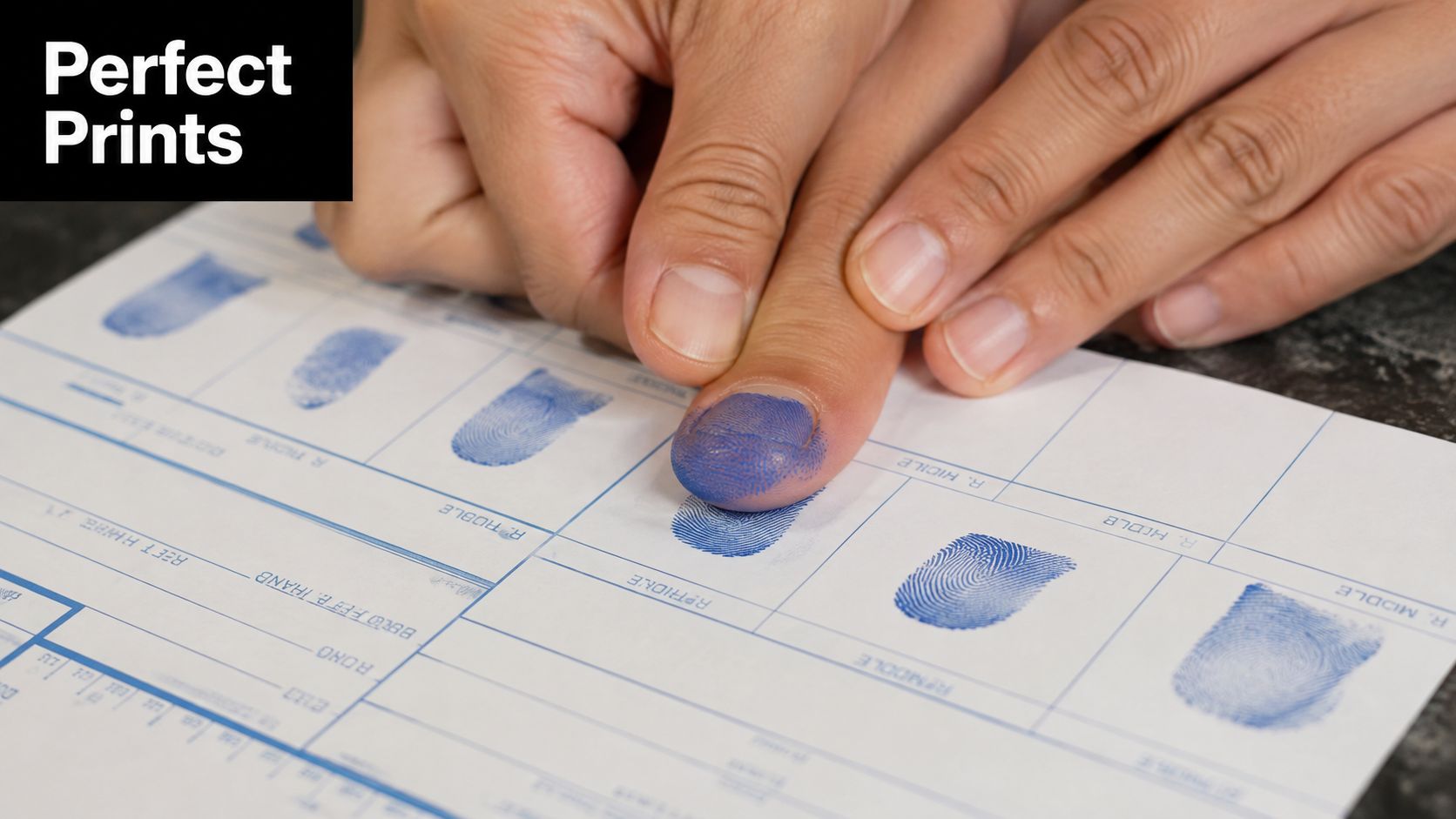
For a paper submission, use the official FD-258 fingerprint card when that’s the card required by your selected FBI route. Use approved blue or red ink, complete every required rolled-impression box, and avoid smudges, excessive ink, broken impressions, or folded cards. Confirm that the current FBI-request information and identifying codes are entered where required. If you’re preparing your own cards, review the live scan and FBI FD-258 fingerprint card service information before the appointment.
What to bring to a Sugar Land appointment
A livescan appointment can reduce the handling problems associated with rolled ink, especially when an approved vendor can transmit the capture through the correct channeler. It doesn’t remove the need to verify the final report format, but it can give you cleaner initial impressions and a more controlled submission.
Bring:
- Valid photo identification: Use the identification requested by the fingerprinting provider.
- Fingerprint cards: Bring two cards if you’re completing a self-rolled paper submission.
- Payment method: Confirm whether the provider accepts your preferred payment before arriving.
- Destination instructions: Have the foreign authority’s document requirements available.
- Return materials: Bring a pre-addressed envelope if your chosen channeler or vendor requires one for document delivery.
Sugar Land and Houston-area applicants who want hands-on help can combine fingerprint capture with document preparation at a local service counter. If someone else will submit the federal apostille packet for you, ask in advance whether a notarized authorization is needed for that provider’s workflow. Notarization of the FBI Identity History Summary itself generally isn’t the standard requirement for the Department of State apostille route, so don’t add it without a specific instruction from the recipient or processing authority.
Before sealing a paper envelope, hold the card up to a light. Check that each impression has continuous ridge detail, that no box is accidentally blank, and that the card hasn’t been folded or damaged.
The following visual provides a useful reference for the fingerprinting stage:
Preparing the Apostille Submission Package
Your FBI Identity History Summary is ready, and the receiving authority expects an apostille. At this stage, small handling mistakes can force a new submission. Keep the report in its official, unaltered form. Do not staple it, punch holes in it, write on it, apply correction fluid, or attach documents directly unless the receiving authority or processing office specifically instructs you to do so.
Assemble the federal packet
Prepare the original FBI report, completed Form DS-4194, the required payment, and a return delivery method. The Department of State accepts FBI reports for apostille processing, and the request must identify the country where the document will be used, as explained in the State Department’s official instructions.
Complete DS-4194 with consistent information:
- Applicant information: Match the report and provide contact details for the person requesting authentication.
- Destination country: Spell the country correctly and identify the intended place of use.
- Document purpose: State the use plainly, such as immigration, employment, residence, or another official filing.
- Signature and contact details: Sign in the required location and provide a working phone number or email address.
The destination field affects how the request is recorded for international use. A blank or inconsistent entry can lead to questions and delay intake.
Payment and return delivery
The commonly cited Department of State fee is $20 per document. Verify the current amount, payee, and accepted payment method using the federal apostille guidance for FBI reports before mailing. Do not send cash.
Add a prepaid, trackable return envelope or courier label that meets the office’s current requirements. Tracking gives you a record after the apostille is completed. For an international return, confirm that the carrier accepts the destination address and that the label will remain usable during processing.
Check the federal submission address and procedures immediately before dispatch. If you are in Sugar Land, a walk-in document service can prepare labels, scan the packet, or coordinate a courier handoff. That convenience costs more than handling the mailing yourself, but it can reduce packaging and delivery errors. Ask the provider exactly which tasks it performs, especially if it will submit documents on your behalf.
Mail versus in-person handling
Mail avoids a trip but gives you less control over intake and return timing. In-person submission can reduce mailing variables. A courier or apostille specialist can manage the Washington, DC handoff when traveling from Sugar Land is impractical.
Practical rule: Keep a complete scan or photocopy of the packet for your records. Never alter the original FBI report to make that copy.
Realistic Timelines and Total Costs
A Sugar Land applicant can control some steps, but not every delay. The FBI report, apostille submission, fingerprinting, shipping, and optional service handling each add time or cost. The federal fees are usually the easiest part to estimate. Delivery and processing stages create the larger planning risk.
The FBI Identity History Summary fee is commonly cited at $18, and the Department of State apostille fee at $20 per document, according to published FBI apostille cost guidance. Direct FBI processing is commonly described as about 7 to 10 business days after receipt for the report itself. Department of State mail processing is often reported at roughly 6 to 8 weeks. Confirm current fees and processing expectations before submitting.
| Route | What it involves | Timing trade-off | Cost pattern |
|---|---|---|---|
| Direct FBI request plus federal mail | Obtain the report yourself, then mail the apostille packet | Lowest control over the slowest stage | Federal fees plus fingerprinting and shipping |
| Channeler plus federal mail | Pay for convenience at the report stage, then use the federal apostille route | Faster report handling, but apostille mailing can remain the long pole | Federal fees, channeler charge, fingerprinting, and delivery |
| Report plus expedited or in-person handling | Use a faster handoff for the apostille stage where available | Can shorten the authentication leg, but requires eligibility, travel, or a service provider | Federal fees plus expedited, courier, or professional charges |
Mail-in federal apostille services are commonly estimated at 5 to 12 weeks. Some walk-in or expedited reports describe the apostille stage as roughly 7 to 10 business days, as summarized by Apostille Corp’s FBI background-check guidance. These figures are route benchmarks, not guarantees.
Match the route to the deadline
An open-ended deadline usually favors direct submission and self-managed mailing. If obtaining the report is urgent, an FBI-approved channeler may reduce that stage’s waiting time. If the report is already complete, the Department of State handoff becomes the decision point.
In Sugar Land, a walk-in shop can handle fingerprinting, prepare a courier label, scan the packet, or coordinate delivery. DIY mailing costs less and keeps each document in your hands. Professional handling costs more, but it can reduce packaging, courier, and return-shipping mistakes. Ask whether the provider is only preparing the packet or submitting and tracking it as well.
The cheapest route is cheaper only when the packet is accepted the first time. A preventable rejection can require new shipping and a complete restart.
Mistakes That Delay or Reject FBI Apostille Submissions
A packet can look complete and still fail intake. In practice, the common causes are an altered FBI report, the wrong federal or state authority, incomplete DS-4194 information, or fingerprints that produce a problem before apostille processing even begins.
Protect the report’s original form
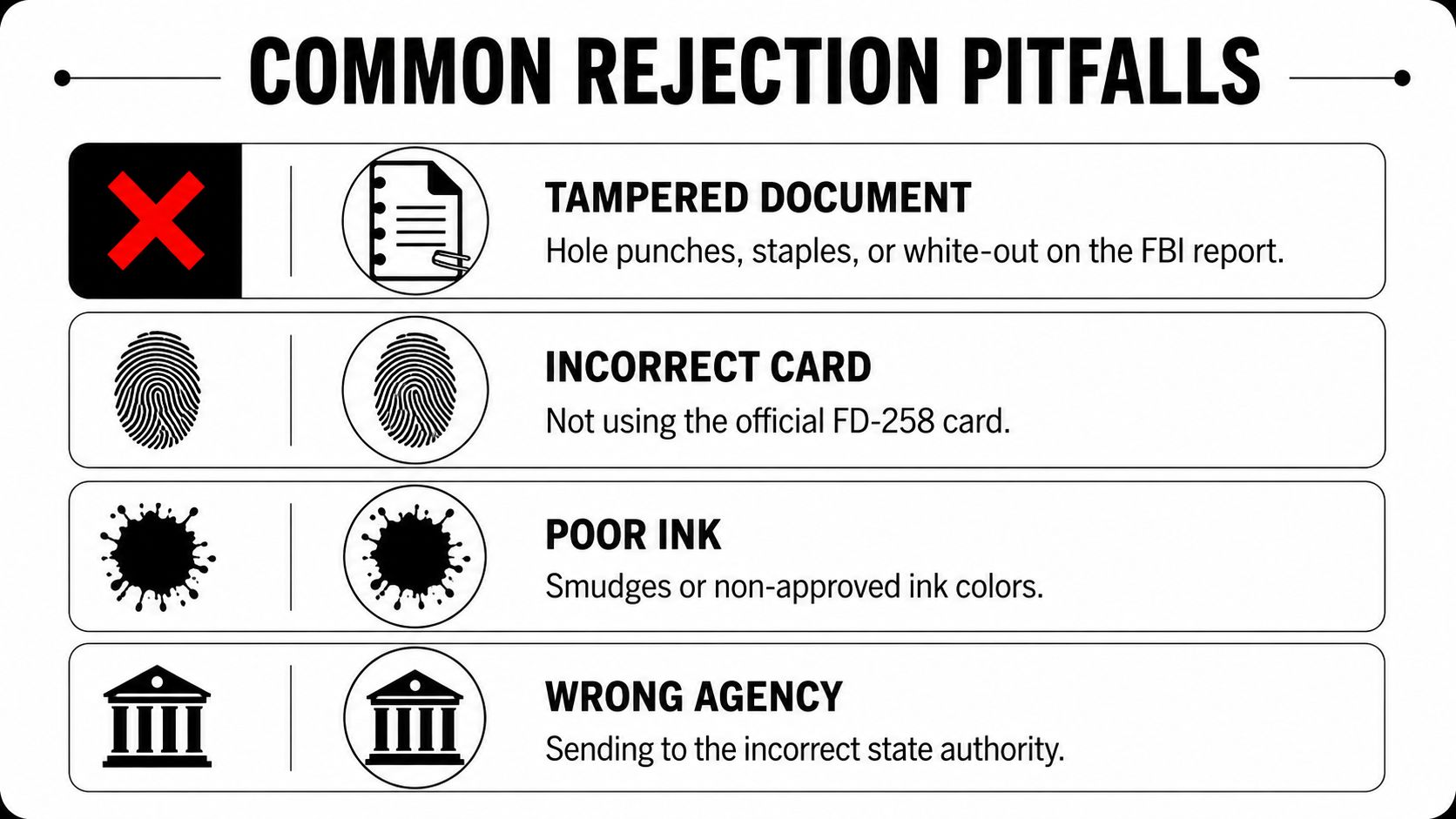
Handle the FBI Identity History Summary as a controlled document. Hole punches, staples, white-out, handwritten notes, added markings, or other changes can make it unacceptable. For an electronic report, print the official digitally signed file exactly as issued. Do not edit, re-save, scan, or combine it with unrelated pages.
The apostille office authenticates the federal signature and document origin. It does not repair a modified or damaged FBI report. If a Sugar Land walk-in shop scans or prepares your packet, ask the staff to preserve the original file and paper report rather than reformatting either one.
Route the packet and form correctly
Send the report to the U.S. Department of State Office of Authentications, not a state Secretary of State, county clerk, or local authentication office. The Department of State’s criminal-record instructions explain the federal route and require the country of use.
Before dispatch, check these failure points:
- Wrong agency: A state office cannot apostille an FBI federal record.
- Missing destination country: DS-4194 must name the country where the document will be used.
- Incomplete signature or payment: An unsigned form or incorrect payment can stop intake.
- Unusable return method: Use a trackable return option that meets current requirements.
- Poor fingerprints: Smudged or incomplete FD-258 impressions can prevent the FBI report from being issued correctly.
Check the current address and submission instructions immediately before mailing. A Sugar Land provider can print labels, arrange courier pickup, and check packet assembly, but you remain responsible for confirming the destination, payment, and return method. An outdated address or return-label assumption can delay an otherwise valid report.
Your Final Pre-Submission Checklist
Before sealing the envelope, confirm each item below. A single unresolved issue can send the packet back or create a preventable delay.
Verify the report
Confirm that the FBI Identity History Summary is the official original or an authorized electronic report printed exactly as issued. It must be unaltered, with no staples, tape, holes, white-out, handwritten corrections, or added markings. If the report does not meet those conditions, obtain a compliant copy before preparing the apostille request.
Verify Form DS-4194
Check the destination country against the foreign authority’s written instructions, visa checklist, employer request, or immigration correspondence. Then review the applicant’s details, stated purpose, contact information, and signature. The country name must be accurate, because the apostille is intended for use in that jurisdiction.
Verify payment and return delivery
Include the current Department of State fee, stated in the applicable instructions as $20 per-document, using the required payment method. Confirm the payee and accepted payment format immediately before mailing rather than relying on an older checklist or prior submission.
Include a prepaid, trackable return envelope or a compliant courier label. The return method should match current federal instructions and give you usable tracking from dispatch through delivery.
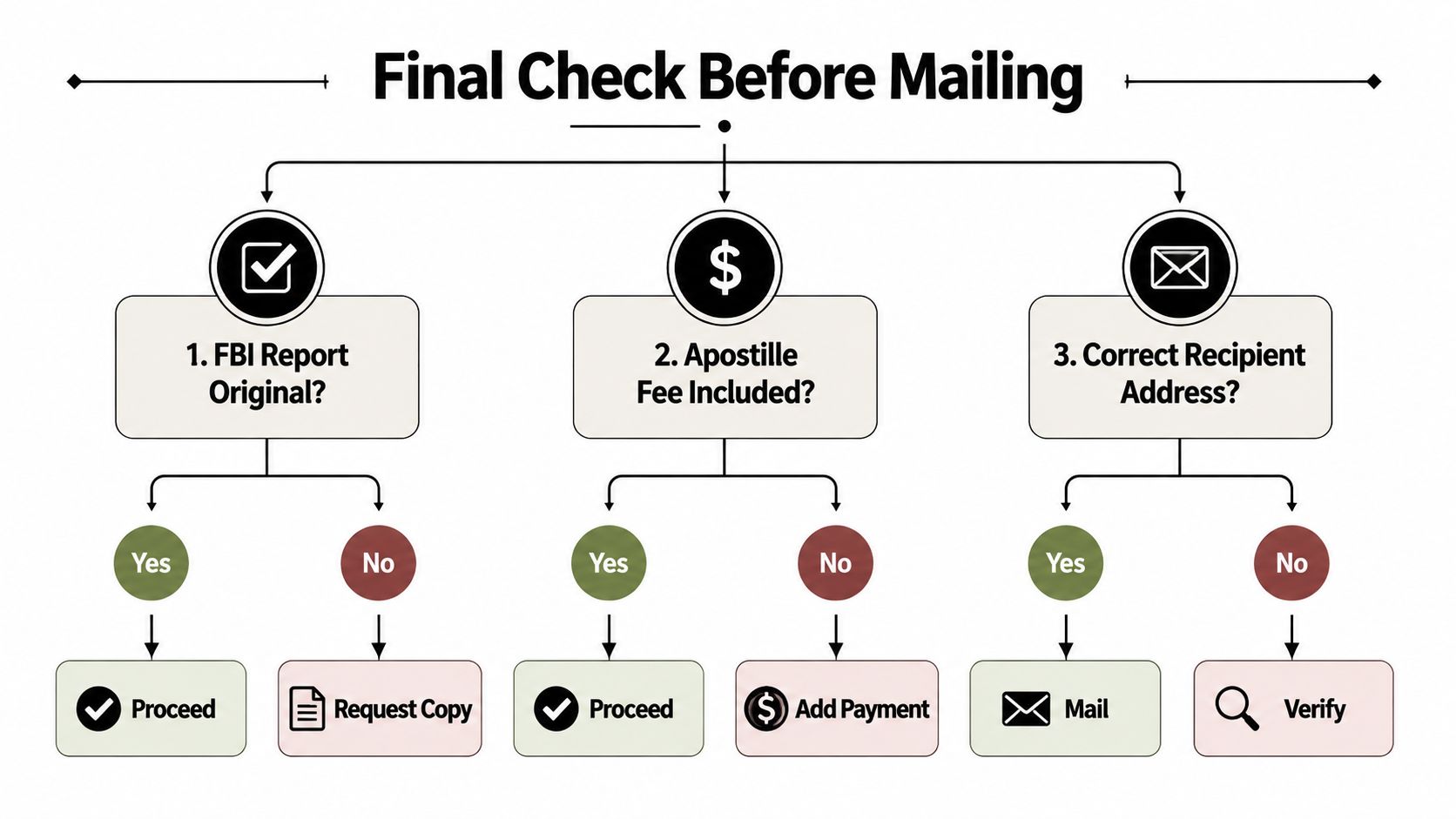
Choose the handling route based on your deadline and tolerance for service expense. Mail gives you direct control but may require a longer federal processing window. A channeler can simplify and speed report delivery, while the apostille stage still follows its own process. Walk-in or courier handling can make sense after the report is ready, especially when timing matters more than minimizing local service costs.
Sugar Land applicants can separate the work: complete the federal submission themselves, then hand off fingerprinting, printing, packing, tracking, or courier drop-off to a local provider. Business Mail Boutique LLC offers those services and can help assemble FBI apostille-related materials. Visit Business Mail Boutique LLC to review the report format and decide which tasks to manage directly.

Related posts

Custom Memorial Glasses Engraved in Three Hours in Sugar Land
When a customer needed eight personalized glasses for a memorial, Business Mail Boutique completed the engraving or...

Custom Martini Glass Engraving in Sugar Land, TX
Custom Logo Engraving on Martini Glasses in Sugar Land, Texas.
Business Mail Boutique recently completed a beautiful custom engravin...

Custom Engraved Wine Glasses for a Golf Club Event in Sugar Land, TX
Custom Engraved Wine Glasses for a Golf Club Event in Sugar Land.
Custom wine glass engraving in Sugar Land, TX at Business Mail Bouti...