
- Print Business Cards in Sugar Land – Same Day Service
- Copying Services
- Document Printing, Finishing & Lamination in Sugar Land
- Flyers
- Print Banner in Sugar Land | Same-Day Banner Printing Near Me
- Graphic Design
- Photo Printing
- Postcard Printing
- Document Printing
- EDDM Full Service Postcards
- FotoZoomer Large Format Printing


Certificate of Naturalization Apostille
Learn how to get a certificate of naturalization apostille with this step-by-step guide. Covers certified copies, federal authentication, fees, and timelines.
Businessmailboutique
11645 S. Hwy 6
Sugar land, Texas 77498 United States (US)
Email: info@businessmailboutique.com
Route
You’re a naturalized U.S. citizen in Texas, and a foreign government has just asked for an apostilled Certificate of Naturalization. Maybe you’re buying property abroad, supporting a spousal visa, or filing a pension claim. You have the certificate in hand, but the instructions are unclear, and the first office you find online is your state Secretary of State.
That’s where many applications go wrong. A Certificate of Naturalization is a federal document, so a state apostille office can’t authenticate it. The correct route runs through the U.S. Department of State, and the safest preparation depends on the condition of your certificate, the destination country, and whether the receiving authority wants the original or a certified copy.
Table of Contents
- What a Naturalization Certificate Apostille Does
- Understanding the Federal Versus State Apostille Rule
- Preparing Your Documents Before Submission
- Submitting the Request to the U.S. Department of State
- Common Mistakes That Delay or Reject Your Application
- Apostille Versus Embassy Legalization for Non-Hague Countries
- Your Action Plan and Where to Get Local Help
What a Naturalization Certificate Apostille Does
A Certificate of Naturalization may be accepted abroad only after the receiving authority can verify its official origin. An apostille provides that verification under the 1961 Hague Convention. It confirms the signature, seal, and authority connected to the document, allowing a participating foreign country to process it through a recognized authentication system. The U.S. Department of State describes apostilles as the route for documents sent to countries covered by the Hague Convention, which currently includes 124+ member jurisdictions worldwide (U.S. Department of State apostille requirements).
The apostille has a limited purpose. It does not re-adjudicate your citizenship, review your immigration history, replace the certificate, or independently confirm every fact printed on it. Instead, it validates the signature, seal, and official authority so the foreign government or institution can accept the certificate under its authentication rules.
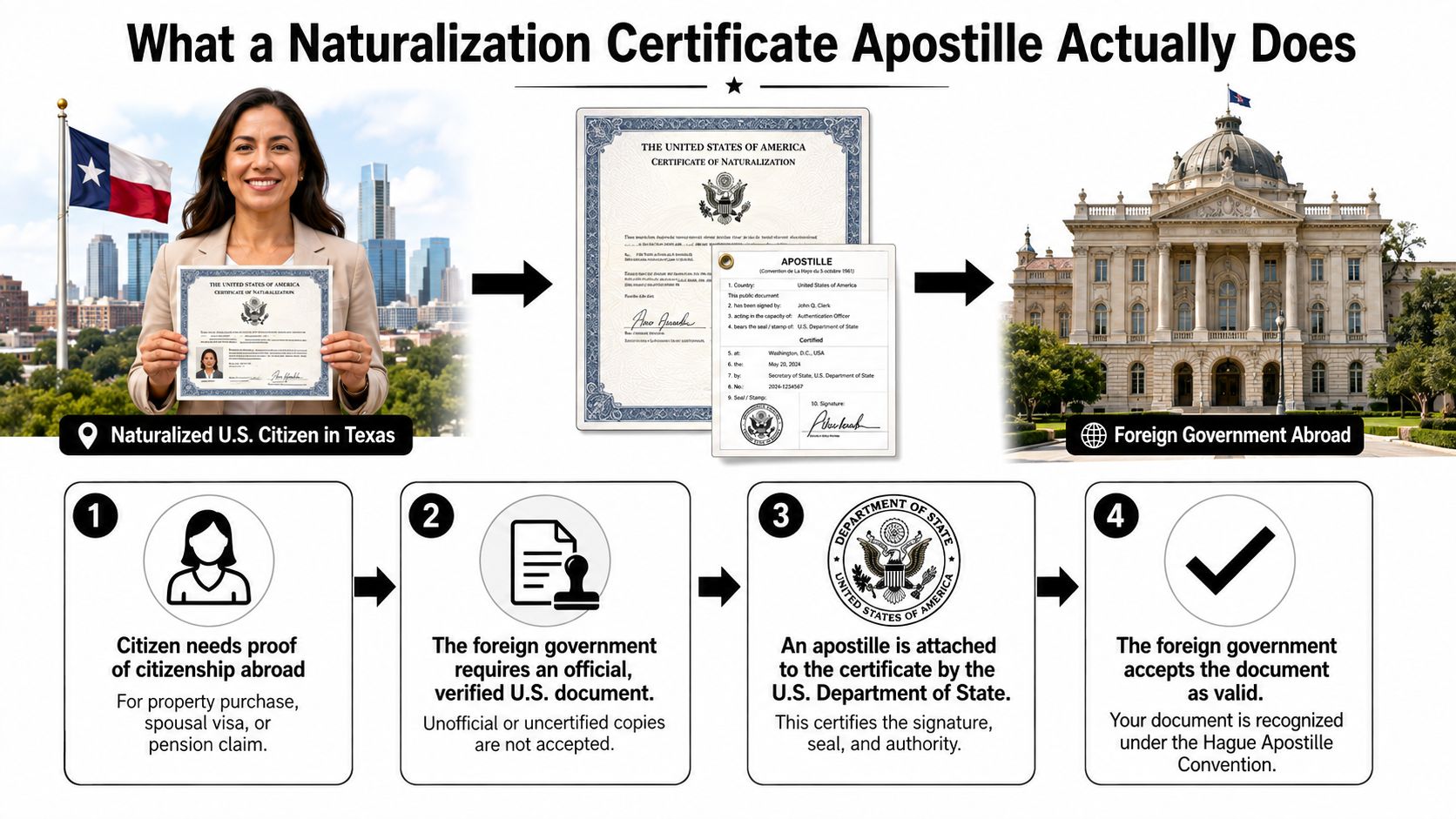
The usual process is straightforward:
- Confirm what the foreign authority requires.
- Prepare the correct naturalization document.
- Submit it to the federal authentication authority.
- Receive the apostille attached to, or issued with, the document.
- Deliver the completed package to the foreign government or institution.
Practical rule: An apostille authenticates the document’s official signature and seal. It does not change the legal meaning of the Certificate of Naturalization.
For a Hague Convention destination, federal apostille processing is generally the final authentication step. A country outside that framework usually requires embassy or consulate legalization afterward. Plan for a four-to-eight-week overall window, including document preparation, shipping, and handling. Use expedited shipping where available, and do not schedule an overseas filing on the assumption that the certificate will return immediately.
Understanding the Federal Versus State Apostille Rule
The office that issued your document determines the apostille route. A USCIS-issued Certificate of Naturalization is a federal record, so request its apostille through the federal authentication system, handled by the U.S. Department of State Office of Authentications. A state apostille office is not the correct starting point for this document.
State Secretaries of State authenticate records created under state authority, including state-issued vital records and documents notarized by a notary commissioned in that state. A county clerk may provide supporting verification in some state-document procedures, but neither a county clerk nor a state office can turn a federal USCIS certificate into a state document eligible for a state apostille.
Why the wrong office rejects the request
The location of your naturalization ceremony does not determine the authentication route. Your current residence does not determine it either. A certificate presented at a ceremony in Houston, Dallas, Austin, or elsewhere in Texas still follows the federal channel.
Sending the certificate to the Texas Secretary of State in Austin creates an avoidable detour. That office cannot authenticate the certificate as a Texas public document, so it may return your package or direct you to the federal authority. You then face another submission, additional shipping risk, and lost time.
Use the U.S. Department of State Office of Authentications for the request. Before you send the document, confirm the current form, mailing address, payment method, and delivery instructions on the State Department’s official page, including its apostille requirements. Procedures change, and an outdated blog post cannot replace the instructions from the agency processing your certificate.
If you need a practical shortcut, arrange a notarized certified copy only when the receiving authority and authentication instructions accept that format. Do not send a photocopy to a state office hoping notarization will make it a state record. The federal route still controls.
Preparing Your Documents Before Submission
Preparation is where you prevent most problems. Don’t put the certificate in an envelope until you’ve checked the document itself, selected the correct document format, and confirmed the destination country’s authentication system.
Check the certificate before you ship it
Review the Certificate of Naturalization in good light. The name, certificate details, identifying information, date, and USCIS seal should be readable. If the document is torn, faded, water-damaged, or otherwise compromised, stop and address that problem before requesting authentication.
A lost or damaged certificate generally requires a USCIS replacement request through Form N-565. The plan notes for this process identify a $555 filing fee and biometrics, with an estimated replacement timeline of roughly six months. Those figures and timing can change, so confirm the current requirements and fee directly with USCIS before filing. Don’t send a damaged document to the State Department and hope the apostille will cure the problem. It won’t.
Choose the document you’ll authenticate
The safest approach is to avoid sending the irreplaceable original unless the receiving authority specifically requires it. Practitioners commonly use a USCIS-certified true copy or another federally certified replacement document, because the apostille validates the signature and seal on the certifying document, not an ordinary photocopy (guidance on apostilling a Certificate of Naturalization).
A regular notarized photocopy isn’t automatically equivalent to a USCIS-certified true copy. Ask the foreign authority exactly what it accepts before choosing the document. If you need a notary for related paperwork, identity verification, or a document that can legally be notarized, review the available notary stamp and seal services, but don’t assume a notary can certify the federal citizenship record itself.
Confirm the country’s status
Check whether the destination country participates in the Hague Apostille Convention using the current State Department country information. If it’s a participating country, the apostille path may be enough. If it isn’t, plan for additional embassy or consulate legalization after federal authentication.
Write the complete destination country on the request form. Don’t rely on an abbreviation, an informal regional name, or a vague statement such as “for international use.” The receiving country determines the authentication path, so the country field needs to be precise.
Submitting the Request to the U.S. Department of State
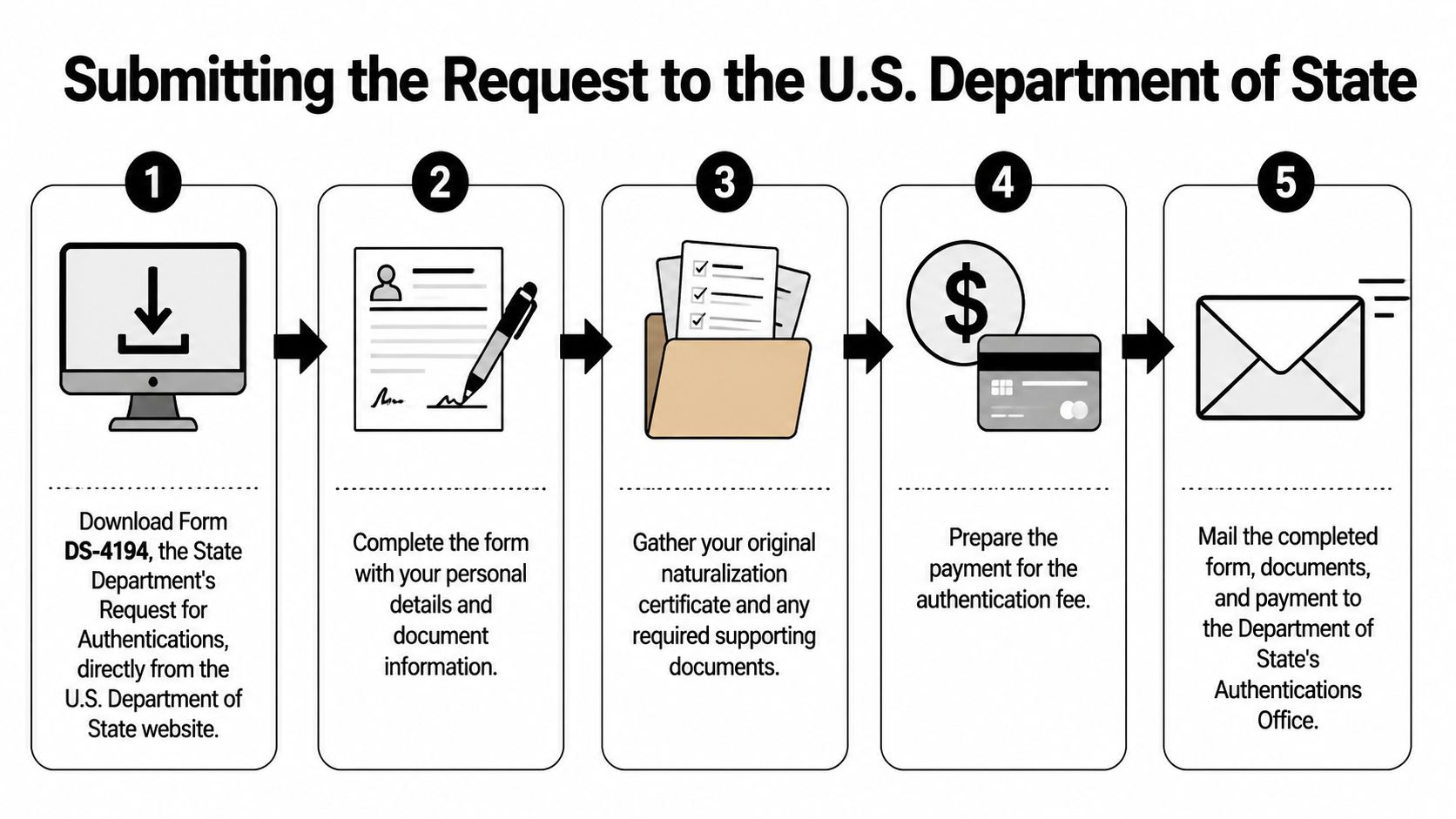
Once your document is ready, submit it through the federal process. Download Form DS-4194, the Request for Authentications, from the U.S. Department of State. Do not rely on a saved copy from an unofficial website.
Enter your contact information, document details, and complete destination country. Sign and date the form. The handling fee is $20 per document. Use the payment method and payee shown on the current form. Credit-card payments require the department’s separate authorization form. For a check or money order, write the payee exactly as instructed.
Build the mailing package
Place the document in a flat, protective envelope. Include the completed DS-4194, payment, and a prepaid return envelope or return shipping label with tracking. The return method must let the department send the authenticated document back without requesting more instructions.
Choose a delivery service that provides tracking. USPS Priority Mail may be sufficient, while UPS or FedEx can provide direct commercial tracking and package handling. Confirm the current mailing address and intake instructions before shipping, since federal offices can change their procedures.
According to current guidance, the Office of Authentications is located at 600 19th Street NW, Washington, DC 20522. Standard processing is described as four to six weeks, with an expedited option of approximately five business days for an additional $60. Verify the current instructions before mailing because processing options and intake arrangements can change.
For help organizing the outbound package, return label, and tracking records, review this certified mail services guide. Keep the receipt and tracking number until the completed document is back in your possession.
The completed apostille normally appears as a certificate attached to, or issued with, the authenticated document. Keep the attachment intact. Do not remove staples, separate pages, or rearrange the certificate before presenting the document overseas.
Common Mistakes That Delay or Reject Your Application
Most failures aren’t mysterious. They come from sending the right document through the wrong channel, omitting a basic form requirement, or damaging the document while preparing the package.
- Using a state apostille office: State offices don’t have jurisdiction over USCIS records. Send the request through the U.S. Department of State Office of Authentications.
- Submitting a damaged certificate: Cracked, faded, or unreadable seals can prevent authentication. Apply for a USCIS replacement before requesting an apostille.
- Forgetting the signature: An unsigned DS-4194 can be returned without action. Sign and date it before sealing the package.
- Using an incomplete destination: Write the destination country’s full name. Don’t use an abbreviation or leave the field vague.
- Skipping the return envelope: Include a prepaid, trackable return method. Otherwise, the department may be unable to send the completed document back promptly.
- Sending the wrong copy: An ordinary photocopy may not satisfy federal authentication requirements. Use the document format accepted by the State Department and the foreign authority.
- Bending or fastening the certificate: Don’t staple or paper-clip the certificate to the request form. Keep it loose, flat, and protected.
Final envelope checklist
Before you seal the package, verify that you have:
- The appropriate original or certified document.
- A completed and signed DS-4194.
- The correct payment.
- The complete destination country.
- A prepaid return envelope or label with tracking.
- A copy of the entire package for your records.
- A separate note with the tracking numbers and submission date.
Before shipping: Photograph the certificate and the assembled package for your records, but never substitute a photograph for the document requested by the authentication office.
Apostille Versus Embassy Legalization for Non-Hague Countries
The destination country determines whether a certificate of naturalization needs a federal apostille or a longer legalization process. The 1961 Hague Convention established the simplified apostille system for participating countries. As noted earlier, the U.S. Department of State handles federal authentication for documents intended for those jurisdictions.
For a Hague destination, the federal apostille is usually the final U.S. authentication step. The receiving authority may still require a translation, specific format, or a document issued within a certain period. Confirm those requirements before mailing anything.
A non-Hague destination generally requires another stage. After federal authentication, submit the document to that country’s embassy or consulate in the United States for legalization. That office verifies the federal authentication for its jurisdiction. Its fees, forms, appointment procedures, translation standards, and delivery instructions vary, so an apostille alone may be rejected.
| Destination status | Usual path | What to confirm |
|---|---|---|
| Hague Convention country | Federal apostille | Translation, format, and copy requirements |
| Non-Hague country | Federal authentication, then embassy or consulate legalization | Consular fee, appointment, translation, and delivery rules |
Check the destination’s current requirements before preparing the package. Choosing the wrong route can leave you with an unusable certification and another submission to complete. Translation remains separate from authentication. If required, use a translator whose certification the foreign authority accepts.
For a local shortcut, have a business center prepare a notarized certified copy of related documents, print forms, and arrange expedited shipping. That support does not replace federal authentication, but it can reduce avoidable trips and packaging mistakes.
Your Action Plan and Where to Get Local Help
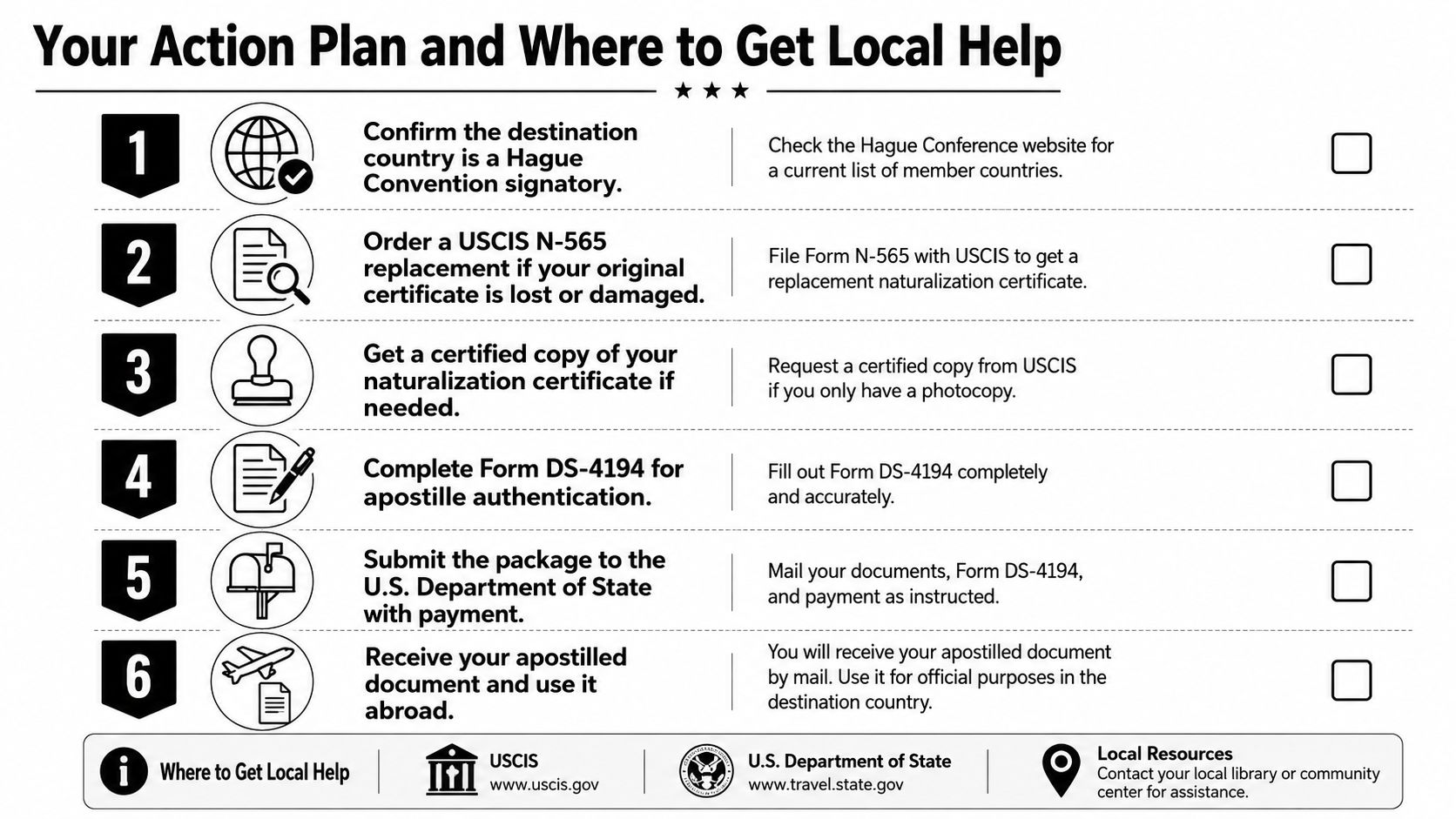
Use this checklist, in order:
- Confirm the destination: Determine whether the country uses the Hague apostille system.
- Inspect the certificate: If it’s lost or damaged, address the USCIS replacement process before authentication.
- Select the document format: Use the original only when appropriate, or obtain the required certified copy through the proper authority.
- Complete DS-4194: Enter the destination country accurately and sign the form.
- Prepare payment and shipping: Include the required fee, outbound package, and prepaid tracked return method.
- Submit federally: Send the package to the U.S. Department of State Office of Authentications, not a state office.
The practical bottlenecks are usually local. You may need a clear copy, a notary for related documents, a flat protective envelope, a prepaid return label, and reliable round-trip shipping. A business center can assemble those pieces in one visit, which is useful when you’re working during a lunch break or trying to avoid separate trips for printing, packing, notarization, and carrier drop-off.
In Sugar Land and the Greater Houston area, notary services on Highway 6 can support the document-preparation side of the process. Business Mail Boutique LLC offers notary services, printing, professional packing, tracking, and UPS or FedEx shipping, so clients can arrange the practical shipment steps in one location. If your deadline is tight, ask about overnight outbound shipping, a tracked return label, and whether expedited federal handling is currently available.
Keep the certificate apostille attached when it returns. The authenticated certificate will arrive separately from any overseas filing or travel arrangements, so wait until it’s safely back in your possession before finalizing the presentation schedule.
If you’re in Sugar Land or the Greater Houston area, visit Business Mail Boutique LLC for document printing, notary support, professional packing, tracking, and UPS or FedEx drop-off related to your certificate of naturalization apostille. Bring the receiving authority’s instructions so the team can help you prepare the package and return shipment correctly.

Related posts

Perfume Bottle Engraving Sugar Land | Same-Day Service
Same-Day Perfume Bottle Engraving in Sugar Land.
Custom Perfume Bottle Engraving in Sugar Land — Same-Day Personalized Gifts
Make a...

Leather Portfolio Engraving in Sugar Land | Custom Initials
Custom Leather Portfolio Engraving in Sugar Land: Personalized Initials for Corporate Gifts
A professional portfolio is something ...

Corporate Watch Engraving in Sugar Land | Business Mail Boutique
Custom Watch Engraving in Sugar Land: Meaningful Gifts for Employee Appreciation
A personalized watch can turn a company’s thank-you i...