- Print Business Cards in Sugar Land – Same Day Service
- Copying Services
- Document Printing, Finishing & Lamination in Sugar Land
- Flyers
- Print Shop in Sugar Land Banners & Posters Printing
- Graphic Design
- Photo Printing
- Postcard Printing
- Document Printing
- EDDM Full Service Postcards
- FotoZoomer Large Format Printing


You’re probably ordering custom hats with logo for one of three reasons. An event is coming up fast, your team needs to look more put-together, or you want something people will keep wearing after they leave your booth, storefront, or jobsite.
That’s where hats beat a lot of other promo items. A good hat gets used in real life. It goes to the grocery store, school pickup, weekend errands, and outdoor jobs. A bad hat, or a rushed order with the wrong logo treatment, ends up in a box.
If this is your first hat order, the biggest mistake is thinking it’s just a matter of uploading a logo and picking a color. Success comes from matching the right hat, the right decoration method, and the right artwork setup to the way your business functions. That’s also why local help matters more than most owners expect, especially when deadlines are tight and you want to see what you’re buying before the full run is produced.
Table of Contents
- Why Custom Logo Hats Are Your Secret Marketing Weapon
- Choosing the Right Hat Style and Material for Your Brand
- Decoding Your Decoration Options Embroidery vs Printing
- Preparing Your Artwork File for a Flawless Finish
- Navigating the Ordering Process with a Local Print Center
- Your Custom Hat Project Checklist and Final Tips
Why Custom Logo Hats Are Your Secret Marketing Weapon
A small business owner gets ready for a weekend event and realizes the table setup is fine, the banner is fine, but the team still looks mismatched. Two people wear plain black caps, one has no hat at all, and the owner is hoping foot traffic remembers the brand name after a quick conversation. That’s usually the moment custom hats move from “nice to have” to “we should’ve done this sooner.”
Hats work because they don’t feel like throwaway marketing. They feel useful. If the fit is good and the logo treatment is clean, people keep wearing them long after the event is over.
There’s a bigger market signal behind that. The global headwear market was valued at approximately USD 28.5 billion in 2024, and promotional products like embroidered logo hats achieve 50% daily usage rates among recipients, according to Gelato’s custom hat market overview. For a small business, that matters more than vanity metrics. Daily use means repeated visibility.
Why hats outperform many one-time promo items
A flyer gets read once, if it gets read at all. A hat can keep working for months.
That doesn’t mean every custom hat order is automatically smart. The hat still has to be wearable. If the crown is too stiff for your audience, the logo is too small, or the color contrast disappears outdoors, you’ve paid for branded inventory instead of usable marketing.
Practical rule: Order a hat people would wear even if your logo weren’t on it. Branding works best when the base product already feels right.
Here’s where hats tend to do well for small businesses:
- Team visibility: Staff at markets, pop-ups, open houses, and service calls look coordinated without feeling overdressed.
- Customer retention: A hat given to a loyal customer has a longer life than most paper handouts.
- Community presence: Local brands benefit when people wear them in the same neighborhoods where they buy.
What actually makes a hat order successful
The best custom hats with logo usually share three traits:
| What works | Why it works |
|---|---|
| Clean, readable logo | People can recognize it at a glance |
| Comfortable hat style | Recipients actually keep wearing it |
| Decoration matched to design | The logo looks intentional, not forced |
A lot of owners focus only on price per piece. That’s understandable, but it’s usually the wrong first question. The better question is, “Will my team or customers want to wear this next week?” If the answer is yes, the order has real marketing value. If the answer is maybe, something in the style, artwork, or decoration choice still needs work.
Choosing the Right Hat Style and Material for Your Brand
The blank hat matters just as much as the logo on it. A polished design on the wrong cap still feels off. When owners say they want custom hats with logo, they’re often talking about decoration. But the first decision should be the hat itself.
Start with how the hat will be used
Think about the person wearing it, not just the logo.
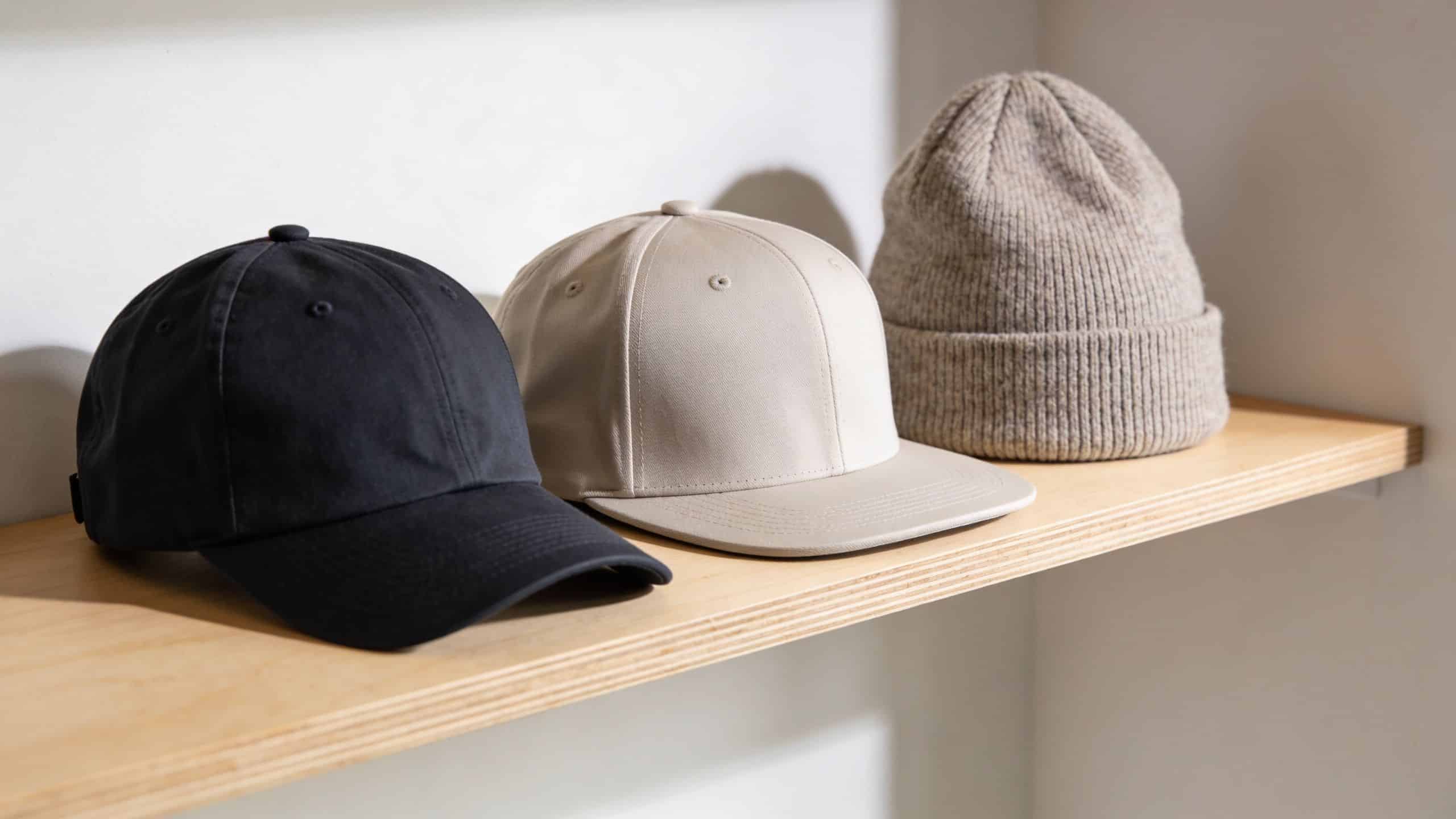
A structured baseball cap usually fits businesses that want a neater, more professional look. Home service companies, real estate teams, medical support staff, and trade businesses often do well with this style because it holds its shape and presents the logo clearly on the front.
An unstructured or “dad hat” feels more casual and approachable. Coffee shops, boutiques, makers, creative businesses, and lifestyle brands often prefer it because it looks less uniform-like and more like retail merchandise.
Trucker hats solve a different problem. They breathe well, which makes them a strong pick for outdoor events, food vendors, mobile businesses, and warm-weather wear. They also tend to feel more casual, which can be an advantage or a drawback depending on the brand.
Beanies are the seasonal option. They make sense for winter promotions, outdoor crews in cooler months, and businesses that want a softer, more understated branded piece.
A quick way to decide:
- Structured cap: Best when you want clean lines and a more official look
- Unstructured cap: Better when your brand is relaxed, creative, or retail-driven
- Trucker hat: Useful for hot weather, outdoor wear, and casual promotions
- Beanie: Strong for seasonal staff gear and cold-weather giveaways
If your team wouldn’t all choose the same fit, offer two approved styles with the same logo treatment instead of forcing one hat on everyone.
Material changes the feel and the message
Material affects comfort, appearance, and how the decoration behaves.
Cotton twill is the dependable standard. It works for many brands, feels familiar, and handles embroidery well. Performance fabrics are better when people will wear the hat in heat, on job sites, or during active use. Wool blends look more premium, but they aren’t always the first choice for everyday outdoor wear in warmer climates.
Some businesses overlook this and buy strictly by color. That’s where disappointment starts. The hat looked good online, but in hand it feels too stiff, too slick, too shallow, or too warm.
Here’s a practical way to think about materials:
| Material | Best fit for | Watch out for |
|---|---|---|
| Cotton twill | Everyday uniforms, events, retail merch | Can feel ordinary if the style is too basic |
| Performance synthetic | Outdoor crews, active use, hot climates | Some logos look less premium on shiny fabric |
| Wool blend | Executive gifts, upscale merch | Not always ideal for rough daily wear |
| Knit acrylic or similar beanie material | Seasonal use, cold weather branding | Logo area is smaller and placement matters more |
Sustainability is now part of the buying decision
For many small businesses, material choice also ties into brand values. 68% of SMBs prioritize sustainability in their branding, and post-2025 regulations in some regions are pushing more attention toward recycled content, according to Custom Patch Hats’ summary of sustainable hat demand.
That doesn’t mean every order needs to become a sustainability campaign. It does mean you should ask better questions when you compare blanks:
- Recycled polyester: Good for brands that want a performance option with a more current sourcing story
- Organic cotton: Worth asking about when softness and natural fiber content matter
- Certifications: If sustainability is part of your public messaging, ask what can be documented
If sustainability is central to your brand, don’t stop at “eco-friendly” in a product title. Ask what the blank is made from and whether the supplier can back that up clearly.
Decoding Your Decoration Options Embroidery vs Printing
Many first-time hat orders go sideways at this stage. A logo can look excellent on a business card and fail badly on a cap. The reason usually isn’t the logo itself. It’s the decoration method.
For hats, the correct decision is rarely “Which option is cheapest?” It’s “Which method fits this design and this hat style without compromising the result?”
When embroidery is the right call
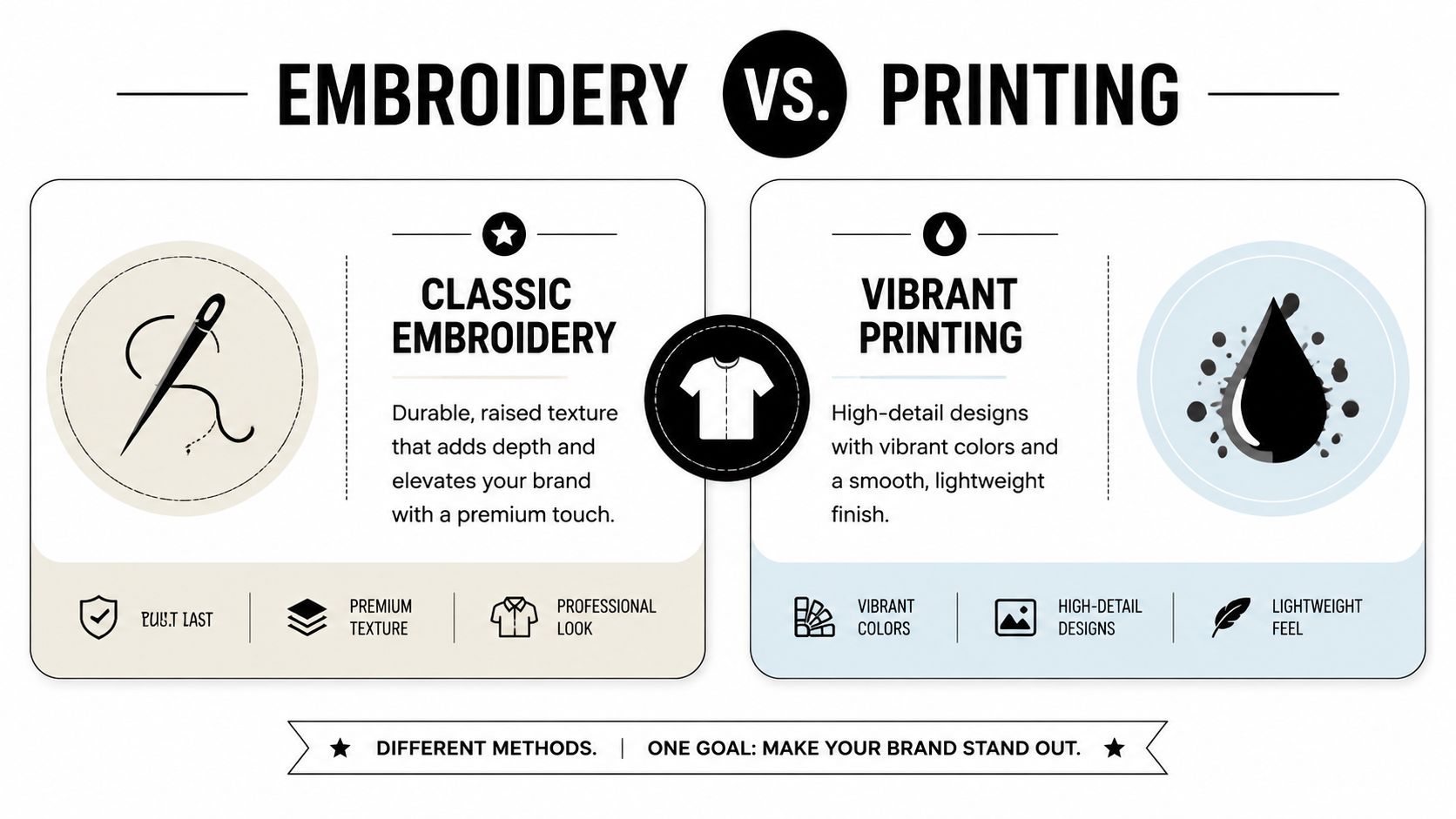
Embroidery is usually the safest choice for business logos. It has texture, durability, and a finished look that most owners want for uniforms, client gifts, and trade show wear.
It works best when the logo has bold shapes, clean lettering, and limited fine detail. If your mark is simple and readable, embroidery often gives the strongest result. It also holds up well under repeated wear.
Color contrast matters more than people expect. For embroidery, a high-contrast color combination such as white thread on a navy hat stays visible from over 50 feet, and 3D puff embroidery can make a logo pop 30% more effectively than standard flat embroidery for event impact, according to Tshirt Envy’s custom hat embroidery guide.
That’s useful in practical settings. If your team is outside, across a booth, or moving around a crowded event, visibility matters.
A logo that looks subtle on screen can become unreadable on a hat if the thread and cap color are too close.
Here’s a common embroidery fit:
- Service company logo with bold icon
- Monogram or initials
- Short business name in clear lettering
- Premium retail-style front logo
Later, if you want to branch into full-color products, sublimation printing options can be useful for other branded items even when embroidery remains the best choice for hats.
When printing makes more sense
Printing has one major advantage. It preserves detail better when the logo includes gradients, small elements, or multiple colors that embroidery would flatten or simplify too much.
If your design is more graphic than corporate, printing may be the better route. That includes artwork with thin outlines, illustrated elements, or color transitions that thread can’t reproduce cleanly.
Screen printing on hats is often limited by the hat style. Foam-front trucker hats are a common fit because they provide a smoother front surface. Heat transfer methods can also help with smaller batches or more detailed images.
Printing tends to work well for:
| Good use case for printing | Why it fits |
|---|---|
| Detailed event graphic | Better reproduction of fine visual elements |
| Full-color art | More faithful color handling |
| Small trial run | Easier way to test a detailed concept |
| Casual promotional trucker hat | Flat front can support graphic-heavy artwork |
A simple comparison
If you’re choosing between embroidery and printing, this is the practical version:
- Choose embroidery when your logo is simple, you want a premium look, and durability is the priority.
- Choose printing when your design is detailed, full-color, or visually complex.
- Choose 3D puff embroidery when the logo is bold enough to benefit from extra dimension.
- Don’t force embroidery on tiny text, gradients, or thin-line artwork just because it sounds more upscale.
A video can help if you want to see how hat decoration translates in practice.
The wrong decoration method creates most “it looked better online” complaints. The right method makes even a simple logo feel finished.
Preparing Your Artwork File for a Flawless Finish
A lot of bad hat orders start with a file problem. Not a printing problem. Not a stitching problem. A file problem.
If you send a tiny web graphic and expect a clean stitched logo, you’re making the production team guess. Sometimes they can fix it. Sometimes they can’t. Either way, you’re adding risk before the order even starts.
Ask for the right file before you order
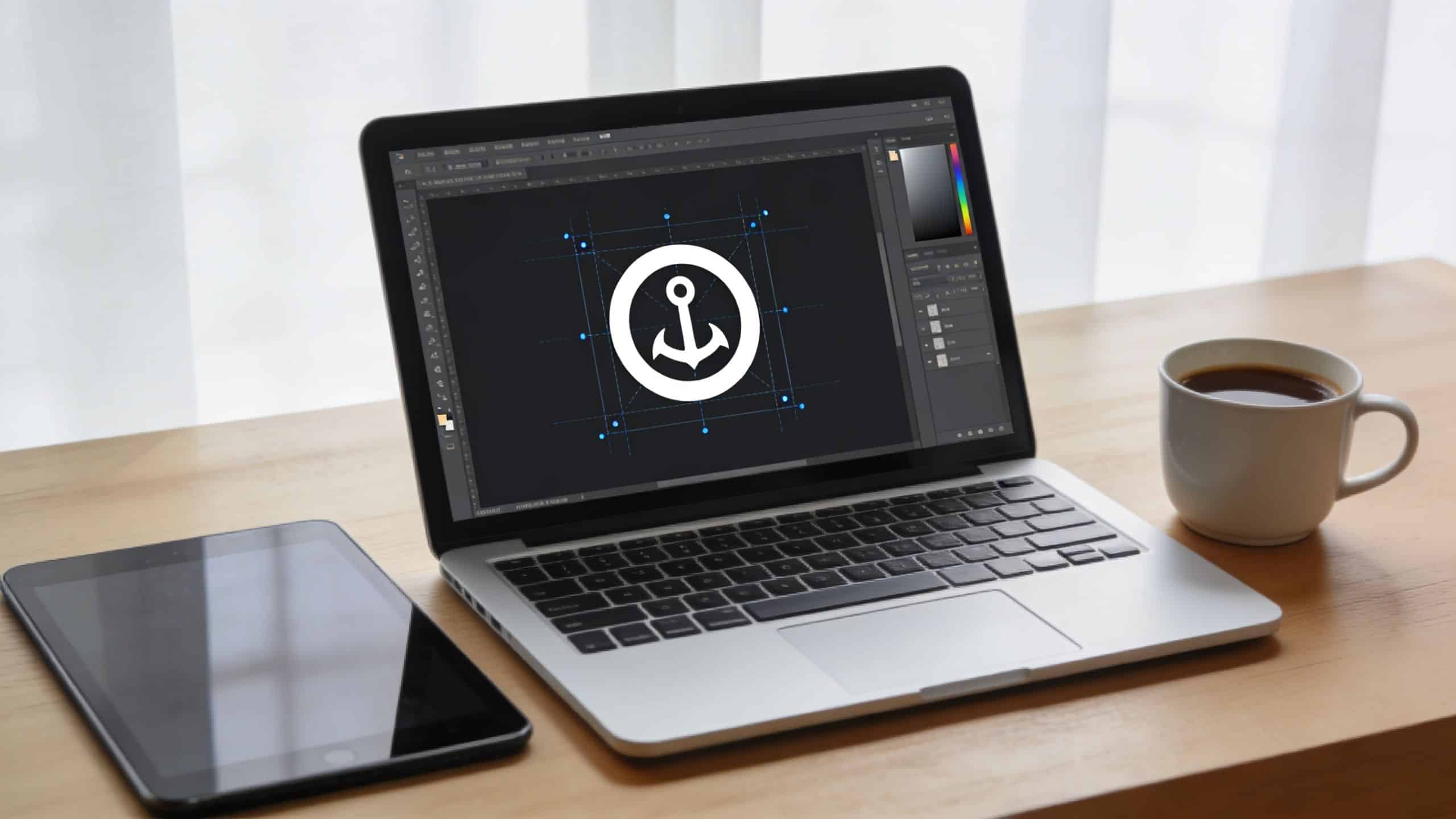
The best file type for logos is usually a vector file, such as AI, EPS, SVG, or a clean PDF. A vector file is built from shapes and paths, not a fixed grid of pixels, so it scales cleanly and gives the decorator clearer information.
A JPG or PNG can still be useful, especially for reference, but it’s often not the best master file for production. If the image was pulled from a website, social profile, or email signature, there’s a good chance it’s too low quality for a sharp result.
The easiest way to explain it to a first-time buyer is this:
- A vector file is like a recipe. It can be remade at different sizes.
- A raster image is like a photo of the finished dish. Zoom in too far and it breaks apart.
If you work with a designer, ask for the original logo package. If you don’t have one, ask whether your printer can help rebuild or clean up the art before production.
For businesses that already use branded handouts or packaging, it also helps to keep your logo assets organized across products like custom sticker printing, mailers, signs, and apparel so you aren’t hunting down different versions every time you reorder.
What to simplify before production
Even with the right file format, some logos need adjustment for hats.
The most common trouble spots are small text, thin outlines, tight spacing, and gradients. These often look fine on a screen but get muddy on a curved hat front. Embroidery especially rewards simplification.
Check your design for these issues before you approve anything:
- Tiny text: If the tagline is too small, remove it from the hat version
- Hairline details: Thin borders and delicate shapes often disappear
- Gradients: These usually need to be converted into solid-color alternatives for embroidery
- Crowded layout: Hats have less usable area than is commonly expected
One good hat logo is often a simplified version of the full brand logo, not a copy-and-paste of everything in the brand guide.
A practical proofing question to ask is, “What will this look like from a few feet away?” If the answer depends on someone standing still and squinting, the art needs revision.
Navigating the Ordering Process with a Local Print Center
Most owners think ordering custom hats with logo online will save time. Sometimes it does. Sometimes it creates a chain of delays that only shows up after you’ve approved the mockup.
The online proof looked acceptable. Then the actual hats arrive, the crown shape feels wrong, the logo placement is smaller than expected, or the deadline slips because production and shipping were treated as separate stages. That’s the gap a local print center closes.

What goes wrong with online-only ordering
Online bulk vendors are built for scale. That’s useful when your order is straightforward, your timeline is flexible, and you already know exactly what you want.
It’s less useful when you need help making decisions. A first-time buyer often needs to compare cap styles in person, check thread colors against real fabric, or confirm whether the logo should be wider, higher, or simplified before production begins.
Speed is another issue. Google Trends data cited here shows a 35% spike in searches for “same day custom hats near me” in US metro areas, while most online providers require 7 to 14 day production plus shipping. That gap matters when you need hats for a late-booked event, a hiring fair, a crew photo, or a weekend activation.
What a local print center helps you catch early
The local advantage isn’t just turnaround. It’s error prevention.
When you work with a nearby print center, you can often do things that are hard or impossible with an online-only workflow:
- Touch the blank hat first: You can check crown height, softness, closure type, and overall quality before ordering.
- Review color in person: Navy, charcoal, cream, and black can look very different in person than on a screen.
- Discuss the logo with someone face to face: That’s useful when the design needs simplification for embroidery or repositioning on a curved front.
- Pick up locally: You avoid shipping delays and last-mile surprises.
A helpful local partner can also walk you through nearby print options when your event needs more than hats. If your branded setup includes signs, flyers, or leave-behinds, a local print shop guide is a good reminder that convenience matters when several pieces have to come together fast.
If your deadline is fixed, don’t ask only for the order date. Ask when the artwork must be approved, when production starts, and whether pickup is local or dependent on shipping.
Questions worth asking before you place the order
Bring these questions with you, especially if this is your first run:
| Ask this | Why it matters |
|---|---|
| Can I see the actual blank hat? | Fit and feel are hard to judge online |
| Will my logo be stitched or printed at this size? | Prevents detail loss |
| Can I approve a proof that reflects the real decoration method? | Mockups can hide scale issues |
| What happens if the artwork needs adjustment? | Avoids surprise revisions |
| Is local pickup available if timing gets tight? | Gives you one less risk point |
Local ordering usually feels easier because it removes guesswork. For a small business, that’s often more valuable than chasing the lowest advertised online price.
Your Custom Hat Project Checklist and Final Tips
A good hat order doesn’t start with “How much are these?” It starts with a clear project brief. Even a simple one.
If you bring the right information into the order, you’ll make faster decisions and avoid most expensive mistakes. Save this list to your phone or keep it in your notes before you visit a print shop.
Bring this checklist to the counter or save it on your phone
- Purpose of the order: Is this for staff uniforms, a giveaway, resale, or a one-time event? The answer affects the hat style and decoration choice.
- Who will wear it: Employees, customers, event attendees, or VIP clients don’t all want the same fit.
- Preferred style: Structured cap, relaxed dad hat, trucker hat, or beanie.
- Material preference: Cotton twill, performance fabric, wool blend, or a sustainable option if that matters to your brand.
- Logo version ready: Use the simplified hat version if your full logo is too busy.
- Best artwork file available: Vector first. Clean PDF second. Raster only if it’s high quality.
- Decoration method: Embroidery for bold, simple logos. Printing for more complex artwork.
- Color contrast checked: Make sure the logo can still be read quickly against the hat color.
- Quantity estimate: Know your ideal quantity and your minimum acceptable quantity.
- Deadline: Bring the actual date, not just “as soon as possible.”
- Proof approval plan: Decide who signs off so production doesn’t stall.
After the order
Once the hats are done, a little follow-through helps them last longer.
Tell staff or recipients how to care for them. Spot cleaning is usually safer than treating a custom hat like ordinary laundry. If the hats are part of a team uniform, keep a note of the exact style, color, and logo treatment that was ordered so reorders stay consistent.
One last practical tip. Keep one unworn sample for your records. It helps with future matching, photos, and repeat orders when someone says, “Can we get more of the same hats from last time?”
If you need custom hats with logo on a tight timeline and want real help choosing the right style, artwork setup, and finish, Business Mail Boutique LLC in Sugar Land offers the kind of one-stop support online-only vendors usually can’t. You can handle printing, shipping, and other event materials in one place, which makes last-minute projects much easier to manage.

Related posts
Promotional Items for Give Away: A Small Business Guide
You're probably seeing branded tumblers at chamber breakfasts, logo tote bags at weekend markets, and custom pens on counters all over ...

The Sugar Land Print Shop Guide for Businesses
The Sugar Land Print Shop Guide for Businesses
You’re probably here because something is due soon. The networking event is tomorrow. T...
Roll Up Banner Printing: A Sugar Land Guide (2026)
You've got an event coming up in Sugar Land. The booth is booked, the tablecloth is packed, and then it hits you. Your display still do...