
- Print Business Cards in Sugar Land – Same Day Service
- Copying Services
- Document Printing, Finishing & Lamination in Sugar Land
- Flyers
- Print Banner in Sugar Land | Same-Day Banner Printing Near Me
- Graphic Design
- Photo Printing
- Postcard Printing
- Document Printing
- EDDM Full Service Postcards
- FotoZoomer Large Format Printing


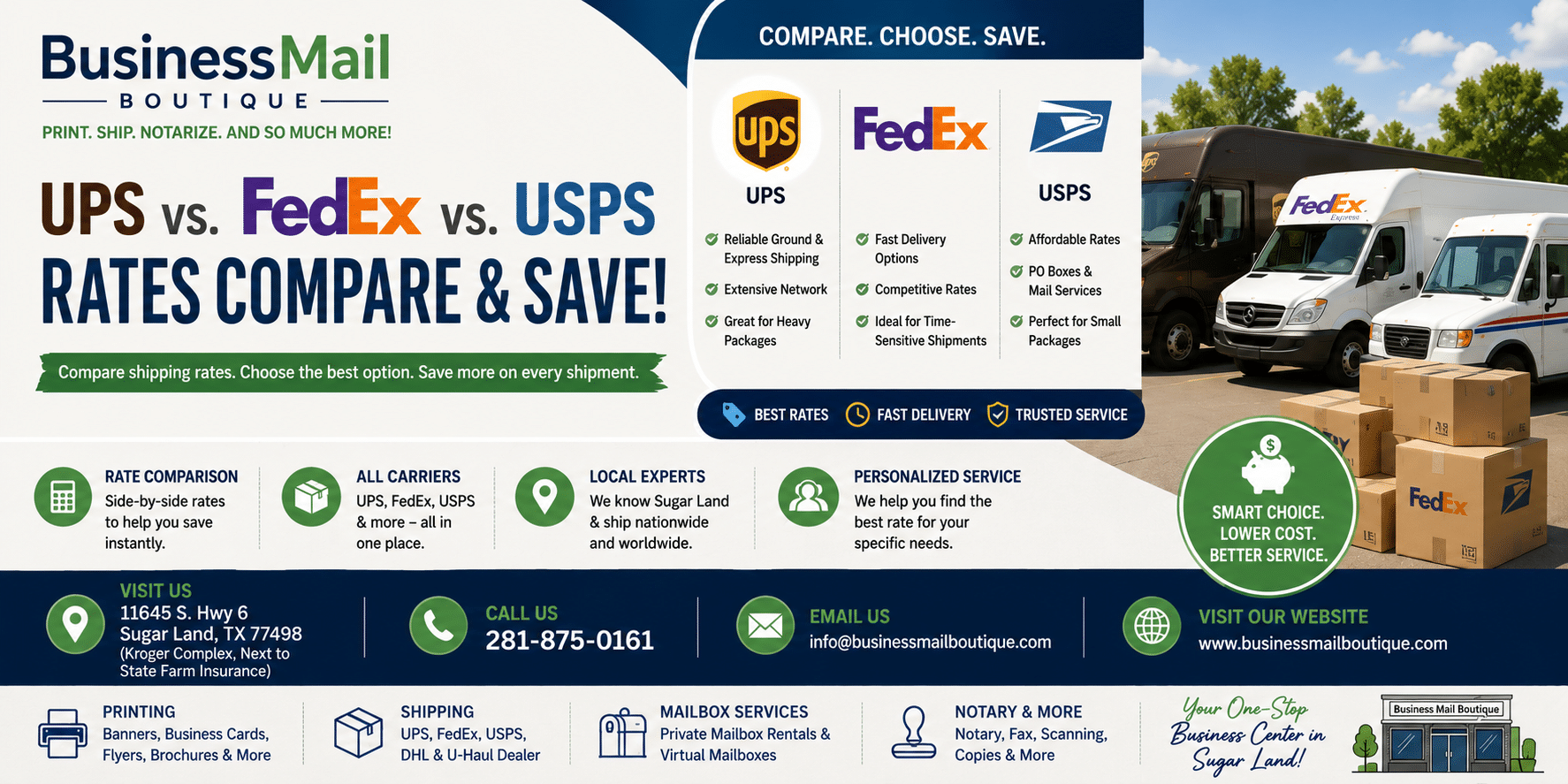
UPS vs FedEx vs USPS Rates Compare & Save
Compare UPS vs FedEx vs USPS rates for 2026. Find the cheapest shipping options, surcharges, & services for your small business.
Businessmailboutique
11645 S. Hwy 6
Sugar land, Texas 77498 United States (US)
Email: info@businessmailboutique.com
Route
You’re probably looking at the same problem most small business owners run into sooner or later. A package looks cheap to send on one carrier’s site, then the final bill comes back higher. Another carrier seems expensive up front, but turns out to be the better deal once the shipment moves. Then a customer asks why a return label cost so much, and now you’re comparing UPS, FedEx, and USPS all over again.
That’s why UPS vs FedEx vs USPS rates is never just a base-price question. It’s a practical shipping question. What are you sending, how far is it going, is it going to a home, how fast does it need to arrive, and what happens if a delay hurts the customer relationship?
Small e-commerce teams in Sugar Land deal with this constantly. One day it’s lightweight orders going out one by one. The next day it’s a bulky return headed to a residential address, where surcharges can subtly alter the math. If you’re tightening margins, resources like CartBoss’s guide to strategies for efficient e-commerce shipping can help you think beyond labels and into process.
If you want a good local primer on what a multi-service shipping center can handle for businesses, this copy and ship guide is useful background before you start comparing carriers line by line.
Table of Contents
- Choosing a Shipping Carrier Can Be Confusing
- How Shipping Rates Are Actually Calculated
- UPS vs FedEx vs USPS A Head to Head Rate Comparison
- The Hidden Costs Surcharges and Fees Explained
- Performance and Reliability Beyond the Price Tag
- Real World Scenarios Which Carrier Is Best For You
- How Business Mail Boutique Unlocks The Best Rates
Choosing a Shipping Carrier Can Be Confusing
A lot of owners start with the same assumption. Compare three base prices, pick the lowest one, print the label, move on.
That works until the invoices start telling a different story.
A seller might ship a lightweight item and find USPS is clearly the best value. Then that same seller sends a heavier return to a residential address and sees UPS or FedEx fees show up in places they didn’t expect. Another owner may choose UPS for consistency, then wonder why a low-margin item suddenly doesn’t make sense after add-ons. The confusion isn’t a sign that you’re missing something obvious. It’s how carrier pricing works.
What makes the big three hard to compare
UPS, FedEx, and USPS each have a different pricing personality.
- USPS is often the easiest place to save on small, lightweight parcels.
- UPS often becomes more competitive once shipments get heavier or reliability matters more.
- FedEx can make sense when the shipment is time-sensitive, especially if service level matters more than the absolute lowest ground cost.
The tricky part is that none of those statements is universally true for every box.
Practical rule: Don’t ask which carrier is cheapest. Ask which carrier is cheapest for this package, this address, and this delivery promise.
What works in practice
The businesses that manage shipping well don’t guess. They standardize packaging, compare carriers by shipment type, and pay attention to where fees show up.
What doesn’t work is defaulting to one carrier for everything. That’s how businesses overpay on light parcels, underprice heavy residential shipments, and end up explaining surprise costs to customers after the fact.
How Shipping Rates Are Actually Calculated
Carrier comparison gets easier once you know what the label price is built from. Most shipping charges come down to the same core ingredients, even though each carrier presents them a little differently.
Weight is only the starting point
The first factor is actual weight. That part is familiar. Heavier packages usually cost more.
The second factor is distance, often shown as shipping zones. A package moving locally usually prices differently from one crossing multiple zones. You don’t need a spreadsheet to use this well. You just need to remember that the same box can price very differently depending on where the customer lives.
The third factor is packaging itself. A box that’s larger than it needs to be can push the shipment into a more expensive bracket even when the item inside isn’t heavy.
DIM weight changes the price fast
This is the part many businesses miss. Dimensional weight, usually called DIM weight, charges for the space a package takes up, not just the scale weight.
The basic formula looks like this:
| Calculation factor | What it means |
|---|---|
| Length × Width × Height | Total package volume |
| DIM divisor | Carrier pricing divisor |
| Billable weight | The higher of actual weight or DIM weight |
A simple example helps. If you ship a light product in an oversized box, the carrier may bill it as if it were much heavier because the package takes up more room in the truck or sorting network.
That’s why better packing decisions often save more than coupon-hunting for labels.
A large light box can cost more than a small heavy box. Businesses usually discover this only after they’ve shipped the same product the wrong way for months.
If you want a practical walkthrough of box math before you rework your packing stations, this guide on how to calculate dimensional weight is worth keeping bookmarked.
What actually helps lower your shipping cost
Use this as a working checklist:
- Measure every box style: Don’t rely on what the carton was sold as. Measure the outside dimensions you’ll ship.
- Match packaging to the product: Too much empty space invites higher DIM charges and more movement in transit.
- Separate your shipments by profile: Small apparel mailers, heavier replacement parts, and customer returns shouldn’t all use the same carrier rule.
- Review residential destinations: Home delivery changes cost structure, especially on heavier parcels.
If you do those four things, the rate comparisons in the next section will make much more sense.
UPS vs FedEx vs USPS A Head to Head Rate Comparison
A rate chart can point you in the wrong direction if you read it too fast. I see that happen at the counter with small businesses that compare one base price, pick a carrier, and later find out the actual winner changed once package weight, delivery speed, and address type came into play.
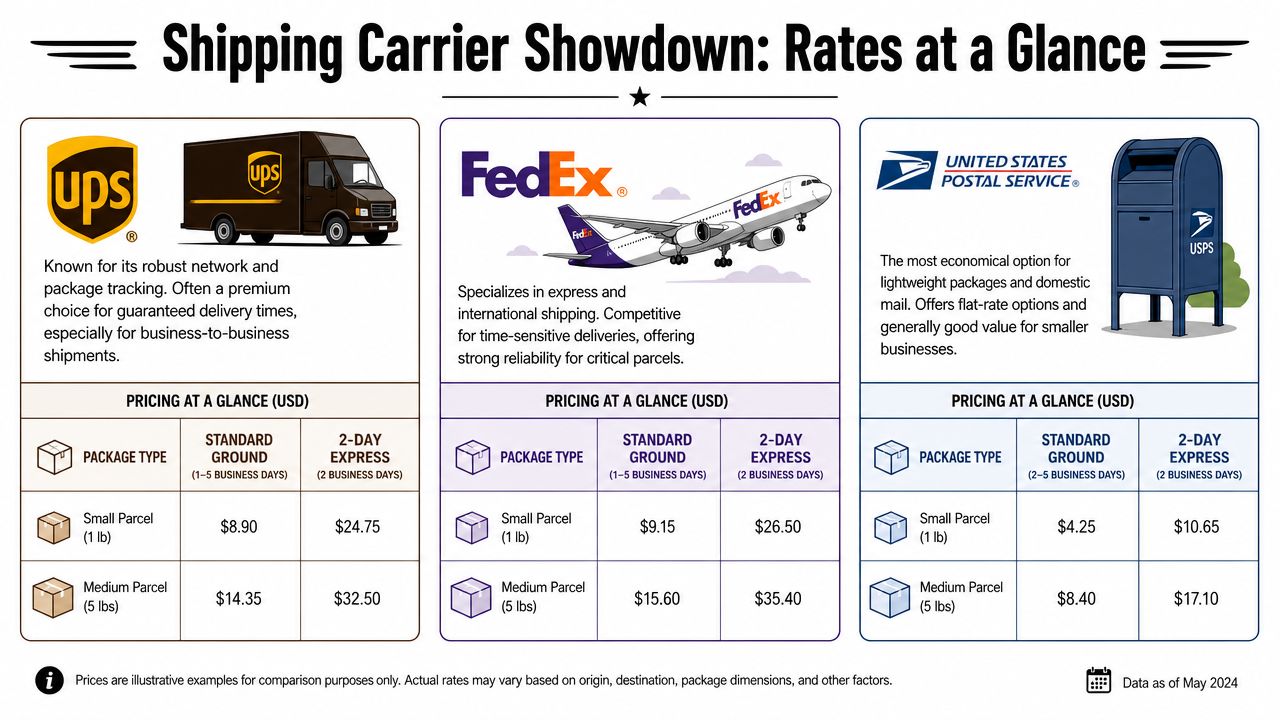
2026 Carrier Service and Cost Overview
| Service Level | UPS | FedEx | USPS |
|---|---|---|---|
| Lightweight ground under 5 lbs | UPS Ground at $14.50 per the Atoship carrier comparison | FedEx Ground at $14.20 according to the same comparison | USPS Ground Advantage at $5.10 according to the same comparison |
| Packages over 10 lbs to residential addresses | Often the better value at negotiated rates, according to the same comparison | Can be competitive depending on service and shipment profile | Usually loses its light-package advantage in this range |
| Sub-1 lb local-zone package example | $7.08 in the 2025 carrier pricing comparison | $10.10 in the same comparison | $6.99 in the same comparison |
| Base rate increase context | 5.9% increase in 2025 in the same comparison | 5.9% increase in 2025 in the same comparison | 6.3% Priority Mail increase in 2025 in the same comparison |
Where each carrier usually wins
USPS usually owns the low-weight conversation. For parcels under 5 lbs, the gap is wide enough that USPS Ground Advantage often deserves the first quote, especially for direct-to-consumer orders where margin is already tight.
UPS gets more interesting as weight goes up. In practice, once a shipment is heavier and headed to a home address, UPS often becomes more competitive than business owners expect, particularly if they have negotiated pricing through a shipping partner instead of paying straight retail counter rates.
FedEx tends to stand out when speed matters. The Atoship comparison found lower 2-day rates for 5 lb and 30 lb packages in those express categories, which matters for stores selling replacement parts, time-sensitive orders, or any product where a late delivery creates support issues.
The trade-off is simple. USPS often wins on light ground shipments. UPS frequently gets stronger on heavier residential parcels. FedEx can make more sense for certain express moves.
That is why I do not recommend choosing one carrier for everything. A small business shipping apparel, supplements, printed materials, and occasional replacement parts will usually overpay if it forces all four into one carrier program.
A better approach is to compare by shipment profile, then use a local shipping partner to place each package with the service that fits the job. That is also the practical advice behind this guide on how to reduce shipping costs for small businesses, especially if you are trying to control packaging decisions, batch processing, and carrier mix at the same time.
The Hidden Costs Surcharges and Fees Explained
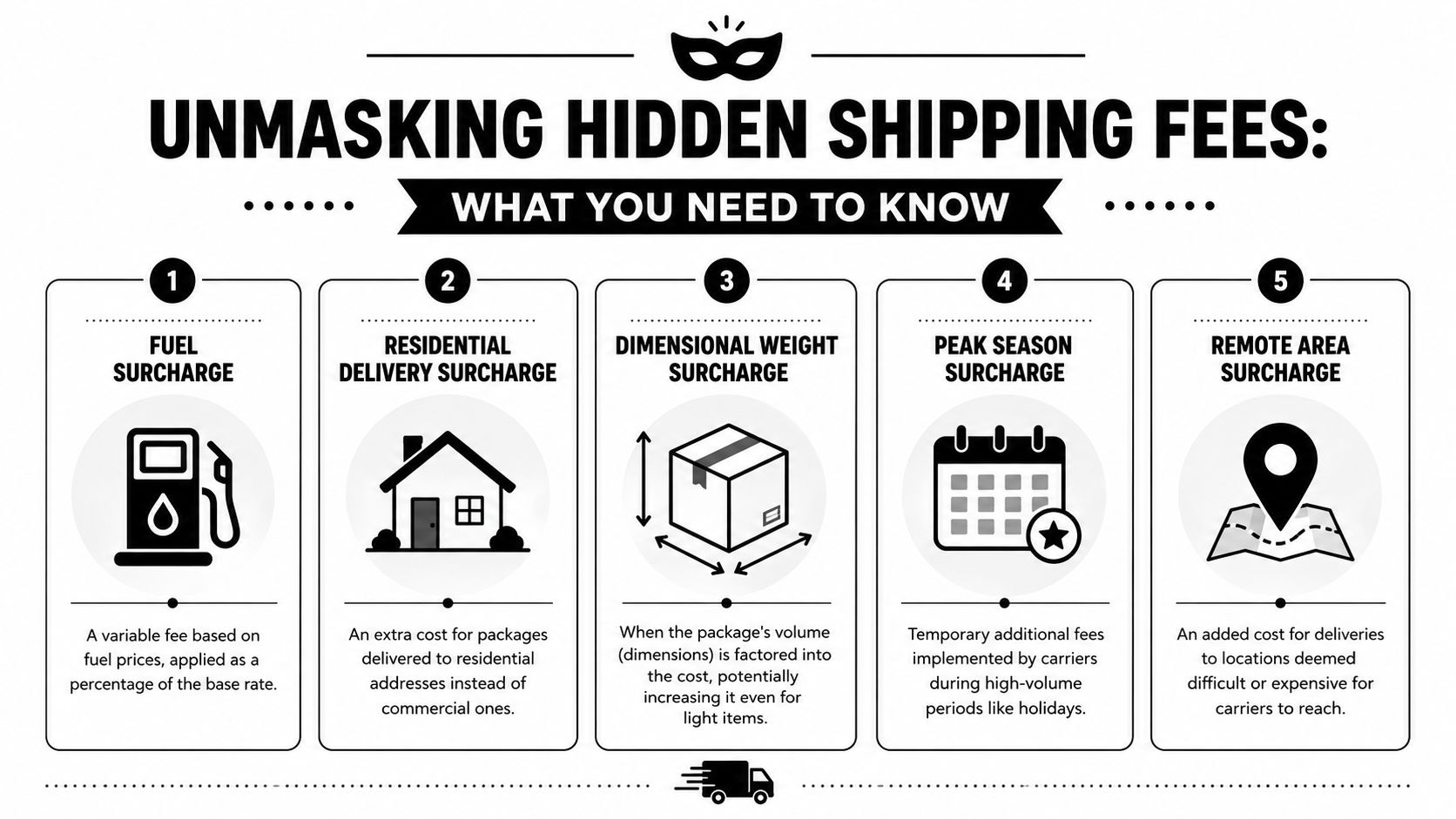
A lot of small business owners look at the label price, approve it, and assume they know their shipping cost. Then the invoice posts, a residential fee shows up, a delivery area surcharge gets added, and the margin on that order is gone.
Residential fees are the charge most businesses miss
Residential surcharges cause more confusion than almost any other line item I see at the counter. A seller compares a base rate from UPS, FedEx, and USPS, picks the lowest one, and expects that number to hold. It often does not, especially for direct-to-consumer orders going to homes instead of commercial addresses.
As noted earlier, UPS and FedEx commonly add residential fees, and those charges have risen over time. USPS generally keeps pricing simpler on many parcel shipments because it does not layer in the same residential, rural, and fuel fee structure the private carriers use in the same way. That is one reason USPS can look very attractive on lighter e-commerce packages.
Remote delivery can widen the gap even more. If the address falls into a harder-to-serve area, the private carriers may add another fee that was never visible in the first quote.
Small businesses rarely lose money on shipping because the published rate looked high. They lose money because the final invoice included charges they did not price into the order.
When the Cheapest Base Rate Isn’t the Best Deal
The base rate only tells part of the story. What matters is landed shipping cost after surcharges, packaging impact, address type, and package weight are all accounted for.
Heavy residential shipments are where owners get surprised. USPS often looks like the budget option on small parcels, but once a box gets larger or heavier, UPS can come back into the conversation even after a residential fee is added. A separate GoBolt comparison highlights that kind of trade-off on heavier packages.
In practice, I tell Sugar Land business owners to evaluate shipments like this:
- Lightweight items going to homes: USPS often keeps the total cleaner because there are fewer add-on charges to account for.
- Heavier residential parcels: UPS may still produce a better total cost than expected once weight and service level are factored in.
- Remote home deliveries: USPS can protect margin when the private carriers start stacking location-based fees.
- Mixed shipping profiles: Using one carrier for everything usually creates avoidable cost.
This is where a local shipping partner earns its keep. At Business Mail Boutique, we do not just print the label with the lowest starting rate. We look at the full shipment, including weight, dimensions, destination type, and whether a surcharge is likely to appear later. That saves clients from choosing a service that looked cheap on screen and expensive on the invoice.
If you sell on marketplaces, that same discipline matters. Tools that help sellers understand true Poshmark profit are useful for the same reason. Real profit comes from counting every fee, not just the sale price and the first postage estimate.
Watch the invoice, not the ad. Base rates narrow the options. Surcharges decide the real cost.
Performance and Reliability Beyond the Price Tag
A late package can erase the savings from a cheap label fast. I see that play out with Sugar Land businesses during holiday rushes, product launches, and time-sensitive replacement orders. One missed delivery turns into a refund request, a second shipment, or a customer who does not order again.
Peak-season performance shows real separation between carriers. In Q4 2025, UPS Ground posted a 97.6% on-time delivery rate, compared with 96.1% for FedEx Ground and 94.2% for USPS Ground Advantage, according to the Rush Order carrier comparison. The same comparison also notes ShipMatrix audit results from December 2024 showing UPS Ground ahead of both FedEx Ground and USPS Ground Advantage during a high-volume period.
That gap matters more on certain shipments than others.
If you ship low-cost items with flexible delivery expectations, USPS can still be the right call. If you ship replacement parts, event materials, birthday gifts, or repeat wholesale orders, a carrier with steadier ground performance can save money even when the label costs more upfront.
Reliability changes your support costs
Delivery performance affects more than the package. It affects your inbox, your staff time, and how often your team has to explain delays you did not cause.
A business owner usually feels carrier reliability in three places:
- customer service tickets asking where the order is
- replacement shipments sent to protect the sale
- refunds or credits issued to preserve goodwill
Those costs rarely show up in a rate table, but they are real operating expenses.
The practical trade-off by carrier
| Priority | Usually the better fit |
|---|---|
| Low-cost shipping for small, less urgent parcels | USPS |
| More consistent ground delivery during busy periods | UPS |
| Faster service options when delivery speed is part of the promise | FedEx |
FedEx often makes sense when the shipment itself is tied to urgency. UPS is often the safer ground choice when consistency matters and a delay would create follow-up costs. USPS still earns its place for lighter residential shipments where keeping postage simple matters more than shaving a day off transit.
A local shipping partner helps sort that out before the mistake happens. At Business Mail Boutique, we look beyond the posted rate and match the shipment to the service level, destination, and customer expectation. That keeps small businesses from paying twice. Once for the label, then again for the fallout from a late delivery.
Real World Scenarios Which Carrier Is Best For You
Carrier decisions get clearer when you stop thinking in brands and start thinking in shipment patterns.
If you ship small online orders every day
Choose USPS first for lightweight parcels and small direct-to-consumer orders. That’s where it usually offers the cleanest value. The pricing is easier to understand, and the absence of residential surcharges helps protect margins on routine e-commerce shipments.
This is a strong fit for apparel, accessories, stationery, beauty items, and other small products that don’t need premium delivery commitments.
If you send heavier boxes or handle returns
Check UPS carefully before assuming USPS is cheaper. This is especially important for returns, replacement items, and heavier inventory moving to homes.
For a lot of small businesses, returns are where shipping strategy breaks down. The outbound package may have been profitable, but the return label turns expensive once home-delivery fees and package weight show up. Heavy residential shipments need total-cost math, not just headline-rate math.
If your return shipments are bulky, stop using a light-package mindset. Heavy boxes follow different rules.
If speed matters more than shaving every dollar
Look hard at FedEx when the shipment has to move quickly and the customer expects a tighter delivery window. That’s often the right call for urgent replacement shipments, legal or financial documents, launch materials, and high-stakes client deliveries.
The key is knowing which jobs deserve premium service and which don’t. Sending every order on a faster service drains margin. Sending urgent orders on the cheapest method creates support issues and customer frustration.
If your business ships a mix of everything
Use a multi-carrier approach. That’s the most practical answer for many Sugar Land businesses because real shipping rooms rarely handle one perfect package type all day.
A simple decision model works well:
- Small and light: Start with USPS.
- Heavy and residential: Compare UPS carefully.
- Urgent or time-sensitive: Check FedEx service levels.
- Odd-size packages: Review box dimensions before choosing anything.
That kind of structure keeps your team from guessing and makes your shipping costs easier to predict.
How Business Mail Boutique Unlocks The Best Rates
For most small businesses, the hardest part isn’t printing one label. It’s building a repeatable process that avoids bad carrier choices, packing mistakes, and fee surprises.
That’s where a local multi-carrier shipping partner changes the experience. Instead of forcing every shipment through one system, you get help comparing options across carriers, matching the service to the package, and catching avoidable issues before they turn into extra charges.

For Sugar Land businesses, that matters in a few practical ways:
- Better carrier matching: A local partner can help you choose between UPS, FedEx, and USPS based on the package in front of you, not a generic rule.
- Packing that avoids waste: Right-sized boxes and professional packing reduce the chance of DIM-related overcharges.
- One-stop convenience: Drop-offs, outbound shipping, returns, and support become easier to manage in one place.
- Access to practical shipping guidance: When you’re sending heavy, fragile, rushed, or irregular shipments, having experienced help saves time and prevents expensive mistakes.
If you want to see how a local shipping center helps businesses save on everyday shipping, this page on shipping packages for less in Sugar Land is a solid next step.
The biggest advantage isn’t just a lower rate on one package. It’s having a process that works across all the packages you’ll ship next week, next month, and during the rush when mistakes cost the most.
Business Mail Boutique LLC helps Sugar Land businesses simplify shipping without guessing through carrier rules every time. If you need a local team for packing, comparing UPS, FedEx, and USPS options, handling returns, or getting shipments out with less hassle, visit Business Mail Boutique LLC.

Related posts

Custom Memorial Glasses Engraved in Three Hours in Sugar Land
When a customer needed eight personalized glasses for a memorial, Business Mail Boutique completed the engraving or...

Custom Martini Glass Engraving in Sugar Land, TX
Custom Logo Engraving on Martini Glasses in Sugar Land, Texas.
Business Mail Boutique recently completed a beautiful custom engravin...

Custom Engraved Wine Glasses for a Golf Club Event in Sugar Land, TX
Custom Engraved Wine Glasses for a Golf Club Event in Sugar Land.
Custom wine glass engraving in Sugar Land, TX at Business Mail Bouti...