
- Print Business Cards in Sugar Land – Same Day Service
- Copying Services
- Document Printing, Finishing & Lamination in Sugar Land
- Flyers
- Print Banner in Sugar Land | Same-Day Banner Printing Near Me
- Graphic Design
- Photo Printing
- Postcard Printing
- Document Printing
- EDDM Full Service Postcards
- FotoZoomer Large Format Printing


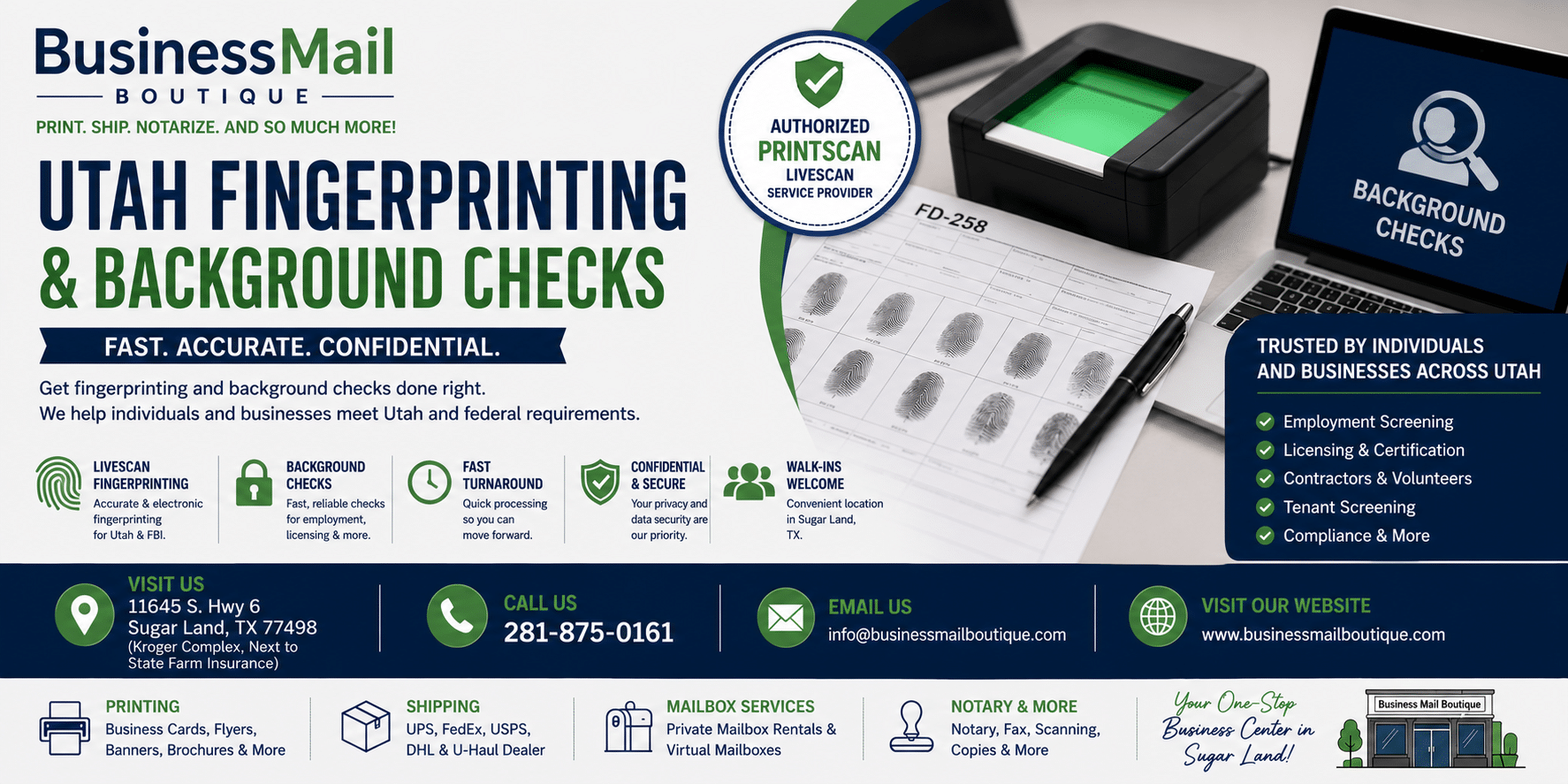
Utah Fingerprinting & Background Checks
Utah fingerprinting & background checks. Covers process, requirements, fees, & timelines for FBI, BCI, employment, and licensing.
Businessmailboutique
11645 S. Hwy 6
Sugar land, Texas 77498 United States (US)
Email: info@businessmailboutique.com
Route
You applied for a Utah job, license, or regulated role, and the instructions sounded simple until they didn’t. Get fingerprinted. Complete a background check. Submit the right form. Then you find out the actual process has handoffs, agency codes, vendor rules, and one delay almost nobody warns you about.
The hidden problem is usually not the fingerprinting itself. It’s the wait before fingerprinting. For some Utah licensing workflows, applicants must wait 2 to 3 business days to receive the required fingerprint authorization form before they can even contact a vendor, according to the Utah Division of Professional Licensing fingerprint instructions. That lag catches people who assumed they could apply today and get printed today.
That’s why planning matters more than most guides admit. The people who move through Utah fingerprinting and background checks smoothly usually do three things well. They confirm which agency is requesting the check, they wait for the correct authorization paperwork instead of guessing, and they prepare every required identifier before the appointment. If you’re the kind of person who likes to sanity-check paperwork before it turns into a delay, these due diligence checklists and red flags are a useful parallel resource because the same principle applies here: small documentation mistakes create bigger downstream problems.
Table of Contents
- Your Complete Guide to Utah Fingerprinting and Background Checks
- FBI vs Utah BCI What Check Do You Need
- The Utah Fingerprinting Process Step by Step
- Live Scan vs Ink Cards Which Is Right for You
- What to Expect Timelines Fees and Requirements
- Where to Get Fingerprinted in Utah
- Utah Background Check and Fingerprinting FAQs
Your Complete Guide to Utah Fingerprinting and Background Checks
Utah fingerprinting and background checks look straightforward on paper. In practice, people lose time at the exact points where one agency hands the process to another. An employer tells you to get fingerprinted, but the vendor needs an authorization form. A licensing board wants prints, but only if the form has the correct code. You show up ready, only to learn the request wasn’t fully activated on the agency side.
The most common planning mistake is assuming fingerprinting starts the day you decide to act. It often doesn’t. For some licensing applicants, the process starts with waiting for the authorization form to arrive from the licensing body. That 2 to 3 business day delay is real, and it matters most when your start date, clinical rotation, classroom placement, or license review is already on the calendar.
The practical way to think about the process
Treat Utah fingerprinting and background checks as a chain, not a single appointment. Each link has to match the next one:
- Requesting agency: Your employer, school, board, or licensing body decides what check is required.
- Authorization paperwork: You may need a specific form before any vendor can legally take your prints.
- Fingerprint capture method: Live Scan and FD-258 cards solve different problems.
- Submission path: Some prints go straight into an electronic workflow. Others move by mail and manual review.
- Receiving agency review: Results don’t always end at fingerprint processing. Some boards perform an extra review after the check is returned.
Practical rule: Don’t book a fingerprint appointment until you know exactly who is requesting the check and what identifier, code, or authorization they require.
What usually works and what usually doesn’t
What works is boring but effective. Read the instructions from the requesting agency first. Wait for the correct authorization when the agency requires it. Use Live Scan when the agency allows it and you’re in Utah. Confirm names, codes, and destination details before your appointment.
What doesn’t work is improvising. Generic FBI checks, walk-in appointments without the right paperwork, and assuming one agency will accept another agency’s fingerprint submission are all common sources of delay. Utah’s system is manageable, but it rewards precision, not speed for speed’s sake.
FBI vs Utah BCI What Check Do You Need
You booked a fingerprint appointment, showed up with ID, paid the fee, and then heard the sentence nobody wants to hear: “These are not the prints your agency needs.”
That happens all the time in Utah. The delay usually is not the fingerprinting itself. It is a scope mismatch. An applicant gets a general FBI check when the employer needed a Utah BCI workflow tied to a state code, or gets state-level processing when the board required a federal fingerprint-based review. In some cases, the slowdown starts even earlier with Authorization Form Lag, where the requesting agency has to release or approve paperwork before your prints can be used at all.
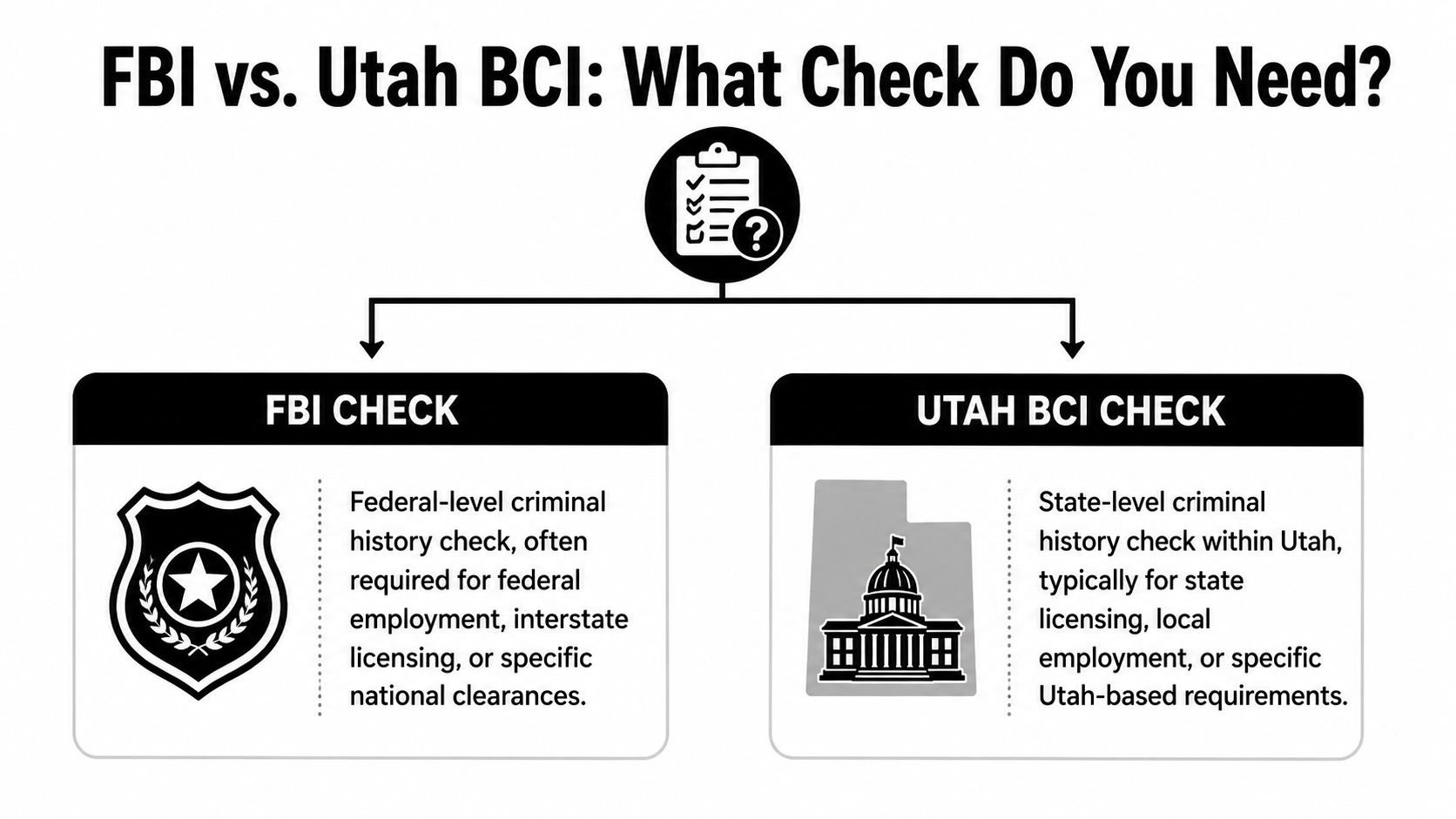
What the two checks mean in practice
A Utah BCI check is the state-side criminal history process handled through the Utah Bureau of Criminal Identification. It usually shows up in state licensing, Utah-regulated employment, and agency workflows that require a Utah-specific submission path.
An FBI fingerprint check covers the federal side. It is used when the requesting organization needs a national fingerprint-based record search, not just a Utah review.
Many applicants assume they can choose the broader option and be safe. That is where delays start. A generic FBI submission does not automatically satisfy a Utah agency workflow, especially if the agency expects a specific code, authorization, portal record, or destination tied to your application.
Where people get tripped up
The question is not which check sounds more thorough. The question is which check your requesting agency will accept.
I have seen applicants lose a week or more because they started with the wrong assumption. A school, care provider, licensing board, or university department may require fingerprinting, but each can use a different process. Some want Utah-centered handling first. Some require both state and federal review. Some will not process anything until the employer or facility has completed its side of the authorization.
That last point gets missed in a lot of online guides. If your workflow includes agency approval before fingerprinting, your timeline starts before your appointment date. That is the hidden delay many people experience. They are ready to be printed, but the paperwork chain is not ready to receive the prints.
For business readers who want a clearer explanation of the federal side, this overview of FBI criminal history checks for businesses gives useful context.
Common triggers for each type
In Utah, these patterns come up again and again:
- Utah licensing and regulated programs: These usually follow Utah-specific instructions, submission rules, and identifiers.
- Jobs involving children or vulnerable populations: These often require stricter handling and are less forgiving if authorization is missing or delayed.
- University or institution-based hiring: Minor-contact and security-sensitive roles often require fingerprint-based screening, sometimes with both state and federal components.
- Multi-state or national screening requirements: These often call for the FBI portion because the review has to reach beyond Utah records.
A practical way to decide
Check the instructions for three things before you schedule anything:
- Who receives the result
- Whether the agency names Utah BCI, FBI, or both
- Whether you need an authorization form, code, or portal approval first
If any of those details are missing, stop and ask the requesting agency before you get fingerprinted. That extra phone call is usually faster than redoing the appointment, repaying fees, and waiting for a second review cycle.
The Utah Fingerprinting Process Step by Step
The fastest applicants follow the sequence in order. The slowest ones usually reverse it. They call a vendor first, then find out they were supposed to start with the employer, licensing board, or portal.
A clean Utah fingerprinting and background checks workflow usually looks like this:
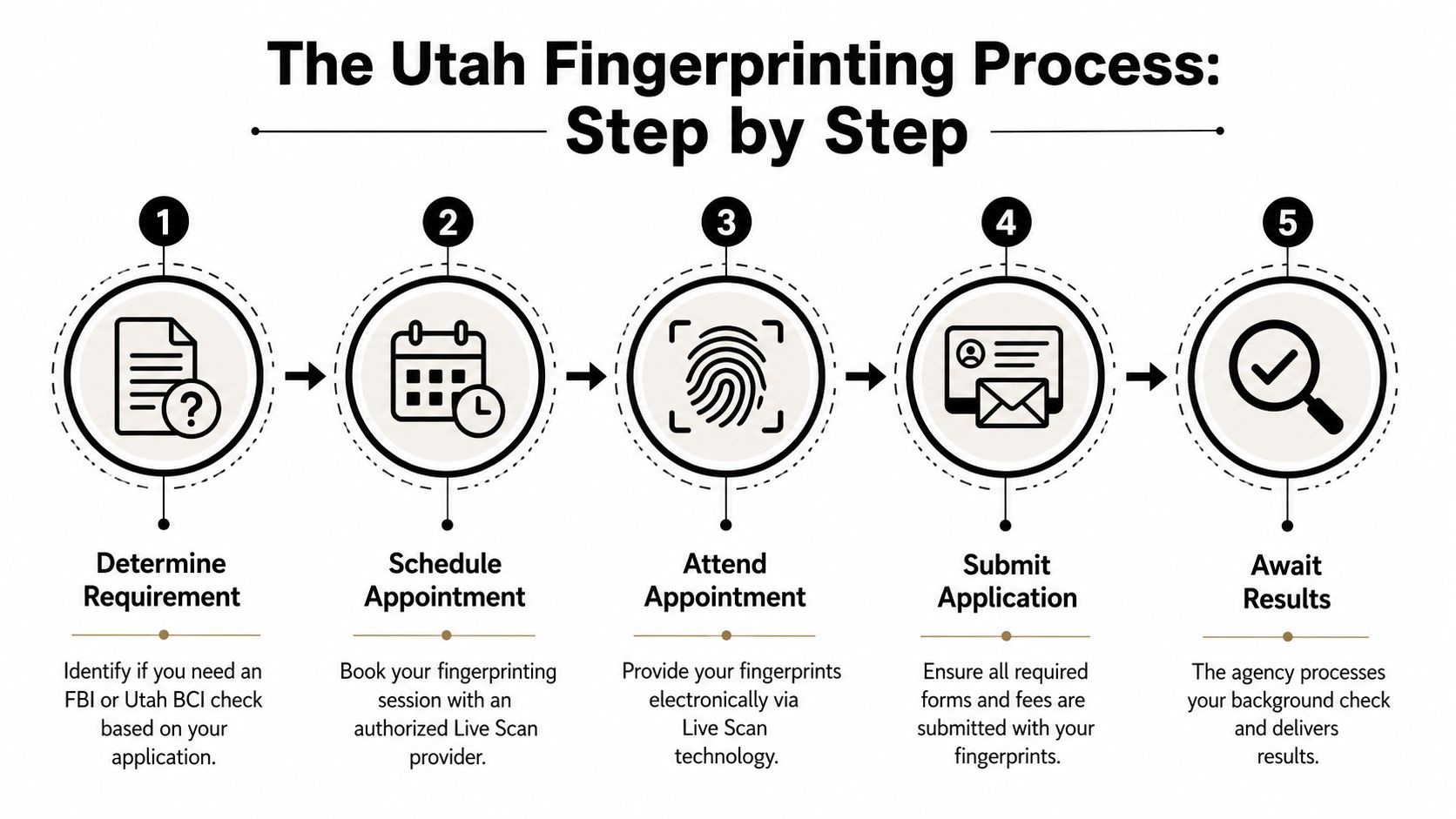
Start with the requesting agency
Your first move is not choosing a fingerprinting location. It’s identifying the agency or employer that owns the requirement. They decide whether you need Live Scan, an FD-258 card, a Utah-specific code, or a particular authorization form.
Often, many delays stem from this issue. If your workflow runs through a Utah licensing or regulated-care system, your prints may be useless if they aren’t tied to the correct authorization.
Watch for the two-step approval workflows
Some Utah background check processes are intentionally designed so applicants can’t complete them alone. Child care and similar private-entity workflows are a good example. Under Utah law, qualifying private entities must use the Division of Licensing and Background Checks provider portal, and the facility must authorize the request after the applicant submits initial information through the Utah DHHS Office of Background Processing child care workflow.
That means there are two active parties in the process:
- The applicant submits their information.
- The provider or facility owner logs in and authorizes the request.
If step two doesn’t happen, the process stalls.
Field note: When an applicant says, “I already submitted everything,” I usually check whether the employer or facility completed its side. In Utah, that missing authorization is a frequent bottleneck.
A quick visual summary can help if you’re coordinating with HR or a licensing contact:
Choose the capture method that matches the requirement
Once the agency side is set, you can choose the capture method the workflow permits. If you’re in Utah and the agency accepts electronic submission, Live Scan is usually the cleaner path. If you’re outside Utah or the board requires a mailed card, you may need an FD-258 fingerprint card instead.
Don’t choose based on convenience alone. Choose based on what the receiving agency will accept.
Prepare for the appointment
Before you go, verify these basics:
- Your name matches the paperwork: Typos and mismatched legal names can create avoidable processing issues.
- Your authorization is in hand: If the workflow requires a specific form, bring it.
- Your destination details are correct: Agency codes and routing details matter.
- Your payment plan is clear: Some locations accept walk-ins, some don’t, and some have restricted payment procedures.
After fingerprinting
Once prints are captured, the rest of the timeline depends on the submission path and the receiving agency’s review process. Electronic workflows move differently from mailed ones. Some results go directly to the requesting agency rather than to you, which is why calling the fingerprint vendor for status updates often won’t answer the actual question. The better contact is usually the agency waiting on the result.
Live Scan vs Ink Cards Which Is Right for You
This choice affects speed, flexibility, and the chance you’ll need to do the process again. If the requesting agency gives you both options, choose based on your location and how tightly your deadline is tied to the result.
Side by side comparison
| Feature | Live Scan | Ink Card (FD-258) |
|---|---|---|
| How prints are captured | Digitally by an electronic fingerprint technician | Rolled onto a physical fingerprint card |
| Best fit | In-state applicants using an electronic Utah workflow | Out-of-state applicants or agency workflows that require mailing |
| Submission path | Sent electronically into the processing stream | Mailed or physically submitted as part of an application packet |
| Speed profile | Faster when accepted by the agency | Slower because mailing and manual handling are involved |
| Error handling | Better for catching poor quality prints at capture | More vulnerable to smudging or rejection if the card quality is poor |
| Convenience trade-off | Requires an authorized provider with the right setup | Easier to obtain locally outside Utah, but less efficient overall |
When Live Scan is the clear choice
If you’re physically in Utah and the agency accepts it, Live Scan is usually the better option. The submission is electronic, the capture quality is easier to manage on site, and experienced technicians can often reduce the risk of rejection by getting cleaner prints on the first attempt.
That matters when your start date is close and you can’t afford a resubmission cycle.
When ink cards still make sense
Ink cards aren’t outdated. They’re just slower and more fragile as a workflow. They’re often the right answer for out-of-state applicants, people applying to Utah agencies from elsewhere, or situations where the receiving body specifically instructs you to use an FD-258 card.
If you need a practical breakdown of the operational differences, this guide to fingerprinting with ink cards and Live Scan capture is useful.
Live Scan is usually the efficiency choice. FD-258 is often the compatibility choice.
What applicants get wrong
The biggest mistake is treating these methods as interchangeable. They aren’t. A clean Live Scan appointment doesn’t help if your board expects a mailed FD-258. An accurately completed ink card doesn’t help if your Utah workflow is built for electronic submission. Match the method to the destination, not to your personal preference.
What to Expect Timelines Fees and Requirements
A common Utah delay looks like this. An applicant gets fingerprinted on Tuesday, expects the check back by Friday, then learns on Monday that the prints were fine but the file could not move because the authorization form was missing, outdated, or routed to the wrong agency. The fingerprint appointment was only one step. The effective timeline starts when the receiving agency has everything it needs to match your prints to your application.

Realistic turnaround expectations
Utah background checks do not move on one clock. Fingerprint capture, state processing, any FBI component, and the receiving employer or board review each add their own delay. That is why applicants hear one estimate at the fingerprint desk and then experience a longer wait in practice.
Electronic submission is usually the faster path. If the prints are accepted on the first try and the authorization paperwork is correct, the state portion can move quickly. The FBI portion, if required, often adds extra business days. After that, some employers or licensing boards still need time to review and post the result internally.
Ink cards add more friction. Mailing time, manual handling, data entry, and resubmission risk all stretch the timeline. If you are on a tight start date, build in extra time for what I call the authorization form lag. That is the gap between getting fingerprinted and having the receiving agency confirm that your prints were tied to the right file.
A practical rule helps. If your deadline is firm, do not plan backward from the best-case estimate. Plan for the processing time plus a buffer for paperwork corrections, agency routing, and final review.
What you’ll usually pay for
Fees are often split across more than one party. The fingerprinting site may charge a capture fee. The state may charge its own processing fee. A federal check, if required, can add another cost. Some public offices also have a separate fee schedule for applicants who are not being printed for government employment.
That is why two people in Utah can both say they paid for a background check and mean different totals. One only needed prints taken and sent to a state agency. Another needed prints, state processing, federal processing, and a board-specific submission packet.
Before booking, ask two direct questions: what does your fee include, and what will I still owe to the agency receiving my prints?
What to bring so you don’t get turned away
The fastest appointment can still fail if the paperwork is wrong. Bring what the receiving agency asked for, exactly as issued.
- Government-issued photo ID. Use an unexpired ID with a name that matches your application.
- Authorization or request form. If your employer, school, board, or agency gave you a fingerprint form, bring that version, not an older copy.
- Agency routing details. ORI numbers, screening codes, licensing identifiers, and similar routing data have to be correct.
- Payment in an accepted form. Some locations do not accept every payment method.
- Any deadline notice or instruction sheet. This helps the technician confirm you are using the right submission path.
If you are still comparing providers, use this directory of Utah fingerprinting locations near you and confirm, before you leave home, whether the site handles your specific agency workflow.
A completed fingerprint appointment is not the same as a completed background check. The submission has to be readable, correctly routed, and matched to your file.
Where to Get Fingerprinted in Utah
A common Utah delay starts after the applicant has done the hard part. They book the closest fingerprint appointment they can find, show up on time, and only then learn the location cannot submit to the agency on their form. I see that problem often with licensing packets, out-of-state requests, and employer forms that require a specific routing code or card format.
Utah has several workable fingerprinting options. The right choice depends less on distance and more on whether the site can handle your exact submission path.
Utah BCI and state-centered options
Utah BCI is the state reference point for many criminal history and licensing workflows. If your instructions point you to a Utah state process, start by confirming whether BCI requires you to appear there, or whether a private provider can capture and route the prints correctly. That distinction saves people days of back-and-forth.
BCI is located at 4315 South 2700 West, Suite 1300, Taylorsville, UT 84129 and generally operates during standard weekday business hours.
Use BCI-centered options when the receiving agency is tightly connected to a Utah state record check or when your paperwork specifically names BCI. Do not assume that “Utah background check” always means “go to BCI in person.” In many cases, the main issue is correct routing, not the building where the prints are taken.
Local law enforcement offices
Sheriff’s offices and police departments can still be a good fit, especially if you need ink cards or live far from a private Live Scan provider. The trade-off is limited scheduling and narrower service scope. Some offices only fingerprint on certain days, and some will take prints without helping you confirm the agency codes or submission method.
That matters more than people expect.
If you use a local law enforcement office, call before you go and ask three things: do you offer Live Scan or ink cards, do you fingerprint for the specific agency on my form, and do I leave with completed cards or does your office submit electronically? Those answers usually reveal whether the appointment will move your application forward.
Private Live Scan vendors
Private vendors are often the fastest option for Utah residents with work, school, or licensing deadlines. They usually offer more appointment availability, multiple locations, and better support for applicants who are unsure whether they need electronic submission or FD-258 cards.
This is also where the hidden delay shows up. A provider may be able to take your prints today, but if your authorization form is outdated, missing an ORI, or tied to a different agency workflow, the appointment does not solve the problem. I tell applicants to treat booking and routing as two separate checks.
If you need to compare availability by city, this directory of Utah fingerprinting locations near you is a practical place to start.
How to choose the right type of location
Choose based on the receiving agency’s rules, not just convenience.
- Use BCI or a state-directed option if your instructions specifically point to a Utah agency process or state licensing track.
- Use local law enforcement if you need traditional fingerprint cards, have limited vendor access nearby, or your agency accepts card-based submissions.
- Use a private Live Scan provider if speed, flexible scheduling, and electronic capture matter most, and the provider can route your prints correctly.
One more point gets overlooked. Some applicants worry about what will appear after the check is run, especially if old search results create confusion with employers or boards. If that is part of your concern, review this guide to removing negative search results before your screening process starts.
The best fingerprint location is the one that matches your paperwork, your deadline, and your agency’s submission rules on the first try.
Utah Background Check and Fingerprinting FAQs
Questions usually show up after the appointment is booked or after a delay starts. These are the issues people raise most often.
What if my fingerprints are rejected
Rejected prints usually mean the image quality wasn’t acceptable for processing. That can happen with poor capture quality, smudging, or card issues in mailed workflows. The practical response is to resubmit quickly through the method the agency allows, then confirm the receiving body can still attach the new submission to your file.
If you’re on a deadline, call the requesting agency first, not just the fingerprint vendor. The agency decides how the resubmission fits your application.
I’m outside Utah. How do I complete a Utah requirement
For out-of-state educator applicants, the Utah State Board of Education requires a standard FD-258 fingerprint card obtained from local law enforcement and mailed to the USBE Fingerprints division. USBE also states that it will not mail blank cards to individuals, according to the Utah State Board of Education background check instructions.
That’s a detail people miss. If you’re outside Utah, don’t wait for USBE to send you a card. Get the FD-258 locally, then follow the mailing instructions exactly.
How long is a background check considered valid
That depends on the employer, licensing board, or program. Some organizations treat the result as current only within their own hiring or licensure window. Others may require a fresh submission if too much time passes or if the first check was tied to a different agency-specific workflow.
The safe assumption is that fingerprint results are not universally portable.
Can I clean up my online search presence before a background review
A criminal history check and a web search are different things, but employers sometimes do both. If you’re concerned about what appears when someone searches your name, this guide to removing negative search results offers a practical primer on the reputational side of pre-employment screening.
Agency background checks evaluate official records. Employers may separately evaluate what they can easily find online. Don’t confuse the two, but don’t ignore either.
What’s the best way to avoid delay
Use the exact instructions from the requesting body. Wait for the authorization when the process requires one. Match the fingerprint method to the destination agency. Bring complete paperwork. If the workflow involves a portal or employer-side approval, confirm the other party completed their step.
That’s what keeps a routine check from turning into a stalled application.
If you need a reliable place for everyday business services beyond fingerprinting, Business Mail Boutique LLC offers packing, shipping, printing, mailbox services, notary support, and other storefront essentials in one location. For individuals and small businesses that value convenience and responsive service, it’s a practical one-stop option.

Related posts

Custom Memorial Glasses Engraved in Three Hours in Sugar Land
When a customer needed eight personalized glasses for a memorial, Business Mail Boutique completed the engraving or...

Custom Martini Glass Engraving in Sugar Land, TX
Custom Logo Engraving on Martini Glasses in Sugar Land, Texas.
Business Mail Boutique recently completed a beautiful custom engravin...

Custom Engraved Wine Glasses for a Golf Club Event in Sugar Land, TX
Custom Engraved Wine Glasses for a Golf Club Event in Sugar Land.
Custom wine glass engraving in Sugar Land, TX at Business Mail Bouti...